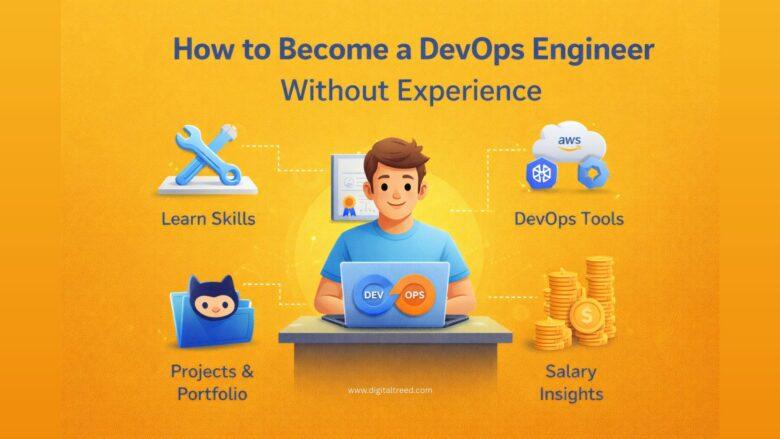
DevOps is one of the most in-demand roles in the IT industry today. Organizations are actively recruiting DevOps Engineers to enhance the deployment speed, reliability, scalability, and automation of the system. However, one common question beginners ask is:
“Can I become a DevOps Engineer without experience?”
The answer is yes, but it requires following the right path of learning, tools, mindset, and hands-on method.
This guide will show you how to be a DevOps Engineer even if you:
- Are a fresher
- Come from a non-IT background
- Have zero DevOps or cloud experience
- Are a student or career switcher
Who is a DevOps Engineer?
A DevOps Engineer is responsible for the automation of deployment and management of software systems in the development as well as production environments. DevOps is the connecting link between the Development (Dev) and Operations (Ops) teams.
A DevOps Engineer ensures:
- Faster software releases
- Stable and scalable infrastructure
- Automated testing and deployment
- High system availability
Can You Become a DevOps Engineer Without Experience?
Yes, you can become a DevOps engineer without experience because you should focus on skills and projects rather than job titles when it comes to this field.
In most companies that hire entry-level DevOps engineers, they don’t necessarily look for work experience in the area of DevOps. Rather, they look for the following:
- Strong fundamentals
- Hands-on project work
- Knowledge of DevOps tools
- Problem-solving ability
- Cloud and automation exposure
Experience can be built through projects, labs, and real deployments, not only jobs.
Step-by-Step Roadmap to Becoming a DevOps Engineer
To become a DevOps Engineer from ground zero is not a function of learning tools. It is a function of learning how the software is developed, deployed, scaled, and maintained, and learning ways to automate and enhance the whole process.
A realistic, easy-to-understand, and industry-aligned roadmap is provided below, explaining how to think like a DevOps Engineer, and not just what to study.
1. Start by Understanding How Systems and Servers Actually Work
Before DevOps, cloud, or automation, it is essential to be familiar with the environment where your applications will run. That’s where Linux and basic systems knowledge enter the picture.
As a DevOps Engineer, you will always be working with servers – starting them, stopping them, debugging them, securing them, and optimizing them. Most production servers are Linux-based, and hence Linux becomes inevitable.
Your aim at this level is not proficiency in Linux but familiarity with the server environment itself.
You should clearly understand:
- How files and directories are organized
- How permissions and users control access
- How processes run in the background
- How services start, stop, and fail
- How to connect to a remote server using SSH
This stage helps to develop confidence. When the process of using Linux no longer intimidates, the rest is not so difficult.
2. Learn How Applications Communicate Over the Internet
DevOps engineers are constantly dealing with application availability and performance. To do that, you must understand how applications communicate over networks.
Instead of memorizing networking terms, focus on real-world understanding:
- How a browser request reaches a server
- What happens when you type a website URL
- Why applications run on specific ports
- How load balancers distribute traffic
- Why applications fail when networking is misconfigured
This knowledge helps you answer questions like:
“Why is my application not accessible?”
“Why does it work locally but not in production?”
Most DevOps issues are network-related, so this stage saves you countless hours later.
3. Learn Automation Through Scripting (This Is Where DevOps Starts)
DevOps is fundamentally about eliminating repetitive manual work. At this stage, you learn scripting not to become a developer, but to automate tasks that humans should not do repeatedly.
A DevOps beginner should focus on:
- Writing small scripts that automate server tasks
- Handling files, logs, and system data
- Automating backups, cleanups, and setup processes
Python and shell scripting are ideal because they allow you to:
- Interact with systems
- Automate deployments
- Integrate with APIs and tools
4. Understand How Code Is Managed and Delivered (Version Control)
Every DevOps workflow begins with code changes. That is why version control is non-negotiable.
Here, your focus should be on understanding:
- How teams collaborate on the same codebase
- How changes are tracked and reverted
- How branches allow safe experimentation
- How code moves from development to production
You should be comfortable using Git platforms like GitHub or GitLab, because DevOps pipelines always integrate with them.
At this stage, you are learning how DevOps connects developers and operations together.
5. Learn CI/CD as a Concept, Not Just a Tool
CI/CD is the core philosophy of DevOps, not just Jenkins or GitHub Actions.
You must clearly understand:
- Why manual deployments are risky
- How automated builds prevent broken code
- How automated testing improves reliability
- How continuous deployment speeds up delivery
Only after understanding these concepts should you learn tools like Jenkins or GitHub Actions.
Your goal here is to understand how code automatically flows from:
Developer → Build → Test → Deployment → Production
Once this clicks, you start thinking like a DevOps Engineer.
6. Learn Docker to Standardize and Package Applications
One of the biggest challenges in software delivery is:
“It works on my machine but not on the server.”
Docker solves this problem.
At this stage, your learning goal is to understand:
- How applications are packaged with their dependencies
- Why are containers lighter than virtual machines
- How Docker ensures consistency across environments
You should practice:
- Converting applications into Docker containers
- Running applications in isolated environments
- Managing multi-service applications
Docker gives DevOps engineers control and predictability.
7. Learn Kubernetes to Manage Applications at Scale
Once applications are containerized, the next challenge is scale and reliability.
Kubernetes exists to answer questions like:
- What happens if a container crashes?
- How do we scale applications automatically?
- How do we update applications without downtime?
As a beginner, you do not need deep Kubernetes mastery. You need a working knowledge, such as:
- How applications are deployed
- How traffic reaches containers
- How scaling and updates work
This step introduces you to production-grade systems.
8. Learn Cloud Platforms to Work in Real Environments
Modern DevOps happens on the cloud.
Instead of thinking of the cloud as “many services,” think of it as:
- Servers you do not physically manage
- Networks you configure using dashboards or code
- Storage that scales automatically
You should understand how to:
- Launch and manage servers
- Deploy applications on cloud infrastructure
- Secure systems using permissions and roles
Cloud knowledge makes your DevOps skills job-ready.
9. Learn Infrastructure as Code to Eliminate Manual Setup
Once you grasp cloud infrastructure, you are ready for the next step, which is automating infrastructure itself.
With Infrastructure as Code, you can:
- Create servers using configuration files
- Rebuild entire environments in minutes
- Avoid human errors
This step is where DevOps becomes scalable and professional.
10. Learn Monitoring, Logging, and Reliability
A DevOps Engineer is not done after deployment.
Your responsibility includes:
- Monitoring system health
- Detecting failures early
- Analyzing logs to find root causes
This step teaches you to think operationally, not just technically.
11. Build Real End-to-End DevOps Projects (This Replaces Experience)
For beginners, projects are an experience.
You must build complete workflows where:
- Code is pushed to Git
- CI/CD pipelines run automatically
- Applications are containerized
- Deployed on cloud infrastructure
- Monitored for performance
These projects prove that you can do DevOps, not just talk about it.
Essential DevOps Skills
- Linux & networking fundamentals
- Git & version control
- CI/CD pipelines
- Docker & containers
- Kubernetes basics
- Cloud platforms
- Automation scripting
- Monitoring & logging
- Problem-solving mindset
How to Follow This DevOps Roadmap in a Structured and Job-Oriented Way
By this time, I hope that you have realized that the process of becoming a DevOps Engineer without experience is not about taking the easy route, but about taking the right route.
This is where a structured DevOps training program can help, not as a shortcut but as a guided implementation of the very same roadmap mentioned above.
A DevOps Certification Program can help you in the following ways:
- Follow a step-by-step learning path instead of random tutorials
- Practice real-time DevOps projects that simulate production environments
- Learn industry tools with proper context and use cases
- Receive mentorship and doubt resolution
- Prepare for DevOps interviews and job roles confidently
If you are interested in a program that closely matches this roadmap but focuses more on job readiness, you can look into the following programs:
This course is meant for beginners and is designed in such a way that it provides ample opportunities for learning the practical aspects of DevOps.
How to Gain Experience Without a Job?
This is the most important part.
1. Build Real DevOps Projects
Examples:
- CI/CD pipeline for a sample app
- Dockerize a web application
- Deploy an app on AWS using Kubernetes
- Automate infrastructure using Terraform
2. Create a GitHub Portfolio
Your GitHub is your experience proof.
3. Practice Labs & Simulations
- Cloud-free tiers
- DevOps practice labs
4. Write About Your Learning
Blogs, LinkedIn posts, or documentation show credibility.
DevOps Job Roles You Can Target as a Fresher
- Junior DevOps Engineer
- DevOps Intern
- Cloud Engineer (Entry Level)
- Site Reliability Engineer (Junior)
- Build & Release Engineer
Companies value skills + projects, not just experience.
DevOps Salary for Freshers
- Entry-level DevOps Engineer: ₹4 LPA – ₹8 LPA
- With 1-2 years of experience: ₹10 LPA+
- With cloud + Kubernetes expertise: ₹15 LPA+
Common Mistakes Beginners Should Avoid
- Trying to learn everything at once
- Skipping Linux fundamentals
- Learning tools without understanding concepts
- Not doing hands-on projects
- Waiting for a job to gain experience
Conclusion
Even a fresh graduate or a person with no experience can become a DevOps Engineer if a proper road map is followed. It’s not about knowing all the tools, it’s about automation, problem solving, and systems thinking.
Start small, stay consistent, practice daily, and remember to do, not only watch tutorials. With the right mindset, you can easily get into the DevOps field, even with no experience or while changing your profession.
For learners who prefer a structured, mentor-led approach with real-world DevOps projects and career guidance, exploring a comprehensive DevOps training program can help implement the roadmap efficiently and accelerate your transition into a DevOps role.
Frequently Asked Questions
Yes, DevOps engineers begin their career as freshers by learning about the tools, working on projects, and developing their skills.
You need basic scripting knowledge, but it is not necessary to be a skilled software developer.
Generally, 6-12 months with continuous learning.
DevOps is not an easy process; however, with a roadmap and hands-on experience, it is possible.
AWS is the most preferred place to begin with because of market demand.