

Quick answer
AI in healthcare, the topic of our old Healthpally post, shows up in four checkable places: reading scans, decision support in health records, prior authorization reviews and research. On the FDA's AI list, current as of September 4, 2026, 1,230 of 1,614 devices, or 76.2%, are radiology tools. Outside imaging, ONC and CMS set the rules, and a licensed clinician still decides. Start with the FDA list.
If you run the front office of a small US practice and searched AI in healthcare and Healthpally, you probably landed on our thin 2022 post. Meanwhile vendors pitch AI add-ons, a patient asks whether a computer read their scan, and a prior authorization letter names a new Medicare model. An AI-enabled medical device is a device the FDA has authorized whose public summary or classification uses AI terms. Questions about your own care belong with your doctor or another licensed clinician.
Each use below is checked against the FDA, ONC, CMS or NIH page that governs it, from reading scans to finding research volunteers. We also counted all 1,614 rows of the FDA's AI device list.
Key takeaways
- Radiology tools make up 76.2% of the FDA's AI device list.
- In our count, 1,553 of 1,614 listed devices came through 510(k).
- ONC's HTI-5 final rule ends model card requirements on December 28, 2026.
- CMS says licensed clinicians, not software, make WISeR non-payment calls.
- Medicare Advantage plans can't deny admission on an algorithm alone.
What is Healthpally, and what did we check?
Our 2022 post credited its ideas to healthpally and two other names. It didn't give links, studies or dates, so a reader couldn't check a single line of it, and neither could we. So on November 11, 2026, we checked the site itself instead of repeating it.
A DNS lookup put healthpally.com on Cloudflare name servers. A header-only request got a 301 redirect to the www address. A header showed WordPress sent it. The www home page then answered with a normal 200. The registry record (RDAP, from Verisign) shows the name registered on July 6, 2017 through Spaceship, Inc., and renewed to July 6, 2027. The home page title reads "HealthPally.com Food, Health And Lifestyle". Its About page calls it "a U.S.-based food, health, and lifestyle digital publication headquartered in Atlanta, Georgia". It also says it helps brands "promote their products and services". We read only those two pages.
That's a lifestyle publisher, not a medical body or a regulator, so nothing below rests on it. Every fact comes from a federal agency, a federal rule or a peer-reviewed paper on an NIH site.
Use 1: reading scans and images
The first federal agency to check is the FDA, because most of the medical AI it has authorized works on images. The FDA's AI-Enabled Medical Devices list names devices "authorized for marketing in the United States". We saved it on November 11, 2026, when the page was marked current as of September 4, 2026, the date every count below depends on. We counted 1,614 rows. Of those, 1,230, or 76.2%, list Radiology as the lead review panel. That's three in four.
Cardiovascular came second with 154 rows (9.5%), then Neurology with 73 (4.5%), and the other 15 panels, from Anesthesiology to Immunology, share the last 157 rows.
The NIBIB page on AI, from the NIH's imaging institute, says AI "may aid in detecting a minute change in an image that a clinician might accidentally miss." Training data, it adds, must be "curated, de-identified, assessed for quality, annotated, and labelled by clinical experts." In that description, the software flags a change in the image, and a clinician still looks at it. Each row links to the FDA's database entry for the device. The FDA's review checked the studies against the device's intended use, so an authorization covers that use, not every scan a clinic might send it.
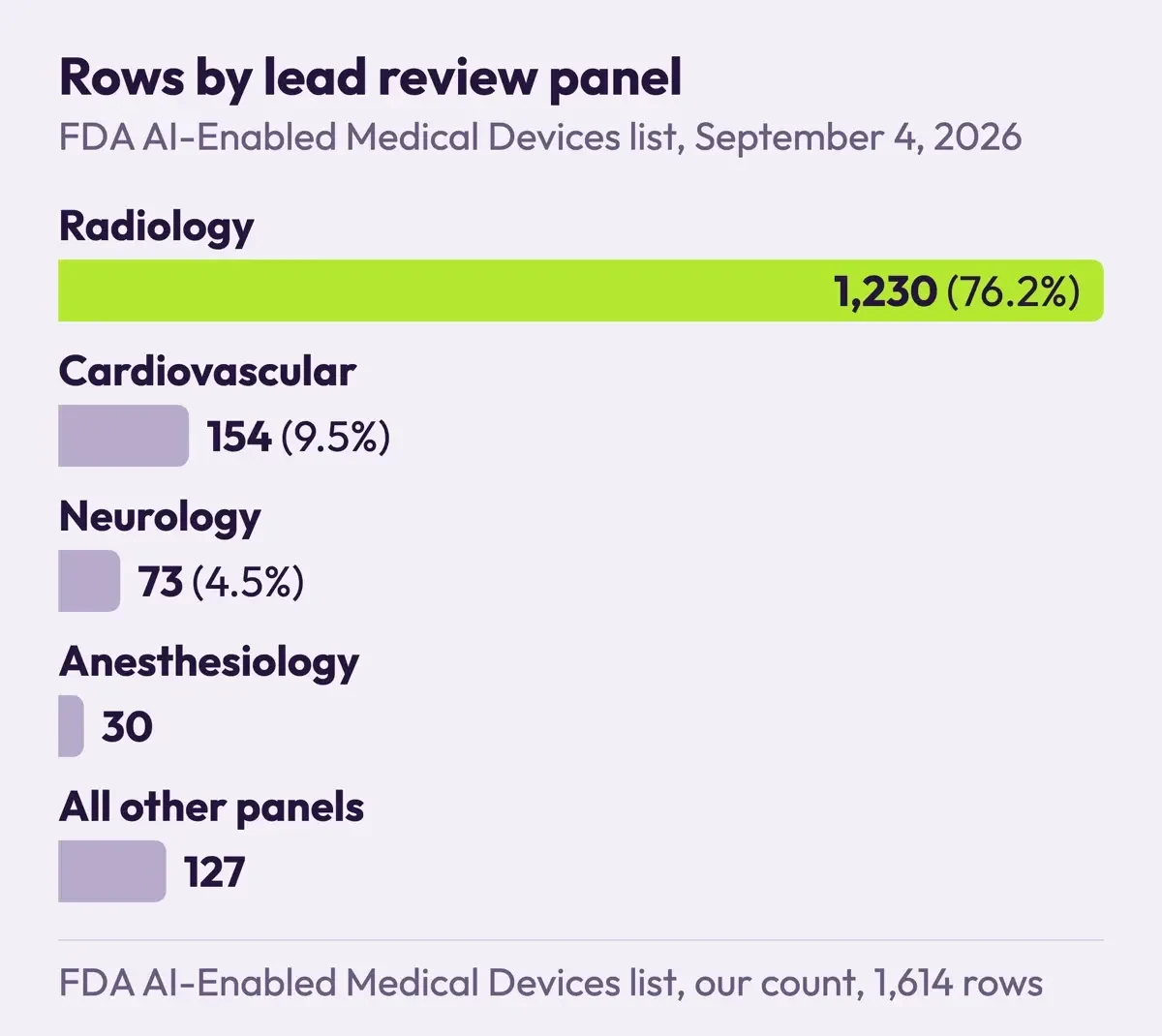 Diagram by DigitalTreed: our count of the FDA AI-Enabled Medical Devices list by lead review panel, page current as of September 4, 2026.
The list has a limit the FDA states outright: it's "not a comprehensive resource of AI-enabled medical devices." Devices land on it mainly through AI terms in their public summaries. A device whose summary skips those words can be missing.
The list is free to search, so a vendor's claim to be listed takes a minute to check by company name.
Use 2: alerts and suggestions in the health record
Beyond imaging, much of the AI a clinician sees sits inside the electronic health record. It's usually a pop-up alert, a sepsis or readmission risk score, or a suggested order that a nurse or doctor can accept or wave away.
The NIBIB page calls clinical decision support "a large focus" of AI in care, built on health observations and the patient's history.
Whether the FDA reviews such a tool depends on a test in the law. Under 21 USC 360j(o)(1)(E), software stays outside the device rules only if it doesn't analyze a medical image or signal. It also has to let a clinician "independently review the basis for such recommendations".
The FDA's clinical decision support guidance explains how the agency reads that test. It's a final guidance from January 2026. It traces the rule to section 3060(a) of the 21st Century Cures Act, enacted December 13, 2016, which carved some decision support software out of the device definition. A risk score whose reasoning the doctor can't see is more likely to count as a device than one that shows its inputs and the guideline it's based on.
Record software also answers to ONC, the HHS office that runs the certification program for health IT. Its HTI-1 final rule set what it called "first of its kind transparency requirements" for AI in certified health IT. That reach is wide. ONC counts certified health IT behind care at more than 96% of hospitals and 78% of office-based physicians across the country. ONC's decision support test method defines a predictive tool as one built on models that "derive relationships from training data". Developers had to review each tool's source information starting January 1, 2025.
In October 2026, ONC finalized a rollback. ONC's list of HTI rules shows HTI-5 as a final rule, and its HTI-5 page says it "removes and revises requirements" for developers. Its title calls it deregulatory. ONC's October 29, 2026 briefing slides list what changed for decision support: the rule removes "model card" requirements and ends required source attribute support. The rule appeared in the Federal Register on October 28, 2026 and takes effect December 28, 2026, so the HTI-1 source attribute rules still bind certified developers until then. After that date, ONC certification no longer requires model cards.
You can still ask for the training data, the test results and the known limits in writing, and note which of the three a vendor won't share. 45 CFR 92.210 is a civil rights rule, separate from certification. Under it, a covered health program can't discriminate by race, color, national origin, sex, age or disability through patient care decision support tools. It has to make reasonable efforts to find tools that use those factors and lower the risk. For a small practice, the first step is a list of which alerts take age or sex as inputs.
Use 3: prior authorization and coverage reviews
CMS's WISeR model page says the model uses "Artificial Intelligence (AI) and Machine Learning (ML), along with human clinical review" in Original Medicare. It's a voluntary model. It runs from January 1, 2026 to December 31, 2031 in New Jersey, Ohio, Oklahoma, Texas, Arizona and Washington. Each selected company covers one Medicare contractor jurisdiction or region. Its examples are skin and tissue substitutes, electrical nerve stimulator implants and knee arthroscopy for knee osteoarthritis.
CMS picked services that have public coverage criteria. They may also raise safety concerns if delivered when not needed, and have drawn past reports of fraud, waste and abuse.
In its June 27, 2025 announcement, CMS said final denial decisions "will be made by licensed clinicians, not machines." The WISeR fact sheet adds that coverage and payment policy don't change. Medicare Advantage isn't included. The companies taking part are paid a percentage of the spending they help avert, and that payment is adjusted for measures that include provider experience. Providers in those six states can send a prior authorization request or accept a review after the service.
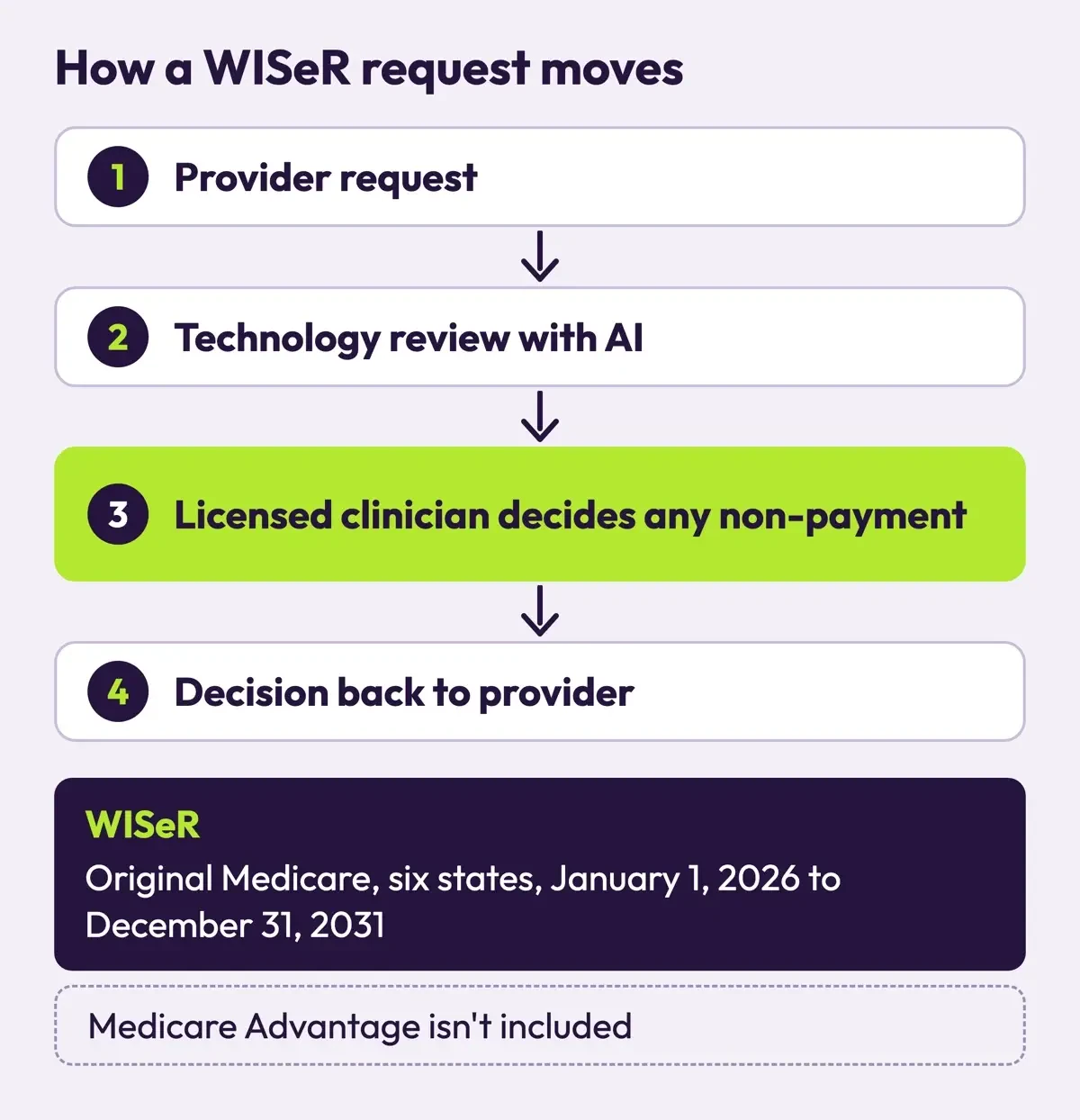 Diagram by DigitalTreed: how a WISeR prior authorization request moves, from the CMS model page and fact sheet.
Medicare Advantage plans run their own prior authorization reviews outside WISeR, and CMS drew a line for them nearly two years before the model started. A February 6, 2024 CMS memo says "An algorithm or software tool can be used to assist MA plans in making coverage determinations". The same memo says "algorithms or artificial intelligence alone cannot be used as the basis to deny admission or downgrade to an observation stay." The rule behind it, 42 CFR 422.101(c), ties medical necessity to the patient's own history, physician recommendations and clinical notes.
So a plan's call can't rest on a score alone. It has to weigh that person's own records.
CMS's Interoperability and Prior Authorization final rule, released January 17, 2024, is the data side of the same push. Payers covered by it had to meet some provisions by January 1, 2026, and they have until January 1, 2027 for most of its API requirements. It's about data exchange, not AI.
Use 4: finding research volunteers and testing drugs
Researchers at NIH's National Library of Medicine and partner schools described TrialGPT in a November 2024 paper on PMC. It uses large language models to match patient notes to clinical trials. On 183 synthetic patients, its criterion-level matching reached 87.3% accuracy across 1,015 checked pairs. A user study found it cut screening time by 42.6%. The patients weren't real. So they're research numbers, not results from day-to-day hospital screening. The authors list another limit: the tool relies on closed GPT models.
Drug makers use AI as well, from predicting patient outcomes to sorting large sets of real-world data, and the FDA now wants to know how they've checked it. Its January 6, 2025 announcement called its draft "the first guidance the agency has issued on the use of AI for the development of drug and biological products." The draft guidance page describes a "risk-based credibility assessment framework" for each use of a model. It's still a draft.
The drug center's AI in drug development page says it drew on "over 500 submissions with AI components from 2016 to 2023."
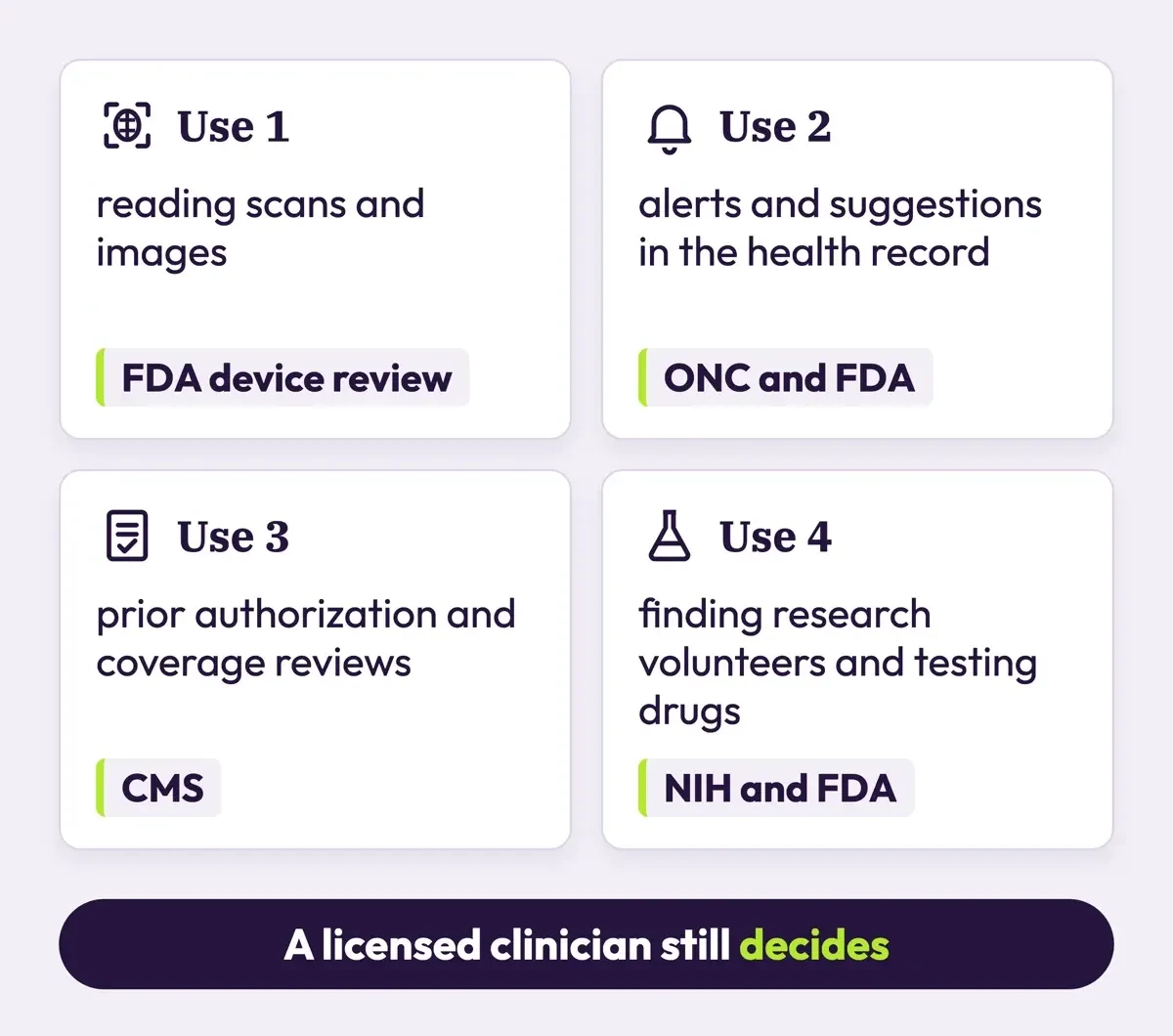 Diagram by DigitalTreed: the four uses of AI in this guide and the federal agency pages that cover each one.
For a patient, research AI is the hardest kind to see, because it works on records and trial criteria long before anyone calls you about a study.
If you're invited to a trial, you sign the informed consent form, not an accuracy score. The study coordinator can say how you were picked, and you're free to ask whether software helped.
Our count of the FDA AI device list
Of the four uses, only medical devices have a public federal list, so we counted that list row by row. The table covers all 1,614 rows on the page we saved.
| What we counted | Rows | Share of 1,614 |
|---|---|---|
| 510(k) clearances (numbers starting with K) | 1,553 | 96.2% |
| De Novo grants (DEN) | 40 | 2.5% |
| Premarket approvals (P) | 21 | 1.3% |
| Radiology lead panel | 1,230 | 76.2% |
| Decisions dated 2025 | 335 | 20.8% |
| Decisions dated 2026, through June 29 | 181 | 11.2% |
| Device names with LLM, GPT or large language | 0 | 0% |
Each share is the row count divided by 1,614. Year counts climbed from 18 in 2016 to 114 in 2020 and then to 335 in 2025, the highest of any year since the first entries in 1995. Of the 516 rows from 2025 and 2026, 389 were radiology, so imaging's lead hasn't shrunk.
No device name used LLM or GPT. That fits the FDA's note that it will "explore methods to identify and tag" devices built on large language models.
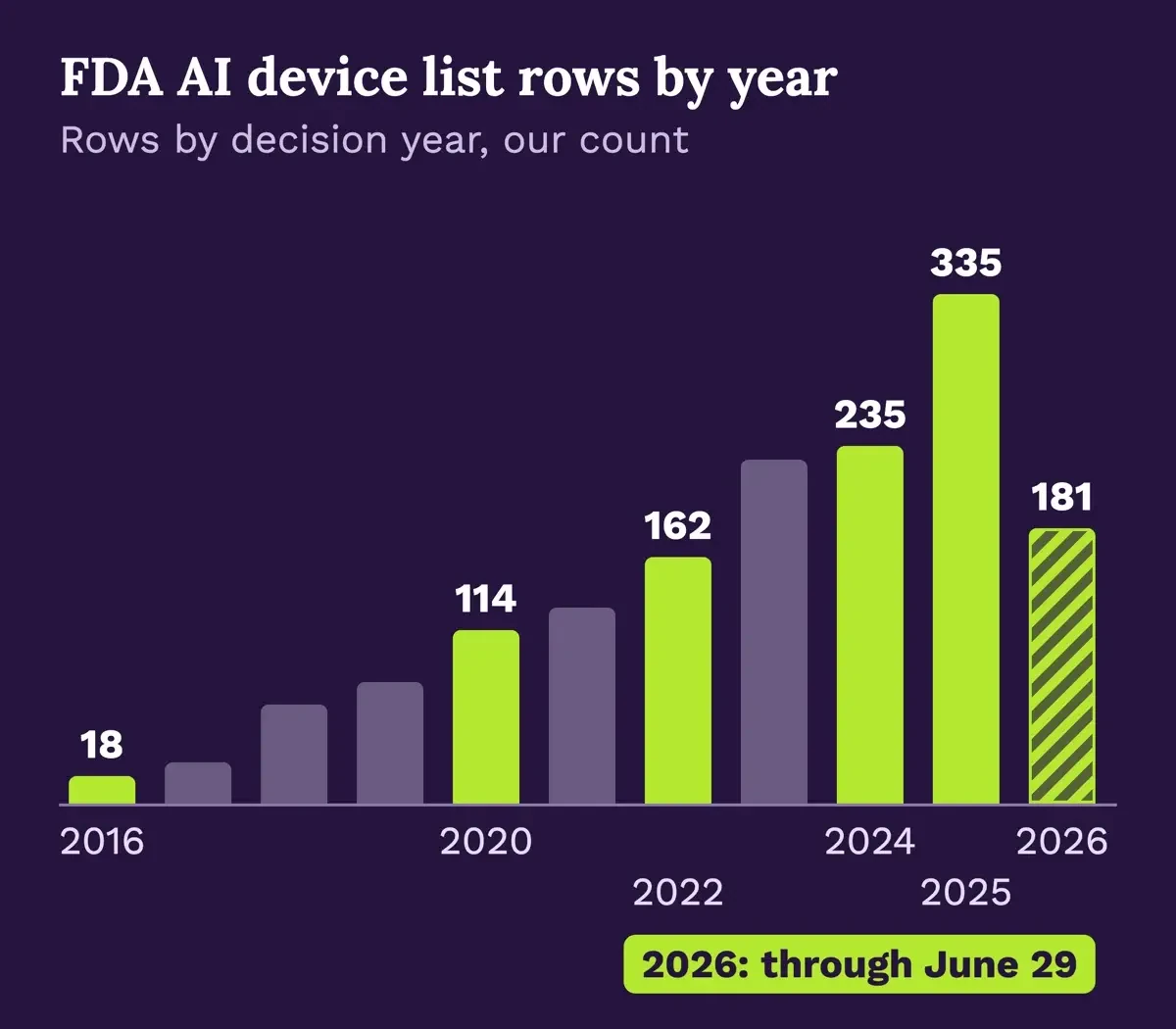 Diagram by DigitalTreed: FDA AI device list rows by year of decision, from our count; 2026 runs only to June 29.
The page's newest decision is dated June 29, 2026. Anything cleared after that isn't in these numbers, and the FDA says devices whose summaries weren't out yet will show up in a later update.
What we tested
We saved the FDA list page on November 11, 2026 with a plain request and ran test/fda_list_count.py over its table. We also ran the DNS, header and RDAP checks on healthpally.com that same day.
How to check an AI health claim
The FDA list, the ONC certification pages, the CMS model pages and the CFR sections linked above are all free to read, with no account needed. Send these six questions to a vendor or a plan, and match each answer to one of those pages.
- Is the device on the FDA AI-Enabled Medical Devices list, and under which submission number?
- Does the tool analyze images or signals, or show a clinician the basis for each suggestion?
- Is it part of ONC-certified health IT, and will the vendor share its source information anyway?
- Which inputs does it use, and do any measure race, sex, age or disability?
- Who makes the final call on a denial or a diagnosis: a licensed clinician or the software?
- Was it tested on real patients, synthetic patients or old records, and where is that published?
We'd drop any vendor that can't answer the first and fifth questions in writing. Those two answers show who checked the tool and who's accountable when it's wrong.
For your practice's public pages, our medical practice website checklist and the HIPAA notes in our dermatology marketing guide say what to keep off them. Records that still move by fax follow our enterprise fax guide. Don't paste patient details into a general chatbot to test a claim. Our Grok and ChatGPT privacy comparison shows what those apps keep, and our AI companion rules explainer covers chatbots that talk like a friend. If you're a wellness business using AI in marketing, the health and wellness AI guide is a closer fit, while our everyday AI examples cover uses outside medicine.
We don't give medical or legal advice here, and nothing above should change a care plan. Ask your doctor or another licensed clinician about any diagnosis, scan or treatment. A health care attorney can say how these rules apply to your practice.
Frequently asked
How many AI medical devices has the FDA authorized?
Our count of the FDA AI device list found 1,614 rows as of September 4, 2026. The FDA says it isn't comprehensive.
Can a Medicare Advantage plan use AI to deny care?
It can use AI to assist. A CMS memo says AI alone can't be the basis to deny admission.
Does the FDA define artificial intelligence?
Yes. Its AI and medical products page calls AI "a machine-based system" that makes predictions, recommendations or decisions.
Is Healthpally a medical source?
Healthpally's About page describes a food, health and lifestyle publication. It isn't a regulator, so we don't cite it.
How we made this guide: We saved the 21 sources below on November 11, 2026 and checked each quoted line against those saved copies. NIH's TrialGPT news release returned 403, so those facts rest on the paper. The HTI-5 dates come from the Federal Register copy on govinfo.gov, read the same day. Facts checked by the DigitalTreed team on November 11, 2026.
First published January 2022 with no sources. Rewritten November 2026 from FDA, ONC, CMS and NIH pages.
Sources
- FDA: Artificial Intelligence-Enabled Medical Devices list (content current as of September 4, 2026)
- FDA: Artificial Intelligence and Medical Products
- NIH NIBIB: Artificial Intelligence (AI)
- FDA: Clinical Decision Support Software guidance (January 2026)
- LII: 21 U.S.C. 360j, General provisions respecting control of devices
- ONC: HTI-1 final rule
- ONC: Decision support interventions test method
- ONC: HTI rules
- ONC: HTI-5 final rule
- ONC: HTI-5 final rule information session slides (October 29, 2026)
- LII: 45 CFR 92.210, Nondiscrimination in the use of patient care decision support tools
- CMS: WISeR (Wasteful and Inappropriate Service Reduction) Model
- CMS: WISeR announcement (June 27, 2025)
- CMS: WISeR model fact sheet
- CMS: FAQ memo on coverage criteria and utilization management, CMS-4201-F (February 6, 2024)
- LII: 42 CFR 422.101, Requirements relating to basic benefits
- CMS: Interoperability and Prior Authorization final rule (CMS-0057-F)
- Jin et al.: Matching patients to clinical trials with large language models, Nature Communications (2024), on PMC
- FDA: Draft guidance on AI in drug and biological product development (January 6, 2025)
- FDA: Considerations for the Use of AI to Support Regulatory Decision-Making for Drug and Biological Products (draft)
- FDA CDER: Artificial Intelligence for Drug Development


Comments
No comments yet. Start the conversation below.