

Quick answer
Customers, federal rules and fraud drive digital transformation for a small US business. As of November 13, 2026, the latest Census releases show 17.1% of retail sales online in April to June 2026. They also show 24.2% of businesses used AI in the two weeks to November 1. If you file 10 or more W-2s and 1099s a year, the IRS already requires e-filing, so start there.
What drives digital transformation for a small US shop or service firm shows up in federal numbers, not in a software rep's pitch. Digital transformation is the shift of a firm's selling, paying, filing and record-keeping from paper and counters to online systems.
Online sales, payment habits, AI use, payment fraud, staff working from home and broadband each have a federal count. The Census Bureau, the Federal Reserve, the FBI, BLS and the FCC publish them, and we confirmed each figure on the agency's own pages. The seventh driver comes from the IRS, and it isn't a trend at all. The IRS 10-return e-file rule has applied to returns filed since January 1, 2024, whether or not your shop feels ready.
Key takeaways
- File 10 or more W-2s and 1099s, and the IRS requires e-filing.
- Online sales reached 17.1% of US retail in April to June 2026.
- Census counts 22.8% of firms with 1 to 4 employees using AI.
- Business email compromise cost reporting victims $3.05 billion in 2025, per the FBI.
- Check your address on the FCC map before buying cloud tools.
Customers who order and pay online
The first push comes from your customers' habits, and the Census Bureau measures them every quarter. Its Quarterly Retail E-Commerce Sales report, released August 18, 2026, counted $340.2 billion in seasonally adjusted online sales for April through June 2026. Census puts that at 17.1% of total retail. That's after 12.2% growth from the same quarter of 2025, while all retail grew 6.7%. The longer view shows it wasn't a pandemic blip. In the Census adjusted e-commerce time series, the online share was 10.3% in the second quarter of 2019 and jumped to 16.3% a year later. It slipped to 14.2% in 2022, then climbed back, a gain of 6.8 points in seven years (17.1 minus 10.3).
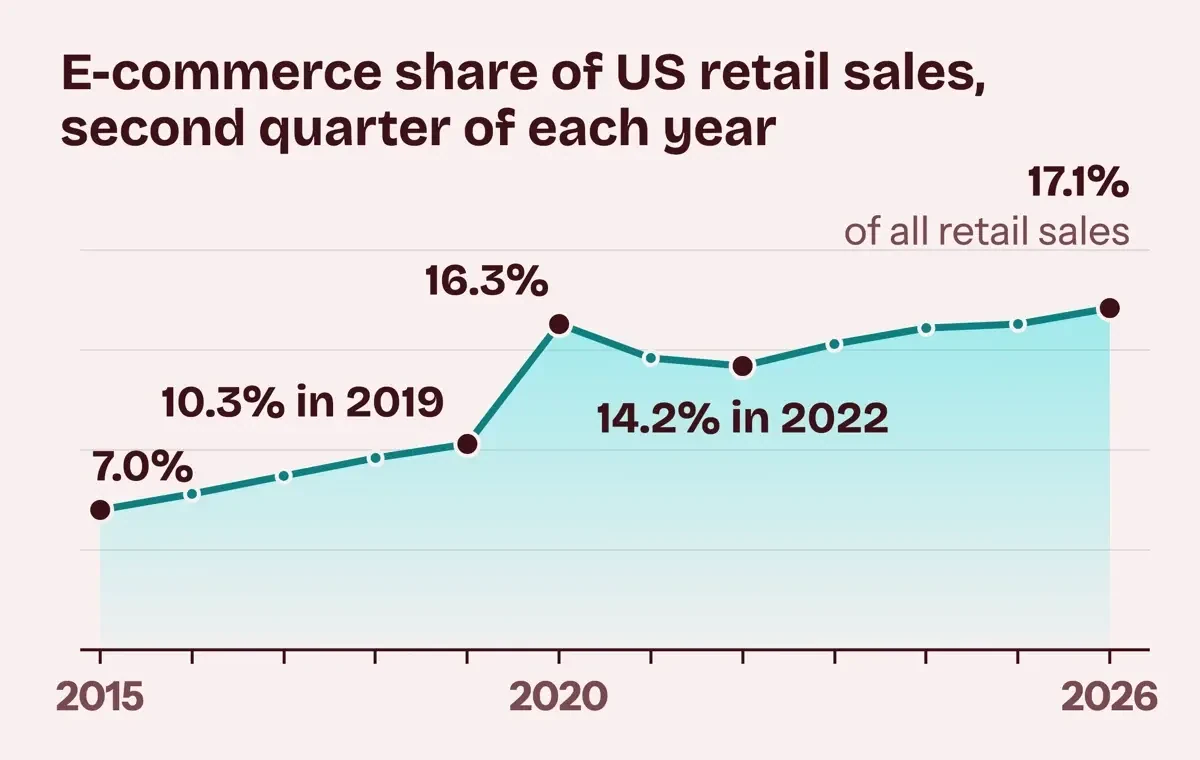 Diagram by DigitalTreed, from the Census Bureau adjusted e-commerce time series read November 13, 2026.
Payments moved too, even at the counter. The Federal Reserve's 2026 Diary of Consumer Payment Choice found cash was 14% of consumer payments in October 2025, down from about one-third in 2016. Remote payments took 37%. They're payments made online, by phone or by mail. Households earning over $100,000 used cash for about 9% of payments, against around 17% below that line. So a dental office whose patients mostly earn over $100,000 may see nearer 9% cash than 14%.
A customer who can't pay you by card, link or app has to fall back on cash, which was only 14% of consumer payments in the Fed's count. The fix usually starts with a plain order or booking page for your top 10 items or services, and the whole website and stock system don't need a rebuild. Our beginner guide to building an e-commerce website covers the build, and the DigitalTreed website speed test shows how fast that page loads.
Why are more small firms using AI now?
Unlike quarterly online sales, AI use gets a Census count every two weeks. The survey asks businesses whether they'd used AI, with examples such as AI-written marketing copy and customer service agents. That Business Trends and Outlook Survey samples about 1.2 million employer businesses, excluding farms, in six panels, and each business reports about once every 12 weeks for a year. In the national BTOS download, 24.2% of businesses said they'd used AI in the last two weeks. That's for the October 19 to November 1, 2026 collection, up from 19.8% in late April and early May.
The same cycle added a question on staff: 26.8% of businesses said employees used generative SI for work tasks. SI is the survey's new label. It asks about "Super Intelligence or SI (formerly referred to as Artificial Intelligence or AI)", and the SBA's pages use SI too. Among small firms, size barely moves the rate. The BTOS employment size file shows 22.8% of firms with 1 to 4 employees used AI, against 25.3% at 10 to 19 employees and 44.1% at 250 or more. Census's May 2026 story on AI use found use "didn't change significantly among firms with fewer than 20 employees" from December to May, while larger firms grew.
Retail stores lag the average: Retail Trade sat around 14% in that same Census story, against a national rate of 19.8% at the time.
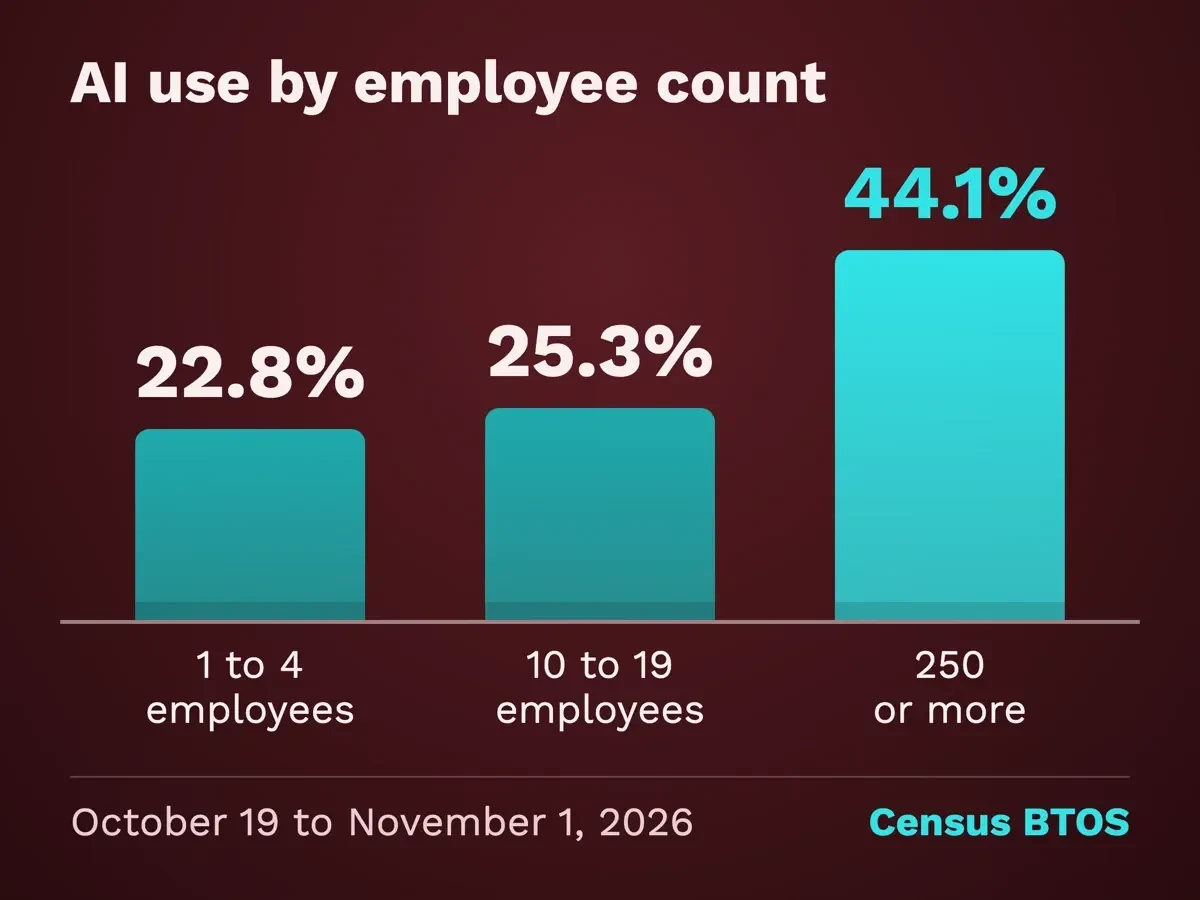 Diagram by DigitalTreed, from the Census Bureau BTOS employment size class download read November 13, 2026.
Headlines quoting Census's 2023 figure of 3.8% don't compare, because that survey asked a narrower question, about AI "to produce goods and services".
The SBA's advice in its manage your business guide fits a small shop: "SI is relatively new, so start small." For free tools, it wants you to "have another person review all SI products" before they go out. The same page notes "there are currently no federal or state laws that require businesses to disclose the use of SI". We'd still pick one weekly writing task, test a tool on it for two weeks, and keep a person checking every output. Our post on how AI fits into digital marketing covers the marketing side.
Payment fraud aimed at small offices
Unlike the Census survey, the FBI reports payment fraud once a year. The FBI's 2025 Internet Crime Report counted 1,008,597 complaints and $20.877 billion in losses reported by victims, the first year IC3's yearly total passed $20 billion. That's a 26% rise from the $16.6 billion in IC3's 2024 report. Our own math, (20.877 minus 16.6) divided by 16.6, gives 25.8%, which rounds to the FBI's figure. Complaints rose too, from 859,532 in 2024 to just over a million. The average reported loss in 2025 was $20,699.
Business email compromise, or BEC, is the type that's aimed at firms paying suppliers by wire. IC3 defines it as "a scam targeting businesses or individuals working with suppliers and/or businesses regularly performing wire transfer payments." IC3 logged 24,768 BEC complaints in 2025. Losses came to $3,046,598,558, second only to investment fraud's $8,648,617,756, which IC3 says was again the largest loss type. Our post on the benefits and dark sides of the internet sets those losses beside what the internet gives back.
The SBA's cybersecurity section names the weak spot. It asks what the leading cause of small business data breaches is, then answers: "Employees and work-related communications." For backups, it says "If possible, perform data backups to cloud storage on a weekly basis."
Multi-factor sign-in is a control both NIST and the SBA push. NIST's small business MFA page says "Passwords alone are not effective in securing your most sensitive business assets". The SBA tells owners to check with each vendor for MFA on accounts such as "financial, accounting, payroll", since those logins move money and hold staff records. We'd turn it on for email and the bank first. Then we'd set long, unique passwords with our password generator. Add one rule that costs nothing: any new bank details get a call back on a number you already have. Our cybersecurity tips for business owners and guide to cloud backup go further.
The IRS 10-return e-file rule
Unlike fraud, this driver is the law. IRS Topic 801 says no one has to e-file information returns "unless the person is required to file at least 10 returns during that calendar year." The 10 is a combined count across almost all form types. W-2s count too. Publication 1099 says Treasury Decision 9972 lowered the threshold to 10 for returns filed on or after January 1, 2024.
Here's an example with made-up inputs. A shop with 9 employees, 2 contractors and 1 landlord paid on Form 1099-MISC files 9 + 2 + 1 = 12 returns. That's over 10, so all 12 go in electronically. Paper is still fine below 10. You don't need paid software for the 1099 side. The IRS IRIS Taxpayer Portal is "free, web-based", lets you "E-file up to 100 returns at a time", and needs a 5-digit IRIS Transmitter Control Code first. W-2s go to the Social Security Administration electronically under the same count.
We're summarizing IRS pages, not giving tax advice, so ask a CPA how the count works for your business.
Staff working from home some days
Those W-2s cover staff who may not work in the shop every day. BLS, the federal labor statistics agency, reported that 22.6% of workers teleworked or worked at home for pay in March 2026. The rate held between 21.5% and 23.0% over the past year, up from 17.9% in October 2022, the first month in the BLS chart.
There's no October 2025 telework figure, because the federal funding lapse stopped that month's survey.
In a nine-person shop, even one bookkeeper working from home on Fridays moves files, payroll access and customer email onto a home router nobody at the shop manages. That's when shared logins, files saved on one desktop and paper-only steps start to break.
The SBA's cybersecurity section says remote staff "should use a Virtual Private Network (VPN)". Each of them also needs MFA on email, the control NIST and the SBA both name.
Broadband at your address
Even the shop's own cloud tools run over its internet line. The FCC's 2026 Section 706 Report, adopted August 13, 2026, kept 100/20 Mbps as the benchmark for fixed broadband: 100 Mbps down and 20 Mbps up. Using June 2025 data, the FCC found 96.9% of Americans had fixed terrestrial service at that speed, a figure its August 14, 2026 news release repeats. Rural coverage lagged at 86.7%, against 99.5% in urban areas. Satellite reaches 99.7% of people at 100/20, the report says, yet it's "only 2.3% of all fixed broadband connections".
If you're rural, check before you move phones, files or the register to the cloud. Type your business address into the FCC National Broadband Map to see which providers report service there and at what speeds, then ask those providers for a business quote. Our explainer on types of broadband connections compares fiber, cable, fixed wireless and satellite.
Which drivers apply to your business?
Payment habits gets its own row, apart from online sales. A shop that doesn't sell online still sees cash customers thin out.
| Driver | Primary number | Date and source | Applies if |
|---|---|---|---|
| Customers buy online | E-commerce was 17.1% of US retail sales | Q2 2026, Census | Customers ask to order, book or pay online |
| Payment habits | Cash was 14% of consumer payments | October 2025, Federal Reserve | Cash alone is over 14% of your payments |
| AI tools | 22.8% of firms with 1 to 4 employees used AI | Oct 19 to Nov 1, 2026, Census BTOS | Someone rewrites the same text every week |
| Payment fraud | BEC losses were $3.05 billion in 2025 | 2025, FBI IC3 | Staff pay vendors by wire or ACH from email requests |
| IRS e-file rule | E-file required at 10 or more returns | Since January 1, 2024, IRS | You file 10+ W-2s and 1099s combined |
| Remote work | 22.6% of workers teleworked | March 2026, BLS | Anyone works from home at least one day a week |
| Broadband | 86.7% of rural Americans had 100/20 fixed service | June 2025 data, FCC | Your shop or office line is below 100/20 Mbps |
We'd fix a slow line first, since everything runs on it, then the IRS rule, then payment fraud, because a legal threshold and lost money can't wait. Sales, payment habits and AI tests follow.
- Will we file 10 or more W-2s and 1099s combined this year?
- Does anyone pay vendors by wire or ACH after an email asks for it?
- Do customers ask to order, book or pay online?
- Are more than 14% of our payments still cash?
- Does someone rewrite similar text, like listings or quotes, every week?
- Does anyone work from home at least one day a week?
- Is our fixed internet below 100/20 Mbps at the shop or office?
Each yes has a first step. For e-filing, pick a route such as the free IRIS portal, and for wire requests, call back on a known number before new bank details go in. For online orders, start a page for your top 10 items. For payments, count one week by type. For AI, run a two-week test with a person checking output. Home workers need MFA and a VPN. A slow line starts with an FCC map lookup.
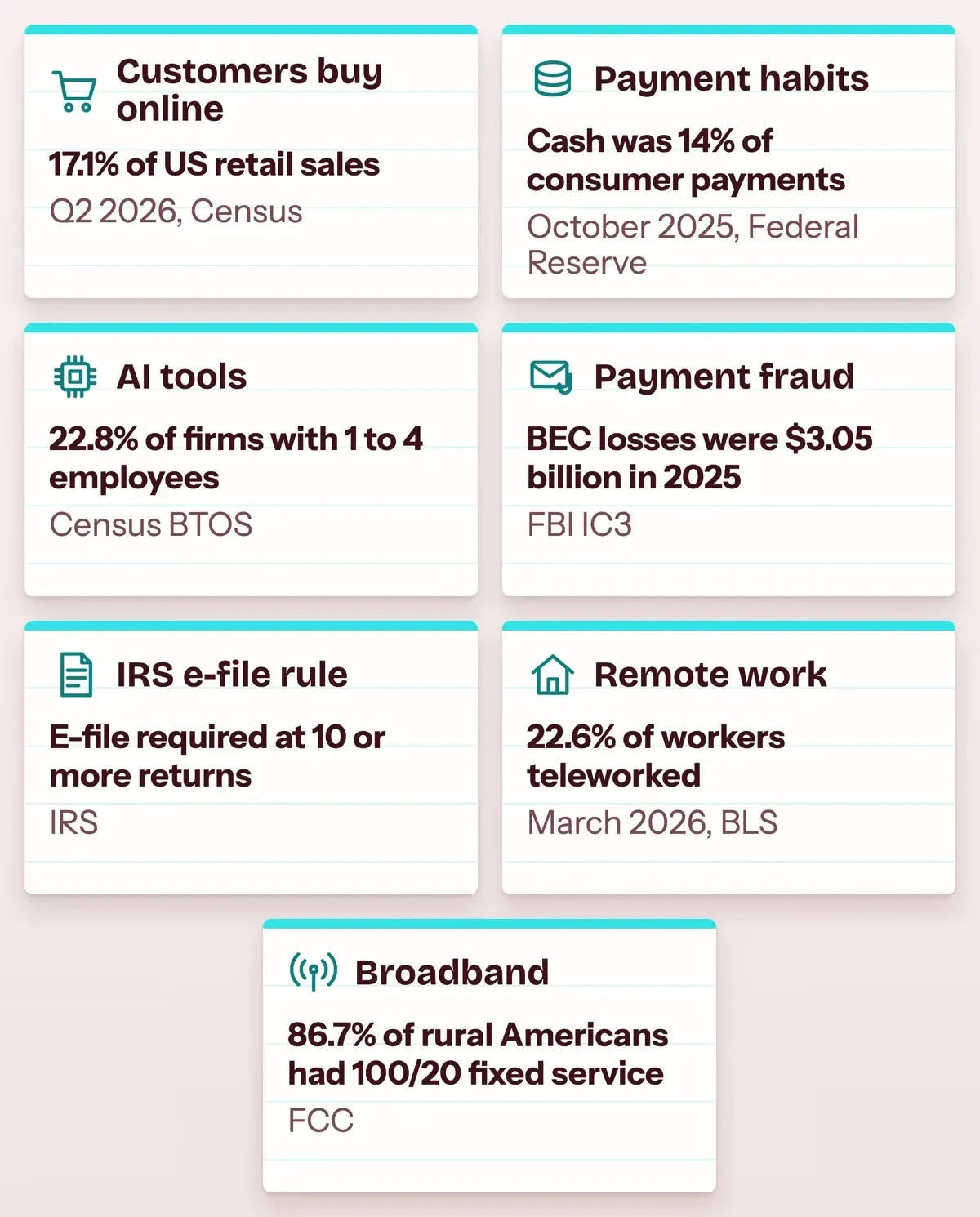 Diagram by DigitalTreed, from the Census, Federal Reserve, FBI IC3, IRS, BLS and FCC pages cited in this guide.
What we tested
Two small Python scripts ran locally on November 13, 2026. The first pulled 25 numbers by code from the federal files we'd saved, and all 25 matched. The second ran the seven questions for Hollowfen Supply, a made-up 9-employee hardware store, and served the result on 127.0.0.1, where the page answered with HTTP 200. Five of the seven drivers applied. Its example count of 12 information returns (9 + 2 + 1) put it over the IRS line. So the order came out as e-file rule, payment fraud, online sales, payment habits and AI tools.
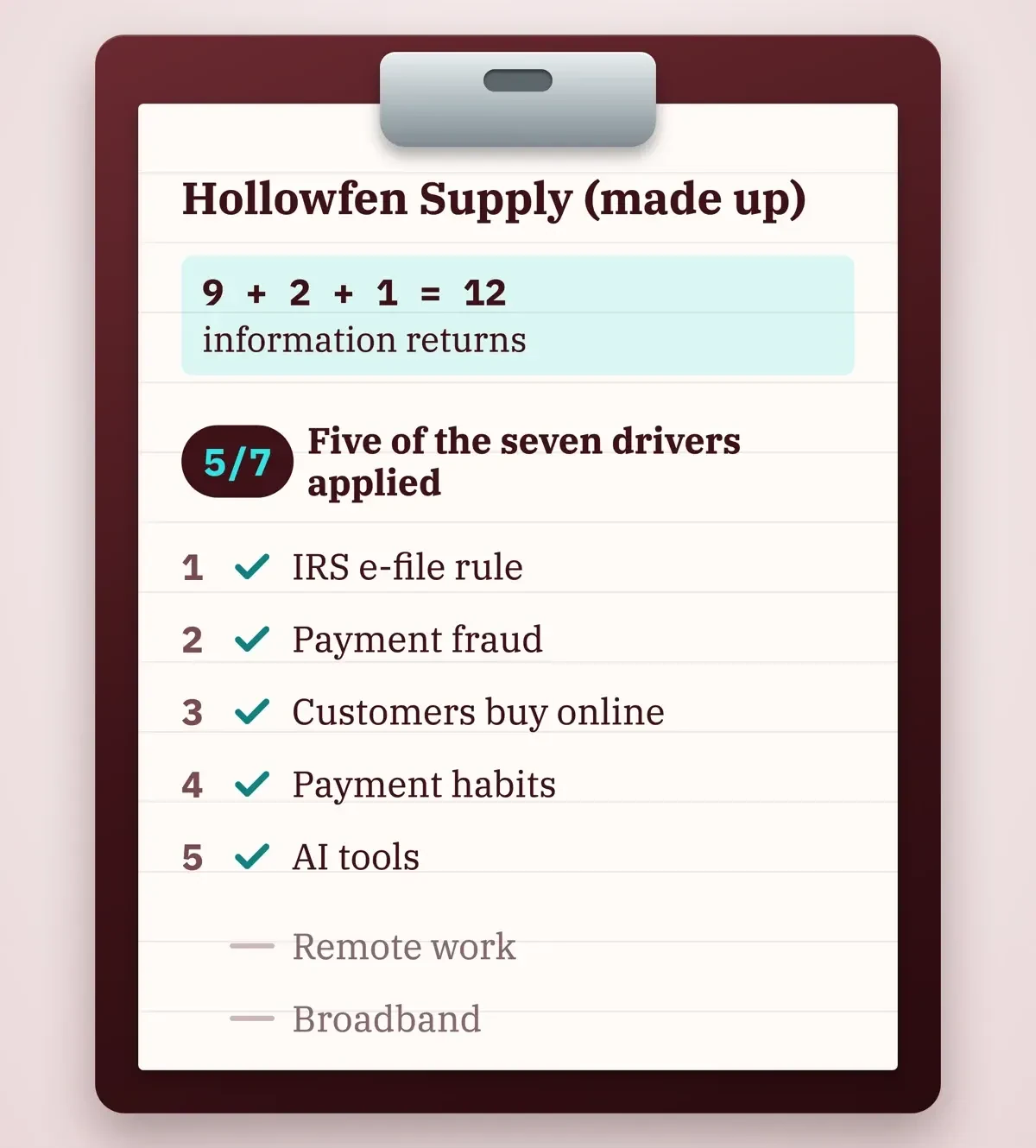 Drawn by us from our self-check run on Hollowfen Supply (made up), November 13, 2026.
Primary pages we confirmed, and gaps we found
We rechecked each federal page behind these numbers on November 13, 2026. Every figure in this guide matched the agency's own page or data file, and we've listed each one in Sources.
We read the Census e-commerce report, time series, BTOS downloads and stories. The Fed Diary, both IC3 reports, three IRS pages, the BLS telework page and the FCC report and release were checked the same day.
Two FCC pages, the broadband map and an older benchmark page, blocked our script with an HTTP 403, so no number here comes from them. You can still open the map normally. The BLS telework page, read earlier the same day, also returned a 403 on our later recheck. We didn't read the BTOS interactive charts, only the downloads. The 2021 post this replaces cited a 97% IT survey and platform market shares with no sources. We dropped them.
Census posts third-quarter 2026 e-commerce on November 19, 2026, with revised second-quarter figures. BTOS updates every two weeks. Check the date on each figure before you quote it.
Frequently asked
How many small businesses are there in the US?
The Census Bureau's Small Business Week story counts 5.58 million employer firms under 500 employees in 2023, plus 30,427,808 nonemployer establishments.
Is cash still used for payments in the US?
Yes. The Federal Reserve Diary found four out of five consumers used cash in the prior 30 days.
Do I have to e-file 1099s if I only send a few?
No. Below 10 combined returns you may file on paper, per IRS Topic 801.
Where can a small business get free cybersecurity help?
NIST's Small Business Cybersecurity Corner lists free guides by topic and a finder for regional support programs.
How we made this guide: We saved the federal pages cited here, pulled 25 numbers from them by script, and ran a local self-check. Facts checked by the DigitalTreed team on November 13, 2026.
First published August 8, 2021 as a general list of transformation drivers. Rewritten November 13, 2026 for small US businesses, with every driver backed by a dated primary source.
Sources
- U.S. Census Bureau: Quarterly Retail E-Commerce Sales, 2nd Quarter 2026
- U.S. Census Bureau: Adjusted e-commerce sales time series
- Federal Reserve Financial Services: 2026 Findings from the Diary of Consumer Payment Choice
- U.S. Census Bureau: Business Trends and Outlook Survey (BTOS)
- U.S. Census Bureau: BTOS national data download
- U.S. Census Bureau: BTOS employment size class download
- U.S. Census Bureau: AI Use at U.S. Businesses (May 26, 2026)
- U.S. Census Bureau: How Many U.S. Businesses Use Artificial Intelligence? (November 28, 2023)
- U.S. Small Business Administration: Manage your business
- FBI IC3: 2025 Internet Crime Report
- FBI IC3: 2024 Internet Crime Report
- NIST Small Business Cybersecurity Corner: Multi-Factor Authentication
- NIST: Small Business Cybersecurity Corner
- IRS: Topic no. 801, Who must file information returns electronically
- IRS: Publication 1099 (2026), General Instructions for Certain Information Returns
- IRS: E-file information returns with IRIS
- BLS: 22.6 percent of workers teleworked in March 2026
- FCC: 2026 Section 706 Report (FCC 26-55)
- FCC: Broadband Report Shows Rapid Expansion of High-Speed Internet (August 14, 2026)
- FCC: National Broadband Map
- U.S. Census Bureau: Census Bureau Data Tell the Small Business Story (May 4, 2026)
Comments
No comments yet. Start the conversation below.