

Many Philippine businesses, particularly small and medium enterprises (SMEs), still depend on paper files and previous-generation computer platforms that don’t integrate into wider systems. This is especially common for very new businesses, as many processes may feel manageable in the early stages. Regardless, the inefficiencies of manual processing become more evident as operations scale upward. Once the business reaches a certain size, teams end up wasting several hours each month reconciling records or rebuilding data that should have been captured automatically in the first place.
These issues become even more apparent in areas that demand regulatory or tax compliance. With tools like a BIR computerized accounting system, Philippine businesses can relegate most of this manual work to smart tools, resulting in fewer reporting and reconciliation errors. Beyond mere compliance, digitalization of this kind helps businesses gain clearer visibility and stronger internal controls, enabling them to achieve the predictable day-to-day performance they need to grow.
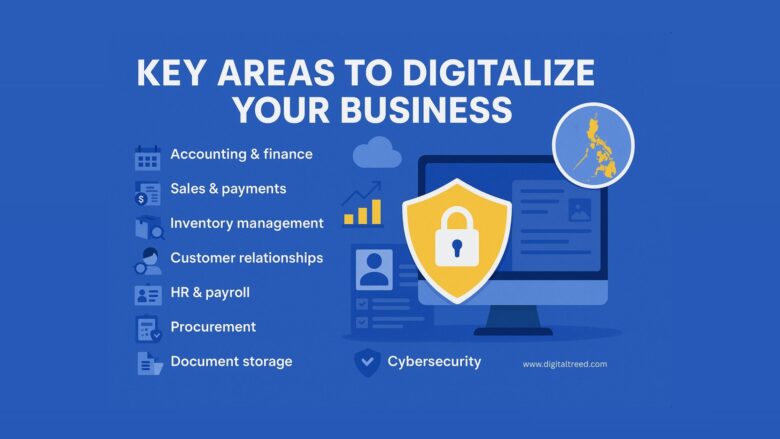
Digitalization does take an investment in resources and can, much like remodeling physical infrastructure, temporarily disrupt the business before it delivers gains. While total digitalization is a good goal, some business areas need it more urgently than others. Here are the key aspects of your business that should be digitalized immediately.
1. Accounting and Financial Management
Even with the best accountants and bookkeepers, there will always be an elevated risk of errors when using legacy accounting systems, especially once your transaction volume grows. A modern digital accounting system can centralize all financial records across different business units, enabling data automation that reduces risky manual processing. As a major plus, these systems can also generate audit-ready statements to support tax filings and can integrate with other operational tools.
2. Sales, Invoicing, and Payment Processing
Sales processes become significantly smoother when quotations, invoices, receipts, and payment confirmations are fully digitized. These tools sync transactions directly with accounting and inventory modules, reducing manual encoding and eliminating discrepancies. When paired with mobile-compatible platforms and the right hardware, your sales team can issue invoices and other documents on the spot, improving the overall experience for your customers.
3. Inventory and Warehousing Management
SMEs that depend on manual inventory management will eventually find themselves losing money due to stockouts, overstocking, and pilferage stemming from inaccurate warehouse records. A digital inventory system gives you real-time visibility across locations, automates reordering, and flags discrepancies as they happen, ensuring your entire team is always working with the same up-to-date data.
4. Customer Relationship Management (CRM)
As businesses grow, customer information tends to end up scattered across different departments, siloed in paper notebooks and messaging threads. This often results in service gaps and missed opportunities.
A digital CRM consolidates customer profiles, purchase history, communication logs, and follow-ups in one place. This makes it easier for teams to coordinate and avoids situations where customers have to keep repeating the same information, improving the chances of building solid long-term relationships.
5. HR, Payroll, and Timekeeping
Important HR work can get backlogged when attendance sheets, leave forms, and payroll computations are handled manually. Digitalizing HR areas like timekeeping, leave approvals, and salary computations saves hours each week, resulting in efficiency. Importantly, it prevents errors that lead to labor regulation issues.
6. Procurement and Supplier Coordination
Digital tools for purchase requests, approvals, supplier records, and delivery monitoring keep your procurement flow predictable and resilient to sudden changes at the supply end. Centralized procurement data also makes it easier for businesses to compare performance among suppliers, so that they can choose the best partners based on up-to-date data.
7. Document Storage and Records Management
Physical documents are prone to misplacement and damage from natural calamities, the latter being a recurring issue for Philippine businesses. A decentralized digital document management system can prevent this issue, keeping all documents across all business units stored securely in one searchable platform, presenting a more audit-friendly documentation trail. Aside from reducing the time spent looking for files, these systems also support remote work and expand your ability to find talent.
8. Cybersecurity and Access Control
As more processes move online, protecting your data must become a priority. Given the sophistication of today’s cyberthreats, you cannot depend on manual processes to provide credible protection for your data.
Digital security tools are now necessary to guard against sophisticated malware and fraud threats. At a minimum, these tools must support features such as role-based access control, multifactor authentication, encrypted storage, and automated system activity monitoring. This ensures that only authorized employees can safely access the sensitive information they need to work without compromising it. Stronger cybersecurity also builds customer trust and keeps businesses compliant with expanding data privacy regulations, both of which are becoming serious challenges in today’s digital economy.
Set Your Business Up for Long-Term Digital Success, One Operation at a Time
Digitalizing key business areas is necessary for building a resilient organization that’s ready for a digital-first landscape. Whether you’re improving compliance readiness, strengthening your internal controls, or just simplifying daily workflows, investing the resources in correctly matched digitalization helps you operate more confidently and sustainably.
For best results in your digitalization programs, make sure you partner with a technology provider that understands your industry as well as the wider context in which Philippine-based businesses operate.
This avoids delays and helps ensure your digitalization activities truly solve the scalability issues that may be holding your business back.
