
Quick answer
Of the 12 affiliate programs for beginners we read on October 28, 2026, HubSpot and Leadpages pair no traffic bar with a low payout minimum. HubSpot pays from a $10 balance and Leadpages from $50. Semrush is the catch for a new blog, since it wants 1,000 unique visitors a month. Start with the table below, then apply where you meet the rule.
You started a blog a few months ago and you've published a dozen or so posts. Now you'd like the links in them to earn something. Affiliate programs for beginners are worth your time only when they'll approve a small site and you can actually reach their payout minimum. An affiliate program is a deal in which a company pays you a commission when a reader buys through your tracked link. The trouble is that most program pages leave out at least one of the two rules a new site cares about.
We start with all 12 programs at a glance and what we tested. Then come the programs that pay out from $10 or $50 and the retail programs with short windows and missing numbers. The software and hosting programs with longer cookie windows follow. After that, we cover networks like Awin, why a $200 minimum can mean months without a payment, the disclosure next to your links, and where we'd apply first.
Key takeaways
- Only 5 of the 12 programs' pages state a dollar payout minimum.
- HubSpot and Shopify let you withdraw from a $10 balance.
- Semrush asks content sites for 1,000 unique visitors a month first.
- At an example $25 a month, a $200 minimum takes 8 months.
- The FTC wants your disclosure close to the recommendation, not buried below it.
Affiliate programs for beginners at a glance
Here are the four terms that decide whether a beginner gets in and gets paid, taken from each program's own page on October 28, 2026. "Not stated" means we searched the page we could open and found no rule or number. Treat that cell as unknown, not as generous. Only Shopify, HubSpot and Hostinger fill every cell. "Not checked" means we couldn't reach the US version of the page. Commission rates sit in the program sections below, since they change by plan and by product.
| Program | Who gets in | How long a click counts | Payout minimum | How you're paid |
|---|---|---|---|---|
| Amazon Associates | 3 qualified sales in 180 days, then a review | 24 hours (cart items 89 days) | In a separate chart | Direct deposit, gift card or check |
| Walmart Affiliates | Approval needed, rule not stated | Not stated | Not stated | Check, about 90 days after month end |
| Etsy Affiliates | Not checked: US page not reached | Not checked | Not checked | Not checked |
| eBay Partner Network | Not stated on the rate card | 24 hours (auctions: win within 10 days) | Not stated | Not stated |
| Shopify | An audience of merchants; not every application approved | 30 days (trials up to 400 days) | $10 | Direct deposit or PayPal |
| HubSpot | Reviewed in 2-3 business days | 180 days | $10 | Direct deposit (EFT) or PayPal |
| Kinsta | Automatic for Kinsta customers | 60 days | Not stated | Monthly, method not stated |
| Semrush | 1,000 unique visitors a month | 120 days | Not stated | Electronic funds transfer or PayPal |
| Leadpages | No minimum audience; reviewed | "Industry-leading", no number | $50 | PayPal or direct deposit |
| Elementor | Reviewed, rule not stated | 45 days | $200 | PayPal or an agreed method |
| Hostinger | Reviewed within 5 business days | 30 days | $100 PayPal, $500 wire, after 3 approved conversions | PayPal or wire |
| Awin (network) | $1 refundable deposit; each brand approves you | Set by each brand | Not stated on pages read | Not stated on pages read |
Read the table from right to left. A program you can't get paid by is no use, however good its rate looks. That's why the minimum and method columns matter before the commission does. Walmart, for one, pays by check about 90 days after month end, so even a cleared balance arrives a season later. Shopify and HubSpot share the lowest stated minimum, $10 as of October 2026, on the Shopify affiliate page and the HubSpot affiliate page. New to tracked links? Read our explainer on what affiliate marketing is first, then come back to the table.
Three rows show neither a dollar minimum nor a named payment method on the pages we read: eBay, Kinsta and Awin. Etsy's row is blank for a different reason, covered below.
What we tested
On October 28, 2026, we saved the public affiliate page of each program with one plain request and no sign-in. A short Python script then searched the saved text for an exact phrase behind every cell. It stopped with an error whenever a phrase was missing. It counted a cell only when the page gave a rule, hours or days, a dollar figure or a named payment method.
The result: an entry rule on 6 of 12 pages, a window on 8, a dollar minimum on 5 and a payment method on 8. The payout timing example further down comes from the same script.
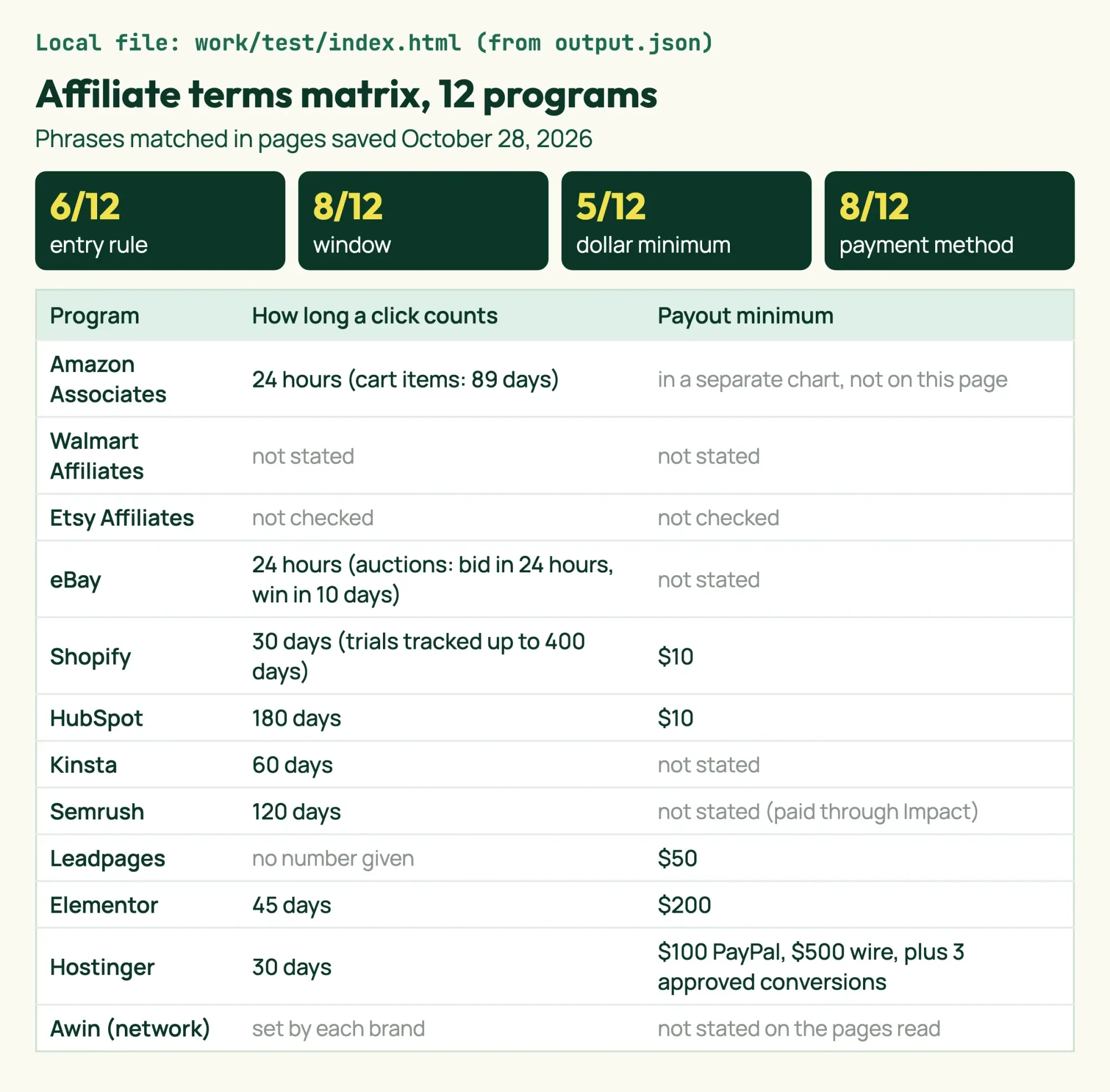 Screenshot: our local test page built from saved program pages, October 28, 2026
Programs that pay out from $10 or $50
Those five dollar minimums split cleanly. Two programs let you withdraw at $10 and one asks for $50, while Hostinger and Elementor want $100 or more. All three below sell software to businesses. They'll fit a blog about marketing, online stores or side hustles far better than a recipe blog.
HubSpot
HubSpot pays "30% monthly recurring commission for up to one year and a 180-day cookie window," as of October 2026, on its affiliate program page. That's about six months. It's the longest standard click window in our table; only Shopify's free-trial tracking, up to 400 days, runs longer. Its team reviews an application and replies "within 2-3 business days," and the page says you're "not required to be a HubSpot customer." Money goes out by direct deposit or PayPal once your balance reaches $10. HubSpot runs the program on Impact, which hosts your links, tracks sales and processes payouts.
Recurring pay adds up slowly, and the fit question comes before the math. Example: a referral on a $20-a-month plan, an example price and not a HubSpot one, earns you $6 a month. Over the 12 months HubSpot pays, that's $72 ($20 x 30% x 12). The catch is that HubSpot sells CRM and marketing software. A hiking or parenting blog rarely has a reason to mention it, while a post on picking a CRM for a small shop is where the link would sit naturally.
HubSpot's tier table starts at 0-29 sign-ups a month, and the next tiers begin at 30 and at 100.
Shopify
Shopify pays a flat amount for each new store that buys a full-price plan: "up to $150 USD per qualified referral" as of October 2026 (Shopify Affiliate Program). The amount varies by the referral's location, and it's paid only when a referred store buys a full-price plan. Shopify tracks a click for 30 days. Trials get up to 400 days. You can withdraw from $10 by direct deposit or PayPal, and Shopify credits your balance once a month, on the 22nd. After that, affiliates "can choose to be paid when their balance reaches a certain amount or on a bi-weekly basis."
The program is "open to anyone with an audience of merchants," but Shopify also says plainly that "not every application is approved." Most applicants hear back within about 24 hours. Its list of ideal affiliates starts with an active website and "an established audience". It then adds original content on commerce or entrepreneurship and experience with Shopify or another commerce platform. A 15-post blog about selling online meets the content part; the audience part is a judgment call Shopify makes.
Shopify's page also promises "No commission caps. Ever." on what a single affiliate can earn.
Leadpages
Leadpages is the only one of these three that says outright it takes small sites. Its page says "There's no minimum audience size," though it still reviews each application (Leadpages affiliate program). You don't need a subscription. Affiliates "can earn up to $400 per referred customer depending on the plan," as of October 2026. Payouts go out on the 15th of each month by PayPal or direct deposit, once you pass $50.
The gap is the cookie. Leadpages promises "an industry-leading attribution window" and never gives the number of days. Ask the affiliate team for that number in writing before you build a review around Leadpages, and save the reply with the date next to your other program notes. If your blog reviews physical products instead, the retail programs below are the closer fit.
Leadpages pays on the 15th, a full week before Shopify credits balances on the 22nd.
Retail programs: short windows and missing numbers
Retail programs suit blogs that review physical goods, but their click windows are short. Neither a payout minimum nor a payment method appears on eBay's page, and we couldn't reach Etsy's US terms at all.
Amazon Associates
Amazon lets you sign up first and reviews you later. Its application review page explains that the team checks you "once you've driven qualified sales," which means at least three in your first 180 days (Amazon application review). Your own orders don't count. It also names "at least 10 posts" as a rule of thumb, and it wants content that's recent, generally from the last 60 days, on a site you own. Under the Associates Program Policies updated April 14, 2026, a click counts for 24 hours. Items the reader puts in the cart count for 89 days, which matters for gear that people research for weeks before they finally check out.
Amazon advertises "up to 10%" in commissions on its program home page, as of October 2026. It pays by direct deposit, gift card or check, and the payout minimum sits in a separate chart that the policy page points to. Our Amazon Associates approval guide walks through that chart and the tax interview. The same review page also rules out unapproved use of Amazon's trademarked words, images and customer reviews on your site, so don't paste product photos or star ratings by hand. Rates differ by category. Our Amazon commission rates guide covers each one.
The review covers every site you've listed on the account, so keep that list current.
Walmart Affiliates
Walmart's program is free to join and pays "up to 4% on each eligible sale," as of October 2026, according to its affiliate FAQ. Its operating agreement pays by check, about 90 days after month end, which is the longest wait in our table. Neither page gives a cookie window in days or a payout minimum, so we'd make Walmart your second retail program. Our guide to choosing affiliate products works out what that 4% earns on a real item and how returns come off it.
Walmart's daily reports run on Impact Radius, where you can see impressions, clicks, orders and the commission earned on each.
Etsy Affiliates
Etsy runs an affiliate program, but we couldn't confirm its US terms. Its terms and FAQ pages returned a 403 to our request, and its main affiliate page reached us as the India version. That isn't the page a US blogger signs up through, so every Etsy cell in our table reads "Not checked". If you sell or review handmade goods, open the page in a browser from the US. Read the commission, cookie and payout terms there before you build posts around Etsy, since we couldn't check any Etsy number against a US page today.
eBay Partner Network
eBay's Partner Network rate card explains when a sale counts, but the category rates didn't show in the page text we saved, and the page offers them as a PDF. A Buy It Now purchase counts within 24 hours of your click, and for an auction the buyer has to bid within 24 hours and win within 10 days. Caps apply per transaction, so one big sale won't pay without limit.
eBay's main partner page answered our request with a browser check, so its entry rule and payout terms stay blank in our table.
Amazon's and eBay's 24-hour windows pay only when a reader buys within a day of the click. Readers who compare for weeks fit the 30- to 120-day windows below better.
Software and hosting programs with longer cookie windows
That's the trade with software and hosting programs: longer windows and bigger payouts per sale, but a stricter entry rule or a higher minimum. The four below state windows of 30 to 120 days.
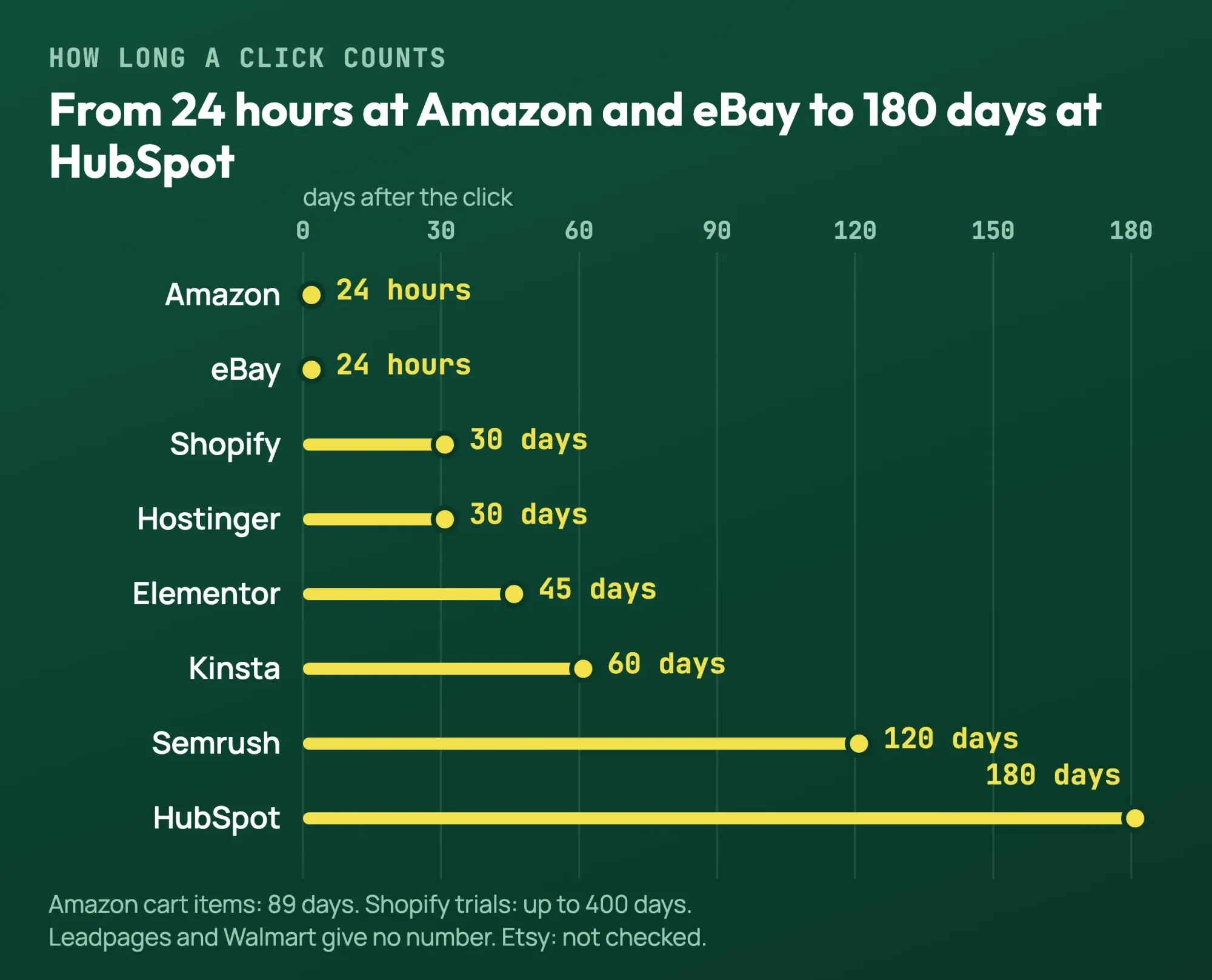 Diagram by DigitalTreed, from each program's own page read October 28, 2026
Kinsta
Kinsta, a managed WordPress host, pays a one-time bonus of $50 to $500 plus "lifetime monthly commissions of 10%" as of October 2026 (Kinsta affiliate program). Its "60-day tracking cookie" uses last-touch attribution. Kinsta customers "get automatically approved." For everyone else the page doesn't spell out the rule, and while it mentions a monthly payout, it doesn't name a minimum or a payment method. If you already host with Kinsta and write about WordPress, it's the easiest yes in this group, since approval is automatic. If you don't, ask the affiliate team how it reviews non-customers first.
Kinsta's tier table starts at 1 to 14 active referrals or $35 or more in monthly recurring revenue, and higher tiers begin at 15 and at 30 referrals.
Semrush
Semrush is the only program in our table that names a traffic number, and it's a high one for a new site. A content creator's website "should have a minimum of 1,000 unique visitors in monthly traffic" (Semrush affiliate program). Once you clear it, Semrush pays "$100 to $300 for every sale, plus $10 for every free trial," as of October 2026, with 120 days of cookie life. Payment runs through Impact by electronic funds transfer or PayPal. The page names no minimum.
Semrush locks each month's transactions 27 days after the month ends, then pays 21 days after the end of the month in which they lock. A January sale locks around February 27 and is paid around March 21. That's 49 days after January ends. We'd bookmark Semrush until your traffic passes 1,000 a month.
Elementor
Elementor pays 45-55% on first purchases of its WordPress products, as of October 2026, with 55% tied to a launch phase for Elementor One (Elementor affiliate program). The cookie lasts 45 days. Its affiliate terms, last updated January 2026, pay only commissions that meet "the minimum threshold of $200 USD." They pay 60 days after the end of the transaction month, so a March sale that clears the minimum would be paid around the end of May. No other program in our table asks for more before a PayPal payout.
Elementor's terms pay only on a customer's first-ever purchase of a listed product, so renewals and upgrades earn nothing.
Hostinger
Hostinger's commission "starts at 40% and grows depending on sales volume," as of October 2026 (Hostinger affiliate program). Hostinger promises you can "Sign up in less than a minute." Its affiliate agreement still reviews new signups within 5 business days before they're accepted. A cookie lasts up to 30 days. You'll need "at least 3 approved conversions" before you can request money. The PayPal minimum is $100. Wires need $500.
A sale refunded within 45 days doesn't count, and the agreement is with a Cyprus company, Hostinger International Ltd.
Is a network like Awin a better first step?
Applying brand by brand is slow, since each program has its own form, dashboard and payment settings, and a network is the middle ground. An affiliate network is a marketplace where you sign up once and then apply to each brand's program inside it. Awin says it works with "30,000+ brands" (Awin for content creators). New publishers pay "a $1 refundable deposit" as of October 2026, which Awin's FAQ page says is there "for compliance and quality reasons." Each brand inside Awin still approves or declines you on its own, and each one sets its own commission rate and its own cookie window.
CJ makes a similar offer, with "Instant Approval from Top Brands" through its Content Certification program and "two monthly payouts" (CJ for publishers). We'd still join one network early, but as a catalog rather than a shortcut. If a brand you already use runs its program on Awin or CJ, that's the network to join first. If you also sell your own products, our comparison of affiliate network fees for merchants shows what brands pay to be listed there.
Neither network page we read names a payout minimum, so check the payment settings inside the dashboard before you count on a date.
A $200 minimum can mean months without a payment
Once you're approved, the payout minimum decides when the first money arrives. To show the gap, take Hollowpine Trail Notes, a made-up hiking blog that earns an example $25 a month in commission from one program. That $25 is invented for the math and isn't a forecast, because real earnings depend on your traffic, the product and how many readers click and then buy.
The formula is months to payout = payout minimum divided by monthly commission, rounded up. At an example $25 a month, a $10 minimum pays in month 1 and $50 in month 2. A $100 minimum takes until month 4, and $200 takes until month 8. For Hostinger, $100 divided by $25 is exactly 4, so its PayPal minimum lands in month 4 with nothing to spare. Those minimums belong to Shopify and HubSpot, Leadpages, Hostinger's PayPal option and Elementor, as of October 2026, from the pages linked above. Our guide to how bloggers make money sets affiliate income beside ads and sponsorships.
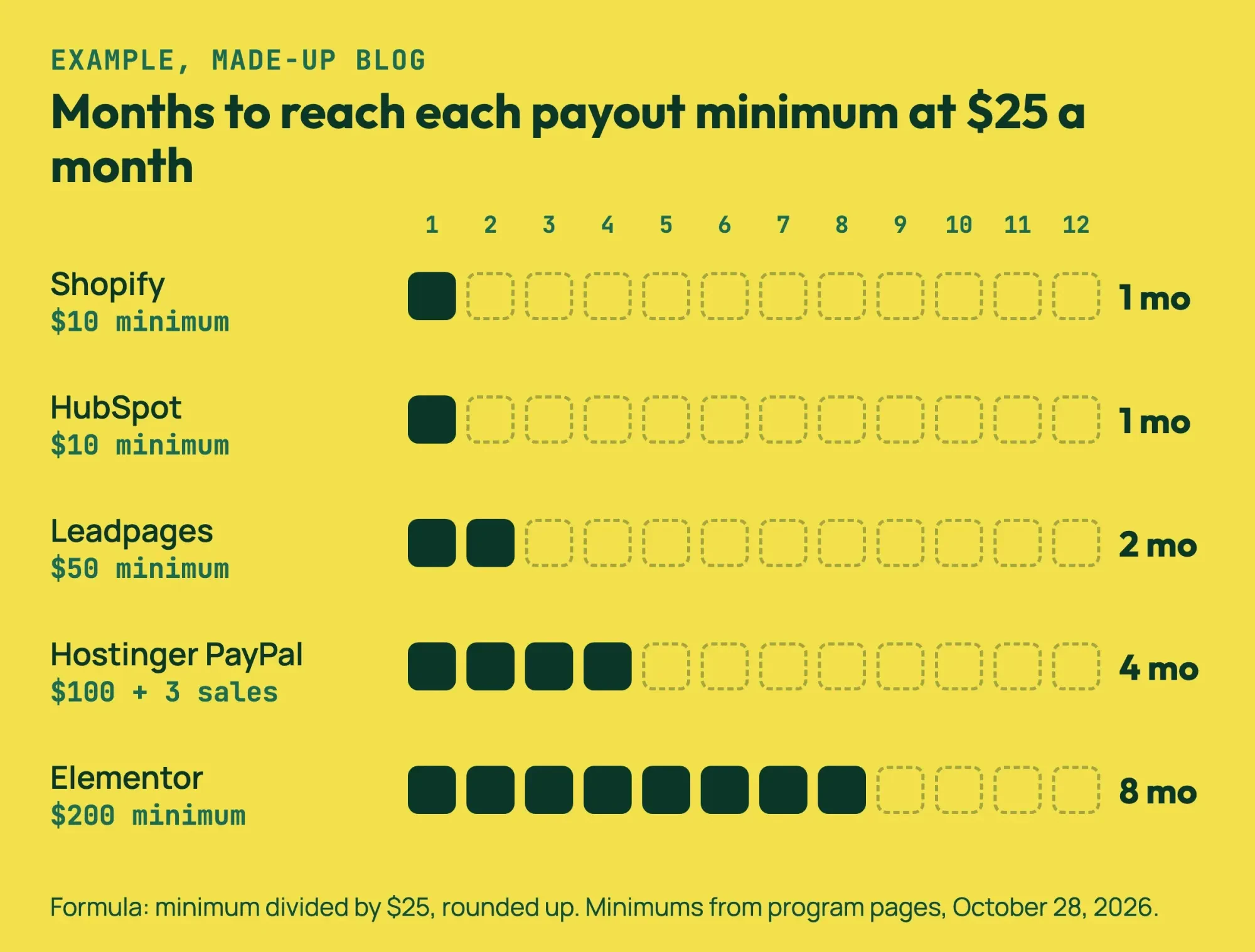 Drawn by us: example figures for a made-up blog; minimums from program pages read October 28, 2026
Hostinger adds a third gate: 3 approved conversions. At the example $25 a month, its 4-month estimate holds only if that $100 comes from 3 or more sales.
The payment date stacks more time on top, because almost no program pays the day your balance crosses the line. Leadpages pays on the 15th for the previous month, and Shopify credits balances on the 22nd. Elementor pays 60 days after the end of the month, and Walmart's check comes about 90 days after month end. So by our reading of Elementor's terms, Hollowpine's first payment would land around month 10, not month 8.
That's why we'd pair a high-minimum program with a low-minimum one in the same niche. Both can run at once. The low one shows within a month or two that your links track and pay. The high one pays more per sale once traffic grows.
Put the disclosure next to your affiliate links
Whichever programs say yes, the first affiliate link you publish needs a disclosure near it, and that holds for a single Amazon link in an old post too. The FTC's answer for affiliate marketers is direct, in its Endorsement Guides FAQ: "You should disclose your relationship to the retailer clearly and conspicuously on your site." Its sample wording is "I get commissions for purchases made through links in this post."
Placement matters as much as the words. The FTC warns that when the review and the link "are separated, readers may not make the connection." It adds, "The closer the disclosure is to your recommendation, the better." A line in the footer or on an About page doesn't do that job, since a reader who clicks mid-post won't scroll down to find it. A one-line label above the first link, like the left side of the sketch below, keeps the disclosure and the link together on a small phone screen. Our guide to affiliate link placement, labels and tracking shows where the label goes in posts, emails and social bios.
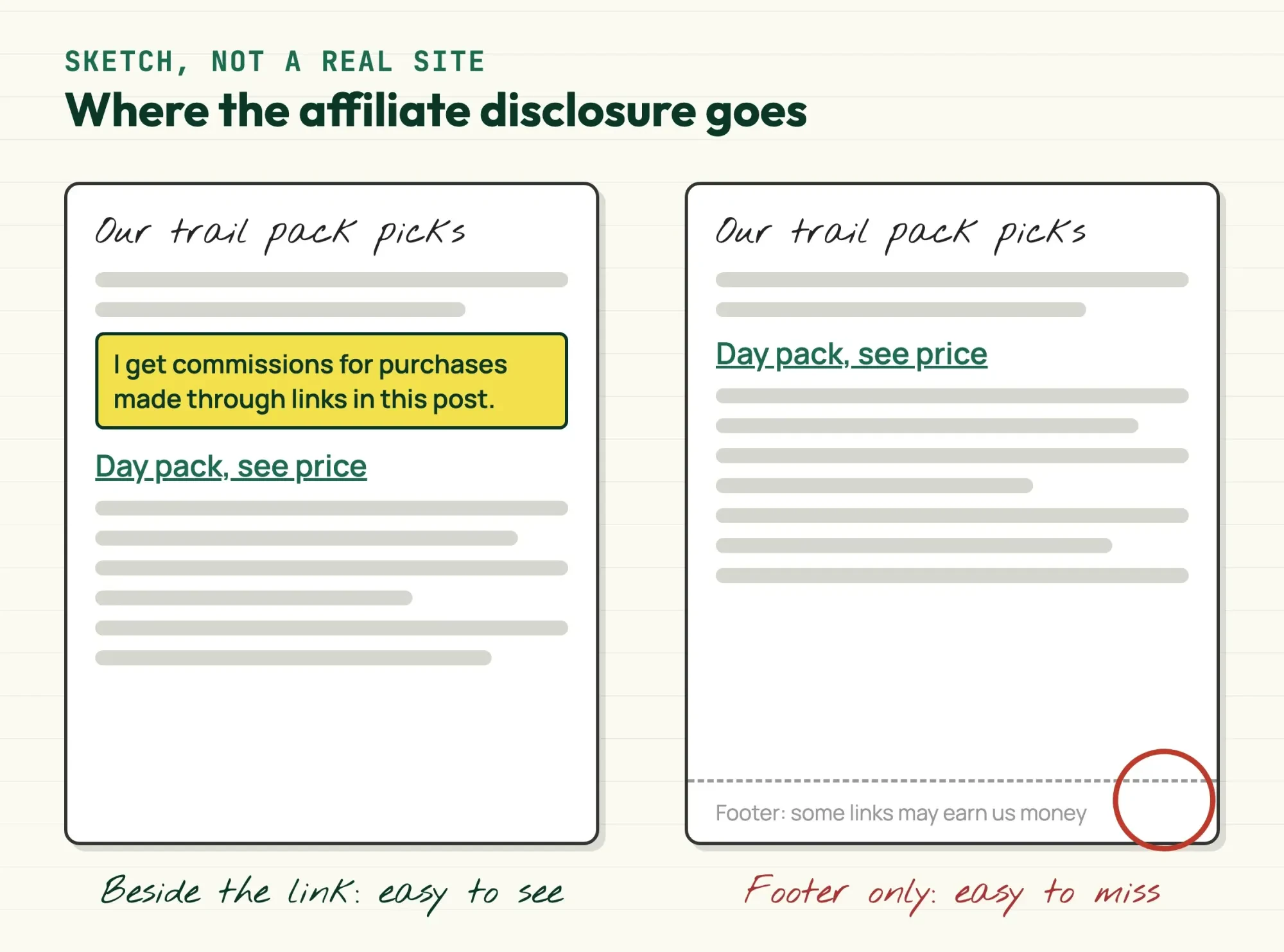 Drawn by us, based on the FTC Endorsement Guides FAQ read October 28, 2026
The FTC's sample sentence is 11 words long. Its FAQ also says one disclosure may be enough when the link sits inside the review and readers see both at once. This section quotes only its affiliate answers, so read the whole FTC FAQ linked above before your first link goes live.
Getting paid brings paperwork as well. A US program may ask you for Form W-9, the IRS Request for Taxpayer Identification Number and Certification, before your first payout. The IRS says the reporting threshold for certain payments "increased to $2,000" starting with tax years that begin in 2026. Keep your own records either way. None of this is tax advice, and a CPA can tell you how to report affiliate income.
Where we'd apply first
So where would we start with a 15-post blog and little traffic? We'd pick two programs whose entry rule you meet today and whose minimum you can reach within two months. Then we'd add a third after the first payment arrives, sorted by what the blog covers:
- Business, marketing or online stores: HubSpot or Leadpages first, and Shopify once you have a steady audience.
- Physical products: Amazon Associates, knowing you need 3 sales in 180 days, plus one brand you already use through a network such as Awin.
- WordPress and websites: Kinsta if you host there, or Hostinger if 3 approved conversions look reachable.
- Any niche, after you pass 1,000 monthly visitors: Semrush.
At the example $25 a month, HubSpot or Leadpages would pay out in month 1 or 2, so you'd see a real payment before choosing a third.
Once a program approves you, run your tracked link through our free redirect checker to confirm it lands on the right shop page. Want posts strong enough to pass a program's review? That's the work of our DigitalTreed content marketing team. We sell content services, so weigh this advice knowing that.
Frequently asked
Does it cost money to join an affiliate program?
Not at Shopify or Hostinger, which both say so in writing. Shopify's affiliate page says it is "completely free to join," and Hostinger's affiliate page says it is "completely free of charge."
Can I promote a product I already use as a customer?
Yes, where the program allows it. Shopify's affiliate page says "Shopify Merchants can join the Shopify Affiliate Program" and calls some merchants its best performing affiliates.
Can I run paid ads to my affiliate links?
Some programs allow it. Leadpages permits ads on Google, Facebook and YouTube but says "You cannot bid on Leadpages branded keywords or use misleading claims" (Leadpages FAQ).
Do returns cancel my commission?
At Walmart, yes. Its FAQ says that if a customer returns a product for a refund, "your account will be debited for any commission earned on that transaction."
How we made this guide: On October 28, 2026, we saved the affiliate, terms and FAQ pages of 12 programs. A local script matched every cell in the table to an exact phrase on them. The FTC page turns away scripts, so its quotes were read through a web page reader. Pages that blocked us, and Etsy's India page, are named in the text, and none of their numbers are used. Facts checked by the DigitalTreed team on October 28, 2026.
First published May 2025. Rewritten October 28, 2026: 12 programs compared on entry rules, cookie windows, payout minimums and payment methods, plus a payout timing example.
Sources
- Amazon Associates: Program home
- Amazon Associates Help: Application review process
- Amazon Associates Program Policies (updated April 14, 2026)
- Walmart Affiliates: FAQs
- Walmart Affiliates: Operating agreement (June 2026)
- Etsy: Affiliates (reached us as the India page)
- eBay Partner Network: Rate card
- Shopify: Affiliate Program
- HubSpot: Affiliate Program
- Kinsta: Affiliate Program
- Semrush: Affiliate Program
- Leadpages: Affiliate Program
- Elementor: Affiliate Program
- Elementor: Affiliate Program Terms and Conditions (January 2026)
- Hostinger: Affiliate Program
- Hostinger: Affiliate Program Agreement
- Awin: For content creators and influencers
- Awin: FAQs
- CJ: For publishers
- FTC: FTC's Endorsement Guides: What People Are Asking (bot-block to scripts, opens in a browser)
- IRS: About Form W-9
- IRS: Instructions for Forms 1099-MISC and 1099-NEC
Comments
No comments yet. Start the conversation below.