
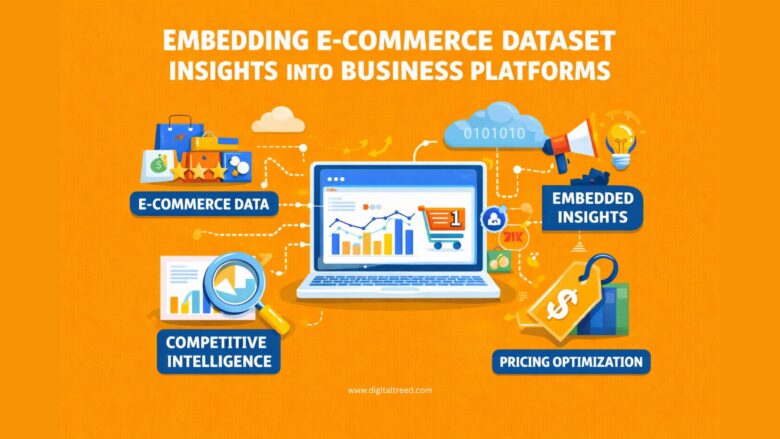
Organizations have stopped depending completely on their gut instincts to make capacity planning choices in the current data-driven environment. They can gather and examine limitless digital data to better comprehend their market, the behaviour of their consumers, the fluctuation of prices, and the strategies of their competitors. One of the most advantageous sources of information is e-commerce data; such data contains a wealth of up-to-the-minute information regarding items, their costs, consumer feedback, the levels of service given by sellers, and purchasing trends. E-commerce dataset can greatly improve the operation of organisations: how they compete and innovate when used directly on business platforms.
The Growing Value of E-Commerce Data
Every second, e-commerce platforms create an overwhelming amount of data that feeds into the volatile nature of e-commerce via product listings, sales and purchases, pricing changes, product evaluations and continuing inventory flow. The sheer amount of data created by e-commerce is valuable to virtually all companies operating in the following ways: Retailers; SaaS providers; marketing analytics; supply chain mgrs.
Previously, companies relied on periodic reporting or manually analyzed the e-commerce data to help support business decisions. In today’s quick-changing markets where pricing changes
from minute to minute; where price levels, demand patterns and customer preferences change significantly, the use of periodic reports/manual analysis is not sufficient to support the majority of business decisions being made in terms of quickly identifying and acting upon customer actions.
By embedding the e-commerce data into their business systems, business decision-makers have immediate access to up-to-date information that helps facilitate informed decision-making within multiple areas of the company.
By embedding the aforementioned e-commerce data into dashboards; analyzing it across the forge your data; etc., companies change from traditional reactive business processes to proactive data-driven business processes.
What It Means to Embed E-Commerce Dataset Insights
The term “embedding e-commerce data insights” means to include structured ecommerce data from the online retail channel directly into software programs (aka enterprise systems) rather than treating this set of data as an external data source that must be extracted/downloaded and then analyzed independently from other sets of data.
For instance, you might have a retail analytics application that includes product pricing information from multiple ecommerce marketplaces. Likewise, you may use an intelligence application that includes consumer sentiment information from product reviews and includes competitive analysis in an e-commerce software as a service application based on aggregate marketplace data.
By embedding these data sets directly into their own internal software applications, users are able to get at the actionable insight they need without leaving the software they use to run their day-to-day operations.
Enhancing Competitive Intelligence
Competitive intelligence is one of the strongest usage methods of having eCommerce data embedded in Continuing business platforms. This is because online marketplaces generally feature many sellers, many with similar product offerings, who are all vying to gain an edge over each other/competitors. Because of this, being able to compare competitors’ pricing structures, product positioning, and customer reviews is one of the most critical actions taken by all companies that are part of an online marketplace to retain/achieve a competitive advantage. By embedding eCommerce datasets into their business platform, an organization can continuously monitor its competitors in real-time/real time. With the use of dynamic pricing dashboards, each organization can track the price changes occurring in the market, and with the use of analytical tools; the seller(s) can spot emerging trends in the demand for a particular type of product. This level of visibility enables all companies to quickly assess and respond to market changes
(including pricing) in a timely manner and improve the way they manage their product listings, long before their competition has gained an advantage over them.
Improve Product and Market Analysis
Product teams also benefit greatly from embedded e-commerce dataset insights. Product managers can analyze market data to understand which features, categories, or price ranges perform best. This information helps guide product development, inventory planning, and assortment strategies. For example, a consumer electronics company might analyze large datasets from e-commerce platforms to identify increasing demand for certain device specifications. By embedding this data into internal analytics platforms, product teams can quickly spot patterns and align product development with real-world market demand. Similarly, marketing teams can use embedded datasets to analyze consumer reviews and sentiment. This helps identify customer pain points, common feature requests, and opportunities for product improvement.
Enabling Better Pricing Strategies
Pricing optimization is another area where embedded e-commerce datasets provide significant value. In the digital retail environment, prices change frequently due to promotions, competitive actions, and supply chain fluctuations. When businesses embed market pricing data into their internal platforms, they can automate price monitoring and implement dynamic pricing strategies. Real-time dashboards can highlight underpriced or overpriced products compared to competitors, allowing businesses to adjust their pricing accordingly. For retailers and marketplace sellers, this capability is especially valuable. Automated pricing insights help maintain competitiveness while protecting profit margins.
Empowering Data-Driven SaaS Platforms
Many SaaS companies are increasingly building data-driven features powered by e-commerce datasets. These platforms serve online sellers, retailers, and brands that need actionable insights to improve performance in digital markets. For example, SaaS platforms for marketplace sellers may include embedded analytics that track product rankings, price changes, and competitor listings. Instead of requiring users to manually gather data from multiple sources, the platform consolidates everything into a single interface. This approach not only improves usability but also increases the overall value of the platform. Data-driven features often become key differentiators that attract and retain customers in competitive SaaS markets.
Challenges in Integrating E-Commerce Datasets
While the benefits are substantial, embedding e-commerce dataset insights into business platforms also presents technical and operational challenges. A major challenge is data collection. E-commerce data comes from many sources, including online marketplaces, retailer websites, and product catalogs. Reliably collecting this information requires scalable data pipelines and robust extraction technologies. Data quality is another important consideration. Inconsistent product names, duplicate listings, and incomplete information can reduce the accuracy of the analysis. Businesses should implement data cleaning and normalization processes to ensure reliable insights. Scalability is also important. As datasets grow in size and complexity, platforms must efficiently handle large amounts of structured and unstructured data. Cloud-based infrastructure and modern data architecture play a critical role in supporting these requirements.
Role of Automation and Real-Time Data
Automation is a key enabler of embedded e-commerce data insights. Modern data pipelines automatically collect, process, and update market data on an ongoing basis. This ensures that business platforms always display the latest information. Real-time or near-real-time data is especially valuable for industries where market conditions change rapidly. For example, retailers need the latest information about competitive pricing and product availability. Without real-time information, businesses run the risk of making decisions based on outdated data. By combining automated data pipelines with integrated analytics dashboards, organizations can create platforms that provide users with timely and actionable information.
Future Opportunities
As e-commerce continues to expand globally, the importance of embedded dataset insights will only increase. Businesses are moving towards a fully integrated data ecosystem where external datasets seamlessly enrich internal analytics platforms. Emerging technologies such as Artificial Intelligence and Predictive Analytics will further enhance the value of e-commerce datasets. Machine learning models can analyze large amounts of market data to forecast demand, detect market changes, and recommend optimal business strategies. Additionally, data marketplaces and API-driven data services are making it easier for companies
to access large-scale structured e-commerce datasets. This trend will accelerate the development of intelligent business platforms that rely on constant streams of external data.
Conclusion
We’re feeling confident that we’re on track to meet our goal of providing an excellent service here at Embedding eCommerce Dataset Insights Into Business Platforms. By integrating real-time insights from eCommerce datasets into operational business applications, you will be better enabled to make quicker and more informed decisions about product features, prices, competition and customer preferences.
The era of embedded eCommerce datasets is changing the way organizations use data to create new and improved competitive advantages (e.g., competitive intelligence, pricing optimization, product development, SaaS innovation). Although there are several remaining issues that organizations face when it comes to implementing embedded eCommerce datasets (e.g., data collection, quality and scalability), advances in data engineering and automation are helping to resolve these issues.
In an increasingly competitive digital economy, organizations that successfully embed eCommerce dataset insights into their business platforms will be well-positioned to identify new opportunities, adapt to changing markets, and deliver increased value to their customers.

