
Quick answer
As of October 31, 2026, 14 business publications with a live contributor page passed our check, and 13 of them invite outside writers to pitch or inquire. Another 52 candidates blocked our checker, so the list leaves out sites we couldn't read. Pitch with your own company's numbers, after the 2-minute check below.
If you searched "business blog write for us", you likely have real business experience and want a byline in front of business readers. Maybe it's a founder's story, a CFO's numbers or your own consulting work. A business write-for-us page is a publication's brief for outside writers, saying who the editors want, what to send and what happens to links. We used to run this URL as our own business pitch page, and today it's a guide to finding, checking and pitching those sites.
It follows the work's order. First come trade publications, association blogs and business magazines, then what business editors ask for and the search strings that find their pages. Next are the funding, crypto and press-release footprints, a 2-minute check and the sites that passed it. The last parts cover a pitch with five angles, the sponsored-link and FTC rules, and your first pitch. Our view, up front: one pitch built on your own company's numbers beats twenty built on a tips list.
Key takeaways
- Business editors want numbers from your own company, not a generic tips list.
- Harvard Business Review asks authors to disclose financial ties to cited companies.
- In a business sitemap, "loan" alone is weak; guaranteed funding offers are the signal.
- Paid business placements need rel="sponsored" and a clear Sponsored label.
- Count only sites whose contributor page still asks for pitches.
Note
Want to write for DigitalTreed? Business is one of the seven topics on our write for us page, and startup founders and agencies are among the readers it names. For an editorial idea, pitch before you draft. The page asks you to "Send a working title, a few lines on what the reader will learn, an outline, and two links to things you have written." Funding and investing ideas get extra review, since finance is on our extra-review list. Sponsored articles carry "One relevant contextual link to your website or brand". New clients pay "50% upfront and the remaining 50% after the post is published", and our media kit lists prices by niche.
Trade publications, association blogs and business magazines want different pitches
We sorted the contributor pages we saved on October 31 by who reads them, and three kinds came out, plus one to avoid. The same idea needs a different first line for each.
A trade publication covers one industry, such as freight, restaurants or construction, and its readers do that work every day, from the dispatcher to the owner. So its editors want detail only an insider has, such as what a contract clause cost you or how a supplier change moved your margin over a year.
Association and chamber of commerce blogs are written for members. They often run posts from member companies and local owners, and they don't need a famous byline. Readership is smaller and narrower than a national magazine's: it's the people the group already serves. NACD's Directorship magazine is one example: the page calls it "an exclusive NACD membership benefit", and its editors still take pitches from outside.
General business magazines sit at the other end. They publish management and strategy ideas for executives, they get far more pitches than they can use, and many don't reply. Harvard Business Review says "Most HBR authors are business school faculty or consultants". A cold pitch there needs real proof.
Then there's a fourth kind that calls itself a business blog but takes anything at all: crypto one day, CBD the next, a casino review on Friday. Our site-check brief treated a guidelines page listing eight or more unrelated categories as a content farm, to be dropped. In the business section, no candidate was dropped on that rule. One magazine in our list, CEOWORLD Magazine, names six broad sections on its page. The run kept it because they all sit inside one business magazine, and its page turns away press releases and thinly disguised ads.
This guide sticks to business publications, management, B2B and startup sites. Most small business and branding blogs are in the small business section of our niche guest post hub. Narrower lists live in our business management write for us guide and B2B marketing write for us guide.
If you're still deciding whether a business byline is worth the hours, our piece on how business guest posts can grow your business weighs traffic, authority and leads.
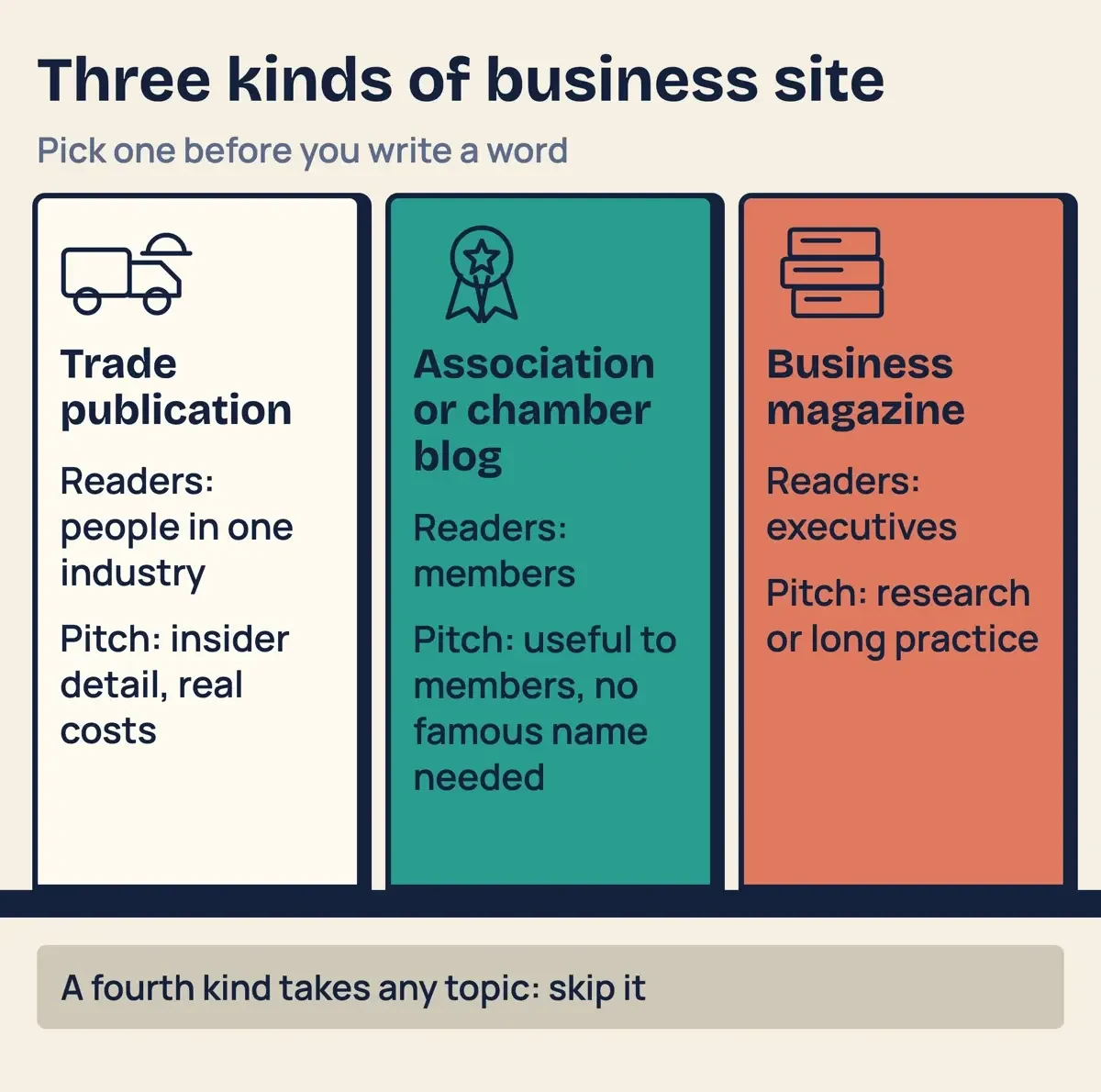 Diagram by DigitalTreed comparing three kinds of business sites, drawn from the contributor pages saved on October 31, 2026.
Business editors ask for named experience and numbers from your own company
Once you've picked a kind, you'll find its editors want the same raw material: a person with standing in the subject, and evidence that person gathered. Harvard Business Review's guidelines set the bar in one line: "you must have demonstrated expertise in the subject you’re writing about." For evidence, the page prefers "ideally empirical research you’ve done yourself". The Muse names the listicle problem. It passes on "Basic stuff" such as a five-tip resume piece. Its reason: "If you could find it on every other career site out there, it’s probably not for us." Strategy+business turns down "articles that seek primarily to market a product, consulting practice, or service".
Google asks for the same thing. Its page on helpful, people-first content gives more weight to strong E-E-A-T on topics that could "significantly impact the health, financial stability, or safety of people". It adds: "We call these "Your Money or Your Life" topics, or YMYL for short." Its How Search Works page on ranking says its systems look for "expertise, authoritativeness, and trustworthiness". Business advice on funding, taxes, hiring law or investing sits inside that line, so a careful editor won't let a single number in it go unchecked.
In a pitch, that means four habits. Put your name, role and company in the first two lines. Give each number a time frame and a source, like "invoices got paid in {X} days instead of {Y}, Q1 to Q3, per our ledger". Say what went wrong, too; Business Insider's page asks for stories with "regrets, and lessons learned", not only wins. On money topics, link the rule or the filing instead of paraphrasing it, and take finance-heavy ideas to our finance write for us guide, which has its own list.
CEOWORLD Magazine is blunt about links: "If your primary objective is securing backlinks or link placements, CEOWORLD Magazine is unlikely to be the right fit." Management 3.0's page puts it in four words: "Will not do dofollows."
Search strings that surface business contributor pages
Every string below works in the normal Google search box, with no paid SEO tool. Google's Search Help article on refining searches lists the operators you need, and you'll use four of them over and over: quoted phrases, site:, the minus sign and after:.
We built the strings below from words editors use on their own pages, like "contributor guidelines", "op-ed" and "pitch". We left out the word "business" itself, since sites that sell posts love it in their page titles.
Find business contributor pages
"contributor guidelines" leadership
"op-ed" "submission guidelines" management
"pitch us" "supply chain"
"write for us" startups -"guest post price"
"submit an article" association members
"guest column" "chamber of commerce"
"writers' guidelines" strategy after:2025/01/01

Vet one business site (replace example.com)
site:example.com "merchant cash advance"
site:example.com "guaranteed approval"
site:example.com "business funding"
site:example.com crypto returns
site:example.com "press release"
"example.com" "guest post" price
Each line is its own search, with the real domain where example.com sits. Expect dead pages in the first block. Copied lists keep guidelines URLs for years after a magazine closes its program, and they won't tell you it's closed.
Before you save a URL, run it through the HTTP status checker we built, and keep it only if it answers 200 without bouncing to the homepage.
For the second block, Google's site: operator documentation cautions: "The list of URLs returned is not always exhaustive". An empty result, then, means "not found today", not a clean site. Open the sitemap as well, as the next section shows.
Funding, crypto and press-release footprints on business sites
Those footprints are mostly about money, because money is what business-site spammers sell. The first is the funding post. Think "same-day business loans", merchant cash advances with "no credit check", or approval promised once you pay a fee. The FTC's page on advance-fee loans draws the line: "Banks and other legitimate lenders won't promise or guarantee you a loan or credit before you apply." That page is written for consumers, and its warning signs include ads that say you can get credit "regardless of your credit history". A business blog with a run of posts promising approval reads like those ads, and your byline would sit next to them.
The second is the crypto pitch. It's an investment offer dressed up as business news. The FTC's cryptocurrency scams page is blunt: "Only scammers will guarantee profits or big returns." The CFTC's advisory on virtual currency risk agrees: "There is no such thing as a guaranteed investment or trading strategy." When a business site runs several posts promising returns from a coin or a trading bot, you've learned how closely it reads what it publishes.
The third is the press-release farm. Announcements with keyword links fill its feed, and there's rarely an editor's voice in sight. Google's spam policies count "links with optimized anchor text in articles, guest posts, or press releases distributed on other sites" as link spam. CEOWORLD Magazine's page asks writers not to send press releases at all. A separate, labeled newsroom is normal. Releases mixed into the articles, each with an exact-match link, aren't.
Here's where business differs from other niches: the word "loan" alone tells you little. Business desks cover lending every week.
Our run counted spam words in each site's sitemap and homepage, but it didn't count "loan" against a business site. Eight business sites still fell to the rule on other words, most often casino and CBD. Skipping "loan" keeps real business news in the list. It also means a funding-spam blog can pass the word count, so the money row in the scorecard below asks you to read the posts. For your own check, read the flagged pages before you judge. Open the sitemap in our XML sitemap validator, search it for each footprint word, and read two or three matching posts. A sourced loan explainer is journalism. Ten posts that end in an "apply now" button aren't.
Can a business site pass a 2-minute check?
Those word counts are one row of a five-row check that takes about two minutes per site. Our hub on finding and vetting guest post sites by niche keeps the full version, with payment terms and audience checks.
The table below is the business version. Our run recorded the first four rows, and you check the fifth by eye.
| Check | Green | Yellow | Red |
| Contributor page | Open call that says what to send | Members only, past writers only, or in transition | Missing, a rate card, or a dofollow promise |
| Traffic signal | Top 100,000 on Tranco | Ranked 100,001 to 1,000,000 by Tranco | Outside the Tranco top million |
| Yearly homepage titles | One publication throughout | An unrelated earlier owner, then one topic | 3+ topic changes, or a casino or pharma past |
| Money and spam words | None in sitemap slugs | 1 or 2, or loan pages that read as news | 3+ outside business, or guaranteed funding offers |
| Press releases | None, or a labeled newsroom | Mixed in with articles but labeled | Unlabeled, with keyword links |
One red ends the check. With two yellows, open five recent posts before you write, and run the contributor category through our noindex tag checker to see whether it's hidden from Google.
The traffic row uses Tranco, a "Research-Oriented Top Sites Ranking" built to resist the manipulation its authors found in older top-site lists. Its methodology page says it averages its providers' ranks across 30 days and scores domains with the Dowdall rule, so one viral week barely moves a rank. It measures reach, not readers. It can't tell you who buys what you sell.
Here's the scorecard applied to three kept sites, using our recorded data and a same-day read of their pages:
- Harvard Business Review: open call that says what to send (green), Tranco rank 903 (green). Homepage titles: Harvard Business names in every capture (green). Money and spam words: none in its sitemap slugs (green).
- MIT Sloan Management Review: program in transition, inquiries by email (yellow), Tranco rank 227 for its parent domain (green). Homepage titles: MIT Sloan Management Review in every capture (green). Money and spam words: 1 hit for "casino" (yellow).
- Entrepreneur: open to members only (yellow), Tranco rank 2,594 (green). Homepage titles: a 1996 capture from another company, then one magazine (yellow). Money and spam words: 1 hit for "casino" (yellow).
Across all 14 listed sites, 12 carry at least one yellow. None of those is a reason to skip a site on its own. Short, valuable domains often had an earlier owner years ago, and a single spam-word hit on a news site can be a story about that industry. A yellow just tells you which page to open first.
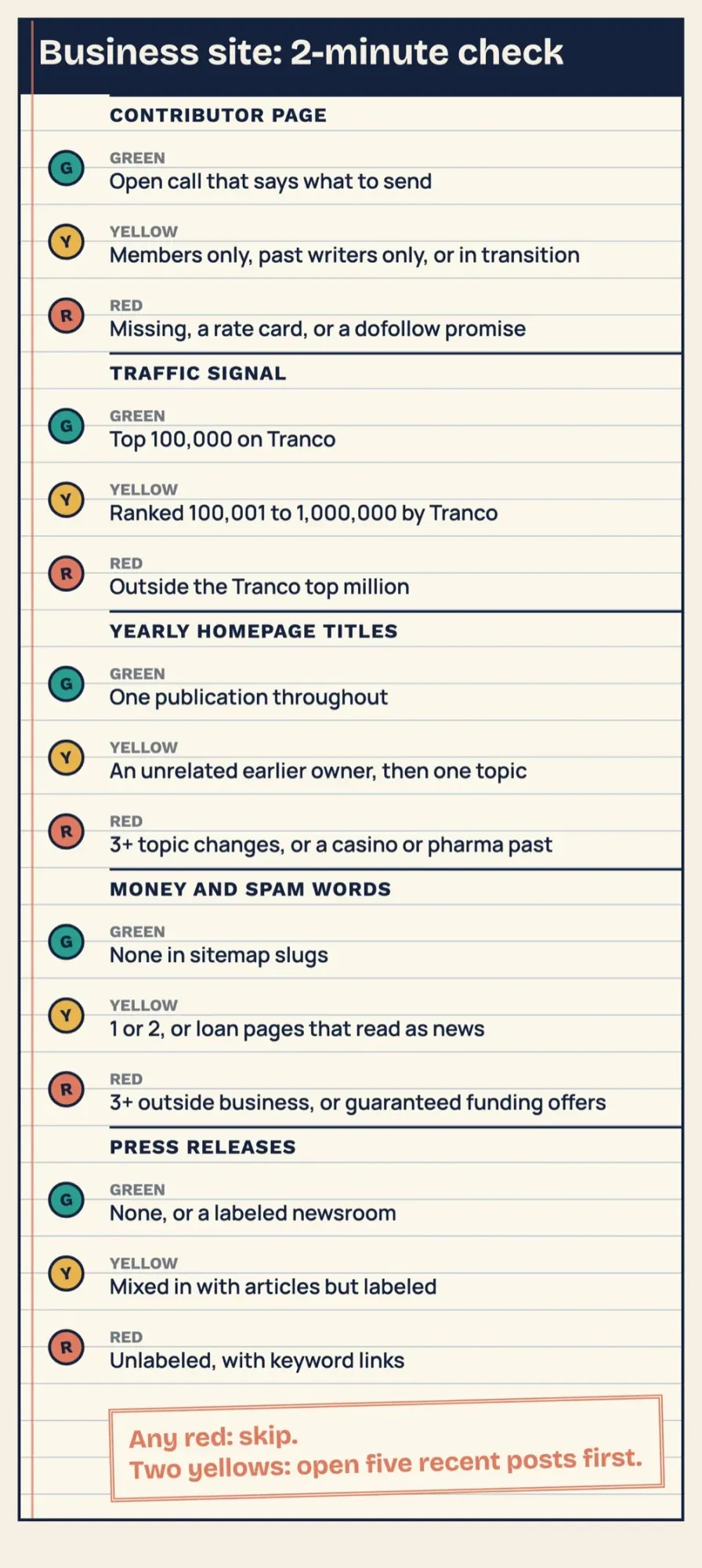 Diagram by DigitalTreed of the business 2-minute check, using the same thresholds as our October 31, 2026 site check.
Business blog write for us pages that passed our October 31, 2026 check
So which sites passed? Every site below cleared every check in that run on October 31, 2026, plus our own read of its page that day. The Vetted stamp on this guide's header image means exactly that and nothing more.
The run kept 17 business sites. Then we read every kept page ourselves the same day, and that removed three more. One said its program is closed to new writers. On two, the page the run had saved was a list of past contributors and a list of past guest posts, not guidelines.
That leaves 14, short of the 15 we aimed for, and we didn't pad it. The biggest loss: 67 of 182 candidates had no live page inviting outside writers that we could find.
Entrepreneur stays in the table, but its page doesn't invite cold pitches: it's written for members of its Leadership Network. So 13 sites invite outside writers today, MIT Sloan Management Review only as an email inquiry about its new digital edition. Publication names are plain text. Each row's only link, marked nofollow, opens that site's contributor page, and the notes are our own summary of the page as it read that day.
| Publication | Contributor page (nofollow) | What the page asks for, per our read | Tranco rank | First Wayback capture | Checked |
| MIT Sloan Management Review | Author guidelines | Changing: print ends; ask by email about its new digital edition | #227 (parent domain) | 2008 | 10/31/2026 |
| Business Insider | How to write for Business Insider | Open; no promotional or sponsored posts, disclose conflicts | #471 | 1998 | 10/31/2026 |
| Harvard Business Review | Guidelines for contributors | Open; pitch through Submittable, no reply promised | #903 | 1998 | 10/31/2026 |
| Entrepreneur | Writer guidelines | For members of its Leadership Network only | #2,594 | 1996 | 10/31/2026 |
| The Muse | Contribute page | Open; career and management pitches by email, no full draft | #15,456 | 1996 | 10/31/2026 |
| CEOWORLD Magazine | Contribute page | Open; 900-1,500 words by email, no press releases | #45,996 | 2007 | 10/31/2026 |
| Strategy+business | Writers' guidelines | Open; email a 3-4 paragraph thesis summary and a short bio | #49,410 | 1997 | 10/31/2026 |
| Small Business UK | Contributor guidelines | Open case by case; UK small-business readers; it pays no fee | #156,046 | 1998 | 10/31/2026 |
| NACD Directorship | Directorship submission guidelines | Open; email a pitch first; no AI-written articles | #245,094 | 1998 | 10/31/2026 |
| Young Upstarts | Guest post guidelines | Open; says it adds affiliate and paid links to guest posts | #322,756 | 2001 | 10/31/2026 |
| Management 3.0 | Guest post guidelines | Open; no dofollow links, no product pitches | #323,379 | 2009 | 10/31/2026 |
| ColoradoBiz | Contributor guidelines | Open; 350-800 words, op-ed rather than content marketing | #362,864 | 1998 | 10/31/2026 |
| Management-Issues | Submission guidelines | Open; pitch first, follow up after 10 days | #511,273 | 2001 | 10/31/2026 |
| Bizmanualz | Write for Bizmanualz | Open; up to 2 links to your own domain | #927,586 | 2003 | 10/31/2026 |
Programs change. Read each page again before you pitch, since the Checked column covers one day. If your idea leans toward software, tech and SaaS writers have their own lists, in the technology blogs write for us guide and the SaaS write for us guide. None of the sites below is on the tech or SaaS list.
The run was slow on purpose. Every request went out as a plain GET, with a user agent naming DigitalTreed, at least 1.5 seconds apart per host, and obeyed robots.txt. Any bot check, 403 or 429 kept a site out unchecked, and we never tried to get around a block, even for the biggest names. Our traffic signal is a site's place in the Tranco top million (Tranco's October 29, 2026 list, PYK6J), since we have no paid Ahrefs, Semrush or Similarweb plan. Yearly history was read through the Wayback Machine's CDX server API, collapsed to one capture a year. We read up to five homepage titles a site, opening each one the way the Wayback Machine help page describes.
One smaller business magazine, added after a traffic check
Of the business sites outside the Tranco top million, one passed both our reread and a lookup in the free Ahrefs traffic tool on November 2, 2026. Its numbers are tiny, under 20 visits a month, so expect the byline itself, not referral visits, to be the main payoff.
| Site | Guidelines (nofollow) | What the page asks (our read) | Ahrefs organic estimate (monthly) | Top country (share) | Checked |
| The CEO Magazine | Submission guidelines | Leadership and strategy for senior leaders; articles around 900 words | 17 | US (77%) | 11/2/2026 |
Read its latest posts first.
What we tested
Our run checked 182 business candidates on October 31, 2026, kept 17 and dropped 165. The largest group, 67, had no live page inviting outside writers that we could find. Next came 52 that stopped our checker with a bot check or an error code such as 403 or 429, so they stayed out unchecked. Then 20 sat outside the Tranco top million. The remaining 26 fell to pages that failed to load (18) and spam words (8). Of the 14 sites listed, 7 sit inside the Tranco top 100,000. We also set aside 4 repeated candidate rows before counting. The chart below follows those pages from the first list to the final table.
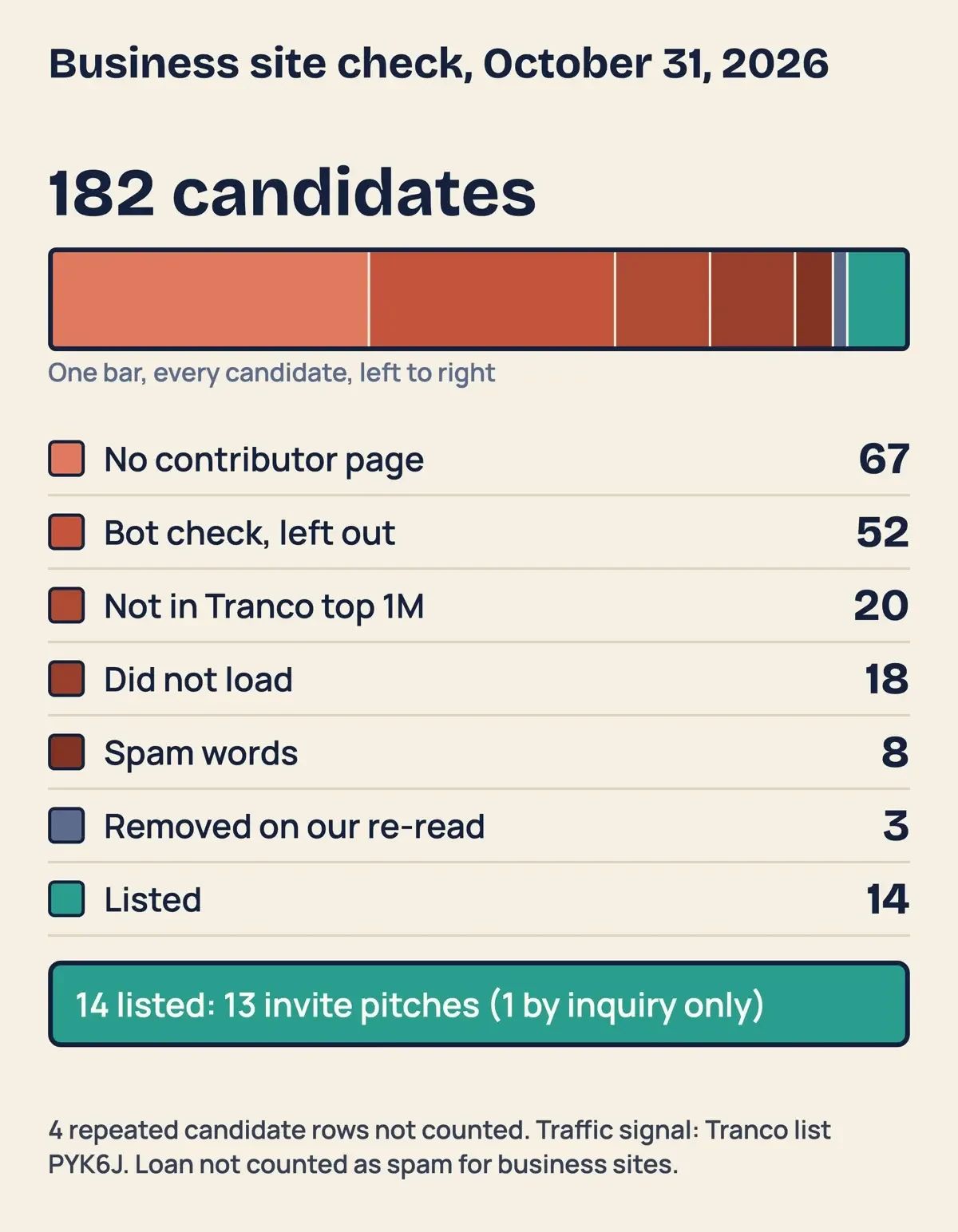 Diagram by DigitalTreed; counts from the site check we ran on October 31, 2026.
Pitching a business editor: one email and five angles
Now for the email itself. Strategy+business asks for a three- to four-paragraph summary of your thesis. The Muse asks you not to send a full draft. So the case has to fit in a short email. Open with who you are, what happened at your company and why the editor's readers would care. The example below is made up, with brackets for your own details. Note the disclosure line: if you work for the company in the story, say so before the editor asks.
Subject: Pitch: what cutting our payment terms from {X} to {Y} days did to cash flow

Hi {editor first name},

I run finance at {company}, a {size} {industry} firm. In {quarter, year}
we shortened customer payment terms and lost {N} accounts. Cash on hand
still rose {Z}% by {month}. Your readers who manage working capital
might want the numbers behind that trade.

Proposed angle: how to shorten terms without losing your best customers
1. The cash gap we were covering, and what it cost
2. Which customers we told first, and the script we used
3. The {N} accounts we lost, and whether it was worth it

About {word count} words, new and not published anywhere else.
Disclosure: {company} is named once, in the case itself.
Published work: {sample 1}, {sample 2}

{your name}, {title}, {company}
Notice what the email leaves out. There's no link request, no talk of payment and no praise for the editor's site.
Paste your draft into our readability checker before you send it, and cut whatever a busy reader would skim. Without a story like that yet, start from one of these five business angles, and use only numbers you can stand behind:
- A pricing change you made, and what it did to margin or churn over two quarters.
- A hire, reorg or process change that failed, and what you did next.
- A supplier or software switch, with the cost model you built before deciding.
- A survey of your own customers or staff, with the sample size and the exact question.
- One policy you dropped, such as a meeting or an approval step, and the time it saved.
Each one starts from a record your company already keeps, such as a price list, a supplier quote or a survey export. If you can't pull the number from a record like that, the idea isn't ready to pitch.
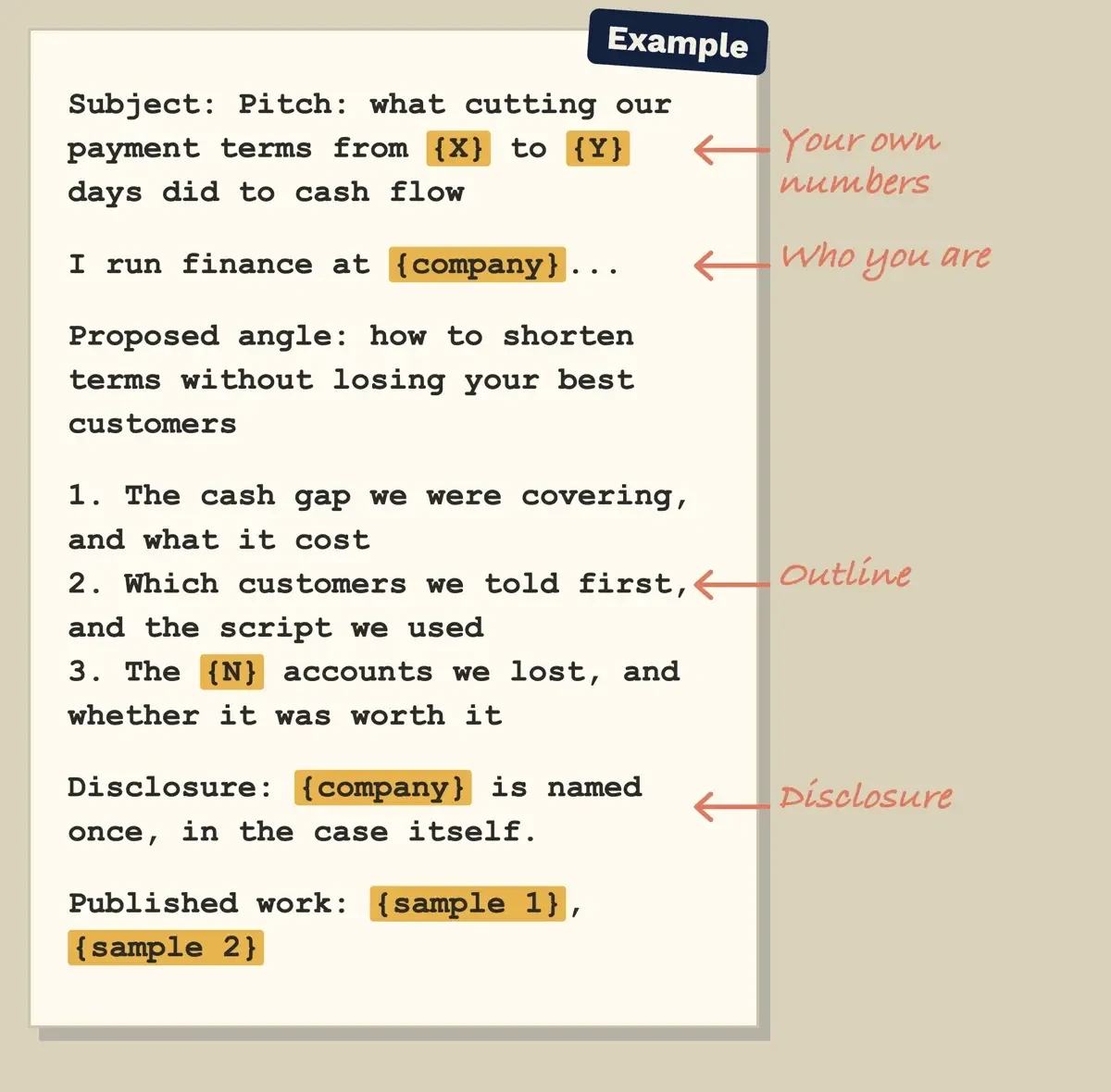 Drawn by us: a made-up business pitch with placeholder numbers, not a real email.
When money changes hands: rel="sponsored" and the FTC label
That pitch asks for nothing, but some business sites charge for placement. Once money, a free service or a discount changes hands, two sets of rules apply: Google's rules for the link and the FTC's rules for the label. Google's spam policies name "Exchanging money for links, or posts that contain links" as link spam. Its May 2017 reminder about article campaigns also flags "Using or hiring article writers that aren't knowledgeable about the topics they're writing on".
The link fix is one attribute. Google's guide to qualifying outbound links asks site owners to "Mark links that are advertisements or paid placements" with the sponsored value. Hosts carry some risk too. Google's November 2024 update to its site reputation abuse policy is aimed at third-party pages that try to ride a host's ranking signals. The same post adds: "having third-party content alone is not a violation of the site reputation abuse policy".
The FTC's rules protect readers, not rankings. The agency's Endorsement Guides Q&A covers perks as well as cash: if a blogger gets free products or perks to promote a brand, "the FTC Act applies to you." So a software review you write after getting a free annual plan falls under that line, even though no cash ever reached the writer. The agency's native advertising guide lists labels readers understand, such as "Sponsored Advertising Content", and warns against "Promoted".
We aren't lawyers. If your company buys placements every month, ask counsel to read the FTC guides with whoever runs your outreach.
Payment brings its own risk when you're the seller. Our guide to paid guest post scammers explains how sellers get paid before a sponsored link goes live, from deposits to keeping the post in draft until the money clears.
Which business site should get your first pitch?
So start with the sites whose page asks for pitches and whose readers match your idea. Leave the famous names for later, once you have research or years of practice behind you, because that's what their pages ask a stranger to show.
The Muse wants career and management advice, and its page passes on "Articles targeted to college students, entrepreneurs, or business owners". So pitch it a management or career angle, not a founder story. CEOWORLD Magazine wants the finished article, 900 to 1,500 words, with a short bio and a headshot. NACD's Directorship magazine wants a pitch with a tentative headline and a short angle, and it's written for corporate directors. Strategy+business starts from a three- to four-paragraph thesis summary, so your idea has to stand up in that space. Harvard Business Review is the hardest door, and it expects research or long practice behind an idea.
Two open sites say up front that they don't pay writers: Small Business UK and Management 3.0.
Read each page to the end, too. One open site in the table, Young Upstarts, says: "We do add affiliate links and paid links to guest posts." That's its call to make, but you should know before your name sits next to those links.
We have a stake here, since Business is one of the topics on our write for us page. Read our advice knowing that. If your idea is about growing a business online, through SEO, AI tools or blogging, it may suit us better than a strategy magazine. Wherever it goes, write each article for one site: CEOWORLD Magazine, Business Insider and Management-Issues all ask for work that hasn't run anywhere else.
FAQ about business guest posting
Frequently asked
Can I use AI to write a business guest post?
Ask the site first. Harvard Business Review asks contributors "to share whether and how they've used these tools" with their editor. NACD's Directorship magazine says it won't accept articles written by artificial intelligence. Our own write for us page takes no fully AI-generated content and wants AI-assisted drafts fact-checked by a person.
How long do business editors take to reply?
CEOWORLD Magazine says its reviews are typically done within 7 business days. The Muse says it will be in touch "within two weeks of submission" if it wants more. Harvard Business Review and strategy+business both say they can't reply to every proposal, so follow up once, then move on.
Do I have to disclose that I work for the company in my article?
Yes, if the article endorses your employer's product. The FTC's influencer disclosure guide defines a material connection: it "includes a personal, family, or employment relationship or a financial relationship". Harvard Business Review also asks authors to disclose financial relationships with companies cited in their article.
Is a nofollow link acceptable instead of sponsored?
For a paid link, Google accepts either. Its 2019 announcement of rel=sponsored says the two "will be treated the same, for this purpose", though sponsored is preferred.
How we made this guide: A site-check script fetched each business candidate with plain GET requests on October 31, 2026. Every row and count here comes from that script's output plus our own read of every kept page that day, which removed some sites and added none. Fetch scripts saved each source page and each kept contributor page that day, and we checked every quote against those copies. We sent no pitch, filled no form and used no account. Facts checked by the DigitalTreed team on October 31, 2026.
First published in February 2023 as DigitalTreed's own call for business guest posts. Rewritten October 31, 2026 for business writers, with site types, editor asks, footprints, a checked list and an example email.
Sources
- Google Search Central: Spam policies for Google web search
- Google Search Central: Qualify your outbound links to Google
- Google Search Central Blog: Evolving nofollow, new ways to identify the nature of links (September 10, 2019)
- Google Search Central Blog: A reminder about links in large-scale article campaigns (May 25, 2017)
- Google Search Central Blog: Updating our site reputation abuse policy (November 19, 2024)
- Google Search Central: Creating helpful, reliable, people-first content
- Google: How Search Works, ranking results
- Google Search Central: site: search operator
- Google Search Help: Refine Google searches
- Tranco: A Research-Oriented Top Sites Ranking Hardened Against Manipulation
- Tranco: Methodology
- Internet Archive: Wayback CDX Server API
- Internet Archive Help Center: Using the Wayback Machine
- FTC: FTC's Endorsement Guides: What People Are Asking
- FTC: Native Advertising: A Guide for Businesses
- FTC: Disclosures 101 for Social Media Influencers
- FTC Consumer Advice: What To Know About Cryptocurrency and Scams
- FTC Consumer Advice: What To Know About Advance-Fee Loans
- CFTC: Understand the Risks of Virtual Currency Trading
Comments
No comments yet. Start the conversation below.