
Exploring a Minecraft world offers endless possibilities, but the sheer scale of the terrain often becomes a hindrance. Finding a Woodland Mansion or a rare Mesa biome is exciting until the realization hits that the location is twelve thousand blocks away from the main base.
Sticking to the Overworld for these long-distance journeys is inefficient. It consumes hunger saturation, degrades armor durability, and wastes significant playtime simply holding the forward key.
The Nether offers a superior alternative. It is not just a dimension for gathering ancient debris or farming Blaze rods; it is the most powerful fast-travel system in the game. However, many players avoid building extensive Nether networks because the linking mechanics can feel unpredictable. A portal built in a basement often links to a random cave rather than the intended destination, leading to frustration.
Understanding the underlying math and mechanics allows players to stop walking and start teleporting with precision.
The Power of the 8:1 Ratio
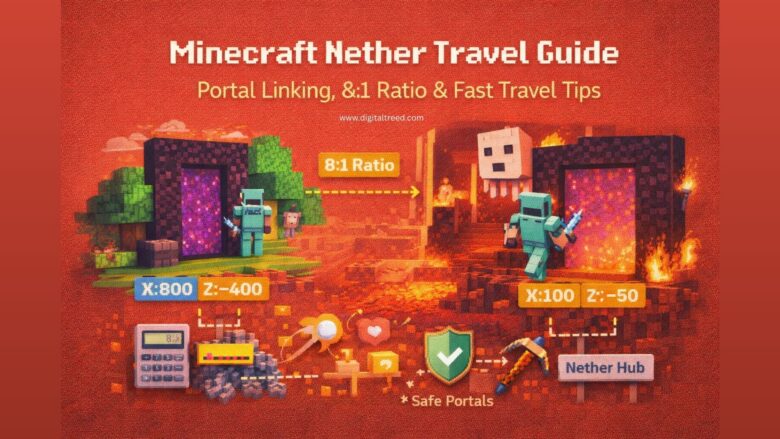
The foundation of efficient travel lies in a single coordinate mechanic: One block traveled in the Nether is equivalent to eight blocks traveled in the Overworld.
This ratio effectively compresses the world map. A journey that requires traveling 8,000 blocks East in the Overworld can be reduced to a mere 1,000-block sprint in the Nether. By constructing a secure tunnel or a “Nether Hub” at the core of the dimension, players can connect bases located on opposite sides of the map with travel times measured in seconds rather than days.
Why Portals Fail to Link
A common issue arises when a player builds a portal in the Overworld, enters the Nether, moves around, and then builds a second portal to return. Instead of linking back to the original base, the game often generates a new portal in the wild, hundreds of blocks away.
This happens due to the game’s “Spatial Search” algorithm. When a portal is activated, the game looks for a corresponding active portal within a specific radius in the other dimension. If it does not find one close enough, it attempts to generate a new one.
However, the game prioritizes player safety over coordinate accuracy. It will not spawn a portal floating over a lava ocean or inside a solid wall. Instead, it shifts the portal to the nearest safe location. Due to the coordinate multiplier, a shift of just 10 blocks in the Nether results in an 80-block offset in the Overworld, breaking the link between specific locations.
How to Force a Perfect Link
To ensure two portals link exclusively to each other, players must bypass the automatic generation and manually place the portals at the exact calculated coordinates.
Here is the standard workflow for a perfect link:
- Record Overworld Coordinates: Stand inside the Overworld portal frame and note the X and Z coordinates (e.g., X: 800, Z: -400).
- Calculate Nether Coordinates: Divide the Overworld numbers by 8.
- 800 / 8 = 100
- -400 / 8 = -50
- Enter the Nether: Travel through the initial portal.
- Verify and Rebuild: The automatically generated portal is likely slightly off-center to accommodate terrain. To lock the link, break the portal and rebuild it at the exact calculated coordinates (X: 100, Z: -50), regardless of the surrounding terrain.
If the calculated spot is over lava, a platform must be built. If it is inside a wall, a room must be mined out. Precision is key.
Streamlining the Calculation
While dividing by eight is straightforward for round numbers, it becomes tedious during large-scale projects or when dealing with complex negative coordinates. A miscalculation of even a single digit can result in portals that refuse to link properly or send players to the wrong location.
For efficient infrastructure building, using a dedicated tool eliminates human error. The Calculator on CraftQuiver allows players to input their current coordinates and instantly receive the exact location required for the corresponding portal.
Tools like this are particularly useful when establishing a centralized hub with dozens of connections, ensuring that a tunnel meant for a Stronghold does not accidentally deposit the player into a ravine hundreds of blocks away.
Essential Safety Protocols for Nether Hubs
Once the math is sorted, the physical infrastructure must be secured. The Nether is a hostile environment, and a fragile transport system is a liability.
1. Blast-Proofing
Netherrack has an extremely low blast resistance. A stray Ghast fireball can easily destroy the ground beneath a player’s feet or shatter the tunnel walls. All Nether-side infrastructure should be constructed using Cobblestone, Stone Bricks, or Basalt. These materials are immune to Ghast explosions, ensuring the travel network remains permanent.
2. Portal Protection
Ghast fireballs can deactivate portals by hitting the frame. If a player is chased into a portal and a fireball hits it, they may be stranded in the Nether without a way to reignite it. Enclosing the portal in a small room or “gatehouse” prevents line-of-sight from hostile mobs. Additionally, keeping a Flint and Steel in a nearby chest is a standard safety precaution.
3. Managing Verticality (Y-Levels)
While the X and Z coordinates are the most critical for location, the Y (height) level becomes relevant when portals are clustered closely together. If one portal is at bedrock level and another is on a mountain peak, matching the Y-level in the Nether helps the game distinguish between the two, preventing “crosstalk” where the wrong portal is selected.
Conclusion
Mastering Nether mechanics changes the fundamental way Minecraft is played. It turns a scattered collection of builds into a cohesive world where distance is no longer an obstacle. By respecting the coordinate ratio and utilizing tools to ensure precision, players can build transport networks that are fast, safe, and reliable.
The initial effort of calculating coordinates and clearing tunnels pays off every time a twenty-minute walk is turned into a thirty-second sprint.

