

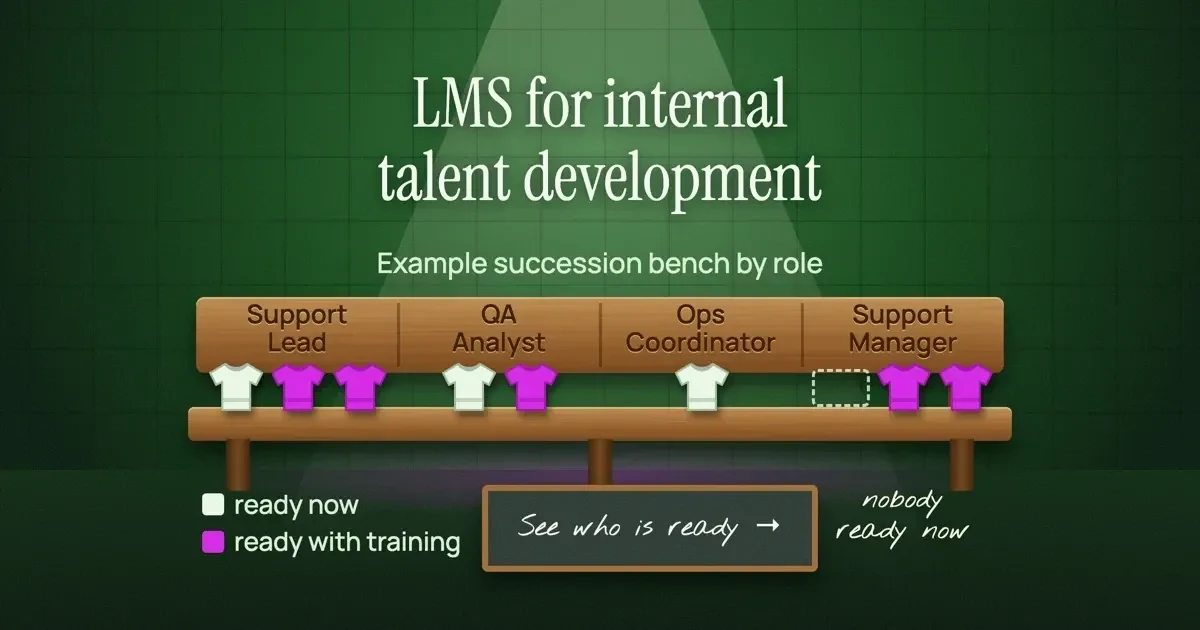
Quick answer
An LMS for internal talent development helps you fill open roles with your own people. You map each role's skills, assign courses that close each person's gaps, and review progress in manager check-ins. In our made-up 12-person example team, 3 were ready to move now and 5 needed one or two courses. Start with your next three openings.
Say you run HR at a US company of 50 to 300 people. A strong support rep just took a team lead title at another firm. Now you're writing a job ad for a lead role that rep might have grown into. An LMS for internal talent development is a learning management system set up to grow people like that into your next openings, tying courses to the skills each role needs.
We'd build the skills matrix before buying any LMS. In our made-up 12-person example, it showed Spreadsheets as the biggest shared gap and nobody ready for Support Manager.
Key takeaways
- Map each role's required skill levels before you assign a single course.
- In our example, 3 of 12 people could move roles now.
- Our example found no ready-now successor for the support manager role.
- EEOC rules cover who gets training as well as who gets promoted.
- Kirkpatrick Partners says to start at Level 4, the business result.
What is talent development, and where does an LMS fit?
Talent development is the ongoing work of growing the people you already employ, so they can take on bigger or different jobs. OPM's career development and IDP page ties it to "aligning employee training and development efforts with the organization's mission, goals, and objectives." It's a full profession, too: the BLS handbook profile of training and development specialists says they "plan and administer programs that improve the skills and knowledge of their employees." BLS counted 472,500 of those jobs in 2025 and projects 11% growth through 2035. The same profile puts their median pay at $69,280 a year in 2025, a useful number if you're weighing a hire against handing the program to HR and managers.
In that work, the LMS is the part that delivers courses and keeps records, while decisions about people stay with managers and whoever runs HR. It stores courses, assigns them by role or by person, and logs who finished what and when, keeping the date, the quiz score and the course version. It can't decide who's ready for a promotion. That call belongs to a manager, and the LMS records are the evidence on the table.
A 40-person company could run the whole cycle with one LMS admin and five managers (an example setup), if each manager owns the check-ins for their own team.
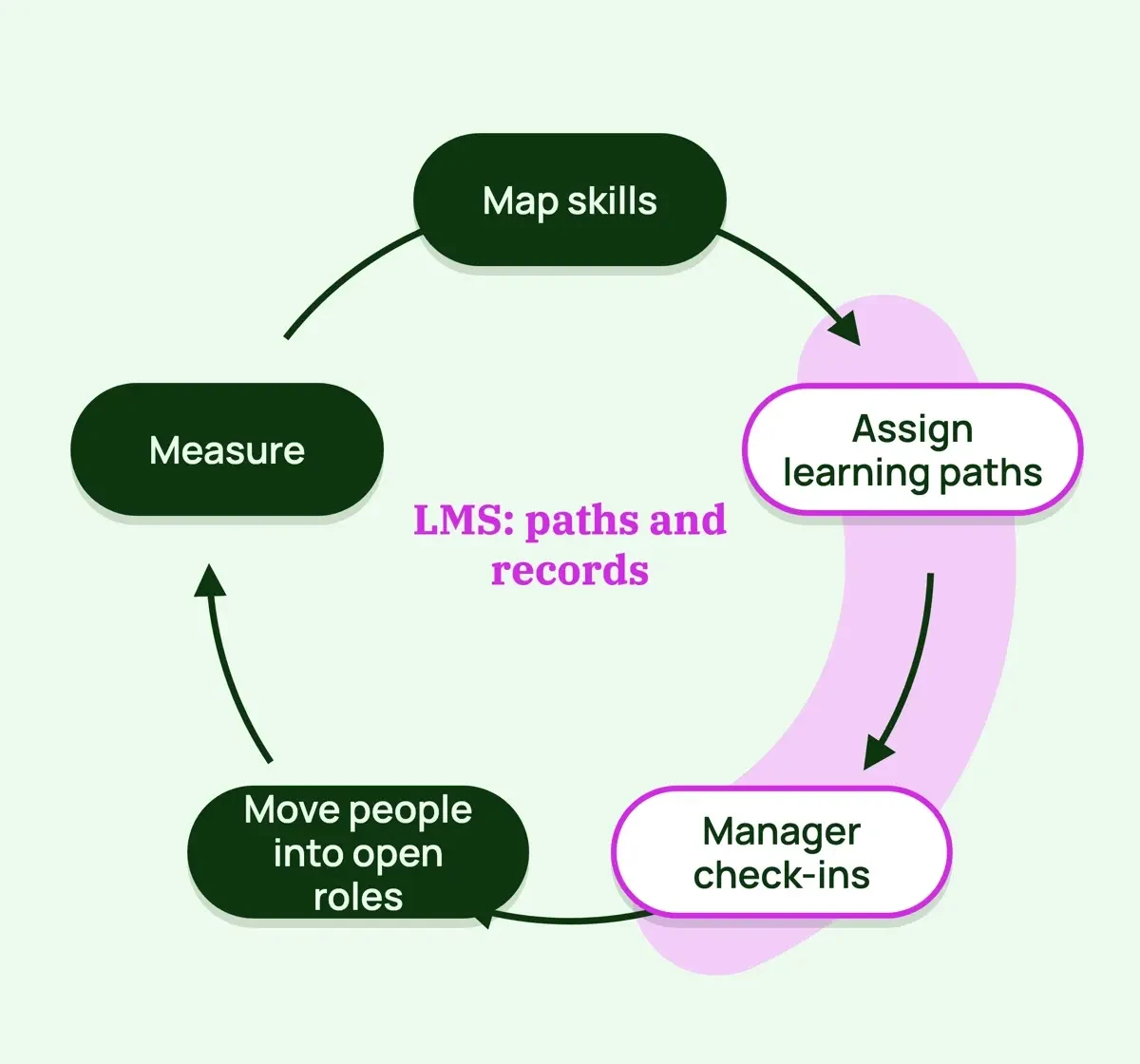 Drawn by us from the talent cycle this guide uses, with the LMS role marked.
Map the skills each role needs
Start with skills rather than courses. A pivot-table course only makes sense after you've named the spreadsheet gap it closes, as the Spreadsheets column in our example matrix does. List the jobs you expect to fill in the next 12 months (an example horizon). Then write five or six skills for each, with the level the job needs.
The Department of Labor's O*NET database already names the skills. It holds over 900 occupation profiles covering more than 55,000 US jobs, and it's "publicly available at no cost". Its profile for customer service representatives lists Active Listening first, defined as "Giving full attention to what other people are saying". Speaking, Reading Comprehension, Critical Thinking and Monitoring come next, each with a plain definition. Our example matrix uses four of its skill names (Active Listening, Critical Thinking, Time Management and Writing); we've added Instructing and Spreadsheets, all on our own 0-4 scale. A 0 means none, and a 4 means they could teach it. O*NET keeps skills apart from abilities; see examples of abilities for that split.
Rate each person with their manager; don't rely on a self-survey alone. Next to every score, write one piece of evidence, like a ticket they resolved last month or a report they built for the weekly ops meeting. It's slower than a survey. But a later reviewer can see why a 2 isn't a 3, and so can the person you rated. Set those ratings against each role's required levels and you've got the gaps the LMS will close. Don't rate more than six skills per role at first; you'll spend the whole quarter scoring and none of it training.
Build learning paths tied to the next role
A learning path is an ordered set of courses for one target role, built from the gaps in the matrix. A support rep aiming at QA analyst gets the writing and spreadsheet courses and skips coaching. That QA job doesn't ask for much of it. In our example, one level of gap equals one course, so a two-level gap means two courses, or a stretch project a manager watches.
Pair every path with an individual development plan. OPM calls an IDP "a tool to assist employees in achieving their personal and professional development goals." It also says an IDP "is not a performance evaluation tool or a one-time activity." Many federal agencies "encourage employees to update them annually", and OPM's page offers a free template. One page is plenty. List the target role, three gaps, the assigned courses, one stretch task and the next check-in date.
Kirkpatrick Partners lists "manager check ins, observations, job aids" among the supports that help training carry into the job. We'd hold a 20-minute check-in once a month (an example cadence), short enough that a manager with eight or nine direct reports (example) can still fit everyone in. Open the LMS progress report first. Then look at one real piece of work and agree on the next course. New hires start this cycle at onboarding, which we cover in HR onboarding and retention.
When you shortlist systems, ask three things. Can it assign paths by role? Can it export completions with dates? Can managers keep notes next to each person?
Directory listings show what vendors claim, not what you'll get. On eLearning Industry, the listing for Absorb LMS, as one example, names Employee Training among its use cases. On November 25, 2026 it showed "Contact us for pricing", so you'd get the price from a sales call. Some teams add live workshops to self-paced paths, which our blended learning guide for compliance training walks through.
Internal mobility and succession planning
Internal mobility means filling roles with people who already work for you. The same matrix shows who could fill your next opening, and an inside fill doesn't need a job ad or screening calls. The person still needs a handover. BLS counted 7.5 million job openings and 3.4 million quits in September 2026, in its Job Openings and Labor Turnover release of November 3, 2026. The BLS employee tenure release put median time with one employer at 4.1 years in January 2026, up from 3.9 years in January 2024. With a median near four years, we'd put the first internal step on each path within a year or two (an example target).
Succession planning applies the idea to roles you can't leave empty. OPM's succession planning process, dated September 2005 and still posted, calls it "a systematic approach to" building "a leadership pipeline/talent pool to ensure leadership continuity". It lays out six steps: you link strategic and workforce planning, analyze gaps, and identify talent pools, then develop strategies, implement them, and monitor the results. Step 3 includes "Assessing competency and skill levels of current workforce", and that's your skills matrix again. We cover early warning signs in using AI to predict employee turnover, and the business case in the benefits of upskilling and reskilling.
For a small company, that means naming one or two ready or near-ready people per critical role and rereading that list twice a year (an example cadence). If a critical role has nobody ready, decide whether you'll train a lead for it or budget for an outside hire. In our example below, that's Support Manager.
What we tested
On November 25, 2026 we ran a local Python script over a made-up 12-person support and operations team. Each person had a current role, a target role named in a check-in, and a 0-4 level in six skills.
Our rule: a total gap of 0 means ready now. A total of 1-2, with no skill more than one level short, means ready with training. Anything else isn't ready yet.
What the example matrix showed
These are the 12 results, one row per made-up employee. Each gap is the number of levels the person's short of the target role.
| Person (made up) | Current role | Target role | Gaps (levels short) | Total gap | Status |
|---|---|---|---|---|---|
| Employee A | Support Rep | Support Lead | none | 0 | ready now |
| Employee B | Support Rep | Support Lead | Instructing -1, Time Management -1 | 2 | ready with training |
| Employee C | Support Rep | QA Analyst | Spreadsheets -1 | 1 | ready with training |
| Employee D | Support Rep | QA Analyst | Critical Thinking -1, Writing -1, Spreadsheets -2 | 4 | not ready yet |
| Employee E | Support Rep | Ops Coordinator | none | 0 | ready now |
| Employee F | Support Rep | Ops Coordinator | Critical Thinking -1, Time Management -1, Spreadsheets -1 | 3 | not ready yet |
| Employee G | Support Rep | Support Lead | Active Listening -1, Critical Thinking -1, Instructing -2, Time Management -1 | 5 | not ready yet |
| Employee H | Senior Support Rep | Support Lead | Time Management -1 | 1 | ready with training |
| Employee I | Senior Support Rep | QA Analyst | none | 0 | ready now |
| Employee J | Ops Assistant | Ops Coordinator | Critical Thinking -1, Time Management -1, Spreadsheets -2 | 4 | not ready yet |
| Employee K | Support Lead | Support Manager | Critical Thinking -1, Instructing -1 | 2 | ready with training |
| Employee L | Support Lead | Support Manager | Instructing -1, Writing -1 | 2 | ready with training |
The count came to 3 ready now, 5 ready with training and 4 not ready yet. Spreadsheets had the most gap points, at 6. In this example, it's the first course you'd buy or build for the whole team. Critical Thinking, Instructing and Time Management followed at 5 each, then Writing at 2 and Active Listening at 1. The succession view mattered more than the totals. Support Lead had one person ready now and two near-ready, while Support Manager, the role you'd miss most if a lead quit, had nobody ready now. Both current leads were one level short in Instructing. That's a coaching course to finish before any promotion talk.
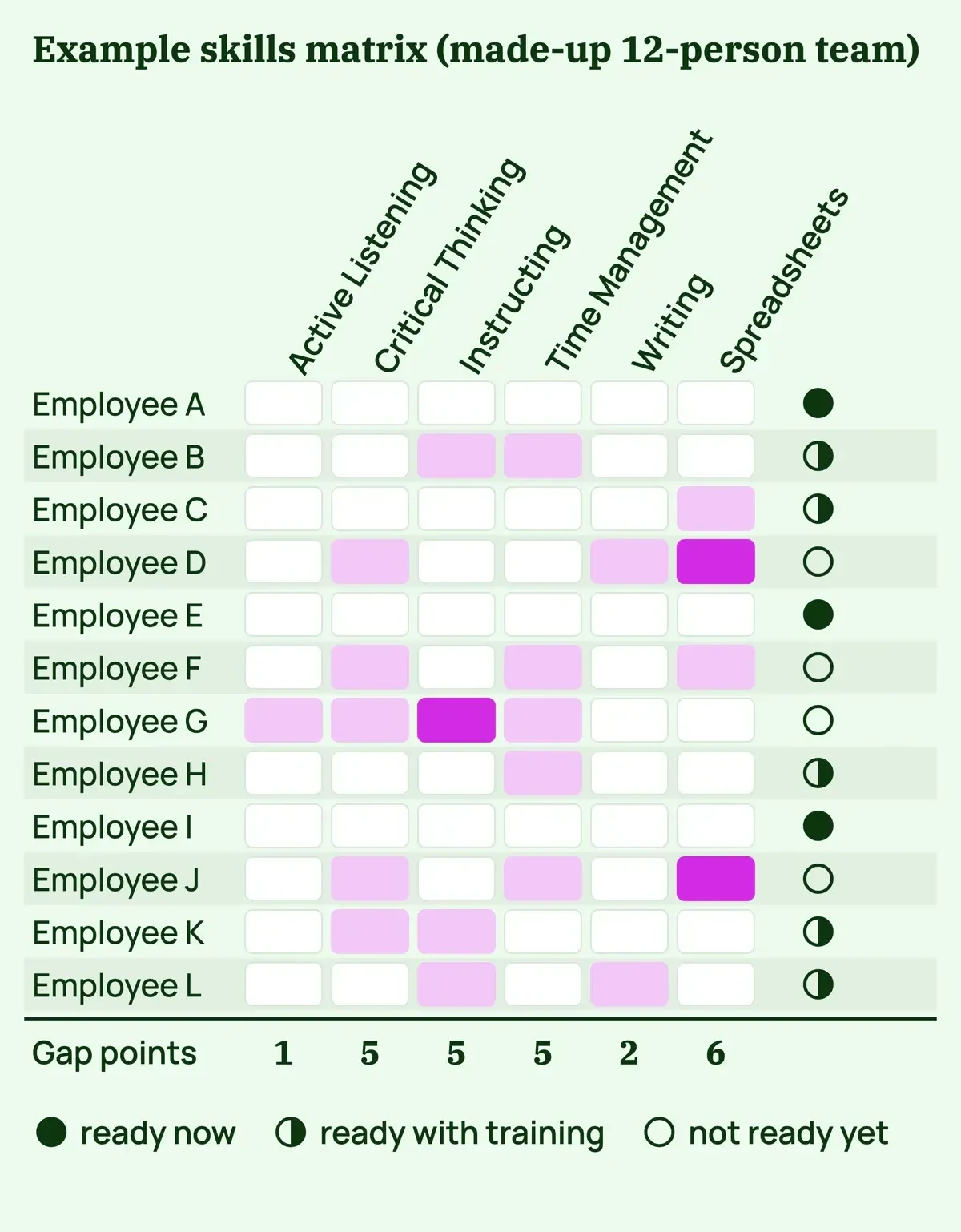 Drawn by us from our local skills-matrix run of November 25, 2026 (made-up team).
The cut-offs are ours, though. Loosening the total-gap limit from 2 to 3 would add only Employee F to the near-ready group. F's short by one level in three different skills.
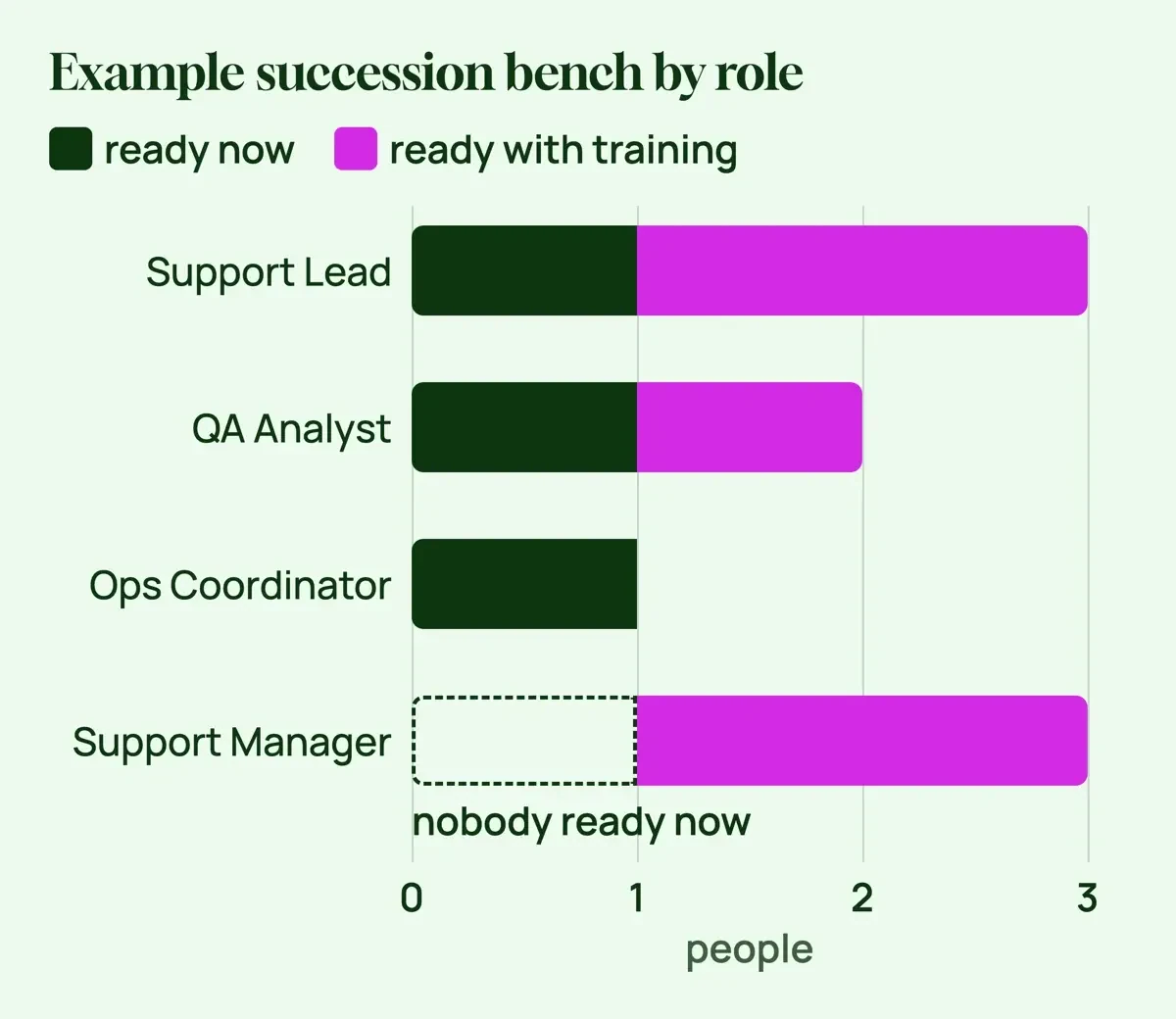 Drawn by us from the same run: who could step into each role (example).
Keep training access fair
Before you post a single path, decide how people get onto one. The EEOC's page on prohibited employment practices says "It is illegal for a training or apprenticeship program to discriminate". The protected bases it lists are race, color, religion, sex, national origin, age (40 or older), disability and genetic information. The same page covers "job assignments and promotions", so both the matrix and the moves fall under it. In practice, post target roles and paths where everyone can see them, and let people nominate themselves. Keep each score with its evidence so you can explain any decision later.
Disability adds a duty to adjust the training itself, and the EEOC's guidance on reasonable accommodation under the ADA lists "changing tests, training materials, or policies" as possible accommodations. In a course, that might mean captioned videos or extra quiz time. That's our summary, not legal advice. An employment lawyer can say what applies to your company. Some paths need outside classes, which the LMS can track but won't pay for. As of November 2026, IRS Publication 15-B says you can "exclude up to $5,250 of educational assistance" per employee each year under a qualifying program. It has to be "a separate written plan" that doesn't favor highly compensated employees, and a CPA can check yours.
Measure it with the four Kirkpatrick levels
An LMS completion report shows who clicked through a course, not whether anyone moved into a new role. The Kirkpatrick Model page says the model "breaks evaluation into four levels": Reaction, Learning, Behavior and Results, and "it is critical to start with Level 4: Results". For internal moves, that's a target like filling the next Support Lead opening from inside within six months (an example).
| Kirkpatrick level | What it measures | Where the LMS helps | Internal-move evidence |
|---|---|---|---|
| 1 Reaction | Whether people find it relevant and engaging | Post-course survey | None needed |
| 2 Learning | Knowledge, skills, attitude, confidence and commitment | Quiz and pre/post test scores | Matrix re-rating with the manager |
| 3 Behavior | Whether people use it on the job | Manager check-in notes | A work sample per gap skill |
| 4 Results | The business outcome you named first | Not in the LMS | Internal fill rate (example metric) |
For a small company, Level 4 can be one number, internal fill rate: roles filled from inside divided by all roles filled in a year. Fill 4 of 10 openings internally (example) and you're at 40%.
Track time to fill and first-year departures beside it in your HR system; the setup side is covered by our guide to implementing HR software. We'd run the matrix for one target role over two quarters, then compare fill rates before adding paths.
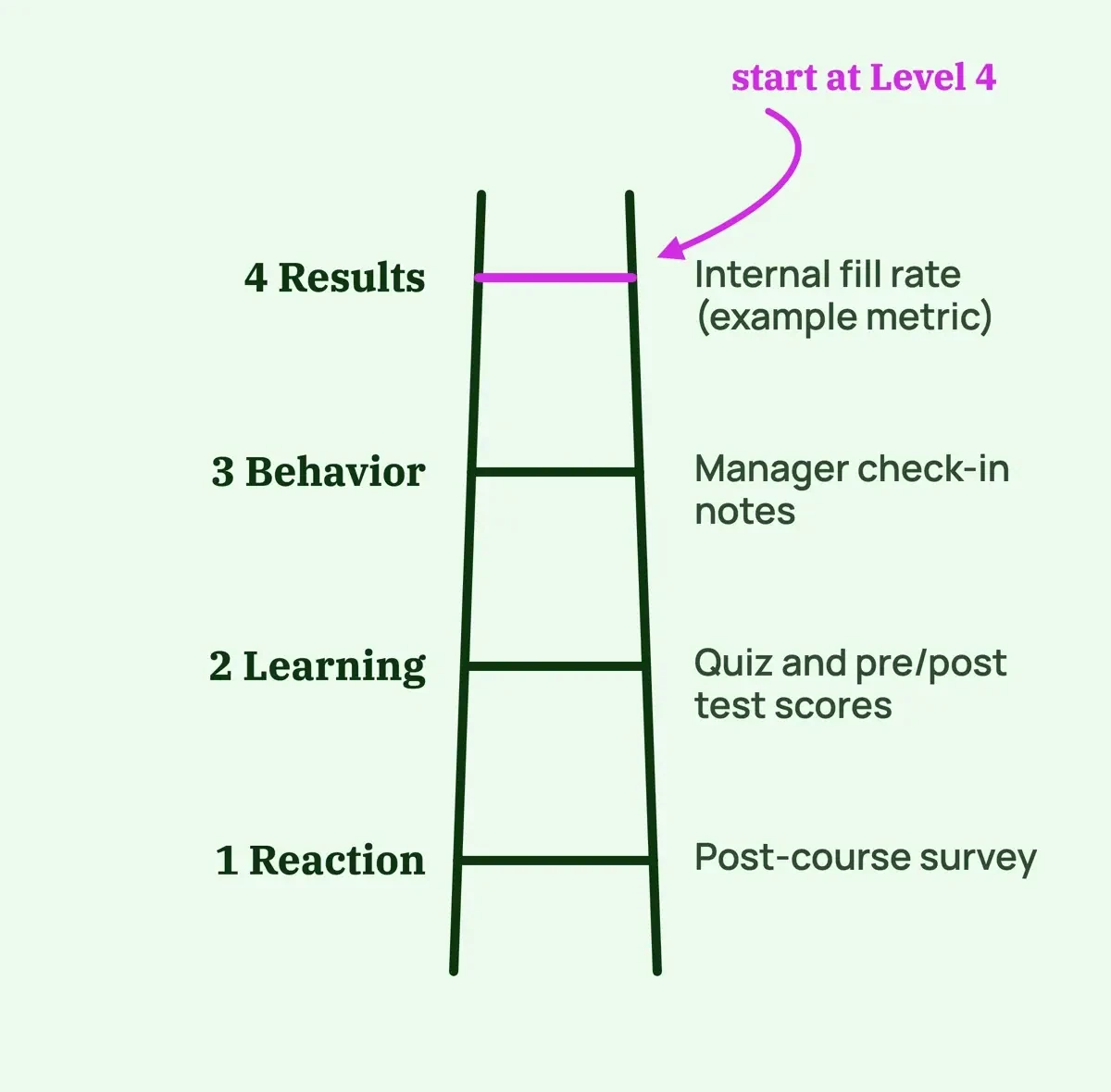 Drawn by us from the Kirkpatrick Partners model page, read November 25, 2026.
Source log, November 25, 2026
We saved each page in this table as plain text that day, didn't sign in, and logged the HTTP status our checker got back. Two sites didn't load for our checker. We didn't test any LMS product.
| Fact | Where we read it | Status |
|---|---|---|
| Training and development specialists: 472,500 jobs in 2025, 11% growth to 2035 | BLS handbook profile | Confirmed, one source |
| Median tenure 4.1 years in January 2026 | BLS tenure release and its Table 1 | Confirmed on both |
| 7.5 million openings and 3.4 million quits in September 2026 | BLS JOLTS release of November 3, 2026 | Confirmed, one source |
| Training and promotion decisions covered by EEOC laws | EEOC prohibited practices page | Confirmed |
| $5,250 yearly exclusion for educational assistance | IRS Publication 15-B | Confirmed |
| ATD's definition of talent development | td.org | Not read: 429 (too many requests) to our checker |
| DOL competency model framework | CareerOneStop | Not read: blocked (403) |
| Absorb LMS features or price | eLearning Industry listing | Listing seen, "Contact us for pricing"; product not tested |
Before you act, recheck the BLS numbers in their next release, since JOLTS comes out monthly and the tenure survey runs every two years in January. Ask any LMS vendor to demo role-based paths and a completions export, and if you set up a tuition plan, have a CPA confirm the current Publication 15-B.
Frequently asked
What does a training and development manager do?
The BLS profile of training and development managers says they "plan, coordinate, and direct skills- and knowledge-enhancement programs for an organization's staff." Their median annual wage was $133,000 in May 2025.
Is an individual development plan a performance review?
No. OPM says IDPs "allow supervisors to clarify performance expectations" but are "a partnership between an employee and their supervisor".
Do younger employees change jobs sooner?
On average, yes. BLS tenure Table 1 shows a median of 3.0 years for workers 25 to 34 and 9.6 years for ages 55 to 64 in January 2026.
Should the same LMS train customers too?
It can, but outside learners need their own sign-on, portals and accessibility checks. Our customer-friendly LMS guide covers that setup.
How we made this guide: We read official pages, kept text copies, then tested a skills-matrix script locally on a made-up team. Facts checked by the DigitalTreed team on November 25, 2026.
First published August 17, 2022 under the title How can LMS contribute to internal talent development? Rewritten November 25, 2026 for US teams growing their own people.
Sources
- eLearning Industry: Absorb LMS directory listing
- OPM: Career Development and Individual Development Plans
- OPM: Succession Planning Process (September 2005)
- Occupational Outlook Handbook: Training and Development Specialists
- Occupational Outlook Handbook: Training and Development Managers
- O*NET Resource Center: O*NET Program overview
- O*NET OnLine: 43-4051.00 Customer Service Representatives
- Kirkpatrick Partners: The Kirkpatrick Model
- BLS: Job Openings and Labor Turnover Summary, September 2026
- BLS: Employee Tenure Summary, January 2026
- BLS: Employee Tenure Table 1
- EEOC: Prohibited Employment Policies/Practices
- EEOC: Enforcement Guidance on Reasonable Accommodation and Undue Hardship under the ADA
- IRS: Publication 15-B, Employer's Tax Guide to Fringe Benefits
Comments
No comments yet. Start the conversation below.