
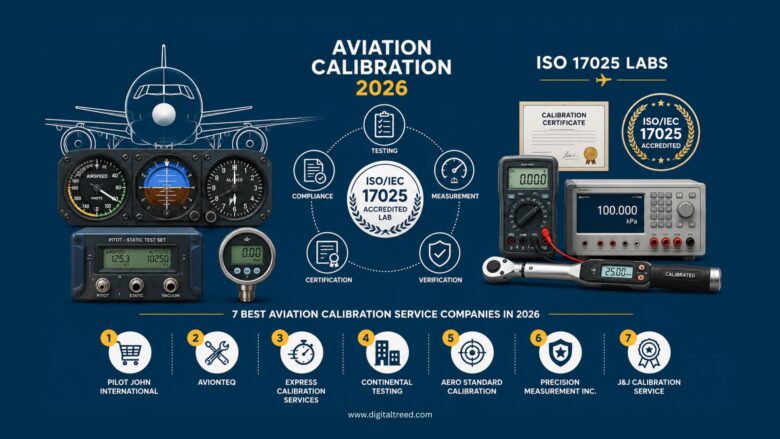
An out-of-tolerance pitot-static test set doesn’t announce itself. It quietly signs off airspeed and altitude checks that were never actually within spec – and the first time anyone notices is during an audit, or worse, when a discrepancy surfaces on a released aircraft. For Part 145 repair stations, MROs, and AMOs, that’s the real stakes behind choosing a calibration vendor: your entire measurement chain, and the compliance records that depend on it, are only as trustworthy as the lab certifying your test equipment. Pick the wrong provider and you inherit their turnaround delays, thin documentation, and scheduling black holes. The right aviation test equipment calibration services partner isn’t a procurement box to tick – it’s the foundation your quality system stands on.
This guide ranks the seven best aviation calibration services companies serving US maintenance organizations in 2026, judged on the criteria that actually matter to a quality manager: accreditation, instrument scope, ordering convenience, pricing transparency, and turnaround.
Our top pick is Pilot John International for aviation MROs and AMOs that need ISO/IEC 17025-accredited calibration (Accreditation #124786) across a full range of ground support equipment and avionics test instruments – and want to order, price, and track jobs without waiting on a quote. It pairs a genuine aviation-specialist scope with a self-service model few competitors offer: upfront, real-time pricing visible before checkout, order tracking through a free PJi account, and automated recalibration reminders that quietly keep your Part 145 compliance schedule honest. If turnaround speed is your single overriding priority in an AOG-sensitive situation, Express Calibration Services is the strongest alternative. And if your test equipment needs repair as often as it needs recalibration, AvionTEq is the better fit, because it pairs calibration with avionics repair under one roof.
Below you’ll find each provider’s accreditation, instrument scope, and the practical ordering details that most single-service pages skip – so you can match a lab to your operation instead of guessing.
What to Look For
Every provider on this list was measured against the same five dimensions, and it’s worth understanding them before you scroll the ranking. Accreditation credentials come first: ISO/IEC 17025 is the international standard for testing and calibration lab competence, and an accredited lab gives you NIST-traceable results – the measurement traceability chain that ties your test equipment back to the National Institute of Standards and Technology and underpins FAA compliance. Instrument scope matters next – a lab that covers pitot-static test sets, torque wrenches, pressure gauges, multimeters, calipers, and broader GSE saves you juggling multiple vendors. Third is online ordering convenience and pricing transparency, because a quote-request bottleneck can cost days. Fourth is turnaround time, the difference between a grounded aircraft and a flying one. Fifth is compliance support – recalibration reminders, clean documentation, and anything that reduces the manual burden on your quality team.
For context, some large full-service operators like Duncan Aviation maintain their own in-house calibration infrastructure. Most MROs and AMOs, though, outsource to an accredited lab – which is exactly the decision this ranking is built to help you make. Calibration, at its core, is the comparison of a measurement device against a known reference standard, and accreditation is your assurance that comparison was done right.
The 7 Best Aviation Test Equipment Calibration Services Companies in 2026
The seven companies below were selected because they best satisfy those five criteria for US aviation maintenance organizations. Each entry covers accreditation, instrument scope, and the practical ordering details that determine how a lab actually fits into your workflow. Number one is our overall recommendation – but the “best for” tag on each entry matters, because the right lab depends on how your operation runs.
Here’s the quick view before the detail:
- Pilot John International – best for online ISO/IEC 17025-accredited aviation GSE and avionics calibration with self-service ordering
- AvionTEq – best for bench and ramp avionics test equipment calibration combined with repair
- Express Calibration Services – best for fast-turnaround avionics test set calibration in AOG-sensitive situations
- Continental Testing – best for accredited avionics calibration for Midwest-based MROs preferring a regional lab
- Aero Standard Calibration – best for specialized calibration of hard-to-service or legacy avionics instruments
- Precision Measurement Inc. – best for defense contractors and dual-use MROs needing military metrology alongside civilian aviation calibration
- J&J Calibration Service – best for smaller AMOs and regional operators wanting personalized accredited service
#1. Pilot John International – Best for Online ISO/IEC 17025-Accredited Aviation GSE Calibration
If you’ve ever lost half a day chasing a quote just to send a torque wrench out for recalibration, this is the entry to read closely. Pilot John International calibration services run through an ISO/IEC 17025-accredited lab (Accreditation #124786) built specifically around aviation and aerospace test and measurement equipment – not a generalist shop that happens to accept avionics work on the side. That accreditation number is published and verifiable, which is exactly what you want when an auditor asks to see your calibration vendor’s credentials.
What genuinely sets it apart is the workflow. For catalogued instruments, there’s no quote required – you see upfront, real-time pricing before checkout, place the order, and track it through a free PJi account. For a busy MRO procurement team, removing the quote-request bottleneck is the difference between a same-day decision and a stalled purchase order. On top of that, automated recalibration reminders help keep your Part 145 compliance schedule from slipping – the kind of quiet, practical tool most competitors never surface.
Key specs:
- ISO/IEC 17025 accredited, Accreditation #124786
- Instruments: pitot-static test sets, torque wrenches, pressure gauges, multimeters, calipers, aircraft maintenance gauges, and broader aviation GSE
- No-quote online ordering with upfront real-time pricing for catalogued items
- Order tracking via a free PJi account
- Automated recalibration reminders
- NIST-traceable calibration documentation
- Serves aviation facilities nationwide
| Pros | Cons |
|---|---|
| Published accreditation number makes credentials trivially easy to verify | No published on-site repair capability alongside calibration (unlike AvionTEq) |
| Aviation-specialist scope spanning the full GSE and avionics instrument range | The self-service model may not suit operators who want a dedicated account manager and relationship-driven engagement |
| Self-service ordering removes the quote-request delay that slows down MRO teams | Depot location details aren’t prominently listed – confirm logistics for time-sensitive jobs |
| Recalibration reminders actively support Part 145 compliance schedules | Legacy or non-catalogued instruments may still require a custom quote rather than instant pricing |
| Real-time pricing transparency is uncommon among specialist aviation labs |
Who it’s best for: Aviation MROs and AMOs that need broad, accredited GSE and avionics calibration and value ordering, pricing, and compliance tracking they can handle online without picking up the phone.
#2. AvionTEq – Best for Bench and Ramp Avionics Test Equipment Calibration and Repair
AvionTEq’s pitch is consolidation. Instead of shipping a faulty ramp test set to one vendor for repair and another for calibration, you get both from a single specialist that lives and breathes avionics test equipment – bench and ramp instruments alike. For line maintenance and MRO shops that regularly deal with test set faults, that single-source support meaningfully cuts down logistics and turnaround handoffs.
This is a specialist, not a generalist lab, and its depth in avionics test equipment shows. It serves both commercial and general aviation operators across the US market.
| Pros | Cons |
|---|---|
| Calibration and repair under one roof reduces logistics complexity | No self-service online ordering – you engage directly for a quote |
| Deep avionics test equipment expertise rather than broad multi-industry coverage | Narrower instrument scope than a full-spectrum calibration lab |
| Ideal when instruments frequently need repair alongside recalibration | Pricing isn’t transparent upfront |
| Established presence in the US avionics support market | Less visible accreditation detail on public materials – verify current scope directly |
Best for: MROs that routinely troubleshoot avionics test set faults and want to consolidate repair and calibration with one vendor.
#3. Express Calibration Services – Best for Fast-Turnaround Avionics Test Set Calibration
When an aircraft is on the ground and a test set is the thing standing between you and a return to service, turnaround stops being a nice-to-have and becomes the whole ballgame. Express Calibration Services is a long-running aviation calibration shop that has built its reputation around quick cycle times on avionics test equipment – the kind of speed that matters in AOG-sensitive situations where extended instrument downtime simply isn’t an option.
It’s an aviation-specific operation, not a generalist calibration provider, so the staff understand the operational context behind the instruments they handle.
| Pros | Cons |
|---|---|
| Turnaround speed is a genuine operational differentiator for AOG environments | No upfront online pricing – requires direct contact |
| Long-standing aviation-specific focus | No self-service ordering workflow |
| Practical for operators who can’t absorb extended instrument downtime | Geographic reach and lab locations aren’t prominently detailed |
| Established track record in avionics test set calibration | Confirm current accreditation scope directly before committing |
Best for: Repair stations and MROs where a fast return on avionics test sets is the overriding priority. Confirm current turnaround commitments directly, since lead times vary with workload.
#4. Continental Testing – Best for Accredited Avionics Calibration in the Midwest
Not every operator wants a self-service portal. Some want to know the people running their calibration, drop off instruments without a cross-country shipment, and pick up the phone to a lab that recognizes their account. For Midwest MROs and Part 145 repair stations, Continental Testing fills that role – an established US calibration lab with a dedicated aviation calibration focus and a regional footprint that makes relationship-driven engagement and local logistics practical.
Its accreditation credentials are in place; as with any lab, confirm the current scope covers your specific instruments before you commit.
| Pros | Cons |
|---|---|
| Regional presence enables closer client relationships and easier logistics for Midwest operators | Limited national reach compared to multi-site providers |
| Dedicated aviation calibration focus, not buried inside a generalist catalogue | No online ordering or upfront pricing |
| Established lab with a verifiable history in aviation calibration | Instrument scope may be narrower than full-spectrum labs |
| Credible option for Part 145 repair stations wanting a local accredited lab | Smaller scale can mean longer queues during peak periods |
Best for: Midwest MROs and AMOs that value a local, relationship-driven lab over online self-service.
#5. Aero Standard Calibration – Best for Specialised Avionics Test Equipment Repair and Calibration
Legacy fleets create a specific problem: the older the instrument inventory, the fewer labs willing to touch it. Aero Standard Calibration is built for exactly that gap. With decades of aviation-metrology experience and real niche depth in less-common and legacy avionics test equipment, it takes on instruments that generalist labs may decline outright.
The value here isn’t measurement theory – it’s staff who understand the operational context of aging equipment, which is precisely what operators maintaining legacy fleets need.
| Pros | Cons |
|---|---|
| Deep experience with legacy and specialist instruments many labs won’t service | Smaller operation – capacity may be limited for high-volume MROs |
| Aviation-metrology focus means practical operational understanding | No online ordering or transparent pricing |
| Strong choice for unusual or aging instrument inventories | Confirm geographic availability outside the primary service area |
| Long track record in the aviation calibration niche | Less public visibility on accreditation specifics – verify directly |
Best for: MROs maintaining legacy fleets where instrument support options are genuinely limited.
#6. Precision Measurement Inc. – Best for Military and Civilian MRO Avionics Test Equipment Calibration
If your facility straddles military and civil programs, most labs force a choice: military metrology rigor or civilian aviation calibration, rarely both. Precision Measurement Inc. is one of the few providers that credibly delivers military metrology standards alongside civilian aviation calibration under one roof. For defense contractors and dual-use MROs, that combination means calibration documentation that can satisfy both military and FAA requirements without splitting the work across two vendors.
That dual-use positioning is a genuine strength – but it’s specialist positioning, and it comes with a caveat.
| Pros | Cons |
|---|---|
| Rare combination of military metrology and civilian aviation calibration in one lab | May be over-specified – and potentially costlier – for purely civilian MROs |
| Strong fit for defense-adjacent and dual-use facilities | No self-service online ordering |
| Specialist expertise rather than generalist coverage | Pricing isn’t transparent upfront |
| Documentation useful for operators bridging military and FAA compliance | Confirm capacity and lead times for purely civilian work |
Best for: Operators with genuine military or dual-use calibration requirements.
#7. J&J Calibration Service – Best for ISO/IEC 17025-Accredited Calibration on a Smaller Scale
Not every operation needs – or wants – a national network. Smaller AMOs and regional repair stations often prefer a specialist lab that knows their name and handles their instruments personally. J&J Calibration Service fits that profile: an ISO/IEC 17025-accredited lab with aviation and aerospace instrument capability, run on a personalized service model rather than an impersonal high-volume pipeline.
The accreditation clears the baseline requirement for Part 145 compliance; confirm the current scope covers your specific instruments before you engage.
| Pros | Cons |
|---|---|
| ISO/IEC 17025 accredited – meets the compliance baseline | Smaller scale can limit capacity for large or time-sensitive programs |
| Personalized service from a specialist lab, not a large network | No online ordering or upfront pricing |
| Aviation and aerospace scope relevant to AMO and MRO needs | National reach isn’t established – confirm service logistics outside the primary area |
| Credible accredited option for lower-volume operations | Less differentiated from other small accredited labs without a unique operational edge |
Best for: Smaller AMOs and regional repair stations that prioritize a direct relationship with their calibration provider over self-service convenience.
Frequently Asked Questions
What’s the Difference Between an ISO/IEC 17025-Accredited Lab and a Non-Accredited Calibration Provider?
ISO/IEC 17025 is the international standard for the technical competence of testing and calibration laboratories. An accredited lab has been independently assessed against that standard and can demonstrate NIST-traceable measurement results – meaning its calibrations tie back through an unbroken chain to national reference standards held by the National Institute of Standards and Technology. A non-accredited provider may perform perfectly good work, but you have no third-party assurance of it, and that gap can surface fast during a Part 145 audit. For aviation compliance, accreditation isn’t a premium feature – it’s the floor. Every lab in this ranking that publishes credentials operates against that standard.
Which Is Best for AOG-Sensitive Situations Where Turnaround Speed Matters Most?
When downtime is the enemy, Express Calibration Services is the entry to look at first – its whole operation is oriented around fast cycle times on avionics test sets. That said, Pilot John International’s self-service ordering removes the front-end delay of chasing a quote, which shaves time off the total loop even before the instrument reaches the bench. The right answer depends on where your bottleneck actually sits: if it’s the calibration turnaround itself, prioritize speed-focused specialists; if it’s your procurement process, upfront online ordering may recover more time overall. Confirm current lead-time commitments directly with any provider, since they vary with workload.
Which Is Best for an MRO That Needs Both Calibration and Avionics Test Equipment Repair?
AvionTEq is the strongest fit here because it pairs calibration with avionics test equipment repair under one roof – single-source support that spares you the logistics of routing a faulty instrument between two vendors. Pilot John International, by contrast, focuses on accredited calibration across a broad GSE and avionics scope and doesn’t publish an equivalent on-site repair capability. If your instruments fail as often as they drift out of tolerance, consolidating repair and calibration with one provider usually wins. If they mostly just need routine recalibration, a calibration-focused lab with a smoother ordering workflow is the more efficient choice.
How Often Does Aviation Test Equipment Need Recalibration, and Which Providers Help Track It?
Recalibration intervals depend on the instrument, its usage, manufacturer guidance, and your quality system’s requirements – a pitot-static test set on a busy ramp may cycle on a different schedule than a bench multimeter used occasionally. The compliance risk isn’t usually the interval itself; it’s forgetting it. This is where Pilot John International stands apart: its automated recalibration reminders flag due dates before they lapse, which directly supports Part 145 compliance and reduces the manual tracking burden on your quality team. Most competitors on this list rely on you to manage that schedule yourself, so if reminder automation matters to your operation, weigh it heavily.
How to Choose Your Aviation Calibration Partner
Line the seven up against the five criteria – accreditation, instrument scope, ordering convenience, turnaround, and compliance support – and the decision usually sorts itself out by how your operation runs.
Choose Pilot John International if you want broad, ISO/IEC 17025-accredited aviation calibration across GSE and avionics instruments with the least friction – verifiable Accreditation #124786, upfront online pricing, order tracking, and recalibration reminders that keep your compliance schedule honest. It’s the default top pick for MRO and AMO teams that would rather manage calibration online than wait on quotes. Choose Express Calibration Services when turnaround speed on avionics test sets is your single overriding priority. Choose AvionTEq when repair and calibration need to come from one vendor. Go regional with Continental Testing if you’re a Midwest operator who values a local relationship; reach for Aero Standard Calibration for legacy or hard-to-service instruments; Precision Measurement Inc. for genuine military or dual-use work; and J&J Calibration Service if you’re a smaller AMO wanting personalized accredited service.
Whichever way you lean, the honest exercise is to hold your current aviation test equipment calibration services provider up against those same five criteria and ask where it falls short. If the answer is “we’re still chasing quotes and manually tracking recalibration dates,” that’s your signal to compare – and a good place to start is a lab that already solves both.

