
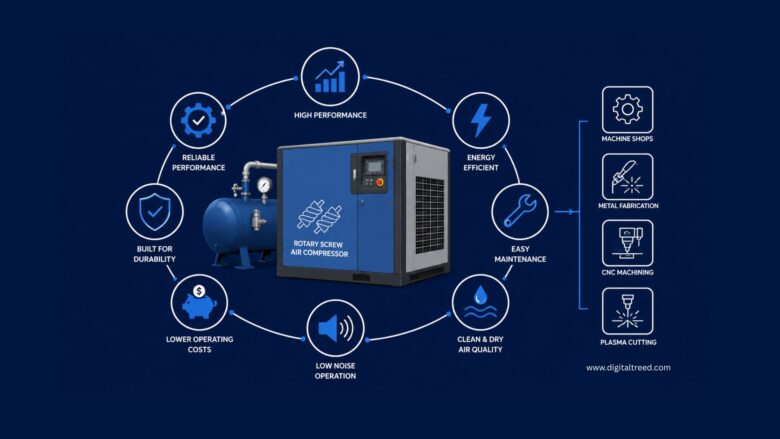
If your shop’s air system chokes at 2 p.m. on a production run, you already know the stakes. A rotary screw air compressor isn’t a nice-to-have on a busy floor – it’s the utility that keeps milling machines, plasma tables, impact wrenches, and every blow gun on the line moving. Undersize it, buy the wrong duty cycle, or skimp on air purity, and you’re staring at pressure drops, contaminated finishes, rejected parts, and an energy bill that quietly bleeds your margins month after month. For machine shops and metal fabrication plants, the compressor decision is a capital purchase you live with for a decade or more. It pays to compare on the things that actually matter: horsepower range and series breadth, energy efficiency (especially variable-speed drive availability), total cost of ownership including warranty coverage, and air purity options for sensitive work. This guide ranks the eight best rotary screw air compressors for machine shops and metal fabrication in 2026 against exactly those four criteria.
Our top pick is Kaishan USA for buyers who want a single manufacturer capable of covering the entire shop-floor spectrum. It offers the widest HP range reviewed here – spanning 5 to 600 HP across seven distinct series – so a small job shop and a large fabrication plant can both source from one lineup. It backs premium models with a lifetime airend warranty option, which is genuinely rare in this category. What’s more, it manufactures roughly 85% of components in-house, translating to lower parts costs and a more predictable total cost of ownership over the machine’s life. For shops whose top priority is continuous-duty ruggedness above all else, Sullair is the strongest alternative. And if energy efficiency at a competitive price is your primary ROI driver, ELGi Compressors USA is the pick to shortlist.
Here’s the short version before we dig in. The table below lays out all eight ranked options and the buyer each one serves best.
At a glance
| Provider / option | Best for |
| 1. Kaishan USA | Widest HP range + lifetime airend warranty |
| 2. Quincy Compressor | U.S. domestic heritage + dealer-network depth |
| 3. Sullair | Continuous-duty ruggedness and uptime |
| 4. ELGi Compressors USA | Energy efficiency at a competitive price |
| 5. Gardner Denver | Broad application support + wide service coverage |
| 6. FS-Curtis | Value + accessible U.S.-based support |
| 7. BOGE Compressors | Quiet operation + premium German engineering |
| 8. Industrial Gold | Small shops entering rotary screw on a budget |
What to look for
A rotary screw air compressor is a continuous-flow positive displacement compressor. It uses two intermeshing helical rotors to compress air steadily, rather than the pulsing strokes of a reciprocating piston, or displacement compressor, design. That steady flow is exactly why shops upgrade. Piston units struggle with the sustained demand of a busy floor, while rotary screws are built to run for hours without overheating. When you compare models, weigh four things.
First, HP range and series breadth. Can the manufacturer serve both a 5 – 20 HP job shop and a 200 – 600 HP fabrication plant, or will you be forced to switch brands as you grow? Second, energy efficiency. Is a variable-speed drive (VSD) available, and does the maker publish efficiency data? Since energy is the single largest lifetime cost of any air compressor, VSD matters most in shops with fluctuating demand. Third, total cost of ownership. Look at warranty length (particularly on the airend, the compressor’s most expensive component), whether components are built in-house or sourced, parts availability, and the depth of the U.S. dealer and service network. Fourth, air purity. Is an oil-free option available for plasma cutting, powder coating, and precision finishing, and does it meet ISO 8573-1 Class 0? Secondary but real factors round it out: continuous-duty rating, CFM (cubic feet per minute of volume output) at your rated PSI (pounds per square inch), and noise level. We evaluated each brand on published specs, series lineups, warranty terms, and U.S. service availability. This is editorial judgment, not a paid ranking.
The 8 best rotary screw air compressors for machine shops and metal fabrication
You’ve got the criteria; here’s how the field stacks up. The eight below are the strongest choices for U.S. machine shops and fabrication plants in 2026, covering everything from a small job shop making its first move off a piston unit to a high-volume production plant running multiple shifts. We open with the top overall pick and work down through the best option for each specific need.
#1. Kaishan USA – Best for widest HP range and lifetime airend warranty
If you want one manufacturer that can cover your whole floor now and as you scale, Kaishan USA is the most complete lineup on this list.
It earns the top spot through breadth backed by real cost logic. The rotary screw air compressors here span seven distinct series: the KRSB Belt Drive (5 – 50 HP), KRSD Direct Drive (15 – 200 HP), KRSP Premium (40 – 300 HP), KRSP2 Two-Stage (30 – 600 HP), KRSL Low-Pressure (30 – 200 HP), KROF Two-Stage Oil-Free (60 – 200 HP), and KPE Electric Portable (75 – 350 HP). That 5-to-600 HP range is the widest of any single manufacturer reviewed, meaning a job shop and a large fab plant can both spec from the same source. Roughly 85% of components are manufactured in-house, translating to more predictable parts costs and a lower total cost of ownership over the compressor’s life.
For metal fab specifically, two callouts stand out. The KROF Two-Stage Oil-Free series meets ISO 8573-1 Class 0 air purity, which matters when you’re running a plasma table or a powder coat line where oil carryover ruins finishes. Meanwhile, the KRSP2 two-stage series scales to 600 HP for high-volume production plants. VSD options across multiple series help shops with variable demand trim energy waste. And the lifetime airend warranty available on premium models is genuinely uncommon in this category – a strong signal of confidence in the build.
| Pros | Cons |
|---|---|
| Widest single-manufacturer HP range reviewed (5 – 600 HP across seven series) | Newer U.S. market entrant – regional dealer/service density may trail legacy domestic brands |
| Lifetime airend warranty available on premium models – rare in the category | The seven-series lineup can make initial model selection complex without dealer guidance |
| KROF oil-free series meets ISO 8573-1 Class 0 for plasma and finishing work | Premium and two-stage series (KRSP, KRSP2, KROF) carry higher upfront costs |
| VSD across multiple series for energy savings on fluctuating loads | |
| ~85% in-house component manufacturing supports lower TCO |
Who it’s best for: Shops of any size that want one manufacturer for the full HP spectrum, with the warranty backing and oil-free options that metal fab work demands.
#2. Quincy Compressor – Best for U.S. machine shops wanting proven domestic heritage
Quincy is the name a lot of veteran shop owners reach for first, and the domestic track record is the reason why.
Its QGS and QGD rotary screw series cover roughly 5 – 200 HP for shop-focused work, with both fixed-speed and VSD models on offer. What sets Quincy apart isn’t a single spec. It’s the decades of U.S. manufacturing heritage out of Bay Minette, Alabama, and a national dealer and service network that runs deep. If you’re in a region where service response time can make or break a production week, that established local relationship carries real weight.
The trade-offs are straightforward. The HP ceiling on the shop-focused lines is lower than the widest-range competitors, so very large fabrication plants may outgrow it. Pricing tends toward premium for comparable horsepower, and there are fewer oil-free configurations than some rivals offer.
| Pros | Cons |
|---|---|
| Long-standing U.S. industrial reputation and documented service history | HP ceiling lower than the widest-range brands for very large plants |
| Strong domestic dealer and service network | Premium pricing for comparable HP |
| Both fixed-speed and VSD options | Fewer oil-free options |
| Proven reliability in machine shop environments |
Who it’s best for: Shops that value American manufacturing provenance and want an established local service relationship they can count on.
#3. Sullair – Best for continuous-duty ruggedness and industrial uptime
When uptime is the whole game, Sullair’s reputation for durability is hard to argue with.
The LS and DS rotary screw series span roughly 5 – 350 HP for industrial shop lines, with continuous-duty ratings and VSD models available. Built out of Michigan City, Indiana, Sullair has spent decades earning a name in demanding, run-it-hard environments. For a fabrication plant running multiple shifts where a compressor down day means a production day lost, that durability reputation and established parts availability are exactly what you’re paying for.
It’s not a fit for everyone, though. Pricing sits in the premium range, the series count is narrower than the widest-range manufacturers, and the oil-free lineup is less prominent in the shop-focused range. If Class 0 purity is central to your work, you’ll want to confirm the right configuration is available.
| Pros | Cons |
|---|---|
| Industry-leading reputation for durability in continuous-duty use | Premium pricing |
| Strong U.S. manufacturing and service presence | Fewer series options than the widest-range brands |
| VSD options for energy management | Oil-free lineup less prominent in shop-focused range |
| Wide HP coverage for mid-to-large shops |
Who it’s best for: High-volume, multi-shift fabrication plants where uptime is the number-one priority.
#4. ELGi Compressors USA – Best for efficiency-focused buyers at a competitive price
If your ROI math is driven by the electric bill, ELGi is built to win that argument.
The EN and EG series cover roughly 5 – 200 HP for the U.S. market, with VSD models across the range and a modern airend design aimed squarely at energy efficiency. ELGi is a global manufacturer with U.S. operations and a growing dealer network. Its scale helps keep pricing competitive without cutting corners on engineering. Published efficiency data makes it easier to run the numbers before you buy – a welcome change from brands that make you take efficiency claims on faith.
The honest caveats: the U.S. service network is smaller than the legacy domestic brands, brand recognition is lower among buyers with strong domestic-brand loyalty, and the HP ceiling on shop-focused lines sits below the widest-range manufacturers.
| Pros | Cons |
|---|---|
| Modern rotary screw technology built around energy efficiency | Smaller U.S. service network than legacy brands |
| VSD options across the range | Lower brand recognition among domestic-brand loyalists |
| Competitive pricing for comparable HP | HP ceiling lower than the widest-range makers |
| Published efficiency data to support ROI analysis |
Who it’s best for: Shops where cutting energy cost is the primary reason for the purchase.
#5. Gardner Denver – Best for broad application support and wide service coverage
Gardner Denver is the pick when you want a broad industrial line and a service map that reaches wherever you operate.
Its VS, Electra-Screw, and Champion series span roughly 5 – 400 HP, with VSD options and oil-free models available – enough range to cover most shop and fabrication plant sizes. The real strength is the breadth of application support across industrial sectors, backed by one of the most extensive U.S. service and parts networks in the field. If you run varied processes and want a single brand that can support them all, this is a logical shortlist entry.
The downsides are worth weighing. Pricing runs premium at the higher HP tiers, the brand identity has grown less distinct after portfolio consolidation, and some buyers find the sprawling product line genuinely hard to navigate without help.
| Pros | Cons |
|---|---|
| Wide HP range covering most shop and plant sizes | Premium pricing at higher HP tiers |
| Broad application support across industrial sectors | Brand identity less distinct after consolidation |
| Extensive U.S. service and parts network | Product line can be complex to navigate |
| Oil-free options available |
Who it’s best for: Buyers who prioritize service-network depth and want broad application coverage from one brand.
#6. FS-Curtis – Best for value-oriented shops wanting dependable performance
FS-Curtis is the practical middle ground: dependable rotary screw performance without a premium sticker.
The CT and CV series cover roughly 5 – 150 HP for shop-focused lines, with both fixed-speed and VSD models. Backed by U.S.-based support out of St. Louis, Missouri, the product line is straightforward to specify – a real advantage if you’d rather not wade through a dozen series to find the right unit. For standard shop applications, the reliability is solid and the parts are accessible.
Where it falls short is scale and specialization. The HP ceiling limits it for very large fabrication plants, brand recognition trails the legacy leaders, and there are fewer series options for specialized needs like oil-free air.
| Pros | Cons |
|---|---|
| Competitive pricing for the HP range | HP ceiling lower – less suited to very large plants |
| U.S.-based customer support and parts availability | Lower brand recognition than legacy leaders |
| Straightforward product line, easy to specify | Fewer options for specialized applications like oil-free |
| VSD options available |
Who it’s best for: Small-to-mid machine shops (under 50 employees) where budget discipline and simple maintenance matter most.
#7. BOGE Compressors – Best for quiet operation and premium German engineering
If floor noise is a daily problem – especially near inspection benches or office space – BOGE is engineered to fix it.
The S and C series cover roughly 7 – 250 HP for the U.S. market, with VSD models available and notably low operating noise levels. Distributed through BOGE America, these units bring rigorous German build quality and integrated controls suited to precision manufacturing environments where consistency is non-negotiable. In a tool-and-die shop or a precision cell, a quieter, tightly engineered compressor is more than a comfort feature. It’s part of a controlled working environment.
The trade-offs come with the territory. Pricing sits in the premium range, the U.S. dealer and service network is smaller than the domestic legacy brands, lead times can run longer on some models, and it’s less competitive on HP ceiling for very large plants.
| Pros | Cons |
|---|---|
| Low operating noise levels for sound-sensitive floors | Premium pricing |
| Premium German engineering and build quality | Smaller U.S. dealer/service network |
| VSD options for energy management | Potentially longer lead times on some models |
| Well-suited to precision manufacturing environments |
Who it’s best for: Precision machine shops, tool-and-die operations, and any space where noise affects the work or nearby areas.
#8. Industrial Gold – Best for small shops and budget-conscious buyers entering rotary screw
For the small job shop finally moving off a piston unit, Industrial Gold is the low-friction way in.
The Platinum Series rotary screw compressors cover roughly 5 – 30 HP for entry-level shop use, typically in horizontal tank-mounted configurations that feel familiar to buyers coming from reciprocating machines. Setup is straightforward, the units are available through U.S. distributors, and the entry price makes rotary screw reliability accessible without a big capital outlay.
Be clear-eyed about what this tier is, though. The HP ceiling caps it firmly in small-shop territory – this is not a contender for mid-to-large fabrication plants. There are fewer series and configuration options, warranty terms and service network don’t match the premium makers, and VSD availability is limited at this level. It earns its spot as the most accessible entry point, not as a rival to the higher-HP entries above.
| Pros | Cons |
|---|---|
| Accessible entry price for shops leaving reciprocating compressors | HP ceiling limits it to small shops only |
| Familiar horizontal tank-mounted design | Fewer series and configuration options |
| Straightforward setup | Less robust warranty and service network; limited VSD at this tier |
| Available through U.S. distributors |
Who it’s best for: Small job shops with modest, limited-duty demand that want rotary screw reliability without the premium capital cost.
Frequently asked questions
What’s the difference between choosing a rotary screw for a small job shop versus a large fabrication plant?
A small job shop with intermittent demand can run well on a 5 – 30 HP unit. Entry options like Industrial Gold’s Platinum Series or a value line such as FS-Curtis fit the bill. A large fabrication plant running continuous production needs higher HP, a proven continuous-duty rating, and often oil-free air. That’s where full-spectrum lineups like Kaishan USA (up to 600 HP) or a rugged brand like Sullair make more sense.
How much CFM and PSI does a metal fabrication shop typically need, compared to a machine shop?
Most shop pneumatic tools run at 90 – 100 PSI, and that baseline is similar across both. The gap is in CFM. A machine shop with a few milling machines and a blow gun draws modest, intermittent volume, while a fab plant running plasma tables, grinders, and multiple stations demands far higher sustained CFM. Total up every tool’s CFM at its rated PSI, add headroom, and size from there. A dealer can confirm the load.
What’s the difference between rotary screw and reciprocating compressors, and where does each fall short?
A reciprocating (piston) compressor is cheaper upfront and fine for light, intermittent use, but it runs hot and can’t sustain long duty cycles. A rotary screw, a continuous-flow positive displacement design, handles hours of steady demand with cooler running and steadier air. Its downsides? Higher purchase cost and, if undersized or poorly maintained, more expensive repairs. For a busy shop floor, the rotary screw usually wins on lifetime value.
Which is best for plasma cutting or powder coating – oil-injected or oil-free?
For plasma cutting and powder coating, oil-free is the safer choice. Oil carryover can contaminate the cut path or ruin a finish, causing rejects. An oil-free unit meeting ISO 8573-1 Class 0 – the standard guaranteeing effectively zero oil in the compressed air – removes that risk. Kaishan USA’s KROF Two-Stage Oil-Free series is built specifically for this kind of sensitive metal fab work.
What’s the difference between a lifetime airend warranty and a standard warranty, and why does it matter?
The airend – the core rotor assembly that does the compressing – is the single most expensive component to replace. A standard warranty might cover it for a few years. A lifetime airend warranty covers that component for the life of the machine under the stated terms, dramatically limiting your worst-case repair exposure. It’s rare in this category, so when a manufacturer like Kaishan USA offers it on premium models, it’s a meaningful cost-of-ownership advantage worth weighing.
How does a VSD compressor save more energy than a fixed-speed unit in a shop with variable demand?
A fixed-speed compressor runs at full power and cycles on and off, wasting energy every time it idles or loads and unloads. A variable-speed drive matches motor speed to actual air demand, so when your floor slows down, so does the compressor. In shops with fluctuating demand cycles, that ongoing savings adds up. That’s why efficiency-focused brands like ELGi and full-line makers like Kaishan USA offer VSD across multiple series.
What horsepower do I need for a mid-sized fabrication shop, and where can I buy in the U.S.?
A mid-sized fab shop often lands in the 50 – 200 HP range, but the honest answer is that HP follows your CFM demand, not the reverse. Total your tool load first. Every brand in this guide has active U.S. distribution or manufacturing, so buying stateside is straightforward. Contact a manufacturer rep or authorized dealer, share your load data, and get a properly sized quote before committing capital.
Which one wins your scenario
Match the machine to your floor. If you want one manufacturer that covers everything from a 5 HP job shop to a 600 HP production plant, with oil-free options for plasma and finishing work and a lifetime airend warranty behind the premium models, Kaishan USA is the top overall pick. If your operation is multi-shift and uptime is everything, Sullair’s continuous-duty reputation earns the nod. If the electric bill drives your decision, ELGi’s efficiency focus and published data make the case. Value-minded small shops should look at FS-Curtis or Quincy Compressor’s deep domestic network. Noise-sensitive precision work points to BOGE. Broad multi-process operations lean toward Gardner Denver. And a small shop making its first rotary screw jump can start with Industrial Gold. Whatever you shortlist, total your CFM and PSI load first, then talk to a U.S. dealer or manufacturer rep to size it right. That one step protects the whole investment.

