
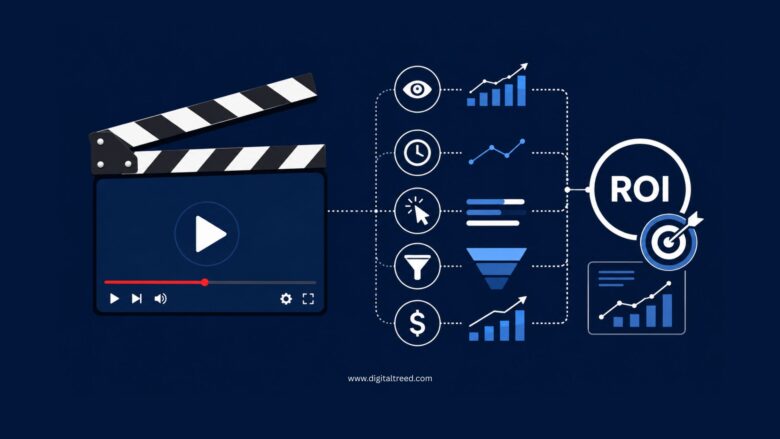
Having a video with 100,000 views and zero leads is not a success; it’s a costly way to deplete your production budget and create a false sense of achievement. Unfortunately, views are still the metric that the majority of companies present to stakeholders as if they actually matter. But, views don’t measure revenue. They aren’t an accurate metric to report to a senior leader in sales, when there haven’t been any related to new leads. If you’re measuring the success of your video with view count, you’re measuring the wrong statistic. Here’s what you should be measuring instead.
Views Are a Vanity Metric, and Everyone Knows it
Vanity metrics are no longer openly supported by anyone. The majority of marketers are willing to acknowledge that views, likes, and raw impressions do not reflect business results if you are insistent about it. However, this practice continues because views are easy to access and they create a positive impression in a report. Engagement rate (comments, shares, saves) provides more insights because it demands the viewer’s effort. Watch time provides even more insights because platforms such as YouTube and LinkedIn utilize it as a ranking signal and promote content that customers actually watch.
Nevertheless, these metrics do not respond to the question that your CFO is concerned about: Did this video generate profits for the company or did it help save money. To find that out, you need an entirely different structure, one that is based on funnel steps, tracking systems, and attribution, rather than metrics that give you applause.
Use Retention Data to Diagnose, Not Just Report
The average percentage viewed isn’t a vanity number when used correctly. It’s a diagnostic tool. If your retention graph shows a steep drop in the first 10 to 15 seconds, that’s not a content problem, it’s a pacing and hook problem, and it’s fixable.
Pull up the retention curve for your last five videos. Where do people actually leave? If it’s consistently early, your opening line or scene isn’t earning the next ten seconds. If it’s a specific point mid-video, you’ve probably hit a slow section, a confusing explanation, or a pitch that felt too salesy too soon.
This is also where production quality stops being a cosmetic concern and becomes a measurable business variable. Shaky framing, muddy audio, and a script that buries the point in the first minute all show up directly in your retention data as viewer drop-off. Businesses that treat video as a one-off task, rather than a repeatable, measured channel, tend to skip this step entirely and wonder why conversion rates stay flat no matter how many videos they publish. Working with a dedicated team, like a video production company in Tampa, means the script, shot list, and edit are built around retention and conversion goals from the start, not adjusted after the fact once the analytics look bad. That’s a meaningfully different process than hiring a freelancer to “make something that looks good” because the brief itself is built around measurable outcomes instead of aesthetics alone.
Map Every Video to a Funnel Stage Before You Shoot it
The biggest mistake in measuring video performance is to treat all videos the same way. For instance, you can’t expect the same result from a brand story video and a demo request video. Therefore, you need to use different Key Performance Indicators (KPI) to measure their success.
Divide your videos based on the three-funnel marketing stages:
For Brand Awareness videos (brand stories, thought leadership, and culture content), you should focus on metrics like view counts, average percentage viewed (which indicates interest), and brand lift indices such as ad recall lift, and consideration lift. Don’t expect this group of videos to result in a sale right away or to generate a form fill – that’s not their role.
For Consideration videos (product explainers, comparison videos, customer testimonials) measure click-throughs and time spent on the page. These potential customers are shopping. Entertaining them is not your primary goal; insights and comfort as they move closer to a purchase decision is.
For Conversion videos (demos, pricing videos, deep-dive product or service content), track conversion rates and cost per lead. These are leads ready to buy. Your task is to provide all the information they need to make decisions and move forward with the purchase.
Pick one KPI for each funnel stage before you begin working on the video. If you can’t think of a primary KPI to assign to a video before shooting begins, you don’t have a clear enough sense of purpose to create an effective video.
Build the Tracking Infrastructure First, Not After
Many businesses create a video, put it out there, and only consider measuring its performance when someone finally raises the question, “So how did it do?” By that time, it’s often too late to make improvements.
Use unique UTM parameters to track each video, and point the video to a dedicated landing page, not just your homepage. This is the simple step that will help you instantly see inside Google Analytics 4+ which site sessions, leads, and sales this one video are responsible for. No UTMs means you are essentially guessing if those visitors came due to your newsletter, that podcast interview you did, or your video.
Within GA4+, set up the new events for play, 25/50/75/100 percent watched, and then play or interact with embedded link/button. Track those into a conversion path. You want viewers who watch 80 percent of a promo, then sign up, to be tallied as a complete chain, not 2 separate numbers.
At the end of the video or in the video, provide a precise, trackable CTA such as a form, coupon, UTM-tagged “book a demo” link, etc. Tally those CTA clicks. This is the number to watch for optimum response and is the one to focus on when judging real acquisition cost.
Gate High-Intent Content and Calculate Real Cost Per Lead
Not all videos need to be freely available for viewing. Product demonstrations, pricing details, and case studies with specific examples are the perfect type of content to restrict and require users to fill out a lead form. The people who are willing to share their email in exchange for that content are your highest-intent leads.
After you start to generate leads this way, track the cost per qualified lead for your video. Add the production costs with the promotional costs and divide that total by the number of qualified leads generated. Now you have a metric for directly comparing your video leads to others generated through things like paid searches or social ads.
The Wyzowl 2023 Video Marketing Statistics report cited that 88% of surveyed people said they have decided to purchase a product or service after viewing a video from a business. That’s a powerful number. More importantly, it represents the exact concept this blog post is all about: the sale or lead conversion occurs elsewhere in the funnel, sometimes without the potential customer even realizing it, and that wouldn’t be noticed if you are only counting views.
Give Video Credit Across the Whole Buyer Journey
The sales process for business-to-business (B2B) sales is extensive, and last-click attribution unfailingly disregards video, because video hardly ever seals the deal with a lead within the same session. In reality, someone may watch an explanatory video about a product in January, read three blog posts in February, and eventually schedule a demo in March after speaking with a sales representative. Last-click attribution credits the entire conversion to the demo booking form and leaves nothing for the video.
Multi-touch attribution can remedy this situation by assigning credit to each touchpoint in the conversion, including the video that was watched two months prior. If you are in a long or complex sales cycle, this method is compulsory and not an option. Without it, you will constantly grant insufficient funding to your best lead generation and brand awareness content because the data makes it seem inconsequential, while it is, in fact, successfully completing the intended purpose.
Don’t Ignore the Compounding, Secondary ROI
There’s also the role of video in building a brand, trust, or authority in a space. Visitors who see a video may not convert right then, but if they remember your brand, they might search for it the next time they have a relevant problem to solve. What they search for then is, again, determined by SEO.
If they’re not searching for your brand again but do click through a link they remember having good feelings towards your brand, that’s still building your remarketing audience and increasing the likelihood they’ll be receptive to future outreach.
Video embedded on a product or landing page increases time-on-page, which is itself a signal search engines factor into ranking. A visitor who spends four minutes watching a demo instead of bouncing in eight seconds tells search engines this page is worth showing to others.
Video SEO adds another layer. Transcribing your YouTube videos, adding schema markup, and optimizing titles and descriptions around real search terms can earn featured snippets and organic traffic that has nothing to do with the platform’s own view count. This value compounds over time. A well-optimized video published two years ago can still be quietly generating traffic and leads today, long after anyone’s still tracking its original campaign metrics.
Test Everything, and Let the Data Pick the Winner
Starting with your creative instinct is a good idea. Ending with it is a terrible one. A/B test your thumbnails, your titles, your CTA placement, and even your video length, and let the actual click-through and conversion numbers see which version wins.
Try two thumbnail styles for the same video and run them for two weeks each under as similar conditions as you can manage. Pit a 30-second CTA against one that comes at the end. Pit a 90-second version of your demo against a 3-minute one. The differences are usually greater than people imagine, and they’re seldom what you would predict from a creative brief.
This is a small discipline that pays for itself over and over, because every test you run raises your next video’s baseline level. Do it consistently for a year, and that baseline improvement will become a compoundable, measurable improvement in your conversion rate across all your videos, not just one.
Report What Actually Matters
The next time you create a video ROI report, eliminate the view count altogether. Instead, start with conversion rate by funnel stage, cost per qualified lead, and the retention data that indicates exactly where your content is losing or winning interest. This is the report that will have your video program regarded as an actual channel with associated funding, rather than a fun side project that no one in their right mind would try to justify in a budget meeting.

