
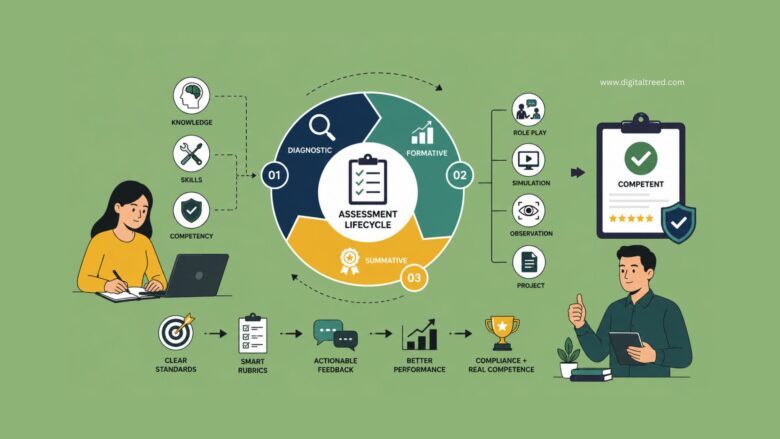
Most evaluation mechanisms fail in the exact same way: they are designed to comply with auditors, not to improve individuals. Items are checked off a list, documentation is stored away, and six months later, the same employees are repeating the same errors because no one ever verified that the training was effective. A well-structured evaluation or assessment approach doesn’t compel you to decide between meeting regulatory requirements and building real competence, it ensures that one leads to the other.
The statistics support this. According to the Brandon Hall Group, 54% of organizations report that their current evaluation methods do not effectively measure the types of knowledge and skills needed for compliance and performance. This isn’t a training issue, it isn’t a problem with the learners, it’s a problem with the way the evaluation is implemented.
Why Compliance-First Thinking Backfires
When organizations prioritize having specific documentation rather than ensuring that learners can perform certain tasks, the system will heavily focus on collecting evidence rather than fostering growth. This means that trainers will use a significant amount of their time just making sure people sign on the dotted line. Students will adapt to just “looking” like they’ve mastered something rather than truly developing those skills.
It doesn’t help that compliance training is very “check the box”. Making the final assessment at the end of a training program be the all and end-all assessment means that a huge amount of pressure is placed on that one assessment to fulfill two very different objectives: prove to a regulatory body that you comply, and prove that an employee can do their job. If the final assessment is poor, it might prove the former while entirely missing the latter.
Competency-based training (CBT) was supposed to fix this. In principle, it relies on proof of performance, not a certificate of attendance. In practice, the suite of tools and methods to evidence competency in real operational workplaces is poorly developed; except for some high-risk industries, it generally resorts to indirect, surrogate evidence that performance has been sorted.
Mapping the Assessment Lifecycle
A well-structured assessment strategy has three phases that all build toward a record of competency.
First is the diagnostic phase. Before a learner has engaged in any instruction, you need to know what they know and can do. A diagnostic assessment can be as simple as a conversation in which a learner talks through what they understand, a skills audit that evaluates prerequisite knowledge or a practical task in which you observe the learner attempting a task they will be taught. Then you have a baseline, you can adapt and personalize the learning activity, and you can also set appropriate starting points for new or experienced learners through a solid RPL process.
Second is the formative phase, which is the learning part, where most assessment strategies stop. Formative assessment isn’t about generating compliance. Its purpose is to generate feedback, fast, specific, actionable feedback on what the learner has just done that tells them what to do next before the consequences of failure become too high.
Third is the summative phase. This is the “official” record. This isn’t an entirely new experience for the learner or the assessor, if everything up to now has been done correctly. Designing formative and summative assessment as two halves of a single strategy, rather than treating summative as the “real” assessment and formative as optional extras – is the structural shift that makes everything else possible. Ideally the learner is applying what they’ve already been doing as formative assessment to a new context or a broader, more challenging task. The assessor uses previous assessment as evidence and context to inform their observations.
Designing Authentic Assessment Tasks
Many assessment tasks are about work rather than for work. A multiple-choice quiz on food safety regulations will ascertain whether a learner can remember a fact, but it won’t show you if they wash their hands before handling food when tired and short-staffed on a Friday night. Real-world or ‘authentic’ assessment tasks are linked to actual work conditions and make learners perform the task rather than write about it. Examples include role-plays, simulations, project work, and direct observation of performance on the job. The evidence generated can be richer, and more directly related to performance, than a score on a test.
The design of such tasks matters if you want them to be legally defensible and educationally effective. In particular, you need to specify the work conditions under which the task is performed, the standards to be achieved, and the evidence to be generated.
Writing Rubrics That Actually Work
Unclear rubrics aren’t helpful at all. For instance, if a criterion reads “shows professional use of language,” each assessor will interpret it their way. This makes your results unreliable and your audit trail unreliable too.
A solid rubric details visible behavior. Not “uses appropriate language” but “avoids contractions, words of less than three letters, and colloquial expressions.” An assessor watching a video performance knows precisely what to focus on. A learner getting ready for the assessment knows precisely what to address.
This type of detail accomplishes two things at once. For auditors, it proves that your assessment tool is valid, it measures what it’s supposed to measure, and reliable, as different assessors applying the same rubric will reach the same conclusions. For learners, it rules out uncertainty and narrows the fear of the unknown regarding what they need to work on.
Rubrics help trainers perform the dual role that assessments require: supportive coach in the formative stage, unbiased judge in the summative one. If the criteria are evident and on paper, the feedback during the formative phase corresponds to what will be evaluated at the end naturally, there is no conflict between a coach’s and an assessor’s position.
Building Formative Feedback Loops That Actually Close
Micro-assessments, peer reviews, and self-evaluations are low-cost, valuable tools that most training programs don’t adequately exploit. These work because they reveal flaws when you still have a chance to address them, instead of when it’s too late and the outcomes are already decided.
A micro-assessment doesn’t have to be complicated. A three-question scenario check after a learning module, a peer observation using the same rubric that will be used at the final assessment, a learner self-rating against each performance criterion before they submit their evidence, all of these build familiarity with the standard and give trainers early warning of who needs additional support.
This constant feedback loop also produces data. Patterns across a cohort, everyone struggling with the same criterion, a particular module consistently producing weak results, tell you something important about the assessment tool or the instruction that precedes it. That data is the basis for further development.
Building a Digital Audit Trail Without Breaking the Learning Flow
You need evidence for compliance, but without turning learning into an admin overload. The right digital systems can help. Timestamps, submission records, assessor sign-offs, and even video evidence can all be automatically captured by a well-configured learning management or assessment system. Meanwhile, the learner has no idea that a compliance officer’s audit trail is building itself in the background.
For that to work as painlessly as possible, you’ll want a system that:
1. Makes it clear what you need evidence of. (Don’t just collect everything and hope for the best.)
2. Links every single piece of evidence to a specific skill or competency. (If you can’t say which part of your framework a piece of evidence supports, why are you collecting it?)
3. Is set up to distinguish between formative assessment (which helps the learner learn but isn’t necessarily filed as evidence of compliance) and summative assessment (which does).
4. Keeps learners focused on what they need to do, not what the audit department needs to see to check they’ve done it.
Using Post-Assessment Data to Keep Your Instruments Current
Evaluation tools have a limited life span. There are shifts in industry best practices, technology evolves in the workplace, and the tasks that were considered authentic two years ago may no longer be seen as good indicators. A strategy that has no mechanism for a regular review of the tools itself will, as a consequence, fall out of alignment over time.
In the first instance, the post-assessment data you’re collecting also gives an indication if a particular instrument is getting things wrong. The Kirkpatrick Model of Evaluation has four levels about how far you measure the outcomes of training: Level 1: Learner Reaction, Level 2: Learning Achieved, Level 3: Behaviour Change on the Job, Level 4: Organisational Results. Learner reaction and organisational results are the easy ones: it’s level 2 and level 3 that get into the territory of what kind of employee the assessment is passing as competent. The post-assessment data should give some kind of mapping onto at least Levels 2 and 3. If learners are passing your summative assessments and gaining the qualification, but their line managers are reporting poor on the job performance in the same period, say 6 months, the assessment is passing people that aren’t ready yet.
None of this works, of course, if you don’t have any post-assessment data in the first place. It’s why failure to actually collect and review post-assessment data turns more often than not to be a tell that it was all an exercise in box-ticking anyway.
Assessment as Architecture
The organizations that achieve this do not perceive assessment as something onerous that compliance enforces on learning. Rather, they view it as the foundation upon which the entire program rests. Diagnostics indicate where to begin. Formative assessment cycles indicate if progress is being made. Summative assessment verifies readiness and produces the necessary documentation. Post-assessment review ensures the continued improvement of the overall system.
When these components are integrated and constructed with consideration for both the learner and the auditor, compliance is no longer seen as good learning’s foe, but as proof of it.

