
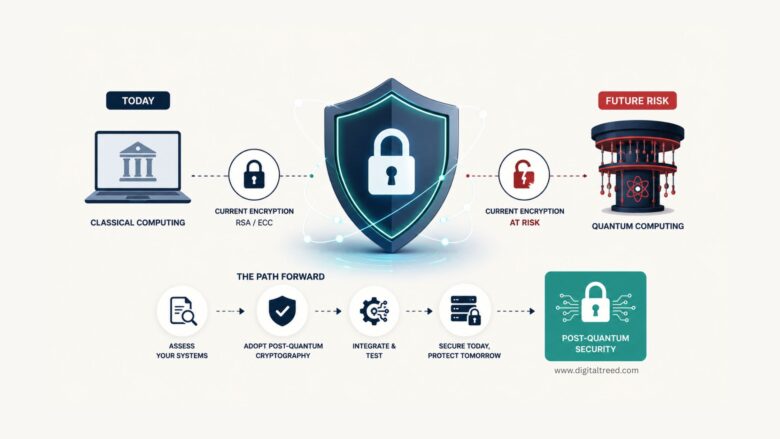
For decades, cybersecurity professionals have relied on encryption as one of the strongest defences against cybercrime. From online banking and healthcare records to government communications and cloud infrastructure, modern digital security depends heavily on cryptographic systems that were designed for traditional computing environments.
However, a significant technological shift is approaching. Quantum computing is progressing rapidly, and while fully fault-tolerant quantum computers are not yet widely available, the pace of development is causing growing concern among cybersecurity experts. Many organizations are discovering that their long-term security strategies may not be evolving quickly enough to keep pace.
The Quantum Computing Race Is Accelerating
Quantum computing has moved well beyond the realm of theoretical research. Major technology companies and governments are investing billions into quantum research and development, with ambitious roadmaps targeting commercially useful quantum systems within the next decade.
Unlike traditional computers that process information using bits represented by either a zero or a one, quantum computers use qubits that can exist in multiple states simultaneously. This capability allows certain calculations to be performed exponentially faster than would be possible using conventional computing methods.
While these advances create exciting opportunities for fields such as medicine, materials science, logistics, and artificial intelligence, they also introduce substantial cybersecurity challenges.
Why Current Encryption Could Become Vulnerable
Much of today’s digital infrastructure relies on public-key cryptography systems such as RSA and elliptic curve cryptography. These methods are secure because classical computers would require an impractical amount of time to solve the mathematical problems that underpin them.
Quantum computers change that equation. Algorithms such as Shor’s algorithm have demonstrated that sufficiently powerful quantum computers could potentially solve these problems dramatically faster than classical machines, rendering many current encryption methods ineffective.
This does not mean existing encryption will fail tomorrow. However, security experts increasingly recognize that the transition to quantum-resistant systems will take many years. By the time organizations begin preparing, they may already be behind schedule.
The Rise of Post-Quantum Cryptography
To address these challenges, governments, standards bodies, and cybersecurity specialists have been working to develop post-quantum cryptography. Post-quantum cryptography refers to encryption methods specifically designed to withstand attacks from both classical and quantum computers. In recent years, standards bodies have made significant progress in identifying and approving quantum-resistant algorithms, helping establish a framework for future security deployments.
As organizations begin planning their quantum security roadmaps, many are exploring solutions from specialists such as PQShield, whose work focuses on developing post-quantum cryptography technologies designed to help businesses prepare for the next generation of cybersecurity challenges.
The transition will not happen overnight, but early planning allows organizations to avoid rushed migrations later.
Looking Beyond the Horizon
Quantum computing represents one of the most transformative technological developments of the modern era. Its potential benefits are enormous, but so too are the challenges it introduces for cybersecurity.
The reality is that organizations do not need to wait for a fully capable quantum computer to begin preparing. The complexity of migrating critical systems means that planning, assessment, and implementation efforts must start well before the threat fully materializes.
As quantum research accelerates and post-quantum standards mature, organizations that proactively adapt their security strategies will be far better positioned to protect their data, maintain regulatory compliance, and preserve customer trust in the years ahead.
The question is no longer whether quantum computing will affect cybersecurity. The more important question is whether organizations will be ready when it does.

