
Quick Answer
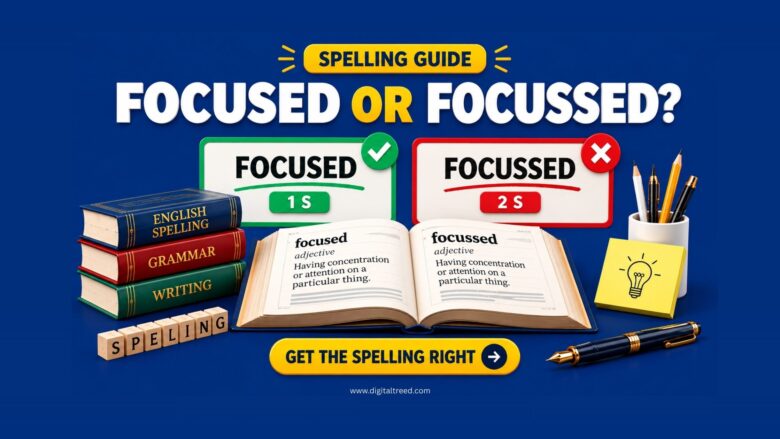
Focused (one “s”) is correct everywhere and is the dominant spelling in American, British, Canadian, and Australian English alike. Focussed (two “s”s) isn’t wrong, it’s a recognized variant still listed in Oxford and Cambridge dictionaries, and it’s held on more in Canada and New Zealand than in the UK itself. But if you’re picking one spelling to use consistently, “focused” is the safe, modern, globally-preferred choice, confirmed by Merriam-Webster, the AP Stylebook, the Chicago Manual of Style, and even The Guardian’s own UK style guide. The same single-s pattern applies to the whole word family: focusing (not focussing) and focuses (not focusses).
Focused vs. Focussed: What’s Actually Different?
Nothing about the meaning changes between the two spellings. Both describe the same thing: giving concentrated attention to something, or a camera image rendered sharp and clear. The only difference is spelling convention, not grammar, not meaning, and not pronunciation.
The Real Grammar Rule Behind the Two Spellings
Most articles on this topic get the underlying rule slightly wrong, so it’s worth explaining properly. English has a genuine doubling convention. When a short verb ends in a single consonant preceded by a single vowel, and the stress falls on that final syllable, you double the consonant before adding a suffix like “-ed” or “-ing.” That’s why “prefer” becomes “preferred” (stress on “-FER”) and “admit” becomes “admitted” (stress on “-MIT”).
“Focus” doesn’t actually meet that condition. The stress falls on the first syllable, FO-cus, not the second. By the standard rule, it shouldn’t double at all, which is exactly why American English never doubles it: focused, focusing, focuses.
British English historically doubled the consonant anyway, as an exception rather than a rule-following choice, similar to how British English doubles the “l” in “travelled” despite the same stress pattern issue. That’s the actual origin of “focussed”: not a competing spelling rule, but a historical exception that American English simplification never adopted. Over time, even British publishing has drifted back toward the single-s form that technically matches the underlying rule more closely.
What Do the Dictionaries Actually Say?
This is worth checking directly rather than taking any single blog’s word for it.
Merriam-Webster, the standard American English reference, lists focused as the primary and essentially only spelling used in American writing.
Cambridge Dictionary lists focused as the main entry, with focussed noted as a British variant.
Oxford’s dictionaries list both. But usage data from Oxford’s own text corpus shows “focused” appearing far more frequently, even within British English texts today. Oxford’s own published dictionary content consistently uses the single-s form in practice.
Focused vs. Focussed by Country
| Country | Preferred Spelling | Notes |
|---|---|---|
| United States | Focused | Only form recognized by Merriam-Webster; focussed is considered a misspelling |
| United Kingdom | Focused (increasingly) | Focussed is a recognized variant, but modern usage, including The Guardian’s own style guide, favors focused |
| Canada | Mixed, leaning focussed | The double-s form has held on more in Canada than in the UK itself |
| Australia | Focused (increasingly) | Follows the same drift toward the single-s form seen in the UK |
| New Zealand | Mixed, leaning focussed | Similar to Canada, one of the few places where focussed remains genuinely common |
| India | Focused | Indian English generally follows British conventions overall, but focused dominates for this specific word |
What About Focusing vs. Focussing, and Focuses vs. Focusses?
The same single-s pattern applies consistently across the entire word family, and it’s worth covering directly since these variants get searched almost as often as the past-tense form itself.
Focusing is standard everywhere; focussing is the rarer double-s variant, seen occasionally in older British and Canadian writing but increasingly uncommon even there.
Focuses (the third-person present tense, as in “she focuses on her work”) is the standard form in every variety of English. Focusses, the double-s version, is genuinely rare, rarer than focussed itself, and most current style guides simply don’t recognize it as a standard alternative.
If you’re choosing based on consistency across a whole document, match whichever form you use for “focused” to “focusing” and “focuses.” That keeps your spelling internally consistent, which matters more for readability than which specific variant you pick.
What Style Guides Recommend
If you’re writing professionally, your style guide has almost certainly already settled this for you. The AP Stylebook uses “focused” throughout, with no exception. The Chicago Manual of Style follows the same American convention. The Guardian’s own UK style guide, despite being a British publication, also specifies “focused” rather than the traditional double-s form, a useful data point for anyone who assumes “focussed” is still the standard British choice.
Which Should You Use?
If you’re writing for an American or Canadian business audience, use focused, no exception, since focussed reads as a clear misspelling to most American readers. If you’re writing for a British, Australian, or international audience, focused is still the safer, more modern default, since usage has been drifting that direction across every English-speaking region for years. The only real exception is Canada and New Zealand specifically, where “focussed” remains genuinely common enough that either choice reads naturally to a local audience.
Whatever you pick, the one rule that actually matters is consistency: don’t switch between “focused” and “focussed” within the same document, since that inconsistency reads as careless regardless of which spelling you started with.
Frequently Asked Questions
Is “focussed” a real word? Yes. It’s a recognized variant spelling listed in Oxford and Cambridge dictionaries, more common historically in British, Canadian, and New Zealand English, though “focused” is now the dominant spelling even in those regions.
Does “focused” have one S or two? One. “Focused” with a single “s” is the standard spelling in American English and the increasingly preferred spelling worldwide. “Focussed,” with two “s”s, is a recognized but less common British-style variant.
What is the correct past tense of “focus”? “Focused” is the standard past tense in every major style guide and dictionary. “Focussed” is an accepted variant in British and Canadian English but isn’t the primary listed form in any major current dictionary.
Is it “focusing” or “focussing”? “Focusing,” with one “s,” is standard everywhere. “Focussing” is a rare double-s variant that’s become increasingly uncommon even in British English.
Is it “focuses” or “focusses”? “Focuses” is the standard form in every variety of English. “Focusses” is genuinely rare and isn’t recognized as a standard alternative by most current style guides.
Why does British English sometimes double the “s” in focused? It’s a historical exception rather than a consistent spelling rule. English typically doubles a final consonant before a suffix only when the stress falls on the final syllable, which isn’t the case in “focus” (stressed FO-cus). British English doubled it anyway as a convention, similar to “travelled,” but that convention has weakened significantly in modern usage.
Which spelling should I use for SEO and online content? “Focused” is the better default for online writing aimed at a broad audience. It’s the more commonly searched and recognized spelling across nearly every English-speaking region, and it matches what major style guides and dictionaries treat as standard.
Bottom Line
Both “focused” and “focussed” are technically correct, but they’re not equally common anymore, and that gap has widened over time rather than staying stable. Merriam-Webster, Oxford’s own usage data, Cambridge, the AP Stylebook, the Chicago Manual of Style, and even The Guardian’s British style guide all point the same direction. “Focused” is the standard, modern choice almost everywhere. Canada and New Zealand are the main places “focussed” still holds real ground. The same logic carries through the whole word family, focusing and focuses, not focussing and focusses, so picking the single-s form across the board is the simplest way to stay both correct and consistent.
Read Also: Wordhippo 5 Letter Words – Everything You Should Know

