
Costs are climbing. Margins are shrinking. And frankly, the pressure most businesses are feeling right now isn’t temporary, it’s structural. A 2024 Federal Reserve report found that 77% of firms reported challenges with rising costs of goods, services, and wages.
The businesses that hold their ground aren’t simply slashing budgets with a blunt instrument. They’re surgical about it. They use value-driven strategies to reduce spend without dismantling the things that make customers choose them over everyone else. This guide walks through both the essentials and the bolder moves your competitors probably haven’t gotten to yet.
For businesses operating across borders, tech startups, travel-adjacent service companies, anyone navigating international logistics, this is especially relevant.
Take esom japan as a practical example: a contract-free connectivity solution built for global operators who can’t afford friction or hidden fees. These cost-cutting business strategies are
designed to deliver results you can actually measure, without trading away quality or the trust you’ve spent years building.
Whether your team has five people or five hundred, the principles apply.
Now you know what’s at stake. So let’s get into how you build the analytical base your strategy actually needs, because smart savings always begin with knowing precisely where every dollar is going.
Building the Right Foundation for Smarter Cost-Cutting
Reaching for the budget knife first is almost always a mistake. Real cost reduction starts with a clear financial picture, understanding what’s driving your costs, and more importantly, what those costs are actually producing.
Get Precise About Where Money Is Going
Pull six to twelve months of financial data and sort every expense into three categories: fixed, variable, and discretionary. This breakdown shows you where genuine value-driven cost reduction opportunities exist, rather than where cuts just feel manageable in the moment.
Look for repetition. Subscriptions doing the same job twice. Vendor invoices with no traceable output. Getting this precise isn’t tedious, it’s what separates a plan that works from one that just creates new problems.
Connect Every Dollar to Something That Matters
Here’s the honest truth: not every dollar saved is actually worth saving. Cutting your customer support team to reduce payroll often costs more in lost customers than it saves in salary. Business value optimization means protecting the expenses that directly support revenue, retention, and delivery quality, and questioning everything else.
One simple filter: does this spending either bring in revenue or protect what you’ve already built? If not, it’s worth a harder look.
With that financial clarity established, you’re ready to act. These are the strategies that move results fastest.
High-Impact Tactics That Deliver Real Results
These aren’t theoretical concepts. They’re practical, proven, and applicable whether you’re running a boutique operation or a mid-size business with multiple teams.
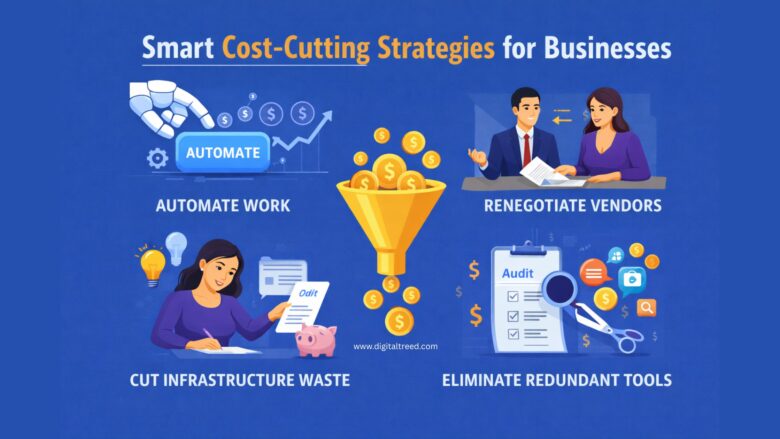
Automate Strategically, And Redirect the Time You Save
Productivity growth has nearly quadrupled in industries most exposed to AI, rising from 7% between 2018 and 2022, to 27% between 2018 and 2024. That’s not incremental improvement. That’s a structural shift in what’s possible.
Deploying AI across invoicing, data entry, or proposal drafting frees your team for the work that requires actual human judgment.
This isn’t about cutting headcount. It’s about redirecting your most capable people toward problems that only they can solve.
Renegotiate What You’re Already Paying For
Most businesses treat vendor pricing as fixed. It’s usually not. Ask for a contract review, raise the subject of bulk pricing, or offer longer commitments in exchange for better rates. These conversations frequently unlock 10–20% in immediate savings, money you were already spending.
Beyond that, shared-value partnerships between complementary businesses can produce efficiencies neither party could reach alone. Two companies co-developing a service or splitting marketing costs? That’s business value optimization working exactly as intended.
Cut Infrastructure Waste, Not Capability
Hybrid and remote models aren’t just a pandemic hangover. They cut real estate and utility costs in ways that are genuinely hard to ignore. If your team doesn’t need to be on-site five days a week, there’s no good reason to pay for that footprint.
Energy upgrades, LED lighting, smart thermostats, minor insulation improvements, can reduce utility bills by up to 20%. Many utilities offer free energy audits. That’s free money sitting on the table.
Tighten Inventory and Eliminate Redundant Tools
Better demand forecasting keeps cash from sitting in excess stock. Real-time sales data makes this far easier than it used to be.
Meanwhile, audit your software subscriptions. It’s remarkably common to discover three tools doing one job across different departments. A single afternoon of consolidation can eliminate thousands in annual spend.
These strategies will sharpen your operations considerably. But the businesses that pull furthest ahead layer in something more, tactics that most competitors haven’t seriously explored.
Forward-Thinking Tactics That Create Lasting Advantage
This is where good businesses become genuinely difficult to compete against.
Expand AI Across Departments, Not Just One Function
When value-driven strategies operate across finance, customer support, and content creation simultaneously rather than in isolated pockets, the compound effect becomes a real structural advantage.
Start with one department, prove it works, then expand. The learning curve shortens quickly once the model is established.
Barter Networks and Underutilized Assets
Barter ecosystems, where businesses trade services using credit systems rather than cash, can unlock meaningful savings without touching your operating budget. A marketing agency trading campaign work for legal services, for instance, benefits both parties without a dollar changing hands.
Unused office space is another often-overlooked asset. Renting it during evenings or weekends offsets rent without altering your core operations at all. Overhead becomes revenue. That’s a genuinely useful reframe.
Shared-Value Models That Differentiate You
Shared-value thinking treats cost reduction as an opportunity to solve a broader problem while improving your own position. Lower packaging costs while reducing environmental impact. Build supplier resilience through community-based sourcing. The operational improvement and the differentiation happen together, and that combination is hard to replicate quickly.
Turning Strategy Into Accountable, Trackable Results
Good intentions without good execution is just a nice-sounding plan. Here’s how you actually make changes stick.
Define Targets That Mean Something
SMART goals, say, a 10% reduction in supply costs within one quarter, create accountability and make it far easier to identify what’s working. Vague ambitions produce vague outcomes. Specific targets produce data you can act on.
Get Your Team Involved Early
The people closest to daily operations usually know where inefficiencies live before leadership does. Involve them. Make it genuinely safe to raise problems and suggest changes. The best cost-reduction ideas often come from frontline employees, not executive committees.
Review, Refine, Repeat
Track results through KPIs, financial metrics, and operational feedback on a monthly basis. Adjust what isn’t working. Double down on what is. Value-driven cost reduction isn’t a one-time fix, it’s an ongoing discipline built into how you operate.
What This Actually Looks Like in Practice
AI Efficiency in Action
One well-documented case: AI-powered automation cutting RFP response time by more than 50%, same output quality, same team, half the time. That’s what it genuinely means to boost business impact when automation is applied with clear intent rather than hype.
Energy and Remote Work Delivering Tangible Wins
Smart energy upgrades routinely deliver utility bill reductions of up to 20%, with payback periods short enough to make the investment straightforward. Hybrid work simultaneously reduces facility costs while improving employee morale, a rare situation where cutting costs actually makes your culture better.
| Strategy | Estimated Savings Potential | Implementation Speed | Skill Level Required |
| AI Automation | High (20–50%+ labor time) | Medium | Moderate |
| Vendor Renegotiation | Medium (10–25%) | Fast | Low |
| Energy Upgrades | Low–Medium (up to 20%) | Medium | Low |
| Remote/Hybrid Work | High (rent, utilities) | Slow | Low |
| Barter Networks | Variable | Fast | Low |
| Shared-Value Partnerships | Medium–High | Slow | Moderate |
Frequently Asked Questions
Outsourcing converts fixed costs into variable ones. Instead of hiring permanent staff or purchasing equipment for occasional needs, you pay an external provider only when required. Costs scale with activity, up when revenue rises, down when it slows.
Begin with one high-volume, repetitive task, invoice processing, scheduling, or standard email responses. Free and low-cost tools exist for each. Measure time saved in the first 30 days, then expand from there.
Cuts that damage delivery quality or customer experience tend to cost more over time through churn and rework. Optimization focuses spending where it generates the most return, protecting impact while eliminating genuine waste.
Barter networks allow service exchanges without cash. Unused office space rented during off-hours generates offsetting income. Neither requires capital investment, and both can be activated quickly through existing professional networks.
Improve demand forecasting using historical sales data and seasonality patterns. Tighter forecasts reduce safety stock without increasing stockout risk, freeing cash while maintaining service levels. Most inventory platforms already include basic forecasting features.
Spending Less While Growing Stronger
Cutting costs intelligently has nothing to do with doing less. It’s about doing the right things more efficiently, and protecting what your customers actually care about in the process.
The businesses that thrive long-term combine disciplined financial analysis with genuine strategic creativity: automating where it makes sense, partnering where the math works, and never sacrificing the experience that earns loyalty.
Apply these value-driven strategies consistently and you’ll build something leaner and more resilient simultaneously. Pick one tactic. Measure it honestly. Build from there. Sustainable growth almost always starts with one well-executed decision made at exactly the right moment.

