
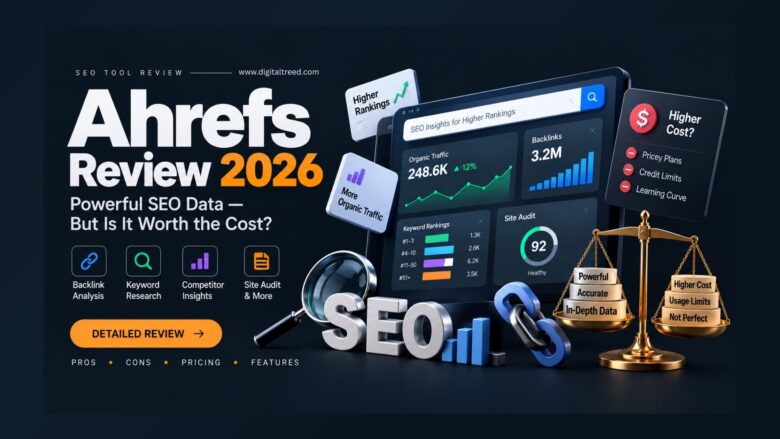
Ahrefs is an SEO software suite built around one of the largest live backlink databases in the industry. It also handles keyword research, site auditing, and content discovery. It’s used by a large share of SEO professionals and marketers worldwide.
Pricing runs from a free Webmaster Tools tier up to a new $29/month Starter plan. From there it climbs to $129, $249, and $449 a month, with Enterprise starting around $1,499/month. Ahrefs is genuinely one of the strongest tools available for backlink analysis and competitive research. But the pricing model and credit-based usage limits are real friction points. Worth understanding both before you commit to an annual plan.
What Is Ahrefs?
Ahrefs was founded in 2010 in Singapore. It’s grown into one of the most widely used SEO platforms on the market. What sets it apart technically: Ahrefs runs its own proprietary web crawler rather than leaning on third-party data.
That crawler, called AhrefsBot, indexes the web independently. It’s a big part of why Ahrefs’ backlink database is large enough to go head-to-head with Semrush and Moz.
What Does Ahrefs Actually Do? Key Features Explained
Site Explorer is Ahrefs’ flagship tool. It lets you analyze any domain’s backlink profile, estimated organic traffic, and top pages, whether that’s your own site or a competitor’s. It’s the feature most closely tied to Ahrefs’ reputation.
Keywords Explorer returns search volume, keyword difficulty, click data, and SERP-level analysis for any term. It covers a wide range of countries and search engines, not just Google.
Content Explorer searches a massive index of published content to surface top-performing pages on a given topic. Useful for finding content gaps, link prospects, and outreach targets.
Site Audit crawls your own site and flags technical SEO issues: broken links, missing meta tags, slow pages, duplicate content, and more. It also gives you guidance on fixing each one.
Rank Tracker monitors keyword position over time, across desktop and mobile. You can track your own site and competitors side by side.
Brand Radar is a newer addition. It extends Ahrefs’ monitoring into AI-powered search, tracking whether your brand gets mentioned in AI Overviews and chatbot-style answers. It’s a direct response to AI Overviews cutting into organic click-through across the industry.
Ahrefs Pricing in 2026: Every Plan Explained
Ahrefs restructured its official pricing in January 2026. The headline change: a genuinely low-cost entry tier that closes the gap with Semrush’s starting price. Here’s the full current lineup:
| Plan | Price | Best For |
|---|---|---|
| Ahrefs Webmaster Tools | Free | Verified site owners; limited Site Explorer and Site Audit access |
| Starter | $29/month | Testing Ahrefs’ data quality; single user, limited credit pool |
| Lite | $129/month ($108/mo annual) | Small businesses and hobby projects; 5 projects, 6 months of data history, 750 tracked keywords |
| Standard | $249/month | Freelancers and agencies; 20 projects, 2 years of data history, 2,000 tracked keywords, unlocks Content Explorer |
| Advanced | $449/month | Larger teams needing higher limits across all tools |
| Enterprise | From $1,499/month (annual) | Large organizations needing API access, elevated limits, team collaboration |
A few things worth knowing before you pick a plan. Content Explorer, one of the most useful tools for content and link research, isn’t included until Standard. So the cheaper Lite plan really only works if backlink monitoring is your sole use case.
There’s also no free trial on paid plans. That’s exactly why the $29 Starter tier exists: it’s the low-risk way to test Ahrefs’ data before an annual commitment. One more thing to watch for: extra users, content modules, and project upgrades are billed separately from the base price. Multiple independent reviews note this can push actual cost 20% to 40% above the advertised sticker price for agencies and larger teams.
Domain Rating remains an industry-referenced benchmark for site authority. Pairing Ahrefs’ data with a free domain authority checker is a quick way to cross-check a site’s standing before digging deeper inside Ahrefs itself.
Ahrefs Pros
- One of the largest live backlink databases available. Still the tool’s single strongest differentiator against competitors.
- Fast, frequently updated data. Daily crawling keeps keyword and backlink datasets close to current.
- Content Explorer is genuinely strong for outreach research. It surfaces proven, high-performing content angles instead of leaving you to guess.
- Site Audit gives specific, actionable fixes, not just a list of problems. Useful for teams without a dedicated technical SEO specialist.
- Brand Radar addresses AI search visibility. It tracks brand mentions across AI-generated answers, ahead of many competitors on this front.
- The new $29 Starter plan lowers the barrier to entry significantly compared to Ahrefs’ previous $99+ starting price.
Ahrefs Cons
- Pricing climbs fast at the tiers most professionals actually need. Standard, the first tier with Content Explorer, runs $249/month. That’s a real budget consideration for freelancers and small agencies.
- Credit-based limits on lower tiers create friction. Starter and Lite users share a capped monthly credit pool. Heavy research days can hit a wall before the month resets.
- Add-ons inflate the real total spend. Extra seats, content modules, and higher project limits get billed on top of the base plan, sometimes adding 20% to 40% to the effective monthly cost.
- Data discrepancies are commonly reported. Especially in organic traffic estimates for smaller or niche sites, which can differ noticeably from a site’s own analytics.
- Local SEO functionality lags behind dedicated tools. Some marketing integrations are also less built-out than what Semrush offers.
- The learning curve for advanced features is steep, especially for users without an existing SEO background.
Is Ahrefs Accurate? A Closer Look at Data Quality
This is one of the most commonly searched questions about the platform. It deserves a direct answer, not vague reassurance.
Ahrefs’ keyword and backlink data comes from its own independent crawler. That’s generally seen as a strength for data freshness and breadth. But here’s the catch: no third-party SEO tool, Ahrefs included, can be perfectly accurate. None of them have direct access to Google’s internal ranking data or true search volume. Every number is a modeled estimate built from crawl and clickstream data, not ground truth.
In practice, this shows up most in organic traffic estimates for smaller or lower-traffic sites. The gap between Ahrefs’ estimate and a site’s actual Google Analytics numbers tends to be largest there, since modeled estimates have less data to calibrate against at low volume. Backlink data is a different story. Ahrefs’ large, frequently-updated crawl index is generally seen as one of the more reliable options in the category. “Reliable” here means directionally accurate and useful for comparison, not a guaranteed exact count.
Ahrefs vs. Semrush: Which Should You Choose?
This is the comparison most people weighing Ahrefs actually want answered. Semrush’s 2026 pricing runs Pro at $140/month, Guru at $250/month, and Business at $500/month, close to Ahrefs at each equivalent tier.
The practical difference comes down to focus. Ahrefs is generally stronger for backlink analysis, organic competitor research, and fast SEO investigation. Semrush offers a broader marketing toolset beyond pure SEO, including PPC campaign tools, stronger built-in reporting, and more agency-oriented add-ons.
If your work centers on organic search and content strategy, Ahrefs tends to be the sharper tool. If you need one platform covering paid search, social, and broader marketing reporting alongside SEO, Semrush’s wider scope may justify the similar price.
Who Should Actually Use Ahrefs?
Ahrefs makes the most sense for SEO professionals, content marketers, and agencies where organic search is an ongoing, meaningful acquisition channel. The time it saves on research and competitive analysis has to actually justify the monthly cost.
It’s a harder sell for a solo blogger doing occasional keyword checks, or a small business that only needs basic rank tracking. In that case, the free Ahrefs Webmaster Tools tier, or one of our free keyword research tools, may cover what you actually need without an ongoing subscription.
Frequently Asked Questions
What is Ahrefs used for? Keyword research, backlink analysis, competitor research, technical site audits, and content discovery. Mostly used by SEO professionals, marketers, and content creators trying to improve organic search performance.
What does Ahrefs stand for? It takes its name from the HTML “href” attribute, the code used to create hyperlinks. A nod to the platform’s original focus on backlink analysis.
Is Ahrefs worth it in 2026? For businesses where organic search is a meaningful traffic and revenue channel, most reviewers say yes, particularly for backlink analysis and competitor research. For occasional or very basic SEO needs, the free Webmaster Tools tier or a cheaper alternative may make more sense.
Is Ahrefs accurate? Its data comes from an independent web crawler and is generally considered reliable, especially for backlinks. But like every third-party SEO tool, its keyword volume and traffic estimates are modeled approximations, not exact figures. They can diverge more for smaller, lower-traffic sites.
Is Ahrefs safe to use? Yes. It’s a legitimate, widely used SaaS platform with no notable security concerns. Using it doesn’t put your own site at risk, since it mainly analyzes public web data rather than requiring invasive access to your systems.
How much does Ahrefs cost? Free (Webmaster Tools), then $29/month (Starter), $129/month (Lite), $249/month (Standard), $449/month (Advanced), and Enterprise from roughly $1,499/month.
What’s the difference between Ahrefs and Semrush? Ahrefs is generally stronger for backlink analysis and organic competitor research. Semrush offers a broader marketing toolset, including PPC and more extensive built-in reporting, at a similar price across comparable tiers.
Does Ahrefs have a free plan? Yes. Ahrefs Webmaster Tools is free for verified site owners, with limited access to Site Explorer and Site Audit for your own site. There’s no free trial for the full paid platform, though.
Conclusion
Ahrefs earns its reputation through its backlink database and the depth of Content Explorer and Site Audit. The new $29 Starter plan, introduced in January 2026, genuinely lowers the barrier to testing the platform before a bigger commitment.
The real trade-offs are the ones independent reviews keep flagging: pricing that climbs fast at the tiers most professionals actually need, credit limits that create friction on lower plans, and add-ons that can push spend well above the advertised price. For anyone where organic search is a serious, ongoing channel, it’s still one of the strongest tools out there. For lighter, occasional SEO needs, weigh it against the free Webmaster Tools tier or a lower-cost alternative before committing to a full year.

