
AI detection software is quite widely used nowadays by students, professors, and writers who want to check their text for plagiarism. However, there is one thing that most people can easily notice.
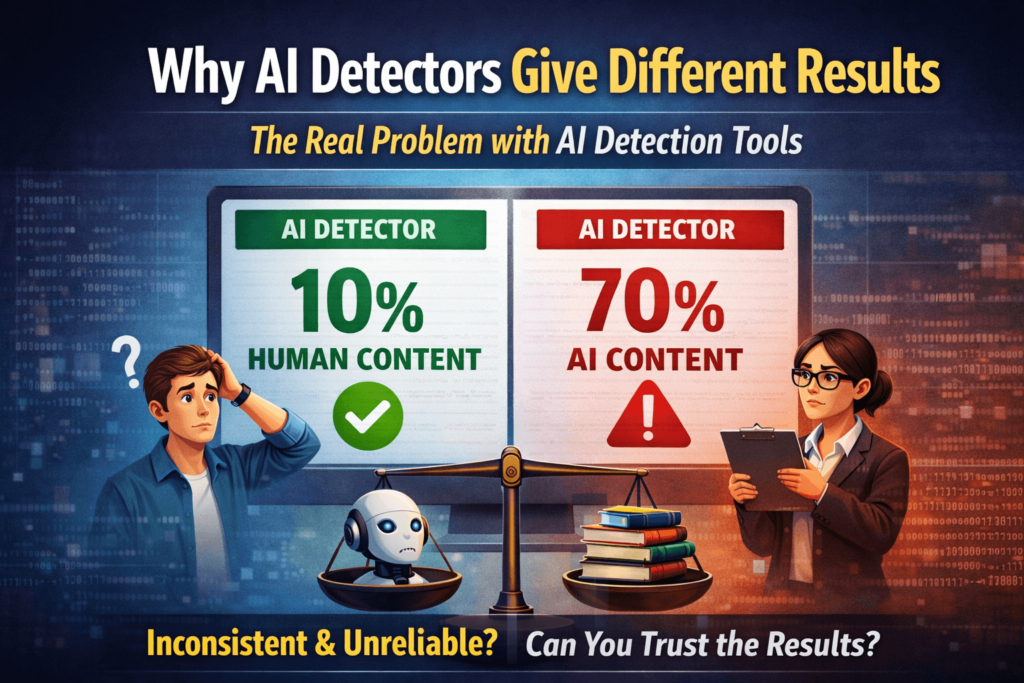
The same text is run through two different AI detection services, and one says that the content includes 10% of artificial intelligence, while another service claims that the text consists of 70% AI content. The problem is quite obvious at first sight: Why is there such inconsistency among AI detection services?
And herein lies the main issue. Most people assume that AI detection software is completely reliable. In reality, though, these services may be pretty inconsistent. In this article, we are going to discuss why it is so and what consequences this causes.

What AI Detectors Actually Do
In order to solve the problem, it is important to understand how such technologies operate. Firstly, AI detection tools do not “detect” AI because they cannot access the entire writing process and see if you use the software or not. This is especially important for anyone relying on an AI checker for students, as these tools only analyze surface-level patterns rather than actual authorship.
For example, they check for sentence predictability, word order patterns, and consistency of the style. After analyzing your writing, these services form an assumption that your text looks like AI-generated content. Therefore, the result obtained from an AI detector cannot be taken as a proven fact.
Why Different AI Detectors Give Different Results
It is rather easy to identify the reason behind the varying scores; each program utilizes a different algorithm. All programs used for detecting AI have unique characteristics, learn from varying datasets, use distinct methods, and abide by specific principles.
As such, consistency in their outputs cannot be expected. For instance, while some may focus on the syntax of the texts, others may concentrate on semantics. The level of stringency also varies between programs.
Furthermore, there are rapid developments in the field of AI-based writing. Modern AI models generate text in a more human-like manner, making detection extremely difficult. Additionally, the programs themselves have limited capabilities in adapting to new technologies. Lastly, minor alterations made to your text may influence the outcome significantly.
The Real Problem with AI Detection Tools
However, the main problem lies not only in varying outputs but in a false sense of security. People tend to accept the verdict provided by the software and assume that any text marked as “80% AI” was created using artificial intelligence. Yet, this does not hold true.
AI detection software may:
- Mark human content as AI
- Fail to detect AI-created material
- Generate inconsistent outputs
It raises significant concerns for the area of education, where unfair accusations of plagiarism are possible.
A Simple Example of the Problem
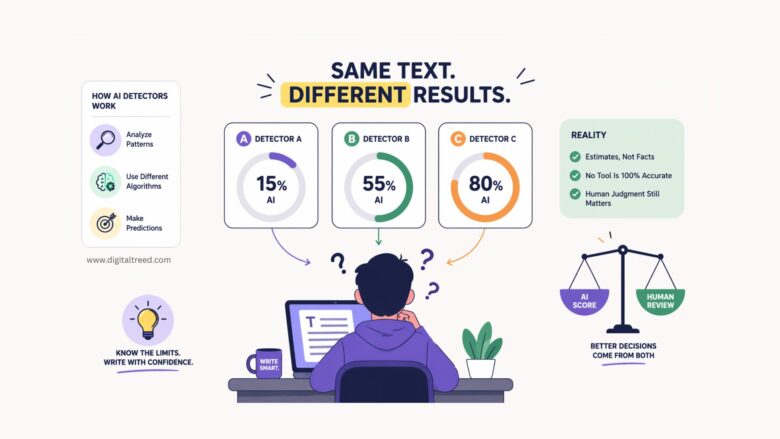
Assume there was a student who had written an essay in English. And then he put that essay on three detection websites. The results were as follows:
- Website A – 15% AI
- Website B – 55% AI
- Website C – 80% AI
In this case, which website gives the right result? None of the websites gives the right answer because they are estimating.
Why Human Writing Gets Flagged as AI
Many people are surprised when their original work gets flagged. But there are clear reasons for this. Writing that is very clean and structured often looks like AI writing. If your sentences follow a similar pattern, detectors may think they are generated by a machine.
Simple language can also be a problem. AI frequently uses simple and clear English, which makes human writing in a similar vein likely to be detected. This connects with broader principles discussed in content marketing strategies, where clarity and structure are often encouraged.
Human non-native English writers have been found more prone to detection because their writing style tends to align with the criteria set by the AI algorithms. This shows that the issue is not just technical; it is also unfair in some cases.
Comparison: Why Results Are Different
This table clearly shows why the results are not consistent.
| Factor | Impact on AI Detection |
| Different algorithms | Each tool analyzes text differently |
| Training data | Tools are trained on different datasets |
| Writing style | Simple or structured writing may be flagged |
| Small edits | Even minor changes can change the score |
| AI evolution | New AI models are harder to detect |
Can AI Detectors Be Trusted?
While useful, however, such tools cannot be depended upon entirely since they will merely offer an estimate, and they lack the authority to affirm anything. Even the inventors of such programs advise their users to exercise caution while dealing with the output.
In most cases, human instinct is more likely to prove effective than the detectors. It is advised that the educators, writers, and other experts review the text rather than depend on the score alone.
What You Should Do Instead
Instead of being concerned about your grade in AI, focus on producing quality work. Write well and write in your own words. Present your views and provide examples. Make sure you know what you are talking about.
In case someone questions your work, be ready to defend yourself. Provide drafts if necessary. This will provide more convincing evidence than an AI score ever could. Furthermore, never depend on only one plagiarism detector. In case you are detecting for plagiarism, use different programs, but none of them are foolproof.
Smart vs Wrong Approach to AI Detection
This helps you understand how to deal with AI detection in a better way.
| Smart Approach | Wrong Approach |
| Use AI tools as a guide | Treat AI score as the final truth |
| Focus on writing quality | Focus only on reducing the score |
| Show your writing process | Ignore how the content was created |
| Use multiple checks | Trust a single tool blindly |
The Bigger Issue: Trust in Writing
The actual problem, however, goes beyond technology to become a matter of trust. If machines yield different results, trust will eventually erode into suspicion. Students will feel unfairly accused, while authors will no longer feel valued for their effort.
It is no wonder that many scholars argue against using AI in isolation. It must be done in conjunction with human insight.
The Future of AI Detection
AI detection technology will advance, but it is unlikely to ever be flawless. The more AI writing evolves, the less detectable it will become. Consequently, the attention is bound to move away from detection towards proper utilization.
Rather than wondering, “Is this written by an AI?”
People are more likely to wonder, “Does this demonstrate true comprehension?”
Conclusion
AI detectors might appear to be highly advanced, but there are significant limitations associated with them. The very fact that they provide various results for identical material is indicative of their major flaw. They operate on patterns rather than comprehension, and hence, they may make mistakes.
Instead of solely focusing on those applications, what really counts are logical thinking, moral writing, and understanding. In the end, what really counts is not the results given by the AI but rather your own level of understanding and hard work.
FAQs
Different AI detectors use different models, rules, and algorithms to analyze text. Because of these variations, the same content can receive different scores across tools.
AI detectors can be helpful for getting an idea about content origin, but they are not fully accurate. Their results may sometimes include false positives or false negatives.
Yes, human writing can sometimes be flagged as AI-generated, especially if it is very clear, structured, or uses simple and predictable sentence patterns.
There is currently no single AI detector that is completely reliable. Each tool has its own limitations, and results often vary from one platform to another.
AI scores should be treated as a general indication rather than a final judgment. It is better to use them as a supporting signal instead of absolute proof.
The best approach is to write naturally using your own ideas, tone, and variation in sentence structure. Avoid overly uniform or repetitive patterns that may resemble machine-generated text.

