

A year ago, an AI demo could turn heads in a boardroom. A chatbot answered a few questions, a dashboard generated insights, and everyone left impressed.
That excitement hasn’t disappeared. The expectations have changed.
Business leaders have seen enough polished demos to know they don’t always reflect what happens after deployment. The real questions now are harder. Will this work with our existing systems? Can we trust the outputs? Will our teams actually use it? Can it scale across the business without creating new risks?
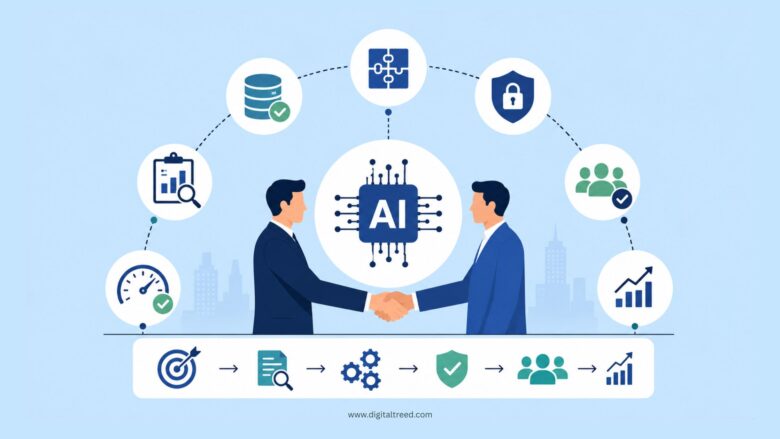
Those questions are shaping how organizations evaluate AI services for enterprises. Instead of chasing the newest model, they’re looking for partners who understand how AI fits into day-to-day business operations and can deliver results long after the pilot phase is over.
The Flashiest Demo Rarely Wins
Enterprises aren’t buying AI for the novelty anymore. They’re investing to solve business problems, whether that’s reducing customer support costs, improving forecasting, automating repetitive work, or helping employees make better decisions.
A polished proof of concept might get a foot in the door, but it won’t close the deal.
Decision-makers want evidence that an AI solution can handle real-world complexity. That means working with messy data, fitting into existing workflows, and delivering consistent performance over time.
The conversation has shifted from “What can your AI do?” to “What can your team help us achieve?”
Your Data Matters More Than Your AI Model
AI is only as useful as the data behind it.
Many organizations still deal with information spread across CRMs, ERPs, cloud platforms, spreadsheets, and legacy systems. If those systems don’t communicate well, AI won’t have the context it needs to produce reliable results.
That’s why enterprises increasingly value partners with strong data engineering and integration expertise. Connecting data sources, improving data quality, and establishing governance often create more business value than introducing another large language model.
Without that foundation, even the most advanced AI struggles to deliver meaningful outcomes.
Governance Has Moved Into the Spotlight
For many organizations, the biggest question isn’t whether AI works. It’s whether they can trust it.
Teams want to know who approved an AI-generated recommendation, whether outputs can be audited, and how sensitive information is protected. These concerns have become even more important as businesses begin adopting AI agents that can complete multi-step tasks with minimal human input.
A good AI partner builds governance into the solution from the beginning instead of treating it as something to add later.
That includes:
- Clear audit trails
- Human review where needed
- Responsible AI policies
- Compliance with industry and regional regulations
- Ongoing monitoring after deployment
Governance may not be the most exciting part of an AI project, but it’s often what determines whether that project earns long-term trust.
Integration Is Becoming a Bigger Differentiator
AI doesn’t operate in isolation.
It needs to connect with the tools employees already use every day. Customer information, financial data, operational metrics, internal documents, and business applications all need to work together.
That’s why enterprises are paying closer attention to implementation capabilities rather than model capabilities alone.
An experienced partner should be able to integrate AI with existing technology instead of forcing organizations to rebuild their entire ecosystem.
When integration is done well, AI feels like a natural extension of the business rather than another disconnected platform.
Looking Beyond the First Six Months
Many AI initiatives start with a pilot. Far fewer make it into everyday business operations.
The difference often comes down to whether the implementation was designed for long-term adoption.
Enterprises now evaluate partners based on questions like:
- Can this solution scale across multiple teams?
- How will performance be measured?
- What happens when business requirements change?
- How will new AI models be introduced over time?
- Who manages updates, monitoring, and optimization?
These conversations reflect a growing understanding that AI isn’t a one-time implementation. It’s an ongoing capability that needs continuous improvement.
Security Is No Longer a Separate Conversation
As AI adoption grows, so do concerns around security.
Organizations are becoming more cautious about how proprietary data is handled, who has access to AI systems, and whether outputs can be traced back to their sources. According to recent industry research, AI-related security incidents have become increasingly common, making governance and security central to enterprise AI strategies.
That’s why security discussions now happen alongside architecture and implementation planning instead of after deployment.
The strongest AI partners don’t treat security as a feature. They build it into every stage of the engagement.
The Best Partners Solve Business Problems First
Technical expertise still matters, but enterprises are placing equal importance on business understanding.
The right partner asks questions about operational challenges before recommending technology. They take time to understand existing processes, identify opportunities with measurable impact, and recommend solutions that fit the organization’s goals instead of forcing a one-size-fits-all approach.
That mindset often leads to better adoption because the technology supports the business rather than asking the business to adapt to the technology.
Final Thoughts
Choosing an AI partner has become less about finding the latest technology and more about finding the right combination of technical expertise, business understanding, governance, and long-term support.
As AI becomes part of everyday operations, enterprises are raising the bar for the partners they work with. They want solutions that integrate smoothly, protect sensitive data, scale with the business, and continue delivering value well beyond the first deployment.
