

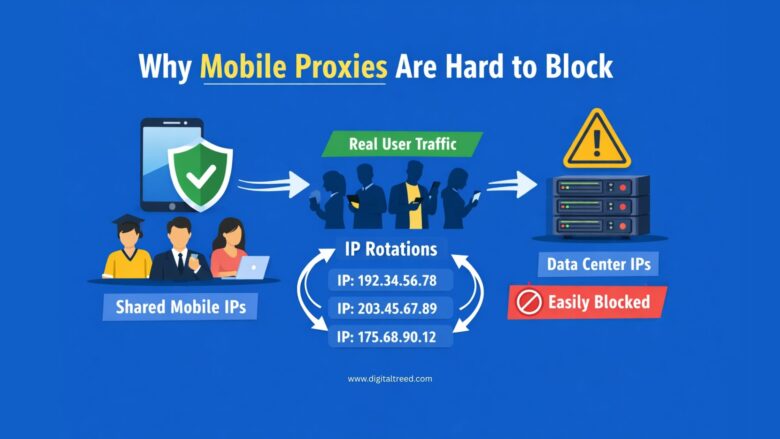
Mobile carriers constructed their networks to reach billions of people, not to make the most undetectable proxies over the internet. Yet that is precisely what has happened.
The way carriers assign, share, and rotate IP addresses throughout their networks has resulted in infrastructure that anti-fraud systems are structurally unable to block without also bringing down legitimate users. Something that no proxy provider could have ever created.
Nobody planned this. It’s just how the math worked out.
Why Carriers Shared IPs in the First Place
It was not a strategic move, it was a resource issue.
IPv4 addresses are limited. They number about 4.3 billion, and by the time smartphones had achieved mainstream, the number had almost dried up. Carriers were not able to allocate a special IP to each device in their network because there were not enough addresses to be distributed.
This resolution was NAT, Network Address Translation. Carriers used to provide one IP to thousands of devices at once instead of providing each device with a public IP. At any time, your phone, the phone of your neighbor, and hundreds of strangers who are in the same network may all be using the same public-facing address.
It addressed the issue of scarcity. When thousands of legitimate users share an IP, blocking that IP becomes a very different calculation, which is what no one predicted would happen to how websites identify and trust traffic.
The Mathematical Impossibility of Banning a Cellular IP
It is easy to block a datacenter IP. A single IP, a single server, no actual users. The probability of a false positive is practically zero.
It is another issue to block an IP of a mobile carrier.
Each IP of a large carrier network may have hundreds to tens of thousands of active users simultaneously. Blocking the IP will not block a single suspicious request, it will block out a large portion of legitimate mobile traffic. That is an unacceptable trade-off to any site that is concerned with user experience.
The numbers make it worse. Large carriers change IPs among their users on a regular basis. An IP flagged at 9 am may be serving a completely different group of users at 9:05 am. Before a blacklist is updated, the IP has already passed through dozens of legitimate users and moved on.
That is why the majority of the anti-fraud systems do not even strive to hard-block cellular IPs. The price is too high and the time to act is too small. The numbers just do not add up in favour of the blocker.
How Anti-Fraud Systems View Mobile Traffic vs. Data Centers
Anti-fraud systems do not treat all traffic the same, and mobile traffic is at the top of the hierarchy of trust.
Datacenter IPs Start With a Trust Deficit
Datacenter IPs can be profiled with ease. They are based on familiar server infrastructure, bear no relationship to actual consumer devices, and are frequently listed on shared blacklists prior to their use. Every request from a datacenter IP begins at a disadvantage that is hard to get past.
Mobile IPs Operate in the Opposite Position
A mobile IP proxy is related to the actual devices, actual SIM cards, and actual consumer behaviour. Anti-fraud systems are aware of this, and when a mobile IP is flagged, there is a danger that thousands of honest people using the same carrier address will have been blocked, so the action threshold is much greater.
The Signals That Trigger Blocks Don’t Apply
Abnormal ASN ownership, datacenter WHOIS entries, absence of browser history, and absence of cookie profile are the indicators that generally indicate suspicious traffic. None of them apply to mobile carrier IPs. Even a carrier address request looks just like it is: an actual human being on an actual phone.
A Structural Advantage That Can’t Be Patched
That is not a loophole in that asymmetry in trust between mobile and datacenter traffic. Until carriers stop using NAT networks, there will be some degree of inherent trust in mobile traffic that no datacenter infrastructure can ever reproduce.
Why Mobile Users Are Never Truly Alone on an IP
In a datacenter proxy, the IP is in a single entity. It is part of everybody on a mobile carrier network.
A single carrier IP could be shared between a student watching a video, a commuter checking his bank balance, and hundreds of others doing absolutely normal things on the internet at any one given point in time. The traffic that flows out of that IP is heterogeneous, random, and cannot be distinguished by normal human behavior.
That is the issue with the fraud detection systems. It is not possible to detect suspicious activity on a shared carrier IP in a clean manner, without catching legitimate users in the same sweep. The outlier is always hidden within a crowd of actual people, and that crowd never leaves.
Why Traditional Blacklists Fail Against Rotating Mobile Pools
Blacklists work on a simple principle – flag a bad IP, block it, move on. That model fails miserably in the case of mobile carrier pools.
Carrier IPs are not permanent. They spin around on thousands of devices on the network. By the time an IP is marked and placed on a blacklist, it has been recycled to a new user, and in many cases, many dozens of times. The blacklist is continually pursuing an IP that has since been processed.
It is worse because of the pool itself. The large carriers have hundreds of thousands of IPs that are rotated. Even a blacklist that could keep pace with the cycling would have been unable to cover the number of addresses. There is never a dirty IP in the pool.
The old method of blacklisting was developed on fixed infrastructure. Mobile carrier networks are the opposite of that, and they were never going to work against each other.
Is Your SIM Card the Ultimate Proof of Personhood?
In a way, yes.
The acquisition of a SIM card would entail physical validation. You enter the shop, present your ID, and subscribe to a plan. No datacenter IP or VPN can emulate that, there is a real human being behind the process.
This is what anti-fraud systems are aware of. A carrier network traffic has an implicit indication that a real person is operating a real device behind the request. Such a signal is hard to counterfeit and almost impossible to create in large quantities using any alternative method.
That is why mobile proxies are now the most reliable choice when it comes to the tasks that are supposed to be legit. The carriers constructed their networks to bring people together, and in doing so, they unwillingly formed the closest thing the internet has ever had to an authenticated human identity.
