

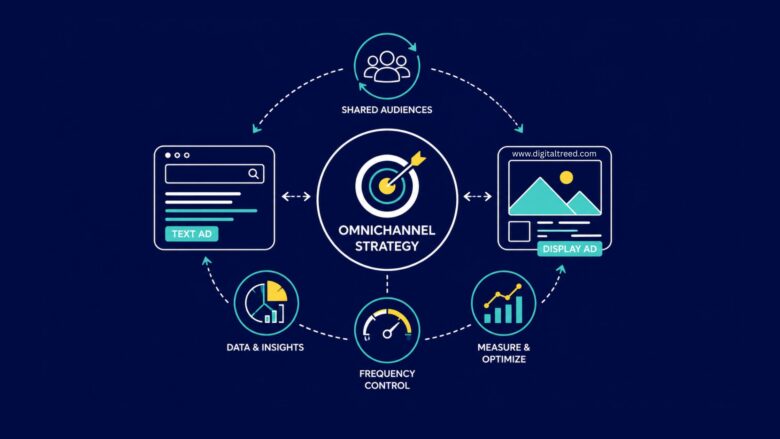
Many brands maintain search and display as distinct budgets overseen by uncommunicative individuals. This is multichannel, not omnichannel, and there is potential revenue being overlooked. Entities with solid omnichannel interactions keep roughly 89% of customers on average while the rate drops to 33% for those with poor cross-channel coordination (Aberdeen Group) – that’s almost three times the retention rate, simply by facilitating communication between the channels. This is not about running additional ads. It’s about ensuring that the ads you currently stream are directed at the same user, with the same message and purpose.
Multichannel isn’t omnichannel
Multichannel refers to a search campaign and a display campaign coexisting and operational. Omnichannel refers to those two campaigns being aware of each other’s existence. The search campaign is informing the display campaign. The display campaign is outreaching what the search campaign missed. A user who clicked a text ad on Tuesday and didn’t convert should ideally see a display banner on Thursday featuring the same messaging, not a generic brand awareness spot that happens to be in the rotation that week alongside search. The budget was already spent to get that person to your website two days ago. Why save the display spend for someone else?
It’s an important distinction to make as I think most modern marketing departments are already set up budget and operations-wise for an omnichannel approach, they just don’t know it. The alignment doesn’t require more ad spend, it requires sharing an audience list. It doesn’t require two creative briefs, just one. Only one monthly recurring meeting instead of two. Only one report.
Give text and visual ads different jobs
Search ads capture individuals with pre-existing needs. When a person enters a specific search term into a search bar, there is a clear intention, and paid search ads are designed to capitalize on that intention as quickly as possible, before a competitor does. On the other hand, display ads capture individuals earlier or later in the buying process. They create awareness before someone begins searching for a product or service, and retarget those individuals who have searched but didn’t make a purchase.
The mistake happens when businesses view search and display ads as direct competitors for the same sale. They’re not in competition with each other. Search ads close the sale, while display ads set the groundwork for a sale and help you get back those sales that slipped through the net. If you evaluate the success of a display ad using the same KPIs as a search ad, you will probably cut your display ad’s budget every time, and you’ll be making a mistake. Instead, view your customer’s buying process in a more continuous manner, where one leads naturally to the other.
Build one creative framework, not two
If the language, colors, and offer structures of your search ad copy and your display banners are nothing alike, you’re forcing a user to see your ad and like your message enough to remember you… and then start the process over with a visually and linguistically different ad. Wasted memory for them and wasted money for you.
Decide on one look/feel before you let either team start writing headlines or designing banners. Settle on a message you think will resonate, paint your time within a set color palette or emotional range, then form Text Ads and Display Creative versions of each ad that shares nothing but the underlying message and those visual/language guidelines. They can’t both say exactly the same thing in the same way (nobody likes ads screaming “copy-paste!”), but they should register as part of the same deployment if someone sees both within a week.
Share your audience data across channels
Retargeting is the most direct way to connect your text and visual ads, and most teams could do better using it. For instance, someone who has clicked a search ad and bounced is a warmer lead than someone who has never engaged with you at all. Therefore don’t neglect to immediately include these leads in your display retargeting pool, instead of waiting until the end of the week for the export that somebody often forgets to make.
The relationship operates in reverse, as well. If display has already provided a solid reach and hit frequency among a segment, you may not need to continue paying top dollar for those branded search terms within the same segment because the awareness is there. Audience overlap is a thing, and if you’re not deduping your lists and your planning across the two formats, you’re throwing money at the same people and crossing your own messages in passing instead of playing them out in a concerto.
To stretch your reach over the long tail of publishers, trafficking your visual creatives through programmatic display networks rather than just the two or three biggest platforms is a better way to go. The more inventory you’re across, the more lower-CPC scale you have to spread your retargeting and awareness plays over.
Cap frequency across the whole system
Frequency capping is typically done per platform. The search team caps their impressions, the display team caps theirs, and no one caps the total number of impressions from both that any single user sees. So, a person might view your ad fifteen times in a week between two channels and begin to view your brand as irritating instead of engaging.
Cap frequency at the user level, across the entire stack. This necessitates cross-device monitoring. The same person searches on their phone and on their laptop, and if you’re not combining those touchpoints under one user, then you’re not actually capping anything. When you can see total exposure per user, estimate how many impressions it takes before sentiment starts to turn, then make sure that’s your cap. This minimum level stays the same whether they arrive by search or display. Your brand sentiment lasts longer when consumers determine how frequently they encounter you.
Let search data steer your display themes
There is a lot of valuable information that your search campaigns have but your display campaigns aren’t using: the actual search phrases people use when seeking your product or service. These high-intent search phrases can provide an excellent starting point for language to use in your display banner ads. If you already have specific ad copy phrases or benefits that have proven successful in generating clicks and conversions in your text ads, test them in your display ads. This closes the gap between what users are actively looking for and what they see passively while browsing. You’re recycling proven language into a new format instead of starting from a blank creative brief every quarter.
Fix attribution before you fix budget
Giving credit only to the last ad click before a purchase isn’t fair. The last ad clicked is often a re-engagement search ad. Re-engagement display ads, and broad reach awareness display ads, may not be the final click in. But they are the first. And that deserves some credit, doesn’t it? Attribution models sound like black magic. They’re not. You can use a data-driven model that uses your own conversion data to weight each channel’s real contribution, and at least appreciates that the first and last click both matter. Or you can use a position-based model that simply spreads the credit over the touch points.
Structure your campaigns like one funnel
Text and display campaigns are frequently stored in distinct structures within your ad platforms. They use different conversion tracking and various remarketing lists. This separation may prevent you from breaking down the internal silos, even though you have already addressed the creative and attribution aspects of the campaigns.
Create common remarketing lists shared by both campaign types. Both campaign types should contribute to and derive benefits from these lists. Configure conversion tracking in such a way that a conversion from a single customer journey – regardless of whether it started with a search click or a display impression – is recorded as one conversion and not two separate ones. This is a preparatory task that will not require constant attention, but it is the key component that makes everything else described here work in reality.
Track blended ROAS, not channel-by-channel wins
When campaigns are structurally paired, you’ll also need to change the way you measure the performance to make that work. Stop asking “how did search do” and “how did display do” which are separate questions. Ask how the pairing did: search and display targeting the same offer, same audience, same window of time, measured as one number.
Blended return on ad spend (ROAS) tells you whether the combined system is working, which is the only question that actually matters to whoever’s approving your budget. A display campaign that shows a mediocre standalone ROAS might be the reason your search campaign’s ROAS looks great, it pre-warmed the audience search then closed. Judge the pairing and reallocate budget based on that combined figure instead of starving the channel that looks weaker in isolation.
Prove it with a controlled test
Doubtful stakeholders won’t believe that “display supports search” on faith, and they shouldn’t have to. Run a proper test. Select a segment, pause display ads to create a control group, continue running display for a matching test group, and keep all else the same. Measure search and total conversions for both groups over a period.
If the group that still sees display performs better than the one that doesn’t, you’ve got an indisputable, incremental lift number, developed internally, with your actual customers, on your actual prospects, trading your actual media. Budget grumbling stops faster than with any attribution model, because you’ve tested display’s direct contribution rather than estimating it.
Crossing the streams on search and display isn’t a project. It’s a discipline: shared audiences, one creative brief, one frequency cap, one model, one number. Get those five things straight and the two channels stop fighting each other and start supporting each other.
