

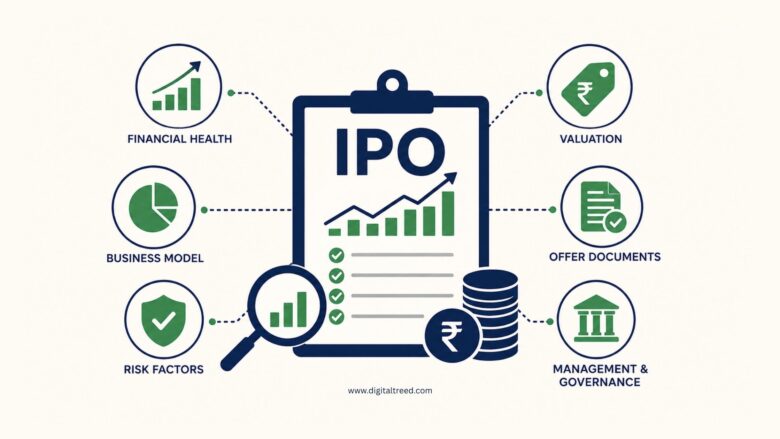
Investing in a newly listed company can be exciting, particularly when an initial public offering (IPO) attracts strong market attention. However, popularity alone does not make an IPO a suitable investment. New listings can offer growth opportunities, but they can also carry considerable uncertainty because investors have limited public-market history to evaluate. Before committing capital, investors should examine the company, its financial position, industry prospects, valuation, risks, and the purpose behind the issue. Reviewing an upcoming IPO list can help investors identify opportunities, but careful analysis is essential before making any investment decision.
Understand What the IPO Represents
An IPO allows a privately held company to offer its shares to the public for the first time. The funds raised may be used for business expansion, debt repayment, acquisitions, working capital, or other corporate purposes. Understanding how the proceeds will be used can provide useful insight into the company’s priorities. Investors should distinguish between fresh shares issued by the company and shares offered for sale by existing shareholders. A fresh issue generally brings capital into the business, while an offer for sale primarily allows existing investors or promoters to reduce their holdings. Neither structure is automatically better, but the difference can influence how an investor views the offering.
It is also useful to study why the company is choosing to enter the public market at that particular stage. Expansion plans, capital requirements, investor exits, or broader strategic objectives can all provide context.
Examine the Company’s Financial Health
Financial performance should be one of the most important considerations when evaluating an IPO. Investors should review revenue growth, profitability, operating margins, cash flows, debt levels, and return ratios over several reporting periods rather than focusing on a single year. Consistent revenue growth may indicate increasing demand, but revenue alone does not establish financial strength. A company can grow sales while continuing to generate weak profits or negative cash flows. Examining operating cash flow alongside reported earnings can therefore provide a more complete picture.
Debt also deserves careful attention. High borrowing can increase financial pressure, particularly when interest rates rise or business conditions weaken. Investors should consider whether the company generates sufficient cash to meet its obligations while continuing to fund operations and expansion.
Study the Business Model and Growth Potential
A promising IPO should have a business model that investors can understand. Consider how the company generates revenue, who its customers are, what differentiates its products or services, and whether those advantages can be maintained as competition increases. Growth potential should also be assessed realistically. A company operating in a rapidly expanding industry may have significant opportunities, but favourable industry conditions do not guarantee individual success. Investors should examine market size, customer demand, competitive intensity, regulatory developments, and barriers to entry. It is equally important to understand whether growth depends heavily on one customer, supplier, product, geographic market, or business segment. Greater concentration can create additional risk if circumstances change.
Evaluate the IPO Valuation
A strong company can still be an unattractive investment if its shares are priced excessively. Valuation is therefore a critical part of IPO analysis. Investors can compare the proposed valuation with established listed companies operating in similar industries. Common measures include the price-to-earnings ratio, price-to-sales ratio, enterprise-value-to-EBITDA ratio, and other sector-specific metrics.
However, comparisons should be made carefully. A younger company with faster growth may reasonably command a higher valuation than a mature competitor. Conversely, a company with slower growth, weaker margins, or greater financial risk may not justify a premium. The objective is not simply to find the cheapest IPO. Instead, investors should determine whether the proposed price appears reasonable relative to the company’s earnings potential, financial quality, competitive position, and future prospects.
Read the Offer Documents Carefully
IPO documents contain information that may not be obvious from advertisements, media coverage, or market discussions. Investors should review the company’s business description, financial statements, risk factors, promoter or management details, litigation disclosures, related-party transactions, and use of proceeds. Risk disclosures deserve particular attention. They may highlight regulatory dependence, customer concentration, supply-chain vulnerabilities, legal disputes, technology risks, or exposure to changing market conditions. Rather than treating these sections as routine legal language, investors can use them to identify potential weaknesses. A company that openly explains its challenges may provide a more balanced picture than promotional material alone.
Assess Management and Corporate Governance
Leadership plays a significant role in determining how effectively a company uses public capital. Investors should examine the experience and track record of senior management and promoters. Questions worth considering include whether management has successfully operated through different business cycles, whether previous expansion initiatives delivered results, and whether the leadership team has relevant industry expertise.
Corporate governance is equally important. Investors should look for transparent disclosures, appropriate board structures, responsible related-party dealings, and a history of regulatory compliance. Governance concerns can become significant long-term risks even when a company’s financial results initially appear attractive.
Create an Investment Checklist
Before investing, it can be helpful to create a simple checklist covering financial performance, valuation, debt, business quality, management, competitive position, industry outlook, risk factors, and the intended use of IPO proceeds. Investors should also decide how much capital they are comfortable allocating and whether the investment fits their overall portfolio strategy. Diversification remains important because even well-researched IPOs can perform differently from expectations. Most importantly, investors should be prepared to walk away. Not every attractive-looking IPO needs to be part of a portfolio.
Conclusion
Evaluating an IPO requires more than checking subscription levels or following market enthusiasm. Investors should study financial statements, understand the business model, assess valuation, review risks, examine management quality, and consider broader market conditions before making a decision. A carefully researched upcoming IPO list can serve as a starting point for identifying potential opportunities, but each company should be evaluated independently. By combining structured research with disciplined risk management and realistic expectations, investors can make more informed decisions instead of allowing short-term excitement to drive their investment choices.
