

Quick answer
As of November 2026, Pew counts 97% of US adults online, and the FBI's IC3 logged $20.877 billion in reported internet crime losses for 2025. The teen harm data shows links rather than proven cause, and the CDC says so in its own report. The family and business steps near the end target the biggest measured losses.
If you're a parent who also runs a shop, the benefits and dark sides of the internet reach you twice: through your kids' phones and through the shop's email. A dark side of the internet is a harm that travels over the same connection as a benefit, such as a fake invoice beside the online orders.
First comes what the internet gives Americans and who still gets less of it. Then we count the dark side in dollars from FBI data, ask whether social media harms teens, and show which numbers we could check. The last two sections give steps for a family and for a shop or office. Our view: the money losses call for action now, while the teen data calls for rules and talk, not panic.
Key takeaways
- IC3 logged $20.877 billion in reported internet crime losses for 2025.
- The CDC says its teen survey cannot show social media causes harm.
- Pew counts 97% of US adults online and 78% with home broadband.
- Home broadband reaches 57% of adults under $30,000 versus 92% at $100,000+.
- Business email compromise averaged about $123,005 per IC3 complaint in 2025.
What the internet gives Americans, in numbers
Pew Research Center's internet and broadband fact sheet says "Today, 97% of U.S. adults say they use the internet." It also finds that 78% subscribe to home broadband. Pew ran that survey from January 30 to June 18, 2026, by web, mail and phone. The NTIA Internet Use Survey, run with the Census Bureau, counts everyone ages 3 and older: 83% used the internet in 2023, up from 80% in 2021.
In 2021, 37.0% of US adults used telemedicine in the past 12 months, according to the NCHS data brief on telemedicine. Use was higher among women (42.0%) than men (31.7%). It also rose with age, from 29.4% of adults 18 to 29 to 43.3% of those 65 and over. That brief covers a pandemic year, and it doesn't say whether video visits replaced office visits or added to them.
For a shop owner, the Census Bureau's quarterly retail e-commerce report puts US online retail sales at $340.2 billion for the second quarter of 2026, seasonally adjusted. That was 17.1% of all retail sales. Online sales grew 12.2% from a year earlier, while total retail grew 6.7%.
In Pew's fall 2024 survey on teens and mental health, 74% of teens said social media makes them feel more connected to their friends.
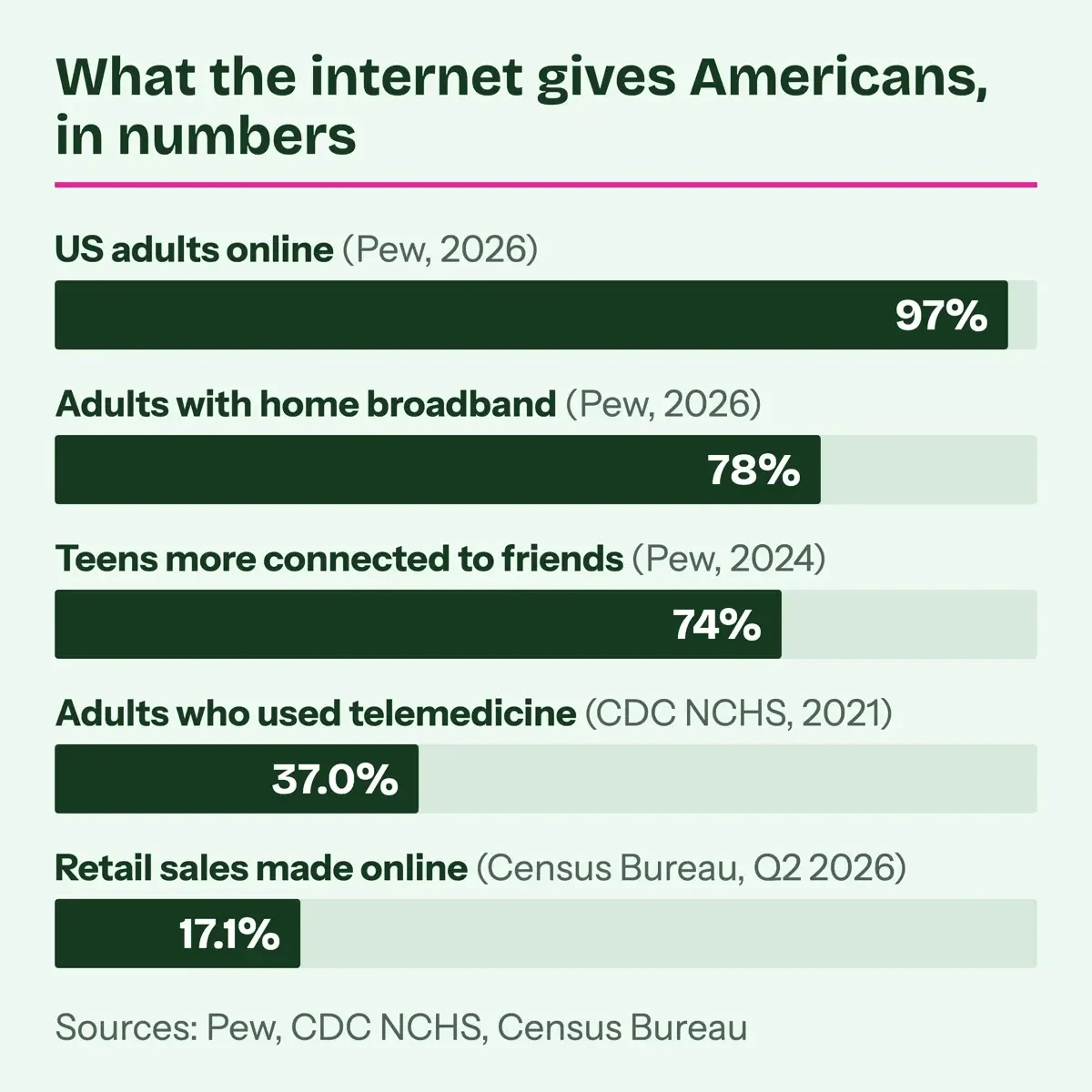 Source: Pew Research Center (2025, 2026), CDC NCHS (2021 data) and Census Bureau (Q2 2026). Chart drawn by us.
Who still gets less of it
The same Pew fact sheet shows the gaps behind the 97%. In its 2026 data, 57% of adults in households earning under $30,000 have home broadband, against 92% of those earning $100,000 or more. That's a 35-point gap. Many lower-income adults lean on a phone instead: 29% of them are smartphone-only, compared with 7% at $100,000 or more and 16% of all adults.
Pew's 2026 figures also split home broadband by place: 84% in suburbs, 75% in cities and 72% in rural areas, a 12-point gap between suburbs and rural places. The FCC's 2024 Section 706 broadband report points to supply as one cause. It found about 24 million Americans lacked access to fixed broadband at 100/20 Mbps as of 2022, including about 28% of people in rural areas. A family in that 28% can't fix the gap by switching plans, because the faster line isn't there to buy. NTIA's survey found 12% of people lived in households without any internet connection in 2023, down from 14% in 2021.
If a phone is your only line, our piece on free phones through Lifeline and SNAP covers it; for home lines, read broadband types.
The dark side in dollars: what the FBI counted in 2025
The FBI's 2025 Internet Crime Report counts 1,008,597 complaints to IC3, its online crime complaint desk, and $20.877 billion in reported losses. That's an average of $20,699 per complaint. The 2024 report counted 859,532 complaints and $16.6 billion. By our math, complaints rose 17.3% and losses 25.8%, which IC3 rounds to 26% (20.877 minus 16.6, divided by 16.6).
Phishing and spoofing drew the most complaints of any crime type in 2025, with 191,561, more than twice the next type, extortion, at 89,129.
Investment fraud was the largest piece. IC3 puts 2025 investment fraud losses at $8,648,617,756, more than 40% of the total. Losses also fell hardest on older adults. People 60 and over filed 201,266 complaints and lost $7.7 billion, which is 36.9% of all reported losses by our math (7.7 divided by 20.877). That's about $38,258 each. Complainants under 20 filed 31,254 complaints and lost $67.1 million, or about $2,147 each. So the average loss per complaint for people 60 and over was nearly 18 times that for people under 20 (38,258 divided by 2,147).
Social media is a common first contact. Per the FTC's April 2026 Data Spotlight, "nearly 30% of people who reported losing money to a scam said it started on social media" in 2025. Losses hit $2.1 billion. Shopping scams were the most reported kind on social media. For job pitches, our guide to earning money online at home without job scams lists the FTC's red flags. The FTC adds that "since most scams aren't reported to the government, the real losses are likely much higher." IC3's data notes say "Statistics are an assessment taken at a point in time, which may change." They also say complainants don't have to give an age, so the age tables leave some reports out.
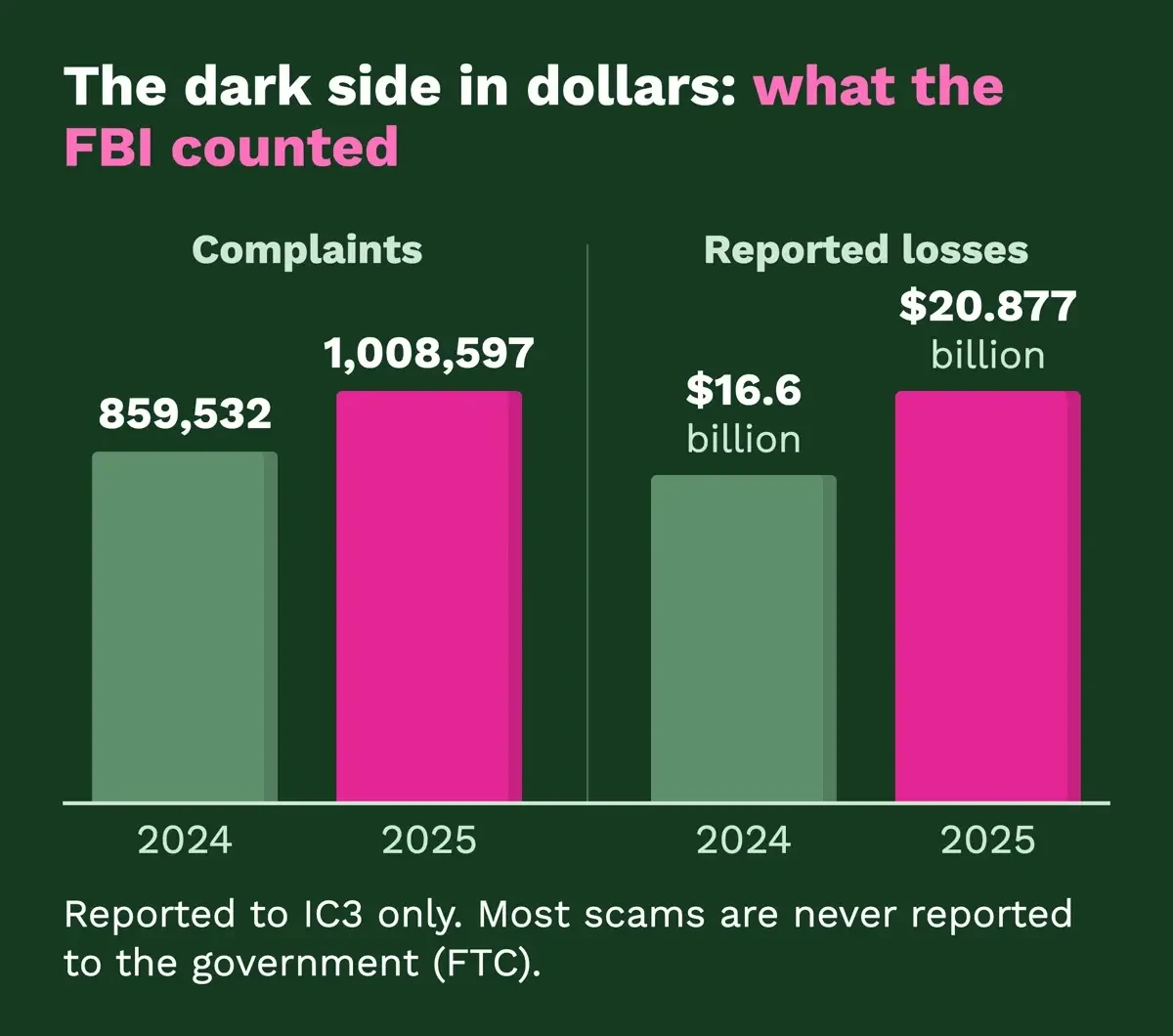 Source: FBI IC3 Internet Crime Reports for 2024 and 2025. Chart drawn by us.
Does social media harm teens, or do the numbers only travel together?
Pew's December 2025 survey of 1,458 teens found "Nearly all U.S. teens (97%) say they use the internet daily, including four-in-ten who say they are almost constantly online." It also found that 36% are almost constantly on at least one of YouTube, TikTok, Instagram, Snapchat or Facebook.
Teens see a cost, mostly in other people. In Pew's mental health survey, 48% said social media has a mostly negative effect on people their age, up from 32% in 2022. Only 14% said so about themselves. Some 45% said they spend too much time on it. Girls were more likely than boys to say it hurt their sleep (50% vs. 40%) and their mental health (25% vs. 14%).
The CDC measured use and harm in the same students. Its report on the 2023 Youth Risk Behavior Survey found that 77.0% of US high school students use social media at least several times a day. Those frequent users more often reported being bullied, feeling persistently sad or hopeless, and suicide risk. The CDC's 2023 survey results page lists the same three findings.
The CDC states the limit itself: "causality and directionality of associations between frequent social media use and health behaviors and experiences cannot be established." The survey is cross-sectional, a single snapshot of 20,103 students, and 15,203 of them answered the social media question. A snapshot like that can't tell whether heavy use leads to sadness or whether sad teens use social media more. The report lists other limits too. The survey's examples of social media weren't a full list of apps, and students who don't use social media were grouped with light users.
The Surgeon General's 2023 advisory goes a step further. Its HHS page on social media and youth mental health covers children and adolescents who spend more than 3 hours a day on social media. It says they "face double the risk of mental health problems including experiencing symptoms of depression and anxiety." That is a risk estimate for a group, so it can't say what will happen to one child.
Cyberbullying is measured more directly. The CDC's page on bullying says "More than one in six high school students reported being bullied electronically in the past year including through texting and social media." The FBI's 2025 report adds that IC3 "referred more than 5,700 submissions involving minors" to NCMEC, the national center for missing and exploited children.
For complainants 17 and younger, IC3 lists extortion as the top complaint type in 2025, with 5,151 complaints.
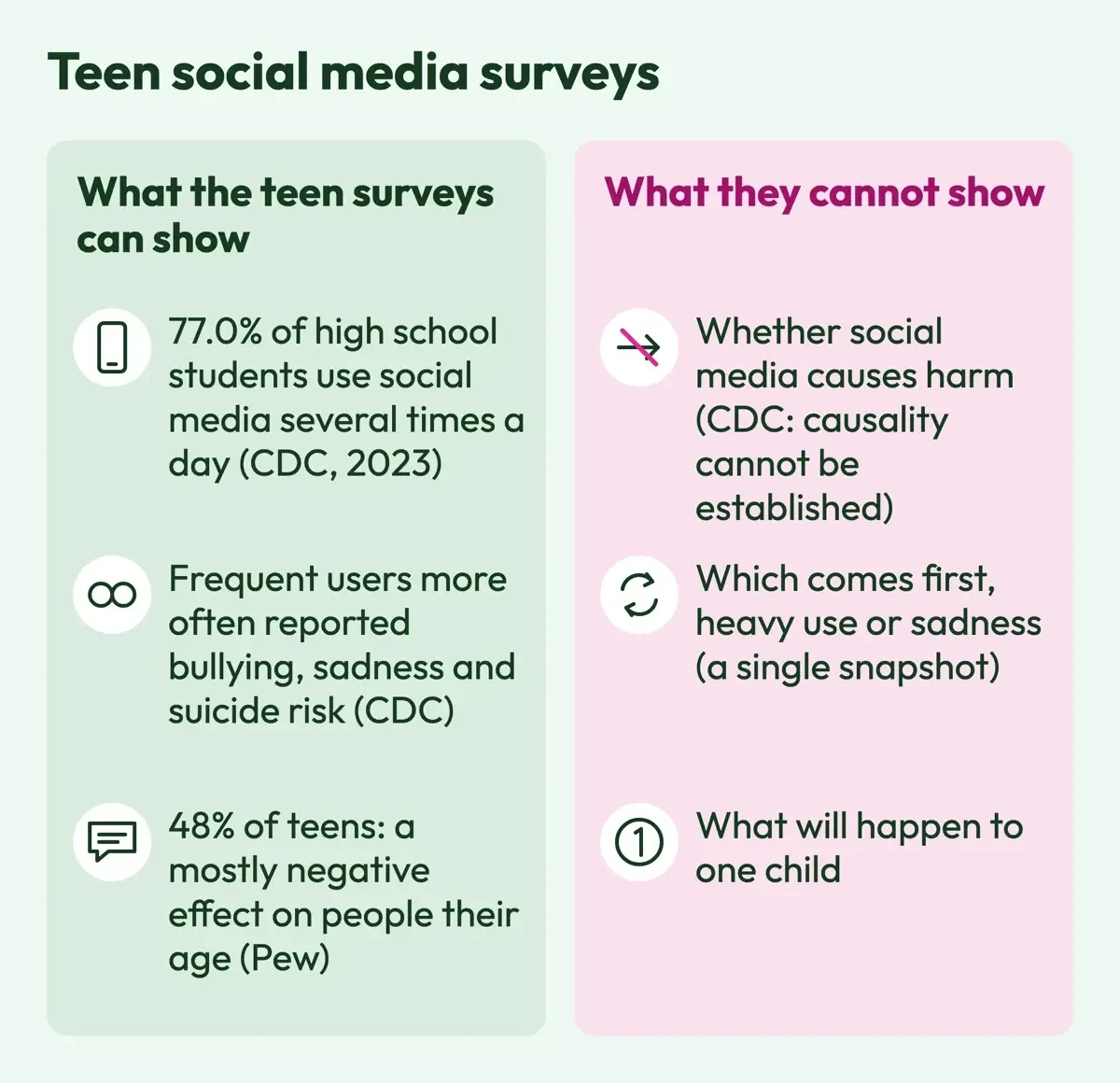 Diagram by DigitalTreed, from the CDC MMWR report on the 2023 YRBS and Pew teen surveys, read November 13, 2026.
Which numbers we could check, and which we could not
Before trusting these figures, we checked 48 of them against the pages they came from on November 13, 2026. Our script fetched every public page with a plain GET request that named us as DigitalTreed-check/1.0. It saved the text, then searched it for the exact words or numbers we use. The table groups the 48 claims by source.
| Source | Claims | Matched | Result |
|---|---|---|---|
| Pew Research Center: internet and broadband fact sheet | 7 | 7 | All matched word for word |
| Pew Research Center: two teen surveys | 9 | 9 | All matched word for word |
| NTIA Internet Use Survey (2023 results) | 3 | 3 | All matched word for word |
| FCC 2024 broadband report (PDF) | 3 | 3 | All matched word for word |
| CDC: telemedicine brief, YRBS report and bullying page | 6 | 6 | All matched word for word |
| Census Bureau e-commerce report | 3 | 3 | All matched word for word |
| FBI IC3 2024 and 2025 reports | 13 | 13 | All matched word for word |
| FTC Data Spotlight on social media scams | 2 | 2 | All matched word for word |
| Surgeon General's 2023 advisory (hhs.gov) | 2 | 0 | Script got 403; we read the HHS page in a browser instead |
Of 48 claims, 46 matched word for word. The 2 that didn't are both on hhs.gov, which returned a 403 error to our script. A 403 means a site refused an automated request, and it says nothing about the content.
So we read the Surgeon General's HHS page in a browser on November 13, 2026, and quote it as written.
Two other sites turned us away. StopBullying.gov returned a 403, and the National Library of Medicine's book site showed a reCAPTCHA page, so we stopped and used CDC pages instead. The FCC's main site also refused our script, but the report PDF on its document server opened, and every FCC figure here comes from that PDF.
The same script searched five saved pages for what each says about cause and coverage; hhs.gov refused it.
| Source | What it says about cause or coverage |
|---|---|
| CDC report on the 2023 youth survey | Calls the survey cross-sectional and says causality "cannot be established" |
| CDC 2023 youth survey results page | Lists bullying, sadness and suicide risk as more common with frequent use; no cause claim |
| Pew teen and mental health survey | Reports what teens say about social media, not measured health outcomes |
| FBI IC3 2025 report | Says its statistics "may change" and that complainants need not give an age |
| FTC Data Spotlight | Says most scams are never reported to the government |
| Surgeon General's advisory | Not scanned: hhs.gov returned 403 to our script; we read its page in a browser for the quote only |
Dividing $20.877 billion by 1,008,597 complaints gives $20,699, the same average IC3 prints, so our math matches the report's.
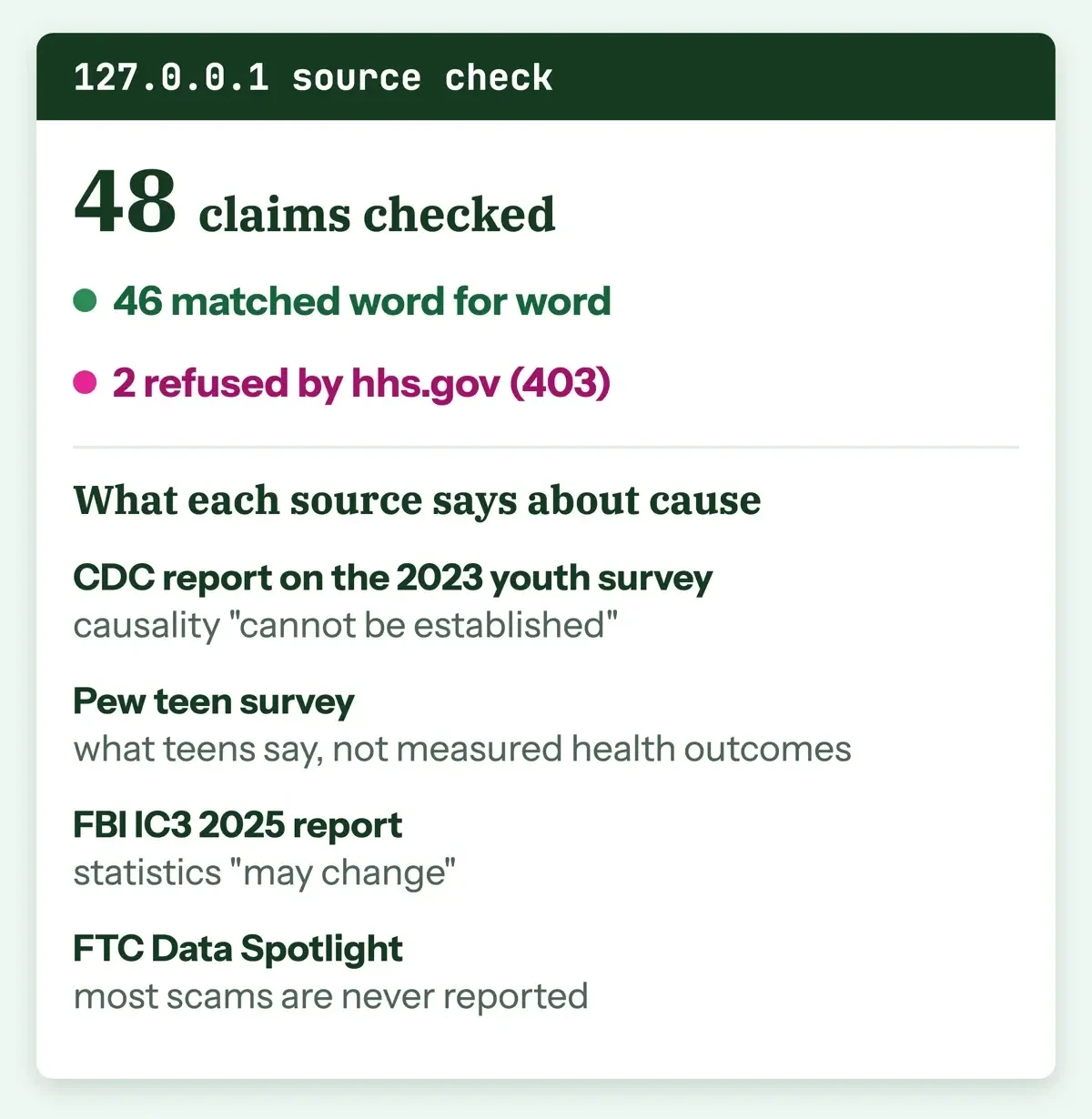 Drawn by us, from our source check run on 127.0.0.1 on November 13, 2026.
What we tested
We ran one Python script over 13 saved public pages on November 13, 2026, then opened its report on 127.0.0.1. It matched 46 of 48 claims and recomputed the 10 averages, shares and gaps we print. Nothing needed a login.
Steps for a family
In its guide to parental controls, the FTC puts a talk before any tool: there's "really no substitute for talking with your kid about your family's rules and expectations." It lists five things most control tools let you do:
- Set how much time your kid spends online.
- Restrict the type of content your kid can see.
- See which websites and apps your kid uses.
- Limit who your kid can talk to.
- Restrict purchases.
The FTC names Apple's Family Sharing for iPhone and iPad, Google's Family Link for Android and Chromebook, and Microsoft Family Safety for Windows and Xbox. It warns that controls "need to be set up on all the devices your kid uses." It also notes, "There are many free parental control tools and apps available." If you've lost the code on an Apple device, our guide to resetting a forgotten Screen Time passcode follows Apple's own reset. Our piece on protecting children from online predators deals with contact from strangers. For younger kids, the Children's Online Privacy Protection Act "gives parents control over what information websites can collect from their kids," in the FTC's words.
We'd start with phones at night, because half of the teen girls in Pew's survey said social media hurt their sleep. Then secure the adults' accounts. CISA's four core steps for everyone are to avoid and report phishing, use strong passwords, use multifactor authentication with a password manager, and update software.
If a scam or threat reaches anyone at home, file with the FBI's IC3 and with the FTC at ReportFraud.ftc.gov.
Steps for a shop or office
IC3's 2025 report describes business email compromise as "official-sounding emails mimicking a company's CEO or other officials" that can carry phishing links or wire instructions. In 2025 it drew 24,768 complaints and $3,046,598,558 in losses. That's about $123,005 per complaint by our math (losses divided by complaints) and 14.6% of all reported losses. We'd keep the bank's fraud line next to whoever pays invoices. We'd also confirm any change in payment details by phone, on a number you already had.
For a wire that already went out, IC3's guidance reads: "If you discover a fraudulent transfer, time is of the essence." It says to contact your bank right away "and request a recall of the funds."
CISA's guidance for small businesses says which defenses come first. It calls FIDO "the only widely available phishing resistant authentication," built into the browsers and phones you already use. Even text-message codes help, CISA says. It also tells owners to "regularly test partial and full restores" of backups, to remove administrator rights from staff laptops, and to turn on automatic updates where possible. CISA asks for that test because some organizations hit by ransomware found restoring their data took far longer than expected.
The FTC's cybersecurity basics for small business repeat the backup advice: "Make it a habit to back up important files regularly." They also say to require multi-factor authentication to protect sensitive information. Our guides to cybersecurity tips for business owners, cloud backup and spotting phishing go step by step. If someone already clicked, go to our phishing-click recovery steps next.
Our view after the numbers: set up email checks and tested backups first, and use the teen data to set rules and start a talk, since it can't prove cause.
Frequently asked
Is the internet good or bad for teens?
Both show up. In Pew's 2024 survey, 63% of teens said social media gives them a place to show off their creative side. Girls more often than boys said it hurt their confidence (20% vs. 10%).
Who takes reports of online fraud?
The FBI at IC3.gov and the FTC at ReportFraud.ftc.gov. IC3's 2025 report says, "We now average almost 3,000 complaints per day."
How many Americans lack fast home internet?
The FCC's 2024 report found about 45 million lacked both 100/20 Mbps fixed service and 35/3 Mbps 5G mobile as of year-end 2022.
Does multifactor authentication really help?
Yes. CISA's MFA page says "Users who enable MFA are significantly less likely to get hacked." Its business guidance adds, "Any form of MFA is better than no MFA."
How we made this guide: This guide rests on 19 public pages from Pew, NTIA, the FCC, the CDC, the Census Bureau, IC3, the FTC and CISA, saved as text. A script then checked 48 claims against 13 of them, and we read the Surgeon General's page on hhs.gov in a browser. Facts checked by the DigitalTreed team on November 13, 2026.
First published October 6, 2021 as a general overview. Rewritten November 13, 2026 with a primary source for each benefit and harm.
Sources
- Pew Research Center: Internet, Broadband Fact Sheet
- Pew Research Center: Teens, Social Media and AI Chatbots 2025
- Pew Research Center: Teens, Social Media and Mental Health
- NTIA: New NTIA Data Show 13 Million More Internet Users in the U.S. in 2023 than 2021
- FCC: 2024 Section 706 Report (FCC 24-27)
- CDC NCHS: Telemedicine Use Among Adults, United States, 2021 (Data Brief No. 445)
- U.S. Census Bureau: Quarterly Retail E-Commerce Sales, 2nd Quarter 2026
- FBI IC3: 2025 Internet Crime Report
- FBI IC3: 2024 Internet Crime Report
- FTC Data Spotlight: Reported losses to scams on social media eight times higher than in 2020
- CDC MMWR: Frequent Social Media Use and Experiences With Bullying Victimization, Persistent Feelings of Sadness or Hopelessness, and Suicide Risk Among High School Students (2024)
- CDC: 2023 Youth Risk Behavior Survey Results
- CDC: About Bullying
- HHS: Social Media and Youth Mental Health (U.S. Surgeon General advisory, 2023)
- FTC: How To Use Parental Controls To Keep Your Kid Safer Online
- FTC: Children's Privacy
- CISA: Cybersecurity Awareness Month
- CISA: Cyber Guidance for Small Businesses
- CISA: More than a Password
- FTC: Cybersecurity for Small Business

Comments
No comments yet. Start the conversation below.