

Every growing business hits the same wall eventually: the stuff that used to be simple stops being simple. What worked when you had five clients or ten vehicles or one location starts breaking down the moment you scale past it. Logistics is usually where this shows up first, and it’s usually the last thing founders think to fix — right up until it’s costing them real money.
Vehicle transport is a small, specific example, but it’s a genuinely useful one, because it illustrates a decision every scaling business eventually has to make: do you build the capability in-house, or do you outsource it to people who already do it well?
The In-House Trap
When a business is small, doing everything yourself feels efficient. You know your operation better than anyone, so why pay someone else to do a piece of it?
The problem is that “efficient” and “scalable” aren’t the same thing. A business that occasionally needs a vehicle moved — say, a dealership relocating inventory, a company car going to a new branch, or an auction purchase that needs to get from the lot to the buyer — can absorb that cost internally when it happens once a quarter. It’s a different story when it needs to happen weekly, and suddenly someone’s job is “manage vehicle logistics” whether or not that’s what they were hired to do.
This is the trap: the in-house approach that felt free early on quietly starts consuming real hours, insurance headaches, and opportunity cost as volume grows.
What Outsourcing Actually Buys You
Outsourcing a logistics function isn’t just about saving time, though that’s the obvious part. It buys three things that are harder to build in-house at small scale:
Specialized infrastructure. A company that moves vehicles for a living has relationships with carriers, established routes, and insurance frameworks already in place. Building that from scratch for occasional internal use is almost always more expensive than it looks on paper.
Predictable pricing. In-house logistics costs are lumpy and hard to forecast — a breakdown, a scheduling conflict, an employee who’s suddenly unavailable. Outsourced providers price based on volume and distance, which is far easier to build into a budget.
Reduced liability exposure. Moving a vehicle carries real risk — accidents, damage, delays. A specialized transport provider carries insurance built specifically for that risk. An internal employee driving company property across state lines usually doesn’t have the same coverage, and most businesses don’t realize the gap until something goes wrong.
A Practical Example: Vehicle Transport
Let’s make this concrete. Say a business regularly buys vehicles at auction to resell, or needs to move fleet vehicles between locations. The instinct is often to just drive them — an employee takes a day, drives the car, comes back another way, or a return flight gets booked.
Run the actual math on that, and it rarely holds up. A single round trip can eat 1–2 full workdays of an employee’s time, plus fuel, plus wear on a vehicle that might be getting resold and doesn’t need extra mileage on the odometer. Do that a dozen times a year, and the “free” in-house solution has quietly cost more than a specialized transport service would have.
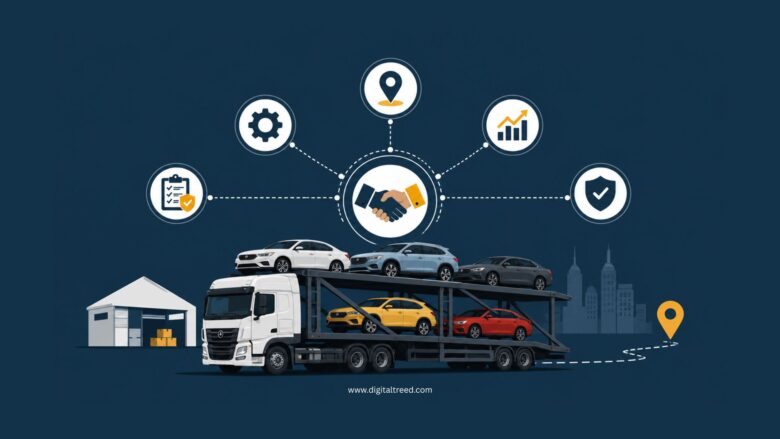
This is exactly the kind of task that door-to-door auto transport companies are built for. A service like Mile Auto Transport handles the entire move — pickup, transit, delivery — without pulling anyone off their actual job to babysit a road trip. For a business moving vehicles with any regularity, that’s not a luxury, it’s a straightforward cost and time calculation.
How to Decide What to Outsource
Vehicle transport is one example, but the framework applies to almost any operational function a growing business is deciding whether to handle internally:
- Calculate the true internal cost, not just the visible one. Include employee time, opportunity cost, and risk exposure, not just the line-item expense.
- Look at frequency, not just cost per instance. Something cheap once a year might be worth doing in-house. The same task weekly is a different calculation entirely.
- Ask what you’re actually good at. Outsourcing the parts of the business that aren’t your core competency frees up attention for the parts that are.
- Price out a specialist before assuming DIY is cheaper. It frequently isn’t, once you account for time and risk honestly.
The Bigger Lesson
The instinct to keep everything in-house usually comes from a good place — control, cost-consciousness, not wanting to depend on outside vendors. But scaling a business means constantly re-evaluating which of those instincts still serve you and which ones are quietly holding you back.
Vehicle logistics is a small, specific case, but the underlying question is one every growing business runs into eventually: is this task actually part of what makes your business good, or is it just something you’ve always done yourself? Once you can answer that honestly, the outsourcing decision usually makes itself.
