

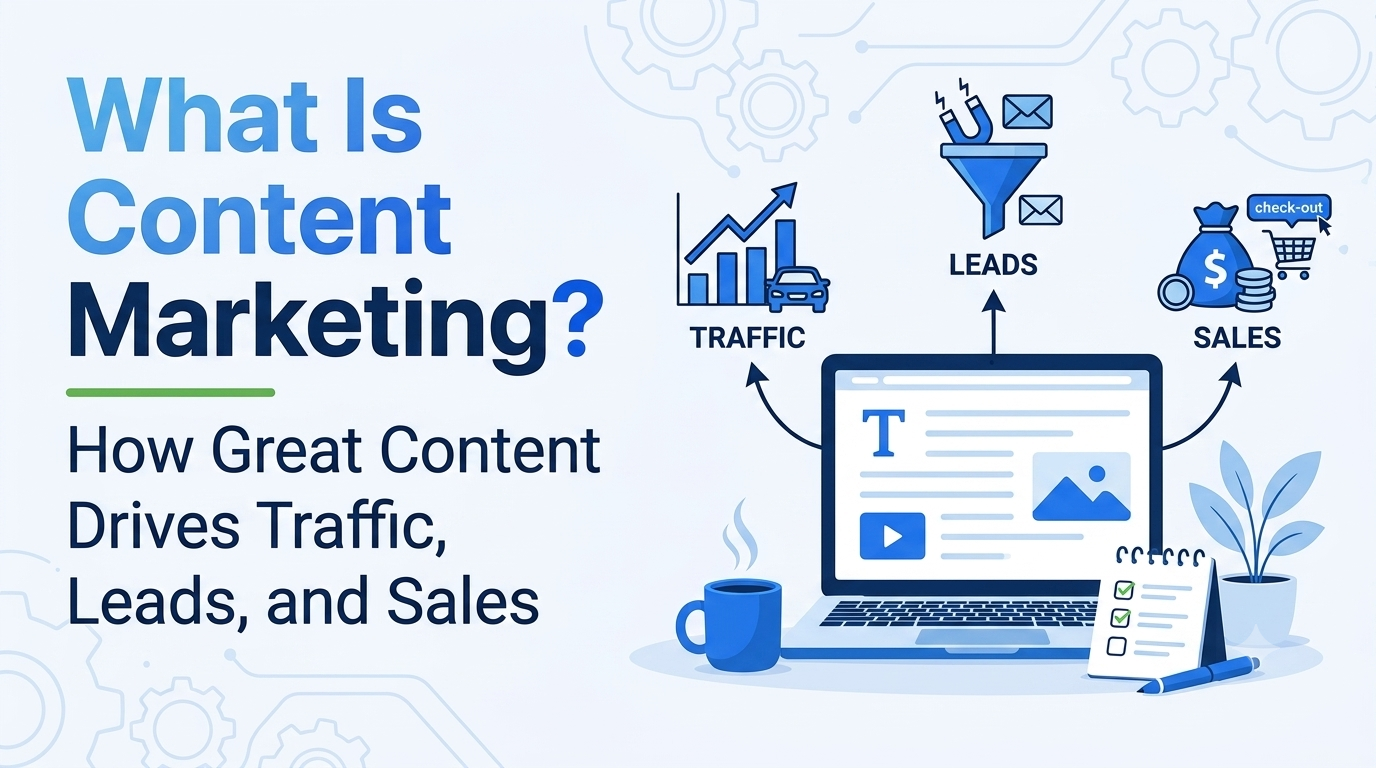
Content marketing is the practice of publishing useful, relevant material that pulls in the right audience instead of interrupting them. No hard pitch. No banner ad shouting for attention. Just information people actually want, delivered until they trust you enough to buy.
That’s it. That’s the whole idea. Everything else is execution.
Here’s the thing though: most companies still get it wrong. They publish a blog post, wait a week, see no traffic, and decide content doesn’t work for them. It’s not that content marketing failed. It’s that one post was never going to move the needle.
What Is Content Marketing, Really?
If you’re asking what is content marketing in plain terms, think of it as owned media. You’re not renting attention through ads. You’re building an asset that keeps working long after you hit publish.
A single guide can rank on Google for years. A well-made video can get discovered on YouTube two years from now and still bring in leads. That’s the payoff. Slow to start, compounding after that.
Honestly, this is where a lot of teams stall out. They know they need content but not how to structure it, staff it, or measure it. That’s usually the point where founders start looking at a content marketing agency to build the system instead of guessing their way through it.
Website content marketing specifically covers the material that lives on your own domain: blog articles, landing pages, resource hubs, product guides. It’s different from social content or paid content because you own the asset outright. No algorithm can take it away from you overnight.
How Content Marketing Fits Into Digital Strategy
Content marketing in digital marketing isn’t a standalone channel. It’s the fuel for almost every other channel you run.
SEO needs content to rank. Email needs content to send. Paid social needs content to promote. Sales needs content to send prospects who aren’t ready to talk yet.
Picture this: a prospect finds your article on a Tuesday, downloads a guide on Thursday, and books a call three weeks later after seeing your name twice more in their inbox. That’s not luck. That’s content doing its job across the whole funnel, quietly, in the background.
The Content Marketing Process That Actually Works
A real content marketing process has four parts. Skip one and the whole thing wobbles.
1. Research first, write second
Start with what your audience is actually searching for and struggling with. Content marketing research isn’t optional homework. It’s the difference between a post that ranks and one that sits at zero traffic forever.
Look at search intent, competitor gaps, and the actual questions your sales team hears on calls. That’s where the good topics live.
2. Plan around a theme, not a calendar
Random topics scattered across a content calendar rarely build authority. Cluster your content around three or four core themes your buyers care about, then go deep on each one.
3. Produce with a consistent voice
Whoever writes it, the piece should sound like it came from the same brand every time. Inconsistent voice is one of the fastest ways to make a website feel like nobody’s actually running it.
4. Distribute like it’s half the job
Publishing isn’t the finish line. Share it in the newsletter, repurpose it for social, link to it from related pages. A great piece with zero distribution might as well not exist.
Quick summary: Strong content marketing runs on research, thematic planning, consistent production, and real distribution. Miss any one of these and results stall, no matter how good the writing is.
Content Marketing Tactics Worth Your Time
Not every tactic deserves your time. Here’s what’s actually pulling weight right now:
- Pillar pages plus cluster content. One deep guide, several supporting posts linking back to it. Google rewards the structure, readers get a clear path.
- Original data and research. Even a small survey of your own customers gives you something nobody else can copy.
- Case studies with real numbers. Vague success stories don’t convert. Specific outcomes do.
- Repurposed video and audio. One interview can become a blog post, five social clips, and a newsletter section.
- AI search optimization. Buyers are asking ChatGPT and Perplexity the same questions they used to type into Google. Content built to get cited there is quickly becoming table stakes.
Note: Tactics rotate every year or two, but the underlying principle doesn’t. Publish what your audience actually needs answered, and the channel it travels through matters less than you’d think.
Why the Content Marketing Industry Keeps Growing
The content marketing industry keeps expanding because buying behavior has shifted for good. People research long before they ever talk to a salesperson, and they trust content from people who’ve clearly done the work over content from people trying to close a deal.
That’s also why strategic content marketing looks different than it did five years ago. It’s less about volume and more about depth, credibility, and showing up in the handful of places your specific buyer actually looks.
Teams that treat content as a real function, with goals, a process, and someone accountable for it, pull ahead of teams still treating it as a side project for whoever has spare time.
Important: Content marketing isn’t a quick campaign you turn off after a quarter. Companies that stick with it for a year or more consistently outperform ones that start and stop.
Getting Started Without Overcomplicating It
You don’t need twenty blog posts a month to see results. You need a handful of genuinely good pieces built around what your buyers are searching for, published consistently, and distributed with intention.
Start narrow. Pick one theme, go deep, measure what happens, then expand. That’s a far more reliable path than trying to cover everything at once and burning out three months in.
FAQs
How long does content marketing take to show results? Most companies start seeing meaningful organic traffic in four to six months, with stronger lead volume building over the following six to twelve months as content compounds.
How is content marketing different from advertising? Advertising rents attention and stops the moment you stop paying. Content marketing builds an owned asset that keeps attracting visitors and leads long after it’s published.
How much content do I actually need to publish? Consistency and depth beat volume. A handful of well-researched pieces published every month will outperform daily posts with no real research behind them.
Do small companies need a full content marketing strategy? Yes, even a lean one. A basic strategy keeps effort focused on the handful of topics your specific buyers care about instead of scattering resources across random ideas.
