

Quick answer
Before you hire a solar panel installation service for your older home, check the roof, the electrical panel, lead and asbestos risks and any historic district rules. As of November 6, 2026, the IRS says the 30% federal 25D credit is gone for systems installed after December 31, 2025. Start with the roof: NLR's federal work spec, as of November 2026, wants its covering under 5 years old.
A solar panel installation service for your older home is a licensed contractor that designs the system, pulls permits, mounts panels and ties them into your wiring and the grid. On an older house, a roofer and an electrician often come first. We'd settle the roof and the electrical panel before talking price, because either one can add a second contractor.
Our checks run roof first, then the electrical panel, lead and asbestos, historic districts, permits and the utility. Then come a power estimate for three made-up houses, the federal credit's end and installer vetting.
Key takeaways
- The IRS ended the 25D solar credit for installs finished after December 31, 2025.
- A federal work spec wants the roof covering under 5 years old.
- Even 100A service handles most home solar inverters, per a 2024 LBNL brief.
- Our made-up gabled house's hidden rear slope made 56% of the front's output.
- Ask every bidder for a state license number and a NABCEP name.
Is your older home's roof ready for panels?
A re-roof decides when panels can go up, so start there. DOE's Homeowner's Guide to Solar says some rooftops "may not be suitable for solar systems due to age or tree cover."
Per DOE's guide, read November 6, 2026, panels typically do best on south-facing roofs sloped 15 to 40 degrees.
NLR's Standard Work Specifications for rooftop PV (as of November 2026) tell the crew to confirm the roof can carry the panels' dead load and wind load. They also want the roof covering "less than 5 years old." Our made-up 1925 test house, with an 18-year-old roof covering, fails that on day one, even if the shingles look fine from the street.
The same spec asks the crew to confirm the roof type suits solar, "e.g. not slate or wood shingle," plus panel capacity and a free breaker space.
The rule exists because roof and panel lifetimes overlap. A 2021 DOE post, Replacing Your Roof? It's a Great Time to Add Solar, put roof life at 20 to 50 years, depending on materials. It put panel life at about 25 to 30 years. The FTC solar guide says a home system is designed to stay put "for at least 20 years." So if your roof has eight years left, you'd pay a crew to pull the array off and put it back halfway through its life. The same DOE post cited an NREL estimate of about $4,000 in average savings when both jobs happen together. That's a 2021 figure, so read it as direction, not today's price.
DOE's step-by-step guide for going solar says a solar installer, roofing expert or structural engineer can judge whether the roof can hold panels. If you don't know the roof's age, the guide says your local government should have the building permit record.
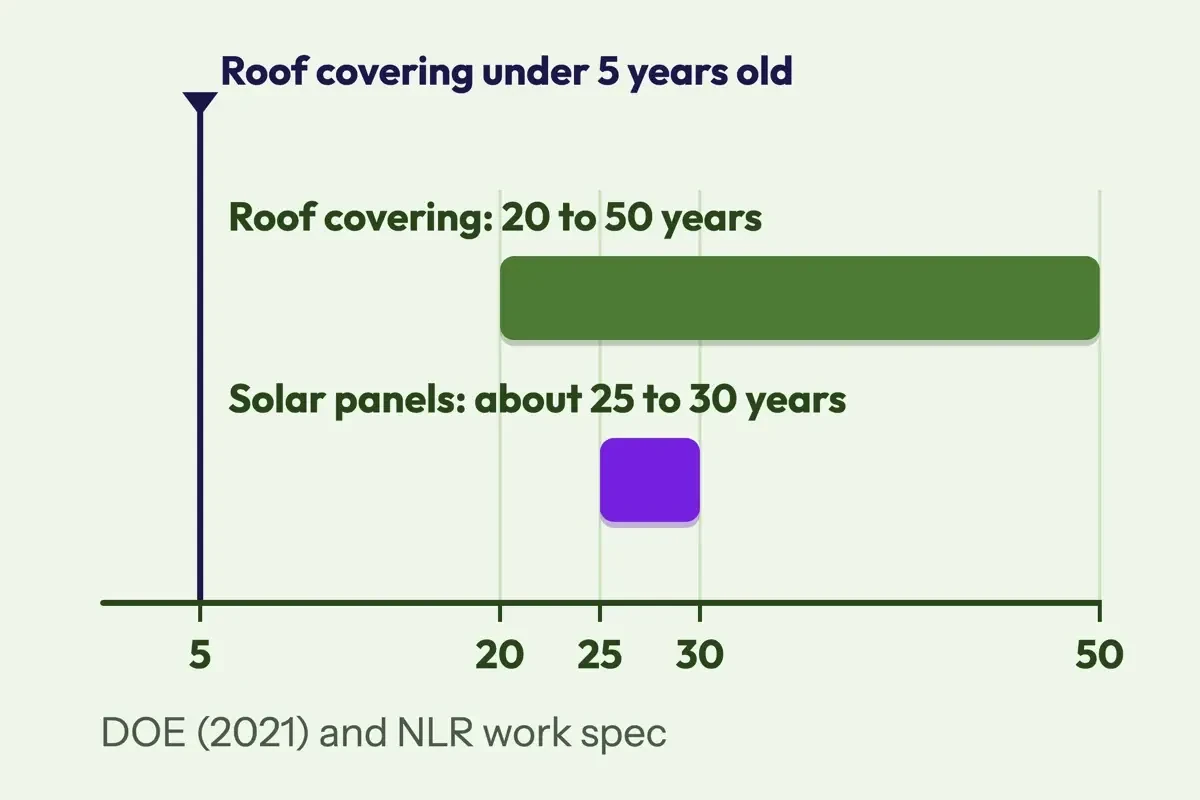 Diagram by DigitalTreed: roof and panel lifetimes from DOE, with the under-5-years roof rule from the NLR work specification.
When an old electrical panel needs an upgrade
A DOE fact sheet on electric panel upgrades says a 100 amp panel is "common in many older homes that have not had a major renovation." Newer homes tend to have 150 or 200 amps. A 2024 Lawrence Berkeley National Laboratory brief on service sizing adds that homes built before 1960 are much more likely to have 100A panels. Solar alone usually isn't what forces the upgrade, though. The LBNL brief says solar PV "is not a load addition" and that "Even 100A service can accommodate most typical residential solar inverter sizes." It notes that 7.68 kW is the largest inverter output that fits a 40A breaker, and that some 80% of home systems are under 10 kW.
Age, condition and space trigger panel work. Each row pairs a finding with what it usually points to, from the LBNL brief and the NLR spec:
| What the electrician finds | What it usually points to |
|---|---|
| 100A panel, spare breaker spaces, no big new loads planned | Solar usually fits without a new panel |
| 100A panel with no spare spaces | Ask about a subpanel, a PV-ready panel or a line-side tap |
| Old or unsafe equipment, or service under 100A | An upgrade may be required before any change |
| EV charger or electric heat on your list | Price a service upgrade during the same visit |
Get that finding written into each bid: the amps, the spare spaces and the connection method. One installer may price a whole new panel that another avoids with a subpanel, and that difference alone can split two quotes for the same array. If an EV charger is coming, LBNL notes owners may upgrade while the electrician's already there, which saves a second trip. The LBNL brief also says certain older breaker panels or fuse boxes "may be unsafe due to design flaws or manufacturing defects" and must be replaced if the wiring changes.
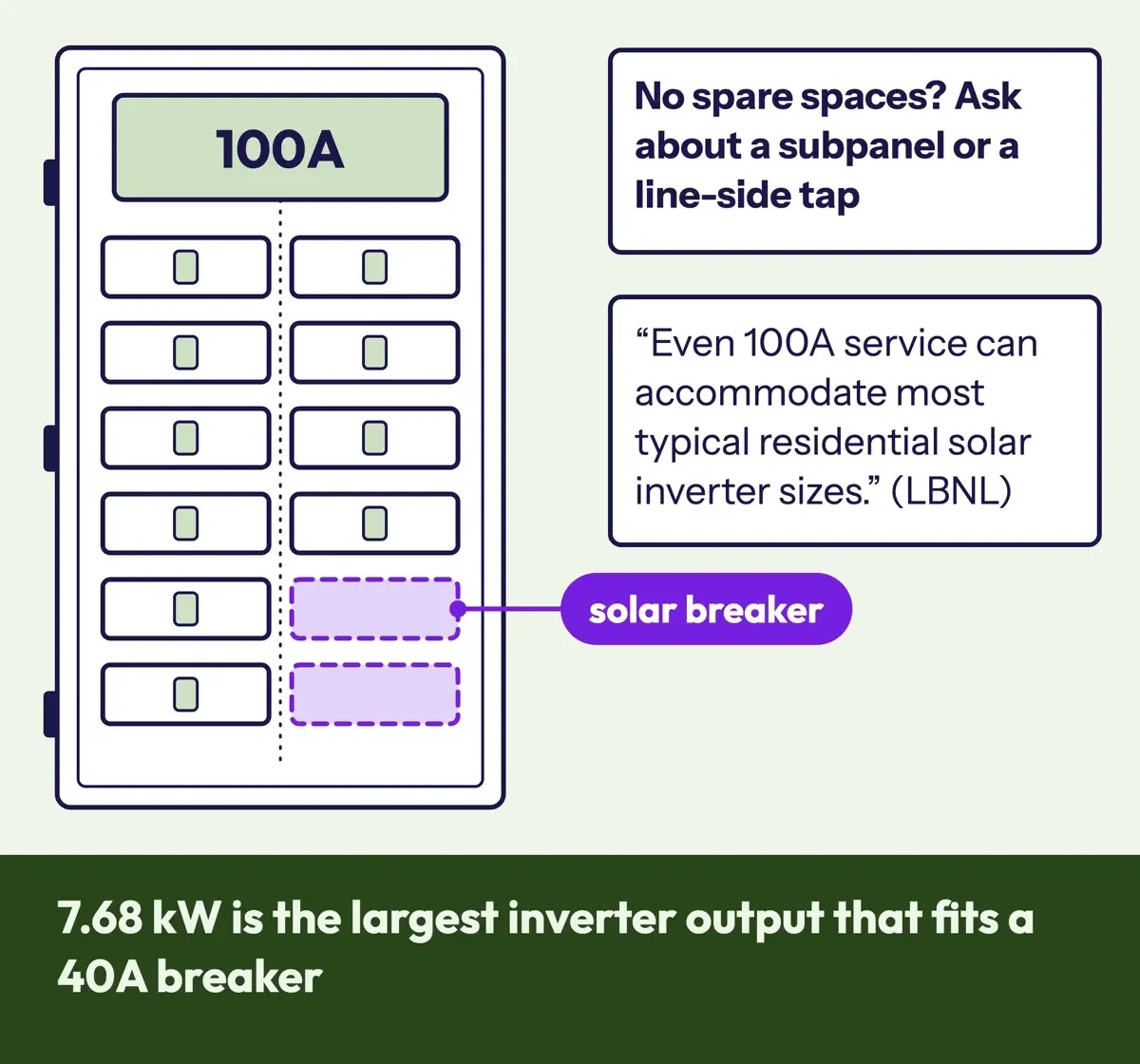 Diagram by DigitalTreed: what an electrician checks in an older 100 amp panel before solar, from the LBNL brief and NLR work spec.
Lead paint and asbestos in a pre-1978 house
That panel work, plus mounting rails and conduit runs, can disturb old surfaces. EPA's Lead Renovation, Repair and Painting page says about three-quarters of US homes built before 1978 still contain some lead-based paint. Its RRP page for contractors says anyone paid to disturb that paint must be certified. It lists "plumbers, carpenters and electricians" among the covered trades. So if your house predates 1978 and the crew will drill or cut painted trim, eaves or walls, ask each bidder for its EPA RRP firm certification. Our guide to a detailed painting estimate covers lead-safe work in more depth.
Asbestos is the other old-roof hazard. EPA's asbestos basics page lists "roofing shingles" among the building materials that once used it. Its page on protecting your family says you can't tell by looking unless the material's labeled. The advice is plain: "If in doubt, treat the material as if it contains asbestos and leave it alone."
EPA suggests an accredited inspection before a remodel, so book one if older layers sit under your current shingles. Send the report to every bidder, so each quote prices the same roof.
Historic districts: what NPS guidance says
Historic status can stall an older-home solar plan, and the rule that binds you is usually local. The National Park Service National Register FAQ says "Listing in the National Register places no federal restrictions or requirements on a private property owner." It adds that state or local preservation laws may apply, and it recommends contacting your State Historic Preservation Office (SHPO) before any action on a listed property.
NPS says panels placed where they "cannot be seen from the ground will generally meet" the Secretary of the Interior's Standards for Rehabilitation. Its bulletin ITS 52 on solar panels says a flat roof or parapet can usually hide panels. Hipped or gabled roofs "are generally not good candidates for a rooftop solar installation," it says, and panels shouldn't show from nearby streets or sidewalks.
The NPS Illustrated Guidelines on Sustainability list what not to do: remove historic roof features, change a character-defining roof slope, or add devices that aren't reversible. They favor panels laid flat or parallel to the roof. They also put efficiency first, adding solar "only after implementing all appropriate treatments to improve energy efficiency." Our energy-saving tips for lower bills cover that cheaper work. Rear porch roofs and pole mounts appear among the NPS examples too, and both keep panels off a street-facing slope.
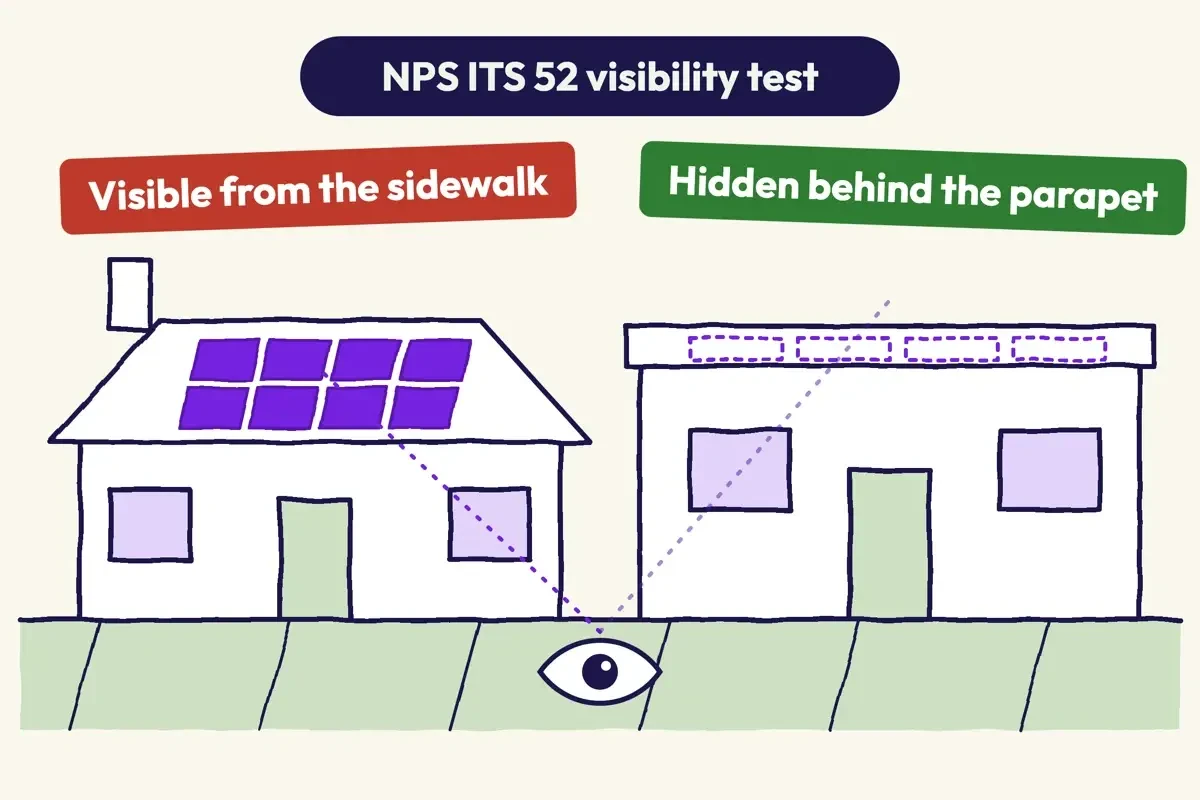 Drawn by us: the visibility test from NPS bulletin ITS 52, on two made-up houses.
Permits, inspection and the utility hookup
Permits set the calendar. That part depends on your town. DOE's 2021 going-solar guide says installation "generally takes only a few days," but "permits and inspections can take weeks to months" under local rules. Ask each bidder how long its last three jobs in your town took, counting from the signed contract to the utility's OK to switch on. Some towns shorten that wait with SolarAPP+, an automated permit tool managed by the nonprofit SolarAPP Foundation. Its site says "Code-compliant applications receive a permit instantly" and claims more than 350 jurisdictions served, as of November 2026. Your building department can tell you whether it's one of them.
The utility comes last. DOE's guide says net metering, which credits power you send back to the grid, depends on policies in your state and at your utility. The FTC says to ask your utility what arrangements it makes with solar homeowners. Get the export rate on paper. Call before you sign, and keep in mind the FTC's point that solar won't erase the utility's fixed charges, such as delivery or administrative costs.
Under a homeowners association, DOE notes that many states have solar access laws, but you'll likely still have to submit a request.
How much power an older roof makes
You can size the job yourself before a salesperson does. DOE's guide points homeowners to PVWatts, a calculator from the national lab NLR that estimates the output of grid-connected PV systems. You enter the address, the system size in kW, the roof tilt and the direction the roof faces, and it returns both yearly and monthly kWh.
Set that kWh figure against the kWh on your last year of bills, as the FTC suggests, and keep fixed charges out of the savings math. For a rough dollar figure, multiply kWh by your state's average residential price. In EIA's Electric Power Monthly table 5.6.A, the August 2026 average was 18.16 cents per kWh for the US and 21.77 cents in Pennsylvania. Your own rate and net metering terms will move the result, and that's why we call it an example.
PVWatts runs on 2020 typical-year weather data, per NLR's API notes. Real years vary.
On a made-up 1925 gabled house in our test below, the hidden north slope made 4,065 kWh a year. That's 56% of the 7,243 kWh from the street-facing south slope. Meeting a visibility rule there costs about $692 a year in example value at EIA's August 2026 price ($1,577 minus $885). If your house has a street-facing gable, it's worth asking the review board about the side or rear slopes before any design work is billed.
A made-up 1940 flat-roofed house hid its panels behind the parapet and still made 7,915 kWh.
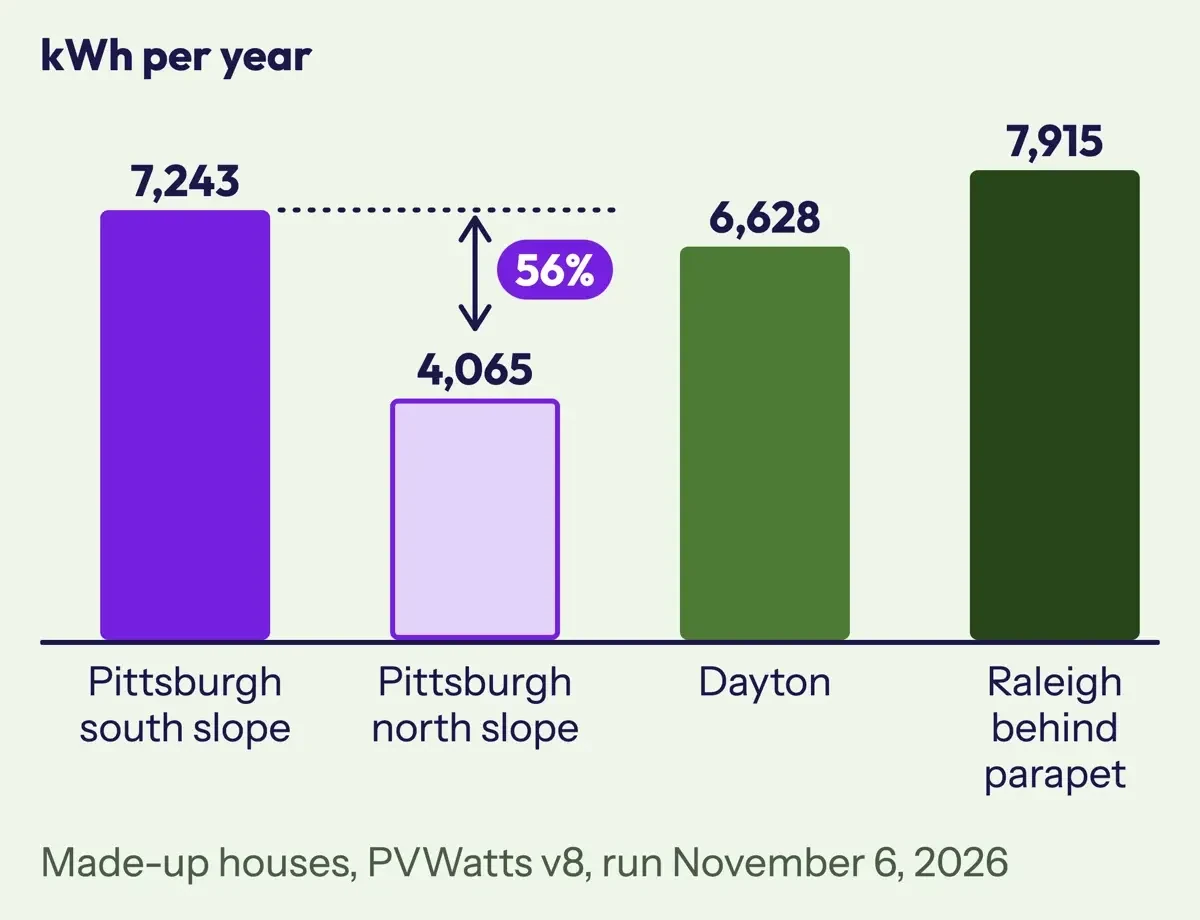 Diagram by DigitalTreed: our PVWatts results for three made-up older houses, run November 6, 2026.
What we tested
On November 6, 2026, we ran a small readiness checker on three made-up older houses. It applies the roof, panel, lead, historic and credit rules above, then asks the PVWatts API, version 8 for each array's yearly output (standard modules, 14% losses, roof mount).
| House (made up) | Checks passed | Array | kWh per year | Example value |
|---|---|---|---|---|
| 1925 gable, Pittsburgh, PA | 0/6 | 6 kW, south slope (street) | 7,243 | $1,577 |
| 1925 gable, Pittsburgh, PA | 0/6 | 6 kW, north slope (hidden) | 4,065 | $885 |
| 1958 hip ranch, Dayton, OH | 3/5 | 5 kW, south slope | 6,628 | $1,285 |
| 1940 flat roof, Raleigh, NC | 3/5 | 6 kW, behind parapet | 7,915 | $1,183 |
Every house flagged the lead rule and the lost credit. The made-up 1925 house also flagged its 18-year-old roof, a full 100A panel, a planned EV charger and its gable in a local district. The 1958 and 1940 houses passed the roof check (3 and 4 years old), the panel check and the historic check.
What happened to the federal solar tax credit?
The lost credit that every house flagged is the federal 25D credit, so our example values don't include it. The IRS page for the Residential Clean Energy Credit (section 25D) was last reviewed or updated July 4, 2026. It says: "The credit is not available for any property placed in service after December 31, 2025." The IRS Working Families Tax Cuts page says the 25D credit is "Not allowed for any expenditures made after Dec. 31, 2025." Paying early doesn't rescue it. The IRS FAQ on Public Law 119-21 says: "If installation is completed after December 31, 2025, the expenditure will be treated as made after December 31, 2025." A 2026 install gets no 25D credit.
DOE's homeowner guide, read the same day, isn't current. It still says the credit is 26% for systems installed in 2020-2022 and 22% for 2023. DOE's text goes on: the credit "expires starting in 2024 unless Congress renews it." The IRS page gives 30% for property installed from 2022 through December 31, 2025. Trust the IRS page and recheck it before you sign; a system that went in during 2025 claims the credit on Form 5695 for that tax year. A CPA or enrolled agent can confirm your case.
State and local incentives are separate; DOE's guide points to the DSIRE database, searchable by ZIP code.
How to vet the installer
Before you sign, the FTC says to check a company's history with your state contractors licensing board and consumer protection agencies. It also notes that "your state may require an installer to have an electrical contractor's license." DOE's installer guide adds licensed, bonded and insured, and it says to verify any subcontractors' credentials too. Then look the license number up yourself. Use the state board's own site. Certification's a separate check. DOE's homeowner guide calls NABCEP (North American Board of Certified Energy Practitioners) the "industry-standard certification." NABCEP's site has a Board Certified Directory where you can look up a name. Ask for both the license number and the certified person's name, since one doesn't stand in for the other.
Get written bids from several companies. The FTC says each should give the system size and expected output, the full cost including permit fees, any production guarantee, and the equipment and workmanship warranties. To compare prices, DOE's installer guide divides cost by watts. A made-up $18,000 bid for a 6 kW system works out to $18,000 / 6,000 W = $3.00 per watt (example numbers, not a price as of November 2026). Bring these questions to the sales visit:
- What is your state contractor license number, and does it cover electrical work?
- Which NABCEP-certified person will design or oversee my system?
- Will subcontractors do any part of the job, and who are they?
- What did you find on my roof, and who pays if a leak starts after install?
- What did you find in my panel: amps, spare spaces and connection method?
- Is your firm EPA RRP-certified for work on a pre-1978 house?
- What yearly kWh do you expect, and how does it compare with PVWatts?
- Which permit, inspection and utility fees are in this price?
- What warranties cover the panels, the inverter and your workmanship?
Walk away from anyone who pushes you to sign that day. The FTC says never deal with a company that pressures you for a quick decision, rushes a signature without time to review, or asks for cash. DOE's guide lists ReportFraud.ftc.gov for complaints. If we owned one of these houses, we'd book a roofer and an electrician's panel check before the first sales visit. That way every bid prices the same scope, and a cheap quote can't hide a missing roof or panel job. Our notes on cutting costs without cutting corners use the same logic for any big quote.
Frequently asked
Does National Register listing stop me from adding solar?
Not under federal law. The NPS FAQ says listing restricts a private owner only in projects with federal assistance, such as funding or permits.
Did the old federal credit cover a new roof under the panels?
No. The IRS 25D page says roof trusses and traditional shingles don't qualify, though solar shingles did.
Do I get tax benefits with a solar lease or PPA?
Generally no. The FTC says some incentives aren't available if you lease or sign a power purchase agreement.
Can I install the panels myself on an old house?
DOE's homeowner guide says the best way is a qualified, certified professional. Permits and inspections still apply.
How we made this guide: We saved the 25 pages and PDFs in Sources on November 6, 2026 (23 government pages, plus NABCEP and SolarAPP+). Then we ran the readiness checker with the PVWatts API. We contacted no installer, and none is named here. Facts checked by the DigitalTreed team on November 6, 2026. This isn't tax or legal advice.
Earlier version: November 2023, a general guide without sources. Rewritten November 6, 2026 for US owners of older homes, with the three off-topic stories cut. For off-grid builds, see our tiny house materials guide; for heating costs, our tips to lower gas bills; and for the wider picture, sustainable tech innovations.
Sources
- IRS: Residential Clean Energy Credit (last reviewed or updated July 4, 2026)
- IRS: FAQs for modification of sections 25C, 25D and others under Public Law 119-21 (FS-2025-05)
- IRS: Working Families Tax Cuts provisions
- IRS: About Form 5695, Residential Energy Credits
- DOE: Homeowner's Guide to Solar
- DOE: Replacing Your Roof? It's a Great Time to Add Solar (July 28, 2021)
- DOE: Walk Me Through It, a step-by-step guide for consumers going solar (August 4, 2021)
- DOE: Decisions, Decisions, choosing a solar installer (August 31, 2021)
- FTC Consumer Advice: Solar power for your home
- NLR Standard Work Specifications: roof interconnected photovoltaic, 0.0501.1
- LBNL: Sizing electric service panels and utility infrastructure, technical brief (2024)
- DOE: Home electrification and electric panel upgrades (fact sheet)
- EPA: Lead Renovation, Repair and Painting Program
- EPA: RRP Program for contractors
- EPA: Learn about asbestos
- EPA: Protect your family from exposures to asbestos
- National Park Service: National Register of Historic Places FAQ
- National Park Service: Solar panels on historic properties
- National Park Service: ITS 52, Incorporating solar panels in a rehabilitation project (August 2009)
- National Park Service: Illustrated Guidelines on Sustainability for Rehabilitating Historic Buildings
- NLR: PVWatts calculator
- NLR: PVWatts API version 8 documentation
- SolarAPP Foundation: SolarAPP+
- NABCEP: certifications and Board Certified Directory
- EIA: Electric Power Monthly, table 5.6.A, average residential price by state (August 2026)


Comments
No comments yet. Start the conversation below.