
Quick answer
As of October 31, 2026, 18 technology blogs with a live write-for-us page passed our check. Each had a Tranco top-million rank, no topic jumps in its Wayback history and fewer than 3 spam words. A site that promises dofollow links fails, whatever its traffic. Run the 2-minute check below on any new site, then pitch one tested idea.
If you typed "technology blogs write for us" into Google, you probably want bylines on sites that cover software, devices or IT. The results hand you hundreds of pages. Many are dead, and some sell links. A write-for-us page is a site's public note on who may contribute, which topics fit and how links are handled. This post used to list tech blogs by authority score, with no check date. We rebuilt it around a check you can repeat.
First comes what tech editors want. Then you get search operators for tech pages, a 2-minute scorecard and the spam footprints that turn up most in this niche. The verified list follows, with how we built it, then a pitch email, the Google and FTC rules for paid posts, and where DigitalTreed fits. Our view: pitch fewer tech sites, and send each one an idea you've already tested.
Key takeaways
- Tech editors want tested steps, screenshots and a pitch before the draft.
- Google lists keyword-stuffed anchors in guest posts under link spam.
- A Tranco rank is a traffic signal; it says nothing about who reads.
- One or two spam-word hits in a tech sitemap mean look closer.
- Paid placements need rel="sponsored" and a plain "Ad" or "Sponsored" label.
Note
Want to write for DigitalTreed? We're a digital marketing and technology publication, read by bloggers, agencies, SaaS teams and startup founders. If your idea fits SEO, AI tools, WordPress, blogging or online growth, send a short pitch with an outline through our write for us page. Guest posts and sponsored articles include one relevant contextual link. New clients pay 50% upfront and the remaining 50% once the post is published, and prices by niche are in our media kit.
What tech editors want before they say yes
Tech editors say yes to proof that the thing works, shown before anyone has to take your word for it. Google's guide to helpful, people-first content asks the same of any page: does it show "first-hand expertise and a depth of knowledge"? Its 2017 post on large-scale article campaigns lists the opposite as a warning sign: writers who "aren't knowledgeable about the topics they're writing on".
We read the guidelines pages of the tech sites that passed our check, and three demands kept coming up. Smashing Magazine is blunt about promotion: "We do not publish articles which are an obvious attempt at content marketing." Linux Handbook wants proof on the page: "Tutorials and explainer articles need screenshots so that readers can understand them easily." BleepingComputer turns away pieces "created solely to promote a particular product or service" and points those writers to its ads.
For your pitch, that means three things. Lead with something you did, like a migration, a benchmark or a bug you chased for a week. Show the versions, the commands and a screenshot of the result, because editors re-run steps and a tutorial that breaks on line one won't get a second look. A pitch that says "I tested this on Ubuntu 24.04 with Nginx 1.26" reads very differently from one that says "I'm passionate about tech". Keep your product, or your client's, out of the body unless it's the honest answer to the reader's problem. With those three in the pitch, the work left is finding tech sites whose guidelines page still exists.
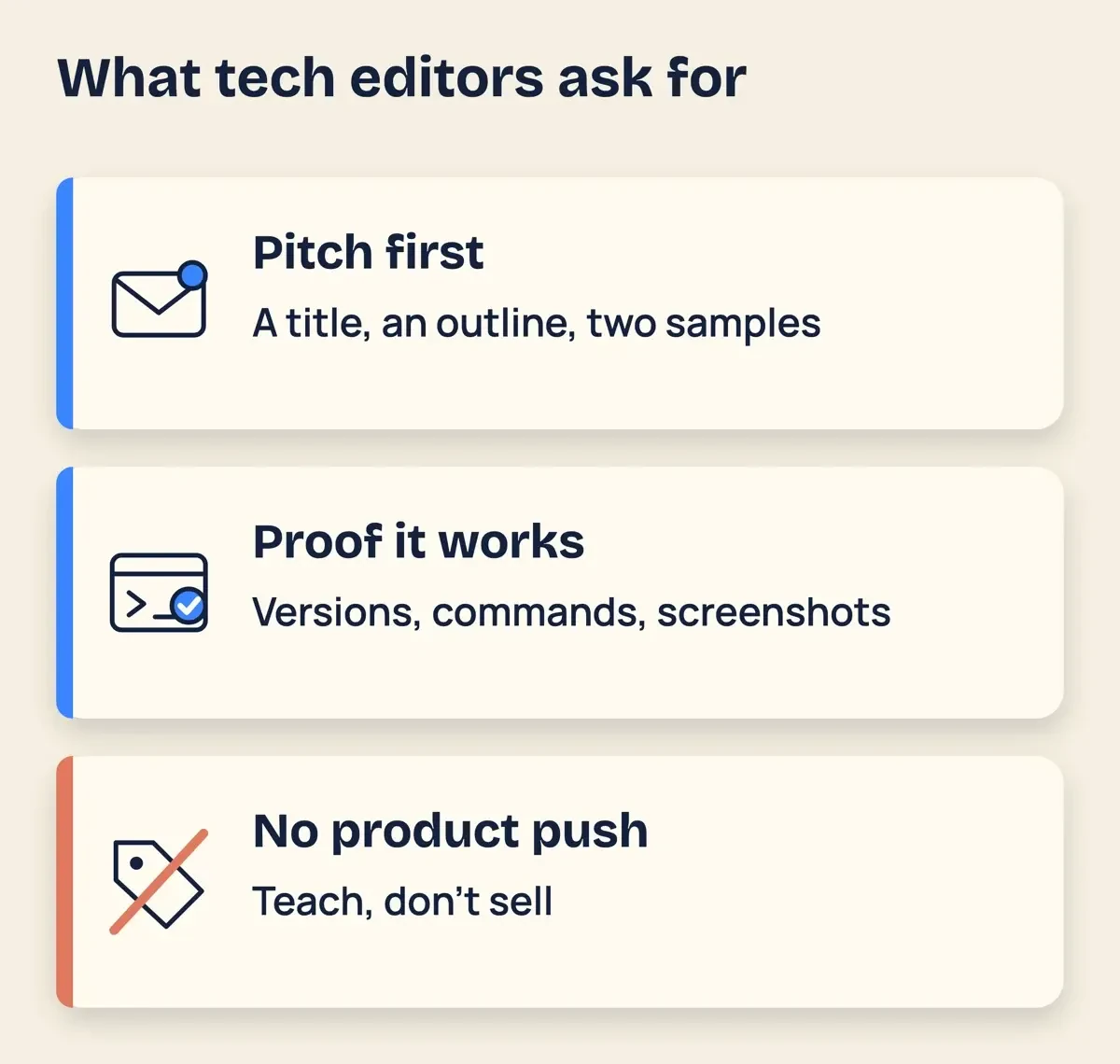 Diagram by DigitalTreed, drawn from the guidelines pages of tech sites in our verified list, read October 31, 2026.
Search operators that find tech write-for-us pages
Finding candidates takes less time than vetting them. Google's Search Help page on refining searches documents a short set of operators. Quotes match an exact phrase, site: limits results to one domain, a minus sign leaves a word out, and after: keeps pages updated after a date. We stuck to those, and you'll find they're enough. We also swapped the generic word "technology", which content farms love to put in their titles, for words a real tech blog uses.
Find tech pages that take contributors
"write for us" "web development"
"write for us" devops -casino -crypto
"contribute" "tutorial" linux
"submit an article" javascript
"become a contributor" cybersecurity
"guest author" "cloud" after:2026/01/01

Vet one site before you pitch (replace example.com)
site:example.com apk
site:example.com crack
site:example.com casino
site:example.com "sponsored post"
"example.com" "guest post" price
Swap example.com for the domain you're vetting, and run each line as its own search.
The second block vets one domain. Google's own site: operator page does the same thing, with site:example.com viagra casino as its example query for spotting spam on a site. The page adds a caveat: "The list of URLs returned is not always exhaustive." So a clean result is a good sign, not proof. Old lists are full of dead guidelines URLs. Test each one in the HTTP status checker on DigitalTreed and look for a 200 on the page itself. If the checker shows a redirect to the homepage instead, the page is gone, even if the search snippet doesn't say so yet.
The 2-minute check and a green, yellow, red scorecard
Then comes the vetting. Run each site on your shortlist through five quick checks, and keep a note of the results, since you'll want them again when an editor finally replies. Our niche guest post hub has the full checklist, covering history, audience, metrics and money. What follows is the short version we'd run on a tech site before writing a single line of a pitch.
| Check | Green | Yellow | Red |
| Guidelines page | Live, about contributing, names topics | Live but vague or years old | Missing, closed, price list or dofollow promise |
| Traffic signal | Tranco rank up to 100,000 | Rank 100,001 to 1,000,000 | Not in the Tranco top million |
| First Wayback snapshot | 2021 or earlier | First snapshot 2022 or later | No snapshots at all |
| Topic history | Same topic in every yearly title | One clear change | 3+ changes, or a past casino or pharma topic |
| Spam words | 0 hits outside tech | 1 or 2 hits | 3 or more hits |
Any red ends the check, and if you've got two or more yellows, read five recent posts before you decide.
The traffic row uses the Tranco list, a research ranking "Hardened Against Manipulation". Its methodology page says it averages provider ranks "over the past 30 days", so one viral week doesn't move it much. Here's the scorecard applied to three sites from our verified list, using only what our check recorded:
- GeeksforGeeks: guidelines live, Tranco rank 3,418 (green), first Wayback snapshot 2009 (green), 2 spam-word hits: crack, slot (yellow).
- Hongkiat: guidelines live, Tranco rank 28,822 (green), first Wayback snapshot 2001 (green), 2 spam-word hits: escort, slot (yellow).
- Techmonk.in: guidelines live, Tranco rank 132,890 (yellow), first Wayback snapshot 2018 (green), no spam words found (green).
2 of the 18 kept tech sites had one or two spam-word hits in their sitemaps (crack, escort, slot). Some of those words have harmless uses in tech, like a time slot or cracking a coding problem. That's why our drop line sat at 3 or more hits outside the niche, so a yellow here just means you open the matching URLs before you pitch.
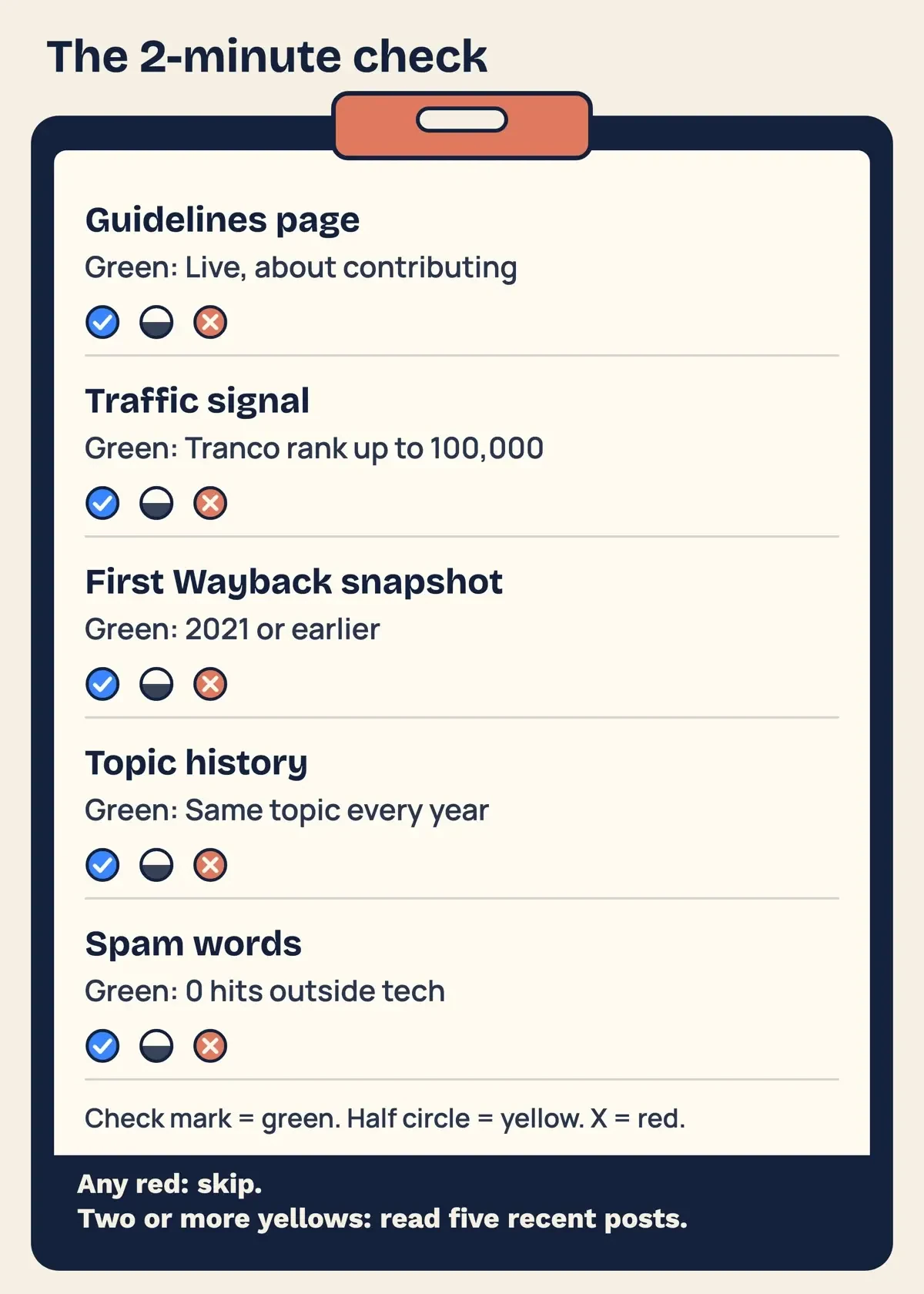 Diagram by DigitalTreed of the 2-minute check, with the thresholds from our October 31, 2026 site check.
Tech spam footprints that a quick scan catches
That spam row needs its own section. Tech sites draw a kind of spam other niches don't, and most of it is piracy: apk, mod-apk, crack and keygen pages. Our scan read each site's sitemap, found through robots.txt or /sitemap.xml, and counted URL slugs holding any of 14 words, from casino and poker to apk, crack and escort. Google's sitemap overview calls a sitemap "a file where you provide information about the pages, videos, and other files on your site". The sitemaps.org protocol allows up to 50,000 URLs per file. For example, a tech blog with 300 posts and 40 slot-machine slugs in that file tells you more than any authority score.
Reading one takes seconds: open /sitemap.xml in a browser, then search the page for each word in the vetting box above.
Those piracy slugs sit next to the casino, betting, CBD and payday loan posts that link sellers slip into any site that takes paid posts without reading them closely. Old tech domains carry their own risk. Google's spam policies define expired domain abuse as a domain "purchased and repurposed primarily to manipulate search rankings", which is why our check read the yearly titles. Then look past single words. A guidelines page that lists a dozen unrelated categories is a link seller with a tech label. So is a homepage that sells high-DA posts. Redirects are another tell. If an old tech domain now forwards to a casino or coupon site, the redirect checker we built shows each hop.
Vendor scores tell you less than that file does. Moz's Spam Score help page calls 61%-100% "a High Spam Score", then says a high score "doesn't mean this site is necessarily spammy". Google's March 2024 spam policy post goes further and says flatly that third-party authority scores "don't correspond to any of Google's own signals nor come from Google". Treat them as a hint, and the sitemap as the evidence.
Verified technology blogs that take guest posts (October 31, 2026)
Those are the checks we ran on every site below on October 31, 2026, plus a same-day reread of each page, and that's what the Vetted stamp stands for. 18 tech sites passed every check, including our same-day reread of each page. They're sorted by Tranco rank, best first, but a smaller blog lower down can still be the better fit for your topic.
Site names are plain text. The only link in each row goes to the site's own guidelines page, marked nofollow.
| Site | Guidelines (nofollow) | Traffic signal (Tranco rank) | First Wayback snapshot | Checked |
| GeeksforGeeks | Contribute | #3,418 | 2009 | 10/31/2026 |
| BleepingComputer | Write for BleepingComputer | #4,818 | 2004 | 10/31/2026 |
| Smashing Magazine | Writing A Smashing Article | #5,842 | 2006 | 10/31/2026 |
| InfoWorld | Guidelines page | #6,556 | 1996 | 10/31/2026 |
| CSS-Tricks | Write for CSS-Tricks! | #10,584 | 2007 | 10/31/2026 |
| TutorialsPoint | Guidelines for Content Creators | #10,964 | 2001 | 10/31/2026 |
| Network World | Guidelines page | #11,852 | 1998 | 10/31/2026 |
| CSO Online | Guidelines page | #13,175 | 2002 | 10/31/2026 |
| A List Apart | Write for Us | #15,912 | 1998 | 10/31/2026 |
| It's FOSS | Community Submission Guideline | #25,758 | 2012 | 10/31/2026 |
| Hongkiat | Write For Us | #28,822 | 2001 | 10/31/2026 |
| Speckyboy Design Magazine | Submit an Article | #79,363 | 2007 | 10/31/2026 |
| The Enterprisers Project | Guidelines page | #118,222 | 2013 | 10/31/2026 |
| Techmonk.in | Guest-Post Guidelines | #132,890 | 2018 | 10/31/2026 |
| Graphic Design Junction | Write For Us | #221,232 | 2010 | 10/31/2026 |
| Linux Handbook | Write for Us | #253,426 | 2004 | 10/31/2026 |
| mindmajix | Write for Us | #259,952 | 2013 | 10/31/2026 |
| DevOpsCube | Contribute | #595,665 | 2014 | 10/31/2026 |
Reread a site's page before you send anything, since the Checked column covers October 31, 2026 only.
SaaS and B2B software blogs are in our SaaS write for us guide, and the two lists don't share a site. We kept them apart on purpose, because a SaaS marketing blog and a Linux tutorial site want very different pitches even when both call themselves tech. Coding-only sites have their own software development write for us guide. For one long list across many niches, see our checked guest posting sites list from October 30, 2026.
Here's how the check worked. Every request was a plain GET from a user agent that names us, with 1.5 seconds between requests to a host. We obeyed robots.txt, the file that RFC 9309 and Google's robots.txt introduction describe. A 403, 429 or bot check meant unchecked, and we left that site out rather than work around the block. Traffic came from the Tranco top million (list PYK6J, dated October 29, 2026). We didn't have Ahrefs, Semrush or Similarweb access. History came from the Wayback Machine's CDX API, one capture a year and up to five homepage titles, read as the Wayback help page describes.
What we tested
We started with 154 tech candidates: 18 passed and 136 were dropped. The biggest group, 72 sites, had no live guidelines page we could find. Another 25 blocked our checker with a 403, 429 or bot check. A further 24 were not in the Tranco top million. The other 10 failed on dead sites (7), spam words (2) or topic changes (1). The script kept 23, and our same-day reread of every listed page removed five more. XDA took no guest posts, only applications to become a paid contributor. Inspirationfeed and TechWorm had stopped taking guest posts. AltexSoft promised do-follow links. TecAdmin allowed no guest post submissions and charged a one-time fee for commercial software.
Of the sites we kept, 12 rank in the Tranco top 100,000. The oldest, InfoWorld, first shows up in the Wayback Machine in 1996, though a first capture can predate the current owner.
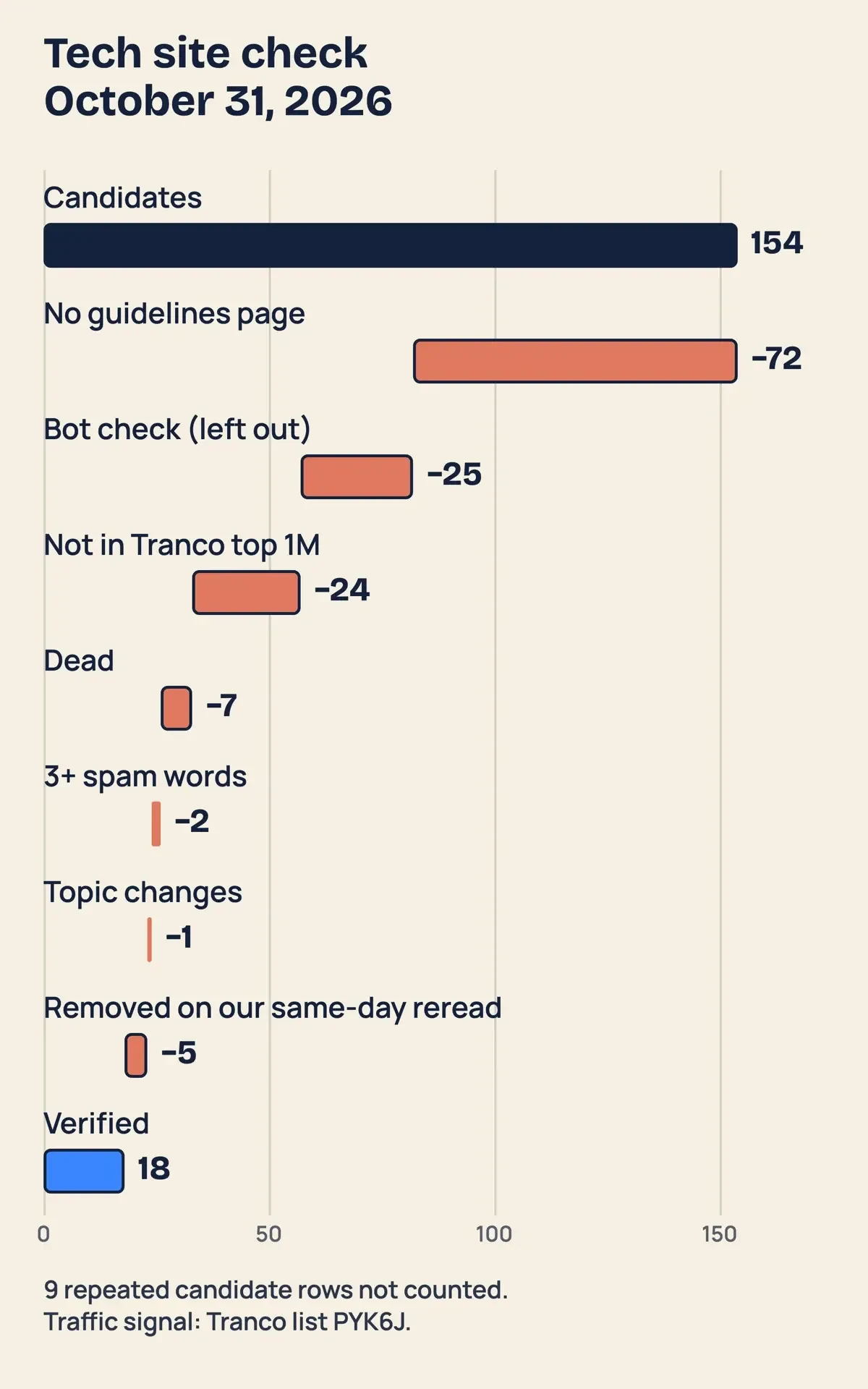 Diagram by DigitalTreed; counts from the tech section of our site check files, October 31, 2026.
How do you pitch a tech blog?
Pitch short and early, before you've written the whole thing. Tech editors often want the idea before the draft, and our own write for us page asks for exactly that. It wants a working title, what the reader will learn, an outline and two links to your writing. If the editor can't tell what your article is about from the first two lines of the email, the pitch has already lost, however good the draft is.
Here's an example pitch with the brackets left for you. The subject line and topic are made up.
Subject: Pitch: restoring a Postgres backup to a new server in under 15 minutes

Hi {editor first name},

Your recent piece on {article title} covered taking backups but stopped
before the restore. That gap bit me last month on {your setup}.

Idea: a step-by-step restore tutorial, tested on PostgreSQL {version}
and {OS + version}. Readers finish with a script they can run.

Outline:
1. What a restore test needs, and why most teams skip it
2. The script, line by line, with timings from my test
3. Three errors I hit and how to read them

About 1,500 words with screenshots. Not published anywhere else.
Two things I have written: {link 1}, {link 2}

Thanks,
{your name}
The pitch leaves out a link request, any talk of payment and flattery, and that's on purpose. Instead it names a gap in the editor's own article, offers a fix the editor can verify, and shows the writer has already done the work. No gap to point at yet? These five tech topics tend to pass a first read, provided the numbers are yours:
- A restore or failover test you ran, with the timings and the commands.
- A benchmark of two tools on your own hardware, with the script attached.
- A migration write-up: what broke moving from one framework or host to another.
- A hardening checklist for one stack, such as a small Linux web server.
- A tool you used daily for three months, including the bug that annoyed you most.
Each idea works because an editor can check it. Writing for a client? DigitalTreed's off-page SEO checklist shows where these bylines fit in a wider link plan, next to reviews, citations and digital PR.
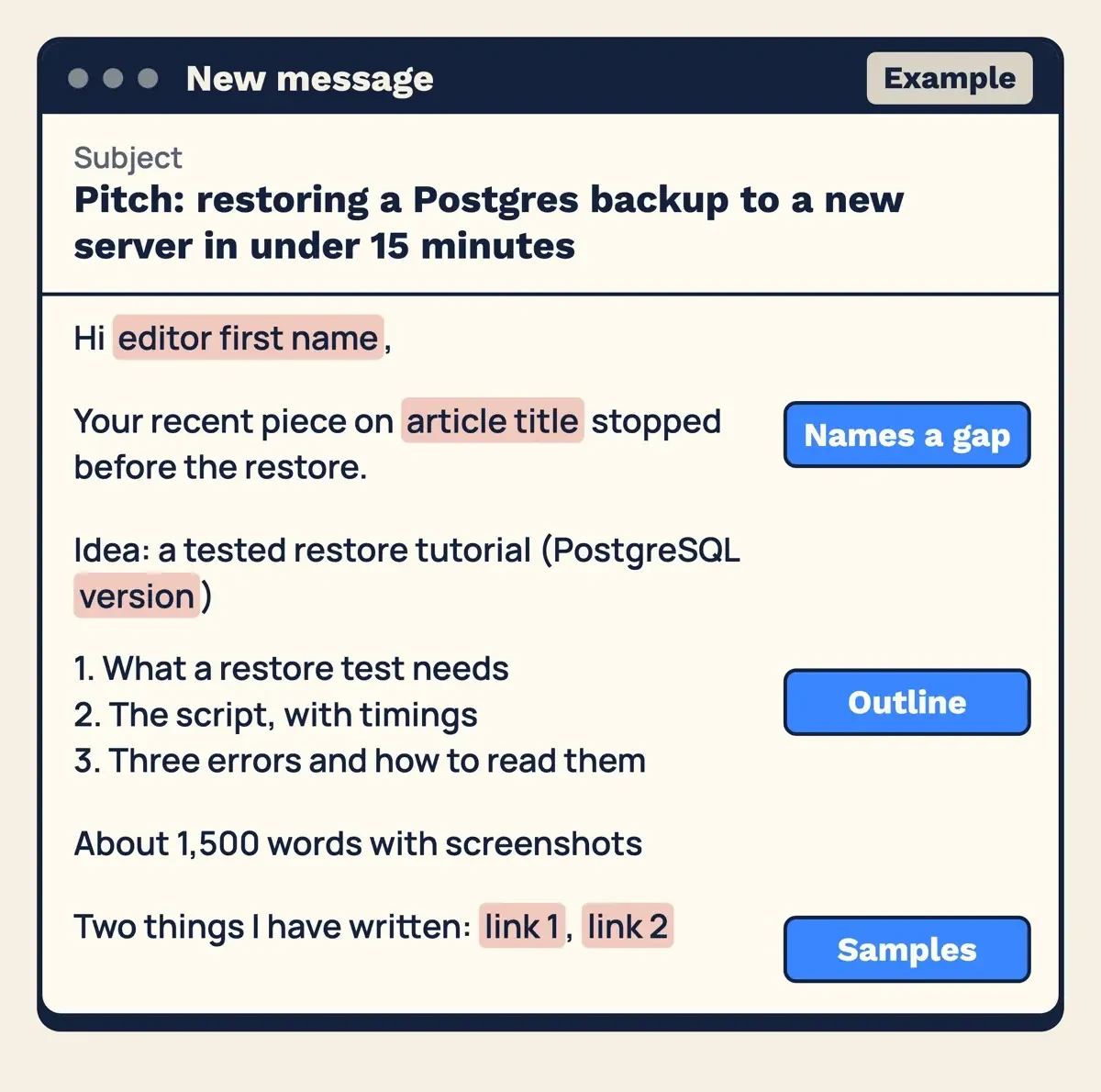 Drawn by us: an example pitch with made-up placeholders, not a real email.
Google and FTC rules for paid tech posts
Once a tech editor says yes, the link and its label decide whether the post helps you or hurts you. Google's spam policies list "Exchanging money for links, or posts that contain links" as link spam. The same list includes "links with optimized anchor text in articles, guest posts, or press releases distributed on other sites". Google's link best practices page asks for anchor text that's "descriptive, reasonably concise, and relevant".
So keep the anchor plain. In a byline, that's your name or your project's name.
If money or a free product changes hands, the link gets rel="sponsored". Google's page on qualifying outbound links says to "Mark links that are advertisements or paid placements (commonly called paid links ) with the sponsored value". Nofollow "is still an acceptable way to flag them, though sponsored is preferred". Hosts carry risk too. Google's November 19, 2024 site reputation abuse update targets third-party pages published "in an attempt to abuse search rankings by taking advantage of the host site's ranking signals". It also says that "having third-party content alone is not a violation".
The FTC side is about readers, not rankings. Its Endorsement Guides Q&A is direct about perks. If you get "free products or other perks with the expectation that you'll promote or discuss the advertiser's products in your blog, the FTC Act applies to you." A tech review written in exchange for a free laptop or a paid trip falls under that line, even when nobody pays the writer in cash.
The FTC's native advertising guide lists labels people understand, such as "Ad" and "Sponsored Advertising Content". It warns against "Promoted".
After a sponsored tech post goes live, make sure the link still works a week later; the broken link checker we offer can test it. Our sponsored blog posts guide explains how hosts label paid posts. Selling placements yourself? The guide to paid guest post scammers covers getting paid before any link goes live.
Where DigitalTreed fits in your tech pitch list
Now, our own page. We take guest posts too, so read this part knowing we have a stake in it.
DigitalTreed covers the marketing side of tech: SEO, AI tools, WordPress, blogging and online growth. Our readers are bloggers, agencies, SaaS teams and founders. We don't accept fully AI-generated content, and we allow one contextual link per post. Finance, crypto, forex, blockchain, real estate and legal topics get extra review. If your idea fits, pitch us through the write for us page. A business angle will do better on the sites in our business blog write for us guide. Wherever you send it, we'd pitch the three sites your readers already visit before the thirty a list suggests.
FAQ about tech guest posting
Frequently asked
Do technology blogs pay for guest posts?
Some do. Smashing Magazine's page says accepted work is "rewarded with a honorarium and full credit". Linux Handbook says "We don't pay for community contributed articles."
How long should a tech guest post be?
Follow each site's own number. A List Apart says "1,500 words is about average" for its articles.
Should I ask for a dofollow link?
No. Google's May 2017 note on article campaigns says a site taking guest articles should ask if "links of questionable intent" carry rel="nofollow". Our check drops any site that promises dofollow links. Speckyboy's page goes further: a submission "clearly only seeking a 'follow' link" is deleted automatically.
What does Moz Spam Score measure?
It's a vendor metric, not a Google signal. Moz says it shows "the percentage of sites with similar features that have been penalized by Google".
How we made this guide: Our site-check script and a fetch script read every page linked above by plain GET on October 31, 2026. The table and every count come from the check's output files, and no site was typed in by hand. No account was used, no form was filled and no pitch was sent. Facts checked by the DigitalTreed team on October 31, 2026.
First published as our own tech pitch page with a list of blogs by authority score. Rewritten October 31, 2026: a checked list with dates, a scorecard, tech spam signs and an example pitch.
Sources
- Google Search Central: Spam policies for Google web search
- Google Search Central: Qualify your outbound links to Google
- Google Search Central: Link best practices for Google
- Google Search Central Blog: A reminder about links in large-scale article campaigns (May 25, 2017)
- Google Search Central Blog: March 2024 core update and new spam policies (March 5, 2024)
- Google Search Central Blog: Updating our site reputation abuse policy (November 19, 2024)
- Google Search Central: Creating helpful, reliable, people-first content
- Google Search Central: site: search operator
- Google Search Help: Refine Google searches
- Google Search Central: Introduction to robots.txt
- Google Search Central: Learn about sitemaps
- sitemaps.org: Sitemaps XML format
- IETF RFC 9309: Robots Exclusion Protocol
- Tranco: A Research-Oriented Top Sites Ranking Hardened Against Manipulation
- Tranco: Methodology
- Internet Archive: Wayback CDX Server API
- Internet Archive Help Center: Using the Wayback Machine
- Moz Help: Spam Score (vendor metric)
- FTC: FTC's Endorsement Guides: What People Are Asking
- FTC: Native Advertising: A Guide for Businesses

Comments
No comments yet. Start the conversation below.