


Quick answer
A detailed painting estimate should list scope, prep, product, coats, gallons, labor and materials apart, dates, payment, permits, cleanup, warranty and change orders, as of November 2026. In a home built before 1978, it should also show the firm's EPA or state lead-safe certification and your Renovate Right pamphlet receipt. Our 15-line checklist below is ready to copy.
You've got three bids to repaint two rooms, and the totals are far apart. A painting estimate is a written offer that says what a painter will do, with which paint, by when and for how much. One bid fills a page; another is one lump sum. We'd ask every bidder for the same 15 lines before comparing prices.
Our cheapest made-up bid left out prep, gallons and the license number. Our made-up house dates from 1965, so paid sanding there falls under the EPA lead rule. If the job goes wrong after you sign, that bid is the first paper you'll need.
Key takeaways
- Our checklist found 12 of 15 lines missing on a made-up $1,650 bid.
- Two paint makers list 350 to 450 square feet per gallon.
- Paid paint-disturbing work in pre-1978 homes generally needs a lead-safe certified firm.
- California caps a home improvement deposit at $1,000 or 10%, whichever is less.
- Signing at home for $25 or more usually brings a three-business-day cancel right.
What should a painting estimate include?
The FTC's minimum is four items. Its home improvement scam page says "A written estimate should include a description of the work to be done, materials, completion date, and the price." Oregon's contractors board lists more for a well-written contract: the license number, specific materials, start and finish dates, a payment schedule and the full price.
Our list adds California's contract rules to those two. Line 14 comes from the EPA lead rule and line 15 from the FTC Cooling-Off Rule. Copy all 15 and send them to each painter who bids.
- Painter's business name, address, phone and state license or registration number
- Rooms and surfaces in scope (walls, ceilings, trim, doors) and what is left out
- Prep steps: patching, sanding, caulking, priming and furniture moving
- Paint product line, sheen and who picks the colors
- Number of coats for each surface
- Gallons of paint and primer the job will use
- Labor and materials priced as separate lines
- Payment schedule with the deposit and when the balance is due
- Start date and finish date
- Who gets any permits, or a note that none are needed
- Daily cleanup and debris removal
- Warranty on labor and materials, in writing
- Changes only by a written change order signed by both sides
- Pre-1978 home: the firm's EPA or state lead-safe certification and your Renovate Right pamphlet receipt
- A three-business-day cancellation notice if you sign at home
Prep and coats can explain a big gap between two totals. A bid that skips sanding and spot-priming is quoting a smaller job, even when the room count matches.
California's CSLB contract page asks for the products in detail, down to the "amounts of materials provided" and the manufacturer model number. It also wants cleanup, debris removal and any warranty put in writing.
Not every state requires a written agreement, but the FTC notes that "Contract requirements vary by state" and says to ask for one anyway. Its checklist for the signed version adds the painter's name, address, phone and license number, plus estimated start and finish dates. It also wants any promises from calls about scope or labor and materials costs written in. And it says every blank space should be filled in.
A blank next to coats or gallons can be filled in later, so we'd ask for a number or a strike-through before signing.
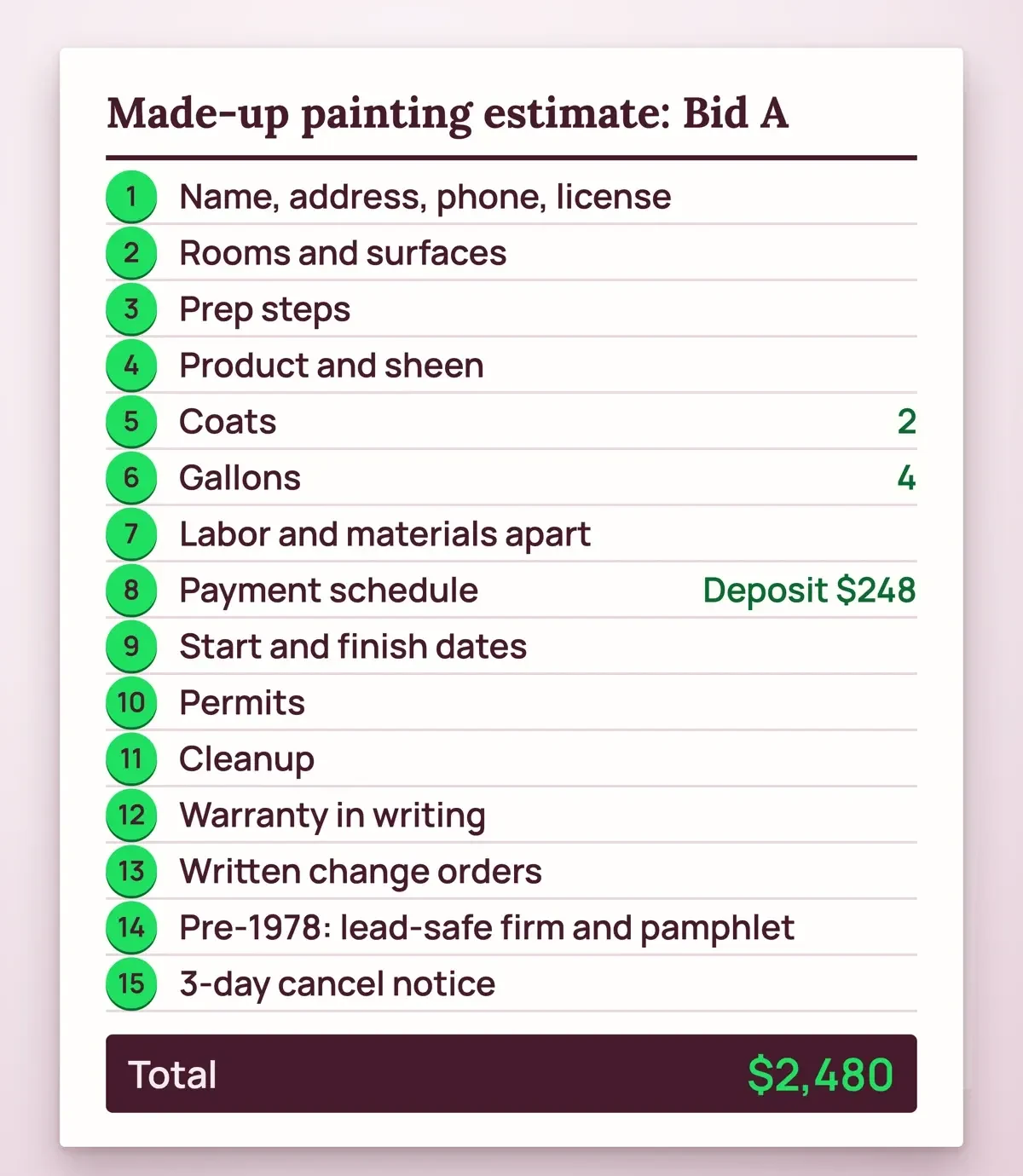 Diagram by DigitalTreed: a made-up painting estimate with the 15 checklist lines marked.
How to compare three painting bids
California's contractors board says to get at least three written bids on "identical plans, specifications, and scope of work." Washington's Department of Labor and Industries says the same: "Get at least 3 written bids and compare them carefully." The FTC adds "Don't automatically choose the lowest bidder" and says to ask why when bids are far apart. Our cheapest made-up bid left out 12 of the 15 lines, so it didn't price the same job as the other two.
When a bid prices labor on its own line and lists crew hours, divide the labor line by them, and you've got a rate you can line up across bids. For scale, the BLS outlook page for painters puts their median wage at $23.75 an hour in May 2025. That's what a painter earns, not what a firm charges, and the BLS wage data by state shows how it shifts by area.
If a bid arrives on paper, our guide to converting a scanned PDF to editable text turns a paper bid into text you can compare.
Check the paint quantity with the makers' numbers
Even a complete bid can come up short on paint. Benjamin Moore's data sheet for Ben interior eggshell gives a spread rate of 400 to 450 square feet per gallon, and its product page shows the same range. The sheet says the company "recommends two coats to achieve full color development."
Valspar's data sheet for 4000 Zero VOC interior latex, linked from its product page, lists "Approximately 350–450 sq. ft. per gallon" and less on rough walls.
Wall area is 2 x (length + width) x height, minus doors (21 square feet each in our example) and windows (15). Multiply by the coats and divide by the spread rate. Then round up.
| Example step (made-up house, built 1965) | Living room 14 x 12 x 8 ft | Bedroom 12 x 10 x 8 ft |
|---|---|---|
| Gross wall area: 2 x (L + W) x H | 416 sq ft | 352 sq ft |
| Less doors (21 sq ft each) and windows (15 sq ft each) | 1 door, 2 windows: 365 sq ft | 2 doors, 1 window: 295 sq ft |
| Both rooms x 2 coats | 660 x 2 = 1,320 sq ft | |
| Benjamin Moore Ben, 400-450 sq ft per gallon | 1,320 / 450 = 2.93; 1,320 / 400 = 3.30 | Buy 3 to 4 gallons |
| Valspar 4000, 350-450 sq ft per gallon | 1,320 / 450 = 2.93; 1,320 / 350 = 3.77 | Buy 3 to 4 gallons |
In this example, walls alone need 3 to 4 gallons for two coats. A bid listing 2 gallons for walls and trim plans one coat or less paint than the makers' rates allow. Ask which before you sign.
These rates fit those two products only; ask for the data sheet behind your bid.
The same sheets explain the coat count and the schedule. Benjamin Moore says previously painted surfaces can take 1 or 2 coats, and it recommends two on bare surfaces. Its eggshell is ready to recoat in 2 hours at 77 degrees Fahrenheit and 50% humidity. Valspar's sheet says 4 hours for its product.
Both list 50 degrees Fahrenheit as the lowest application temperature. A cold, unheated room can push the dates. A finish date that leaves no time between coats is a fair thing to question.
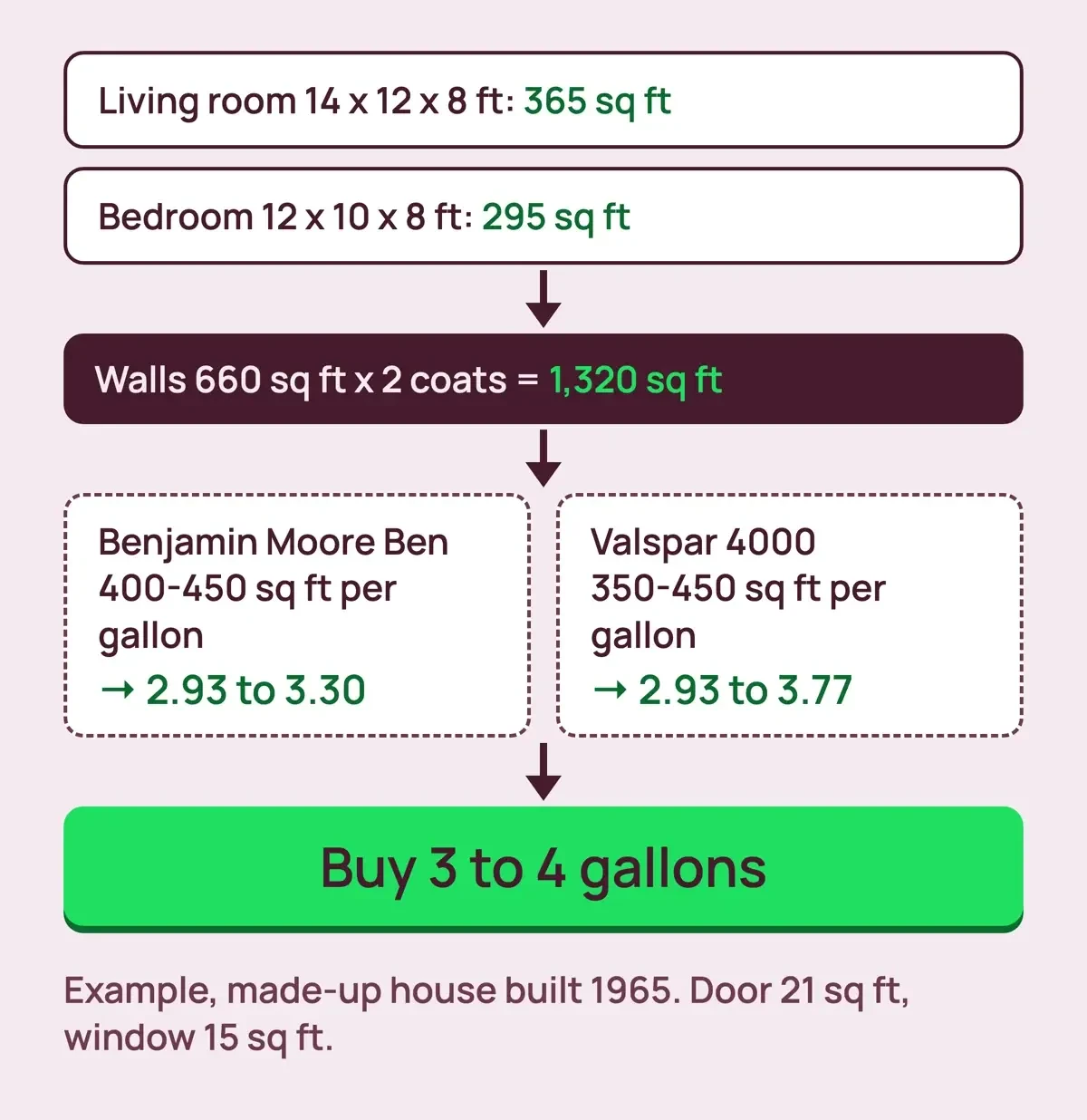 Diagram by DigitalTreed: the gallon formula on our made-up two-room job, with both spread rates.
Pre-1978 homes: the EPA lead-safe lines
In 1978, the federal government banned the sale of lead-based paint for use in homes. Even so, the EPA lead renovation page says "Approximately three-quarters of the homes in the United States built before 1978 still contain some lead-based paint." Federal rules call them target housing, defined in 40 CFR 745.103 as housing built before 1978, with a few exceptions.
In general, EPA says, the RRP rule covers anyone paid to disturb paint in those homes, sole proprietors included. Under 40 CFR 745.82, it applies to paid renovations there. One exception is a written finding by a certified inspector or risk assessor that the parts are free of lead-based paint. Small jobs count as minor repair: the definitions in 40 CFR 745.83 cover work that disturbs "6 square feet or less of painted surface per room" inside, or 20 outside. That carve-out ends if the work uses a banned practice, replaces windows or demolishes painted surfaces.
For example, one sanded 10-by-8-foot wall is 80 square feet, well past the 6-square-foot line. So a bid on an older house should name the firm's EPA or state lead-safe certification and say how the crew will contain dust. Under 40 CFR 745.85, open-flame burning or torching of paint is banned. So is high-speed sanding or grinding unless the machine has a shroud or containment system and a HEPA vacuum attachment. Heat guns must stay below 1,100 degrees Fahrenheit. EPA's RRP rules page links the full rule set.
Under 40 CFR 745.84, the firm must give you the Renovate Right pamphlet no more than 60 days before work starts and get your written receipt. If a bid doesn't show a certification number or a pamphlet line, ask the painter about both. Certification belongs to the firm, not only the crew. Under 40 CFR 745.89, firms that renovate for pay must apply to EPA electronically for certification. EPA's page for do-it-yourselfers also notes you can hire a certified lead dust sampling technician, inspector or risk assessor to test for dust once the work's done.
You can also check a firm yourself. EPA's lead-safe page for homeowners says to ask whether a contractor's certified or to use its search tool for certified firms. Fourteen states, Oregon among them, run their own EPA-authorized programs. Oregon's CCB lookup shows whether a contractor is licensed for pre-1978 homes that could contain lead-based paint. Planning solar on an older house too? We have a separate guide to solar for older homes.
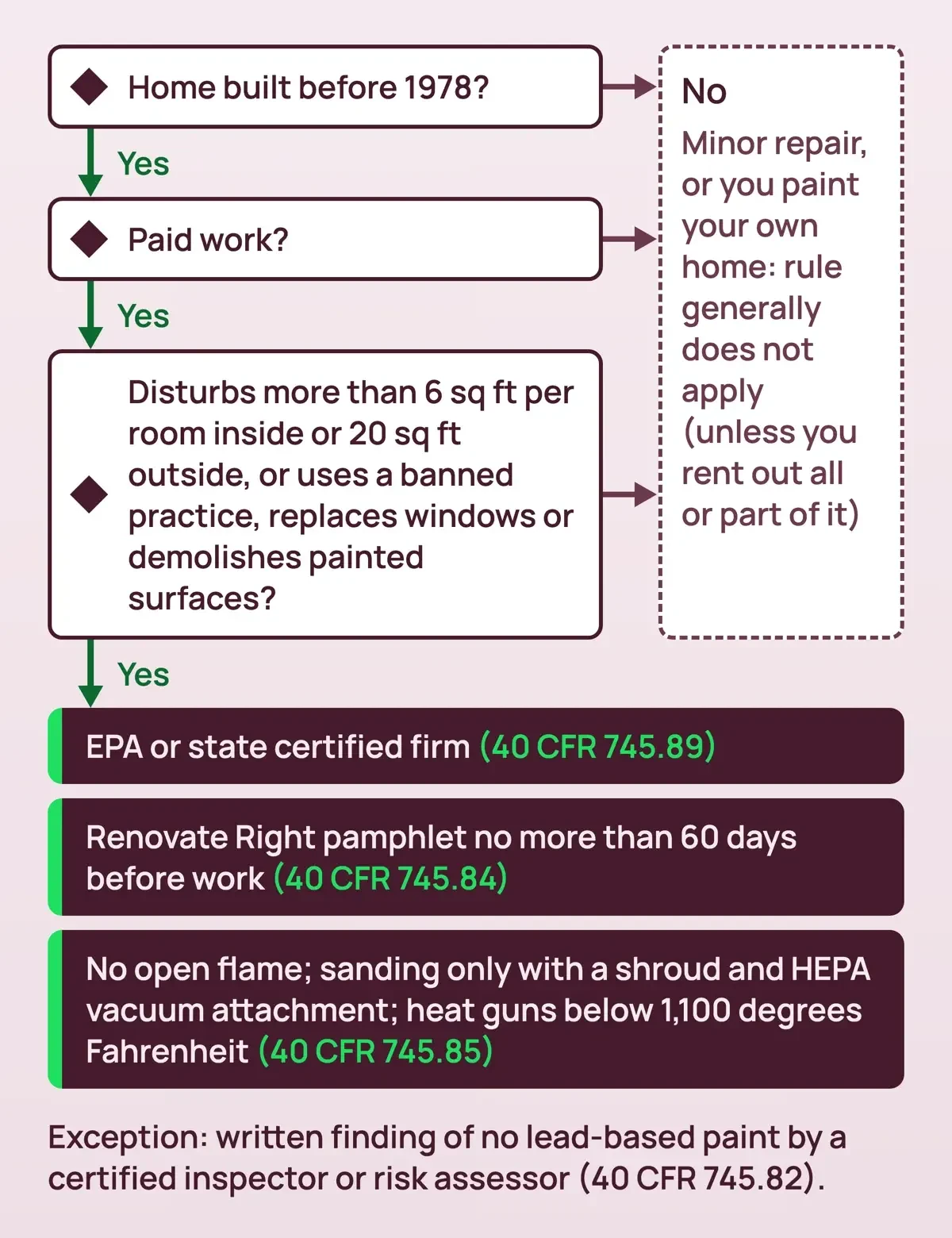 Diagram by DigitalTreed: when the EPA lead-safe rule applies to a painting job, from 40 CFR 745.82 to 745.85.
Check the license and the contract terms
Beyond the lead rule, each state sets its own licensing. In California, CSLB's contractor guide says anyone who "contracts for work valued at $1,000 or more for combined labor and materials costs must hold a current, valid license from CSLB." It licenses 45 classifications, and painters are one. CSLB also warns that "Few, if any, unlicensed individuals have a bond or workers' compensation insurance." That's the practical risk if a worker falls off a ladder in your stairwell. CSLB's hiring tips add that contractors must put their license number on business cards and on all bids and contracts. You can check it online or at (800) 321-CSLB.
Washington uses registration. Its L&I registration page says "Washington State requires all construction contractors to register with L&I," and painting is one of 63 specialties that need it. The agency's hiring page also suggests a performance bond for larger projects and points to its Homeowner Recovery Fund.
Oregon's CCB lookup shows an active license, bond, insurance, workers' comp and complaints from the past 10 years. Other states' rules aren't the same, so check the number on your own state board's site.
CSLB's contract page says, as of November 2026, that a home improvement down payment can't be more than $1,000 or 10% of the price, whichever is less. For the example bids below, that is 10% of each total. CSLB also says payments can't run ahead of the value of the work done, so a schedule tied to finished rooms fits that rule.
The FTC adds that some states limit down payments, and that you shouldn't make the final payment until the work's done and you're satisfied. Its warning signs include a crew that's "in the area," leftover materials, pressure to decide fast, cash only and a push to pay everything up front. Reviews help, though not every review is real. Our guide to FTC and Google review rules explains what's banned.
Read the dispute clause too. Oregon's CCB notes that construction contracts often hold arbitration clauses, and it says to know who will arbitrate, what it might cost and which rules apply before you sign.
On financing, the FTC warns against financing through a contractor's lender without shopping around and comparing loan terms. Our pages on credit card financing for big purchases and financial emergency options compare other ways to pay.
What we tested
On November 7, 2026, our checker script scored three made-up bids for the job above on the 15 lines, the gallons and California's deposit cap.
| Made-up bid | Total | Checklist | Deposit vs California cap | Gallons for walls (3-4 needed) |
|---|---|---|---|---|
| Bid A | $2,480 | 15/15 | $248, within the $248 cap | 4, inside the range |
| Bid B | $1,650 | 3/15 | $825, over the $165 cap | Not stated |
| Bid C | $3,100 | 12/15 | $1,550, over the $310 cap | 2, short |
Bid B passed only coats, payment schedule and dates. Bid C missed the permit, pamphlet and cancel lines, and its 2 gallons can't cover two coats.
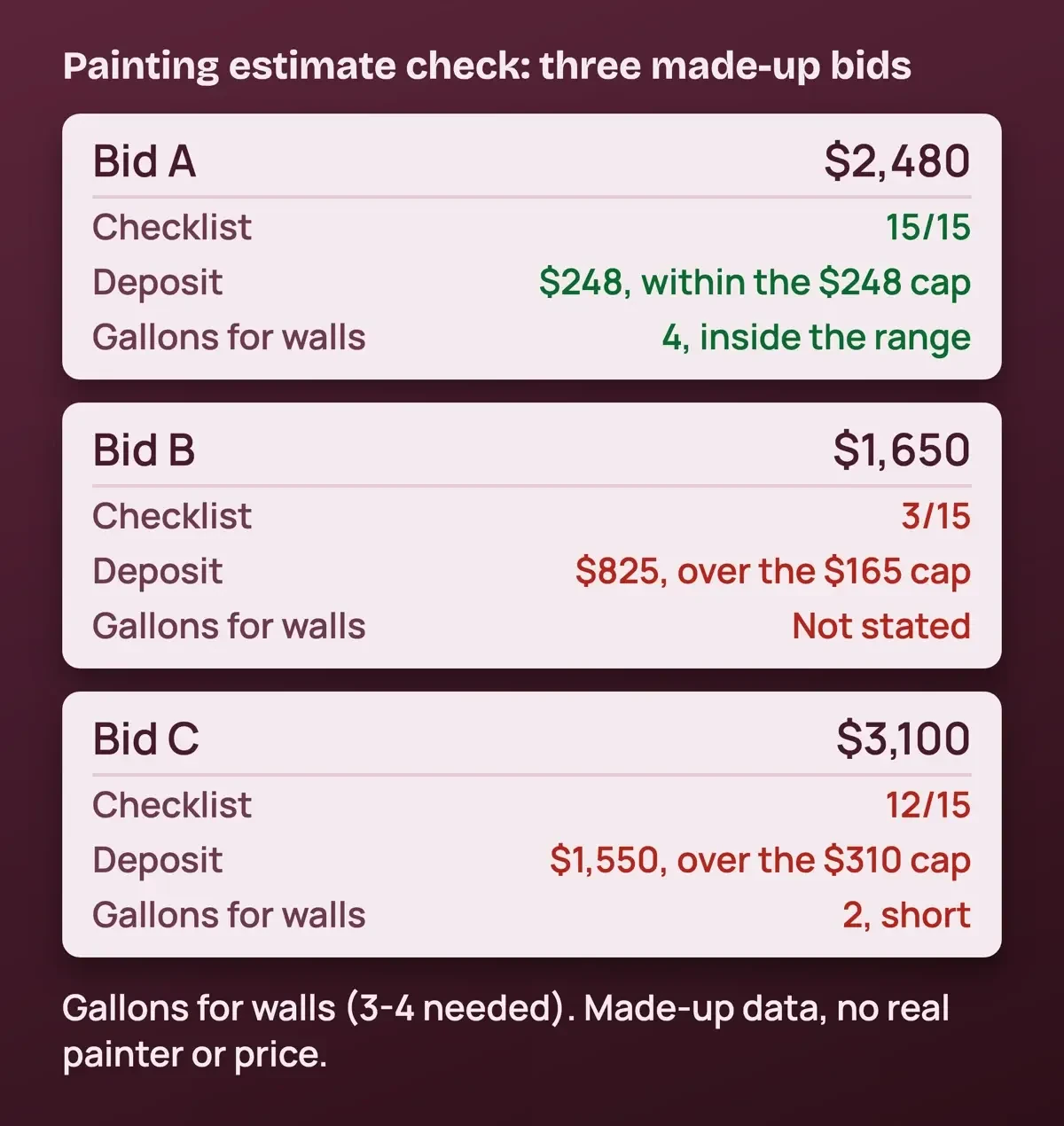 Illustration: our local checker, November 7, 2026.
If the job goes wrong after you sign
The FTC's scam page says to try the contractor first and to follow any phone call with a certified letter, return receipt requested. Our gym cancellation letter guide shows that letter format. Dated photos help too: take them from the same spots before work starts and again when it ends, the way our before-and-after renovation guide sets up matched shots. The FTC also says to keep notes and copies of every letter and document. If talking doesn't work, it points you to your state attorney general or local consumer office. Keep the signed estimate with those copies, since it shows the scope, gallons and dates you agreed to.
Suspect a lead-rule violation? EPA lists the National Lead Information Center, 1-800-424-5323.
Frequently asked
Is a painting estimate a contract?
Not by itself; CSLB's contract page says California requires a written contract for home improvement projects over $500.
How should I pay a painter's deposit?
Oregon's CCB says never to pay in cash; write the check to the business name.
Can I cancel a painting contract I signed at home?
Often, yes. The FTC Cooling-Off Rule covers sales of $25 or more made at your home, per 16 CFR 429.0, and gives you three business days to cancel.
Does the lead rule apply if I paint my own pre-1978 house?
Generally not, says EPA, unless you rent out all or part of it, run a child care center there or flip houses.
How we made this guide: We saved every page in Sources except the BLS state wage tool, pulled text from both data sheets and matched each quote to those copies. Facts checked by the DigitalTreed team on November 7, 2026. Not legal advice: for a contract dispute, ask a local attorney to read your paperwork.
First published May 2024 with no sources. Rewritten November 7, 2026: a 15-line checklist, paint math from maker data sheets, the EPA lead rule, state licensing examples and FTC rules. A stray brand mention and the old sales pitch were cut.
Sources
- FTC Consumer Advice: How To Avoid a Home Improvement Scam
- FTC Consumer Advice: Buyer's Remorse, the FTC's Cooling-Off Rule
- LII: 16 CFR 429.0, Cooling-off period definitions
- EPA: Lead Renovation, Repair and Painting Program
- EPA: Lead RRP Program rules
- EPA: Lead-safe renovations for DIYers
- EPA: RRP Program for contractors
- EPA: Renovate Right pamphlet
- LII: 40 CFR 745.82, Applicability
- LII: 40 CFR 745.83, Definitions
- LII: 40 CFR 745.84, Information distribution requirements
- LII: 40 CFR 745.85, Work practice standards
- LII: 40 CFR 745.103, Definitions (target housing)
- LII: 40 CFR 745.89, Firm certification
- California CSLB: What is a Contract?
- California CSLB: What Kind of Contractor Do You Need?
- California CSLB: Finding the Right Contractor
- Washington L&I: Hiring a Contractor
- Washington L&I: Register as a Contractor
- Oregon Construction Contractors Board: Consumer Tools
- Benjamin Moore: Ben Interior Eggshell N626 technical data sheet
- Benjamin Moore: Ben Interior Paint Eggshell product page
- Valspar: 4000 Zero VOC Interior Latex product data sheet
- Valspar: 4000 Interior Paint product page
- BLS Occupational Outlook Handbook: Construction and Maintenance Painters
- BLS OEWS: Painters, Construction and Maintenance (47-2141), May 2025


Comments
No comments yet. Start the conversation below.