

Quick answer
To earn money online at home, apply for remote jobs at the source: USAJOBS, CareerOneStop, your state job bank or the employer's own careers page. Never pay to get hired. The FBI's IC3 counted $362,934,762 in employment-fraud losses for 2025, its latest report as of November 2026. Check each offer against the eight red flags below.
If you're working out how to earn money online at home, you've seen posts offering, for example, $900 a week for typing, rating apps or reshipping parcels. Some lead to real jobs. Others are built to look exactly like them, or sell you a business instead. In FTC terms, a business opportunity is a paid deal to start a new business where the seller promises customers, locations or buy-backs.
On November 13, 2026, we checked nine sites that post remote jobs and tested 10 made-up ads. Our view: get hired through a posting you found yourself, and hold business offers to the FTC's 7-day rule.
Key takeaways
- Federal job applications are always free, per the FTC; USAJOBS posts them.
- Per the FTC, no honest employer has you send on check money.
- Reshipping packages from home is never a real job, per the FTC.
- Business opportunity sellers owe you disclosures seven days before you pay.
- Our checker reached USAJOBS but was blocked by CareerOneStop and three state job banks.
Where remote jobs are posted at the source
The FTC's job scams page tells job seekers to "start with safe and reliable sources." It names three: USAJobs.gov, CareerOneStop and local government websites found through USA.gov. On each one, the employer or a government office posts the job, so no stranger sits in the middle asking for a fee.
USAJOBS is the federal government's hiring site, and its footer says it's a United States Office of Personnel Management website. The FTC is blunt about cost: "it's always free to apply for a federal or postal job." So an ad selling a federal job, a paid list of hidden government openings or a recruiter's fee to fast-track an application doesn't match the official process. You'll need a USAJOBS profile to apply, per the site's overview of federal hiring. We didn't create one. Nothing in this guide needed an account.
As of November 2026, OPM's telework page says guidance that conflicts with the Presidential Memorandum "Return to In-Person Work" is rescinded, so confirm the duty station before accepting.
CareerOneStop covers jobs outside the federal government. The FTC describes it this way: "Sponsored by the U.S. Department of Labor, CareerOneStop lists hundreds of thousands of jobs." The CareerOneStop job finder also links to employment and training programs in each state. The Labor Department's American Job Centers page counts "approximately 2,300 American Job Centers nationwide." It sends people to the CareerOneStop finder or the toll-free line 1-877-US-2JOBS, and it notes that services may vary from state to state.
Local offices hire too. USA.gov's local governments directory finds city and county sites by state, which the FTC says "list any open positions they may have on their websites."
For a private employer, apply on the company's own careers page. Type its main web address yourself instead of tapping a link in a text or email. The FTC's advice on phishing is to contact a company "using a phone number or website you know is real." If a recruiter's email domain differs from the company's site, look up both in our DNS lookup tool. Then ask the company, through the contact page on its main site, whether that recruiter works there and whether the job you were offered is really open.
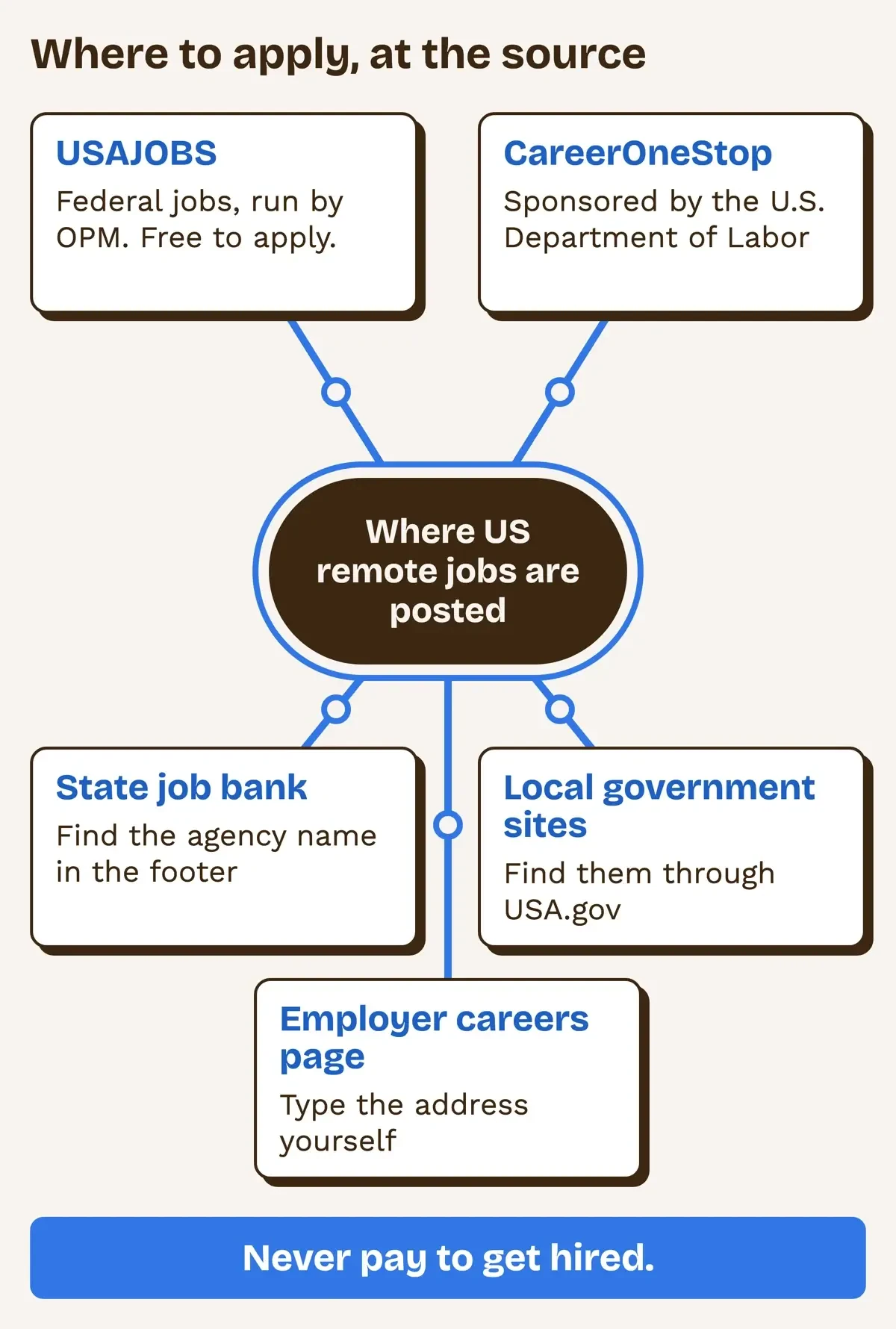 Diagram by DigitalTreed, from FTC, OPM, DOL and USA.gov pages read November 13, 2026.
For kinds of work, see our list of legit work-from-home jobs and their pay or our freelance jobs for college students.
What we could verify on November 13, 2026
Then we tested nine of these job sources with a small script and four questions. Did the page answer over verified HTTPS? Is it on a .gov address? Does the page name who runs it? Does the FTC name it as a place to start? Each request carried our checker's name, DigitalTreed-check/1.0, and we stopped at any page that turned it away; nothing needed a login.
| Source | Answered our script | .gov address | Says who runs it | Named by the FTC |
|---|---|---|---|---|
| USAJOBS home page | Yes (200) | Yes | Yes | Yes |
| USAJOBS search with remote filter | Yes (200) | Yes | Yes | Yes |
| CareerOneStop job finder | No (403) | No | Not checked | Yes |
| USPS careers | Yes (200) | No | Yes | Yes |
| DOL American Job Centers page | Yes (200) | Yes | Yes | No |
| USA.gov local governments | Yes (200) | Yes | Yes | Yes |
| WorkInTexas (Texas job bank) | No (403) | No | Not checked | No |
| Employ Florida (Florida job bank) | No (403) | No | Not checked | No |
| CalJOBS (California job bank) | No (403) | Yes | Not checked | No |
USAJOBS, its search page and USA.gov passed all four checks. USPS careers answered, but on usps.com rather than a .gov address.
CareerOneStop and all three state job banks we tried, WorkInTexas, Employ Florida and CalJOBS, refused our script with a 403 error. A 403 says nothing about honesty. It only means a site turned away an automated request. In a regular browser the same day, CareerOneStop's state job banks page linked all three. Open your state's job bank in your usual browser and find the state workforce agency's name in the footer. Then confirm the address from your state's official .gov site. Our script also didn't try other states, so if you live outside Texas, Florida and California, your own state's job bank is still untested by us.
We didn't count job listings, because USAJOBS loads its results with a script and our plain request saw only the filters.
Which job ads does the FTC call scams?
Once you've found an opening, check the ad itself. On its job scams guide, the FTC calls three pitches scams outright: paying to get hired, sending on part of a check and reshipping packages. The table quotes eight red flags word for word, six from the FTC and two from the FBI's IC3.
| Red flag in the ad | What the agency says | Source |
|---|---|---|
| Pays you only after you pay for a kit, training or certificate | "Honest employers, including the federal government, will never ask you to pay to get a job." | FTC |
| Mails you a check, then wants part of it passed on | "No honest potential employer will ever send you a check to deposit and then tell you to send on part of the money, or buy gift cards with it." | FTC |
| Wants you to receive, repack and reship packages | "Reshipping goods is never a real job." | FTC |
| Promises big money for little work | "If someone offers you a job and claims that you can make a lot of money in a short period of time with little work, that's almost certainly a scam." | FTC |
| A placement firm wants a fee from you | "Honest placement firms do not typically charge a fee to job candidates." | FTC |
| You pay the employer in cryptocurrency to get more tasks | "You are directed to make cryptocurrency payments to your employer as part of a job." | FBI IC3 |
| Guaranteed income or a "proven system" | "If it promises guaranteed income, large returns, or a "proven system," it's likely a scam." | FTC |
| Wants bank or Social Security details in an offer you never asked for | "Do not send financial or personal identifiable information to people making unsolicited job offers." | FBI IC3 |
The crypto and personal-details lines come from an FBI IC3 alert on work-from-home scams, dated June 4, 2024. It describes fake jobs built on simple tasks, such as rating restaurants or clicking a button over and over. The alert lists one more sign: "The scammer does not require any references as part of the hiring process." It advises: "Never send money to an alleged employer." The guaranteed-income line comes from the FTC's page on business offer and coaching scams.
The FTC's fake check scams page explains the timing: "By law, banks have to make deposited funds available quickly." Yet "It can take weeks for a bank to figure out that the check is a fake." Here's an example with made-up amounts. A new "employer" mails you a $2,450 check, says to keep $350 for your time, and wants $2,100 wired to a vendor. When it bounces, the bank takes back all $2,450. The $350 still in your account covers part of that. You're out the $2,100 you sent (loss = check amount minus the amount you were told to keep).
The FBI's IC3 2025 Internet Crime Report counted 24,688 employment-fraud complaints and $362,934,762 in losses for 2025. For 2024 it counted 20,044 complaints and $264,223,271, and for 2023, 15,443 complaints and $70,234,079. By our math, 2025 had 23.2% more complaints and 37.4% more money lost than 2024, or about $14,701 per complaint in 2025 (losses divided by complaints). IC3 also logged almost $13 million in 2025 losses to AI-involved employment scams. Those totals cover only the people who filed with IC3, and the FTC spotlight below adds that "most scams aren't reported to the government."
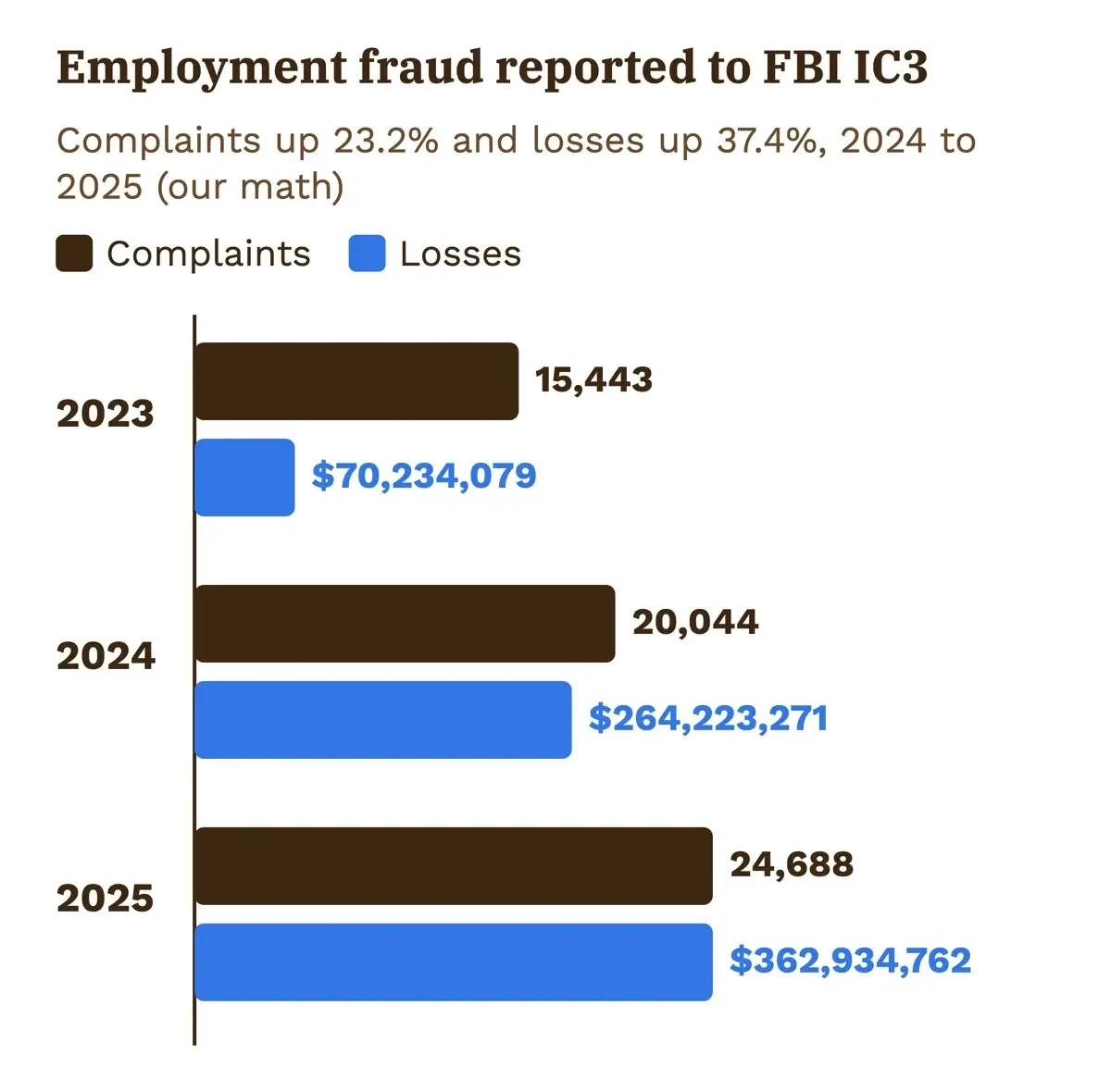 Source: FBI IC3 2025 Internet Crime Report, employment fraud, 2023-2025. Chart drawn by us.
Many of these pitches start on social media, according to an April 27, 2026 FTC Data Spotlight on social media scams. "One in three people who reported losing money to a job or business opportunity scam in 2025 said it started on social media." Our guide to Instagram scams shows how those direct messages tend to open.
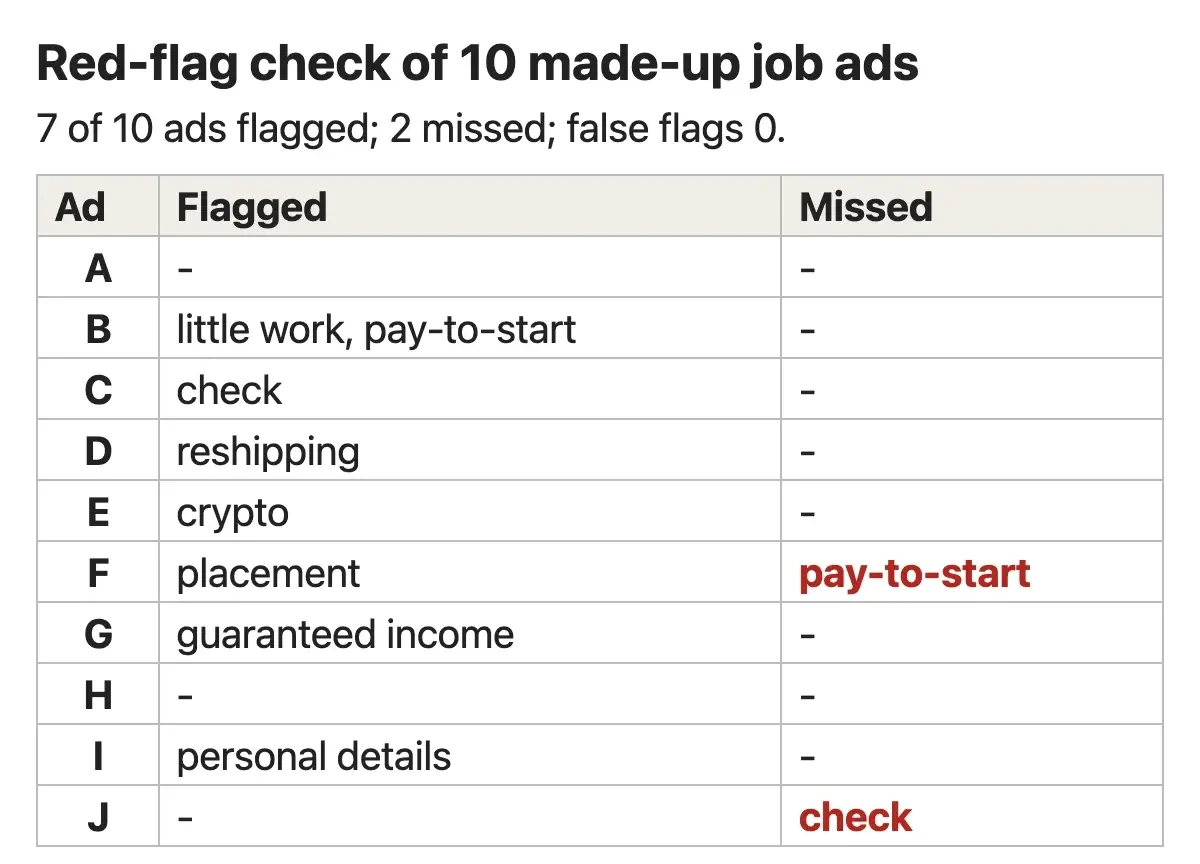 Screenshot: our red-flag check of 10 made-up job ads, run on 127.0.0.1 on November 13, 2026.
What we tested
We wrote 10 made-up job ads, 8 with a red flag and 2 ordinary ones, and ran a keyword checker on them on November 13, 2026. It flagged 7 of the 8 scam ads and neither ordinary ad. It missed two things. Ad F's example $120 placement fee tripped the placement flag but not the pay-to-start flag. Ad J, a mystery shopper told to buy gift cards and text the numbers, tripped nothing at all, so read each offer against the table yourself.
Business opportunity offers and the FTC's 7-day rule
Unlike a job ad, some pitches ask you to pay for a home business. The FTC's Business Opportunity Rule (16 CFR Part 437) exists so buyers can "assess the risks of buying a work-at-home program or any other business opportunity." The FTC published the current version as a final rule on December 8, 2011.
The rule's definitions section covers deals where you make a required payment and the seller says it'll supply locations, outlets, accounts or customers. A seller who promises to buy back what you produce is covered too, and the rule's own buy-back example is envelope stuffing at home. So a pitch that promises clients once you buy a starter package, a website bundle or a set of leads can fit that pattern, whatever the seller calls it. Under 16 CFR 437.2, the seller must give you its disclosures in writing "at least seven calendar days before" you sign a contract or pay. The disclosure document section lists what that one document must show:
- The seller's name, business address and phone number, plus the salesperson's name.
- A yes or no box on whether the seller makes any earnings claim.
- Any civil or criminal action for fraud, misrepresentation or deceptive practices in the past 10 years.
- The refund or cancellation policy, if there is one.
- References: past buyers from the last three years, at least the 10 nearest to you.
A seller who wants payment today, before those seven days pass, isn't following the rule. We'd phone at least three of those references before paying and ask what they earned in their first six months. The rule's prohibited practices section also bars a seller from misrepresenting what buyers may earn or the terms of its refund policy.
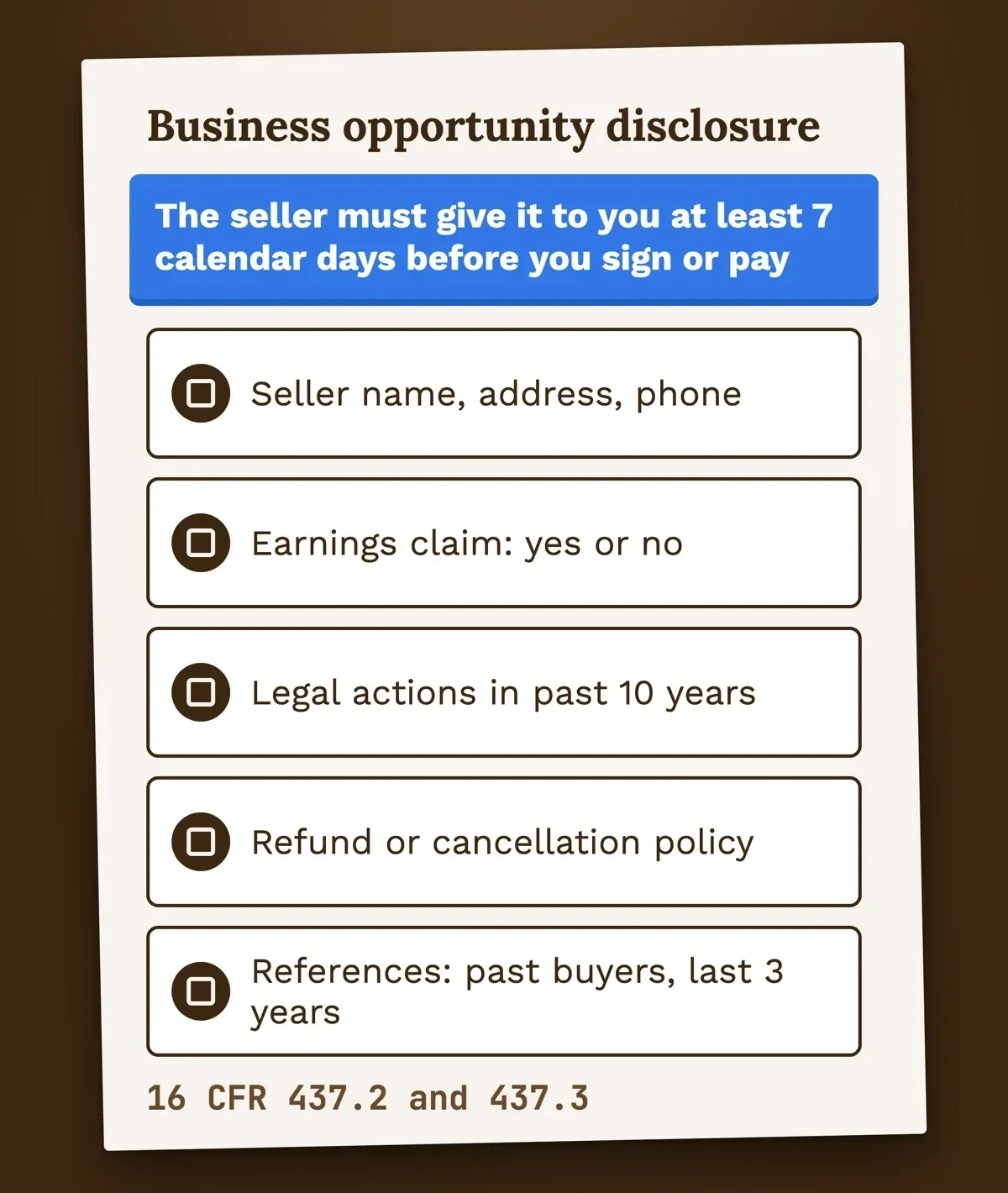 Diagram by DigitalTreed, from 16 CFR 437.2 and 437.3 as read November 13, 2026.
The FTC's business offer page gives three questions to answer first: "What would I be selling or doing?" "How would the business generate income?" "When would I expect to turn a profit?"
Before joining a multi-level marketing plan, read the FTC's MLM and pyramid scheme guide: "Most people who join legitimate MLMs make little or no money."
If you already paid or sent your details
If you've already sent money or personal details, start with the payment. The FTC's job scams page says to "immediately contact the company you used to send the money, report the fraud, and ask to have the transaction reversed, if possible." For a bank transfer that's your bank, for a card it's the card issuer, and for a payment app it's the app's own help or fraud team.
Move fast with gift cards, crypto and wires too, since the FTC's fake check page says that once you've paid that way, "It's almost impossible to get it back."
Then report it. File at ReportFraud.ftc.gov and with the FBI's Internet Crime Complaint Center. Tell your state attorney general too, whom USA.gov's state attorneys general list will help you find. If you handed over an SSN "thinking it was for payroll," the FTC warns "you may now have an identity theft problem." Its page on what to do if you were scammed points you to IdentityTheft.gov for a recovery plan.
Tapped a link in the recruiter's message? Our steps after a phishing click cover PC, Mac and phone, and our pointers on spotting phishing help with the next one.
For client work, see our guides to starting out as a freelancer and freelancing while employed. For a job, we'd begin with one USAJOBS Remote jobs search and one search on your state's job bank, typed in yourself.
Frequently asked
Does USAJOBS list remote federal jobs?
Yes. On November 13, 2026, the USAJOBS search page offered Remote jobs, Exclude remote jobs and Offers telework filters.
Do staffing agencies charge job seekers a fee?
Honest ones typically don't. The FTC says, "Instead, the hiring company pays them a fee to find qualified candidates."
What must a business opportunity earnings claim show?
Under 16 CFR 437.4, a separate "EARNINGS CLAIM STATEMENT REQUIRED BY LAW" giving the claim, its dates, and the number and percentage of past buyers who reached it.
Do I owe tax on a small side job from home?
Usually. The IRS says gig income counts even without a 1099 or W-2, and self-employment tax applies from $400 of net earnings. This isn't tax advice; ask a CPA.
How we made this guide: We saved FTC, FBI IC3, OPM, Labor Department, USA.gov, IRS and CFR pages as text, checked nine job sources and tested 10 made-up ads. Facts checked by the DigitalTreed team on November 13, 2026.
First published April 2, 2020 with online income ideas. Rewritten November 13, 2026 around remote job sources and job-scam red flags.
Sources
24Sources we checkedFTC, law.cornell.edu, FBI IC3 and 8 moreViewHide
- 01FTC: Job Scamsconsumer.ftc.gov
- 02FTC: How To Spot, Avoid, and Report Fake Check Scamsconsumer.ftc.gov
- 03FTC: When a Business Offer or Coaching Program Is a Scamconsumer.ftc.gov
- 04FTC: Multi-Level Marketing Businesses and Pyramid Schemesconsumer.ftc.gov
- 05FTC: What To Do if You Were Scammedconsumer.ftc.gov
- 06FTC: How To Recognize and Avoid Phishing Scamsconsumer.ftc.gov
- 07FTC: Business Opportunity Rule (16 CFR Part 437)ftc.gov
- 08FTC Data Spotlight: Reported losses to scams on social media eight times higher than in 2020ftc.gov
- 0916 CFR 437.1 Definitions (Cornell LII)law.cornell.edu
- 1016 CFR 437.2 The obligation to furnish written documents (Cornell LII)law.cornell.edu
- 1116 CFR 437.3 The disclosure document (Cornell LII)law.cornell.edu
- 1216 CFR 437.4 Earnings claims (Cornell LII)law.cornell.edu
- 1316 CFR 437.6 Other prohibited practices (Cornell LII)law.cornell.edu
- 14FBI IC3: 2025 Internet Crime Reportic3.gov
- 15FBI IC3: Scammers Defraud Individuals via Work-From-Home Scams (I-060424-PSA)ic3.gov
- 16USAJOBSusajobs.gov
- 17OPM: Teleworkopm.gov
- 18CareerOneStop: Job Findercareeronestop.org
- 19U.S. Department of Labor: American Job Centersdol.gov
- 20USAGov: Local governmentsusa.gov
- 21USAGov: State attorneys generalusa.gov
- 22USPS: Careersabout.usps.com
- 23IRS: Gig Economy Tax Centerirs.gov
- 24IRS: Self-Employment Tax (Social Security and Medicare Taxes)irs.gov
Comments
No comments yet. Start the conversation below.