
Quick answer
Text mail subscriber is a caller label no official page explains: it appeared 0 times in 24 FTC, FCC rule and app pages we read on November 5, 2026. Treat it as an unknown number, and hang up if it plays a recorded sales pitch or asks for money or a code. Report unwanted calls at DoNotCall.gov and forward spam texts to 7726.
Our 2023 version of this article said a text mail subscriber is anyone who makes requests over the web. We couldn't back that up. The phrase may show up as a caller name or in a voicemail greeting. Either way, no FTC page, FCC rule or app listing we read defines it.
Our take: read the label as a blank caller ID. Several apps hand out real US numbers that call and text, and the FTC says scammers can put any name on caller ID. So the label tells you neither who called nor whether calling back is safe; what the caller asks for tells you more.
Key takeaways
- No FTC page, FCC rule or app listing we read uses this label.
- Scammers can fake any caller ID name, so the label proves nothing.
- Forward spam texts to 7726 so your carrier can block similar ones.
- Report unwanted calls at DoNotCall.gov, or at ReportFraud.ftc.gov after a loss.
- The Do Not Call Registry stops legal sales calls, not scammers.
What the label means, and what we could not confirm
On November 5, 2026 we saved 24 pages: nine FTC pages, five law and FCC rule pages, three App Store listings and seven app and support pages. A script searched every copy for the label and two variants, and it found 0 matches. FCC.gov's consumer guides and TextNow's help center returned 403 to our checker, a bot-block (they open in a browser), so we couldn't search those two sites.
The wording points to a texting service. Several apps hand out real US numbers. TextNow's App Store listing offers "a free local phone number or keep your own for a private second line or business use". TextFree's free phone number page says "Choose an area code and find a phone number that fits." The TextMe listing opens with "Your private line & 2nd phone number." Google Voice help says the service "gives you a phone number for calls, texts, and voicemails." None of the four says what name the other person sees, so we don't name any app as the source of the label.
Calls from those apps run over the internet, and since TextFree lets users pick an area code, the area code may not show where the caller lives. The FTC's call-blocking page says VoIP means "your phone makes calls over the internet instead of phone lines". The FCC's rule in 47 CFR 64.1601 makes carriers and interconnected VoIP providers pass the calling number down the line. That covers the number only; no page we read says how the name on your screen gets picked.
A caller can also hide the number. Under 64.1601(b), carriers using Signaling System 7 treat *67 dialed first as a request not to pass the number on an interstate call. When the label comes with digits, the caller didn't hide the number that way, and you have something to look up.
Texts count too. The FCC's definitions in 47 CFR 64.1600 cover "a call made using a voice service or a text message sent using a text messaging service". So a text from an app number gets the same caller ID protections as a call, including the ban on faking the sender to cheat you.
On AT&T, the label can't be an email turned into a text. Its email-to-text support page says "Effective June 17, 2025, you can no longer send or receive texts using email."
Want an app number of your own for sign-ups? Our guide to temporary phone numbers for SMS covers what those services can't do.
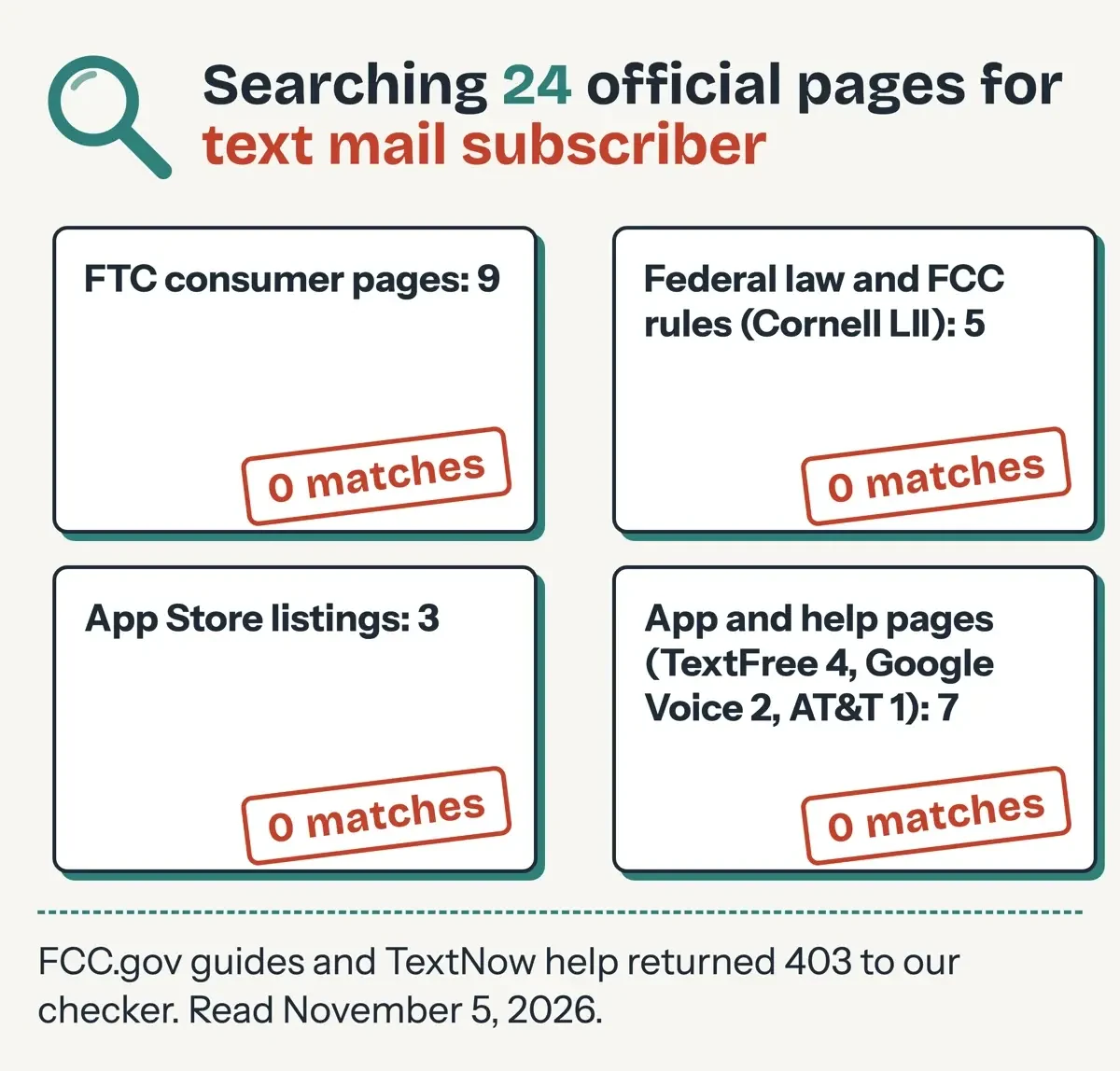 Diagram by DigitalTreed, from our search of 24 saved FTC, FCC rule, app and help pages, November 5, 2026.
Is a text mail subscriber call a scam?
Not by itself, and it doesn't prove a call is safe either. The FTC's phone scams page warns: "Scammers can make any name or number show up on your caller ID. That's called spoofing." Its robocalls page says why there are so many: "It's cheap and easy for them to make robocalls over the internet from anywhere in the world." Faking caller ID to cheat someone breaks federal law. Under 47 U.S.C. 227(e), nobody may "knowingly transmit misleading or inaccurate caller identification information with the intent to defraud, cause harm, or wrongfully obtain anything of value". The FCC's rule in 47 CFR 64.1604 says the same, and it reaches callers outside the US too.
In our made-up test set, the phrase sat on a harmless "not available" greeting and on a caller posing as your bank. What the caller asks for matters more, and the FTC pages and Google's Voice help flag these types:
- A recorded message selling something: "the call is almost always illegal. It's also probably a scam."
- A caller claiming to be a government agency, threatening you over taxes or Medicare.
- A text promising free prizes, gift cards or coupons, per the FTC's spam text page.
- A text about suspicious account activity or a payment problem.
- Anyone asking for a verification code you were just sent.
On that last one, Google's Voice help on verification codes says "Google employees will never ask for this code." For government callers, the robocalls page is blunt: if they say something bad will happen unless you pay, "It's a scam." Not every robocall breaks the law, though. The FTC's robocalls page says "messages that are purely informational or calls to collect a debt aren't illegal". So a text mail subscriber call that fits none of the signs may just be a person on a texting app, like a contractor on a work line. Our tips to avoid phishing and our Instagram scams guide cover the message tricks in more depth.
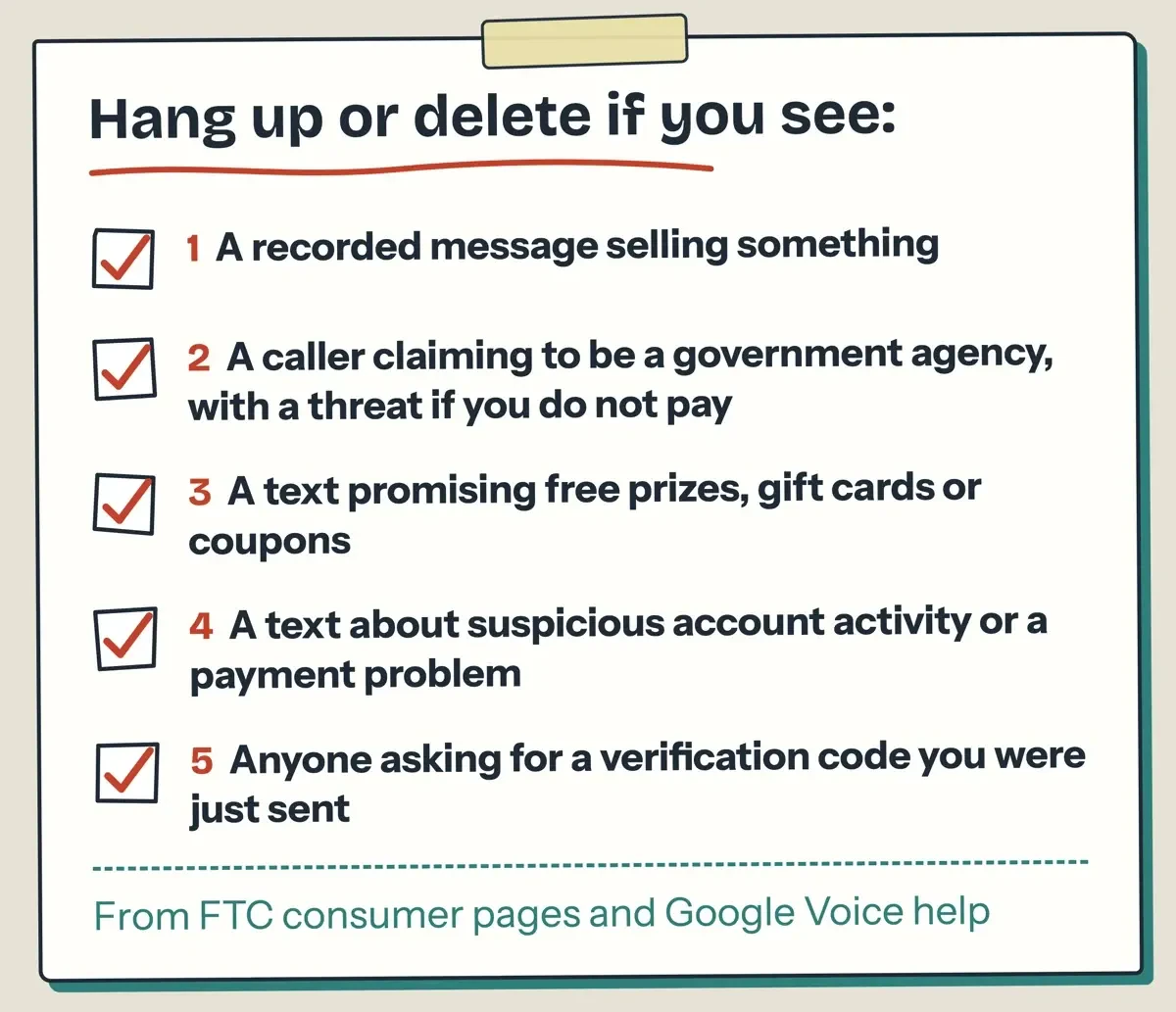 Diagram by DigitalTreed, from FTC consumer pages and Google Voice help, read November 5, 2026.
How to look up a text mail subscriber number
Calling back has a cost. The FTC's robocalls page says pressing numbers to reach someone or get off a list "will probably only lead to more robocalls." None of these steps dials the number:
- Read the voicemail or text first, and note any company it names.
- Check how your phone or carrier labeled the call.
- Type the full number into a search engine yourself.
- Try a caller ID app, after reading what it can see.
If the message names a company, the FTC spam text page says to "contact the company using a phone number or website you know is real." Use your bill or the company's own site, not the number in the voicemail. Your carrier's label may be missing. The FTC blocking page says not every scam call gets flagged. For a web search, our VoIP number lookup guide covers what an internet number lookup can and can't show. Leave lookup apps for last: our Truecaller number search guide walks through one, and the FTC notes that "Some apps access your contacts list". Read the privacy policy first.
If the voicemail asked for money, a gift card or a code, skip the lookup and go straight to blocking and reporting. A search result can't prove who called either; the robocalls page says "Caller ID is easy to fake".
How to block the calls and texts
The FTC's blocking page describes three places to block a number: your phone, your carrier and a call-blocking app. Cell phones, internet home phones and landlines each have their own options, it says. On a cell phone, you can block one number from the recent calls list. Phones "also usually have features like Do Not Disturb, where you can set the hours that calls will go straight to voicemail", the FTC says. For texts, the FTC's spam text page points to built-in filters for messages from unknown senders on iPhone and Android.
A block on your phone covers one number. A spoofer can switch to another. Your carrier may block calls and texts for you, and the FTC notes that some of these services are free while others charge you a fee. The FTC suggests checking your provider's website or calling customer service. It also points to the FCC's Call Blocking Resources for links by company. The FCC adds a rule for texts in 47 CFR 64.1200(p). A mobile provider "must block a text message purporting to originate from a North American Numbering Plan number on a reasonable do-not-originate list."
A call-blocking app guesses which calls to stop. The FTC says "The company behind the app uses call data or reports from users, the FTC, and other sources to predict which calls are illegal or likely scams." Some apps are free; others charge. They can stop a call, let it through without ringing, or send it to voicemail. Inside a texting app, check its own settings; TextFree's App Store listing says users can "Silence spam & send it to voicemail".
Landlines get a different tool: the FTC page describes call-blocking devices as small boxes you attach to the phone. Some use databases of known scam numbers. Others rely on a block list you build yourself, which is fine if the same text mail subscriber number keeps calling.
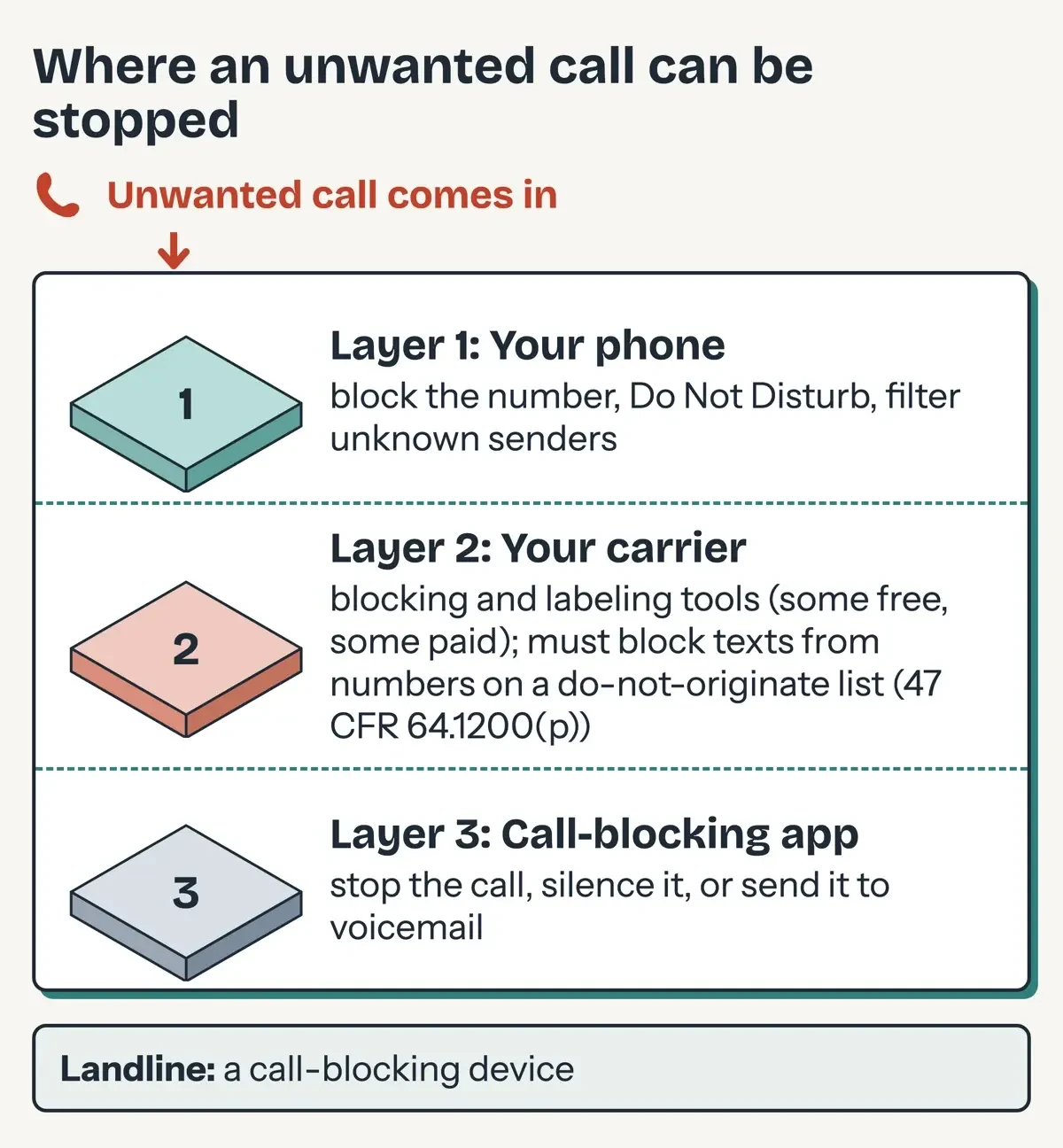 Diagram by DigitalTreed, from the FTC call-blocking and spam text pages and 47 CFR 64.1200(p), November 5, 2026.
Where to report: FTC, Do Not Call and 7726
The FTC sends each case to a different place: DoNotCall.gov for an unwanted call, ReportFraud.ftc.gov once money or details are gone, and 7726 for a spam text. Each row names the FTC page that says so:
| What happened | Where to report | FTC page |
|---|---|---|
| Unwanted call, no money lost | DoNotCall.gov | Block unwanted calls |
| Money or personal details lost | ReportFraud.ftc.gov | Phone scams |
| Spam or phishing text | 7726, your messaging app, ReportFraud | Spam texts; phishing |
| Someone misused the SSN you gave | IdentityTheft.gov | If you were scammed |
Each report asks for the same few details. The FTC's Do Not Call FAQ lists your own number and the number on your caller ID, "even if you think it might be spoofed or faked". Add any number you were told to call back, plus the date and time, which the FTC and other agencies analyze to find the people behind illegal calls. Forwarding to 7726 "helps your wireless provider spot and block similar messages in the future", says the spam text page. The FTC's phishing page gives the same step for phishing texts.
Don't expect a reply. The FAQ says the FTC gets "millions of reports each year, so we can't respond to each one."
FCC.gov's consumer guides and its complaint site returned 403 to our checker, a bot-block; they still open in a browser. Three FTC pages we could read name the FCC Call Blocking Resources page linked above. We couldn't read the FCC's complaint steps anywhere, so the table lists FTC routes only.
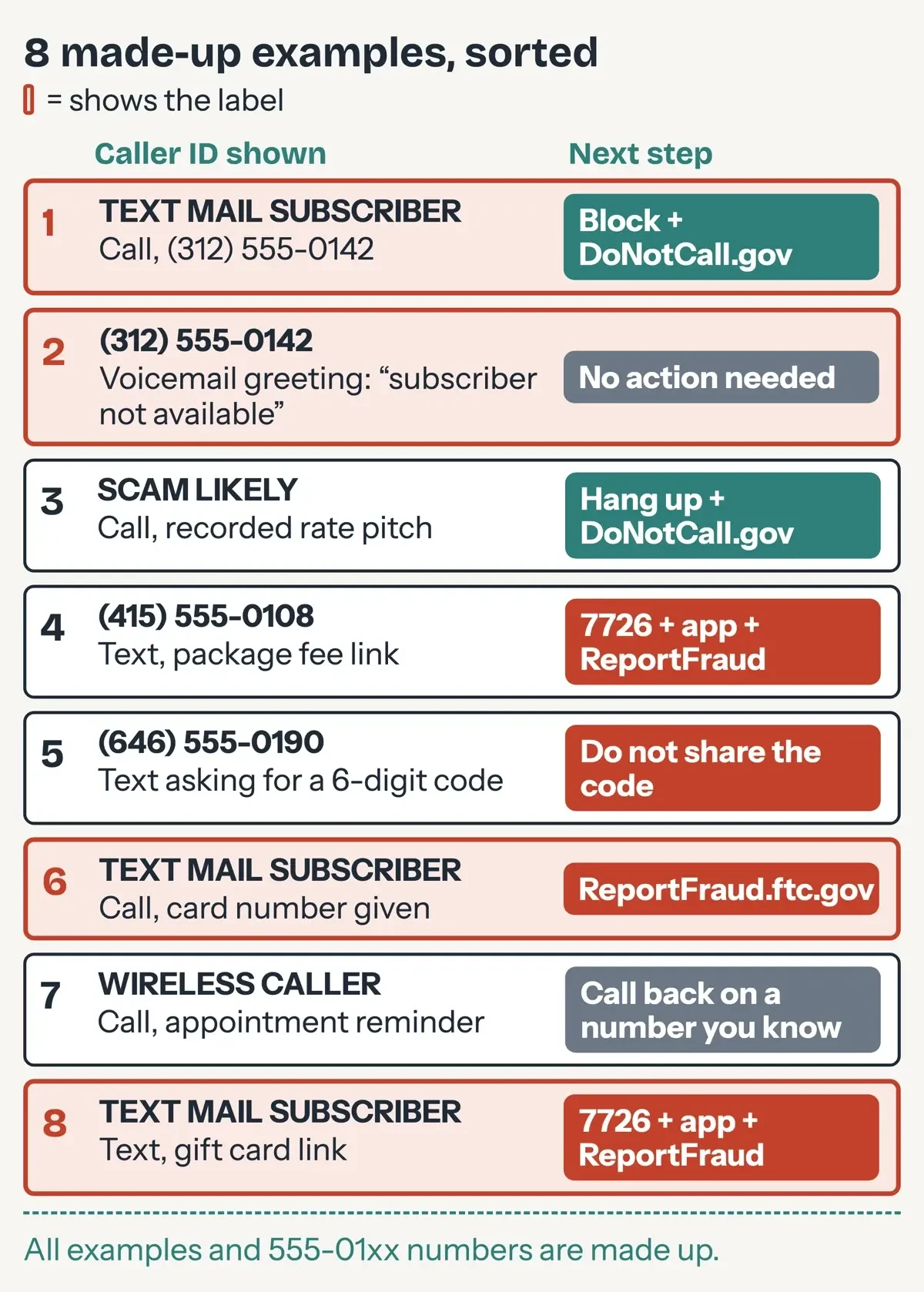 Drawn by us from test/results.json (made-up examples, fake 555-01xx numbers), November 5, 2026.
What we tested
We ran a Python script over our 24 saved pages, and it found the label 0 times.
It then sorted eight made-up calls, voicemails and texts, all with fake 555-01xx numbers, into the FTC step each one fits. The four with the phrase went to block and DoNotCall.gov, no action, ReportFraud.ftc.gov and 7726. The other four didn't: a SCAM LIKELY pitch (hang up), a package-fee text (7726), a code request (don't share it) and a dentist reminder (call a known number).
Why the Do Not Call Registry will not stop these calls
The Do Not Call FAQ says the Registry "won't stop calls from scammers making illegal calls". It doesn't block calls either: it tells sales callers which numbers to skip, and the FCC's rule in 47 CFR 64.1200(c) says those registrations "must be honored indefinitely".
Registration is free, and cell phones count as well as landlines, per the FAQ.
You can add a cell number at DoNotCall.gov, or by calling 1-888-382-1222 from that phone. The FAQ says "it can take up to 31 days for sales calls to stop." It also says "your registration will never expire." Sellers who call a listed number "can currently be fined up to $50,120 per call", per the same FAQ, as of November 2026.
Since the Registry only reaches legal sellers, register after you block and report a text mail subscriber number, not instead. If the calls reach a business line, see our cybersecurity tips for small businesses.
Text mail subscriber questions
Frequently asked
Should I call a text mail subscriber number back?
Not if you don't know who it is. The FTC's robocalls page says the number on your caller ID "probably isn't real".
What if I already gave the caller my information?
If someone misused the SSN you gave, the FTC's scam recovery page sends you to IdentityTheft.gov. Tapped a link? See our phishing link recovery steps.
Can scammers fake the number on a text too?
Yes. 47 U.S.C. 227(e) covers "any voice service or text messaging service".
Is a text mail subscriber a Google Voice number?
We couldn't confirm that. Google Voice help lets you disconnect your number if you're "not a Google Voice user, but have been scammed to give your verification code".
How we made this guide: We saved 24 official pages, matched every quote to them and sorted made-up examples locally. We called and texted no number. Facts checked by the DigitalTreed team on November 5, 2026.
First published November 2023 with a definition, text-volume figures and a lookup-app list that no official page we read supports. Rewritten November 5, 2026 from FTC pages, FCC rules and the apps' own listings.
Sources
- FTC Consumer Advice: How To Block Unwanted Calls
- FTC Consumer Advice: How To Recognize and Report Spam Text Messages
- FTC Consumer Advice: Phone Scams
- FTC Consumer Advice: Robocalls
- FTC Consumer Advice: National Do Not Call Registry FAQs
- FTC Consumer Advice: How To Recognize and Avoid Phishing Scams
- FTC Consumer Advice: What To Do if You Were Scammed
- 47 U.S.C. 227, Restrictions on use of telephone equipment (Cornell LII)
- 47 CFR 64.1200, Delivery restrictions (Cornell LII)
- 47 CFR 64.1600, Definitions (Cornell LII)
- 47 CFR 64.1601, Delivery requirements and privacy restrictions (Cornell LII)
- 47 CFR 64.1604, Prohibition on inaccurate caller identification information (Cornell LII)
- App Store: TextNow listing
- App Store: Text Free listing (Pinger, Inc.)
- TextFree: Free phone number
- App Store: Text Me listing (TextMe, Inc.)
- Google Voice Help: Set up Google Voice
- Google Voice Help: Protect your verification code
- AT&T Support: Say goodbye to email-to-text and text-to-email
Comments
No comments yet. Start the conversation below.