
Quick answer
Twitter marketing now happens on X, and it pays off when your buyers already talk there: 18% of US adults use X, per Pew Research Center's 2026 survey. Start with the free Professional Account, reply more than you post and tag every link. Most small businesses can skip the $200-a-month gold checkmark.
Twitter is called X now, though most people still search for "Twitter," and plenty of the advice you'll find was written before the name change. Prices, checkmarks and the rules on paid posts have all moved since then.
We wrote this for US small businesses deciding whether X deserves an hour a week. We read X's own help pages for prices and rules, read the FTC's guidance on paid posts, and ran a test of our own on how X links show up in Google Analytics.
Short version: X is a reply-first channel.
It's cheap to run, and it's easy to get wrong.
Key takeaways
- Pew's 2026 survey puts X at 18% of US adults, below LinkedIn.
- Switching to a free Professional Account adds Location Spotlight and ad tools.
- Most small businesses can skip gold, which costs $200 a month.
- Tag X links with source twitter, because GA4's social list lacks x.
- Paid posts need X's Paid Partnership label plus "Ad:" or "#ad" up front.
X fits some businesses and wastes other businesses' time
X is worth it when your customers or your industry already talk there. Pew Research Center's 2026 fact sheet puts X at 18% of US adults, down from 21% in 2025. Pew's survey of 5,511 adults ran from January 30 to June 18, 2026.
For context, the same Pew table has YouTube at 84%, Facebook at 70%, Instagram at 51%, TikTok at 37% and LinkedIn at 31%.
So X now reaches fewer American adults than LinkedIn does.
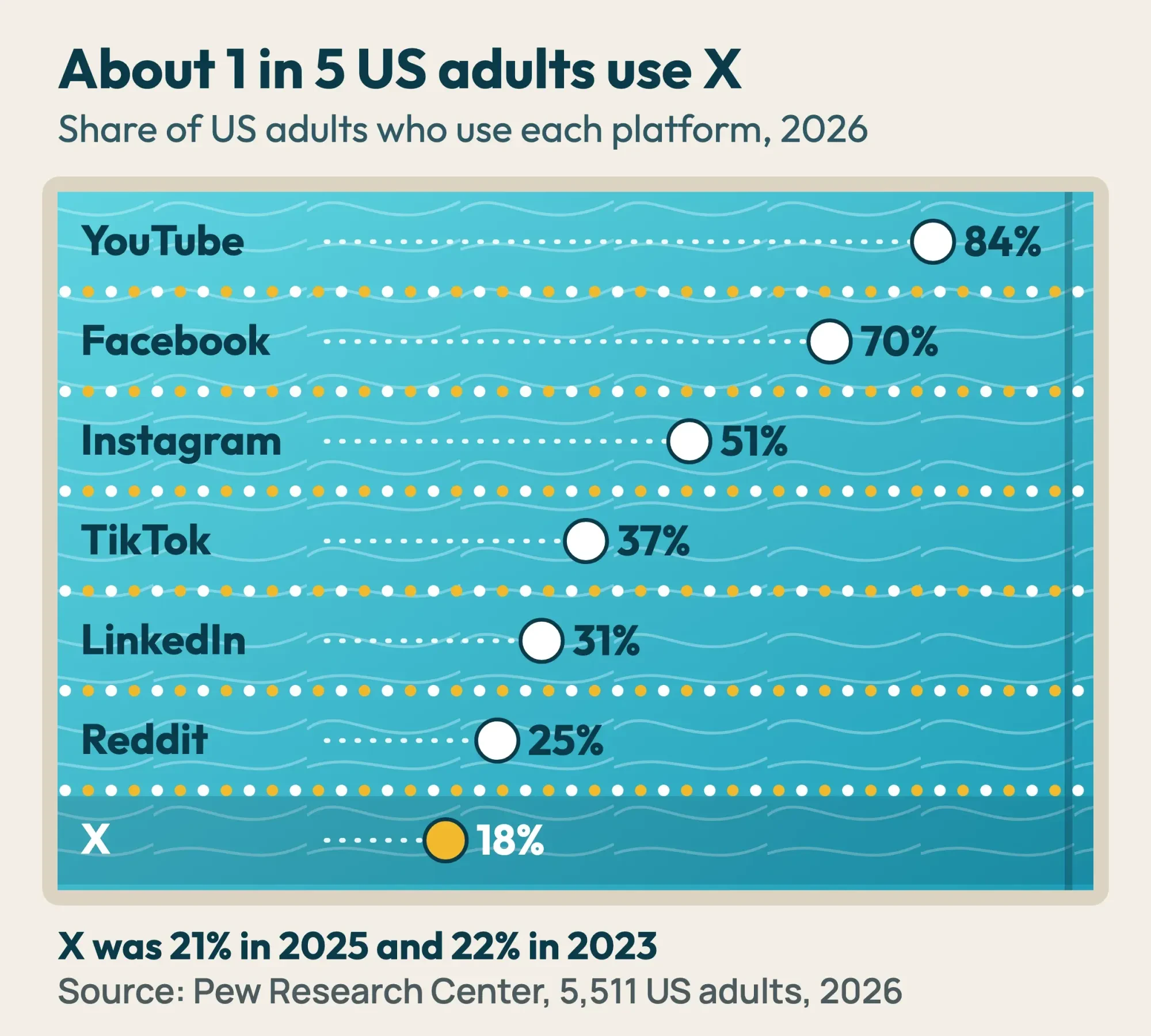 Source: Pew Research Center, Americans' Use of Social Media, October 2026.
That doesn't make X useless. It makes it narrow.
In our experience it suits news, sports, tech, software, media and local events, where people follow a conversation while it happens. It also suits B2B firms whose buyers follow trade voices there, and our guide to B2B vs B2C marketing explains why those two audiences need different channels. And it's a public place to complain, so your customers may already be tagging you whether you post or not.
If your customers mostly live on Facebook and Instagram, spend the hour there instead.
Set up a free Professional Account before you post
Once you've decided X fits, set the account up properly. X's Professional Accounts page says "Converting to a Professional Account is completely free." It adds a business category, a Professional Home dashboard, profile spotlights, X Shopping, and access to ads and Quick Promote.
You can only convert an account you already have, and X wants a complete profile first: an account name, a bio and a profile picture. Here's the order we'd follow:
- Claim a handle that matches your website and your other profiles, so people can guess it.
- Add your name, a one-line bio that says what you sell and where, a profile picture and a header image.
- Open your profile, choose "Switch to Professional," pick a category, then choose "Business."
- If you have a storefront, turn on Location Spotlight for your address, hours and contact buttons.
- Pin one post that explains what you do, with a tagged link to the right page.
- Put your @handle on your website, business cards and email signature, as X's business starter guide suggests.
Location Spotlight is the part most guides skip. X says it lets you "display your business' location, hours of operation, and additional contact methods," with buttons for a call, a text, a DM or an email. For a local shop, that's the X version of a map listing, and our hyperlocal marketing playbook covers the rest of the local side.
There's also a Shop Spotlight, marked "US Only," but it's open only to "some qualifying accounts." Don't plan around it.
Your bio gets one link. If you need to send people to several pages, our guide to link-in-bio pages weighs the options.
What does X cost a business?
A business account on X costs nothing. The paid tiers buy features and a checkmark, and here are X's US web prices as of October 2026, before tax:
| Option | Price (US, as of October 2026) | What you get |
|---|---|---|
| Free account + Professional Account | $0 | Business category, Location Spotlight, ads and Quick Promote |
| X Subscription Plus | $8 a month or $80 a year | Checkmark, creator tools, fewer ads |
| X Subscription Premium | $30 a month or $300 a year | Full X Premium+ benefits, more Grok use |
| Super or Ultra | $100 or $200 a month | Same X benefits as Premium, more Grok and Cursor use |
| Premium Business Basic | $200 a month or $2,000 a year | Gold checkmark, square avatar, Premium+ features |
| Premium Business Full Access | $1,000 a month or $10,000 a year | Adds affiliate accounts at $50 a month each |
New customers now start on The X Subscription instead of the old Premium tiers, per xAI's overview. So the individual prices come from its price list. X's Premium help page still covers existing subscribers. The business prices come from X's Premium Business page, which warns that prices "may vary by region and are subject to change," so treat these as a snapshot. We read the US rows from India, so check what X shows you at checkout.
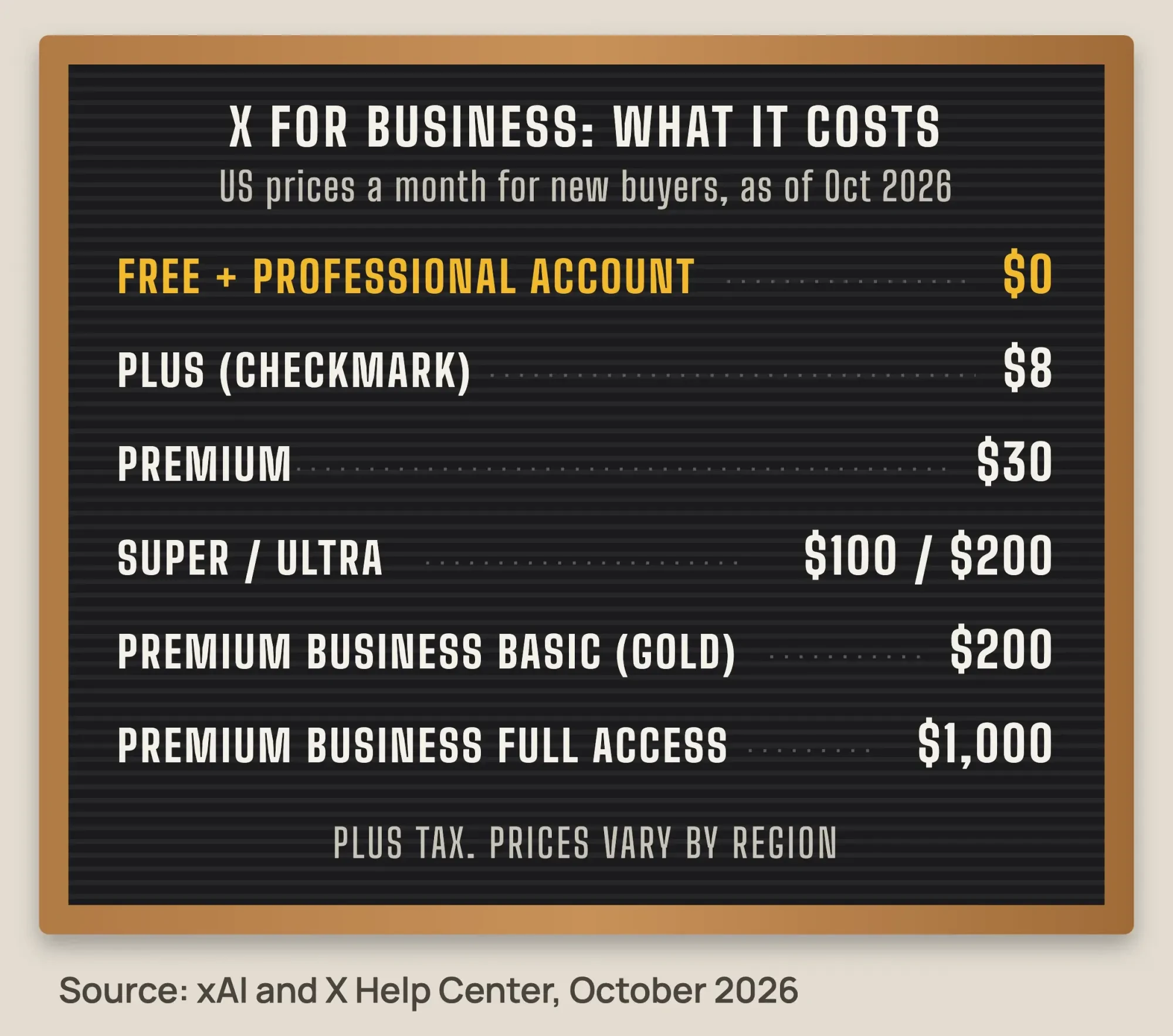 Source: xAI X Subscription price list and X Help Center Premium Business page, October 2026.
A blue check isn't instant.
X's Premium page says it shows up "after a review," and that X can remove it "at any time in its sole discretion without offering you a refund." Gold is for organizations. X asks for a matching account, a current organization email address and a website domain, and it takes credit cards only.
Our take: most small businesses don't need gold. Premium Business Basic costs $2,400 over a year if you pay monthly, or $2,000 if you pay up front. A free Professional Account and a clear bio do most of the trust work for a local shop. Gold starts to make sense for a brand that gets impersonated, since X says Premium Business accounts are "defended against impersonation," or for one with several staff accounts to tie together.
Want a checkmark without the gold price? Plus, at $8 a month as of October 2026, is the cheap tier for new subscribers. Free accounts post up to 280 characters. X's Premium page says subscribers get up to 25,000, so check that your plan includes longer posts before you count on them.
Write a plan you can keep for 90 days
So the account's ready. Now decide what it's for, because an account without a goal turns into a feed of sale announcements nobody asked for.
Pick one goal per quarter.
Booked calls, email sign-ups, event tickets or fewer support emails all work. "Brand awareness" doesn't, since you can't tell when you've hit it.
Then pick two or three things you'll post about again and again, and mix the formats: plain text, photos, short video and the odd poll. A record store might choose new arrivals, store events and opinions on local music. A tax firm might choose deadline reminders, plain-English rule changes and answers to client questions. Write down the voice as well: how formal you sound, whether you joke, and what you never post about. Our branding strategy guide walks through a simple voice sheet.
How often should you post? X doesn't publish a number, and we haven't seen a study we'd trust for small accounts. We'd start with one original post each weekday plus 15 minutes of replies, then adjust after a month of data.
Batch the posts once a week and schedule them. Replies can't be batched, and that's the next section. For the plan across all your platforms, start with our guide to planning social media.
Replies grow a small account faster than posts
That daily 15 minutes matters more than the posts. X's own business guide says "Engaging with other Posts helps build relationships and increase the discoverability of your account."
In practice, reply to local reporters, trade voices, customers and partners with something useful: a fact, a fix, a true and funny line.
"Great post!" does nothing.
Paid tiers change where your replies show. X's Premium page lists reply prioritization at each paid tier, larger at Premium and largest at Premium+. X doesn't claim more than that. So be wary of anyone promising a big reach "boost" from a subscription.
Complaints need a rule before they arrive. Decide who answers, how fast, and when a thread moves to DMs. Answer once in public, kindly, then fix it in private. If someone's only trolling, mute them and move on.
A rule like that protects you more than any crisis plan.
Links: X says there's no penalty, so test it yourself
Next comes the question everyone asks: do posts with links get less reach? X's head of product, Nikita Bier, says no. In October 2025, Roboin reported that he denied link posts are deboosted and said they get less engagement because people leave the post. In April 2026, it reported that X called deboosting a myth and suggested putting links in the post itself.
Your own link posts may still reach fewer people. Both can be true. X may not punish links while readers still like, reply and repost less once they've left.
So test it on your own account.
Post the same kind of content four times with the link in the post and four times with the link in a reply, then compare clicks in Google Analytics, not likes.
Whichever you choose, X wraps the link. Its link service page says links "will automatically be processed and shortened to an http://t.co link," and you can't opt out. That matters for tracking, as you'll see below.
Before you post, check how the link card will look. Our free social preview checker shows the title, description and image a page gives social sites, so you can fix a missing image before the post goes out. If your link shows a small card or no image, the fix is on your site: see why shared links lose their preview.
Tag every X link, or GA4 has to guess
Those t.co links are why tags matter. Google's GA4 channel rules put a visit in Organic Social when its source is on Google's list of social sites, or when the medium is "social" or a close variant. Paid Social needs a social source plus a paid medium such as "cpc" or "paid-social."
We wanted to know which tags hold up, so our October 23, 2026 test ran 12 source and medium pairs for X through our UTM builder on a test copy of our site. Then we downloaded Google's own list of social sources from that help page and searched it. The list has "twitter," "twitter.com" and "t.co." It doesn't have "x" or "x.com." So a link tagged source=x lands in Organic Social because its medium says social, and a link tagged x.com with medium "tweet" matches no rule at all. GA4 files that one under Unassigned, where it's easy to miss.
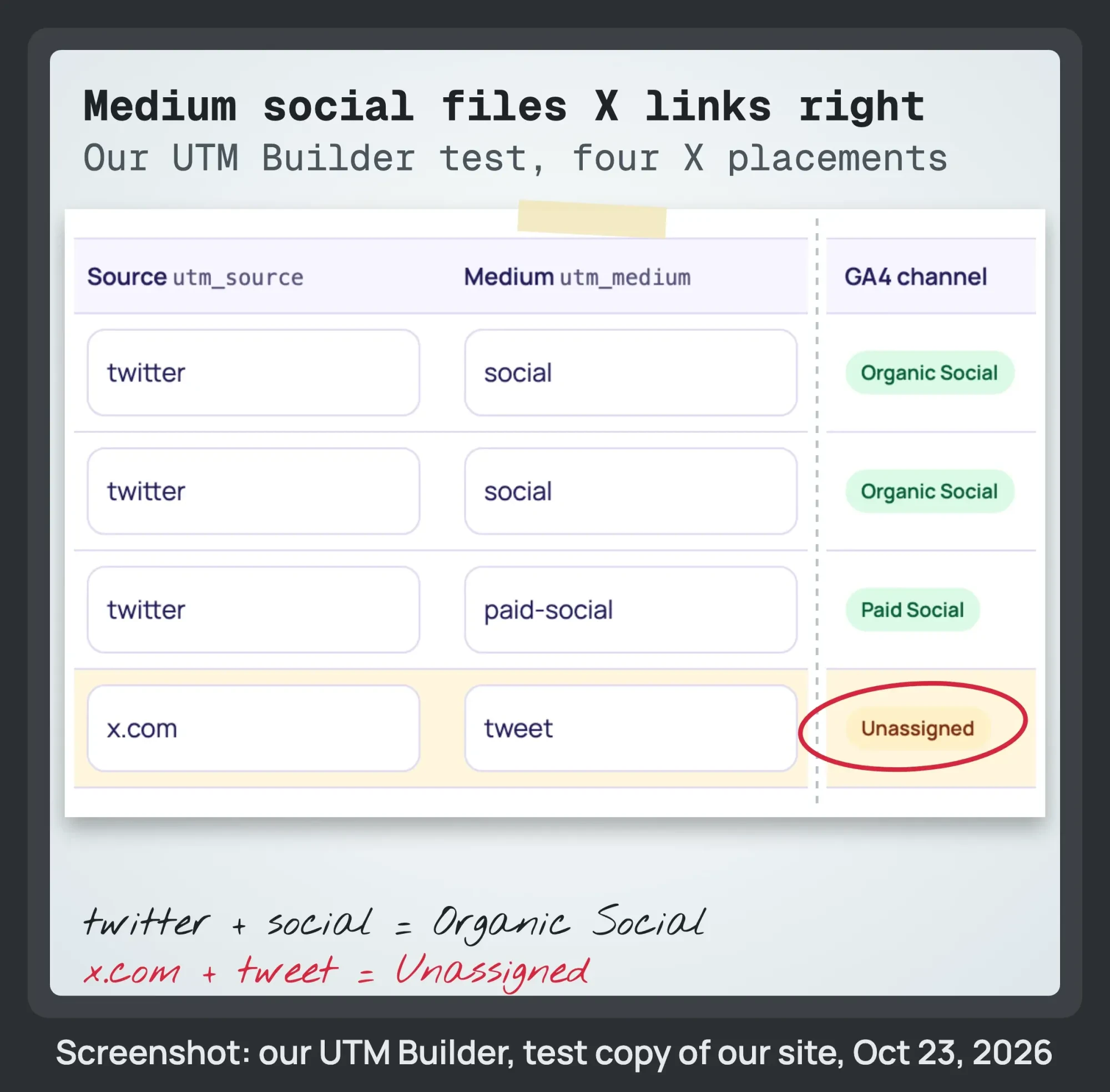 Screenshot: DigitalTreed UTM Builder on a test copy of our site, October 23, 2026.
Here's the set we use.
Bio link: source twitter, medium social, content bio. Posts: source twitter, medium social, and a content tag that names the post. Promoted posts: source twitter, medium paid-social. We use "twitter" rather than "x" because Paid Social needs a source on Google's list. "x" isn't on it, so x with paid-social falls into Paid Other. Keep one campaign name per goal, spelled the same way everywhere.
Untagged clicks aren't lost. Since t.co is on Google's social list, they should still count as Organic Social, but they arrive as one lump with no campaign or post name attached.
Our post on promoting a business blog goes deeper on UTM naming, and our roundup of website analytics tools covers where to read the numbers.
Pay to promote only the posts that already work
Once tagged links show which posts bring visits, you can put money behind the winners. X's ads pricing page says "There is no minimum spend required for X Ads," and that prices come from an auction, not a fixed rate.
What you pay depends on four things X lists: how engaging the ad is, how big the audience is, how many other advertisers want that audience, and your bid. With the Engagements objective, X says you pay only when someone engages, "including a click, repost, reply, like, poll vote."
You won't find an average cost per click or per thousand views from X.
Vendor blogs quote figures, but without data behind them, so we won't repeat them. Instead, set a daily cap you'd be fine losing, promote one post for a week, and compare its tagged visits with what the same post did unpaid.
X's advertising page lists promoted posts, image and carousel ads that show "up to six products," collection ads and a Boost option for existing posts. For a shop or a small firm, boosting a post that already did well is the simplest start. Your Professional Account's Quick Promote does the same job.
Do you have to label paid posts on X?
Yes, whenever you pay, gift or employ the person posting and the post promotes you.
The FTC's Endorsement Guides make advertisers liable "for failing to disclose unexpected material connections" with endorsers. They also tell advertisers to guide endorsers on disclosing.
The FTC's examples still use X's old name. Its endorsement FAQ says "Ad:" or "#ad" at the start of a post "would likely be effective" on "a platform like Twitter or Facebook," and it treats the two as about equal. Its Disclosures 101 guide adds that "AcmePartner" or "Acme Ambassador" work on space-limited platforms, and warns against "sp," "spon" and "collab."
X has its own rule on top. Its Paid Partnerships policy says organic posts that are part of a paid partnership "must have the 'Paid Partnership' disclosure on," which you set in Content Disclosure when you write the post. Some categories can't be paid partnerships at all, including alcohol, supplements, weight loss products and dating services.
Use both.
Keep the toggle on, since the FTC says "Don't assume that a platform's disclosure tool is good enough," and put "Ad:" or "#ad" at the start of the text, not in a pile of hashtags at the end.
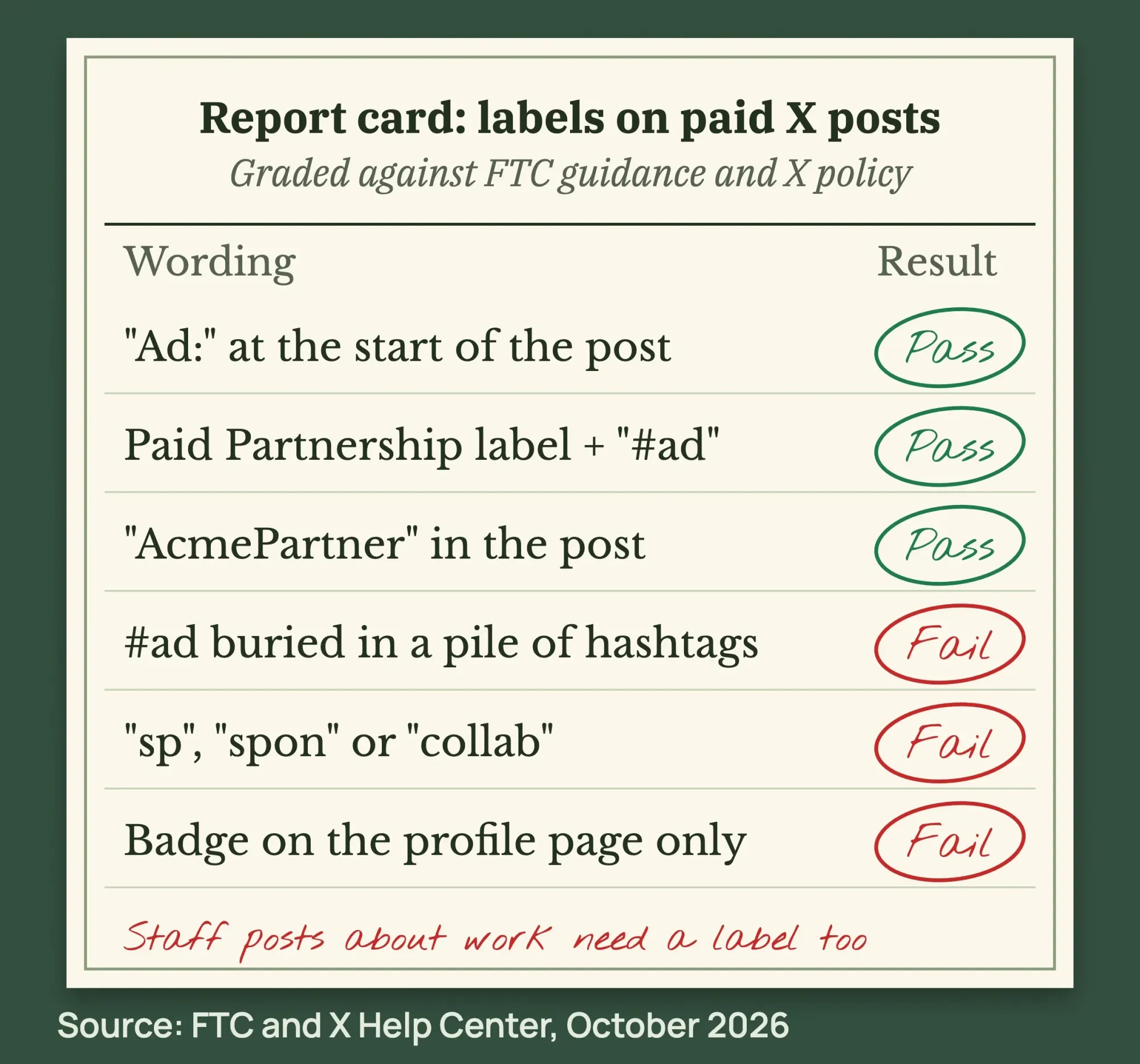 Source: FTC endorsement FAQ and Disclosures 101; X Paid Partnerships policy, October 2026.
Staff count too. The FTC's FAQ says employees who share company posts "should disclose their relationship to the company," and offers "Check out my company's great new product" as an easy way to do it. A badge on a profile page isn't enough, the FAQ says, because many people "probably wouldn't see it."
Planning a giveaway on X? The US prize rules in our giveaway guide apply there too.
We're a marketing agency, so treat this section as a map of the FTC's guidance, not legal advice. If you pay creators regularly, have a lawyer check the contract and the disclosure wording.
Buying fake followers now breaks an FTC rule
That legal map has one more stop. The FTC's 2024 rule on fake reviews also covers fake followers, and the agency said the rule lets it "seek civil penalties against knowing violators."
Under 16 CFR 465.8, a business may not "purchase or procure fake indicators of social media influence" that it knew or should have known were fake, when they misrepresent its influence for a commercial purpose. The rule counts followers, views, likes, reposts and comments.
Penalties can be steep. For knowing violations of a rule like this one, the FTC Act allows civil penalties for each violation. 16 CFR 1.98(d) sets the current maximum at $53,088 per violation, as read in October 2026. That's a ceiling, not a set fine.
Fake followers also wreck your own numbers. Bots don't click, buy or reply, so every rate you measure gets worse.
Fake and paid-for reviews fall under the same FTC rule, and our guide to automating review requests explains that side.
Example: a record store's first 90 days on X
Example: Crate Day Records is a made-up record store in Milwaukee, Wisconsin, with two staff and a loyal Saturday crowd. Its customers follow local bands, venues and music writers on X, so the owner decides the channel fits.
Month 1 is setup. She converts the account to a Professional Account for free and turns on Location Spotlight with the store's hours. Then she pins a post about the weekly new-arrivals crate, linked with source twitter, medium social and content pinned-post. Her goal for the quarter is 40 sign-ups for the store's email list.
Month 2 is the routine. She writes one post each weekday from three pillars: new arrivals, in-store shows and opinions on Milwaukee releases. She spends 15 minutes a day replying to venues, bands and writers. When a band she gave free records posts about the store, she asks them to switch on the Paid Partnership label and start the post with "Ad:".
Month 3 adds money only if a post has earned it. If GA4 shows the pinned post brought the most sign-ups, she promotes it at $10 a day for 7 days, tagged source twitter and medium paid-social, so paid visits land in Paid Social. That's a $70 test. She skips gold, since one month of Premium Business Basic would cost nearly three times the whole test.
No bought followers, no checkmark, no guesswork about where sign-ups came from.
If you'd like help running a plan like this, our social media management team handles setup, posting and reporting for small businesses. (That's a paid service of ours, so weigh our advice with that in mind.)
How we made this guide: our team read X's help pages on prices, Professional Accounts, links and paid partnerships, the FTC's endorsement guidance and rules, Pew's 2026 social media fact sheet, and Google's channel rules, all dated October 23, 2026. We ran the UTM test that day on a test copy of our site and searched Google's downloadable list of social sources ourselves. Every claim links to its source where it appears, and Eram N. reads the rewrite before it goes live.
First published August 2020. Rewritten October 23, 2026: rebuilt for X, with X's US prices, the free Professional Account, link tags we tested, ad basics, and the FTC rules on paid posts and fake followers.
Frequently asked
Who uses X in the US?
Younger adults and men, mostly. Pew's 2026 social media fact sheet shows 31% of adults aged 18 to 29 use X, but only 7% of those 65 and older. It also shows 23% of men use X, against 14% of women. Check that this matches your customers before you commit.
Should a B2B business use X or LinkedIn?
LinkedIn usually reaches more professionals. Pew's 2026 fact sheet shows 51% of college graduates use LinkedIn, compared with 22% who use X. Among adults with $100,000+ household incomes, it's 45% for LinkedIn and 24% for X. X still helps when your buyers follow trade voices there.
Do people still get news on X?
Fewer than on other sites. Pew's social media and news fact sheet, from an August 2026 survey, found 10% of US adults regularly get news on X. That compares with 40% on Facebook and 34% on YouTube. News-led posts can still work for local events and fast-moving topics.
Sources
- Pew Research Center: Social Media Fact Sheet (Americans' Use of Social Media in 2026)
- X Help Center: About X Premium
- xAI docs: The X Subscription plans and pricing
- X Help Center: Premium Business
- X Help Center: Professional Accounts
- X Business: Get your business started with X
- X Help Center: About X's link service (t.co)
- X Help Center: Paid Partnerships policy
- X Business: Ads pricing
- X Business: Advertising
- Google Analytics Help: Default channel group (and the downloadable source list)
- 16 CFR Part 255: Guides Concerning the Use of Endorsements and Testimonials (eCFR)
- FTC: Endorsement Guides, What People Are Asking
- FTC: Disclosures 101 for Social Media Influencers
- FTC press release, August 2024: Final rule banning fake reviews and testimonials
- 16 CFR 465.8: Misuse of fake social media indicators (eCFR)
- 16 CFR 1.98: Adjustment of civil monetary penalty amounts (eCFR)
- Roboin, October 2025: X product chief denies link posts are deboosted (press)
- Roboin, April 2026: X says link deboosting is a myth (press)


Comments
No comments yet. Start the conversation below.