
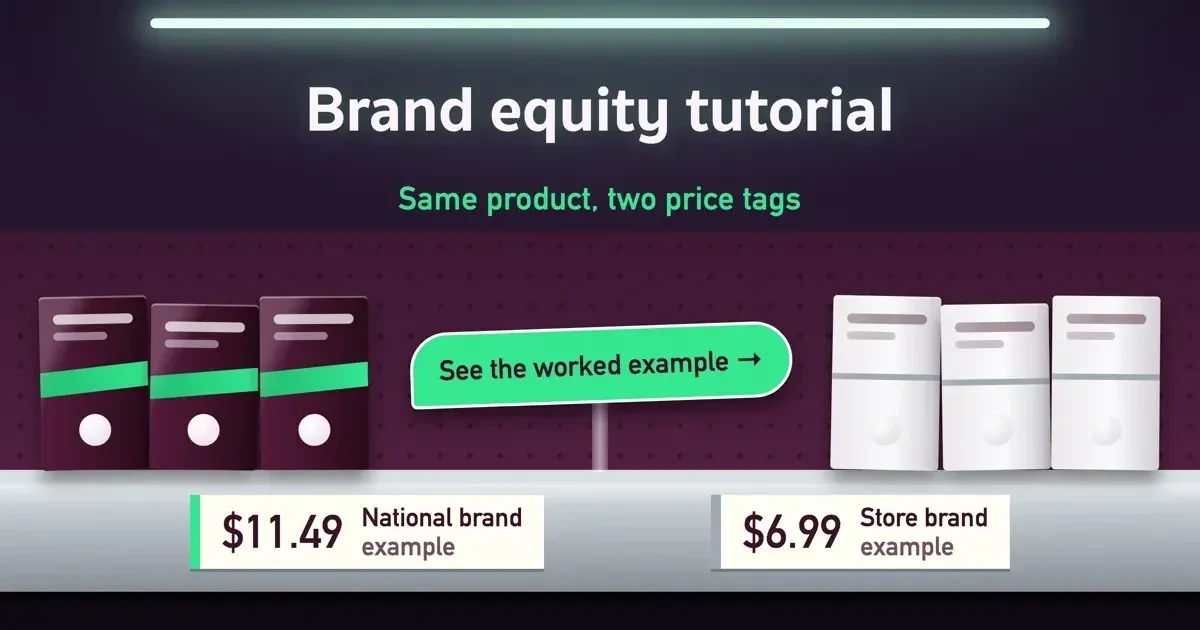
Quick answer
This brand equity tutorial uses Kevin Lane Keller's 1993 definition: brand equity is the gap between how people treat your brand and the same product unnamed. A higher price alone doesn't prove it. In our made-up shelf example, a 64.4% price premium still earned $62.25 a week less than the store brand, so watch price, volume and awareness together.
Say you roast coffee and sell it in a few grocery stores under your own name. Someone tells you to build brand equity, and nobody says what to count. Usually it's an agency pitching a campaign, or a buyer explaining why the store brand sits beside yours for less.
Two older answers give you something to count: David Aaker's 1991 list of what a brand owns, and Keller's 1993 paper on what one shopper remembers.
Key takeaways
- A big price premium can still lose money when volume drops.
- Keller measures equity against an unnamed version of the same product.
- Aaker counts loyalty, awareness, associations and perceived quality as brand assets.
- Pharmacists bought national-brand headache remedies 9% of the time, average shoppers 26%.
- Federal trademark registration gives you a legal presumption of ownership.
What is brand equity?
Keller's 1993 abstract in the Journal of Marketing defines customer-based brand equity as "the differential effect of brand knowledge on consumer response to the marketing of the brand." On a coffee shelf, that means people act differently because they know your name. They'll pay a little more, reach for your bag first, or forgive a stale batch they'd hold against a stranger. If your coffee sells better in your labeled bag than in a plain one at the same price, that gap is the equity, and it's something you can count. A grocery buyer sees it in reorders. You see it when a price increase doesn't cost you regulars.
David Aaker, author of the 1991 book Managing Brand Equity, takes the company's side. On the Prophet site, he calls it "a set of brand assets and liabilities linked to a brand name and symbol." In his words, they "add to or subtract from the value provided by a product or service."
On a crowded shelf, brand equity is an important concept because it sets how far above a lookalike you can price before shoppers walk away. The American Marketing Association's branding glossary defines it this way: "Brand equity is the intangible value a brand holds in the minds of consumers." Intangible, yes, but two traces of it are easy to count. One is the gap between your shelf price and the store brand's; the other is how many people search for your name each month. If you haven't settled your positioning yet, the beginner's guide to branding strategy on this site is the better place to start.
Aaker's model and Keller's model, side by side
Aaker's 1991 book counts a company's assets. Keller's paper, published two years later in volume 57 of the Journal of Marketing, looks inside one shopper's memory instead.
Aaker 1991: four kinds of brand assets
On that Prophet page, Aaker names four dimensions, brand loyalty, brand awareness, brand associations and perceived quality, and says each one provides value to a firm "in numerous ways." Loyalty brings reduced marketing costs and buys time to respond to a competitor, while awareness gives "Visibility that helps gain consideration" and associations supply a reason to buy. His list folds perceived quality into associations and names them as the basis for extensions, the move covered in the brand extension and its types guide. If you'd start with loyalty, the customer acquisition and retention strategies piece here lists three tactics.
Aaker admits that putting loyalty inside the model "was and is still controversial." Others treat loyalty as a result of equity. He keeps it anyway, for a practical reason: when a company buys a brand, the loyal customer base is often what it's paying for.
Keller 1993: what one shopper knows
Keller builds equity out of brand knowledge. He splits it into brand awareness and brand image, the "set of brand associations" a person holds. Awareness alone won't get you there. Equity shows up, the abstract says, when a consumer "is familiar with the brand and holds some favorable, strong, and unique brand associations in memory." The test compares your brand with "a fictitiously named or unnamed version of the product or service." If people respond better to your marketing than to that nameless twin, your equity's positive. If they respond worse, it's negative. Two bags of the same coffee, one labeled and one plain, are enough to run it.
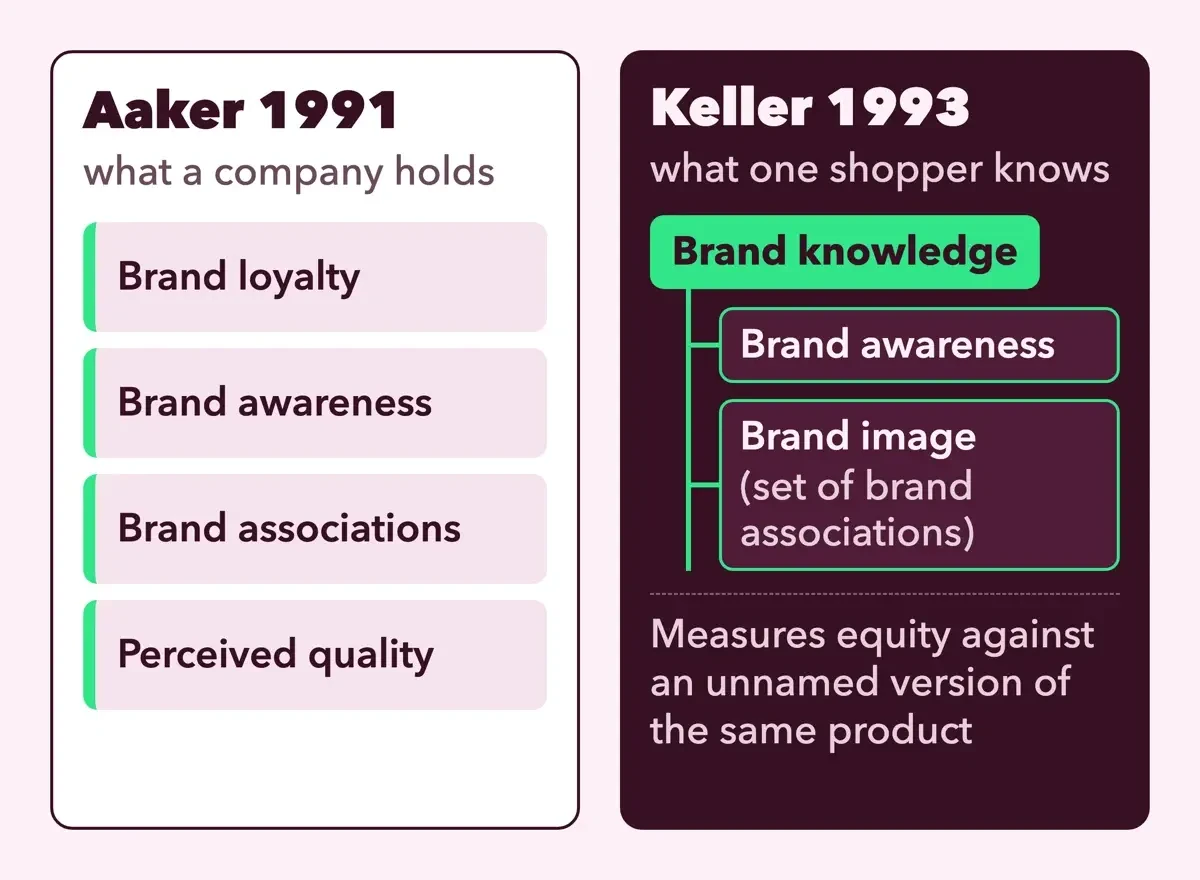 Diagram by DigitalTreed from David Aaker on the Prophet site and the abstract of Keller (1993), Journal of Marketing.
Brand equity examples from published research
Researchers have run Keller's comparison, a labeled version against a plain one, on sodas and painkillers. S. M. McClure and colleagues at Baylor College of Medicine served people Coke and Pepsi. The abstract of their 2004 paper in Neuron calls the two drinks "nearly identical in chemical composition." Each drink was given once anonymously and once with the brand shown. In the anonymous round, a response in the ventromedial prefrontal cortex tracked each person's preference between the two drinks. Then the labels went on. The abstract reports that "brand knowledge for one of the drinks had a dramatic influence on expressed behavioral preferences and on the measured brain responses."
Coca-Cola ran into the label effect with its own customers. On April 23, 1985, it announced the first change to its formula in 99 years, after taste tests of nearly 200,000 consumers favored the new recipe. The company's own history of New Coke says the aim was to re-energize the brand in its largest market, the United States. The tests missed "the bond consumers felt with their Coca-Cola." Then the phones started. By June 1985 its hotline took 1,500 calls a day, up from 400 before the change. The original formula came back on July 11, 1985, 79 days after the announcement, renamed Coca-Cola classic.
Store brands make the cleanest test, since many sit in what Bart Bronnenberg, Jean-Pierre Dubé, Matthew Gentzkow and Jesse Shapiro call "physically homogeneous product categories." Their NBER working paper on informed shoppers gives the numbers in its abstract. Pharmacists chose national brands of headache remedies only 9% of the time, against 26% of the time for the average consumer. That's close to three to one. Chefs showed it too. They put 12 percentage points less of their pantry-staple purchases, such as salt and sugar, into national brands than similar non-chefs. The authors then ran the analysis across 50 retail health categories and 241 food and drink categories.
The abstract blames misinformation and related consumer mistakes. Together they explain "a sizable share of the brand premium for health products, and a much smaller share for most food and drink products." In both case studies, the shoppers who knew the product best were the ones buying the store brand.
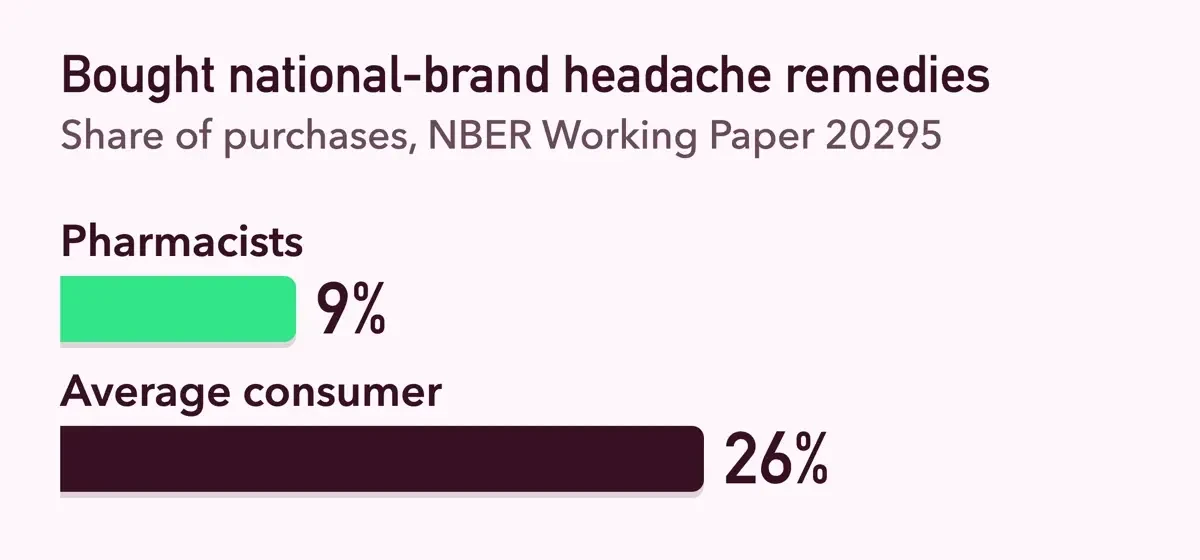 Source: Bronnenberg, Dubé, Gentzkow and Shapiro, NBER Working Paper 20295. Chart drawn by us.
How do you measure brand equity?
Few small roasters can scan brains or buy national purchase data on shoppers. Aaker's 1996 paper for California Management Review needs neither; its abstract groups ten sets of measures into five categories: "loyalty, perceived quality, associations, awareness, and market behavior."
| Measure | What it tells you | Where the data comes from | Formula or unit |
|---|---|---|---|
| Awareness | Do people know your name? | Branded searches in Search Console; an unaided recall question | Impressions per month; % who name you |
| Preference | Do they pick you over the same product unnamed? | A labeled cup next to a plain one | Branded picks minus plain picks |
| Price premium | How much more do they pay? | Shelf or listing prices, same size, same week | (your price - comparison price) / comparison price x 100 |
| Revenue premium | Does the premium survive volume? | Prices and weekly units for you and the store brand | Your revenue - store-brand revenue |
For awareness, open Google Search Console's Performance report, which counts clicks and impressions from Google Search results, the queries dimension "groups your data by the search query users typed." Filter it for searches that contain your brand name, and you'll see impressions month by month.
Offline, ask people at a market stall which coffee brands they can name. That's unaided recall, and the five marketing tactics to build brand awareness here can lift it.
Preference is Keller's test in miniature: the same coffee in a plain cup and a labeled one, and 20 regulars asked which they'd buy. Say it comes out 14 to 6 (example): the name is working. A 10-to-10 tie (example) means it isn't yet.
Price premium needs two price tags, yours and the store brand's (or the closest unbranded rival's), same size and same week, run through the formula in the table. Revenue premium multiplies each price by the units sold, a measure Kusum Ailawadi, Donald Lehmann and Scott Neslin proposed in the Journal of Marketing in 2003. Their abstract calls it "a simple, objective, and managerially useful product-market measure of brand equity," taken against a private label product. The same abstract says the measure "reflects real changes in brand health over time," which a price tag can't show. Because the yardstick is a private label product in the same category, the worked example below uses a store brand for every comparison.
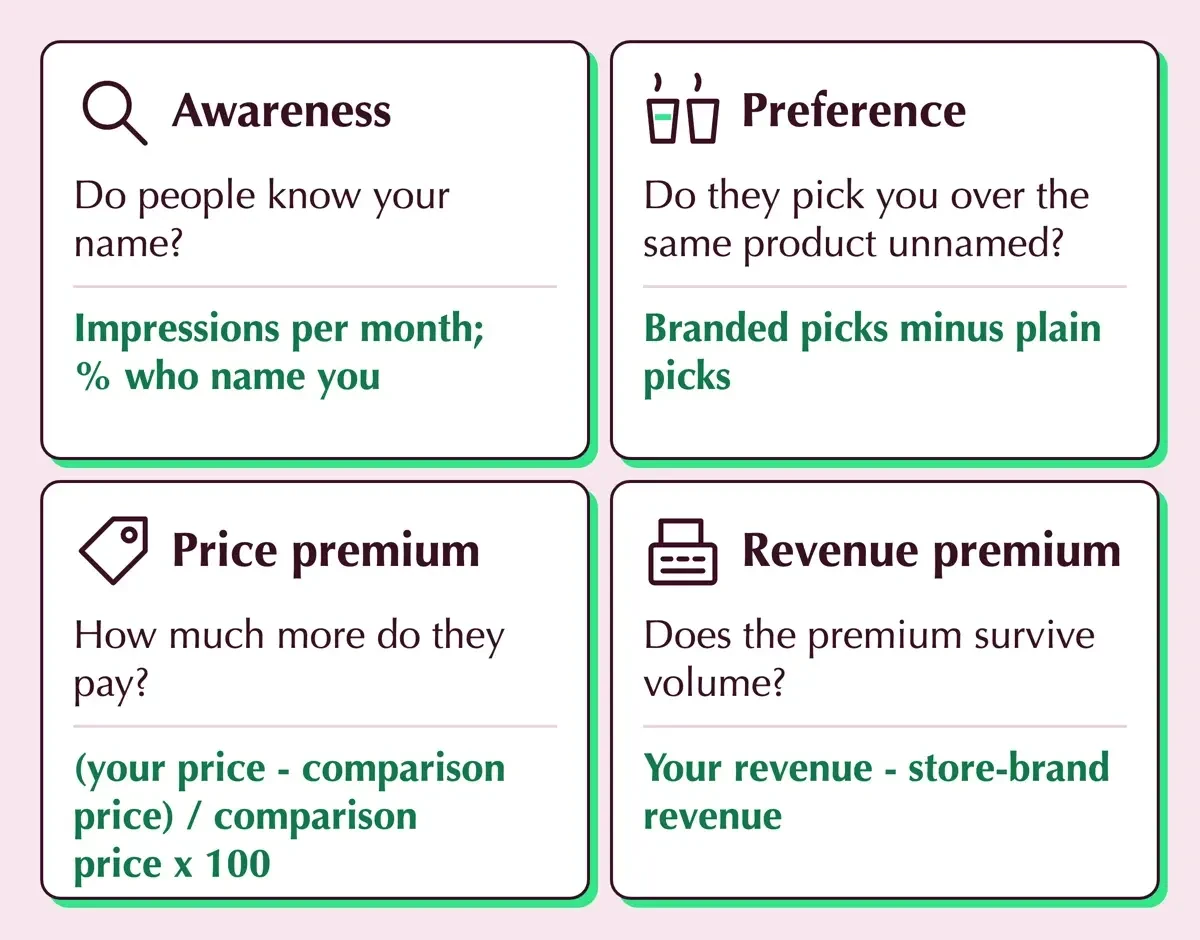 Diagram by DigitalTreed from Aaker (1996), Ailawadi, Lehmann and Neslin (2003) and Google Search Console Help.
A worked price premium example
Below is the worked example, a made-up shelf with a store brand beside each of three products. Every price and weekly unit count is invented (example).
| Product (example) | Price: national / store | Units a week | Price premium | Revenue: national / store | Revenue premium |
|---|---|---|---|---|---|
| Ibuprofen 200 mg | $11.49 / $6.99 | 25 / 50 | 64.4% | $287.25 / $349.50 | -$62.25 |
| Ground coffee | $9.99 / $7.49 | 60 / 40 | 33.4% | $599.40 / $299.60 | $299.80 |
| Table salt | $1.79 / $1.29 | 20 / 25 | 38.8% | $35.80 / $32.25 | $3.55 |
Ibuprofen carries the biggest price premium, 64.4% (example: ($11.49 - $6.99) / $6.99 x 100). Yet it's the only product with a negative revenue premium. The national brand brings in $287.25 a week ($11.49 x 25) against $349.50 for the store brand ($6.99 x 50), a gap of -$62.25. Coffee is the reverse. It shows the smallest price premium, 33.4%, but the largest revenue premium, $299.80, because it outsells the store brand 60 units to 40. Break-even volume shows the risk. It's national revenue divided by the store price, the store-brand count at which the premium hits $0. For ibuprofen that's 41.1 units, and the store brand already sells 50.
Salt sits in between, at a 38.8% price premium and a $3.55 revenue premium (example).
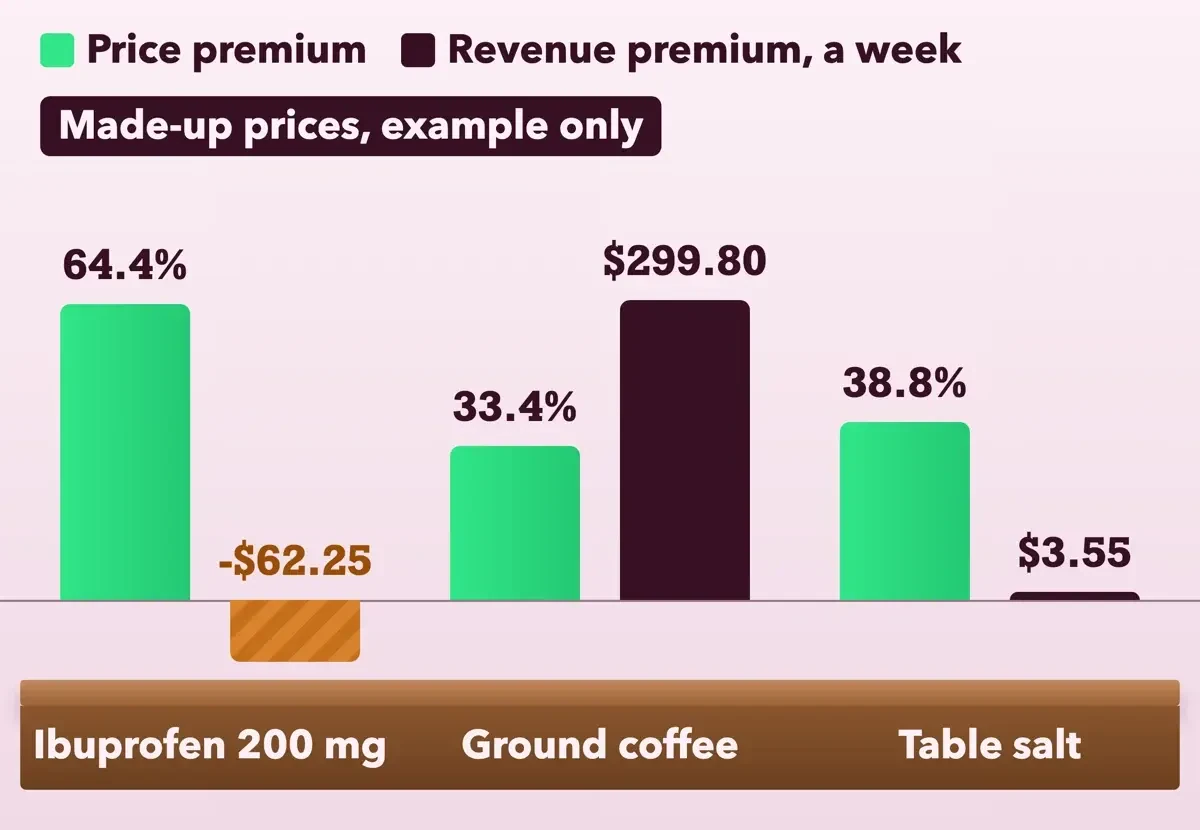 Diagram by DigitalTreed from our local test on November 20, 2026 (test/results.json). Made-up prices, example only.
What we tested
We wrote the calculator in Python and ran it on November 20, 2026 against a CSV file of the made-up shelf, then saved the output as JSON and text. We leaned the ibuprofen volumes toward the store brand on purpose, echoing the NBER finding for informed buyers of headache remedies. Coffee's store brand would need 80 units a week (example: $599.40 / $7.49) to erase its premium.
Protecting the name your brand equity sits on
In the US, the legal protection for a brand name is a trademark. The USPTO's trademark basics page says a trademark "Identifies the source of your goods or services" and "Provides legal protection for your brand." The page is plain that you don't own a word in general, only its use with your goods or services. For a roaster with a café, the USPTO draws one more line: a trademark is used for goods, while a service mark is used for services. Its own example is a small woodworking business, whose logo doesn't stop others using a similar one outside woodworking.
Federal registration isn't required. Among its benefits, the USPTO's page on why to register your trademark lists a "Legal presumption that you own the trademark" in federal court. Without registration, common law rights reach only the areas where you use the mark, and a state registration "creates rights in that state only." A registration also lets you use the ® symbol and record the mark with U.S. Customs and Border Protection, which can stop infringing imports. This section is general background on US trademark law; a trademark attorney can say how it fits your name. The free brand name generator here gives you candidates to search, and the guide to choosing a website name covers the domain.
Sources we read in full on November 20, 2026, and the ones that blocked us
Before writing, we read the Coca-Cola, NBER, USPTO, EPA, AMA, Google and Prophet pages on November 20, 2026, and saved each one as text. Publisher pages for the Keller, Aaker and Ailawadi papers blocked our checker, which identifies itself honestly and doesn't get around blocks. We confirmed their titles, volumes, pages and abstracts through Crossref and OpenAlex records instead. NCBI's E-utilities service gave us the abstract of the Coke and Pepsi study, whose PubMed page blocked us too. Every paper quote here, NBER included, comes from an abstract. Sage's page for Aaker's 1996 paper showed an error even in a browser, so we link its OpenAlex record. The Investopedia entry linked earlier returned an error to our checker, though it opens normally in a browser.
Keller's 2001 working paper for the Marketing Science Institute needs a log-in, so we left it out.
Frequently asked
What does brand equity mean in plain words?
It's the value your name adds to the product. The AMA glossary adds that "A strong brand equity equates to higher customer loyalty and increased market share."
Can brand equity be negative?
Yes. Aaker's post names Volkswagen. On September 18, 2015, the EPA issued a Notice of Violation alleging Volkswagen installed software in 2009-2015 2.0 liter diesel cars that circumvents emissions standards.
Who came up with the idea of brand equity?
No single person. Aaker writes that in the late 1980s "brand equity was just emerging as an important idea," and his book followed in 1991.
Can a small business track brand equity without paying for research?
Partly. Search Console's Performance report counts Impressions as "How many times your site appeared in Search results," so impressions on searches with your name track awareness.
How we made this guide: We read the primary pages listed below and saved them as text, using abstract records where a publisher blocked us, and matched every quote against those files. The worked example comes from our calculator on a made-up shelf. Facts checked by the DigitalTreed team on November 20, 2026.
First published July 15, 2020 as a short beginner's guide. Rewritten November 20, 2026 from the Aaker and Keller models, with a worked example.
Sources
- Investopedia: Brand equity
- Keller (1993), Conceptualizing, Measuring, and Managing Customer-Based Brand Equity, Journal of Marketing 57(1)
- David Aaker, Prophet: What Is Brand Equity?
- Aaker (1996), Measuring Brand Equity Across Products and Markets, California Management Review 38(3), OpenAlex record
- Ailawadi, Lehmann and Neslin (2003), Revenue Premium as an Outcome Measure of Brand Equity, Journal of Marketing 67(4)
- NBER Working Paper 20295: Do Pharmacists Buy Bayer? Informed Shoppers and the Brand Premium
- McClure et al. (2004), Neural correlates of behavioral preference for culturally familiar drinks, Neuron
- The Coca-Cola Company: New Coke history
- American Marketing Association: Brand and branding
- Google Search Console Help: Performance report
- USPTO: What is a trademark
- USPTO: Why register your trademark
- EPA: Learn about Volkswagen violations

Comments
No comments yet. Start the conversation below.