
Quick answer
A brand extension puts an established brand name on a product in a new category. We sort them into five working types, drawn from the OpenStax textbook and the journal studies below: line, category, complementary, co-brand and licensing. Only a line extension stays inside a category the brand already sells. For the other four, fit with the parent brand matters most, so score fit first with the example sheet below.
Brand extension and its types stop being theory the day you want to sell something new under a name your customers already trust. A brand extension is a new product sold under an existing brand name in a category that brand didn't sell before. That's the core of Aaker and Keller's 1990 definition. Our view: start with the closest stretch that still gives buyers a fresh reason to pay, and score anything further away before you spend a dollar on it.
Arm & Hammer is a handy live case. It's a baking soda brand whose own site now sells detergent, toothpaste and cat litter, plus 48 licensed products made by other companies. The studies keep coming back to fit. That's what our example sheet weighs most.
Key takeaways
- Fit with the parent brand ranked first among ten studied success factors.
- Line extensions stay in a current category; brand extensions enter a new one.
- Arm & Hammer's site listed 48 licensed products on November 20, 2026.
- A weak extension can blur what buyers believe about your core product.
- Each extra USPTO trademark class adds a $350 base filing fee.
Brand extension vs line extension
The two terms get mixed up because both reuse a name you've already built. The real difference is the category. The open textbook Principles of Marketing from OpenStax sorts new products on two measures, "new/existing brand name and new/existing product category," and that gives four boxes.
| Existing product category | New product category | |
|---|---|---|
| Existing brand name | Line extension (Oreo holiday flavors) | Brand extension (Starbucks bottled coffees) |
| New brand name | Multibrands (Nabisco: Chips Ahoy, Oreo, Teddy Grahams) | New brand (Starbucks owns Ethos Water) |
The textbook says a line extension "may sell more products to already-aware and interested customers without many risks." A brand extension carries more upside and more risk. In the book's words, "if the new product is inferior to the brand's known quality, the entire brand portfolio may be at risk." Research uses a narrower definition. Aaker and Keller's Journal of Marketing study calls a brand extension the "use of an established brand name to enter a new product category." By that test, a lavender version of your oatmeal bar soap is a line extension, while an oatmeal body lotion sold under the same name is a brand extension.
Line extensions are what most companies reach for, partly because they reuse the same factory, the same shelf space and the same buyers you already sell to. A 1994 Harvard Business Review forum, The Logic of Product-Line Extensions, opened by saying "Most companies are pursuing product-expansion strategies" and named line extensions as the main one.
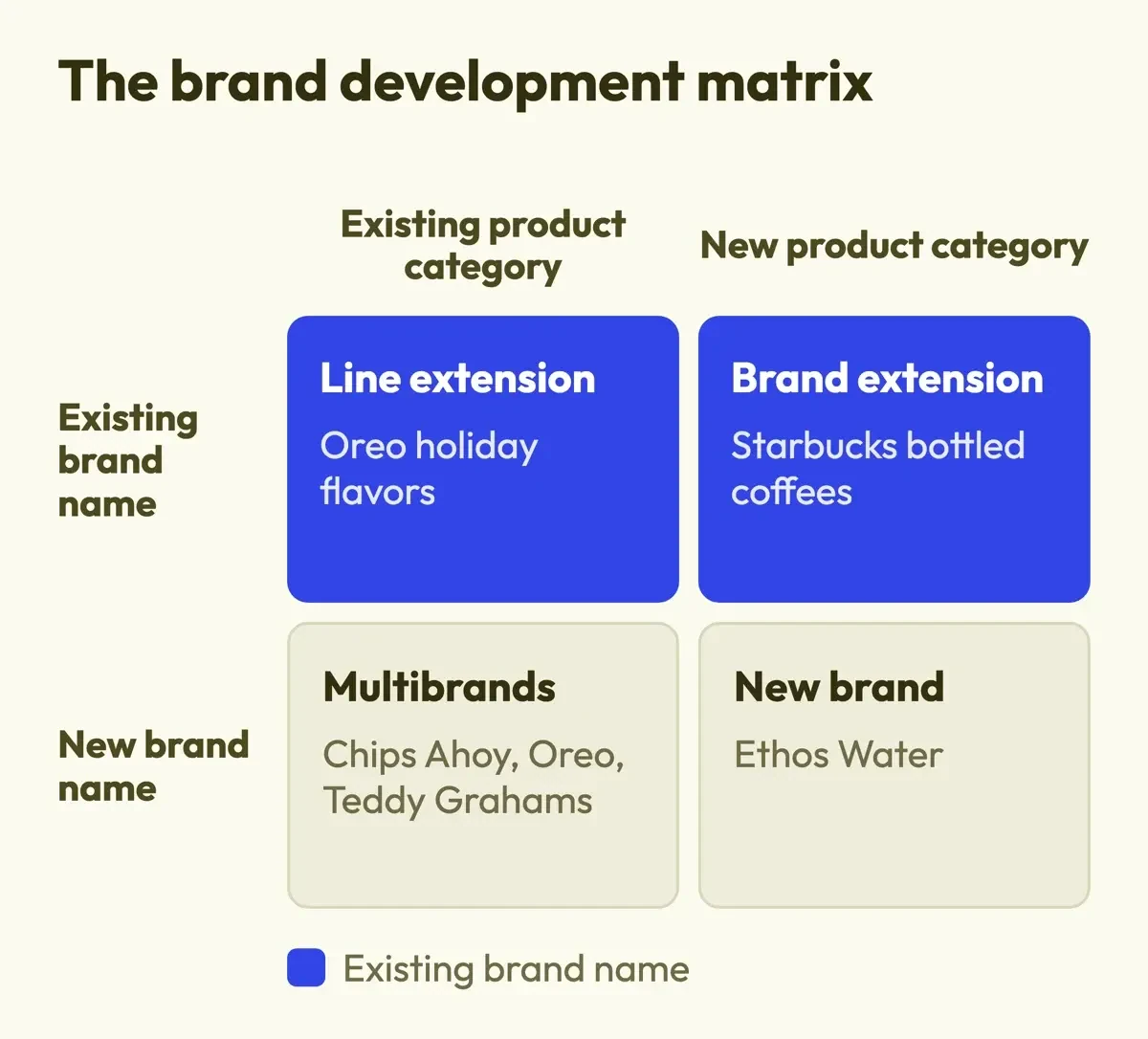 Diagram by DigitalTreed, based on the brand development matrix in OpenStax Principles of Marketing, section 9.6.
The 5 types of brand extension, with textbook examples
Textbooks label the boxes in different ways. We use five working types, and each one answers a different question: same category or a new one, your name alone or shared, and your own production or someone else's.
Line extension
A line extension adds a flavor, size, scent or formula inside a category you already sell. OpenStax's example is Oreo adding holiday flavors, and for a small soap maker the same move would be a lavender version of the best-selling oatmeal bar. It doesn't need a new supplier, shelf or customer, but most of its sales come from people who'd buy from you anyway, so it rarely brings in new ones.
Category extension
A category extension takes the name into a product type the brand has never sold. OpenStax cites Starbucks, which "developed a line of bottled coffees under its corporate brand name." The book says this kind of stretch can "gain instant recognition and affinity for the new product, which may increase sales rapidly." That speed cuts both ways. Buyers who'd try bottled coffee for the name will judge the name by it, so a weak product in a new category hurts more than a flavor that doesn't sell.
Complementary extension
A complementary extension sells something people use alongside the core product, like a soap dish next to the soap. Most textbooks don't treat it separately; they fold it into brand extension. We don't. Its fit comes from shared use, not shared features, and that changes how you'd score it. Arm & Hammer's site lists licensed cat litter pans and accessories next to the brand's own cat litter.
Co-branding
Co-branding puts two brand names on one product, and each brand's owner shares the credit and the risk. OpenStax's example is Doritos Locos Tacos, from Doritos and Taco Bell, and the book notes that "co-branding necessitates a revenue split." Park, Jun and Shocker's 1996 study of composite brands used the example "Slim-Fast chocolate cakemix by Godiva." Pairing "two brands with complementary attribute levels" gave the new product a better attribute profile than a direct extension of one brand. That's a reason to pick a partner that's strong where you're weak.
Licensing
Licensing rents your name to a company that makes and sells the product, so you're paid a fee without running a factory. The OpenStax section on branding uses eyeglass frames. Tiffany & Co., Kate Spade and Tommy Hilfiger don't make frames; they license their names to Luxottica. The book gives both sides: licensing is "a quick way to gain recognition," yet "licensing fees can be costly" for the maker. If you haven't settled what your brand stands for, work through our step-by-step branding strategy plan before you pick any of these five.
One brand, five types: what Arm & Hammer's pages show
Textbook examples are tidy, so we checked one US brand's own pages to see the types side by side. Arm & Hammer's story begins with baking soda. Its About Us page calls it "A trusted solution for more than 170 years."
The page's timeline says that in the 1980s and 1990s "we launch the first detergent with baking soda!" That detergent's success, the company says, sparked "innovations in numerous other categories including toothpaste, carpet deodorizer and cat litter." Those are category extensions held together by one shared ingredient. The page names it: "Our laundry, cat litter, toothpastes and personal care products are made with ARM & HAMMER™ Baking Soda."
Line extensions show up in the Arm & Hammer home page menu. When we loaded it on November 20, 2026, Laundry offered the detergent as liquid, powder, paks, sheets and scent boosters. The Oral Care group listed 14 toothpastes, and each one's a variant inside a category the brand's own timeline dates to its 1980s and 1990s expansion.
Licensing and co-branding live on a separate Licensed Products page. A small script counted every item on our saved copy, using the page's own groups:
| Group | Licensed products | Examples named on the page |
|---|---|---|
| Auto Care | 1 | FRAM Fresh Breeze cabin air filters |
| Baby Care | 17 | Diaper Pail by Munchkin, changing pads, pacifier wipes |
| Home Care | 16 | Hefty Ultimate trash bags with Arm & Hammer odor control, Dutch Boy Refresh paint |
| Personal Care | 2 | Body wash, foot care |
| Pet Care | 12 | Dog dental gel, cat litter pans and accessories |
| Total | 48 | Counted November 20, 2026 |
Several are co-brands too, since a second company's name sits on the pack: FRAM, Munchkin, Hefty and Dutch Boy. Many of the items deal with odor, freshness or cleaning, which matches what the brand already means to buyers. The page doesn't say how licensees are picked. Treat that pattern as our observation, not company policy.
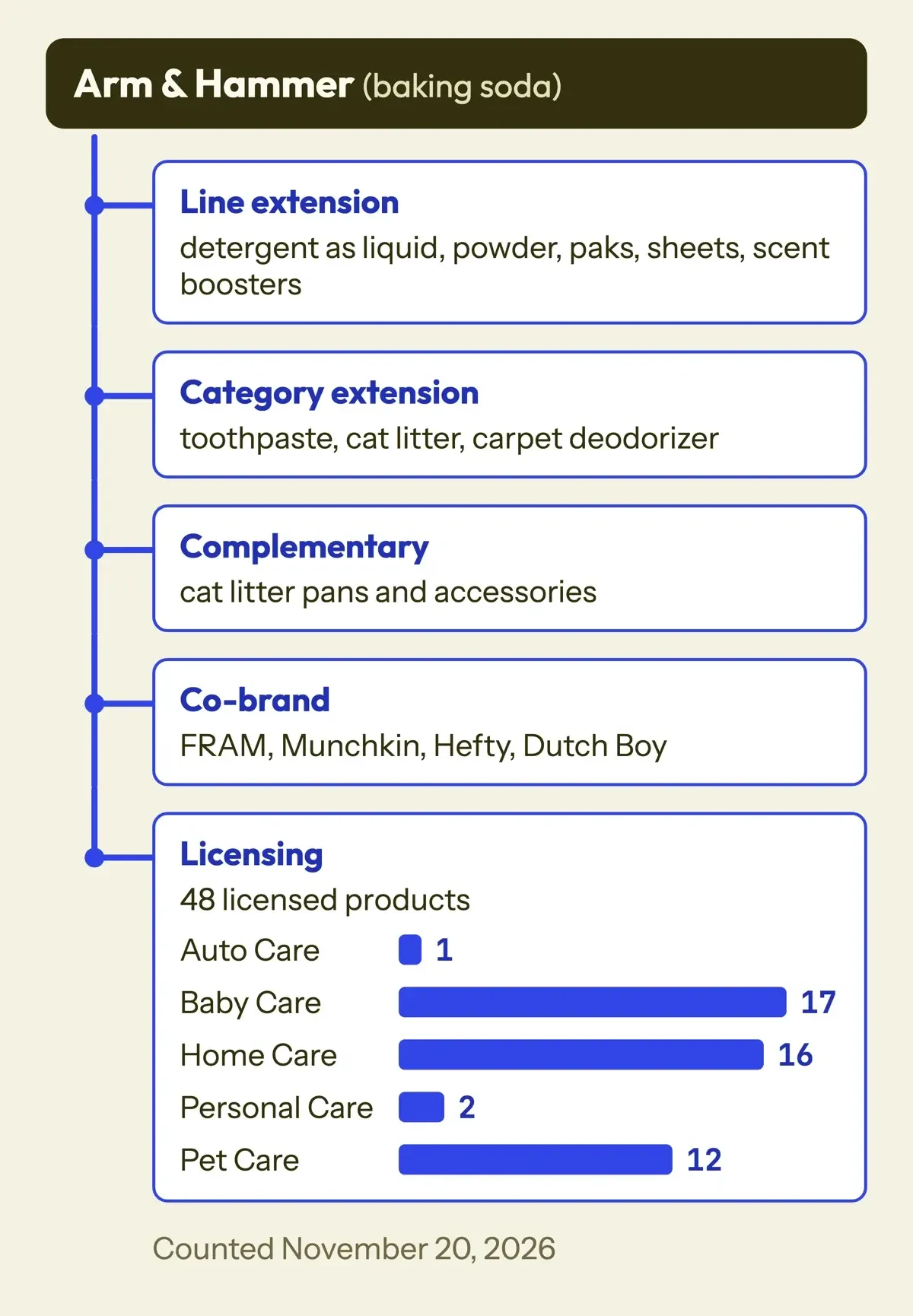 Diagram by DigitalTreed, from Arm & Hammer pages read November 20, 2026. Brand names shown as plain text only.
What decides the success of a brand extension?
Three journal studies from 1990, 1991 and 2006 all point to fit. They just don't measure it the same way. Aaker and Keller tested reactions to "20 brand extension concepts involving six well-known brand names." Attitudes were better when people saw a fit between the two product classes along one of three dimensions and also rated the original brand's quality high. People also liked an extension more when it "was not regarded as too easy to make." A famous name doesn't add much to a product anyone could produce.
Park, Milberg and Lawson split fit into two parts in 1991: "product feature similarity and brand concept consistency." Both mattered. The best reactions came when both were high.
A prestige brand "seems to have greater extendibility to products with low feature similarity than the functional brand does." That held when the extension still matched the brand's concept. The study compared function-oriented and prestige-oriented names. So a luxury name can travel further than a cleaning brand's, provided the idea behind it carries over.
The broadest test came from Völckner and Sattler in 2006, who studied "ten success factors" at once. They found that "fit between the parent brand and an extension product is the most important driver of brand extension success." Marketing support came second, then parent-brand conviction, retailer acceptance and parent-brand experience. Investopedia also has a glossary entry on the success of a brand extension, but the ranking here comes from the journal study. If you've got no ad budget, marketing support in second place is the awkward finding. Our five marketing tactics to build brand awareness cover low-cost ways to put a new product in front of people who already buy from you.
Parent-brand conviction, third on the list, depends on how much buyers already think of you. That's brand equity, and our brand equity tutorial shows how to measure it before you stretch the name.
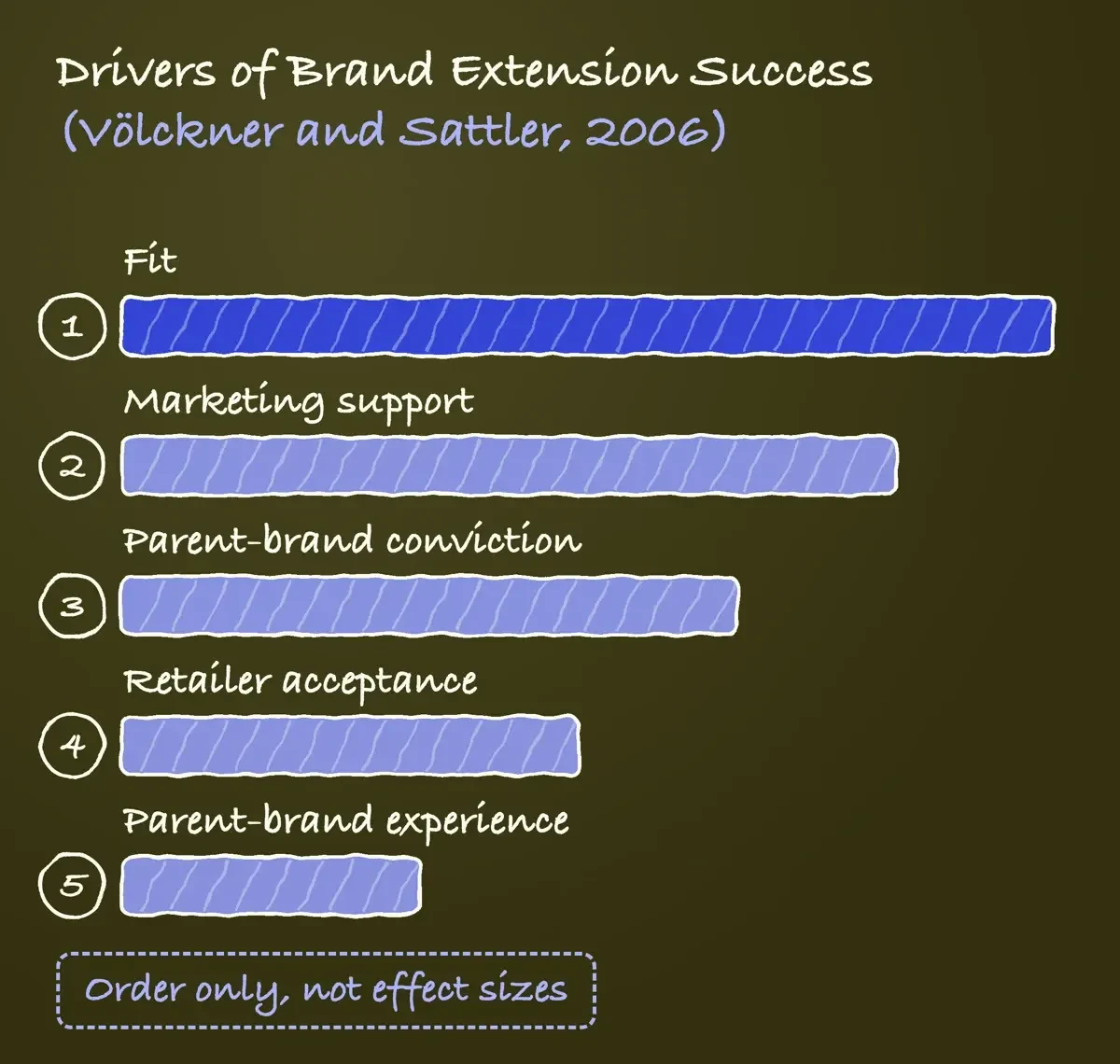 Drawn by us from the Völckner and Sattler 2006 abstract. Order only; the bars are not effect sizes.
Dilution: when an extension hurts the parent brand
Fit also protects the brand you've already built. Loken and Roedder John's 1993 study on diluting brand beliefs found that "dilution effects do occur when brand extension attributes are inconsistent with the family brand beliefs."
There's a twist: dilution was less likely when shoppers saw the extension as atypical and that was salient when they were asked. So an odd product that clearly stands apart can do less harm than a close cousin that breaks the core promise. A scratchy soap from a brand known for gentle soap is the risky case. A follow-up by Keller and Aaker in 1992 adds a second risk. In their lab test, "an unsuccessful intervening extension decreased evaluations of a proposed extension only for a high quality core brand." The same flop "did not decrease core brand evaluations regardless of the quality level of the core brand." It's one lab study, not a field result.
If an extension does damage the name, the usual fix is a new name for that product or, in a bad case, a wider rename of the whole business. Our pages on rebranding a business and on rebranding successfully cover when that's worth the cost.
Brand expansion and your trademark
Brand expansion into a new category has a US legal side that the marketing papers skip. Your application lists the goods or services the mark is for, and you must use it, or truly intend to, on all of them. So a new category can mean a new filing. Classes decide the cost. The USPTO goods and services page says each category is "assigned a number from 1 to 45."
That page also says "goods and services are never in the same class." As of November 2026, it adds: "The base filing fee for each class of goods or services is $350." The USPTO fee information page gives matching math: two classes cost "$700 ($350 for each class)." Example: a soap brand registered only for bar soap that later adds scented candles may need to file in a second class to cover them. The base filing fee for both would then be 2 x $350 = $700 as of November 2026. Run a USPTO trademark search for your name in the new class first, because it's possible another company already holds it there.
In law, dilution means something narrower than the marketing studies do. Under the Lanham Act, 15 U.S.C. 1125, dilution by blurring is association that "impairs the distinctiveness of the famous mark." A mark counts as famous only if it's "widely recognized by the general consuming public of the United States." That rule shields famous marks from other companies, so it rarely touches a small brand stretching its own name. Talk to a trademark attorney before you file in a new class. If your fit sheet says the new product needs its own name, start with our tips on picking a brand name for a business and the brand name generator. Each name you shortlist still needs that search.
Score your idea: an example fit sheet
Those studies give six questions you can score before you've spent any money. We built them into a sheet with our own weights and tested it on a made-up company, Tallowbrook Soap Co. (made up), which sells oatmeal bar soap at farmers markets. Similarity and concept come from Park and colleagues. Quality and the too-easy-to-make test come from Aaker and Keller, while support and retailer acceptance come from Völckner and Sattler. A dilution flag marks any option that could contradict what buyers believe about the brand.
Score each line 0 (no), 1 (partly) or 2 (yes). Then use weighted score = sum of (weight x score / 2), which tops out at 100.
| Option (example) | Type | Weighted score | Dilution flag |
|---|---|---|---|
| Oatmeal liquid hand soap | Line extension | 90 | No |
| Coffee scrub bar with a local roaster | Co-brand | 72.5 | Yes |
| Oatmeal body lotion | Category extension | 65 | No |
| Cedar soap dish | Complementary extension | 55 | No |
| Scented candles | Category extension | 10 | Yes |
The hand soap wins at 90 because it's close to the core product, even with a 0 for being hard to make. Candles fail. They score 10, with a 0 on similarity, concept, quality and marketing support. The coffee scrub reaches 72.5 but carries a flag, because in our example the scrub is coarse and that clashes with the gentle promise of the brand's oatmeal bars. We'd put any flagged option through a small test batch and customer feedback before the brand name goes on it, whatever it scores.
Paste these six questions into your own sheet, weights included:
- Does the new product share features with what we sell now? (weight 25)
- Does it fit the idea buyers hold about our brand? (weight 20)
- Can we make it as well as our core product? (weight 20)
- Would buyers see it as hard for just anyone to make? (weight 10)
- Do we have the money and time to market it? (weight 15)
- Will our current shops and markets stock it? (weight 10)
Fill it in with someone who talks to customers every week, such as whoever runs your market stall, then adjust the weights to fit your situation. A shop with a strong retail partner might move 5 points from marketing support to retailer acceptance.
What we tested
We coded the sheet in Python and scored all five options on November 20, 2026. Its result page loaded from a local server at 127.0.0.1 with HTTP 200. Every option and score is made up, and the weights are ours. A second script counted 48 licensed products on our saved Arm & Hammer pages and found all four timeline lines quoted above.
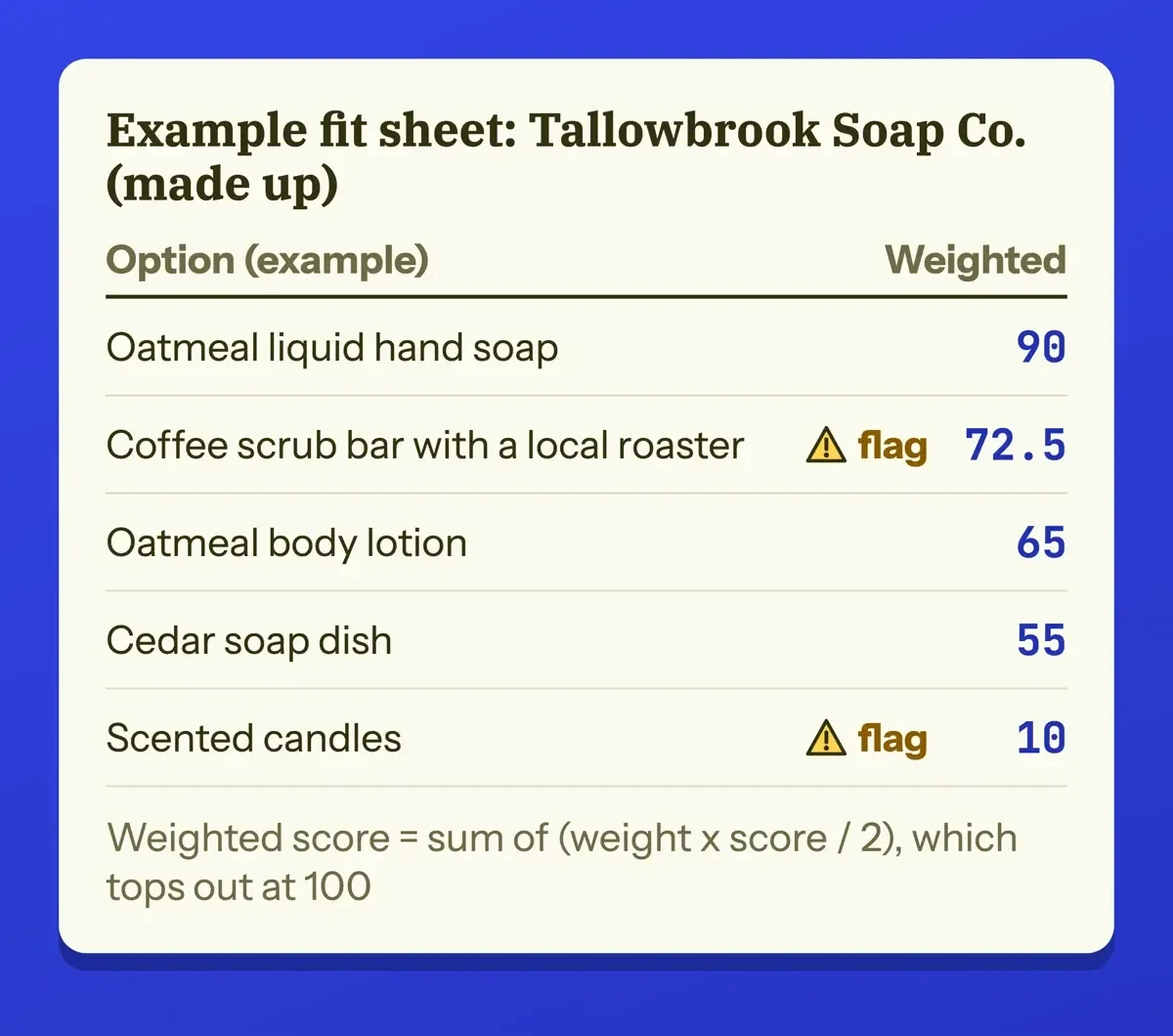 Drawn by us from our local fit sheet test, November 20, 2026. Brand and scores made up.
Our source check: what opened and what didn't
We read every source on November 20, 2026. Several sites turned away our checker, which asks under its own name.
We read in full OpenStax sections 9.5 and 9.6, three Arm & Hammer pages, two USPTO pages and the Lanham Act text on Cornell's Legal Information Institute.
The six journal publishers turned our checker away with a 403, so we read each study's official abstract through its Crossref and OpenAlex records instead. Aaker and Keller's three fit dimensions are named only in the full paper, and since we didn't get it, we left the names out. We couldn't read the Investopedia page linked above either, since it returned 402. Nor could we open the Starbucks annual report on sec.gov and the Starbucks and Nestle press pages, so nothing here comes from them.
Check Arm & Hammer's current licensed list before you quote our count of 48, since licensed lines change and the page itself carries no visible update date.
Frequently asked
Is co-branding a type of brand extension?
It overlaps. OpenStax lists four ways a brand can be owned: "national brand, private brand, licensed brand, or co-brand." When a co-brand carries your name into a new category, it works as an extension too.
How should you advertise a new brand extension?
Talk about the new product itself. Aaker and Keller found negative associations "can be neutralized more effectively by elaborating on the attributes of the brand extension" than by praising the original brand.
What's the difference between a brand extension and a multibrand?
A multibrand uses a new name in a category you already sell. OpenStax warns it "does not work when the products have a small market share or fail to gain favorable retail shelf space."
Where did research on brand extension start?
One early paper is Edward Tauber's 1981 Business Horizons article, "Brand franchise extension: New product benefits from existing Brand Names." The studies above followed from 1990.
How we made this guide: Textbook sections, journal abstracts, company pages and US government pages, plus a script that counted licensed products and a made-up fit sheet scored locally. Facts checked by the DigitalTreed team on November 20, 2026.
First published July 17, 2020. Rewritten in November 2026 with sources, a dated check and an example fit sheet.
Sources
- Aaker and Keller (1990), Consumer Evaluations of Brand Extensions, Journal of Marketing 54(1)
- Park, Milberg and Lawson (1991), Evaluation of Brand Extensions, Journal of Consumer Research 18(2)
- Keller and Aaker (1992), The Effects of Sequential Introduction of Brand Extensions, Journal of Marketing Research 29(1)
- Loken and Roedder John (1993), Diluting Brand Beliefs, Journal of Marketing 57(3)
- Park, Jun and Shocker (1996), Composite Branding Alliances, Journal of Marketing Research 33(4)
- Völckner and Sattler (2006), Drivers of Brand Extension Success, Journal of Marketing 70(2)
- Tauber (1981), Brand franchise extension, Business Horizons 24(2)
- Harvard Business Review (1994), The Logic of Product-Line Extensions
- OpenStax Principles of Marketing 9.6: Forms of Brand Development
- OpenStax Principles of Marketing 9.5: Branding and Brand Development
- Arm & Hammer: About Us
- Arm & Hammer: Licensed Products
- Arm & Hammer: home page product menu
- USPTO: Goods and services
- USPTO: Trademark fee information
- USPTO: Search trademark database
- Cornell LII: 15 U.S. Code 1125
- Investopedia: Brand Extension

Comments
No comments yet. Start the conversation below.