
Quick answer
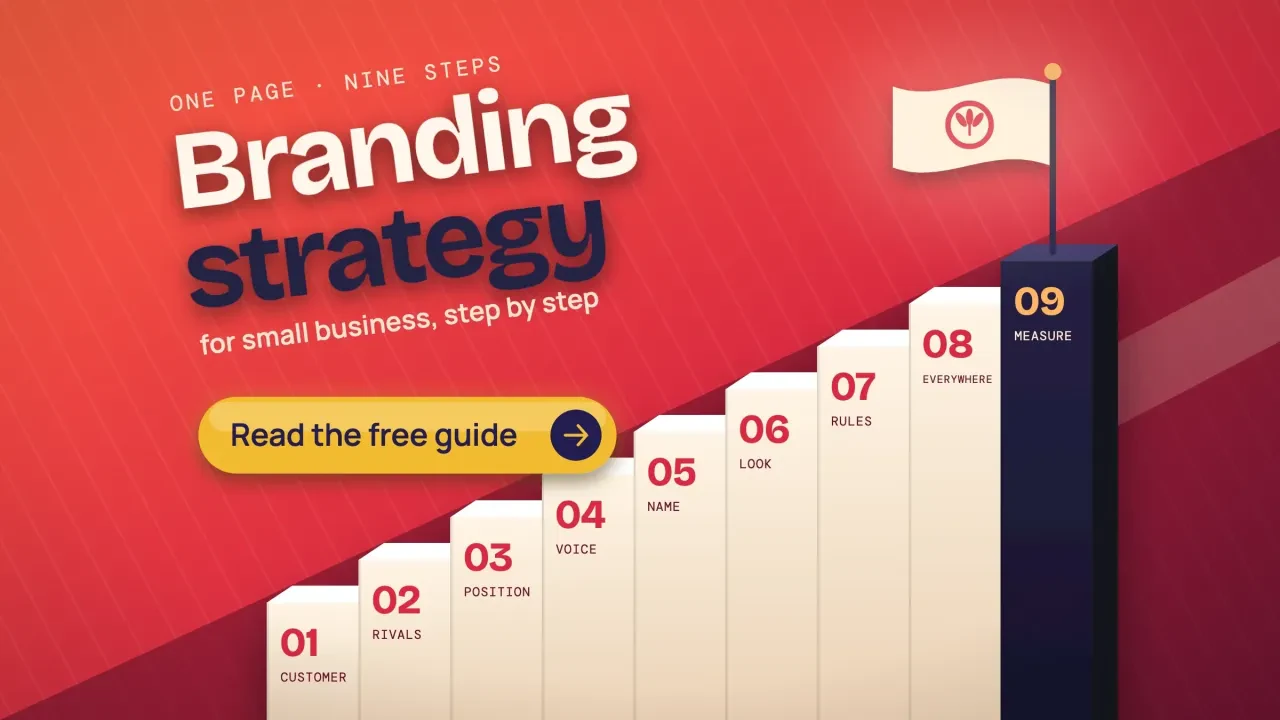
A branding strategy is a short written plan for who you serve, what you promise and how you look and sound. For a small business, it fits on one page. It covers your customer, competitors, positioning, values and voice, a name you can protect, a logo you own, readable colors and measures.
Most guides start with the logo. We start with the decisions, because the logo only works once you know who it is for. Then we add the legal part: none of the 6 top guides we read mentions the USPTO. The USPTO explains that using a name gives you trademark rights, but only in the area where you trade.
This branding strategy guide is written for US small businesses. Every fee comes from uspto.gov, read on October 22, 2026, and every color number is our own math.
Key takeaways
- Write the strategy before anyone designs a logo. The logo is the result, not the start.
- Search your name at the USPTO before you print anything. Searching is free.
- As of October 2026, a federal trademark application costs $350 per class, plus surcharges in some cases.
- A freelancer's logo is usually not yours until they sign a written transfer.
- Test your brand colors. In our example, a soft purple failed the WCAG contrast rule for body text.
What is a branding strategy?
A branding strategy is the written set of decisions behind your brand: who you serve, what you promise and how you look and sound. A small business can fit it on one page. It's the brief your logo designer, your staff and your website all work from, so every place a customer meets you says the same thing.
If you want the basics first, read our guide to what branding is and why it matters.
Brand identity is the visible result: the name, logo, colors and fonts. Marketing is how you spread the word, through ads, posts and email. Strategy comes first, so the other two pull in the same direction.
Positioning is one part of a brand strategy, not all of it. Positioning says why a customer should pick you. In this guide, the strategy also covers your values, voice, name, look and how you measure.
Why bother when you are small? Our take: one page stops you paying for a logo twice. It also lets staff or a freelancer make brand choices without asking you each time.
All 9 steps below fit on one page. Our take: a sole owner can do steps 1 to 5 in a weekend.
Branding strategy key facts for US small businesses
- As of October 2026, a federal trademark application costs $350 per class, per the USPTO fee information page.
- Registered owners file a declaration of use between years 5 and 6. They file it again with a renewal between years 9 and 10, per the USPTO maintenance page.
- Under 17 U.S.C. 204(a), a copyright transfer, such as a logo, is valid only in writing and signed by the owner or their authorized agent.
- WCAG 2.2 success criterion 1.4.3 sets a contrast ratio of at least 4.5:1 for normal text and 3:1 for large text.
- Google Search Console's branded queries filter reached all eligible sites on March 11, 2026, per the Google Search Central blog post.
Steps 1-2: who is your customer, and who else do they pick?
Your customer is the one group you most want to serve, written down in their own words. Your competitors are the 3 to 5 businesses that group would also consider. You find both in your reviews, emails and a few competitor websites, and they shape every step after them.
Step 1 is one customer card. Write who they are, where they live, what job they need done and what worries them. Use words from your real reviews, emails and calls, not marketing words.
If you sell to other businesses, the card looks different. Our guide to B2B vs B2C marketing shows how buyers differ.
Step 2 is a look at 3 to 5 competitors your customer would also consider. For each, note:
- Their promise, in one line from their website or sign.
- Prices they show, if any.
- Their look: colors, logo style, photos.
- Their Google rating and what reviews praise or complain about.
Then find the gap: a need nobody meets well. Google says reviews feed local "prominence," per its local ranking help page. So competitor reviews are also free research.
Steps 3-4: how do you write a positioning statement, values and a voice?
Write the positioning statement as one fill-in sentence: who you serve, what you do for them and your proof. Then add a purpose line, 3 values you won't trade away and 3 voice words with "we say / we don't say" pairs. All of it goes on the same page as your customer card.
A positioning statement is one sentence that says why a customer should pick you. Fill in this brand strategy template:
Note
For [customer] in [place] who [need], [brand] is the [category] that [main benefit] because [proof].
Proof matters most. "Because we care" is not proof. "Because we cap orders at 30 a week" is.
Step 4 starts with purpose and values. Write one sentence on why your business exists, beyond making money. Then write 3 values you will not trade away, such as on-time orders.
Some big brands publish theirs. Patagonia's core values page lists 5 values it updated in 2022. They are quality, integrity, environmentalism, justice and not being bound by convention. Each value has a one-line rule, such as "Do it our way."
Next comes your voice. Voice is your personality, and it stays fixed. Tone is how that voice shifts by situation, such as an apology versus a sale post.
Mailchimp's public voice and tone guide makes the same split. In its words, you have "the same voice all the time, but your tone changes" with the reader's mood. "We are plainspoken" is the first of its 4 voice traits. Pick 3 words for your voice, then write pairs like these:
| We say | We don't say |
|---|---|
| Your cake is ready Friday at 3 p.m. | Your order is being processed. |
| Sorry, we got this wrong. Here is the fix. | We apologize for any inconvenience. |
| Made this morning | Artisanal, handcrafted excellence |
Those 3 voice pairs suit a friendly local business. Keep yours on the same page as the positioning statement. To keep that voice steady on social media, see our post on brand voice consistency.
Do you need a brand story or a tagline?
A short brand story helps on your About page. Write 3 lines: the problem you saw, why you started and what you do about it now.
Taglines can come from the main benefit in your positioning statement. Use yours on your site, signs and bios. Keep it out of your Google Business Profile name, because Google's name guidelines do not allow marketing taglines there.
Step 5: how do you choose and protect your brand name?
Choose a name that's easy to say and spell and that nobody else uses for similar goods or services. Then protect it: search the USPTO database, state records and domains, use TM or SM right away, and file a federal application when you can. The fee table below shows what that costs.
Aim for a name that is also easy to remember and hard to confuse. The USPTO strong trademarks page says strong marks are "suggestive, fanciful, or arbitrary." Weak ones are descriptive, like "Creamy" for yogurt.
If you are still brainstorming, our brand name generator guide and our post on choosing a brand name for your business help with ideas. Then check every finalist:
- Search the USPTO trademark search system. It is free, and you do not need to log in.
- Search your state's business entity records and the web for the same or similar names.
- Check the domain and the social handles you want.
- Say the name out loud to 5 people and ask them to spell it.
The USPTO database shows federal filings only. Its why register page warns it does not include owners with "no federal registration." So the web and state search matter too.
Your LLC filing, DBA and domain are separate from a trademark. The SBA business name guide says these name registrations "are legally independent."
You can put TM (goods) or SM (services) next to your name today. The USPTO trademark basics say to use the ® only once your mark is registered.
Trademark cost in 2026: our USPTO fee table for one class
As of October 2026, the USPTO fee page lists $350 per class for the base application. You pay $100 more per class if information is missing. Typing your own description instead of picking one from the ID Manual adds $200 per class.
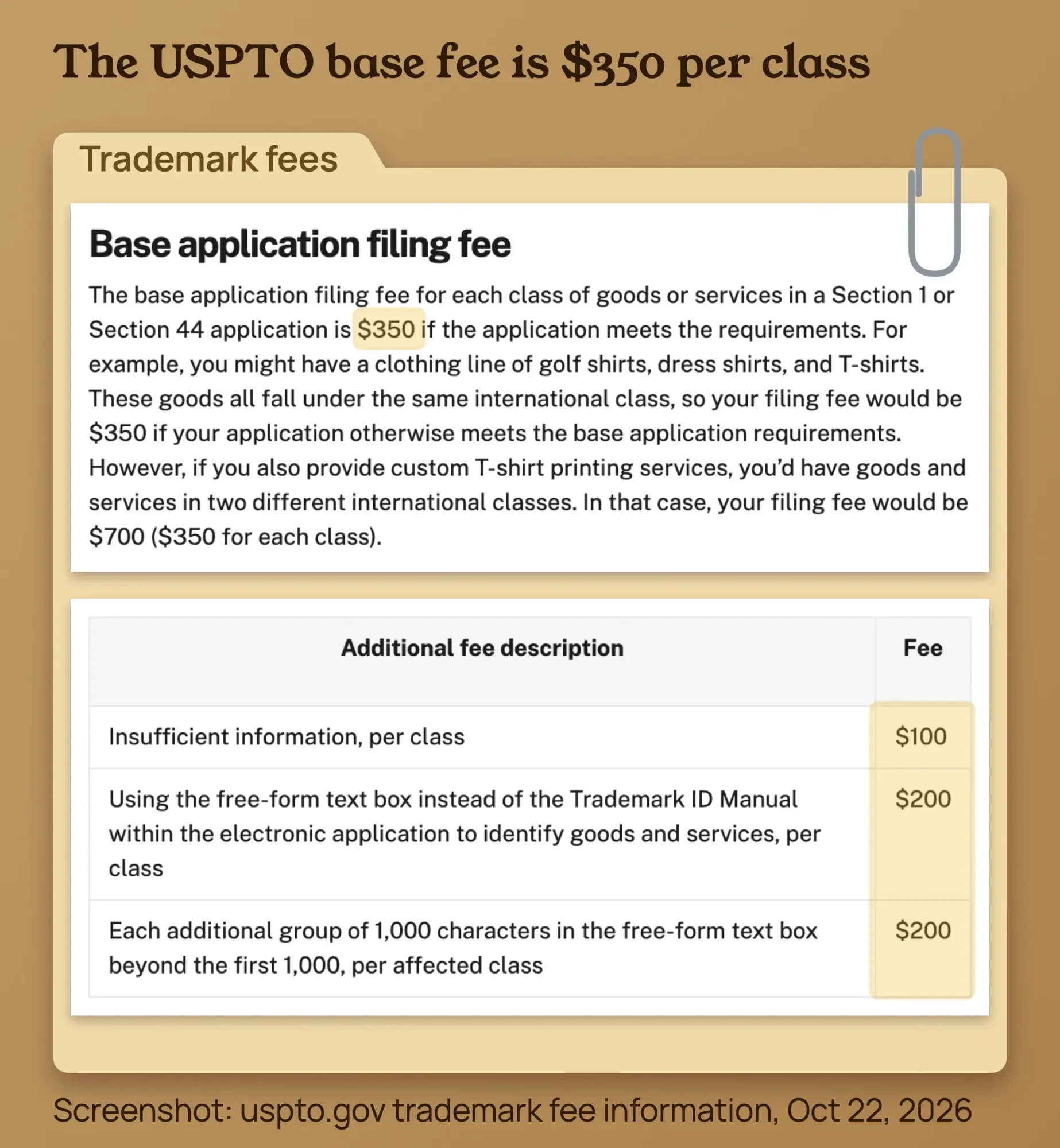 Screenshot (excerpt): USPTO trademark fee information page, uspto.gov, October 22, 2026.
| Situation (1 class) | USPTO fees, as of October 2026 |
|---|---|
| Name already in use, description from the ID Manual | $350 |
| Same, with your own free-form description | $550 ($350 + $200) |
| Not using it yet (intent-to-use), then a statement of use, no extensions | $500 ($350 + $150) |
| Name and logo filed as 2 separate applications | $700 ($350 x 2) |
| Years 5-6: declaration of use (Section 8) | $325 |
| Years 9-10: declaration plus renewal (Sections 8 and 9) | $650 |
These are USPTO fees only, as of October 2026. You can list only one trademark per application, per the fee page, so a name and a logo are 2 filings. The USPTO cost page gives the $650 renewal figure.
Fees continue while you own the mark. The USPTO maintenance page sets filings between years 5 and 6, then between years 9 and 10. For one class, our sum of these USPTO fees is $350 + $325 + $650 = $1,325 in the first 10 years after registration. That counts the filing fee paid before registration, at October 2026 fees, with no surcharges or late fees.
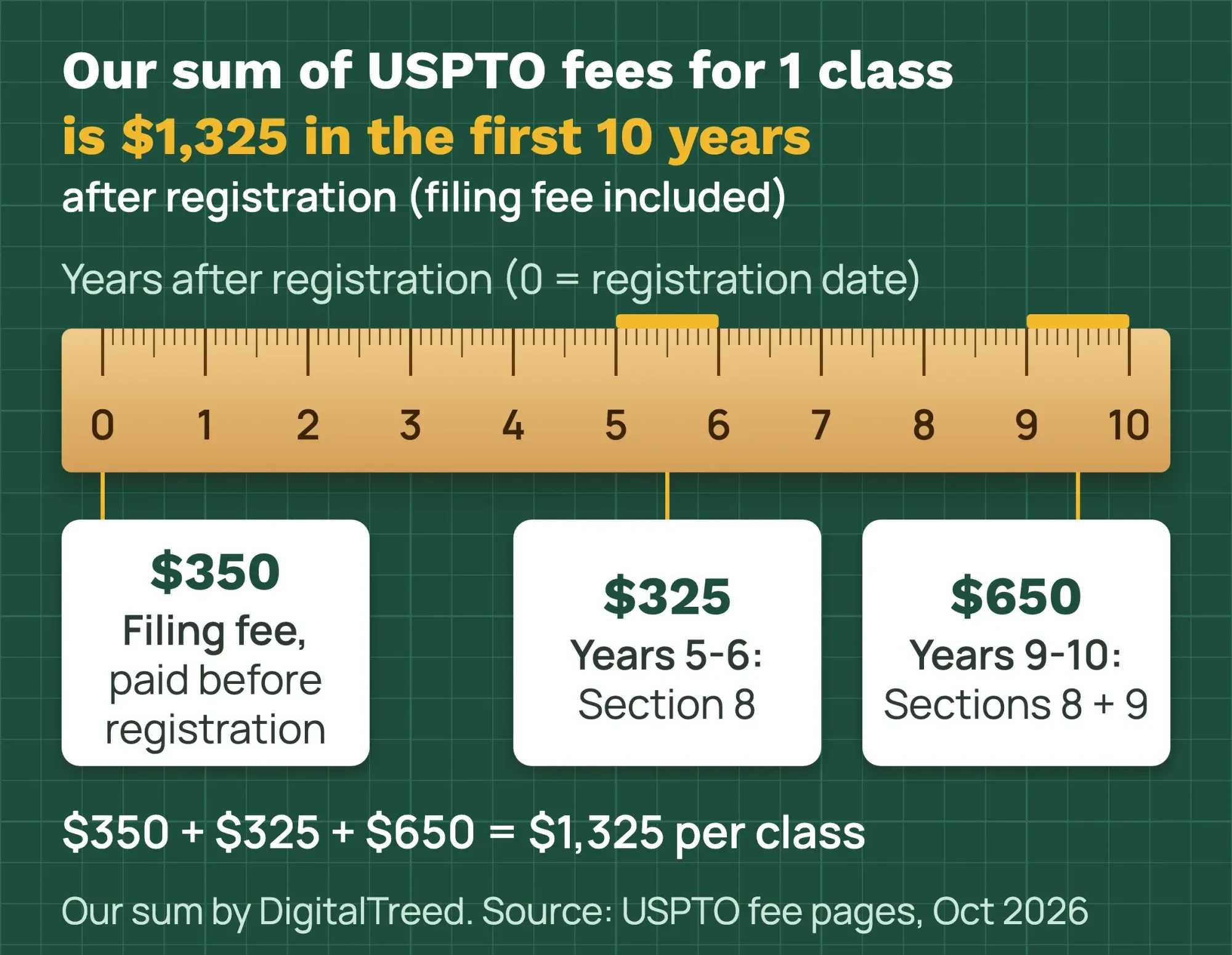 Diagram by DigitalTreed: our sum of USPTO fees. Source: USPTO fee information page, October 2026.
Which class do you file in? The USPTO's Nice class list puts "bread, pastries and confectionery" in Class 30. Services for providing food and drink sit in Class 43. Pick your exact wording in the Trademark ID Manual to avoid the $200 surcharge (as of October 2026).
Watch for fake "USPTO" calls and emails. The USPTO scams page says its staff never ask for payment by phone, email or text. Real USPTO emails end in @uspto.gov.
US residents can file without an attorney. The USPTO process page says the USPTO "strongly encourage[s]" hiring one. This is general information, not legal advice; check with an attorney for your situation.
Step 6: how do you build a visual identity that works?
Your visual identity is a logo, 2 to 3 colors, 1 to 2 fonts and a photo style. To use your palette well on posts and flyers, see our graphic design tips for beginners. Build it from the positioning statement, not from what is trendy. Before you print anything, get a signed copyright transfer for the logo and check that your text colors pass the WCAG contrast rule.
First, make sure you own the logo. Under 17 U.S.C. 204(a), a copyright transfer is not valid unless it is "in writing and signed" by the owner. A freelancer you hire usually keeps the copyright by default.
The Copyright Office's Circular 30 on works made for hire (PDF) lists 9 kinds of commissioned work that can count as works made for hire. A standalone logo is not one of them. So ask for a signed copyright assignment in the contract. When you're ready to pay someone for the logo, see how much a graphic designer costs and what to put in the contract. This is general information, not legal advice; check with an attorney for your situation.
Next, test your colors. WCAG 2.2 rule 1.4.3 asks for a contrast ratio of at least 4.5:1 for normal text and 3:1 for large text. On October 22, 2026, we ran the WCAG 2.2 contrast formula on the example palette below, with each color on white.
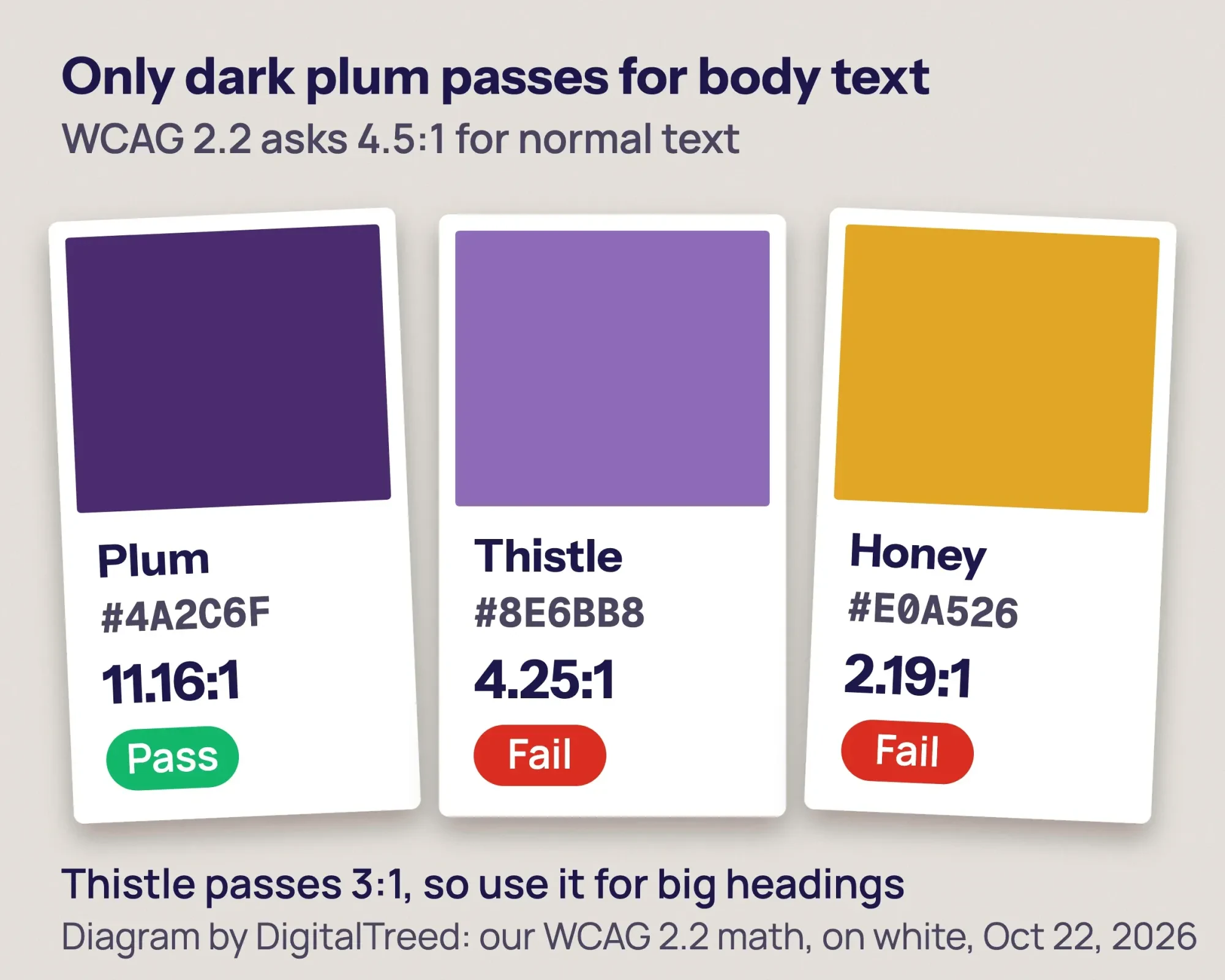 Diagram by DigitalTreed: our WCAG 2.2 contrast math on white, October 22, 2026.
Thistle purple #8E6BB8 on white scored 4.25:1. That fails body text, so it suits big headings and shapes. Dark plum #4A2C6F scored 11.16:1, so it can carry text and buttons. Honey #E0A526 scored 2.19:1, so use it only for decorative shapes.
Stuck on the logo and colors? Our logo and graphic design team can turn your one-page strategy into a logo, a palette and guidelines. (DigitalTreed sells this service.)
Your website should use the same identity. If you plan a new site, read our guide to hiring a website designer first.
Step 7: what goes in one-page brand guidelines?
Brand guidelines are the written rules anyone can follow without asking you: how to write the name, which logo file to use, the color codes, fonts, voice and photo style. One page is plenty when you're small. Here's what to put on it:
- The exact business name, and how not to write it (no ALL CAPS, no "LLC" where you do not use it).
- Logo files: full color, one color and white, with a minimum size.
- Colors with hex codes and which pairs pass 4.5:1 for text.
- Heading and body fonts, plus a free backup font. Saw a font you like elsewhere? Here's how to find a font from an image and check its license first.
- Voice: your 3 words and the "we say / we don't say" pairs.
- Photo style, such as real staff and daylight, no stock smiles.
- The TM, SM or ® rule.
Our take: email signatures are an easy place for brand rules to slip. Make one signature for everyone with our free email signature generator, using the colors and logo from the guidelines.
Step 8: how do you keep your brand the same everywhere?
Use one exact name, one logo and one short promise on every channel: your Google Business Profile, website, social bios, email, invoices and signs. Check them in that order, because the profile and the website are what people see when they search for your name.
Start with your Google Business Profile. Google's Business Profile guidelines say your name should match your "real-world name" on your storefront and website. Taglines, ® signs and all-caps words are not allowed, and breaking the rules can get the profile suspended.
Our take: for a local business, the profile is often where customers first see your name. Our guide on what local SEO is shows how the profile fits in.
For the setup itself, the DigitalTreed guide to running a Google Business Profile covers verification, categories, reviews and suspension appeals.
Next, your website. Google's site names documentation says to add WebSite structured data to your home page and to use your site name consistently. Then check how your title and brand name will look in results with our SERP snippet preview tool.
Last, social bios, invoices, signs and your vehicle. Use the same name, logo and one-line promise. When sponsors or press ask for those files, send a dated media kit with your logo, colors and audience numbers. For channels and posting, see our social media marketing strategy guide.
Step 9: how do you know your branding strategy is working?
Your branding strategy is working when more people search for you by name, your reviews grow and new customers say they've heard of you. Check every 3 months with free tools: Google Search Console, your Google Business Profile, your review count and one question to new customers.
- Search Console's branded queries filter splits clicks into branded and non-branded. Google's launch post says it reached all eligible sites on March 11, 2026.
- Google Business Profile shows the "search terms people used to find your business," per Google's performance help page.
- Track your review count and average rating once a month.
- Ask every new customer, "How did you hear about us?"
Google limits the branded filter to top-level properties with enough search volume. On a small site, filter the Queries report for your name instead. Our Google Search Console guide shows where it is.
If you run ads or post links, tag each one with our UTM builder. Then your analytics show which campaign sent each visit.
What do branding strategy examples from real brands look like?
Most companies keep their full branding strategy private, so real examples come in pieces. Patagonia publishes its core values, Mailchimp its voice and tone guide and Spotify its logo rules. Each page shows one step from this guide, as the table below sets out.
| Brand | Step it shows | What the brand publishes | Lesson for a small business |
|---|---|---|---|
| Patagonia | Step 4: values | 5 core values, updated in 2022, each with a one-line rule | Write a rule under each value, so staff know what it means in practice. |
| Mailchimp | Step 4: voice | A voice that stays the same and a tone that changes with the reader's mood | Write "we say / we don't say" pairs for good news and for bad news. |
| Spotify | Step 7: guidelines | Logo rules for partner apps: the green logo only on black or white, and never smaller than 70px on screens or 20mm in print | Set a minimum logo size and the backgrounds your logo may sit on. |
These are big brands with big teams. The method still fits on one page for a 2-person business, as the next example shows.
Example: a one-page branding strategy for a bakery
Example (fictional): Oventhistle Bakery is a made-up 2-person bakery in Columbus, Ohio. The name and numbers are invented to show the method. They are not a client.
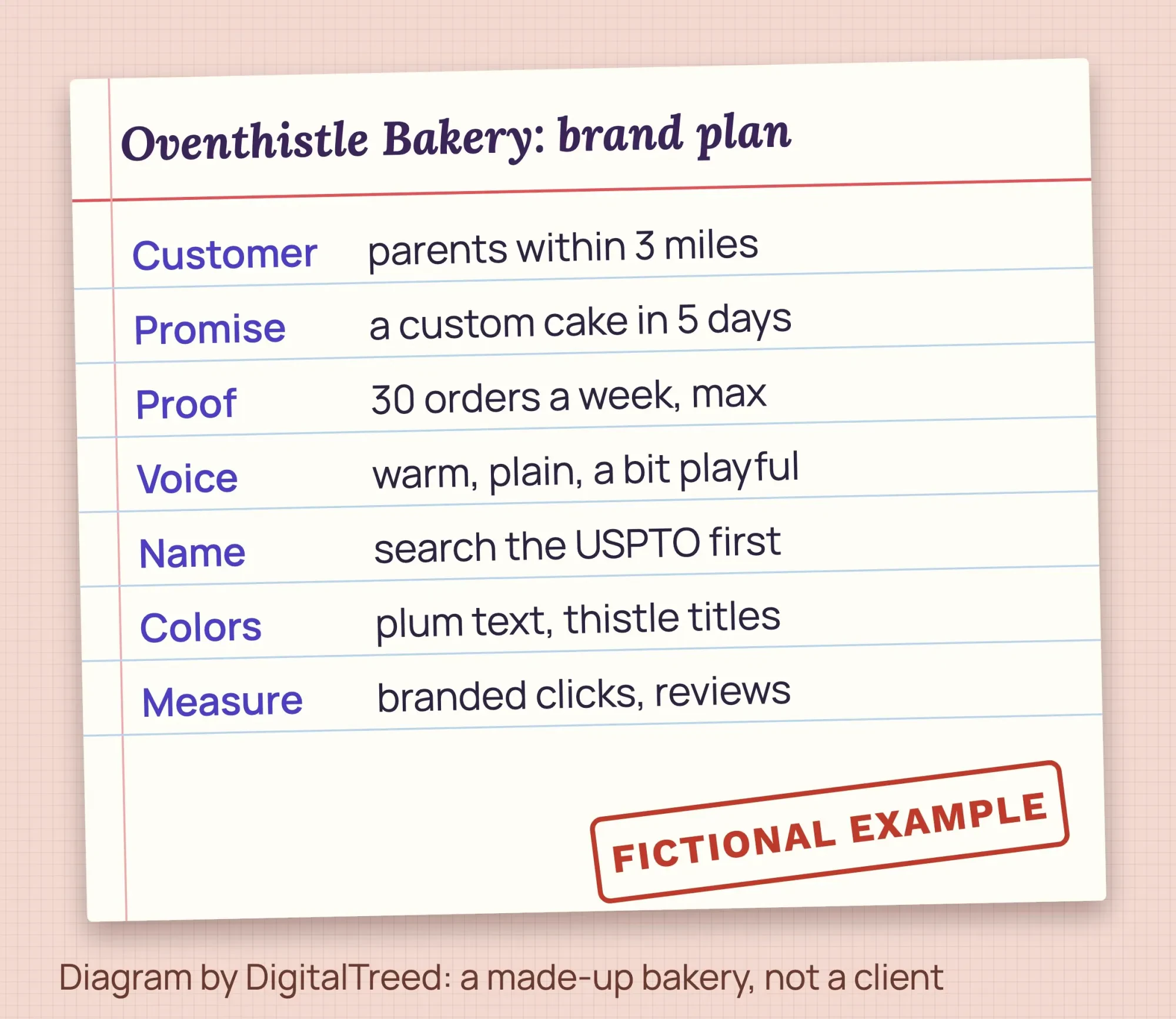 Diagram by DigitalTreed: a fictional example, not a real business.
- Customer: busy parents within 3 miles who need a custom birthday cake fast.
- Competitors: 2 grocery bakeries (cheap, generic) and 1 boutique with a 3-week wait.
- Positioning: "For Columbus parents who need a birthday cake within a week, Oventhistle is the neighborhood bakery that bakes to order in 5 days."
- Proof: a cap of 30 orders a week, so every order gets its slot.
- Voice: warm, plain, a little playful. Never "artisanal."
- Name check: USPTO search, Ohio business records, domain and handles. We did not search this name, and you must search yours.
- Trademark budget: one word mark in Class 30, already in use, ID Manual wording. That is $350 in USPTO fees as of October 2026.
- Colors: plum for text and buttons, thistle for large headings, honey for decorative shapes only.
- Google Business Profile name: "Oventhistle Bakery," not "Oventhistle Bakery - Best Cakes in Columbus."
- Measure: branded clicks, profile search terms and reviews, every quarter.
The USPTO calls invented words "fanciful" and counts them as strong marks. Strong does not mean free. Only a search tells you that.
Common branding mistakes to avoid
- Designing the logo before the strategy.
- Picking a descriptive name, such as "Columbus Cakes," that is hard to protect.
- Thinking an LLC filing or a domain gives you trademark rights.
- Using ® before the USPTO registers your mark.
- Paying a freelancer for a logo without a signed copyright transfer.
- Adding a tagline or "LLC" to your Google Business Profile name.
- Choosing a brand color that fails contrast for text and buttons.
- Paying a caller or emailer who claims to be the USPTO.
- Measuring your brand by likes alone.
Frequently asked
What is a branding strategy, in simple terms?
It is a written plan for who you serve, what you promise and how you look and sound. Then every place a customer meets you says the same thing.
What is the difference between brand strategy and brand identity?
Strategy is the decisions: audience, positioning and voice. Identity is what people see: the name, logo, colors and fonts. Make the decisions first.
What is the difference between brand strategy and marketing strategy?
Brand strategy decides who you are for and what you promise. Marketing strategy decides how you reach those people, through ads, posts, email and offers. Our take: the brand strategy comes first and stays steady, while marketing plans change often.
Do I need to trademark my business name?
It is not required. Using a name gives you limited rights where you trade. A federal registration gives broader rights. As of October 2026, the USPTO charges $350 per class to apply, per its fee page.
Can I trademark a name for free?
No. Searching the USPTO database is free, but filing an application is not. TM and SM can be used without filing.
How often should I update my branding strategy?
Our take: review it once a year, and again when your customer or your offer changes. Keep the name and logo stable unless there is a real reason.
Your next step
Today, write your customer card and your positioning statement. Then search your name at the USPTO before you spend money on design.
When the page is done, our graphic design team can build the logo, colors and guidelines from it. You see the price before any work starts.
How we made this guide: it's built from USPTO, Copyright Office, SBA, Google and W3C pages. On October 22, 2026, we re-read the USPTO fee pages and took the fee screenshot. That day we also confirmed Class 30 on the USPTO Nice class page and ran the WCAG contrast formula on our example colors. Sources are linked inline at each claim. Updated October 23, 2026: added purpose and values, a brand story and tagline section, and a brand vs marketing strategy FAQ. We also added real brand examples from Patagonia, Mailchimp and Spotify.
First published July 2020. Rewritten October 2026: a 9-step plan, USPTO fees with a 10-year total, logo ownership, tested colors, Google name rules and free ways to measure. Updated October 25, 2026: a direct answer at the top of each step and a key facts list. We also added the date of our contrast test and a link to our Google Business Profile guide.
Sources
- USPTO: What is a trademark?
- USPTO: Strong trademarks
- USPTO: Search our trademark database
- USPTO: Why register your trademark?
- USPTO: Trademark fee information
- USPTO: How much does it cost?
- USPTO: Trademark process
- USPTO: Keeping your registration alive
- USPTO: Recognizing common scams
- USPTO: Nice Agreement current edition, class headings
- USPTO: Trademark ID Manual
- SBA: Choose your business name
- US Code, 17 U.S.C. 204: Execution of transfers of copyright ownership
- US Copyright Office: Circular 30, Works Made for Hire (PDF)
- Google Business Profile Help: Guidelines for representing your business
- Google Business Profile Help: Performance
- Google Business Profile Help: How to improve your local ranking
- Google Search Central Blog: Branded queries filter in Search Console
- Google Search Central: Site names in Google Search
- W3C: WCAG 2.2, 1.4.3 Contrast (Minimum)
- Patagonia: Our core values
- Mailchimp Content Style Guide: Voice and tone
- Spotify for Developers: Design and branding guidelines

Comments
No comments yet. Start the conversation below.