

What GEO and AEO are, and what Google says about them
This is guide 5 of 5 in our SEO learning path, and you can read it straight after Guide 2. It takes one question, "can you get us into ChatGPT?", and answers it with what the search engines have said, what the studies measured, and what you can check on your own site.
It's written for in-house SEOs and content leads, agency staff who get asked that question, business owners deciding whether to pay for "GEO services", and developers who look after robots.txt. There are nine chapters, about 80 minutes in all. Read chapters 1 to 3 first for the evidence, then work through chapters 4 to 8 with your own site open, and keep chapter 9's checklist and 30-day plan for last.
Every number comes with its source, date and sample, and vendor studies are marked as vendor studies. The stories from our own work (a sports platform, a perfume brand, and the students I taught) say only what happened, and none of them claims an AI citation.
Quick answer
GEO and AEO are names for getting your content used and cited in AI-written answers. The term GEO comes from a 2023 research paper. Google's own position, published in May 2026, is that optimising for its AI features is still SEO: no special files, no special markup, just crawlable, indexable, useful pages.
A client asks, "Can you get us into ChatGPT?" Before you answer, you need two things straight: what the words mean, and what the search engines themselves have said. This chapter covers both. The rest of the guide is the practical part.
Where the words come from
GEO (generative engine optimization) is the work of making your content more likely to be used and cited when an AI system writes an answer. The term comes from a research paper, "GEO: Generative Engine Optimization", by Pranjal Aggarwal and colleagues from IIT Delhi, Princeton University and two independent researchers. It went up on arXiv in November 2023 and was accepted at KDD 2024.[1] The first author was at IIT Delhi, so the name of a whole industry trend started partly in India.
The other labels mean roughly the same job. AEO (answer engine optimization) puts the focus on "answer engines" such as ChatGPT and Perplexity. LLMO (large language model optimization) is a third variant. Patrick Stox of Ahrefs titled a 2025 conference talk "GEO? AEO? LLMO? What's With All This AI Stuff?", which tells you how settled the vocabulary is.[2] Google's own guidance on third-party services mentions both AEO and GEO by name.[3]
| Term | Stands for | What people mean by it | Who uses it most |
|---|---|---|---|
| SEO | Search engine optimization | Getting pages found, indexed and ranked in search engines | Everyone, including Google |
| GEO | Generative engine optimization | Getting your content used and cited in AI-written answers | Researchers (from the 2023 paper), agencies, tool vendors |
| AEO | Answer engine optimization | The same job, framed around answer engines and featured answers | Agencies and vendors |
| LLMO | Large language model optimization | The same job, framed around the models | Some vendors and conference talks |
We use "GEO" in this guide because it has a paper behind it. Don't let anyone sell you AEO and GEO as two separate services.
What changed for searchers
For most of search's history, you typed a query and got ten links. Between 2024 and 2026 that changed fast:
- May 2024: Google's AI Overviews rolled out to all US users.[4]
- 31 October 2024: OpenAI launched ChatGPT search; everyone could use it from 5 February 2025.[5]
- 24 June 2025: Google's AI Mode came to India in Search Labs, the first market outside the US, with the Labs requirement dropped weeks later.[6]
- 20 May 2026: at Google I/O, Google brought AI Overviews and AI Mode together into one AI Search experience, live that day worldwide.[7]
The scale is large. Sundar Pichai said in July 2026 that AI Mode had passed 1 billion monthly active users and the Gemini app had 950 million.[8] OpenAI said in February 2026 that ChatGPT had reached 900 million weekly users.[9]
What it means for clicks
Two facts are true at the same time, and you need both when you talk to a client.
8% vs 15%
of visits where people clicked a normal result, with and without an AI summary on the page (900 US adults, March 2025)[10]
0.32%
of site traffic came from AI referrals in January to April 2026, against 42.75% from organic search (101,574 sites)[11]
1B+
monthly active users of Google's AI Mode by July 2026[8]
First, AI answers take clicks. In Pew Research Center's study, people clicked a link inside the AI summary itself in just 1% of visits. That's US browsing data, not a global figure. Second, AI assistants are huge products but small referrers. The SE Ranking figure is from a vendor, and its sample is sites connected to Google Analytics. So GEO is mostly about being seen and named, and only partly about traffic. Chapter 8 covers measuring it.
Google's position, in its own words
On 15 May 2026 Google published a guide called "Optimizing your website for generative AI features on Google Search", announced by John Mueller.[12] It is the clearest statement any search engine has made on GEO. The key line:
From Google Search's perspective, optimizing for generative AI search is optimizing for the search experience, and thus still SEO.[13]
The guide says Google's AI features are "rooted in our core Search ranking and quality systems". It then lists things you can ignore for Google Search:[13]
- llms.txt files and other "special" markup or Markdown files (chapter 7)
- "Chunking" your content into small pieces
- Rewriting content just for AI systems
- Seeking inauthentic "mentions"
- Over-focusing on structured data
What it asks for instead is "non-commodity" content: things only you can write, from first-hand experience. Its example contrasts a generic "7 Tips for First-Time Homebuyers" with a homeowner's story about inspecting a sewer line. Chapter 4 shows how to apply that.
The older "AI features and your website" page is even shorter. It says there are no additional requirements to appear in AI Overviews or AI Mode. A page has to be indexed and eligible to show with a snippet, and there's "no special schema.org structured data that you need to add."[14]
The rules that changed in 2026
Two changes make the "anything goes" GEO tactics risky.
On the same day as the new guide, Google clarified that its spam policies cover AI answers too. Spam now includes "attempting to manipulate generative AI responses in Google Search".[15] As we read it, hidden text written for bots, fake mentions and mass pages built to catch AI answers now fall under the same policies as old-school spam.
Then on 5 June 2026 Google published guidance on third-party SEO tools and services, naming "AEO" and "GEO" tools among the things to look at carefully. Its words: "Third-party tools don't have access to our internal ranking data." And: "They can't guarantee performance."[3] The AI optimisation guide says the same about AI systems.[13]
Warning
If an agency promises "guaranteed placement in AI Overviews" or says it can see inside Google's AI, it's claiming something Google says no outside tool can do.
The Search Console setting you should know about
Google's guide adds one condition: to be eligible for its generative AI features, a site must be "included in Search generative AI features in Search Console".[13] That's a toggle Google announced in June 2026. It decides whether your site appears in AI Overviews, AI Mode and AI Overviews in Discover, and helps ground their answers. It rolled out to all sites worldwide by 31 August 2026.[16] Every site is included by default.[17] Chapter 6 explains what switching it off does. If you're cited nowhere in AI Overviews, check this setting first. It takes two minutes.
Bing's position
Microsoft goes further than Google in naming the term. In February 2026 Bing rewrote its Webmaster Guidelines[18] to cover Copilot answers as well as normal results. As Search Engine Journal reported it, the guidelines now name "Generative Engine Optimization (GEO)". They treat it as making content eligible to ground and be cited in AI answers, and say GEO doesn't guarantee citations, just as SEO doesn't guarantee rankings. They also turned a one-line warning about prompt injection into a full section on prompt injection and AI manipulation.[19] In May 2026 Bing's search team wrote that the index is moving "from ranking pages to supporting answers". They describe the unit of value as "groundable information": specific facts that can be supported and traced to a source.[20]
Keep that idea in mind for the whole guide. Clear facts with a clear source are what an AI system can use.
Where we stand
GEO is SEO plus brand building plus being cited on other sites, measured with some new reports. Lily Ray, who tracks AI citations for her own studies, put it plainly in January 2026:
AEO/GEO is not an overhaul or abandonment of SEO.[21]
Patrick Stox's slide said it in five words: "AI Search Is Still Search."[2]
Our view: GEO isn't a separate product. The levers that work are the SEO levers (access, indexing, ranking for the right questions, useful pages) and the PR levers (being mentioned by others). A "GEO package" that sells a file, a schema bundle or a guaranteed ChatGPT spot instead is selling the parts Google told you to ignore. Chapter 9 lists the red flags.
Note
Search "generative engine optimization" in Google India and, when we looked in October 2026, you got a Wikipedia article, Google's own guide to its generative AI features, and a lot of tool-vendor, course and agency pages, many quoting numbers without a source. Most of the ads above them sell AI trackers, so check who wrote what you read, and whether the study behind a number is named.
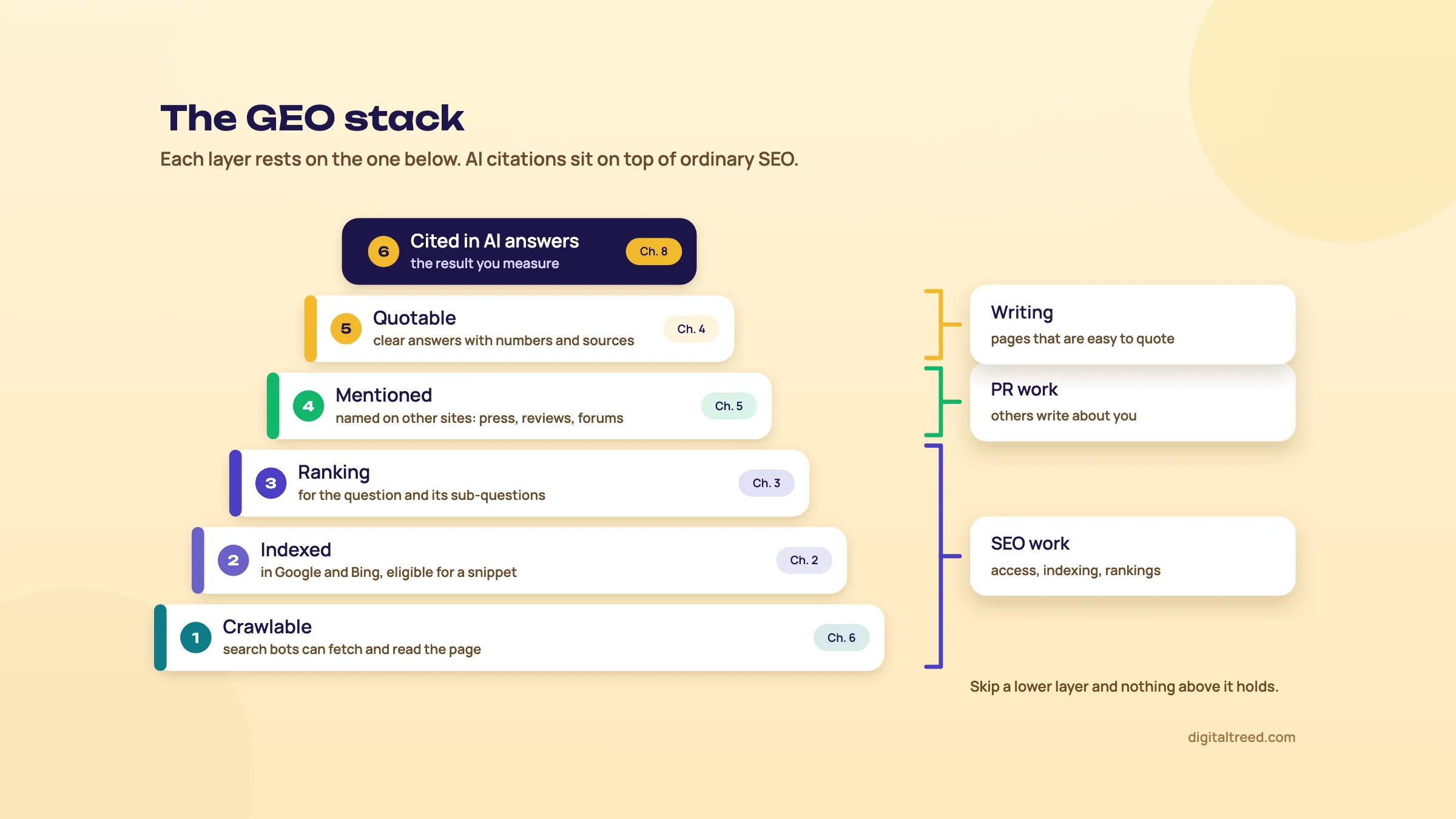 Each layer rests on the one below. Skip a lower layer and nothing above it holds.
Your first check
Before any writing or outreach, make sure AI search bots can read your site at all. A robots.txt rule or a firewall setting can quietly block them. Chapter 6 covers the details; the quick test takes a minute.
Then fix the SEO base, because everything in this guide sits on it. If you haven't read them, Guide 1 chapter 5 explains AI answer engines for beginners, and Guide 3 chapter 8 covers AI search for technical SEOs.
Next, chapter 2 looks at how each AI answer engine actually finds the pages it cites.
How AI answer engines find and cite sources
Quick answer
Each AI answer engine searches an index, pulls passages and writes an answer with a few citations. Google AI Overviews, AI Mode and Gemini use Google's index; Copilot uses Bing's; ChatGPT search uses third-party search providers and partners; Perplexity runs its own crawler plus live fetches. Each engine has favourite sources, and the mix shifts month to month.
If you know where an engine gets its pages, you know which door to knock on. A site that's invisible in Bing will struggle in Copilot. A site that blocks OAI-SearchBot won't be shown in ChatGPT search answers, except as a plain navigational link. This chapter goes engine by engine, with dated numbers, and ends with why you shouldn't treat any of those numbers as fixed.
The common pattern: retrieve, ground, write, cite
Almost every AI answer engine works the same basic way. It doesn't answer from memory alone. It searches, reads what it found, and writes an answer based on those pages. Google's 2026 guide calls this retrieval-augmented generation, "also known as grounding", and says its version relies on "our core Search ranking systems to retrieve relevant, up-to-date web pages from our Search index".[13]
The second idea is query fan-out: the model turns one question into "a set of concurrent, related queries" to fetch more results.[13] Someone asks AI Mode "best coaching for NEET in Kanpur". Behind the scenes it might also search for fees, batch timings, results, reviews and distance from a locality. The answer then pulls passages from pages that rank for those sub-searches, as well as for the main one.
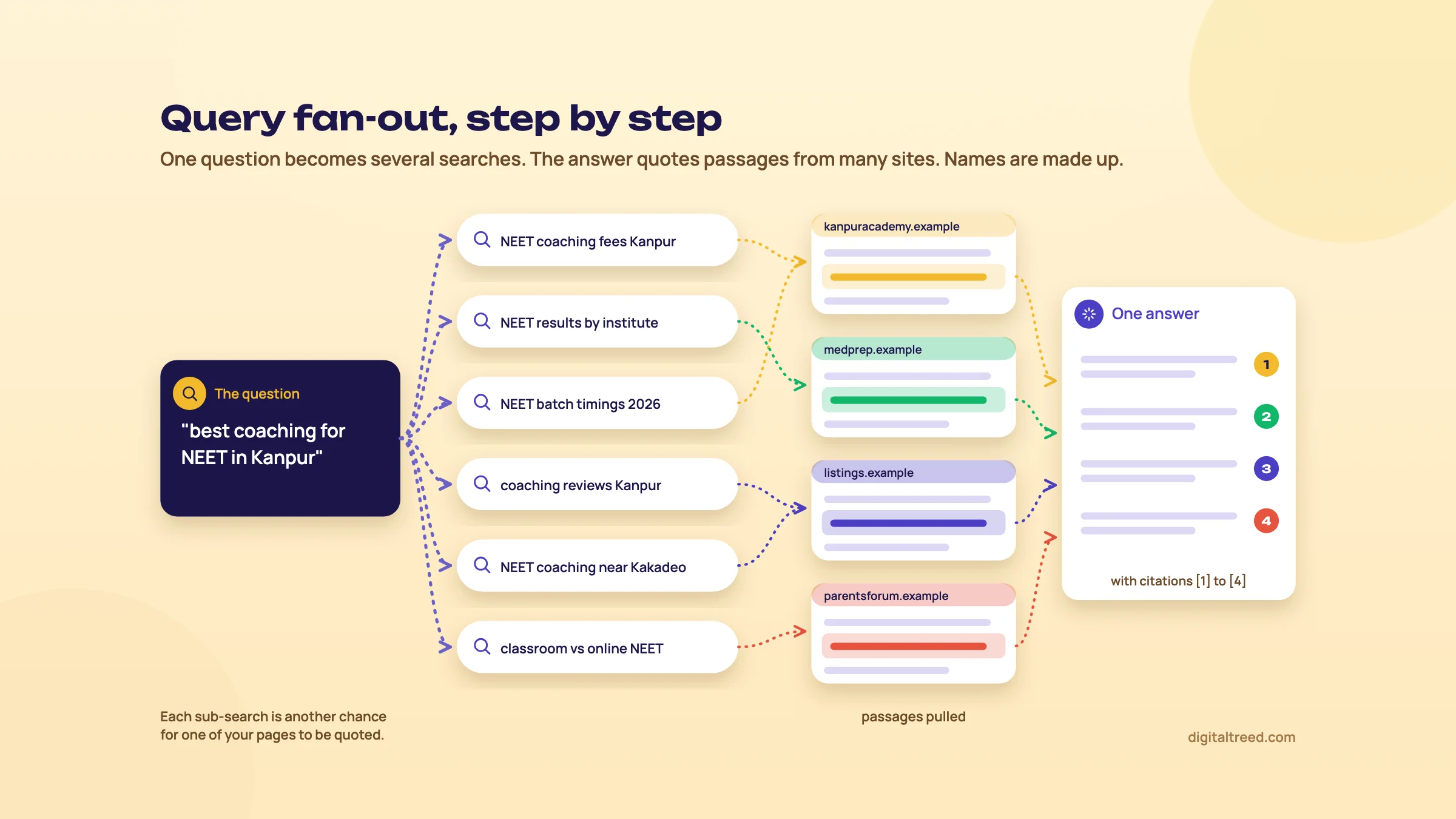 One question becomes several searches, and each is another chance to be quoted. Site names are made up.
Mike King of iPullRank explains it with a raffle. Every relevant passage you have is a ticket; more relevant passages across more sub-questions mean more tickets in the draw.[22]
The query fan-out technique…is the big thing that I think we need to be thinking about in our space.[22]
King built a tool, Qforia, that simulates fan-out queries for a question. It's a simulation, not Google's real list, so use it for ideas.
Which index feeds which answer
This table is the one to keep. Scale figures are the latest we could source, with dates.
| Engine | Where its pages come from | Bot to allow | Training bot (separate) | Scale |
|---|---|---|---|---|
| Google AI Overviews and AI Mode | Google's index, with query fan-out | Googlebot (snippet controls apply) | Google-Extended does not affect these | AI Mode 1B+ monthly users (July 2026)[8] |
| Gemini app | Grounds on Google Search | Googlebot | Google-Extended (training and Gemini grounding) | 950M monthly users (July 2026) |
| ChatGPT search | Third-party search providers plus partner content | OAI-SearchBot | GPTBot | 900M weekly users (Feb 2026, per OpenAI) |
| Perplexity | Its own crawler plus live fetches | PerplexityBot | None; says PerplexityBot isn't for training | 780M queries in May 2025 (CEO figure)[23] |
| Microsoft Copilot | Bing's index | Bingbot | Not covered in this guide | No official consumer figure |
| Claude | Web search; provider not officially stated | Claude-SearchBot, Claude-User | ClaudeBot | 2.62% of AI referral visits (2026) |
Sources for the table are in each section below. Chapter 6 covers every bot in detail, with robots.txt examples.
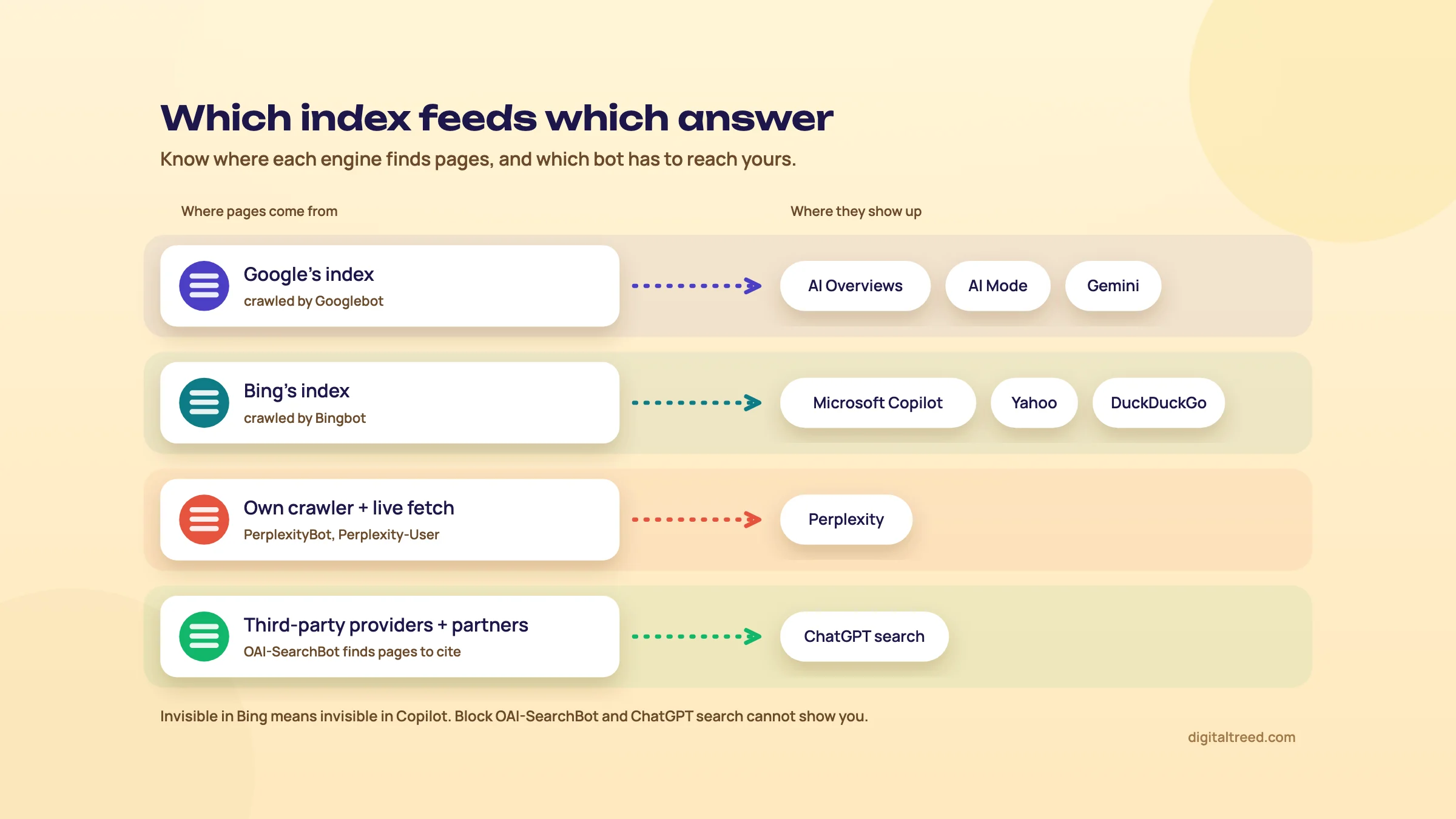 Which index feeds which answer, and which bot has to reach your pages.
Google AI Overviews and AI Mode
Google is the simplest case. Its AI features use Google's index, and a page is eligible if it's indexed and can show with a snippet. Nothing else is required.[14] Google says both features may use query fan-out, so they can show "a wider and more diverse set of helpful links" than classic results.
Pew Research Center's study of real browsing (900 US adults, March 2025) gives a picture of what the summaries cite:[10]
- 88% of AI summaries cited three or more sources; only 1% cited a single source.
- The median summary was 67 words long.
- Government (.gov) sites were 6% of cited sources, against 2% in standard results.
- Wikipedia, YouTube and Reddit together were 15% of AI summary sources (17% of standard results).
Longer queries trigger summaries far more often. That matters, because buyers' questions are usually long.
AI Mode reaches further beyond the normal results. Moz reported on 18 February 2026 that 88% of AI Mode citations were not in the organic results for the same query, across nearly 40,000 US and UK queries.[24] It's one vendor's data (Moz sells AI tracking), but the direction fits what Google says about fan-out.
Google keeps adding ways for sites to show up inside AI answers. Preferred sources (where users pick sites they like) were extended to AI Mode and AI Overviews on 27 May 2026.[25] On 15 October 2026 Google announced more and higher inline links in AI answers and a test of an "official websites" section.[26]
ChatGPT search
OpenAI launched ChatGPT search on 31 October 2024 and opened it to everyone, logged in or not, on 5 February 2025.[5] It draws on third-party search providers and content from partners.[27] OpenAI hasn't published a full list of providers.
The bot that matters is OAI-SearchBot. OpenAI's own page says: "Sites that are opted out of OAI-SearchBot will not be shown in ChatGPT search answers, though can still appear as navigational links."[28] GPTBot, the training crawler, is a different bot, and blocking it doesn't block search. Chapter 6 has every OpenAI bot in its table.
What does ChatGPT cite? Profound analysed about 680 million citations from August 2024 to June 2025 (it sells AI tracking, so it's a vendor study). For ChatGPT, Wikipedia was far ahead at 7.8% of all citations, then Reddit 1.8%, Forbes 1.1% and G2 1.1%.[29] Ahrefs found ChatGPT cited the newest pages of the engines it compared.[30]
ChatGPT is also where most AI referral visits come from: about three in four in SE Ranking's 2026 data (chart in chapter 8).[11]
Perplexity
Perplexity runs its own crawler. PerplexityBot "is designed to surface and link websites in search results on Perplexity", and Perplexity says it isn't used to crawl content for AI foundation models.[31] Its user fetcher, Perplexity-User, is covered in chapter 6.
In Profound's data, Perplexity leaned hard on Reddit (6.6% of all citations), then YouTube 2.0%, Gartner 1.0% and Yelp 0.8%.[29] Its CEO said in June 2025 that Perplexity had handled 780 million queries in May;[23] later "billion a month" figures are third-party estimates.[32]
Perplexity also behaved differently in Lily Ray's small study of sites that lost Google traffic in early 2026: it was the one engine where most of them gained citations (chapter 3).[33]
Gemini
The Gemini app grounds its answers on Google Search, so normal Google SEO applies. The one control to understand is Google-Extended, a robots.txt token that controls Gemini training and grounding in Gemini apps and Vertex AI. It doesn't remove you from AI Overviews or AI Mode (chapter 6).[34]
Gemini had 950 million monthly active users in July 2026, according to Pichai's earnings remarks.[8] One vendor report (Tinuiti with Profound) found AI Overviews cite social media more than four times as often as Gemini does.[35] So even two Google products, on the same index, pick differently.
Microsoft Copilot
Copilot answers draw on Bing's index. Bing's guidelines, rewritten in February 2026, treat grounding and citations in Copilot as outcomes a page can be eligible for. According to Search Engine Journal's report, they advise stating facts directly, keeping entity names consistent and focusing each URL on one topic.[19] The same report says NOARCHIVE keeps a page out of Copilot responses and grounding results.[19] IndexNow tells Bing when a page changes, so it can recrawl it sooner.[36] Chapter 6 covers NOARCHIVE, NOCACHE and the other directives.
Bing's index reaches beyond Copilot. It powers Yahoo's results and most of DuckDuckGo's links.[37] So if you've never set up Bing Webmaster Tools, do it now. Its AI Performance report, in public preview since 10 February 2026, is the only first-party count of AI citations we've found (chapter 8).[38]
Claude
Anthropic runs three bots: ClaudeBot for training, Claude-SearchBot for search and Claude-User for fetches a person asks for. All three follow robots.txt.[39] The one to allow for Claude's search answers is Claude-SearchBot.
Which search index Claude uses isn't stated on Anthropic's crawler page. In March 2025 Simon Willison found Claude's web search results matched Brave Search exactly for his test query. Anthropic's Trust Center listed Brave Search as a subprocessor from 19 March 2025.[40] Treat that as likely, not confirmed. Claude sent 2.62% of AI referral visits in SE Ranking's 2026 data.[11]
The engines disagree with each other
Chen, Wang, Chen and Koudas compared AI search engines in a September 2025 paper. They found a "systematic and overwhelming bias towards Earned media" (third-party coverage) over brand-owned and social content, unlike Google's more balanced results. The engines also differed a lot from each other in how many domains they cited, how fresh the sources were, and how much the answer changed with the wording of the question.[41] Chapter 5 is about earning that coverage.
Here's how different the favourites are, from the same Profound dataset:
| Rank | ChatGPT | Google AI Overviews | Perplexity |
|---|---|---|---|
| 1 | Wikipedia 7.8% | Reddit 2.2% | Reddit 6.6% |
| 2 | Reddit 1.8% | YouTube 1.9% | YouTube 2.0% |
| 3 | Forbes 1.1% | Quora 1.5% | Gartner 1.0% |
| 4 | G2 1.1% | LinkedIn 1.3% | Yelp 0.8% |
Share of all citations, August 2024 to June 2025; vendor study.[29]
Note
A case from Glenn Gabe. An AI-generated site on "your money or your life" topics, with no author, contact or company details, was invisible in Google. Yet ChatGPT cited it in more than 90,000 prompts in June 2026 and more than 464,000 by 3 August. Bing deindexed the whole site, about 90,000 URLs, on 10 July 2026. Gabe couldn't pin down why ChatGPT kept citing it.[42] Two lessons: a citation is not proof of quality, and a citation you don't deserve can vanish overnight.
Shares move fast
Every percentage in this chapter is a dated snapshot. In Tinuiti's tracking, social media's share of all AI citations rose every month from October 2025 to January 2026, when it topped 9%.[35] AI Overviews moved to Gemini 3 in January 2026, according to Ahrefs, and Ahrefs saw the share of citations from top-10 pages change sharply between its two studies.[43] If someone shows you "the sources ChatGPT trusts" without a date range, ask for one.
Tip
Try it yourself. Ask ChatGPT, Perplexity, Gemini, Copilot and Google AI Mode the same buyer question about your service, for example "best physiotherapy clinic in Pune for back pain". Note which sites each one cites, and the date. You'll see the differences in five minutes, and you've started the prompt log from chapter 8.
What to do with this
Three things follow, and the rest of the guide builds on them:
- Be in both indexes. Google feeds Google's AI features and Gemini; Bing feeds Copilot. Guide 1 chapter 4 compares the engines.
- Let the search bots in: Googlebot, Bingbot, OAI-SearchBot, PerplexityBot and Claude-SearchBot. Check with our tool below, then read chapter 6.
- Rank for the sub-questions as well as the head term. Chapter 3 shows what the research says about ranking and citations.
What the research says works (and what it doesn't)
Quick answer
One lab study, the 2023 GEO paper, found that adding quotations, statistics and cited sources made a page's text appear more in AI answers, while keyword stuffing hurt. A 2025 benchmark found those rewrites mostly don't work, that any gain shrinks when competitors use them too, and that ranking higher in what the AI retrieves matters more. Rank first, then write well.
Most GEO advice you'll read online quotes "up to 40%" from one paper and stops there. This chapter reads that paper properly, puts the main follow-up study next to it, and then looks at what citation data from Ahrefs, Lily Ray, Glenn Gabe and Seer says about ranking, freshness and clicks.
The GEO paper, in plain words
Aggarwal and colleagues built a test bench of about 10,000 queries, called GEO-bench, from nine sources including MS MARCO, Natural Questions, ELI5 and Perplexity's Discover page. About 80% of the queries are informational.[1]
They didn't test a real search engine at first. They built a simple one:
- Take the top 5 Google results for a query.
- Give their full text to GPT-3.5 (gpt-3.5-turbo) and ask it to write an answer with citations, five times per query.
- Rewrite one of the five sources with a method, such as "add statistics".
- Measure how much of the answer comes from that source, weighted towards citations that appear earlier. They call this position-adjusted word count.
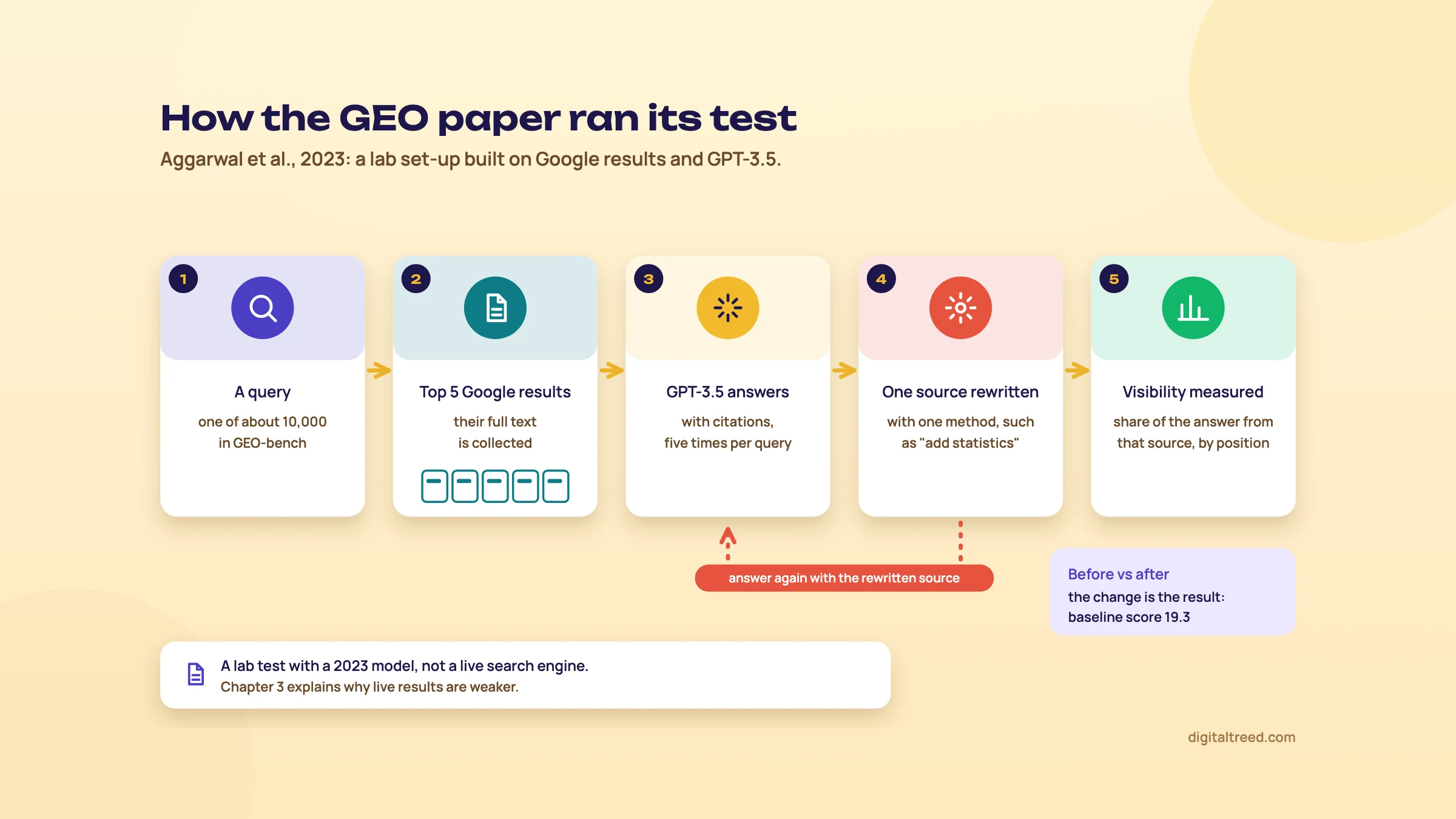 How the GEO paper (Aggarwal et al., 2023) ran its test: a lab set-up, not a live search engine.
What it found
Here are the nine methods, as relative change against the unchanged source. We computed the percentages from the paper's Table 1 (the overall position-adjusted word count, where the baseline score is 19.3).
They also tried the methods on the real Perplexity. Quotations still came first and keyword stuffing last, but the gains were smaller: quotations +20.7%, statistics +8.7%, and keyword stuffing -9.1% (our calculation from the paper's Perplexity table, Table 5).[1]
Three findings matter more than the headline:
- Lower-ranked sources gain most. For the source in fifth place, cite sources gave +115.1%, quotations +99.7% and statistics +97.9%. For the source in first place, the same methods lowered its visibility: -30.3%, -22.9% and -20.6%.
- Combining helps a little. Fluency plus statistics beat any single method by more than 5.5%, tested on a 200-example subset.
- Topic changes what works. Statistics helped most for law and government, debate and opinion queries. Quotations helped most for people and society, explanation and history.
Its limits
This is one lab study. The "engine" was GPT-3.5 reading five sources, and only one source was rewritten at a time while the other four stayed as they were. Real engines retrieve from far more pages, use newer models, and change often. The paper tells you how an LLM quotes text it has already been given. It says nothing about whether your page gets retrieved in the first place.
The 2025 follow-up: C-SEO Bench
Haritz Puerto and colleagues tested exactly that gap. C-SEO Bench was accepted at NeurIPS 2025 (Datasets and Benchmarks).[44] They took ten rewriting methods, eight of them from the GEO paper, and tested them in question answering (web, news, debate) and product recommendation (retail, video games, books). The answering models were gpt-4o-mini, Claude 3.5 Haiku, o3 and o4-mini. Crucially, they also tested what happens when several competing pages use the same tricks.
The authors' summary: most current methods are "largely ineffective", and they often lower the page's ranking. In their full results, only 3 of 54 cases showed a statistically significant gain. Adding statistics lowered rankings in 19 of 24 settings. As more competitors adopted the methods, the gain per adopter shrank towards zero.
What did work? Moving the page higher in the list of documents the model was given. That is their stand-in for traditional SEO, and its effect was much larger than any rewrite. The authors conclude these rewrites should add to SEO, not replace it.
| GEO paper (2023) | C-SEO Bench (2025) | |
|---|---|---|
| Setup | Top 5 Google results, one source rewritten | Six domains, several competitors rewriting at once |
| Model | GPT-3.5; also tried on Perplexity | gpt-4o-mini, Claude 3.5 Haiku, o3, o4-mini |
| Main finding | Quotes, statistics and sources raise visibility 28% to 41%; stuffing lowers it | Most rewrites don't help and often hurt; a higher position in what the model retrieves helps much more |
| Main limit | One player, a lab engine, an old model | Still a lab test; "SEO" simulated by moving a document up the list |
Read together, they say: how you write changes how much of your page gets quoted once it's retrieved. Being retrieved at all is the bigger lever. That's ranking.
Do you need to rank? The citation data
Ahrefs studied 863,000 keyword results and about 4 million AI Overview URLs, published 2 March 2026 (Ahrefs sells an AI tracker, so it's a vendor study).[43]
The July 2025 version found about 76% of citations came from the top 10. The two aren't directly comparable: Ahrefs changed its parser, doubled the dataset, and AI Overviews moved to Gemini 3 in January 2026. Ahrefs' best guess is query fan-out: Google now cites pages that rank for the sub-questions, not for the original search. YouTube stood out: it made up 18.2% of cited pages that didn't rank in the top 100, and those YouTube pages alone were 5.6% of all AI Overview citations.
So "you must be top 10" is out of date, but "ranking doesn't matter" is wrong too. You need to rank somewhere in what the engine retrieves, for the question or its sub-questions. Lily Ray's summary from a May 2026 podcast: "it's almost always ranking number one on Google gets you more citations".[45]
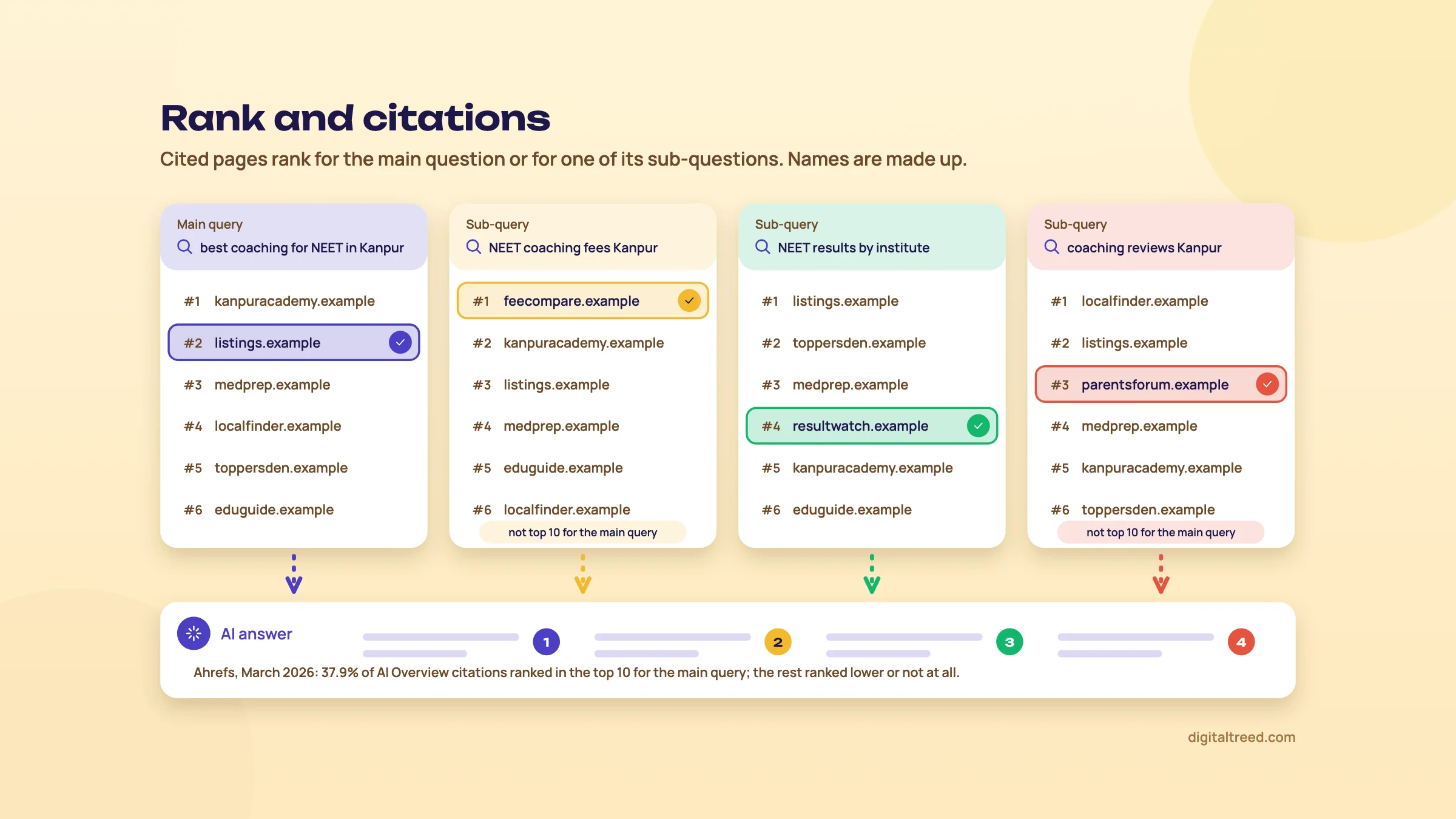 Cited pages rank for the main question or for one of its sub-questions. Names are made up.
Lose Google, lose AI
The strongest real-world evidence runs the other way: when a site drops in Google, its AI citations tend to drop too.
-22.5%
average fall in AI citations for 11 site sections that lost Google traffic, January to February 2026[33]
25.7%
fresher: AI-cited pages averaged 1,064 days old against 1,432 for organic results[30]
+35%
organic CTR for brands cited in an AI Overview (0.70% vs 0.52%), which may be because strong brands get cited more[46]
Lily Ray compared 11 subfolders hit by an unconfirmed Google update in mid-January 2026, using Ahrefs data from 20 January and 16 February. Organic traffic fell between 5.7% and 53.1% (26.7% on average). AI citations fell for all 11, by 22.5% on average, and ChatGPT citations by 27.8%. Perplexity was the exception. It's a small sample, and she says so. Her line: "the fastest way to lose visibility in AI search might be to lose it in Google first."[33]
Glenn Gabe saw the same with NationalToday.com. Its section of more than 850,000 AI-generated local news pages got a scaled content abuse manual action and dropped out of Google's index. Its ChatGPT citations largely disappeared too; he didn't give exact counts.[47]
Drop in Google and you can drop in AI Search.[48]
Freshness
Ahrefs looked at about 17 million citations across ChatGPT, Perplexity, Gemini, Copilot, AI Overviews and organic results (July 2025). AI-cited URLs averaged 1,064 days old, against 1,432 days for organic results: 25.7% fresher. ChatGPT cited the newest pages; AI Overviews and organic results the oldest.[30] That's a correlation from a vendor, not proof that updating gets you cited.
Real updates are worth doing anyway. Fake ones aren't: Google's helpful content guidance says not to change a page's date to look fresh when the content hasn't substantially changed.[49] Guide 2 chapter 6 covers refreshing content properly.
Being cited and clicks
Seer Interactive measured 3,119 informational queries across 42 client organisations (published November 2025). When a brand was cited in the AI Overview, its organic CTR was 0.70%, against 0.52% when it wasn't cited.[46] Seer itself warns that strong brands may simply get cited more, so the citation may not cause the clicks.
And many AI sessions never leave the answer. In Kevin Indig's AI Mode usability study of 37 US participants, 77.6% of sessions had no external visit.[50] Small sample, US only, but it fits Pew's 1% click rate on links inside AI summaries from chapter 1.
Warning
Correlation, not cause. Almost every GEO number you'll see, including several in this chapter, comes from a vendor that sells AI tracking and compares groups rather than running an experiment. They are useful for direction. They are not proof that a tactic causes citations.
How to read a GEO study in 60 seconds
Run through this before you quote any GEO number, including the ones in this guide:
Tip
- Who paid for it? A vendor study can be honest, but say it's a vendor.
- What was the sample: how many queries, sites or people, and in which country?
- When was the data collected? AI engines change models every few months.
- Which engine, and which surface (AI Overviews, AI Mode, ChatGPT, Perplexity)?
- Was it an experiment or a correlation?
- What exactly was measured: citations, mentions, clicks, or share of answer words?
- Can you find the original, not a blog post quoting it?
What to do with this
Fix the SEO base first, then check whether your key pages rank for the main question and the questions around it. Search Console's Performance report shows the queries you already appear for, free. For questions you don't appear for yet, a paid tool such as Ahrefs or Semrush shows who ranks. Chapter 4 shows how to list the sub-questions.
One tactic lowered a page's share of the answer both in the lab and on Perplexity: keyword stuffing. If you're unsure whether a page overdoes it, check it. Density is a warning light, not a target.
Chapter 4 turns the useful half of the GEO paper (quotes, numbers, sources, clear writing) into a way of writing pages for people that also happens to suit AI answers. Guide 2 chapter 1 covers keyword research, and Guide 3 chapter 10 covers spam and updates.
Writing for citation: passages, numbers, quotes and sources
Quick answer
Write so any section can be lifted out and still make sense: a heading that names the question, a direct answer in the first two sentences, then the detail. Add real numbers with their source and date, short quotes from named people, and links to primary sources. Don't stuff keywords, and don't chop pages up for bots.
Chapter 3 showed that being retrieved matters more than any rewrite. This chapter is about what happens once you are retrieved: whether the engine can find a clean, quotable answer on your page, and whether that answer is worth trusting. The good news is that everything here also makes the page better for the person reading it. Use that as the test: if a change only makes sense for a bot, don't make it.
Why passages, and where Google disagrees
AI answers quote passages, not whole pages. Aleyda Solis built her AI search checklist on this idea: AI systems retrieve chunks of a page, so each passage should make sense on its own.[51] Mike King gives similar advice: clear sections with descriptive headings, and specific statements written as plain subject-predicate-object facts, which he calls semantic triples.[22]
Google, though, lists "chunking" content among the things you can ignore, together with rewriting content just for AI systems.[13] These two positions fit together better than they look. Google is warning against cutting one good page into many thin ones, or splitting text into fragments for machines. Solis and King are describing well-organised writing. Do the second and avoid the first: one strong page per topic, with clear self-contained sections, because people scan too. In Nielsen Norman Group's study, 79% of users scanned a new page and only 16% read word by word.[52]
The answer-first section
Every chapter of our guides opens the same way: a question, a 40 to 60 word answer, then the detail. Use that pattern for each important section of a page:
- A heading that names the question in the reader's words ("How much does a root canal cost in Delhi?").
- The direct answer in the first one or two sentences.
- The detail: conditions, exceptions, numbers, examples.
- A link to the source or to the next step.
Why 40 to 60 words? Pew found the median Google AI summary was 67 words long (March 2025).[10] That's our inference, not a rule anyone has published: a short, complete answer is easy to quote inside an answer of that size, and a reader can use it too.
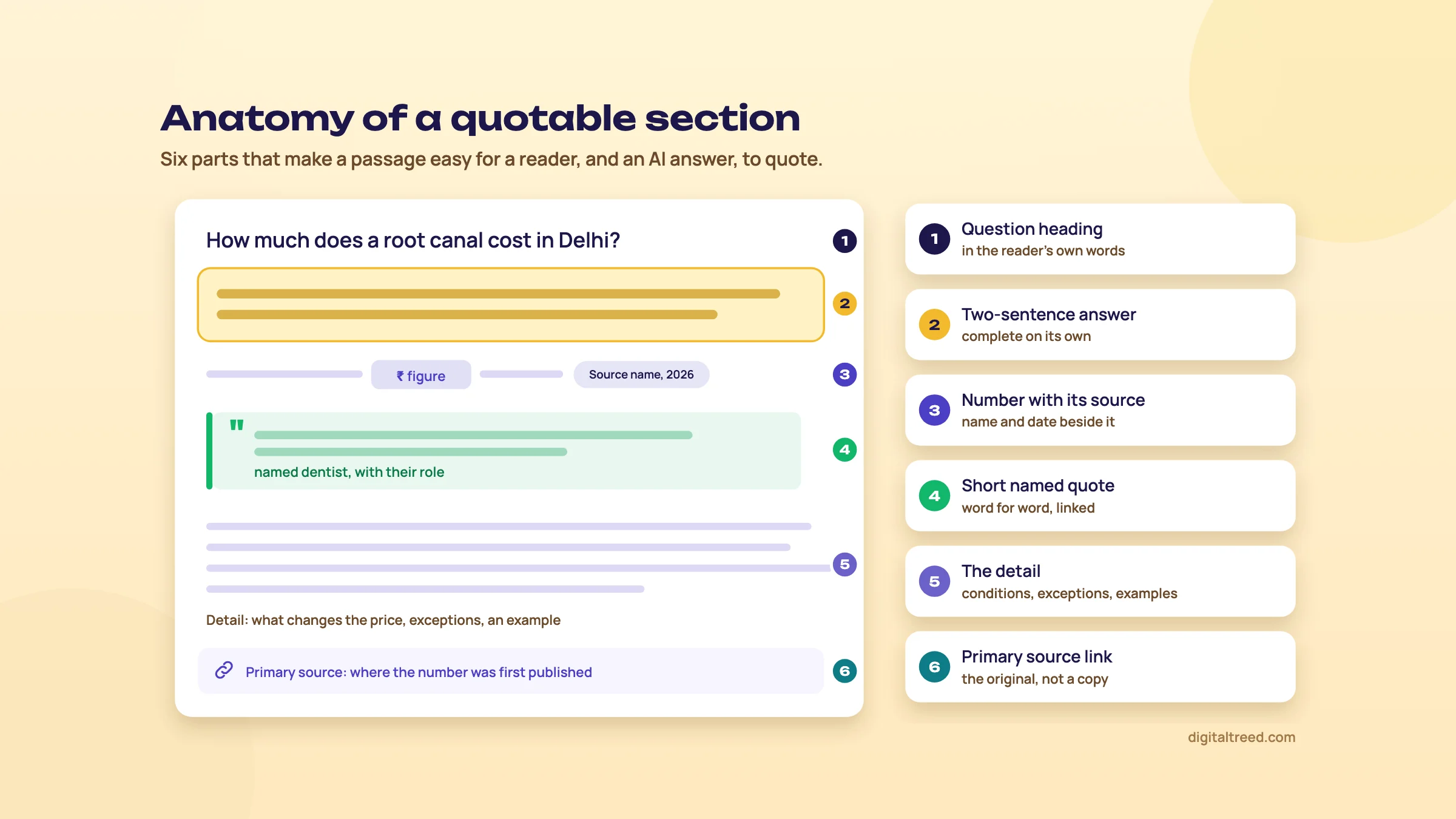 Six parts that make a passage easy for a reader, and an AI answer, to quote.
Numbers, quotes and sources
In the GEO paper, adding quotations, statistics and cited sources raised a source's share of the answer by 27.5% to 40.9% in the lab, mostly for sources ranked lower down.[1] Chapter 3 explained why that result is weaker in competitive tests. Do it anyway, for a simpler reason: a number with a source is checkable, and a page people can check is a page they trust.
Our rules, the same ones this guide follows:
- Every number has a source, a sample and a date. "AI summaries cite three or more sources 88% of the time (Pew, 900 US adults, March 2025)" beats "most AI answers cite several sources".
- Quotes are word for word, from a named person, with a link. If you can't find the exact words, paraphrase without quote marks.
- Link to the primary source, not a blog that quoted it.
- Say what the number doesn't cover. US data is US data.
Here's a section from a made-up agency page, before and after:
Do not
- Before: "AI is changing search fast. Experts agree AI answers reduce clicks, so businesses must adapt their strategy to stay ahead of the competition."
Do
- After: "Do AI Overviews reduce clicks? Yes, in the data we have. In Pew Research Center's study of 900 US adults (March 2025), people clicked a normal search result in 8% of visits when an AI summary appeared, against 15% without one. Google's own advice is that optimising for AI features is still SEO."
The second version answers the heading's question in its first word, gives one sourced number with its sample and date, and points to Google's own words. Any AI engine, or any reader, can lift it out and use it.
Non-commodity content
Google's 2026 guide asks for "non-commodity" content. Its example contrasts "7 Tips for First-Time Homebuyers", which anyone could write, with a homeowner's first-hand account of inspecting a sewer line.[13] John Mueller said it a year earlier:
Focus on making unique, non-commodity content that visitors from Search and your own readers will find helpful and satisfying.[53]
For an Indian business, non-commodity means the things only you have. A coaching institute's own pass rates by year. A clinic's real price range for a procedure. A D2C brand's photos of how a product is made. A SaaS company's numbers from its own users. An AI engine can find "10 tips for NEET preparation" on a thousand pages. It can find your institute's last three years of results only on yours.
Cover the sub-questions, on one page
Query fan-out means AI answers pull from pages that rank for the questions around the main one (chapter 2). Solis's advice is to cover every side of a topic in depth.[51]
The trap is making a page for every variation. Google is direct about it: creating separate content for every way people might search, mainly to manipulate rankings or generative AI responses, violates its scaled content abuse policy.[13] So the rule is one strong page per intent, with a section for each sub-question. "Root canal cost in Delhi" gets one page, with sections on what changes the price, insurance, the number of visits and aftercare. Not five pages.
To list the sub-questions, look at Google's "People also ask" boxes, your Search Console queries, and the questions customers ask on calls. AnswerThePublic gives about three free searches a day.[54] Our free Question Finder collects them from autocomplete, merges the ones you copy from the box, and exports the heading list.
Tables, images and video
Make comparisons real HTML tables, not images of tables, so any system can read them. Give images descriptive alt text and captions.[51] Google's May 2025 advice for AI search also says to go beyond text, with images and video, and to keep Merchant Center and Business Profile up to date.[53]
Video deserves a mention of its own. In Ahrefs' March 2026 study, YouTube pages that didn't even rank in the top 100 for the query made up 5.6% of all AI Overview citations.[43] If your competitors only write, a short video that answers the same question is an opening.
Authorship and dates
Google's helpful content page asks you to make clear who created the content, how, and why. That means bylines where readers expect them, and an honest note on how it was made, including AI use where readers would wonder.[49] Solis's checklist describes citation-worthy content as accurate, current, verifiable, sourced and clearly authored.[51]
In practice: a byline linked to a real author page, a reviewer for medical, legal or financial topics, and a "last updated" date that changes only when the content does. Guide 2 chapter 5 covers E-E-A-T in more depth.
What not to do
Do not
- Repeat the keyword to "help the AI". Stuffing lowered visibility by 8.3% in the GEO paper and 9.1% on Perplexity, and it breaks Google's spam policies.[1]
- Add hidden text or "instructions for AI" that people can't see. Google's spam policies now cover attempts to manipulate generative AI responses.[15]
- Publish hundreds of AI pages for every question variant.
- Change the date without changing the content.
- Split one good guide into many thin pages.
Do
- Answer the question in the first two sentences under a clear heading.
- Add your own numbers, photos, prices and cases.
- Give every number a source, sample and date; link the original.
- Quote named people word for word.
- Use HTML tables, alt text and captions.
- Show who wrote it and when it really changed.
The mass-AI-pages warning has numbers behind it. Lily Ray tracked more than 220 sites publicly named as customers of AI content platforms, using Ahrefs and Sistrix estimates up to May 2026. 54% had lost 30% or more of their peak organic traffic, and 22% had lost 75% or more. Her summary: "it works, until it doesn't."[55] It's a correlation, not a proven cause. The typical shape she saw was fast growth for six to twelve months, a peak, then a drop that erased most of the gains, often to below where the site started.
Evidence vs hype: our verdict on common tactics
| Tactic | Evidence | Our verdict |
|---|---|---|
| Be crawlable, indexed, snippet-eligible | Google: the only requirement for AI Overviews and AI Mode | Required |
| Rank for the question and its sub-questions | Ahrefs citation data; C-SEO Bench | Strong |
| Earn mentions on other trusted sites | Ahrefs brand study; Chen et al. (chapter 5) | Strong, but correlational |
| Add sourced statistics, quotes and citations | GEO paper lab gains; weak in C-SEO Bench | Moderate; do it because it helps readers |
| Answer-first, clear sections | GEO paper (fluency); Google's helpful content advice | Moderate, low risk |
| Real content updates | Ahrefs freshness correlation | Moderate; fake date bumps are against Google's advice |
| Structured data | Google: no special schema needed; must match the page | Hygiene, not a lever |
| llms.txt | Google Search ignores it (chapter 7) | Not a citation lever |
| Keyword stuffing | -8.3% in the lab and -9.1% on Perplexity (GEO paper) | Harmful |
| Hidden AI-only text, mass variant pages | Google spam policies | Avoid |
If you use AI to help write
Plenty of teams draft with ChatGPT or Gemini. That's allowed. Google's guidance, last updated on 1 October 2026, is plain about checking the output:
Warning
Google's generative AI content guidance: "It is critical to manually factcheck and review all AI-generated content for accuracy and trustworthiness before publishing." It says the review also covers titles, meta descriptions, structured data and image alt text.[56]
Our rule is simple. AI can help with outlines and first drafts. It never supplies a number, a quote or a date; those come from the source, checked by a person. Tools such as Surfer, Clearscope and Frase are fine for building a brief. Don't write to hit their score.
Rewrite one page for citation
- Pick the page Choose a page that already ranks on page 1 or 2 for a buyer question. In Search Console, open Performance, then Search results, then the Pages tab.
- List its questions Note the queries it shows for, plus "People also ask" questions for its main topic. Keep the five most useful.
- Write one answer-first section per question A heading in the reader's words, a one or two sentence answer, then detail. Merge or delete text that answers nothing. Paste the page into our free Readability Checker: it marks the sections that bury the answer and the sentences too long to quote.
- Add one sourced number and one named quote From your own data if you have it, otherwise from a primary source, with the sample and date.
- Link the primary sources The original study or official page, not a blog that quoted it.
- Fix tables, images and the byline HTML tables, alt text, captions, author, and a real "last updated" date.
- Fact-check by hand Every number, quote, title, meta description and schema field, especially anything an AI tool drafted.
- Re-test later After a few weeks, ask the same questions in two AI engines and note whether you're cited. Add a Search Console annotation on the day you publish: right-click the Performance chart and choose "Add annotation".
Check the result with our tools: keyword density as a warning light, schema that matches the visible page, and titles and descriptions that still say what the page does.
Guide 2 chapter 4 covers content briefs. If you'd like us to rewrite your key pages this way, our content marketing service does exactly that. Next, chapter 5 moves off your site: what other sites say about you.
Entities and brand mentions: being talked about where AI looks
Quick answer
AI answers lean on what other trusted sites say about you, as well as on your own pages. Brands mentioned widely across the web show up more in AI Overviews, and AI engines favour earned media. So keep your facts consistent everywhere, earn real coverage, and take part honestly where your buyers talk: forums, video, reviews and trade press.
Chapters 3 and 4 were about your own pages. This one is about everyone else's. When an AI engine recommends "the best physiotherapy clinics in Pune" or "a good invoicing tool for small businesses", it's summarising what the web says. If the web says little about you, there's little to summarise.
What correlates with AI visibility
The most-quoted study here is from Ahrefs. Louise Linehan looked at 75,000 brands (sites with Domain Rating above 40) and measured which factors went together with being mentioned in Google's AI Overviews. Published May 2025, it's a vendor study, and it measures correlation (Spearman), not cause.[57]
Branded web mentions, meaning your brand named on other sites with or without a link, correlated far more strongly than backlinks did. About 26% of the brands had no AI Overview mentions at all. Ahrefs' own summary is that AI visibility depends on how widely your brand appears across the web, not just on your website.
Correlation can mislead in both directions here. Big brands get mentioned more and get cited more, and both may come from being big. Still, it points the same way as the academic work below.
Earned media bias
Chen and colleagues' September 2025 paper compared AI search engines with Google. They found the AI engines had a "systematic and overwhelming bias towards Earned media": third-party coverage such as reviews, press and independent sites, over a brand's own pages and its social posts. Google's results were more balanced. They also warn of a "big brand bias" that puts niche players at a disadvantage.[41]
For a small Indian brand, that's both the problem and the plan. You won't out-shout the big names on your own blog. You can get written about in the places that cover your niche.
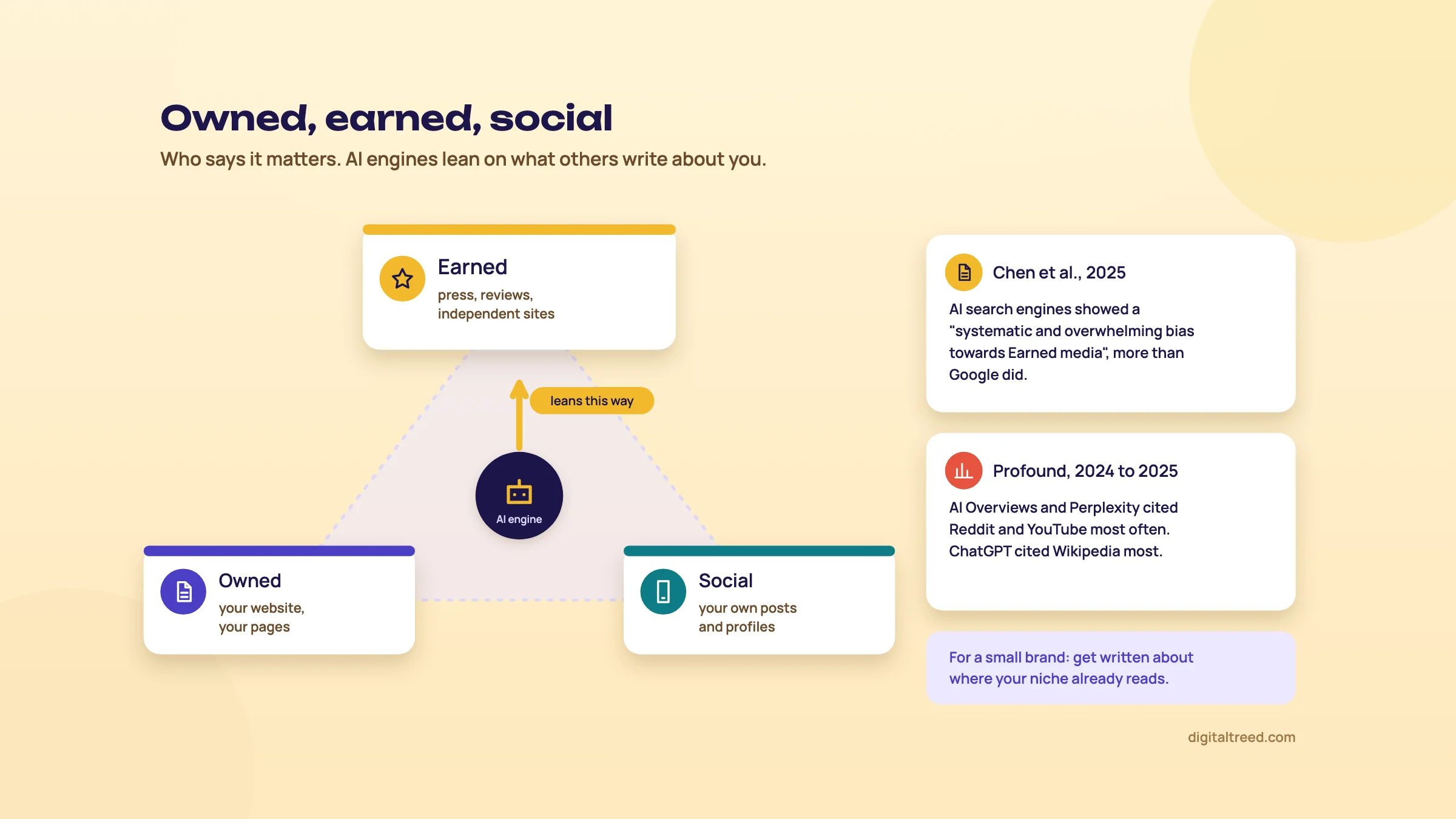 AI engines lean on what others write about you (Chen et al., 2025; Profound).
Where AI looks
Each engine has favourite third-party sources (chapter 2 has the full table). In Profound's data from August 2024 to June 2025, ChatGPT cited Wikipedia most; AI Overviews and Perplexity cited Reddit and YouTube most.[29] Pew found Wikipedia, YouTube and Reddit together made up 15% of the sources in Google's AI summaries (US, March 2025).[10] A Tinuiti and Profound report put social media at about 9% of all AI citations in January 2026.[35]
We looked for India-specific data on which sites AI engines cite for Indian queries, or on AI referral traffic in India. We didn't find any published study. So the platforms above are a starting point to test with your own prompts, not a rule for Indian buyers.
Entities: one set of facts everywhere
An entity is a thing a search engine can identify: your business, its founder, its products, its address. Google's Knowledge Graph stores entities, and knowledge panels, the boxes that appear for some brands and people, are generated automatically from information across the web.[58] If you're the official representative of an entity that has a panel, you can claim it and suggest changes. The help page doesn't describe any way to request one.
What you control is consistency. Your name, address, phone, founders, services and prices should match on your site, Google Business Profile, directories, marketplaces and social profiles. Organization and Profile page markup are among the structured data types Google supports, so mark up your About and author pages, and make sure the markup matches what the page shows.[59] Guide 3 chapter 7 goes deeper on entity SEO.
Jono Alderson made the point well when writing about AI agents that check prices and policies on your behalf:
Making three contradictory prices machine-readable gives the agent a better-documented problem.[60]
A coaching centre with one fee on its website, another on Justdial and a third in a Facebook post has that problem. Fix the facts before you add markup.
Note
A case from Marie Haynes. She described four sites that did well in Google's December 2025 core update. One, a store in a sensitive (YMYL) category, worked on its navigation, checkout, About page and PR, and gained a knowledge panel. She gave no traffic figures.[61] It's one case, but it shows the kind of work that helps: a clearer identity on your own site, plus other sites talking about you.
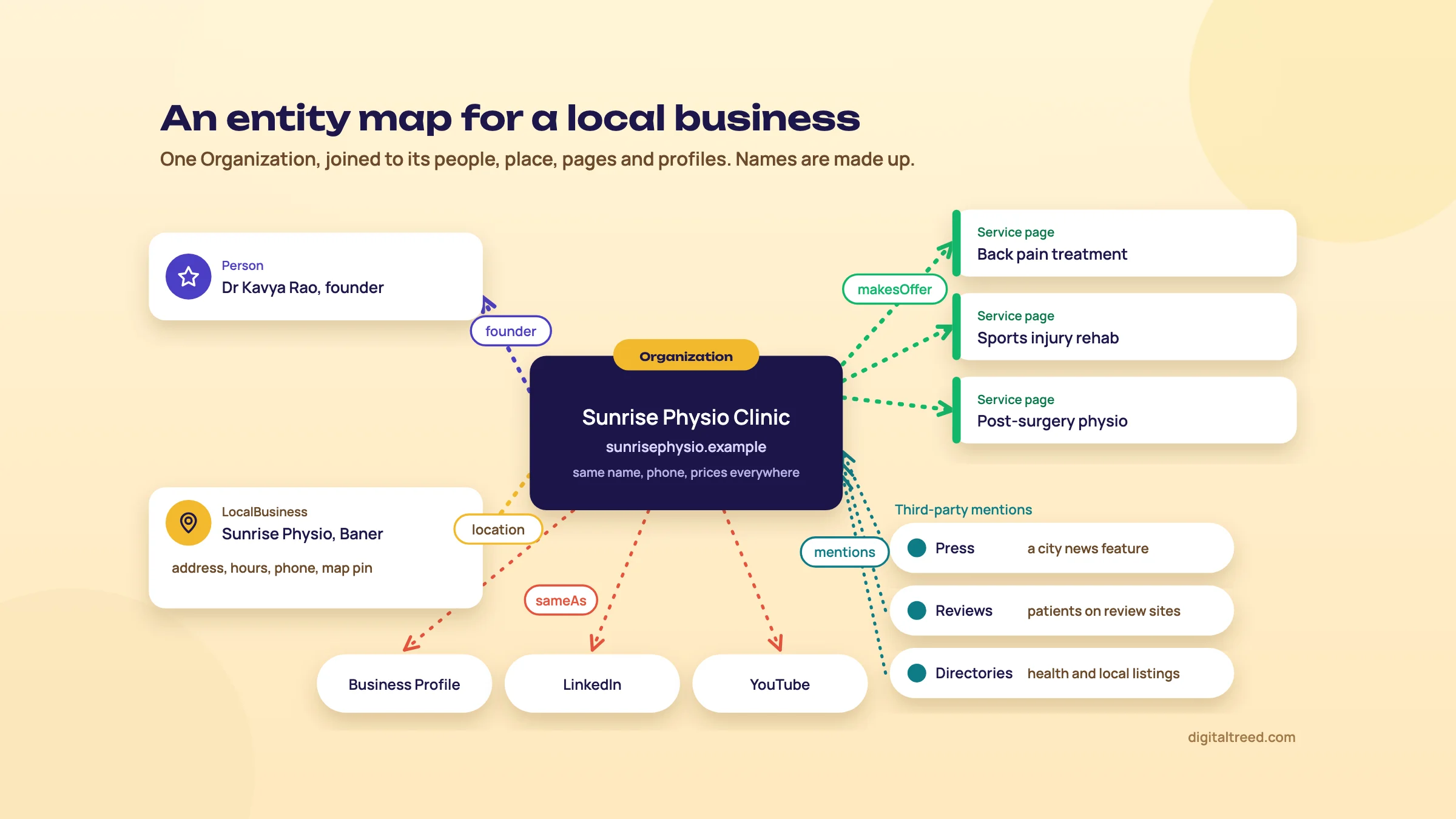 One Organization, joined to its people, place, pages and profiles. Names are made up.
Earning mentions that count
Mentions that count are ones a journalist, reviewer or community member chose to write. A few ways to earn them:
- Publish your own data. A survey of your customers, prices you track, results from your own work. Data gives writers a reason to name you. Guide 2 chapter 9 covers digital PR.
- Trade press and local news. An expert comment, a case, a useful number. Indian-language news sites count too: Techmagnate, by its own account, used PR on Hindi news sites as part of a vernacular SEO campaign for Bajaj Finserv.[62]
- Reviews. Ask real customers, on the platforms your buyers read.
- The same message in several places. Mike King points out that the passages AI answers use can come from other sites as well as yours: LinkedIn, Reddit, YouTube, review sites, news and trade sites.[22] Keep your key facts the same on all of them.
Kevin Indig and Amanda Johnson suggest giving off-site distribution and community time their own budget line, with a named owner, and spending about 5% of the marketing budget on community (10% in some cases).[63] That's their suggestion for planning, not a measured benchmark, but it's a useful way to stop mentions being nobody's job.
Note
From our work: a sports platform. A global sports platform and networking community already had its technical SEO in good shape. Its posts linked to no outside sources at all, so nothing in them showed where its facts came from, and its earlier link building had been spammy. We added sports statistics, with their sources, to the posts. Collaboration requests started coming in, and they brought links from inside other sites' articles and mentions of the brand by name. Traffic rose 60%.
That story is about links, mentions and traffic, not AI citations. The point is the mechanism: give people something worth citing, and mentions can follow.
Communities without spam
Reddit, Quora, YouTube comments, Facebook groups and LinkedIn are where buyers ask each other for recommendations, and where AI engines often look. Take part as a named person who works for the business, say so, and answer the question asked. Don't drop links into every thread.
This is where GEO most often turns into spam. Google lists "seeking inauthentic mentions" as something to ignore for its AI features,[13] and its spam policies cover both user-generated spam and attempts to manipulate generative AI responses.[15]
The platforms have their own rules. Wikipedia requires anyone paid to edit to disclose their employer, client and affiliation. It strongly discourages paid editors from editing affected articles directly; they should propose changes on the article's talk page instead.[64] Reddit's own rules ask you to "participate authentically in communities where you have a personal interest" and not to spam,[65] and every community (subreddit) adds its own rules on self-promotion, so read them before you post. Many ban it outright.
Do not
- Buy "AI mentions" or placements in "best X" lists.
- Post fake reviews or ask staff to review you.
- Run anonymous accounts that praise your brand.
- Edit your own Wikipedia page without disclosure.
- Publish dozens of "best X" listicles that rank yourself first.
Do
- Earn coverage with data, cases and expert comments.
- Ask real customers for reviews.
- Answer questions in communities as a named, disclosed person.
- Keep your facts identical across every profile.
- Pitch trade press and local news with something new.
What stopped working
For a while, a popular GEO trick was publishing self-promotional "best X" listicles that ranked your own product first, on your site and others. Lily Ray says these worked for a time and are now treated as spam and risky.[45] In her tracking, at least 40 sites with many self-promotional listicles fell 40% to 95% between January and April 2026.[55]
Warning
Google's spam policies now include "attempting to manipulate generative AI responses in Google Search" (May 2026).[15] A tactic built only to get an AI engine to name you is the kind of thing that policy is written for.
Local businesses
For clinics, salons, coaching centres and shops, the most important third-party profile is your Google Business Profile. Google's May 2025 advice for AI search includes keeping Business Profile and Merchant Center information up to date.[53] Guide 2 chapter 10 covers local SEO step by step.
Use of AI for local choices is growing fast, at least in the US. BrightLocal's 2026 survey of 1,002 US adults found 45% had used ChatGPT or another AI tool for local business recommendations, up from 6% in 2025.[66] That's a vendor survey of US consumers. We found no Indian equivalent.
Where to be mentioned, by business type
| Business | Where to be mentioned | What to do | What not to do |
|---|---|---|---|
| Local service (clinic, coaching centre) | Google Business Profile, Justdial or Practo-type directories, local news, YouTube | Same facts everywhere; real reviews; answer local questions on video | Fake reviews; different fees on different sites |
| B2B SaaS | G2-type review sites, LinkedIn, trade press, Reddit communities | Customer reviews; data reports; founder posts under their own name | Paid "best tool" lists ranking yourself first |
| E-commerce or D2C | Merchant Center, marketplaces, YouTube reviews, niche blogs | Product data synced; send products to real reviewers | Undisclosed paid reviews |
| Publisher or blog | Other publishers, Wikipedia (as a cited source), newsletters | Original data others cite; clear authorship | Editing Wikipedia to add your own links |
These are our suggestions from the citation data above; test them with your own prompts.
Brand is the long game
Rand Fishkin has argued that the main shift is zero-click search, with AI as a secondary part of it. His answer is short:
Brand is the solution.[67]
Seer's CTR data in chapter 3 points the same way, with the same caveat that strong brands may simply be cited more.[46] Either way, the brands people already know and talk about are the ones AI engines name.
Tools for this chapter
Check that your Organization or LocalBusiness markup matches the page, and that your Open Graph tags show the same name and description when people share your links.
We don't have a backlink or mention checker yet. Meanwhile, Search Console's Links report shows who links to you, its branded queries filter shows whether people search for your name more over time, and Ahrefs Free shows backlinks to your own verified sites. For mention tracking at scale, Ahrefs Brand Radar AI starts at $199 a month (price seen 16 October 2026).[68]
Chapter 8 shows how to measure whether any of this changes your AI visibility. If you want help earning coverage, that's part of our content marketing service.
Technical access: AI crawlers, robots.txt and rendering
Quick answer
AI companies run separate bots for training, for search and for fetching a page a user asked about. Blocking training bots (GPTBot, ClaudeBot, Google-Extended, CCBot) keeps your content out of model training but not out of AI search answers, with one catch: Google-Extended also covers answers in the Gemini app. Blocking search bots (OAI-SearchBot, PerplexityBot, Claude-SearchBot, Googlebot, Bingbot) does remove you. Decide per purpose.
Everything in chapters 2 to 5 assumes one thing: the engine can actually read your page. This chapter makes sure it can. It's the full version of the short crawler section in Guide 3, chapter 8, and it's the one technical job in GEO where a single wrong line can switch you off.
Three kinds of AI bot
Most people talk about "AI crawlers" as one thing. They're not. Each company runs bots with different jobs, and the job decides what happens when you block one.
- Training crawlers collect pages that may be used to train future models. Blocking them is an opt-out from training. It doesn't stop the company's search product from finding you.
- Search crawlers build the index an AI search product looks things up in. Block one and you drop out of that product's answers.
- User fetchers open a single page because a person asked the assistant about it. They don't crawl the web on their own, and some of them don't follow robots.txt at all.
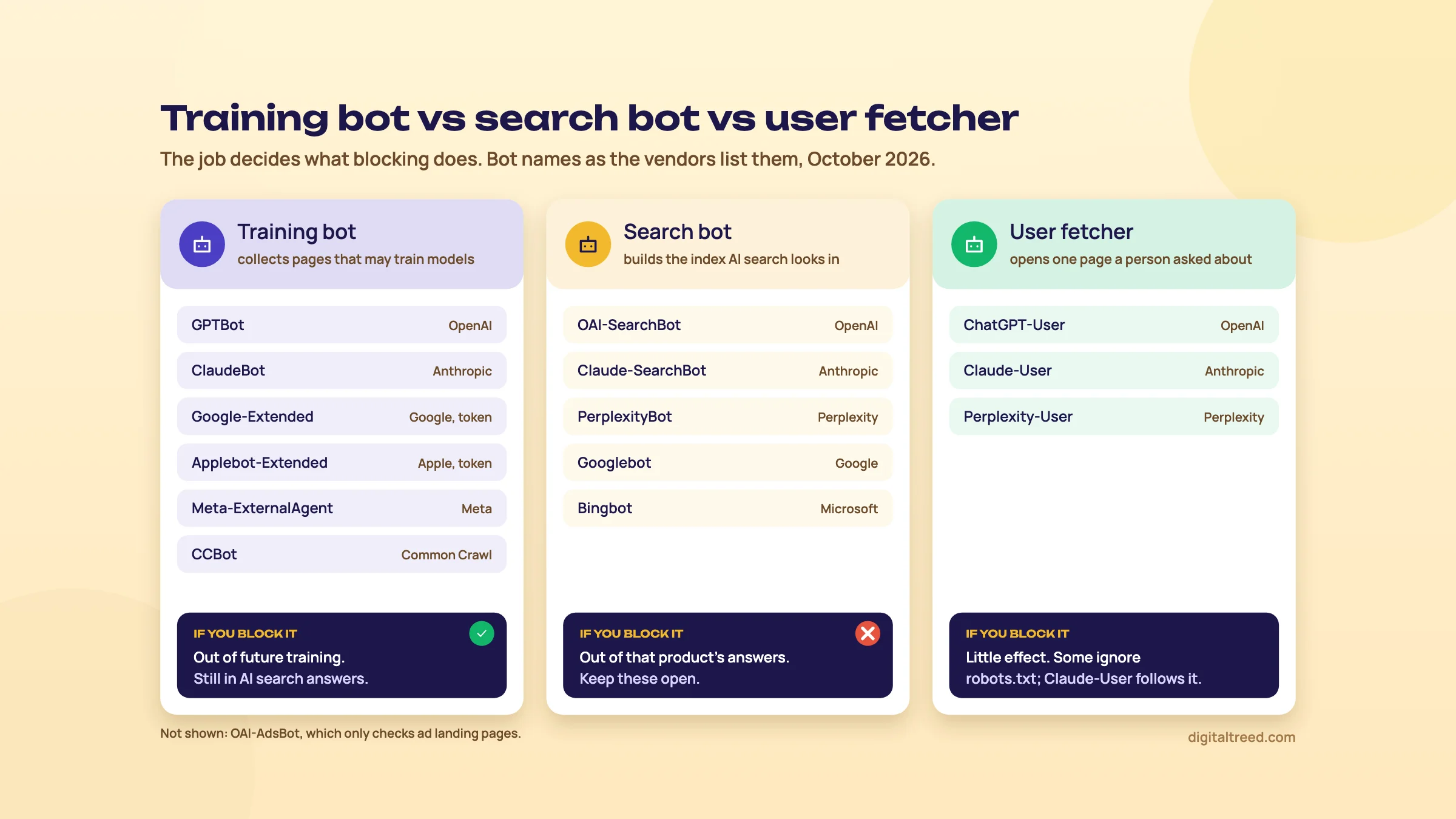 The bot's job decides what blocking it does. Names as vendors list them, October 2026.
The AI bot table, by company and purpose
Every row below comes from the company's own crawler page, read on 16 October 2026. Bot names change, so check the vendor pages again before you edit your file.
| Bot (token) | Run by | What it does | Follows robots.txt? | If you block it |
|---|---|---|---|---|
| GPTBot | OpenAI | Collects content that may be used to train its foundation models[28] | Yes | Out of training, still in ChatGPT search |
| OAI-SearchBot | OpenAI | Finds sites to show and cite in ChatGPT search | Yes, changes take about 24 hours | Out of ChatGPT search answers (navigational links can still show) |
| ChatGPT-User | OpenAI | Fetches a page when a user's request in ChatGPT or a custom GPT needs it | "robots.txt rules may not apply" | Not used to decide search inclusion |
| OAI-AdsBot | OpenAI | Checks landing pages of ads submitted to ChatGPT | Page doesn't say | Only matters if you advertise on ChatGPT |
| ClaudeBot | Anthropic | Collects content that could be used for model training[39] | Yes, and it honours Crawl-delay | Your future pages are left out of training |
| Claude-SearchBot | Anthropic | Indexes content to improve Claude's search results | Yes | May reduce your visibility in Claude's search results |
| Claude-User | Anthropic | Fetches pages when a Claude user asks a question | Yes | May reduce your visibility in user-directed search |
| PerplexityBot | Perplexity | Surfaces and links sites in Perplexity results; not used for training[31] | Yes, changes take up to 24 hours | Out of Perplexity's search results |
| Perplexity-User | Perplexity | Fetches a page for a user's question | "generally ignores robots.txt rules" | Little effect |
| Googlebot | Crawls for Google Search, which includes AI Overviews and AI Mode[14] | Yes | Out of Google Search, AI features included | |
| Google-Extended | A token, not a separate crawler: controls Gemini training and grounding in Gemini Apps and Vertex AI[34] | Yes | No effect on Google Search | |
| Bingbot | Microsoft | Builds the Bing index, which Copilot searches when it needs the web[69] | Yes | Out of Bing and the Copilot answers that draw on it |
| Applebot-Extended | Apple | A token, doesn't crawl: controls whether Applebot's data trains Apple's generative models[70] | Yes | Still in Spotlight, Siri and Safari results |
| Meta-ExternalAgent | Meta | Crawls for uses such as training Meta's AI models[71] | Meta gives a robots.txt rule for it | Out of that crawl |
| CCBot | Common Crawl | Builds Common Crawl's open web archive[72] | Common Crawl gives a robots.txt rule for it | Out of future Common Crawl data |
Two details are easy to miss. Apple's normal crawler, Applebot, may itself help train Apple's models as well as feed its search features, so Applebot-Extended is the opt-out for the training use only.[70] And Amazonbot and Bytespider (ByteDance) show up in server logs in large numbers. This guide doesn't cover their vendors' pages, so read those before you write rules for them.
robots.txt by purpose
Here's the pattern we suggest: say no to training if you want to, and say yes to every search bot.
User-agent: GPTBot
Disallow: /

User-agent: Google-Extended
Disallow: /

User-agent: OAI-SearchBot
Allow: /

User-agent: PerplexityBot
Allow: /
Add ClaudeBot and CCBot to the disallowed groups and Claude-SearchBot to the allowed ones if you want the same split for Anthropic and Common Crawl. If you're happy for your pages to be used in training, leave the training groups out. No rule means allowed. One trade-off: blocking Google-Extended also stops the Gemini app grounding its answers on your pages, so leave that group out if Gemini matters to you.
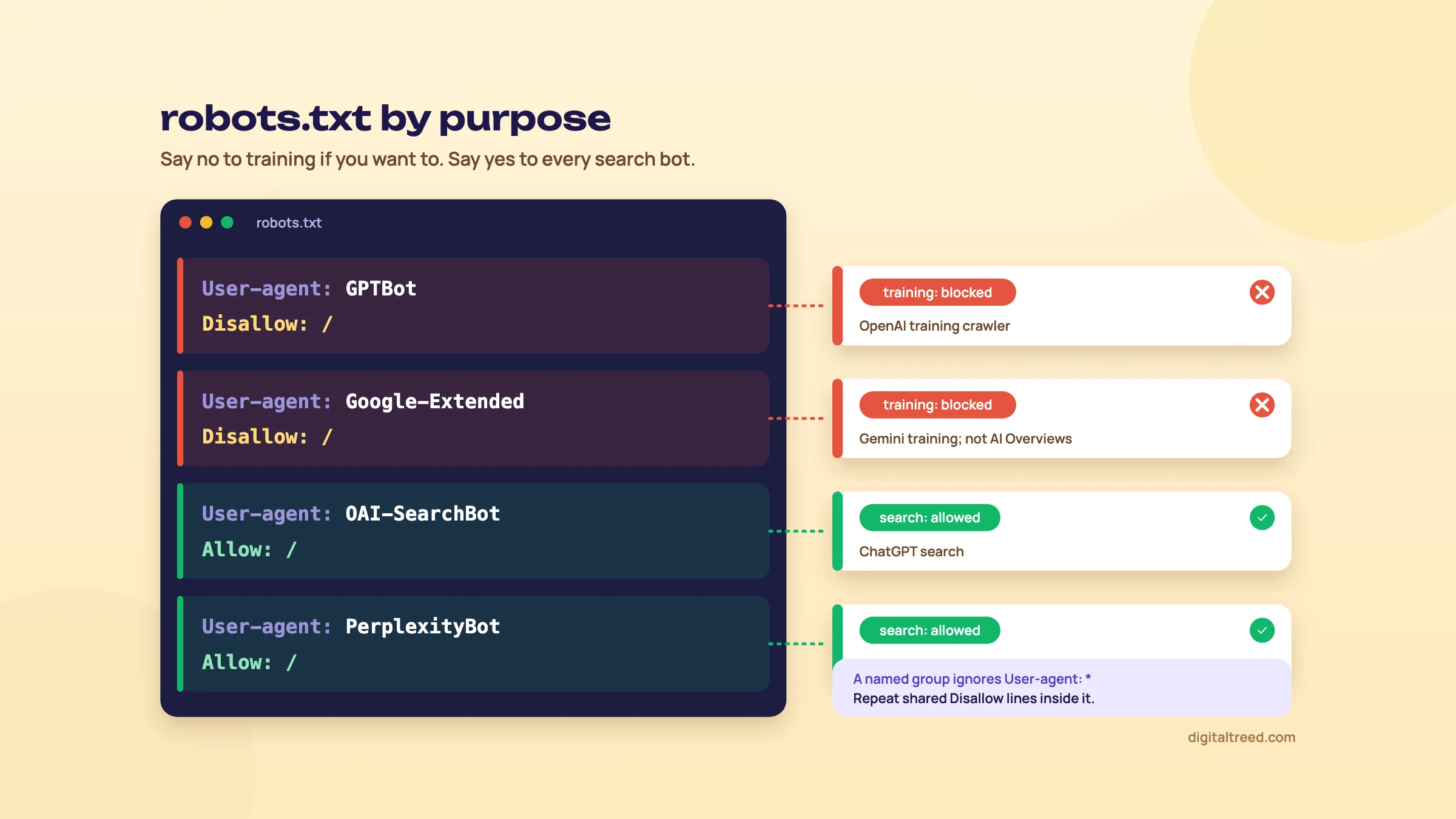 Say no to training if you want to, and yes to every search bot.
One rule from Google's robots.txt specification catches people out more than any other here. A crawler obeys only the group with the most specific user agent that matches it, and named groups aren't combined with the * group.[73] So if you give GPTBot its own group, your User-agent: * rules no longer apply to it. Repeat any shared Disallow lines inside the named group.
The other limits (the 500 KiB cap, caching for up to 24 hours, what a 5xx on robots.txt does) are in Guide 3, chapter 8, with the edge cases in Guide 3, chapter 1. Guide 1, chapter 8 covers the basics. Test after every change, not once a year.
Warning
Google-Extended is not an AI Overviews switch. Google says it "does not impact a site's inclusion in Google Search",[34] and AI Overviews and AI Mode are part of Search. Blocking it keeps your content out of Gemini training and Gemini app grounding. Your pages can still be cited in AI Overviews the next day.
Google's own controls for AI features
For AI Overviews and AI Mode, Google uses the same controls as the rest of Search: robots.txt rules for Googlebot, and the nosnippet, data-nosnippet, max-snippet and noindex directives.[14] A page has to be indexed and eligible for a snippet to appear at all. So a stray nosnippet doesn't just shorten your result. It can keep the page out of AI answers.
Since 31 August 2026 every site also has a dedicated switch. In Search Console, go to Settings, then Search generative AI. "Include" is the default. "Exclude" keeps your links and content out of AI Overviews, AI Mode and generative AI features in Discover, and you get no impressions or traffic from them.[17] Google says the setting isn't a ranking or inclusion signal for the rest of Search, it doesn't affect AI training (that's Google-Extended), and changes generally take a few days to apply.
Our view: very few businesses should flip this to Exclude. It's there for publishers who've decided the trade isn't worth it. Know it exists, and check nobody on your team switched it by mistake.
Bing and Copilot
Microsoft's documentation for Microsoft 365 Copilot Chat says Copilot writes a short web query from your prompt and sends it to Bing.[69] So Copilot visibility is Bing visibility: let Bingbot in and set up Bing Webmaster Tools (Guide 1, chapter 8).
Bing's rewritten guidelines also explain how its directives work in AI answers. According to Search Engine Journal's report of February 2026, NOARCHIVE keeps content out of Copilot responses and grounding results, NOCACHE limits Copilot to the URL, title and snippet, and nosnippet can lower citation quality.[19] If a developer once added NOCACHE or NOARCHIVE "for privacy", that's a reason Copilot cites you thinly or not at all.
To keep Bing current, use IndexNow. It tells Bing, Naver, Seznam.cz, Yandex and Yep that a URL changed, so they can recrawl it sooner. Google doesn't use it.[36]
User-triggered fetchers, and how to tell a real bot from a fake
ChatGPT-User, Perplexity-User and Meta's Meta-ExternalFetcher may ignore robots.txt, and their makers say why: a person asked for that page, so the fetch is treated like a visit, not a crawl.[71] Anthropic is the exception here and says Claude-User follows robots.txt. If you really need to stop user fetchers, robots.txt won't do it.
Anyone can type "GPTBot" into a user agent string, so don't trust the name alone. The vendors publish their IP address lists:
- OpenAI: openai.com/gptbot.json, openai.com/searchbot.json and openai.com/chatgpt-user.json[28]
- Perplexity: perplexity.com/perplexitybot.json and perplexity.com/perplexity-user.json
- Anthropic: claude.com/crawling/bots.json[39]
- Google: developers.google.com/crawling/ipranges/[74]
- Common Crawl: a JSON list of CCBot's ranges, and it suggests a reverse DNS check, since fake CCBots exist
Compare the IP in your server log with the list. We don't have a DNS or IP lookup tool yet, so use your host's log viewer or the host command on a Mac or Linux terminal for now. One warning from Anthropic: don't block its bots by IP, because then they can't read your robots.txt and your opt-out may not work.[39]
What the crawling costs you, and what it gives back
Cloudflare compared how often each company's bots crawl with how many visits its products send back. These are July 2025 figures from Cloudflare's network.[75]
38,066
Anthropic crawls per visit referred, July 2025[75]
1,091
OpenAI crawls per visit referred
195
Perplexity crawls per visit referred
5.4
Google crawls per visit referred
The same post found that 79% of AI crawling in July 2025 was for training, 17% for search and 3.2% for user actions. The ratios move fast: Anthropic's was about 286,930 in January 2025.
So should you block training bots? Decide by business, not by fear. A news publisher or a paid course provider whose content is the product has good reasons to say no to training. A dental clinic in Pune or a SaaS company in Bengaluru usually wants its name, prices and services known as widely as possible, and gains little by blocking. Either way, keep the search bots open.
Rendering: can AI crawlers read JavaScript?
Google renders pages with a recent version of Chrome,[76] and Googlebot fetches up to 2MB of each HTML file. Anything past that isn't rendered or indexed.[77]
Most AI crawlers are less patient. In Vercel and MERJ's study of traffic across Vercel's network, published in December 2024, GPTBot, ClaudeBot and PerplexityBot didn't render JavaScript. ChatGPT's and Claude's crawlers fetched JavaScript files but didn't run them. Applebot did render, through a browser-based crawler, and Gemini uses Google's infrastructure.[78] That's one network and one point in time, and the bots may have changed since. We haven't found a newer first-party statement from OpenAI, Anthropic or Perplexity on rendering.
The safe rule: your main text, headings, prices and internal links should be in the HTML the server sends, before any script runs. That's what Aleyda Solis's AI search checklist asks for too: make content reachable and renderable by search and AI crawlers, with server-side rendering and no blocking.[51] To check a page, open it in Chrome, turn off JavaScript in DevTools and reload. Whatever disappears is what a non-rendering bot can't see. For Google's own rendered view, use URL Inspection in Search Console. Guide 3, chapter 2 goes deeper on JavaScript SEO. A rendered-vs-raw HTML checker is on our list of tools to build.
Don't block what you want cited
Asked about llms.txt, John Mueller said the bigger priority is simple: "don't block agents".[79] Many blocks aren't decisions at all. They're accidents:
- A "block AI bots" or "bot fight" setting switched on in a CDN, firewall or security plugin, often without anyone remembering
- A staging site's
Disallow: /copied to the live site at launch - A firewall that answers bots with a challenge page or a 403 instead of the page
- A stray
noindex,nosnippetorX-Robots-Tagheader on templates you want cited - A slow server that times out before the bot gets the page
robots.txt can say "allowed" while the firewall says no, so check the file and also what the server sends back. Our HTTP Status Checker shows the status code a URL returns, and the Noindex Tag Checker catches stray noindex tags. The status checker sends its own user agent, and you can't pick another. A firewall that blocks only AI bots can still give it a 200, so check your CDN or firewall's bot settings and logs too.
Note
From our work: a perfume brand. A perfume brand's slow WordPress site was hurting how Google crawled and indexed it. With their developer we moved to a lighter theme, added a caching plugin and optimised the images, then added blog posts and synced the products to Google Merchant Center. Results came in five to six weeks, including organic orders. Access isn't only about permission. A bot that's allowed in but can't load the page gets nothing either.
Check and set AI crawler access in 6 steps
- Run the AI Crawler Checker Enter your homepage. For each bot it shows allowed or blocked, and the robots.txt group and rule that decided it.
- Decide per purpose Write down one line each: training bots allowed or blocked; search bots always allowed.
- Edit robots.txt Give each bot you treat differently its own group, and copy your shared Disallow lines into it.
- Test the tokens In the Robots.txt Tester, paste the new file before you upload it and test each bot against your key URLs: Googlebot and Bingbot, the search bots (OAI-SearchBot, PerplexityBot, Claude-SearchBot) and the training bots you decided on. The tester lists the AI bots, and you can also type any user agent.
- Check the firewall and CDN Look for bot-blocking or challenge settings in your host, CDN and security plugin. Run your key URLs through the HTTP Status Checker and expect a 200. It doesn't pretend to be an AI bot, so a 200 there doesn't rule out a bot-only block.
- Re-run after 24 hours Robots.txt is cached for about a day, so check again tomorrow and note the change in a Search Console annotation.
How our checker scores this: its score counts only the search bots and user fetchers you allow, because those decide whether AI answers can cite you. Training bots are shown separately as your choice, and llms.txt is reported for information only, with no points. So blocking GPTBot, ClaudeBot or Google-Extended on purpose doesn't lower your score.
Agents are next
The newest visitors aren't crawlers or chat fetchers but agents that act for a person: compare plans, fill a cart, book a slot. Google's AI optimisation guide points site owners to agent-friendly practices and says protocols like the Universal Commerce Protocol "are emerging that will allow Search agents to do more".[13] The basics are the same as this chapter: don't block them, and serve real HTML with accurate prices and stock. Guide 4, chapter 9 looks at where this is heading.
With access sorted, the next question everyone asks is whether you also need an llms.txt file. Chapter 7 answers it in five minutes.
llms.txt, honestly
Quick answer
llms.txt is a proposed Markdown file that lists a site's key pages for AI tools. Google Search ignores it and says it neither helps nor harms. In Ahrefs' log study of 137,210 sites, 97% of llms.txt files got no requests in May 2026. It's cheap and harmless, useful for documentation sites, and not a way to get cited.
Few GEO topics get more questions per word of evidence than this one. Here's the whole picture in five minutes, both sides, so you can decide and move on.
What llms.txt is
Jeremy Howard of Answer.AI proposed llms.txt on 3 September 2024. The idea: a Markdown file at /llms.txt that gives AI tools a short, clean map of a site. Then an assistant or agent working at question time doesn't have to wade through menus, scripts and ads.[80] The proposal also suggests offering plain Markdown copies of pages.
The format, in order:
- An H1 with the site or project name. This is the only required part.
- A blockquote with a short summary.
- Optional notes: paragraphs or lists, but no headings.
- H2 sections, each a list of links written as
[name](url), with an optional note after a colon. - By convention, a section called "Optional" for links an agent can skip when it's short of space.
A minimal file for an Indian coaching institute might look like this:
# Example Coaching Academy
> NEET and JEE coaching in Kota with classroom and online batches. Fees, batch dates and results are on the pages below.
## Courses
- [NEET two-year programme](https://example.in/neet-two-year): Syllabus, timetable and fees
- [JEE crash course](https://example.in/jee-crash-course): 12-week batch, starts every January
## Optional
- [Blog](https://example.in/blog): Exam tips and toppers' interviews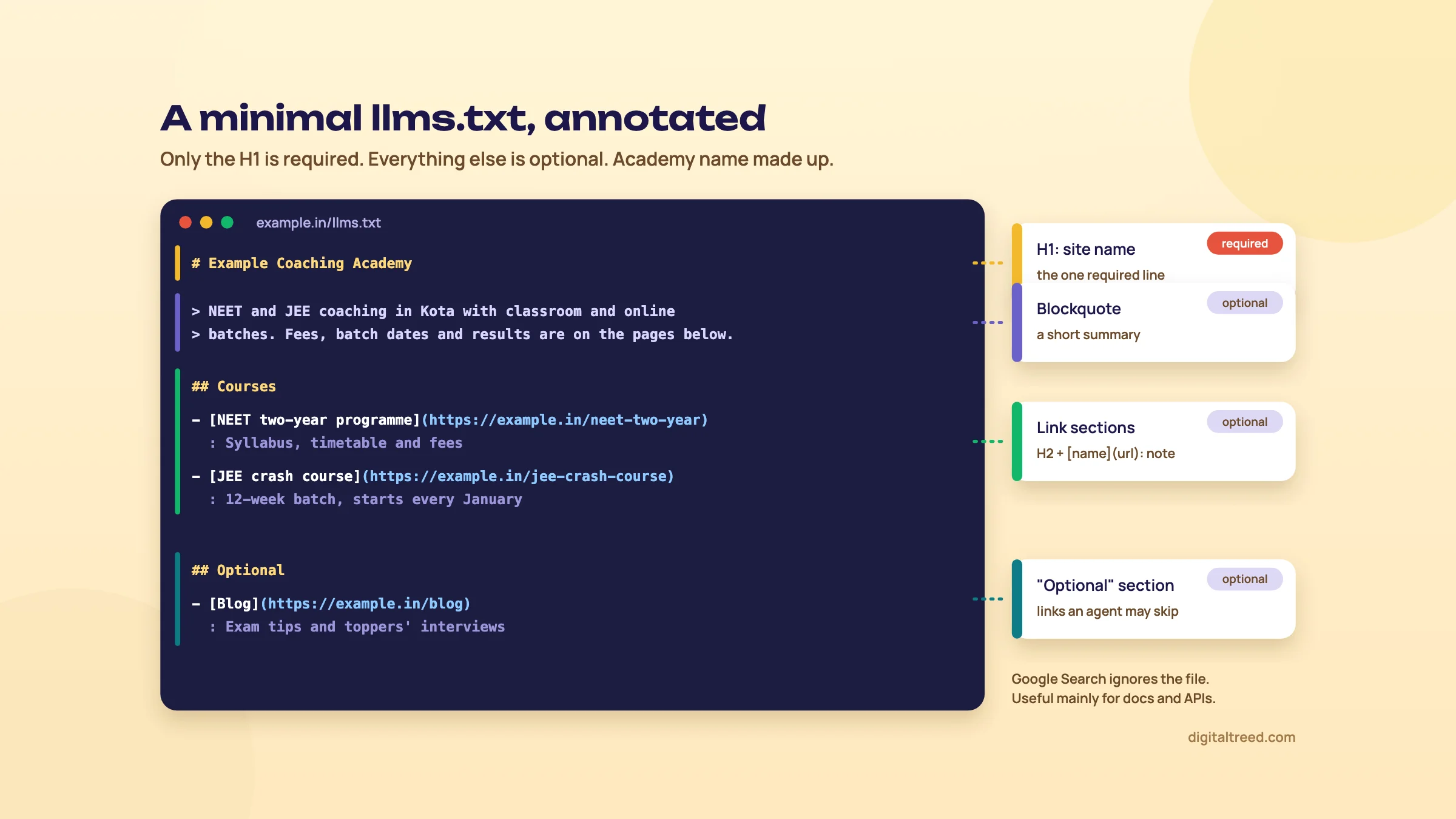 Only the H1 is required. Google Search ignores the file.
We don't have an llms.txt generator yet. Write the file by hand from the llmstxt.org format; for a small site it's a short job.
Who publishes one
Adoption depends heavily on whose sites you count.
36,120
sites with llms.txt in May 2026, out of 3 million+ tracked by Originality.ai (4,088 in June 2025)[81]
28%
of 137,210 domains in Ahrefs Web Analytics had one in May 2026[82]
97%
of those files got zero requests that month
Originality.ai's tracked sites put adoption at about 1%. Ahrefs' 28% comes from its own analytics customers, who are more technical than the average site, and Ahrefs itself calls the figure an upper bound.[82]
Who actually reads it
This is the part that matters. Ahrefs looked at the server logs of those 137,210 domains for May 2026, published on 15 June 2026. About 1,100 files got any requests at all, roughly 22,000 between them, and 96% of those requests came from bots.[82] Here's who sent them:
Inside that 19.5%, AI agents made 10.5% of requests and training crawlers 5.3% (GPTBot 4.51%, ClaudeBot 0.8%). The bots that fetch pages to answer questions, the ones you'd want reading it if it helped citations, made 3.6%: retrieval bots such as OAI-SearchBot and PerplexityBot 1.1%, and assistants such as ChatGPT-User 2.5%. And a request doesn't prove anything was read or used. Ahrefs treats every consumption figure as a ceiling.
The study didn't check whether files followed the format, and it covered only the llms.txt file itself, not Markdown copies of pages. Their own one-line summary: publish one today, and the most likely outcome by far is that nothing ever fetches it.
What Google says
Google has been unusually direct. Its AI optimisation guide lists llms.txt under things you can ignore. You don't need new machine-readable files, AI text files or Markdown to appear in Google Search, including its AI features. Creating them "will neither harm nor help your site's visibility or rankings in Google Search, as Google Search ignores them."[13] A changelog note on 15 June 2026 added that "it's fine if you want to maintain these files for other services or systems that use them."[25]
John Mueller wrote in June 2025 that no AI system currently uses llms.txt.[83] A year later, answering questions on Reddit, he hadn't changed his mind.[79]
it's purely speculative for now[79]
His test for when to make one is practical: "When an AI platform that brings you clients complains that it needs the file for your site." Patrick Stox of Ahrefs put it more bluntly in a 2025 conference talk: llms.txt "Isn't used, probably won't be."[2]
When it does make sense
The case for llms.txt is strongest where the reader is a program, not a search engine. Documentation sites, APIs and developer tools are the clearest fit: an AI coding assistant or agent may be pointed at the file to find the right docs fast. The llmstxt.org site says OpenAI, Anthropic and Google's Gemini publish llms.txt files for their developer documentation, that documentation platforms generate them automatically, and that Chrome's Lighthouse checks for one in its agentic browsing audits.[80] Those are the author's claims. Ahrefs counted about 22 Lighthouse requests in its whole sample.[82]
Pros
- Quick to write and free
- Can't hurt your Google rankings
- Useful for docs, APIs and products that agents work with
- Forces a useful exercise: listing your 20 most important pages
Cons
- Google Search ignores it
- 97% of files got no requests in Ahrefs' sample
- No study shows it raises AI citations
- One more file to keep in sync when prices and pages change
Note
Our own llms.txt. digitaltreed.com publishes an llms.txt. It lists our services and free tools, each linking to a Markdown copy of the page.
The red flag
If an agency's GEO package leads with "we'll set up your llms.txt", ask what evidence they have that it changes citations. There isn't any public evidence yet. Adding the file is fine. Paying for it as a visibility service isn't.
The real priority is still the one from chapter 6: make sure the search bots can get in.
Our AI Crawler Checker reports whether you have llms.txt and llms-full.txt for information only. It gives no points for them, for the reasons in this chapter. The bot access results are the part that matters.
Next, chapter 8 shows how to measure whether any of this is working.
Measuring AI visibility: Search Console, Bing, GA4 and prompt tracking
Quick answer
Measure AI visibility in four places. Search Console counts AI traffic inside "Web" and has a generative AI report for impressions. Bing Webmaster Tools' AI Performance report counts Copilot citations. GA4 shows referrals from chatgpt.com, perplexity.ai and others. Then add a monthly manual prompt log. Expect small traffic numbers. Report citations and leads alongside clicks.
The obvious follow-up to "can you get us into ChatGPT?" is "how will we know?" There's no single dashboard for it. There are two free first-party reports, one analytics setup and one spreadsheet, and together they give an honest picture.
Where to measure, and what each place can't tell you
| Source | What it shows | What it doesn't | Cost | How often |
|---|---|---|---|---|
| Search Console, Performance ("Web") | Clicks and impressions, AI Overviews and AI Mode included | Which of them came from AI features | Free | Monthly |
| Search Console, generative AI reports | Impressions in AI Overviews, AI Mode and Discover AI features, by page, country and device | Clicks, queries, position | Free | Monthly |
| Bing Webmaster Tools, AI Performance | Citations in Copilot and Bing AI summaries, grounding queries, cited pages | Clicks; ChatGPT, Perplexity or Gemini | Free | Monthly |
| GA4 | Visits and key events from AI assistants that pass a referrer | Visits with no referrer; mentions that bring no click | Free | Monthly |
| Manual prompt log | Whether you're cited or named for the questions your buyers ask | Volumes; anything statistically solid | Your time | Monthly |
| Paid tracker | The same at scale, across many prompts and engines | What happens inside the engines | About $40 to $300 a month | Daily or weekly |
Before you read any AI number, run the AI Crawler Checker from chapter 6. A site that blocks OAI-SearchBot will show zero ChatGPT citations, and no report will tell you why.
Google Search Console
Clicks and impressions from AI Overviews and AI Mode are counted in the normal Performance report under the "Web" search type, mixed in with everything else.[14] You can't filter them out there.
On 3 June 2026 Google added separate generative AI performance reports, one for Search and one for Discover, and had rolled them out to all sites worldwide by 31 August 2026.[84] They show:
- Impressions: how often your URLs appeared in generative AI features in Search and Discover
- Pages: which URLs appeared
- Countries
- Devices (for Search only)
- Dates by hour, day, week or month
No clicks, no queries, no position. The same data still counts in the overall Performance report; the new reports are just a separate view. Google says it may add more metrics over time.
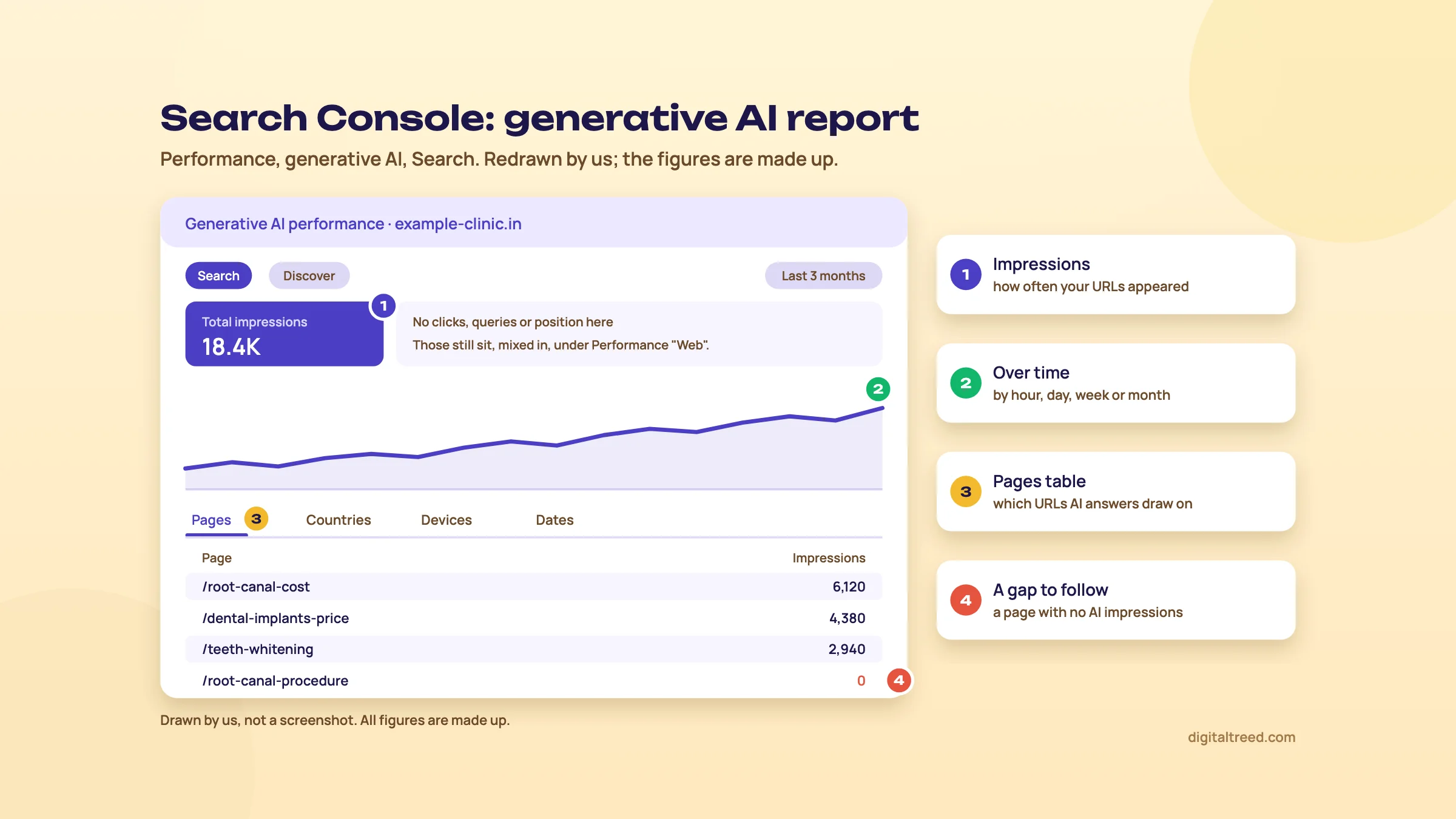 Drawn by us, not a screenshot. All figures are made up.
Use it to see which pages AI answers draw on. If your clinic's "root canal cost" page gets AI impressions and your "root canal procedure" page gets none, that's a lead worth following. Don't use it to judge traffic. One more thing to check while you're there: if someone set Settings, Search generative AI, to Exclude, these impressions drop to zero by design (chapter 6).[17]
Two older Search Console features help here. The branded queries filter, open to all eligible sites since 11 March 2026 (whole-site properties with enough impressions, so small sites may not see it), separates people searching your name from everyone else. Rising branded demand is one of the few signs that AI mentions are working.[85] And custom annotations let you mark the day you changed robots.txt or rewrote five pages, so you can line changes up with results later.[86]
Finding AI Mode-style queries
Search Console doesn't label AI Mode queries, but you can make a good guess. Glenn Gabe's method: export all queries through the Search Analytics API to get past the 1,000-row limit. Have an AI assistant flag the long, conversational ones and the follow-ups, then look at their clicks. He found few or none on many of them. Check the flagged list by hand before you use it; his included queries from automated tracking tools.[87] Guide 2, chapter 11 walks through the steps. Treat the result as a list of topics people explore in AI Mode, not as traffic you're missing.
Bing Webmaster Tools: AI Performance
This is the only first-party report we know of that counts citations. Bing launched it in public preview on 10 February 2026. It covers Microsoft Copilot, AI-generated summaries in Bing and some partner integrations, and shows:[38]
- Total citations: how many times your content was shown as a source in AI answers. It doesn't say where in the answer.
- Average cited pages: the average number of your pages cited per day
- Grounding queries: a sample of the phrases the AI used when it retrieved your content
- Page-level citations and a trend over time
On 16 June 2026 Bing added four views, still in preview. They are Intents (informational, commercial, local and so on), Topics, Citation Share (your share of all citations for a grounding query) and Compare (this period against the last).[88] Bing is careful about that third one: "Citation Share is designed as an observational metric – not a ranking system or a competitive scoreboard."
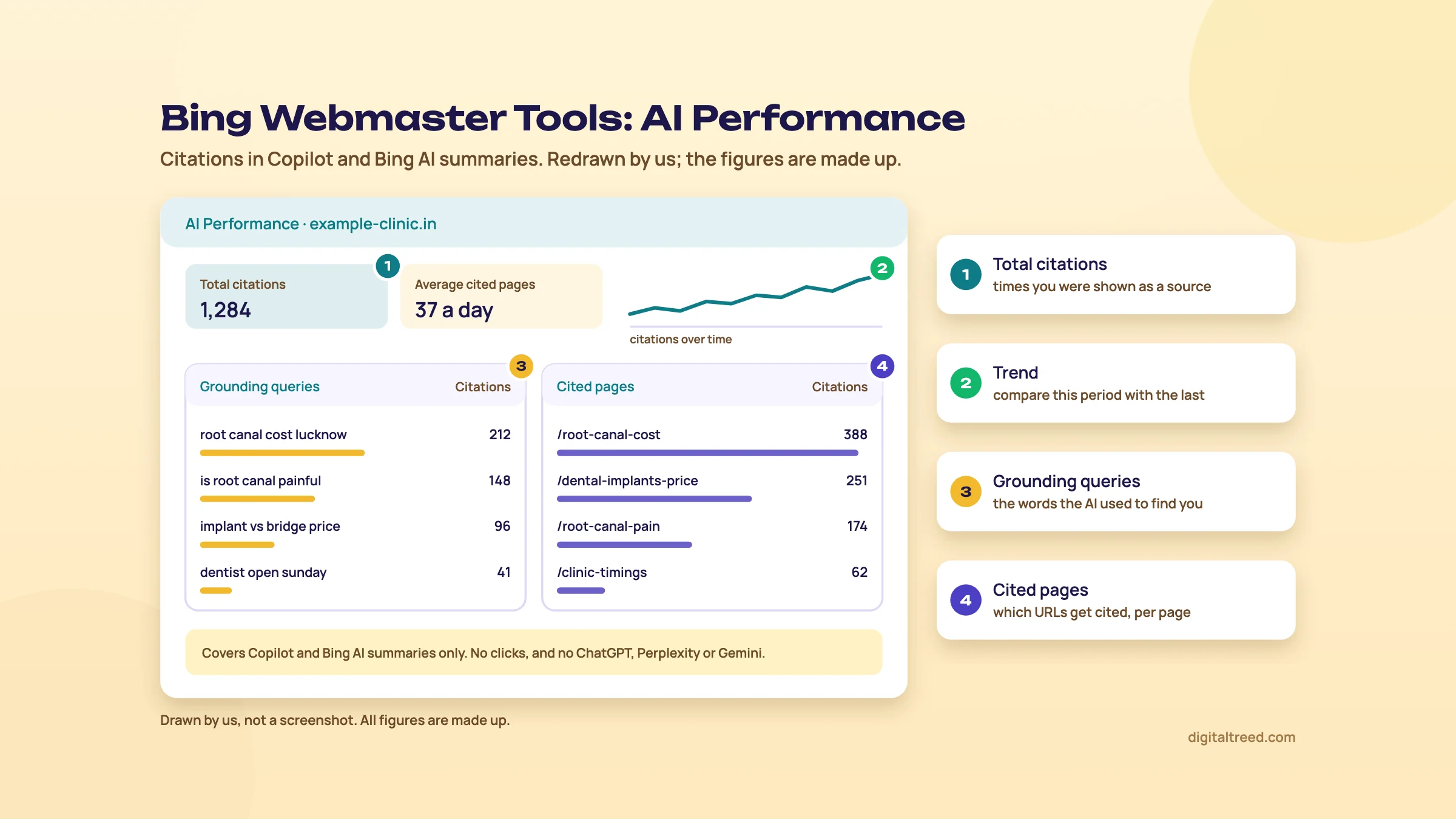 Drawn by us, not a screenshot. All figures are made up.
The grounding queries are the most useful part. They're the words an AI system used to find you, and they often read like the questions your customers ask on the phone. Neither Bing announcement mentions clicks, and the report doesn't cover ChatGPT, Perplexity or Gemini.
GA4: AI referrals
When someone clicks a link in ChatGPT, Perplexity, Gemini, Copilot or Claude, the visit usually arrives with the assistant as its source. Since 13 May 2026, GA4's default channel group has its own "AI Assistant" channel[89] for these visits, from sources like ChatGPT, Gemini, DeepSeek, Copilot and Grok.[90] Google's AI Overviews and AI Mode aren't in it. Check that channel first. Build the channel below only if you want to add sources Google's list misses.
Widen the AI channel in GA4 (optional)
- Open channel groups In Admin, go to Data display, then Channel groups. You need the Editor role or above.[91]
- Create a group Click "Create new channel group". GA4 copies the default group, so you keep all the normal channels. Name it, for example, "Channels with AI".
- Add the AI channel Click "Add new channel", call it "AI assistants", add a condition on Session source with "matches regex" and paste the pattern below. Save the channel.
- Move it up Use Reorder to place "AI assistants" at the top, above GA4's own "AI Assistant" channel and "Referral". GA4 puts each visit in the first channel it matches, so lower down it would catch little or nothing. Apply, then save the group.
- Read it In Reports, Acquisition, Traffic acquisition, switch the channel group to yours. Custom channel groups apply to past data too, so you get history straight away.
.*(chatgpt|openai|perplexity|gemini\.google|copilot|claude\.ai|deepseek|grok).*A standard GA4 property allows two custom channel groups besides the default, so don't waste them on experiments.[91] If you'd rather not touch the settings, an Exploration with the same regex as a filter on session source gives the same numbers. Ahrefs Web Analytics, included in the free Ahrefs plan for verified sites, also shows traffic from AI assistants.[92]
One caution, from how referrers work rather than from a study: some AI visits arrive without a referrer, for example from a copied link or an app, and land in Direct. Your AI channel is a floor, not the full number.
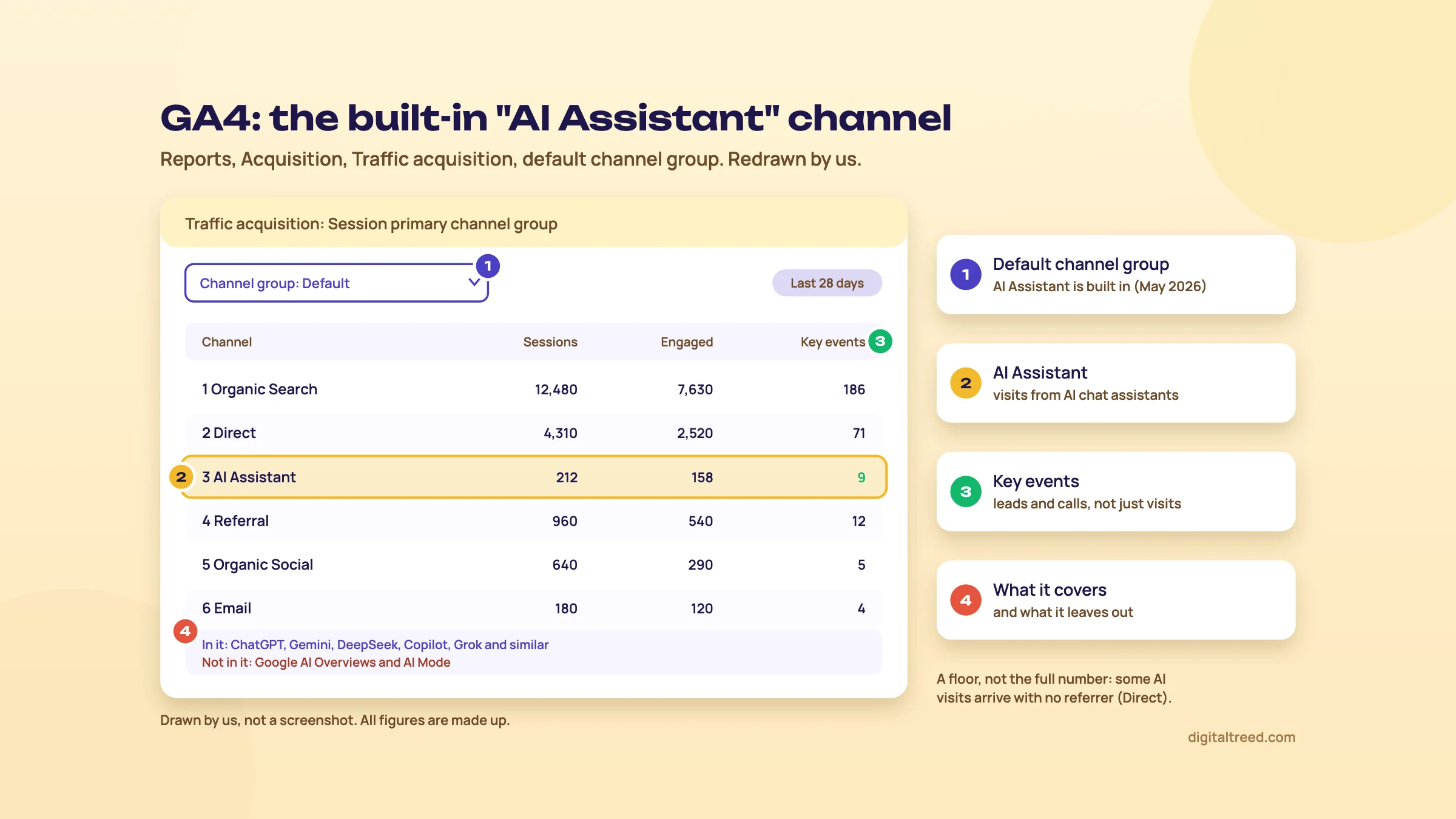 Drawn by us, not a screenshot. All figures are made up.
Keep the expectations real
SE Ranking looked at 101,574 sites connected to Google Analytics. AI assistants sent 0.32% of their traffic from January to April 2026, against 42.75% from organic search.[11] Most of that 0.32% came from one source:
Small doesn't mean worthless. At Ahrefs, Patrick Stox reported that 0.5% of visitors came from AI and drove 12.1% of sign-ups.[2] That's one software company, not a rule. You'll also see "AI traffic converts 4.4 times better" quoted everywhere; it's a Semrush figure, reported on MarTech (a Semrush-owned site) without any method.[93] Measure your own key events in GA4 instead.
The manual prompt log
Reports show what Google and Bing count. They don't show whether ChatGPT names you when a parent in Jaipur asks for the best IIT coaching online. For that you ask, by hand, every month.
Run a monthly prompt log
- Write 20 to 30 prompts Use the questions buyers really ask: sales calls, WhatsApp enquiries, Search Console queries, "People also ask". Mix "best X in city" with specific questions such as "how much does a root canal cost in Lucknow".
- Fix the conditions Decide once: logged out or logged in, which city, which device. Write it at the top of the sheet. Answers change with all three.
- Run each prompt in five places ChatGPT, Perplexity, Gemini, Copilot and Google AI Mode. Use a fresh chat each time.
- Record what you see Date, engine, prompt, whether your site is cited (linked), whether your brand is named without a link, which competitors appear and which sources are cited.
- Save the evidence Take a screenshot of anything that mentions you or a competitor. Answers change, and you'll want proof next month.
- Compare month on month Count cited and named across all prompts and engines. Look at trends over three months, not one.
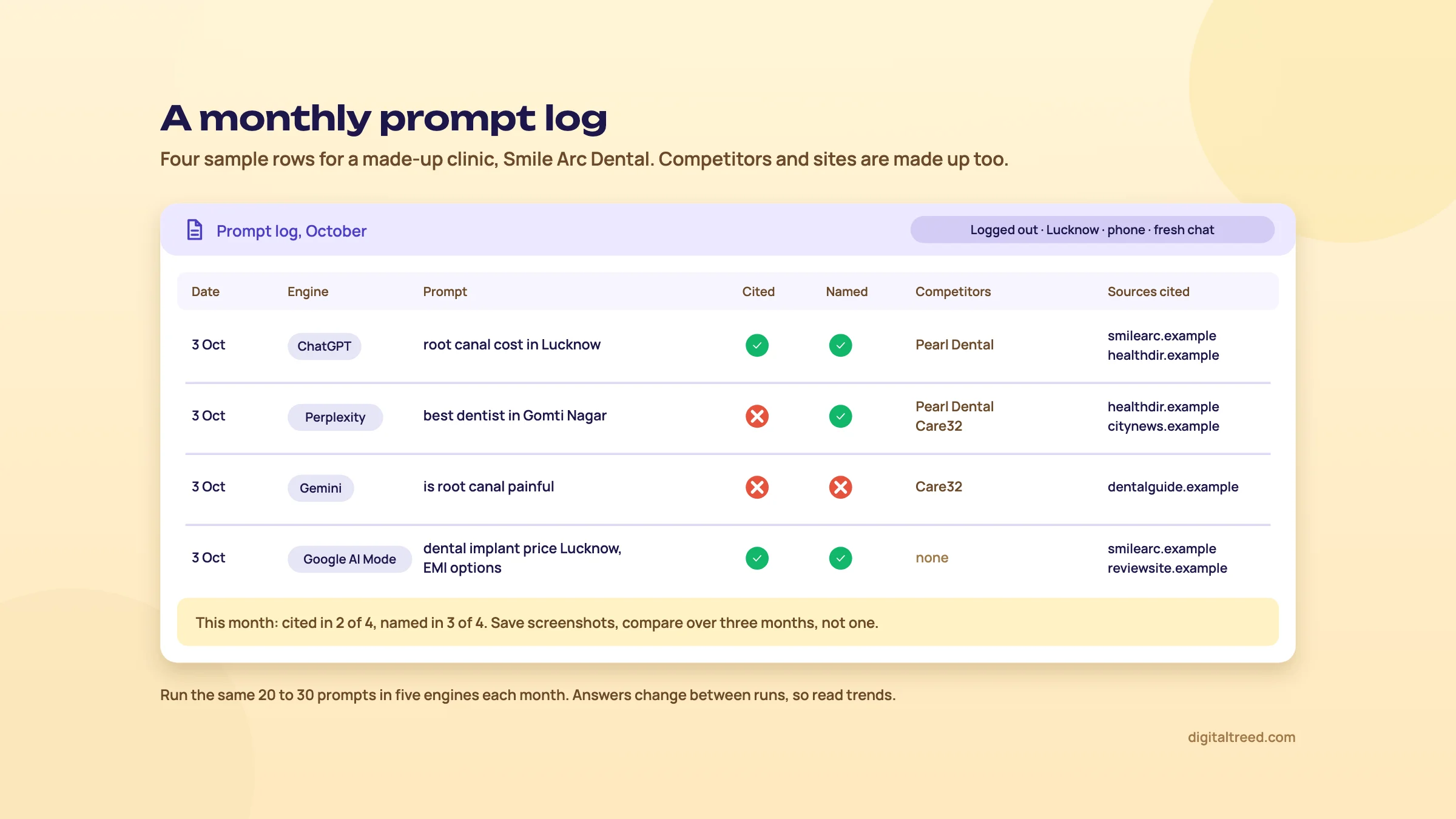 Run the same prompts every month and read the trend. Names are made up.
Why only a snapshot? AI answers are generated fresh each time, so the same prompt can give different sources an hour apart. And the mix of sources each engine cites shifts within weeks (chapter 2). We've also found no public source for how often people ask a given prompt, so ignore any tool that quotes "prompt volume" as if it were Keyword Planner data.
Paid trackers, honestly
Paid tools run hundreds of prompts on a schedule and chart the results. Here's what the main ones charge for AI visibility, in US dollars, as shown on their own pricing pages on 16 October 2026. We have no affiliate links with any of them.
| Tool | AI visibility option | Price a month | What you get |
|---|---|---|---|
| Ahrefs | Brand Radar AI (separate product) | From $199[68] | Brand mentions and citations across AI answers |
| Semrush | Starter (SEO + AI Search) or Pro+ | $199 or $299[94] | 50 or 100 AI prompts a day, plus the SEO toolkit |
| SE Ranking | AI Search add-on | $89, on top of a plan from $129[95] | AI visibility tracking in an SEO suite |
| Surfer | AI Search Analytics | $82, billed yearly[96] | Prompt tracking only |
| Frase | Included in plans | From $49 ($39 billed yearly)[97] | ChatGPT and Google AI tracking, more engines on higher tiers |
Remember what Google says about all of them: "No third-party tool has access to our internal ranking or AI systems."[13] They ask the engines questions, just as your prompt log does, only more often.
Which one when: start with Search Console, Bing Webmaster Tools, GA4 and your own log. They're free and cover most small and mid-sized businesses. Buy a tracker when a client pays for monthly AI visibility reporting across dozens of prompts, or when you track several brands and the manual log takes more than a day.
What to report each month
Kevin Indig and Amanda Johnson suggest reporting three groups together every month: exposure (visibility, mentions, citations), behaviour (branded searches, direct visits) and outcomes (pipeline, conversions).[63] For AI visibility that becomes:
- Exposure: Search Console AI impressions, Bing citations, prompts where you're cited or named
- Behaviour: branded queries in Search Console, direct and AI-referral visits in GA4
- Outcomes: leads, calls, WhatsApp enquiries and sales, including from AI referrals
Clicks are scarce. Influence is plentiful.[50]
Put it on one page, with last month beside each number, and build it once in Google's free reporting tool with the Search Console and GA4 connectors (Guide 2, chapter 11). If you run this reporting for clients as a service, Guide 4, chapter 5 covers how to package it.
If you add links to your site on profiles that AI answers often cite, such as LinkedIn or directory listings, tag them with UTM parameters so the visits show up clearly in GA4. Our free UTM Builder makes them, with a LinkedIn preset and the GA4 channel shown for each link.
Take a baseline with the audit before your first monthly report. Chapter 9 turns everything in this guide into a checklist and a 30-day plan.
A GEO checklist, a 30-day plan and the myths to drop
Quick answer
Start with access and the SEO base, then rewrite your most important pages answer-first with sourced numbers, fix your facts across the web, earn a few real mentions and measure monthly. That's a 30-day start, not a finish. Skip llms.txt as a lever, special AI markup, hidden AI text and anyone who guarantees ChatGPT placement.
This chapter is the one to print. It turns the guide into 20 checks, a four-week plan you can start on Monday, and a list of claims you can stop worrying about.
The GEO checklist
Twenty checks in five groups. Each one points to the chapter that explains it. The checklist PDF that comes with this guide has all twenty, plus a few more.
| Group | Check | Where |
|---|---|---|
| Access | 1. Search bots (OAI-SearchBot, PerplexityBot, Claude-SearchBot, Googlebot, Bingbot) allowed | Chapter 6, AI Crawler Checker |
| Access | 2. Training-bot policy decided and written into robots.txt | Chapter 6, Robots.txt Tester |
| Access | 3. No firewall, CDN or security-plugin rule blocking or challenging search bots | Chapter 6, HTTP Status Checker |
| Access | 4. Main content and links in the raw HTML, before any JavaScript runs | Chapter 6 |
| Access | 5. No stray noindex, nosnippet, NOCACHE or NOARCHIVE on pages you want cited, and Search generative AI set to Include | Chapter 6, Noindex Tag Checker |
| SEO base | 6. Top issues from a site audit fixed | Free Website Audit |
| SEO base | 7. Target pages rank, or are close, for the main question and its sub-questions | Chapters 2 and 3 |
| SEO base | 8. Bing Webmaster Tools set up and IndexNow on | Chapter 6 |
| Content | 9. Your five most important pages rewritten answer-first | Chapter 4 |
| Content | 10. Every number with its source and date | Chapter 4 |
| Content | 11. Quotes word for word, with a link to where they were said | Chapter 4 |
| Content | 12. Tables in HTML; images with alt text and captions | Chapter 4, Meta Tag Analyzer |
| Content | 13. Bylines, author pages, reviewer and real update dates | Chapter 4 |
| Content | 14. All AI-assisted text fact-checked by hand, titles, meta, schema and alt text included | Chapter 4 |
| Brand | 15. Same name, address, people and prices on your site, Business Profile, directories and social profiles | Chapter 5 |
| Brand | 16. Organization or LocalBusiness markup that matches the page | Chapter 5, Schema Markup Validator |
| Brand | 17. One earned-mention activity a month; no paid "AI mentions" | Chapter 5 |
| Measurement | 18. Search Console generative AI report and Performance "Web" checked monthly | Chapter 8 |
| Measurement | 19. Bing AI Performance and GA4 AI referrals checked monthly | Chapter 8 |
| Measurement | 20. Prompt log run monthly and reported as exposure, behaviour, outcomes | Chapter 8 |
A 30-day plan
This is our plan, built from the chapters of this guide, not from anyone's study. It assumes one person with a few hours a week and a site that's already indexed.
| Week | Tasks | Chapter | Tools | Output |
|---|---|---|---|---|
| 1. Access and baseline | Run the crawler check, set robots.txt by purpose, check firewall and CDN, run a site audit, note this month's Search Console AI impressions, Bing citations and GA4 AI visits, run the first prompt log | 6, 8 | AI Crawler Checker, Robots.txt Tester, HTTP Status Checker, Free Website Audit | A one-page baseline |
| 2. Five pages | Pick five pages that rank, or nearly rank, for questions buyers ask. Rewrite each answer-first, with one sourced number, one named quote and links to primary sources. Fact-check by hand | 4 | Word Counter & Keyword Density Checker, Meta Tag Analyzer | Five rewritten pages, dated |
| 3. Facts and mentions | Make your name, address, prices and people match across your site, Google Business Profile, directories and About page. Check Organization markup. Start one earned-mention idea | 5 | Schema Markup Validator | Clean entity facts, one outreach started |
| 4. Measure and report | Run the prompt log again. Compare with week 1. Report exposure, behaviour and outcomes. Add Search Console annotations for what changed | 8 | Search Console, Bing Webmaster Tools, GA4 | First monthly report and next month's list |
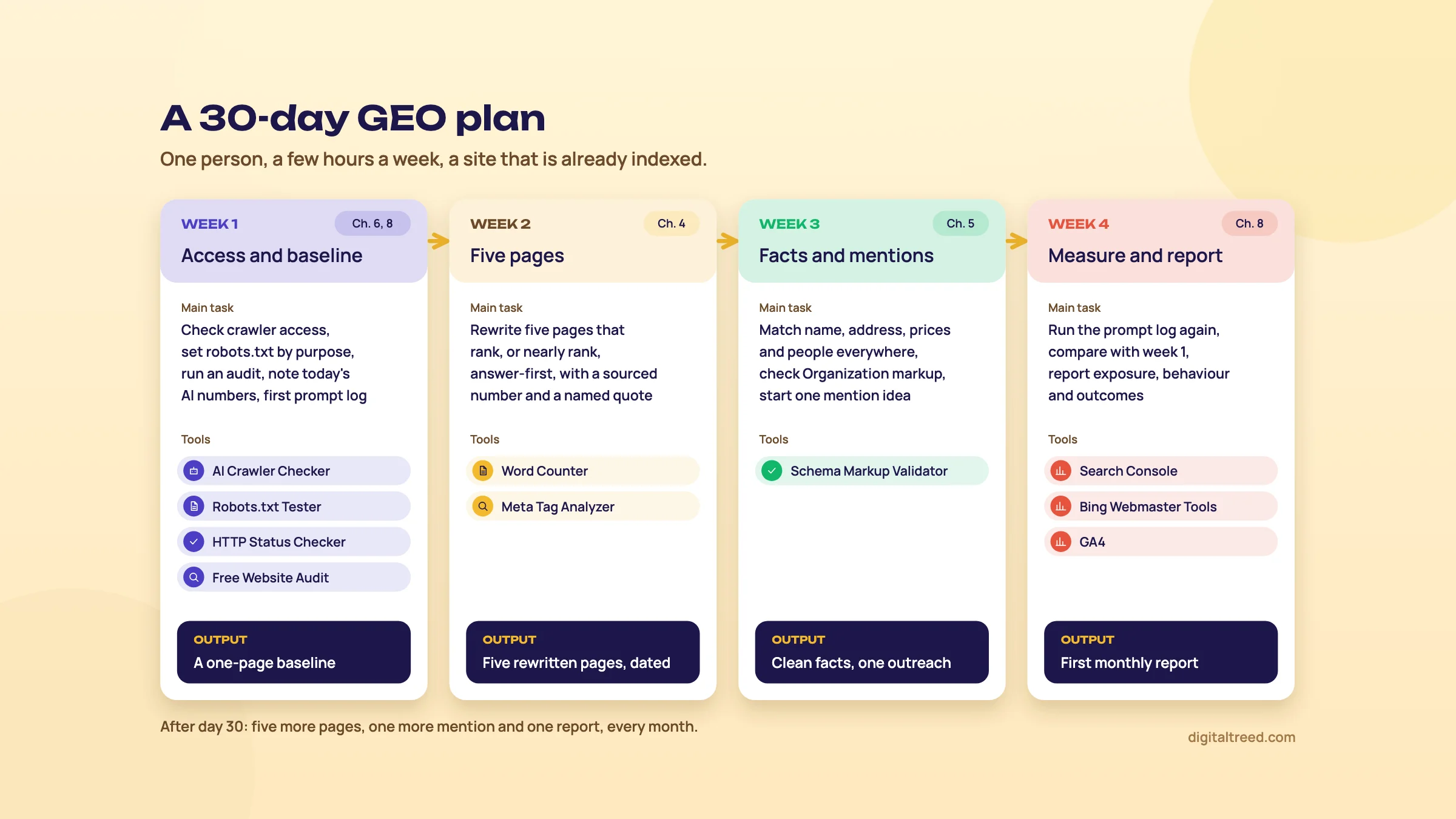 A 30-day GEO plan for one person with a few hours a week.
After day 30, keep the rhythm monthly: five more pages, one more mention, one report. Don't expect the week 4 numbers to move much. Week 4 is about having a baseline and a habit; the changes from weeks 2 and 3 take longer to show in search and AI answers.
Note
From our work: SEO training. When I taught SEO from A to Z at a training institute, my students were already doing client work. The part they found hardest was technical SEO, because the local business sites they handled mostly ran on WordPress with shared hosting, and the most common issue was site speed. That's why week 1 is access and the technical base. Content changes can't help a page a bot can't load.
Myths to drop
These claims turn up in GEO advice and sales pitches. Here's what the sources actually say, as of October 2026.
| The claim | What's true |
|---|---|
| "GEO replaces SEO." | Google: optimising for generative AI search is "optimizing for the search experience, and thus still SEO."[13] Lily Ray: "AEO/GEO is not an overhaul or abandonment of SEO."[21] |
| "You need an llms.txt file." | Google Search ignores it. In Ahrefs' logs, 97% of files got no requests in May 2026 (chapter 7).[82] |
| "AI needs special schema." | Google: there's "no special schema.org markup you need to add."[13] Normal structured data is still worth having for rich results. |
| "Chunk every page into small pieces for AI." | Google: "There's no requirement to break your content into tiny pieces for AI to better understand it."[13] Write clear sections for readers instead (chapter 4). |
| "Blocking GPTBot removes you from ChatGPT." | GPTBot is OpenAI's training crawler. ChatGPT search uses OAI-SearchBot (chapter 6).[28] |
| "Blocking Google-Extended removes you from AI Overviews." | It "does not impact a site's inclusion in Google Search".[34] The AI Overviews switch is Search generative AI in Search Console's Settings (chapter 6).[17] |
| "Keyword stuffing works for AI." | In the 2023 GEO paper's tests it lowered a page's visibility by 8.3% (chapter 3).[1] |
| "Make a page for every question variant." | Google: separate pages for fan-out queries made mainly to manipulate rankings or AI answers break its scaled content abuse policy.[13] |
| "Hidden AI-only text or prompt-injection lines get you cited." | Google's spam policies now cover "attempting to manipulate generative AI responses in Google Search",[15] and Bing's guidelines have a section on prompt injection (chapter 1).[19] |
| "AI traffic converts 4.4x better." | A Semrush figure, reported on a Semrush-owned site without its method. Measure your own (chapter 8).[93] |
| "Update the date and AI will treat it as fresh." | Google asks whether you're changing dates to make pages "seem fresh when the content has not substantially changed". Only change the date when the page has really changed.[49] |
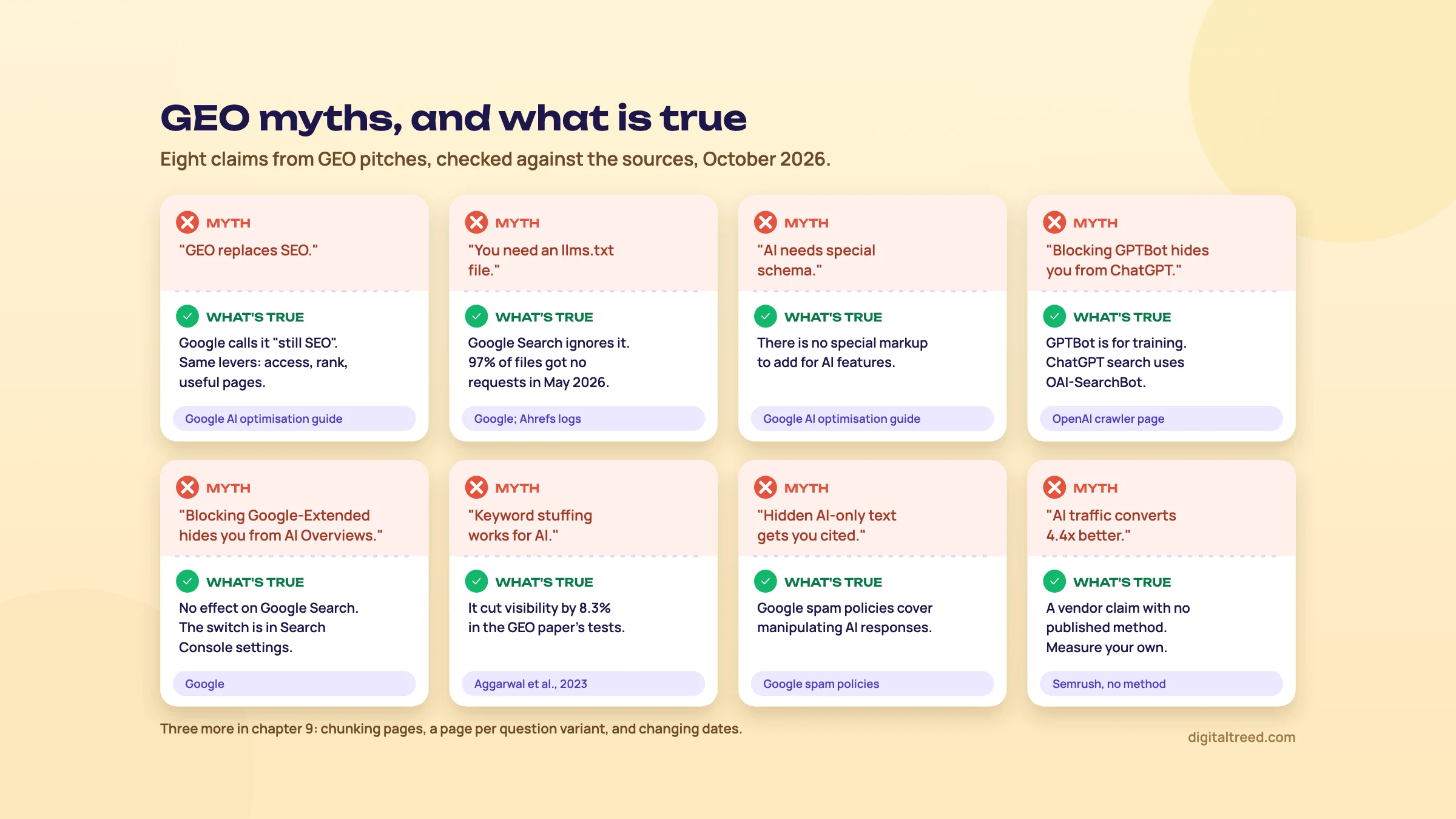 GEO myths, checked against the sources, October 2026.
How to judge a GEO vendor
Clients now ask agencies and freelancers "can you get us into ChatGPT?", and some answer with promises no one can keep. Google's guidance on third-party SEO and "AEO/GEO" services says plainly that third-party tools don't have access to its internal ranking data.[3] Use that as your starting point.
Red flags:
- Guaranteed placement in ChatGPT, Perplexity or AI Overviews. AI answers are generated fresh each time, and no outside tool can see inside the engines.
- Hidden text for AI, or lines meant to instruct a chatbot
- Hundreds of near-identical pages, one for every question variant
- An llms.txt file sold as the main GEO deliverable
- Claims to use "internal" Google data or a secret AI ranking score
- Paid "mentions" placed in bulk on forums or listicles
Questions to ask before you sign:
- Which engines will you track, and which prompts? Can I see the list?
- How do you measure, and will I get the raw prompt log and screenshots?
- What exactly will you change on my site?
- What will you do off the site, and how does it stay within Google's and Bing's spam rules?
- What do you report each month besides citations: branded searches, leads, sales?
Do not
- Pay for guaranteed AI rankings
- Accept a report of citations with no prompts or dates
- Let anyone add hidden text or mass pages to your site
- Judge the work on one month of results
Do
- Ask for the prompt list and the method up front
- Check access and the SEO base first (chapter 6)
- Expect content, brand and measurement work you can see
- Review results over at least three months
Do not implement risky and spammy tactics just to rank in AI search.[47]
He wrote that after a site's AI-generated section was hit by a Google manual action for scaled content abuse, and its ChatGPT citations for that section largely disappeared too. Whatever loses Google's trust tends to lose AI visibility with it.
If you'd like us to run the 30-day plan with you, see our SEO service and content marketing service, or get a quote. Otherwise, start week 1 today, and take the 10-question quiz below to check what stuck.
Test yourself
Ten questions on the whole guide. Pick an answer, check it, and see your score at the end.
You got 0 of 10 right.
Frequently asked questions
Frequently asked
What is generative engine optimization (GEO)?
GEO is the work of getting your content used and cited in AI answers such as Google AI Overviews, AI Mode, ChatGPT and Perplexity. The term comes from a 2023 research paper by a team including researchers from Princeton University and IIT Delhi. Google's own view, from its May 2026 guide, is that optimising for generative AI search is optimising for the search experience, "and thus still SEO."
Is GEO different from SEO?
Mostly not. The base is the same: pages that can be crawled and indexed, that rank, and that genuinely help. What GEO adds is more weight on brand mentions across the web, on clear and sourced passages that are easy to quote, and new ways to measure, such as citation reports and prompt logs.
What is AEO?
Answer engine optimization. It's another label for the same work, named after "answer engines" instead of "generative engines". Google's guidance treats AEO and GEO the same way: as SEO for search experiences that now include AI answers.
How do I get my website cited by ChatGPT?
First make sure robots.txt allows OAI-SearchBot, the crawler ChatGPT search uses; blocking GPTBot only stops training. Then rank for the questions your buyers ask and the sub-questions around them, write clear sections with sourced numbers, and get mentioned on the sites AI answers already cite. Nobody can guarantee a citation, because answers are generated fresh each time.
How do I appear in Google AI Overviews?
Google says there are no additional requirements: the page must be indexed and eligible to show with a snippet. Check that Search Console's Search generative AI setting is on Include, that no nosnippet or noindex blocks the page, and that you rank for the question and the related questions AI Overviews fan out to.
Does llms.txt help with AI visibility?
There's no evidence that it does. Google Search ignores it and says it neither helps nor harms. In Ahrefs' study of 137,210 sites, 97% of llms.txt files got no requests at all in May 2026. It's harmless and can be useful for documentation sites, but it isn't a way to get cited.
Should I block GPTBot or other AI crawlers?
Decide by purpose. Blocking training crawlers such as GPTBot, ClaudeBot and CCBot keeps your content out of model training and keeps you in AI search answers. Google-Extended is the exception: blocking it also stops the Gemini app using your pages in its answers, though AI Overviews and AI Mode aren't affected. Blocking search crawlers such as OAI-SearchBot, PerplexityBot, Claude-SearchBot, Googlebot or Bingbot takes you out of those answers. Most businesses that want customers should keep every search crawler allowed.
Does structured data help AI citations?
Google says structured data isn't required for its AI features and there's no special schema.org markup to add. It's still worth using for rich results, and it must match what's visible on the page. Treat it as hygiene, not a GEO lever.
How can I see AI Overview traffic in Search Console?
Clicks and impressions from AI Overviews and AI Mode are counted in the Performance report under "Web", mixed with other results. The separate generative AI performance reports, available to all sites since 31 August 2026, show impressions by page, country and device, but no clicks or queries. For Microsoft Copilot, Bing Webmaster Tools' AI Performance report shows citations.
Can a small business in India get cited by AI answers?
Yes, in the same way it gets found in Google. Rank for the local questions buyers ask, keep your Google Business Profile and website facts current and matching, and get mentioned on trusted local sites and directories. We haven't found any India-specific study of AI citations or AI referral traffic yet, so we can't give you local numbers.
Sources
References
- GEO: Generative Engine Optimization (Aggarwal, Murahari, Rajpurohit, Kalyan, Narasimhan, Deshpande), arXiv / KDD 2024, v1 16 Nov 2023, v3 28 Jun 2024, accessed 16 Oct 2026
- GEO? AEO? LLMO? What's With All This AI Stuff? (slides), Patrick Stox, Ahrefs Evolve, 15 Oct 2025, accessed 16 Oct 2026
- Guidance on third-party SEO tools and services, Google Search Central, 5 Jun 2026, accessed 16 Oct 2026
- Generative AI in Search: Let Google do the searching for you, Google, 14 May 2024, accessed 16 Oct 2026
- Introducing ChatGPT search, OpenAI, 31 Oct 2024, updated 5 Feb 2025, accessed 16 Oct 2026
- Google AI Mode now available in India, Search Engine Land, Jun 2025, accessed 16 Oct 2026
- Google I/O 2026: all our announcements, Google, 20 May 2026, accessed 16 Oct 2026
- Alphabet Q2 2026 earnings: CEO remarks, Google, Sundar Pichai, 22 Jul 2026, accessed 16 Oct 2026
- ChatGPT reaches 900M weekly active users, TechCrunch, 27 Feb 2026, accessed 16 Oct 2026
- Google users are less likely to click on links when an AI summary appears in the results, Pew Research Center, 22 Jul 2025, accessed 16 Oct 2026
- AI traffic research study, SE Ranking, 18 Jun 2026, accessed 16 Oct 2026
- A new resource for optimizing for generative AI features, Google Search Central blog, John Mueller, 15 May 2026, accessed 16 Oct 2026
- Google's guide to optimizing for generative AI features on Google Search, Google Search Central, 15 May 2026, updated 10 Jul 2026, accessed 16 Oct 2026
- AI features and your website, Google Search Central, updated 10 Dec 2025, accessed 16 Oct 2026
- Spam policies for Google web search, Google Search Central, updated 28 Aug 2026, accessed 16 Oct 2026
- New opportunities, control and insights for website owners, Google, Mrinalini Loew, 3 Jun 2026, updated 31 Aug 2026, accessed 16 Oct 2026
- Search generative AI control, Search Console Help, accessed 16 Oct 2026
- Bing Webmaster Guidelines, Microsoft Bing, accessed 16 Oct 2026
- Bing adds GEO to official guidelines, expands AI abuse definitions, Search Engine Journal (Matt G. Southern), 27 Feb 2026, accessed 16 Oct 2026
- Evolving role of the index: From ranking pages to supporting answers, Bing Search blog (Madhavan, Risvik, Merchant), 6 May 2026, accessed 16 Oct 2026
- A reflection on SEO and AI search, Lily Ray, Substack, 19 Jan 2026, accessed 16 Oct 2026
- AI Mode webinar recap (Mike King with Andrea Volpini), iPullRank, 3 Jul 2025, accessed 16 Oct 2026
- Perplexity received 780 million queries last month, CEO says, TechCrunch, Aisha Malik, 5 Jun 2025, accessed 16 Oct 2026
- Only 12% of AI Mode Citations Match URLs in the Organic SERP, Moz, Chima Mmeje, 18 Feb 2026, accessed 16 Oct 2026
- Latest Google Search documentation updates, Google Search Central changelog, accessed 16 Oct 2026
- More ways to connect with the web from Search, Google, Hema Budaraju, 15 Oct 2026, accessed 16 Oct 2026
- ChatGPT search, OpenAI Help Center, article 9237897, accessed 16 Oct 2026
- Overview of OpenAI crawlers, OpenAI, accessed 16 Oct 2026
- AI platform citation patterns, Profound, 5 Jun 2025, updated Aug 2025, accessed 16 Oct 2026
- Do AI assistants prefer to cite fresh content?, Ahrefs, Ryan Law, 28 Jul 2025, accessed 16 Oct 2026
- Perplexity crawlers, Perplexity, accessed 16 Oct 2026
- Perplexity statistics, AIRefs, accessed 16 Oct 2026
- Are citations in AI search affected by Google updates?, Lily Ray, Substack, 17 Feb 2026, accessed 16 Oct 2026
- Google's common crawlers, Google Search Central, updated 15 Oct 2026, accessed 16 Oct 2026
- AI citation trends report Q1 2026, Tinuiti with Profound, 2026, accessed 16 Oct 2026
- IndexNow, IndexNow.org, accessed 16 Oct 2026
- Where do DuckDuckGo search results come from?, DuckDuckGo Help, accessed 16 Oct 2026
- Introducing AI Performance in Bing Webmaster Tools (public preview), Bing Webmaster blog, 10 Feb 2026, accessed 16 Oct 2026
- Does Anthropic crawl data from the web, and how can site owners block the crawler?, Claude Help Center, 7 Apr 2026, accessed 16 Oct 2026
- Anthropic appear to be using Brave to power web search for Claude, Simon Willison, 21 Mar 2025, accessed 16 Oct 2026
- Generative Engine Optimization: How to Dominate AI Search (Chen, Wang, Chen, Koudas), arXiv, 10 Sep 2025, accessed 16 Oct 2026
- Surging in ChatGPT, dead in Google, GSQi, Glenn Gabe, 22 Jun 2026, updated 3 Aug 2026, accessed 16 Oct 2026
- AI Overview citations and the top 10 (update), Ahrefs, Louise Linehan, 2 Mar 2026, accessed 16 Oct 2026
- C-SEO Bench: Does Conversational SEO Work? (Puerto, Gubri, Green, Oh, Yun), arXiv / NeurIPS 2025 Datasets and Benchmarks, v3 20 Oct 2025, accessed 16 Oct 2026
- Lily Ray: what the SEO industry is getting dangerously wrong about AI search, PPC Land, 14 May 2026, accessed 16 Oct 2026
- AIO impact on Google CTR: September 2025 update, Seer Interactive, 4 Nov 2025, accessed 16 Oct 2026
- When MT AI crumbles, ChatGPT follows, GSQi, Glenn Gabe, 20 Apr 2026, accessed 16 Oct 2026
- Core roars back: Google May 2026 core update analysis, GSQi, Glenn Gabe, 10 Jun 2026, accessed 16 Oct 2026
- Creating helpful, reliable, people-first content, Google Search Central, updated 5 Oct 2026, accessed 16 Oct 2026
- What our AI Mode user behavior study reveals about the future of search, Search Engine Journal, Kevin Indig, 7 Oct 2025, accessed 16 Oct 2026
- SEO expert releases AI search content optimization checklist, PPC Land, 18 Jun 2025 (checklist released 16 Jun 2025), accessed 16 Oct 2026
- How users read on the web, Nielsen Norman Group, Jakob Nielsen, 1997, accessed 16 Oct 2026
- Top ways to ensure your content performs well in Google's AI experiences on Search, Google Search Central blog, John Mueller, 21 May 2025, accessed 16 Oct 2026
- AnswerThePublic pricing, AnswerThePublic, seen 16 Oct 2026
- It works, until it doesn't: AI content risks, Lily Ray, Substack, 13 May 2026, accessed 16 Oct 2026
- Google Search's guidance on using generative AI content on your website, Google Search Central, updated 1 Oct 2026, accessed 16 Oct 2026
- AI Overview brand correlation study, Ahrefs, Louise Linehan, 26 May 2025, accessed 16 Oct 2026
- About knowledge panels, Google Search Help, accessed 16 Oct 2026
- Structured data markup that Google Search supports, Google Search Central, updated 15 Jun 2026, accessed 16 Oct 2026
- From query to condition, Jono Alderson, 27 Sep 2026, accessed 16 Oct 2026
- The December 2025 core update: observations on 4 sites that did well, Marie Haynes, 20 Feb 2026, accessed 16 Oct 2026
- Vernacular SEO case study: Bajaj Finserv, Techmagnate, no date shown (agency's own claim), accessed 16 Oct 2026
- How to plan 2027 when traffic is down and AI won't attribute, Growth Memo, Kevin Indig and Amanda Johnson, 5 Oct 2026, accessed 16 Oct 2026
- Wikipedia: Paid-contribution disclosure, Wikipedia, accessed 16 Oct 2026
- Reddit Rules, Reddit Inc., accessed 16 Oct 2026
- Local Consumer Review Survey 2026, BrightLocal, 11 Feb 2026, accessed 16 Oct 2026
- Branding in the age of AI and zero-click SERPs (The Search Session, ep. 28), Advanced Web Ranking, 1 Sep 2025, accessed 16 Oct 2026
- Ahrefs pricing, Ahrefs, seen 16 Oct 2026
- How web search works in Microsoft Copilot Chat and agents, Microsoft Support, accessed 16 Oct 2026
- About Applebot, Apple Support, accessed 16 Oct 2026
- Meta web crawlers, Meta for Developers, accessed 16 Oct 2026
- CCBot, Common Crawl, accessed 16 Oct 2026
- How Google interprets the robots.txt specification, Google, updated 31 Aug 2026, accessed 16 Oct 2026
- New location for the Google crawlers' IP range files, Google Search Central blog, 31 Mar 2026, accessed 16 Oct 2026
- The crawl-to-click gap: Cloudflare data on AI bots, training, and referrals, Cloudflare blog (João Tomé), 29 Aug 2025, accessed 16 Oct 2026
- In-depth guide to how Google Search works, Google Search Central, updated 18 Dec 2025, accessed 16 Oct 2026
- Inside Googlebot: demystifying crawling, fetching, and the bytes we process, Google Search Central blog (Gary Illyes), 31 Mar 2026, accessed 16 Oct 2026
- The rise of the AI crawler, Vercel and MERJ, 17 Dec 2024, accessed 16 Oct 2026
- Google says LLMs.txt is purely speculative for now, Search Engine Journal (Roger Montti), 2 Jun 2026, accessed 16 Oct 2026
- The /llms.txt file, v2, Jeremy Howard, llmstxt.org, 3 Sep 2024, updated 10 Aug 2026, accessed 16 Oct 2026
- llms.txt tracking study, Originality.ai, updated 2 Jul 2026, accessed 16 Oct 2026
- We analyzed 137K sites: 97% of llms.txt files never get read, Ahrefs (Louise Linehan), 15 Jun 2026, accessed 16 Oct 2026
- Google says no AI system currently uses LLMs.txt, Search Engine Roundtable, 18 Jun 2025, accessed 16 Oct 2026
- Introducing Search Generative AI performance reports in Search Console, Google Search Central blog (Hillel Maoz, Moshe Samet), 3 Jun 2026, note added 31 Aug 2026, accessed 16 Oct 2026
- Introducing the branded queries filter in Search Console, Google Search Central blog, 20 Nov 2025, accessed 16 Oct 2026
- Adding context to your Search Console data with custom annotations, Google Search Central blog, 17 Nov 2025, accessed 16 Oct 2026
- How to find and organize AI Mode queries via the Search Analytics API, Analytics Edge, and Claude Cowork, GSQi (Glenn Gabe), 13 Aug 2026, accessed 16 Oct 2026
- New AI visibility insights in Bing Webmaster Tools: Intents, Topics, Citation Share, Compare, Bing Search Blog, 16 Jun 2026, accessed 16 Oct 2026
- [GA4] What's new in Google Analytics, Analytics Help, answer 9164320, entry of 13 May 2026, accessed 16 Oct 2026
- [GA4] Default channel group, Analytics Help, answer 9756891, accessed 16 Oct 2026
- Custom channel groups, Analytics Help, accessed 16 Oct 2026
- Ahrefs Webmaster Tools: free SEO tools to grow your site, Ahrefs, accessed 16 Oct 2026
- Average LLM visitor worth 4.4x organic search visitors, MarTech (owned by Semrush), Mike Pastore, 13 Jun 2025, accessed 16 Oct 2026
- Semrush prices, Semrush, seen 16 Oct 2026
- SE Ranking subscription plans, SE Ranking, seen 16 Oct 2026
- Surfer pricing, Surfer, seen 16 Oct 2026
- Frase pricing, Frase, seen 16 Oct 2026
Get the free checklist
Every step of this guide on one page, to print or tick off. We email you the PDF link.