

Is SEO still worth learning in 2026?
This is guide 4 of 5 in our SEO learning path. Guides 1 to 3 teach the work itself. This one is about making a living from it: who is hiring, what the jobs pay, how to start freelancing, how to get paid from abroad, how to learn in 90 days, and where search is heading. Guide 5 then covers GEO, getting cited by AI answers.
It's written for students, freshers, career switchers and freelancers in India. There are ten chapters, about 73 minutes in all. If you're still deciding, read chapters 1 to 4 first. If you already have the skills and want clients, go to chapters 5 and 6. If you want to start learning today, chapter 7 has the plan.
The author, Aijaz Alam, is the founder and CEO of DigitalTreed and has spent more than a decade in digital marketing as a consultant, trainer and author. Every salary, fee and rule here comes with its source and a date. Where sources disagree, or a figure comes from a small sample or a vendor's own claim, the text says so. Chapter 6 is general information from official sources, not tax advice.
Quick answer
SEO isn't dead, but clicks are harder to get. When Google showed an AI summary, people clicked a normal result in 8% of visits, against 15% without one (Pew, US, March 2025). Google says normal SEO is still how pages appear in its AI features, and most companies haven't cut SEO budgets.
If you're a student, a fresher or someone thinking of switching careers, you've probably seen the posts: "SEO is dead", "AI killed SEO", "learn prompt engineering instead". You've also seen institutes promising a job in 90 days. Both are selling something. This chapter puts the data from both sides on one page, dated, so you can decide for yourself.
Why people say SEO is dead
There are real reasons behind the headlines. Google now answers many questions on the results page itself, first with featured snippets and now with AI Overviews and AI Mode. ChatGPT, Gemini and Perplexity answer questions without sending anyone to a search engine at all. If fewer people click, the thinking goes, fewer people need to be paid to win those clicks.
The claim itself is old. In 2024 Google's Gary Illyes poked fun at it in a LinkedIn post: "Looking at the history of search engines and according to these posts, SEO has been dying since cca 2003."[1] Every big change to search brings a wave of these posts. That doesn't mean nothing is changing this time. It means "dead" is the wrong word, and "different" is closer.
Guide 1's chapter on AI answer engines explains how those AI tools find and pick sources. Here we stick to what it means for your career.
What the data shows
Start with clicks, because that's where the worry is. Pew Research Center tracked the browsing of 900 US adults in March 2025, covering 68,879 Google searches. Its findings:[2]
So when an AI summary appeared, people clicked a regular result about half as often, and only 1% clicked a link inside the summary. More of them simply ended their browsing session.
Zero-click searches, where nobody clicks anything, point the same way. SparkToro's 2024 study with Datos data found 58.5% of US Google searches ended without a click.[3] Its 2026 study, using Similarweb data, put the figure at 68.01% for January to April 2026.[4]
Note
Zero-click figures from different data providers can't be joined into one trend line. SparkToro switched from Datos to Similarweb between those two studies, and coverage of the 2026 study points out that different panels and methods make the two hard to compare. The 2026 study gives its own figure for 2024, 60.45%, so read 58.5% and 68.01% as two separate snapshots.
Now the other side. The total number of searches is still growing. Datos clickstream data, presented by Rand Fishkin and Will Critchlow in a 2025 SearchPilot webinar, showed browser searches on Google grew 22% in 2024, about one trillion extra searches.[5] Their summary: clicks per search are falling, but there are many more searches. Their advice was to measure impressions and assisted conversions as well as clicks.
8% vs 15%
visits with a click on a normal result, with and without an AI summary (US, March 2025)[2]
68.01%
US Google searches with no click, January to April 2026 (SparkToro, Similarweb data)[4]
+22%
growth in browser Google searches in 2024 (Datos data)[5]
65%
of SEOs in SEJ's State of SEO 2026 survey expected no SEO spending cuts the next year[6]
What Google says
Google's own documentation is clear on one point: you don't need a separate discipline to appear in its AI features. Its page on AI features says: "There are no additional requirements to appear in AI Overviews or AI Mode, nor other special optimizations necessary."[7]
In May 2026 Google published a full guide on optimising for generative AI search. On the new labels people sell, AEO and GEO, it says optimising for generative AI search "is optimizing for the search experience, and thus still SEO."[8]
That matters for your career choice. The skills you learn for classic SEO (making pages Google can crawl and index, answering real questions well, earning mentions and links) are the same skills Google says it uses for AI answers. You aren't learning something that expires next year. Guide 5 covers GEO, getting cited by AI answers, in detail.
What companies are doing with budgets
Search Engine Journal's State of SEO 2026 report surveyed 371 SEO professionals in 52 countries and came out in September 2025.[6] Only 43% said their company had cut any SEO spending in the past year, and 65% expected no cuts in the next. At the same time, 77% were worried that AI answers would reduce clicks to websites.[6]
Read that carefully. Most companies are still paying for SEO, and most SEOs are nervous. Both are true. It's a survey of SEO people, mostly about their employers and clients, so it tells you about sentiment and spending plans, not about job numbers. Chapter 2 has the job numbers.
I don't think SEO is dead. If anyone is prepared for this shift, it's SEO professionals.[9]
In the same interview she said that much of what SEOs have done for years, structuring content, understanding searcher intent and optimising for machines, carries over well to AI search.
So, should you learn it?
Our honest answer: yes, if you like working out why something happened and fixing it. SEO is part analysis, part writing, part technical work, and part explaining all of that to someone who doesn't care about any of it. If two or three of those sound fun, you'll do fine.
It's a poor choice if you want quick income. Courses that promise you'll "earn lakhs in a month" are selling the course, not the career. Expect months of practice before anyone pays you, and a year or two before you're good.
And be careful which part of SEO you bet on. US job ads already show content-only roles shrinking and technical SEO in demand (chapter 2 has the numbers). Writing blog posts around keywords is the part AI copies most easily. Fixing a slow site, reading data and earning links are harder to replace.
Pros
- Demand is moving towards senior, technical and data skills, which pay more (chapter 2)
- Over 40% of US SEO listings were remote in late 2025, so location matters less[10]
- It costs almost nothing to learn: free Google tools, free courses, one small site
- You can prove your skill with your own site before anyone hires you
Cons
- Fewer entry-level rungs: in late 2025, 59% of US SEO listings were leadership roles[10]
- Content-only roles are shrinking first
- Clicks per search are falling where AI answers appear, so results are harder to show
- Results take weeks or months, and clients can be impatient
Here's what the work looks like when it goes right, from our own client work:
Note
From our work: a global sports platform. Its technical SEO was already good, but its posts linked to no outside sources, and earlier link building had been spammy. We added sourced sports statistics to the posts. Other sites started asking to collaborate, which brought contextual links and brand mentions, and traffic rose 60%.
Notice what did the work there: original data and relationships with other sites. Neither of those is going away because of AI answers, and Google's own advice for AI search asks for exactly that kind of non-commodity content.[8]
If you'd like a quick, practical look at the AI side today, check whether AI search bots can read a site you know.
Next, chapter 2 looks at who is actually hiring SEOs, how many jobs there are, and what those jobs ask for. Chapter 9 comes back to the future of SEO in more depth.
SEO jobs and global demand: who is hiring and for what
Quick answer
On 16 October 2026 LinkedIn showed 2,000+ SEO jobs in India, 5,000+ in the US and 17,000+ worldwide, and it rounds these counts. Demand is moving to senior, technical and data roles: technical SEO appeared in 75% of US listings in late 2024, while content-only SEO roles fell 28%.
"Scope of SEO in India" is one of the most searched career questions, and most answers to it are a paragraph of adjectives. Here are the counts we could actually get, with dates, and what the job ads behind them ask for.
How many SEO jobs there are
We searched LinkedIn's public job search for "SEO" on 16 October 2026, without logging in.[11] For the UK we also used ITJobsWatch, which tracks permanent IT job ads that mention SEO.
| Where | Count | What it counts | Date |
|---|---|---|---|
| India | 2,000+ | LinkedIn job ads matching "SEO" | 16 Oct 2026 |
| United States | 5,000+ | LinkedIn job ads matching "SEO" | 16 Oct 2026 |
| United Kingdom | 1,000+ | LinkedIn job ads matching "SEO" | 16 Oct 2026 |
| United Kingdom | 955 | Permanent IT job ads citing SEO, 6 months to 15 Oct 2026 (584 in the same period of 2025)[12] | 15 Oct 2026 |
| Worldwide | 17,000+ | LinkedIn job ads matching "SEO" | 16 Oct 2026 |
Warning
Job counts on LinkedIn are rounded and capped. Use them as a rough size, not an exact number. A search for "SEO" also catches marketing roles that only mention SEO in passing.
When we searched on 21 October 2026, Naukri listed 22,863 jobs for "seo", about 10,400 of them in marketing, with Delhi NCR (5,309), Mumbai and Bengaluru on top;[114] Indeed India showed about 12,000.[115] Those are keyword matches, so they include jobs that only mention SEO, and they change every day: search them yourself on the day you read this. Naukri is where most Indian agencies and companies post; LinkedIn is better for in-house roles and remote roles abroad.
The UK figure is worth a second look. ITJobsWatch counted 955 permanent ads citing SEO in the six months to 15 October 2026, up from 584 in the same period a year earlier.[12] That's one country and one kind of job board, but it's a rise, not a fall.
What employers are hiring for
The best recent study of what SEO job ads ask for is Semrush's. It analysed 3,900 SEO listings on Indeed in the US, captured on 25 November 2025 and published in March 2026.[10] It's US data, so read it as a picture of the biggest SEO job market, not of India.
- 59% of listings were leadership roles (head, director, VP, lead).
- SEO Specialist was 15% of job titles, and SEO Manager 10%.
- The skills asked for most were communication and project management at every level, plus experimentation for senior roles.
- Google Analytics was the tool named most, in 33.5% of senior listings and 47.7% of the rest.
For senior listings the order changes: Google Analytics 33.5%, project management 31%, communication 26.5%, experimentation 23.9%, Google Ads 20.2%, site speed and Core Web Vitals 18%, keyword research 10.6% and SQL 9.5%. Seniors are hired to run tests and teams; juniors to do the research and report on it. Chapter 3 turns this into a skills list by level.
The 2024 trend: fewer content roles, more technical ones
SEOJobs.com and Previsible looked at about 10,000 US SEO jobs posted in 2024.[13] Three findings stand out:
- Openings and the number of companies hiring fell in the last quarter of 2024.
- Content-related SEO roles fell 28% year over year.
- Technical SEO was a required skill in 75% of listings in Q4 2024, up from 71% the quarter before.
Previsible's report on the same data adds that 65% of the jobs were in-house and 35% at agencies, and that the share of listings asking for AI skills rose from 16% in the first quarter of 2024 to 21% in the fourth.[14]
75%
of US SEO listings required technical SEO in Q4 2024[13]
-28%
content-related SEO roles in the US, 2024 against 2023[13]
40%+
of US SEO listings were remote in November 2025[10]
If you're starting out in India, the message is simple. Don't plan a career around writing keyword blog posts alone. Learn the technical side (Guide 3) and how to read data (Guide 2's chapter on measuring SEO), even if content is what you enjoy most.
New AI-search roles
A small set of jobs now carry AI search in the title. Kaleigh Moore tracked postings for about two weeks in mid-2026 and found more than 50 dedicated AI search roles at more than 50 companies, counting only full-time roles built around AI visibility, AEO or GEO.[15] Examples include an "AEO & SEO Manager" at Experian and a GEO/AEO growth marketing specialist at Odoo (chapter 4 has their pay).
Fifty roles is a tiny number next to thousands of SEO ads. Most of the AI-search work is being folded into normal SEO jobs, which fits what Google says: it's still SEO. In Semrush's data, AI search terms (SGE, AEO, AI search) appeared in only 6.3% of senior and 3.7% of other listings in late 2025, even though general AI skills appeared in 31% and 22.3%.[10]
Remote work
Over 40% of US SEO listings were remote in November 2025: 43% of senior roles and 41.5% of the rest.[10] A year earlier the picture was less rosy. In 2024, SEOJobs.com counted 34% remote, 45% onsite and 21% hybrid, and noted that return-to-office policies were pushing remote roles down.[13]
Most remote US roles still want people who can work US hours and are eligible to work there. We found no reliable figure for how many Indians work remotely for foreign employers in SEO. If you read a confident number somewhere, ask where it came from.
Countries that hire Indian freelancers
The data here is old, so treat it as background. A PayPal survey of 500 Indian freelancers[16], reported in January 2018, named Australia, the US and the UK among their main markets, and 80% had both Indian and foreign clients.[17] In July 2017, the Oxford Internet Institute's Online Labour Index found India supplied 24% of the online freelance workers it observed, more than any other country.[18]
Payment provider Skydo lists the US, UK, Australia, Canada and Singapore as the leading client markets for Indian freelancers, but it names no survey behind that list.[19] In practice, these are English-speaking markets with higher rates than India, and their time zones overlap at least partly with ours.
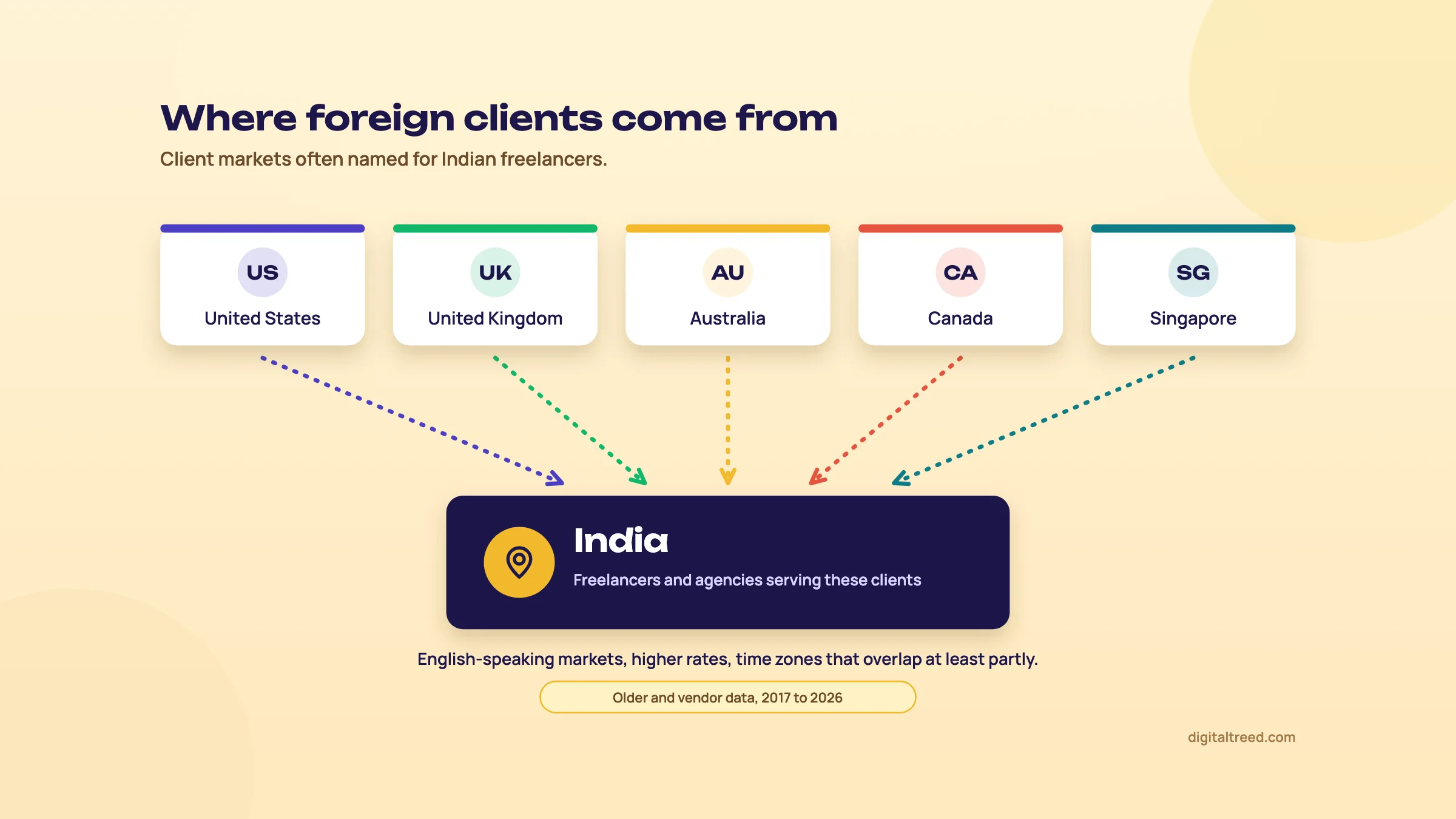 The client markets most often named for Indian freelancers, from older and vendor data.
How big the SEO market is
Only orders of magnitude here. Research firms put the global market for SEO services at roughly $81 billion to $88 billion in their estimates for 2024 to 2026, and their figures differ because each defines the market differently.[20] In India, digital ad spend grew to ₹71,621 crore in 2025, according to the dentsu-e4m report.[21] That's advertising, not SEO, but it shows how much money Indian businesses now put into being found online.
The US government doesn't track SEO as its own job. The closest category in the Bureau of Labor Statistics handbook is market research analysts and marketing specialists: median pay $78,760 in May 2025, with employment projected to grow 7% from 2025 to 2035.[22] That's a proxy, not an SEO figure, so don't quote it as SEO pay.
Next, chapter 3 looks at the different SEO roles and paths these jobs fall into, and the skills each level needs. Salaries come in chapter 4.
SEO roles and career paths, and the skills for each level
Quick answer
There are five common paths: in-house at one company, agency work for many clients, freelancing, consulting, and earning from your own sites. Most people start in an agency or in-house as an executive or analyst. Beginners need keyword research, on-page SEO and Search Console; seniors need data, experiments and managing people.
"SEO" on a job ad can mean very different jobs. One person writes product descriptions for an online store, another argues with developers about JavaScript rendering, a third runs a team of twelve and spends the day in meetings. Knowing the paths helps you pick your first job on purpose, not by accident.
Five SEO career paths
| Path | What you do | Typical start | How income works | Main risk | Good for |
|---|---|---|---|---|---|
| In-house | SEO for one company's site, working with its product, content and tech teams | SEO executive or analyst | Salary (chapter 4) | Your growth depends on one company's priorities | People who like going deep on one site |
| Agency | SEO for many clients at once, with reports and deadlines | SEO executive or intern | Salary, sometimes small incentives | Long hours, many clients, some of them impatient | Freshers who want to see many sites fast |
| Freelance | You sell hours or monthly work to your own clients | After 1 to 3 years of practice, or alongside a job | Fees per project, hour or month (chapter 5) | Uneven income, finding clients yourself | People who can sell and manage themselves |
| Consultant | You sell advice and strategy; others do the work | After years of senior experience and a known name | Higher monthly or project fees | Needs reputation before it pays | Senior SEOs with a speciality |
| Own sites | You build sites and earn from ads, affiliate links or products | Any time, usually as a side project first | Ads, affiliate commission, sales | One Google update can cut your income | Patient people who like writing and testing |
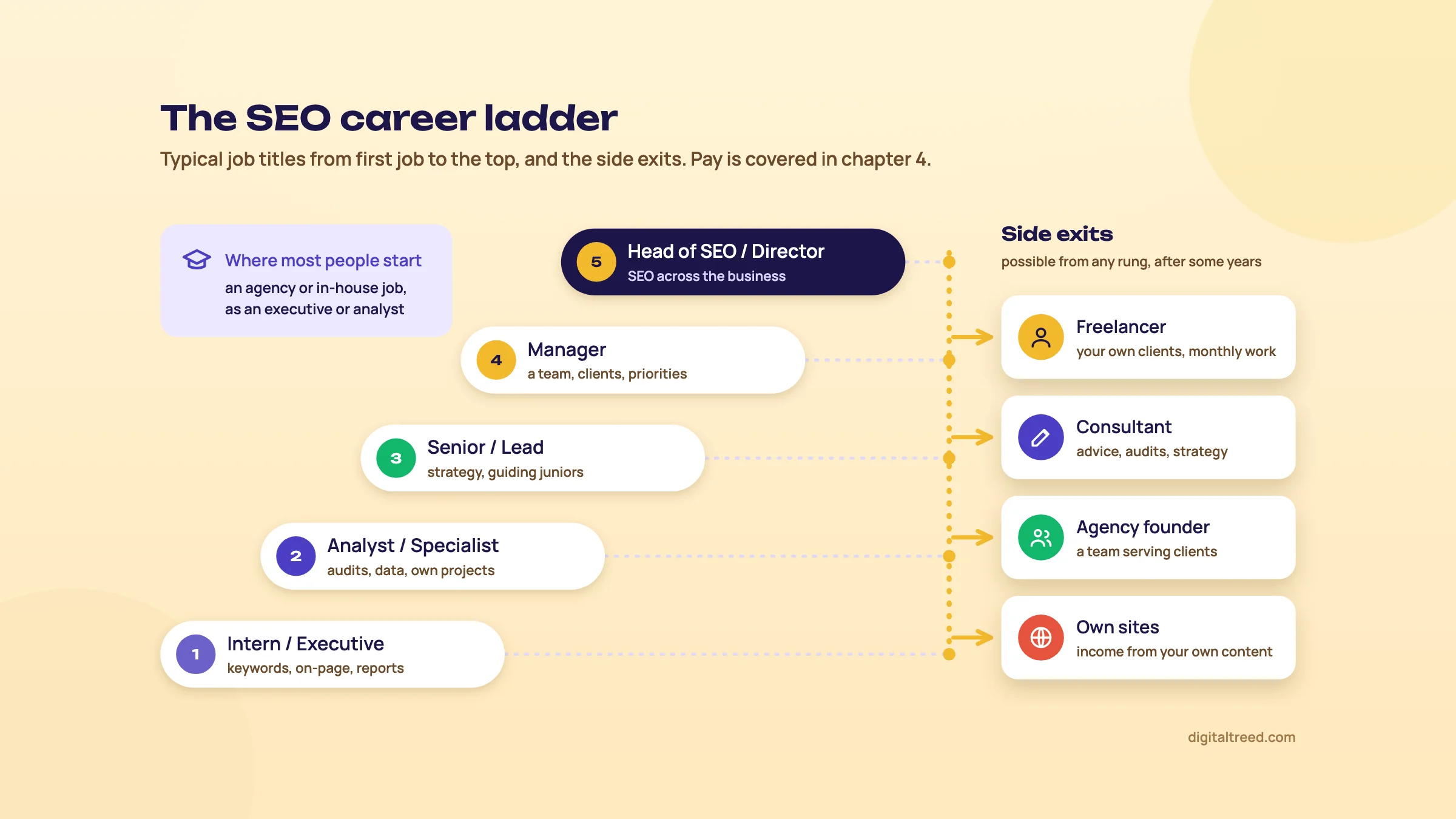 Five common rungs from first job to head of SEO, and the side exits open along the way.
In-house or agency for your first job?
In the US, about 65% of SEO jobs posted in 2024 were in-house and 35% at agencies, according to Previsible's summary of the SEOJobs.com report.[14] In India, small and mid-sized agencies hire a large share of freshers, though we have no count to back that up.
A day at an agency usually means three or four client sites, a keyword sheet for one, title fixes for another, and a monthly report due on Friday. In-house, you'll spend more time on one site, more time persuading other teams, and less time on reports nobody reads. We run an agency, so we're biased, but we'd still tell most freshers to start agency-side for a year or two. You'll see more sites, and more ways for them to break, than you would on one in-house site.
Pros
- Agency: many sites, many problems, fast learning
- Agency: senior colleagues to copy and ask
- In-house: you see what your work does to sales over months
- In-house: often better pay at product, SaaS and e-commerce firms (chapter 4)
Cons
- Agency: deadlines and client pressure, lower starting pay at small firms
- Agency: you rarely see the long-term result on one site
- In-house: slower learning if the company has one simple site
- In-house: you may be the only SEO, with nobody to learn from
Tip
Your first job title matters less than what you can show you did. "Executive" at one firm is "analyst" at another. A before-and-after Search Console chart from a site you worked on says more than either.
Freelancers and consultants
A freelancer mostly sells doing: audits, fixes, content, links, monthly SEO work. A consultant mostly sells advice: what to do, in which order, and why, while the client's team or another agency does the work. The line blurs, but pricing shows the difference. Freelancers are often paid by the hour or the month; consultants charge for decisions.
Eli Schwartz, a US SEO consultant, is a good example of the path. He freelanced on the side while still employed and went full time in April 2019.[23] Chapter 5 shows how his prices grew, and chapter 8 tells more stories like his.
Own sites, blogs and affiliate
Some SEOs never work for clients. They build their own sites and earn from ads, affiliate links or their own products. The upside is clear: you own the asset. The downside is that the traffic risk is entirely yours.
HouseFresh, an independent air purifier review site, is the warning: it lost most of its Google traffic in the March 2024 core update (chapter 8 has its story).[24] If you go this way, build an email list and a second traffic source early, before you need them.
Agency founder
Some freelancers hire help and become agencies. One example is E2M Solutions, a white-label partner for other agencies: they sell, E2M does the work under their name (chapter 8 tells how Manish Dudharejia built it).[25] Running an agency is a different job from SEO, mostly hiring, sales and cash flow, so go in knowing that.
Specialisations
After a year or two, most SEOs lean towards one area. Each one has its own chapters in this series:
- Technical SEO: crawling, indexing, site speed, migrations, JavaScript sites (Guide 3).
- Content SEO: keyword research, briefs, writing and refreshing pages (Guide 2, chapters 1 to 6).
- Local SEO: Google Business Profile, reviews and local pages for shops, clinics and service firms (Guide 2, chapter 10).
- E-commerce SEO: category and product pages, filters, product feeds (Guides 2 and 3).
- International SEO: several languages or countries, hreflang (Guide 3).
- Link building and digital PR: earning links and mentions from other sites (Guide 2, chapter 9).
- AI search (AEO/GEO): being cited in AI answers (Guide 5).
Technical SEO is the one we'd push freshers towards first. From our own training work:
Note
From our work: teaching SEO to working students. Our founder taught SEO from A to Z at a training institute, to students who were already doing client work. Using his methods, they saw results within 2 to 3 weeks. The hardest part for them was technical SEO, because most local business sites they handled ran on WordPress with shared hosting. The most common problem was site speed.
Skills for each level
The table below is our own mapping, built from what Semrush found in US job ads (chapter 2) and from Guides 1 to 3. It isn't a cited standard; use it as a checklist.
| Level | Skills | Where to learn it |
|---|---|---|
| Beginner (executive, analyst, 0 to 2 years) | Keyword research, on-page SEO (titles, headings, content), Google Search Console, Google Analytics, basic reporting | Guide 1; Guide 2 chapters 1, 7 and 11 |
| Intermediate (specialist, 2 to 5 years) | Technical SEO and audits, content strategy and briefs, internal linking and schema, digital PR, local SEO, clear monthly reports | Guide 2; Guide 3 |
| Senior (lead, manager, head of SEO) | SEO experiments, project and stakeholder management, SQL and data, working with product and engineering teams, AI search visibility | Guide 3; Guide 5; on-the-job experience |
At the senior end, the job is as much deciding what to work on as doing it. Tim Soulo's switch of the Ahrefs blog to keyword-led topics is a good example, and chapter 8 tells it.
Soft skills employers ask for
Two of the three most requested skills in US SEO job ads aren't SEO skills at all. In Semrush's late-2025 data, communication appeared in 39.4% of non-senior listings and project management in 37.1%.[10] For senior roles, the most requested degree was marketing, in 31.6% of listings.
That matches what the work needs. You'll explain to a shop owner why their new site lost traffic, ask a developer to fix something they think is fine, and plan three months of work across four people. Clear written English and the habit of writing things down will move you up faster than any extra tool.
it's this nice bridge between both computing and marketing.[26]
The quote is from 2020, but it still describes the job well: half the skill is technical, half is understanding people and markets.
On tools, learn the free ones first. Google Analytics was the tool named most in US listings (47.7% of non-senior roles), Google Ads came next, and Semrush was named in 9.6%.[10] Search Console and GA4 cost nothing. Learn one paid suite later, when a job or client pays for it.
Interview questions to prepare for
Interviewers want to see how you think through a real problem. These are common questions to prepare for. Practise an answer to each from your own site:
- A page lost half its clicks last week. What do you check first?
- How would you find keywords for a dental clinic in Lucknow?
- Search Console shows "Crawled - currently not indexed" for 200 pages. What does that mean, and what would you do?
- How do you decide whether to update an old page or write a new one?
- Walk me through how you'd audit a small WordPress site.
- What would you put in a monthly SEO report for a business owner who has five minutes?
- How does Google say a site can appear in AI Overviews?
- Show me something you ranked or improved, with numbers and dates.
Prepare the last one most carefully. It's the one you can only answer with proof, which is why chapter 7's 90-day plan ends with a written case study. Next, chapter 4 covers what each of these roles pays in India, the US, the UK and remotely.
SEO salary and income in India, the US, the UK and remote
Quick answer
In India, first-year SEO executives average about ₹2.1 lakh a year on AmbitionBox. Specialists earn roughly ₹3.5 lakh to ₹5.8 lakh, and managers ₹8 lakh to ₹10 lakh on average (PayScale and AmbitionBox, 2025-26). In the US, PayScale puts specialists at about $59,000 and managers at about $82,000 base. Sources disagree, so read ranges.
Search "SEO salary in India" and you'll get a dozen answers, many from institutes selling a course. The numbers below come from named salary sites and job-ad studies, each with its date and sample. Where two sources disagree, we show both and explain why.
Note
We read every salary on this page on 16 October 2026. Salary sites update often, so we review this chapter every 6 months. Figures are yearly and gross (before tax) unless we say otherwise.
India, by role
Two sources give usable Indian figures by role. PayScale shows averages from salary profiles people submit, with the 10th to 90th percentile range. AmbitionBox, run by Info Edge (the company behind Naukri), shows averages from far more salaries, split by years of experience.
| Role | PayScale (average base, 10th to 90th percentile) | AmbitionBox (average, by experience) |
|---|---|---|
| SEO Executive | No page | ₹2.7 lakh average; ₹2.1 lakh at 0 to 1 year, ₹2.5 lakh at 1 to 3 years, ₹3.4 lakh at 3 to 6 years. 20,800 salaries, updated 15 Oct 2026[27] |
| SEO Analyst | ₹2,95,899; ₹1.38 lakh to ₹5.2 lakh. 120 profiles, updated 10 Mar 2026[28] | ₹3.6 lakh average; ₹2.7 lakh at 1 to 3 years, ₹4.1 lakh at 3 to 6 years, ₹5.3 lakh at 6 to 9 years. 7,300 salaries, updated 15 Oct 2026[29] |
| SEO Specialist | ₹3,53,178; ₹1.75 lakh to ₹7.71 lakh. 148 profiles, updated 9 Apr 2026[30] | Typical ₹5.3 lakh to ₹5.8 lakh with 1 to 7 years; ₹3.4 lakh to ₹3.8 lakh at 1 to 3 years. 4,300 salaries, updated 15 Oct 2026[31] |
| SEO Manager | ₹8,03,036; ₹1.85 lakh to ₹20 lakh. 74 profiles, updated 14 Jun 2025[32] | ₹10.2 lakh average; ₹6.9 lakh at 3 to 6 years, ₹9 lakh at 6 to 9 years, ₹12.9 lakh at 12+ years. 4,300 salaries, updated 13 Oct 2026[33] |
The ranges inside each role are wide. On PayScale, the 90th percentile SEO manager earns about ten times the 10th percentile one. That gap is mostly about the kind of company. A small agency in a tier-2 city and a funded product company in Bengaluru both hire "SEO managers", and they don't pay the same. AmbitionBox lists Bengaluru as the top-paying metro for SEO executives, specialists and managers, and software product as a top-paying industry for analysts and specialists.[31]
We haven't published figures for head of SEO, technical SEO, content SEO or consultant roles in India. We couldn't find a source with enough salaries behind it. We'd rather leave a gap than print a guess.
Per month, in plain numbers
Most job offers in India are discussed per month, so here's our own arithmetic from the yearly averages above. These are gross figures before tax, PF and other deductions, so take-home pay will be lower.
- SEO executive in the first year: ₹2.1 lakh ÷ 12 ≈ ₹17,500 a month (AmbitionBox).
- SEO analyst: ₹2,95,899 ÷ 12 ≈ ₹24,700 a month (PayScale).
- SEO specialist: ₹3,53,178 ÷ 12 ≈ ₹29,400 a month (PayScale).
- SEO manager: ₹8,03,036 ÷ 12 ≈ ₹66,900 a month (PayScale).
Warning
This is general information from named sources as of October 2026, not tax or financial advice. In-hand pay depends on your salary structure and tax regime. Check with a chartered accountant for your case.
United States
US figures come in two kinds: what people report they earn (PayScale) and what job ads offer (Semrush, Rankability, SEOJobs.com). The two don't always agree. Our guess is that ad medians run higher when senior roles are more likely to list a salary, but Rankability's all-ads median of $65,000 sits close to PayScale's figures.
| Role or sample | Figure | Source and date |
|---|---|---|
| SEO Specialist | Average base $59,179; $44,000 to $80,000 (10th to 90th percentile); 444 profiles | PayScale, updated 21 May 2026[34] |
| SEO Manager | Average base $81,910; $56,000 to $116,000; 389 profiles | PayScale, updated 28 Feb 2026[35] |
| Job ads, senior (head, director, VP, chief, lead, executive) | Median $130,000 | Semrush, 3,900 Indeed listings, 25 Nov 2025[10] |
| Job ads, other SEO roles | Median $71,630 | Same study |
| All SEO job ads | Median $65,000; 19,205 postings | Rankability, Adzuna data, October 2025[36] |
| All SEO job ads, 2024 | Median fell from $90,000 (Q1) to $75,000 (Q4); VP of SEO $191,850 | SEOJobs.com, about 10,000 jobs, March 2025[13] |
Warning
Don't compare a US salary with an Indian one by currency conversion alone. Rent, healthcare, taxes and the cost of living differ, and most US jobs need the right to work there.
United Kingdom
UK salary data for SEO is thinner than you'd expect. PayScale's UK pages rest on very few profiles, so the job-ad data from ITJobsWatch is more useful here.
| Role or sample | Figure | Source and date |
|---|---|---|
| SEO Specialist | Average base £27,514; £21,000 to £43,000; only 38 profiles | PayScale, updated 6 Oct 2025[37] |
| SEO Manager | Average base £32,670; £25,000 to £62,000; only 15 profiles | PayScale, updated 30 Apr 2025[38] |
| Permanent IT jobs citing SEO | Median £45,000; 10th percentile £30,000, 90th £73,900; 573 salaries quoted | ITJobsWatch, 6 months to 15 Oct 2026[12] |
ITJobsWatch counts ads that mention SEO anywhere, including developer and marketing roles, so its median runs above pure SEO jobs. For head of SEO roles it had only two salaries in the latest six months, which is too few to use.[39]
Remote and AI-search roles
The new AI-search jobs pay at US senior levels. Experian listed an "AEO & SEO Manager" at $100,000 to $174,000, and Odoo a GEO/AEO growth marketing specialist at $75,000 to $95,000.[15] These are single ads from one tracker, not averages.
What an Indian SEO earns working remotely for a foreign company is the number everyone wants, and we found no reliable source for it. It depends on whether you're hired as an employee, through an agency, or as a contractor, and on which country's rates the company uses. Treat any single figure you see online with suspicion.
Freelancer income
Freelance income is the hardest to pin down, because nobody reports it to a salary site. The best known survey is old: BrightLocal's local SEO industry survey, published in January 2018, found freelance SEOs averaged $49,422 a year in personal income, against $66,617 for agency SEOs, with an average of 9 clients per freelancer.[40] That was eight years ago, before AI answers and before most of today's platforms changed their fees, so read it as history.
Individual stories show what's possible, not what's typical. US SEO consultant Eli Schwartz made over $150,000 freelancing part-time while still employed, by The SEO Freelancer's account, before he quit his job in April 2019.[23] Chapter 5 covers what freelancers charge per month and per hour, including Indian rates.
Why the numbers disagree
Six things explain most of the gaps between salary sites:
- Sample size: from 15 profiles (PayScale UK manager) to 20,800 salaries (AmbitionBox SEO executive).
- Base pay or total pay: some sites add bonus and profit sharing, some don't.
- Reported salaries or job ads: ads show what's offered now, and senior ads list pay more often.
- Job titles: "SEO executive" at one firm does the work of a "specialist" at another.
- City and company type: Bengaluru product firms and small-town agencies sit in the same average.
- Vendor models: some sites estimate salaries with their own models, not from reported pay. We left those out.
Use the sites for what each does best. PayScale is good for averages with a visible sample size. AmbitionBox is good for Indian experience bands and company-level figures. Job ads on Naukri and LinkedIn tell you what's being offered this month.
What moves your pay
The biggest jump is between rungs, not within one. In Semrush's US data, the median senior SEO ad paid $130,000 against $71,630 for other SEO roles.[10] On AmbitionBox, an Indian SEO manager with 12+ years averages ₹12.9 lakh, about six times a first-year executive.[33]
What gets you up the rungs faster:
- Technical and data skills. Technical SEO was required in 75% of US listings by late 2024 (chapter 2), and SQL shows up more in senior ads.
- A case study with numbers. One site you grew, with a dated Search Console chart, beats a list of tools on your CV.
- Clear spoken and written English, especially if you want foreign clients or employers.
- Managing people and projects. Most senior roles are as much about running work as doing it.
- Choosing the right employer. Product, SaaS and e-commerce companies tend to pay at the top of the Indian ranges.
Next, chapter 5 shows how to start freelancing step by step, including what to charge.
How to start SEO freelancing, step by step
Quick answer
Start with one service you can do well, such as an SEO audit or local SEO for small businesses. Build proof on a site you control, write it up with numbers, then pitch through LinkedIn, referrals or Upwork. Charge a monthly retainer with a written scope. Upwork's fee is 0 to 15%; Fiverr keeps 20%.
Freelancing is the path many Indian SEO learners want, and the one with the least honest advice online. Nobody hands you clients because you finished a course. Clients pay for a problem solved, and they want to see that you've solved it before. This chapter goes in the order the work actually happens: offer, proof, finding clients, pricing, proposal, contract, invoice, reporting.
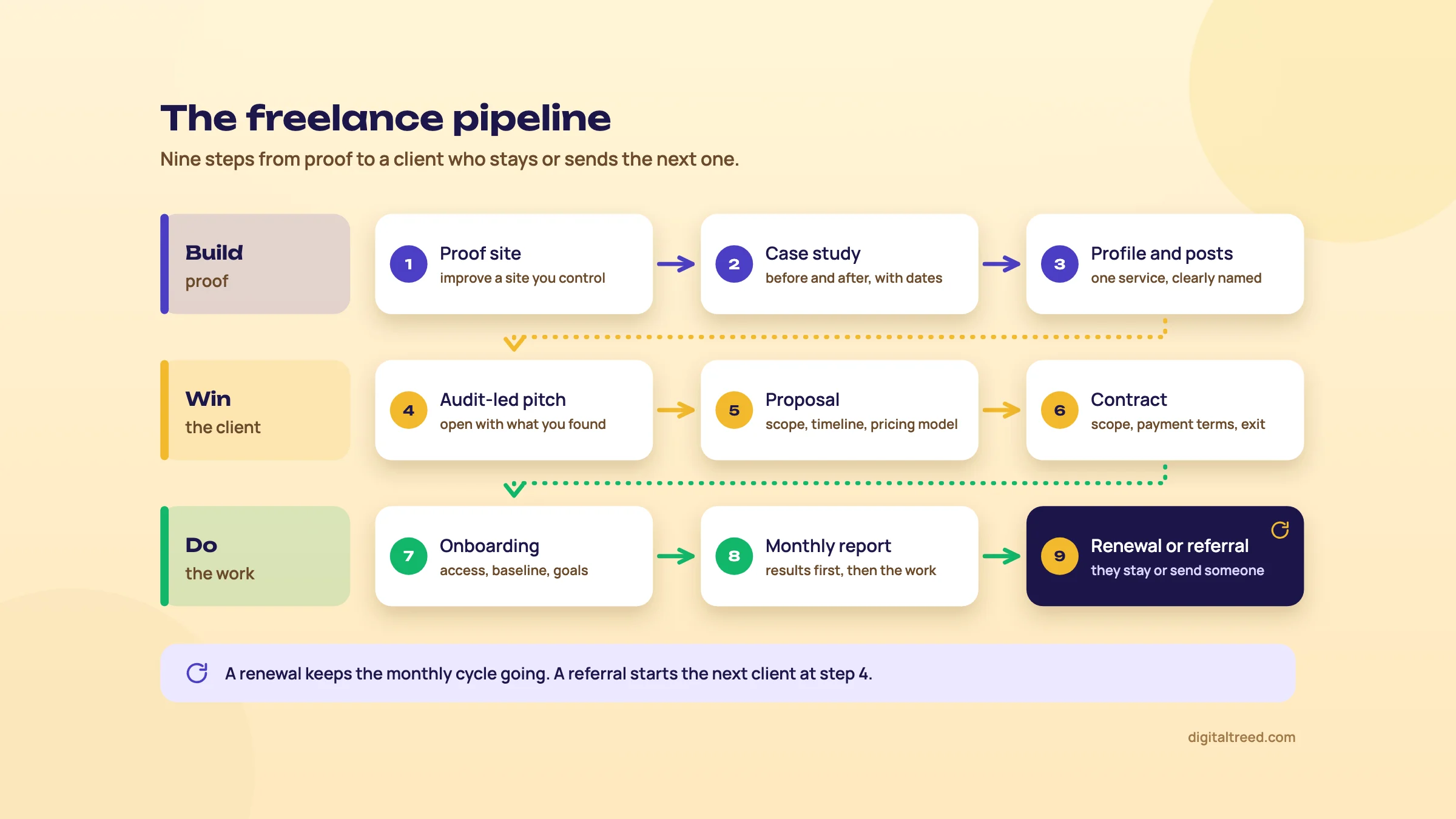 The freelance pipeline, from building proof to a client who renews or refers.
Start SEO freelancing in eight steps
- Pick one service and one kind of client For example, local SEO for clinics and shops in your city, or SEO audits for small foreign businesses.
- Build proof before the first client Improve a site you control, record Search Console clicks before and after, and write a one-page case study with dates.
- Set up where clients find you A LinkedIn profile that names your one service, plus Upwork or Fiverr if you want a marketplace.
- Price your work Choose a model (monthly, project or hourly) and work out your minimum rate from your costs and hours.
- Write the proposal Show a problem you found on their site, your first actions, deliverables and timeline, and what you won't promise.
- Agree a written contract Scope, deliverables, reporting, payment terms, notice period, and who owns the content and accounts.
- Invoice and get paid Send a proper invoice with your details and the client's, and ask for an advance.
- Report monthly and keep the client Send a short report on clicks, queries and leads, and the plan for next month.
Step 1: pick one service and one kind of client
"I do SEO" is hard to buy. "I fix local SEO for dental clinics in Pune" is easy to say yes or no to. Pick one service you can deliver well and one kind of client you understand:
- SEO audits: a one-off report with priorities. Good first product, because it has a clear end.
- Local SEO: Google Business Profile, reviews, local pages. Indian small businesses need it and understand it quickly (Guide 2, chapter 10).
- Technical fixes on WordPress sites: speed, indexing, redirects (Guide 3).
- Content SEO: keyword research and briefs or pages for a store or blog (Guide 2).
Our view: local SEO for Indian small businesses, or audits for small businesses abroad, are the easiest first offers. Both have results a client can see, and neither needs a big tools budget.
Narrow offers also make the work itself sharper. From our own client work:
Note
From our work: a women's wear manufacturer's online store. We moved the product pages away from short, competitive keywords and onto long-tail keywords. Results started within a month.
Step 2: build proof before the first client
You don't need a client to have a case study. Use your own blog, a family business, or a friend's shop. Run our Free Website Audit on it, fix what it finds, and note the date of each change. After four to eight weeks, compare Search Console clicks and impressions before and after.
Then write one page: the site, the problem, what you changed and when, and the result with a chart. If nothing improved, write that up too, with what you'd try next. Clients trust an honest small result more than a vague big claim.
Tip
Your first case study can be your own site. Show the Search Console chart with dates on it.
Step 3: set up where clients find you
Freelancers find clients in four main places. Each has a different cost and speed.
| Channel | Cost to you | How fast | Best for |
|---|---|---|---|
| Upwork | Variable service fee of 0% to 15% per contract, shown before you bid; Freelancer Plus $19.99 a month with 100 Connects; extra Connects $0.15 each[41] | Slow at first: you compete on proposals with no reviews | Foreign clients who want to hire through a platform |
| Fiverr | The seller keeps 80% of each order[42] | Slow until a gig ranks inside Fiverr | Fixed packages like audits or on-page fixes |
| LinkedIn and your network | Free; costs time | Slow to build, then steady | Higher-value clients who hire people they know |
| Referrals and local networking | Free | Depends on your first few clients | Local businesses in your city |
Note
Old guides that quote Upwork's "20% on the first $500" are out of date. Upwork now uses a variable fee of up to 15%, and you see the exact fee before you submit a proposal. On Upwork's Direct Contracts the fee is 5%, or 0% with Freelancer Plus.[41]
LinkedIn is slower but tends to bring better clients. Eli Schwartz, the US SEO consultant from chapter 3, said his clients came through LinkedIn, conference talks and articles he wrote for Search Engine Journal and Search Engine Land. His biggest client, a public company, first reached him with a LinkedIn message.[23] You don't need conference talks to start. Posting one useful finding a week from your own SEO work is enough to begin.
Step 4: price your work
Most SEO providers charge a monthly retainer. In an Ahrefs survey of 439 SEO providers, 78.2% used monthly retainers, 48.9% charged per project and 34.8% charged by the hour (many used more than one).[43] The survey is several years old (the page was last updated in August 2024). It's still the only one we found with a separate India figure: 76% of Indian respondents charged $1,000 a month or less, and 85.7% charged $30 an hour or less.
| What | Range | Source and date |
|---|---|---|
| Indian freelancers, monthly | ₹10,000 to ₹25,000 | PW Skills blog, 2025[44] |
| Local SEO, single location, India | ₹8,000 to ₹20,000 a month (basic tier) | upGrowth blog, 30 Jun 2026[45] |
| Small local business, Bengaluru | ₹15,000 to ₹40,000 a month; freelancers ₹10,000 to ₹30,000 | OneCity blog, 2026[46] |
| Indian SEO providers, monthly | 76% charge $1,000 or less | Ahrefs survey, older data, page updated Aug 2024 |
| Upwork SEO experts, hourly | Median $21 an hour; most charge $15 to $35 | Upwork, seen Oct 2026[47] |
| Agencies (US, Canada, UK, Europe, Australia, New Zealand, Singapore), monthly | 64% charge under $1,000; 30% under $500 | SE Ranking, 260 agencies, Dec 2024[48] |
| Same agencies, hourly and per project | 45% charge $50 to $100 an hour; about 66% charge $500 to $2,000 per project | SE Ranking, Dec 2024 |
The Indian ranges come from agency and course-provider blogs, not surveys, so read them as what the market quotes, not as averages. The SE Ranking survey has no Indian agencies in it. And we didn't find any reliable survey of per-link prices, so we don't give one.
Note
How one consultant priced, in his words. Eli Schwartz started at $100 an hour. An early client took 20 hours a month, "two grand a month". He later moved smaller clients to retainers of about $1,000 to $3,000 a month, and quoted a large public company $10,000 a month. It asked him to send a contract that afternoon.[23] That's a senior US consultant with years of reputation, so use it to see how pricing grows, not as your starting rate.
How to set your own rate
Here's a simple method, with our own example numbers. Change them to yours.
- Decide the monthly income you need: say ₹40,000.
- Add your monthly costs: internet, laptop, tools, phone. Say ₹5,000.
- Add money to set aside for tax. Ask a CA what fits your case; we'll use ₹5,000 as an example. Total: ₹50,000.
- Count the hours you can bill. A full month is about 160 working hours, but finding clients, admin and learning eat a lot of it. Assume 60% are billable: 96 hours.
- Divide: ₹50,000 ÷ 96 ≈ ₹520 an hour. That's your minimum.
- Price monthly work from hours. A local SEO retainer that takes you 20 hours a month should be at least 20 × ₹520 ≈ ₹10,400.
That example lands inside the Indian ranges above, which is a good sanity check. If your number comes out far above the market, cut costs or find better-paying clients. If it's far below, you're probably underpricing.
We plan to build a free freelance SEO rate calculator for this. Until then, a Google Sheets file with the six lines above does the job.
Step 5: write the proposal
Good proposals are short and specific to the client. This outline works for most small clients:
- One problem you found on their site, with a screenshot (from our audit, Meta Tag Analyzer or Website Speed Test).
- Three to five first actions, in order.
- Deliverables: what they'll get each month, in plain words.
- Timeline: when they can expect to see the first changes in Search Console.
- Price, payment terms and notice period.
- What you won't promise.
The last point protects you. Never promise rankings or "page 1 in 30 days". Google's own guidance on third-party SEO services says: "Keep in mind that using a service or tool doesn't guarantee ranking success."[49] The same page names services "promising improvements for AI experiences" (sold as AEO or GEO) among those to think hard about, and says to be wary of any that claim Google approves them. Quote that line to clients; it makes you look honest, because you are.
Step 6: agree a contract
A one or two page agreement is enough for a small client. Put these in writing before you start:
- Scope: which site, which pages, which tasks. And what's not included, like content writing or paid ads.
- Deliverables and reporting: what you'll send and when.
- Payment terms: advance, monthly in advance, or milestones; and what happens if a payment is late.
- Notice period: how either side ends the work, for example 30 days.
- Access and ownership: you get access to Search Console and the CMS through your own login; the client owns the site, content and accounts.
Ask for an advance, at least for the first month. In a 2018 PayPal survey of Indian freelancers, about 61% said they had gone unpaid at least once.[17] That's old data, but it's a cheap habit that protects you.
Step 7: invoice and get paid
Send a proper invoice: your name and address, the client's, a number and date, what the work was, the amount and currency, and your payment details. Our Free Invoice Generator makes one as a PDF. For clients abroad, chapter 6 explains the payment routes (PayPal, Payoneer, Wise, Skydo), their fees, and the GST and income tax questions to take to a CA before your first foreign invoice.
Step 8: report monthly and keep the client
Clients get nervous when they don't know what's happening, even more than when results are slow. A short monthly report fixes that:
- Clicks and impressions from Search Console, against last month and the same month last year.
- Top queries and pages that moved.
- Leads, calls, orders or form fills, if they share them.
- What you did this month and what you'll do next.
Search Console now also has generative AI performance reports, open to all sites from 31 August 2026. They show impressions in AI Overviews and AI Mode, not clicks, so report them as visibility.[50]
Good reports tie the work to money where you can. From our own client work:
Note
From our work: a perfume brand. Its slow WordPress site was hurting crawling and indexing. With the client's developer we moved to a lighter theme, added a caching plugin and optimised the images. We wrote blog posts on topics its competitors covered, and synced the products to Google Merchant Center. Results came in 5 to 6 weeks, including organic orders.
If the client sells online, put orders from organic search on the first line of the report.
Do this, not that
Do not
- Promise rankings, or "page 1 in 30 days"
- Buy links for clients; it's their site that takes the risk
- Copy a proposal or outreach template word for word; Ahrefs warns that people have seen the original Skyscraper email too often[51]
- Start work without a written scope
- Take every kind of client in your first year
Do
- Send a short audit of their site with your pitch
- Put scope, price and notice period in writing
- Ask for an advance for the first month
- Get your own logins to their tools
- Report monthly, even when the month was quiet
For paid tools, wait. Search Console and GA4 are free and cover most small-client work. Buy a Semrush or Ahrefs plan when a client's fee pays for it, not before.
Next, chapter 6 covers how to get paid from abroad: fees, GST, LUT, section 44ADA and FIRA.
Getting paid from abroad: fees, GST, LUT, 44ADA and FIRA
Quick answer
Indian freelancers commonly get paid through PayPal, Payoneer, Wise or Skydo. Compare the total cost on your usual invoice, not the headline fee: PayPal takes 4.40% plus $0.30, then about 3% to convert. Exports of services can be GST-free under an LUT. Take your GST, 44ADA and FIRA questions to a CA.
Warning
This is general information from official sources as of October 2026, not tax advice. Check with a chartered accountant for your case.
Your first foreign client says yes. Then come the questions nobody on your course answered. Which app do I give them? Why did $500 turn into much less? Do I need GST? What's an LUT? This chapter answers what official pages and the providers' own fee pages say, and tells you plainly where the rules depend on your situation.
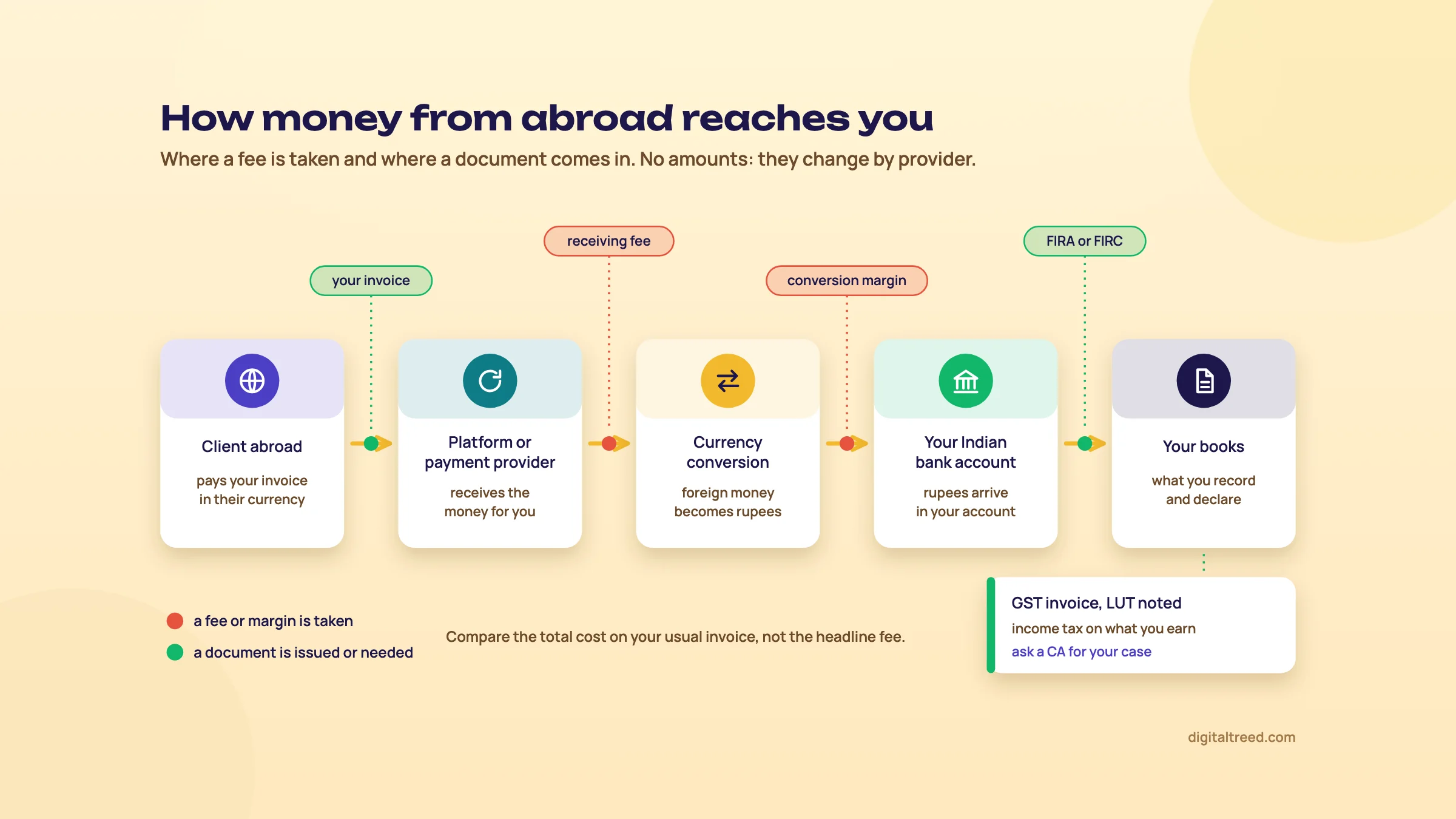 Where fees are taken and where documents come in as money travels from a foreign client to you.
Payment routes compared
Every route has two costs: a fee for receiving the money and a margin when dollars become rupees. Some also charge a yearly fee or GST on their fee. Here's what each provider's own page said when we read it on 16 October 2026.
| Provider | Receiving fee | Conversion to INR | Other costs and notes |
|---|---|---|---|
| PayPal India | 4.40% + fixed fee (USD 0.30) on international commercial payments[52] | 3.0% above the base exchange rate | Fee page last updated 28 March 2024 |
| Payoneer | 1% (minimum $1) into a receiving account in a currency other than your own, which for an Indian freelancer includes a USD, GBP or EUR account; up to 3.99% + $0.49 if the client pays by card[53] | 1.2% to 4% on withdrawal with conversion; no India-specific rate listed | $29.95 a year if you receive under $6,000 in 12 months |
| Wise (India) | Receiving is only for Wise Business customers; the page shows no separate receiving fee[54] | Depends on the currency; no single figure shown | 18% GST on Wise's fees |
| Skydo | $19 up to $2,000; $29 from $2,001 to $10,000; 0.3% above $10,000 (for its global bank accounts; payment links are priced separately)[55] | Advertises zero FX margin (its own claim) | FIRA by email or download; shows an "RBI PA-CB authorized" badge (its own claim); 18% GST on the fee in its example |
| Stripe (card payments) | Not researched for this guide | Not researched | Use our Stripe Fee Calculator with your own country settings |
Upwork and Fiverr take their own cut before any of this. Chapter 5 covers platform fees; here we start from the money that leaves the client's account or the platform.
Note
Fees change, and old blog posts quote old rates. Always check the provider's own page on the day you decide.
Which one should you use? We don't recommend one provider and we take no affiliate money from any of them. Work out the total cost on your usual invoice size, then check two things: does the client find it easy to pay, and do you get a FIRA without paying extra for it? A client in the US who already uses PayPal may refuse anything else, and that's a real cost too.
Worked example: a $500 invoice through PayPal
Say a client in the US pays you $500 through PayPal for an SEO audit. Using PayPal India's published rates:
- Receiving fee: 4.40% of $500 is $22.00, plus $0.30, so $22.30.
- That leaves $477.70 in your PayPal balance.
- Converting to rupees costs 3.0% above the base rate, about $14.33 on $477.70.
- What reaches your bank is worth roughly $463 at the base rate, about 7.3% less than you invoiced.
That's our arithmetic from PayPal's page, so check it in the tool with the day's rate. If the 7.3% hurts, you have two honest options. Quote in a way that covers it (our PayPal Fee Calculator has a reverse mode that tells you what to charge), or offer the client a cheaper route.
GST basics for exporting services
Under GST law, a service counts as an export of services only when all five conditions in section 2(6) of the IGST Act are met. CBIC reproduces them in its Circular 161/17/2021-GST:[56]
- The supplier of the service is located in India.
- The recipient is located outside India.
- The place of supply is outside India.
- The supplier receives payment in convertible foreign exchange, or in Indian rupees where the Reserve Bank of India allows it (words added from 1 February 2019).[57]
- Supplier and recipient aren't merely two establishments of the same person (for example, an Indian company and its own unincorporated branch abroad).
An SEO audit for a company in London, paid in pounds, usually ticks all five. Section 16 of the IGST Act calls an export of services a zero-rated supply,[58] which in practice usually means no GST is collected from your foreign client if you follow the process below. Confirm this for your case with a CA.
Do you need to register at all? CBIC's registration guide says businesses supplying services need not register below ₹20 lakh of all-India aggregate turnover in a year (₹10 lakh in Manipur, Mizoram, Nagaland and Tripura). It also says suppliers of taxable services across state lines are exempt from compulsory registration below the same limit, under Notification 10/2017-Integrated Tax as amended by Notification 03/2019-Integrated Tax.[59] You can always register voluntarily below the limit.
Read together, many freelancers take this to mean that someone with only foreign clients and under ₹20 lakh a year doesn't have to register. Published opinions don't all agree, and the official pages we read don't address export-only freelancers in so many words. This is the first question to ask a CA.
The LUT: invoicing without IGST
If you are registered, you file a Letter of Undertaking (LUT) in Form GST RFD-11 on the GST portal. It lets a registered person export services without paying integrated tax (IGST). The GST portal's user manual sets out the process:[60]
- File it before you make the export supply.
- Path: Services, then User Services, then Furnish Letter of Undertaking (LUT).
- You need the names, addresses and occupations of two independent witnesses, and you sign with DSC or EVC.
- If the officer takes no action within 3 working days, it shows as Deemed Approved.
- It covers one financial year and then expires, so you file a new one each year.
Without an LUT, a registered exporter has two other routes: furnish a bond instead of the LUT (rule 96A of the CGST Rules), or pay IGST on the export and claim it back as a refund, which Notification 01/2023-Integrated Tax allows for services.[61] With a refund, your money stays with the government until the refund is processed. Ask your CA which route suits your service.
Your invoice should show that the supply is an export under LUT. Ask your CA for the exact wording, then add it to your template once. Our Free Invoice Generator lets you add your own notes line for this.
Income tax: the presumptive scheme (44ADA)
Freelancers often hear about section 44ADA, a presumptive scheme where you declare part of your receipts as income instead of keeping full accounts. According to the Income Tax Department's ITR-4 help pages:[62]
- It's open to a resident individual or a partnership firm (not an LLP).
- It covers specified professions: legal, medical, engineering or architecture, accountancy, technical consultancy, interior decoration, and other professions notified by CBDT.
- You declare income at 50% of gross receipts (or more, if you actually earned more).
- The limit is ₹50 lakh of gross receipts a year, or ₹75 lakh if cash receipts are no more than 5% of the total.
Notice what's missing from that list: SEO. Whether SEO consulting counts as technical consultancy or a notified profession is not settled in anything we read. Don't assume it; ask your CA.
There's a second change. The Income-tax Act, 2025 replaced the 1961 Act from 1 April 2026.[63] Tax years from April 2026 fall under the new Act; earlier years still follow the 1961 Act and 44ADA. In the new Act the same scheme for professionals is entry 3 of the table in section 58, on the same terms: resident individuals or firms (not LLPs), 50% of gross receipts, and the ₹50 lakh or ₹75 lakh limit. Its list of professions, in section 62(4), now also names information technology and company secretary work.[64] Whether SEO counts as technical consultancy or information technology still isn't settled anywhere we read, so ask your CA.
FIRA and FIRC: proof the money arrived
A FIRC (Foreign Inward Remittance Certificate) or FIRA (Foreign Inward Remittance Advice) is the document your bank or payment provider issues to confirm that foreign money reached your Indian account. RBI's export rules don't define either term, so ask your bank which one it gives you. It's your proof that you were paid in foreign exchange, which is one of the five export conditions above.
The GST portal asks for BRC or FIRC details when an exporter of services claims a refund.[65] Even if you never claim a refund, keep one for every foreign payment, with the client's name and the invoice it matches. Each provider's own pages explain how. Skydo sends a FIRA by email or in its dashboard. PayPal India offers a free weekly digital FIRA (since February 2026) and charges for a custom one.[66] Payoneer says it issues a free digital FIRA for each payment to your bank.[67] Wise emails an e-FIRC and charges about $2 a transfer for it.[68]
RBI rules also set a deadline for bringing export money into India. Under RBI's export regulations in force from 1 October 2026, it's nine months from the invoice date for services, or twelve months if you invoice or get paid in rupees. An amendment of 22 September 2026 cut these from fifteen and eighteen months, so older blog posts are out of date. Ask your bank or CA what applies to invoices raised before October.[69]
Five terms, in one line each
| Term | What it means for a freelancer |
|---|---|
| GST | Goods and Services Tax, India's tax on supplies of goods and services, with a registration limit of ₹20 lakh for most service businesses. |
| IGST | Integrated GST, the part of GST that applies to supplies across states and to exports. |
| LUT | Letter of Undertaking in Form GST RFD-11; lets a registered exporter invoice without paying IGST, for one financial year. |
| 44ADA (section 58 from April 2026) | Presumptive income scheme for specified professions: declare 50% of receipts as income, within the limits. Whether SEO qualifies is a question for your CA. |
| FIRA / FIRC | The bank's or provider's record that a foreign payment reached you; keep one per payment. |
What we deliberately don't tell you
Some questions we've left out on purpose: the RBI purpose code to quote for SEO services, TDS on foreign receipts, and whether to register as a business. We couldn't confirm them from official sources, and a wrong answer here costs real money. One thing we could confirm: if you use the presumptive scheme, the whole year's advance tax is due by 15 March.[62] Take this list to your CA instead:
- With only foreign clients and my expected turnover, do I need GST registration, or should I register voluntarily?
- If I register, when do I file my LUT, and what exact line goes on my export invoice?
- Does my SEO work qualify for the presumptive scheme (44ADA, or section 58 of the Income-tax Act, 2025), or should I keep full accounts?
- Which documents should I keep for each foreign payment: FIRA, FIRC, platform statements?
- Which purpose code should I give my bank or provider for SEO and marketing services?
- Do I need to pay advance tax, and how much by 15 March?
This list is also in the checklist PDF for this guide. Print it, take it to your first CA meeting, and then go back to chapter 5 to send that invoice.
How to learn SEO: a 90-day plan, courses and certificates
Quick answer
Learn SEO by doing it on a real site for 90 days: setup and basics first, then keywords, content and links, then technical SEO and a full audit. Free courses from Google, Semrush Academy and Ahrefs Academy are enough to start. Certificates help you learn in order; a written case study is what gets you hired.
You can't learn SEO from videos alone, the same way you can't learn to drive from a book. You need a site you control, where you can change things and watch what happens in Search Console. Your own blog works. So does a family shop's site, or a friend's small business, as long as they let you touch it.
This plan uses the other guides in this series as the textbook. Give it 1 to 2 hours a day. At the end you'll have one site you improved, one full audit, and a written case study with dated numbers, which is the thing chapter 5 tells you to show clients.
One warning before you start. When our founder taught SEO to working students (chapter 3), technical SEO was the part they found hardest, and slow WordPress sites on shared hosting were the most common problem. That's why the last 30 days of this plan go to technical work.
The 90-day plan
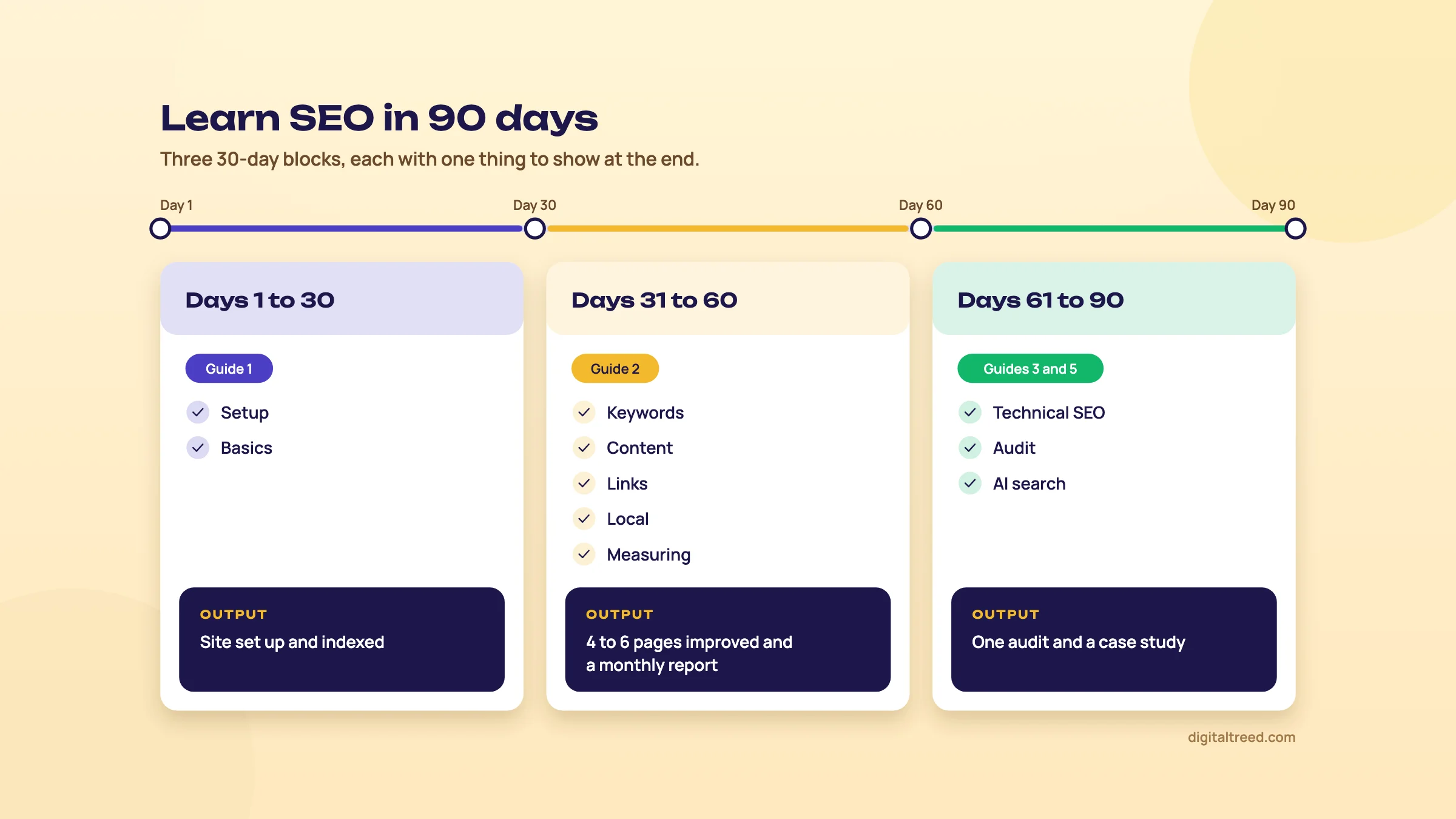 Three 30-day blocks, each ending with something you can show.
| Days | Read | Do | Output by day 30, 60 or 90 |
|---|---|---|---|
| 1 to 30 | Guide 1, SEO for beginners: how Google works, keyword basics, on-page basics, first site setup | Verify Search Console, submit a sitemap, check robots.txt and HTTPS, fix titles and descriptions on your main pages | Your site set up and indexed, with a "before" screenshot of Search Console |
| 31 to 60 | Guide 2: keyword research in depth, content briefs, on-page in depth, internal links and schema, link building, local SEO, measuring | Research one topic cluster, write or improve 4 to 6 pages, add internal links, set up one Business Profile if it's a local business | Pages live, one local profile, and your first monthly report |
| 61 to 90 | Guide 3 (technical SEO and the full audit) and Guide 5 (GEO: how to get cited by AI answers) | Check speed, crawling, indexing and canonicals; check AI crawler access; run a full audit and fix the top issues | One full audit of a real site, and a one-page case study with dated numbers |
| Every week | Chapter 10 of this guide and the sources it lists | One hour of news: what changed and does it affect your site | A short notes file you can talk about in interviews |
Use our free tools as practice tasks along the way. Each one teaches you to read one thing Google reads.
- Days 1 to 30: Meta Tag Analyzer, Robots.txt Tester, HTTP Status Checker, SSL Checker.
- Days 31 to 60: Word Counter and Keyword Density Checker, Schema Markup Validator, Hyperlink Generator.
- Days 61 to 90: Free Website Audit, Website Speed Test, Canonical Tag Checker, Noindex Tag Checker, AI Crawler Checker.
All 90 days run on free Google tools: Search Console, GA4 and Keyword Planner. You don't need a paid Semrush or Ahrefs plan to learn. Buy one when a client is paying for the work.
Tip
Keep a learning log with dates and screenshots: what you changed, on which page, and what Search Console showed two and four weeks later. By day 90 that log is your case study.
Free courses and certificates
Courses give you structure, so you learn things in a sensible order instead of jumping between random videos. These are the free ones we'd start with, checked on 16 October 2026.
| Course | Cost | Time | Certificate | Good for |
|---|---|---|---|---|
| Google Search Central learning paths (YouTube)[70] | Free | Self-paced playlists | No | How Google itself explains crawling, indexing, Search Console and technical SEO |
| Semrush Academy[71] | Free | About 1 hour each (On-Page SEO and AI Search Essentials, Keyword Research Essentials, Local SEO Essentials) | Yes, per course | Short, focused topics; partly teaches the Semrush tool |
| Ahrefs Academy[72] | Free | SEO Course for Beginners: 14 lessons, 2 hours; AEO course: 12 lessons, 1 hr 26 min | A separate 67-question certification exam, linked to the How to Use Ahrefs course (cost not stated on the page) | A clear beginner course; the exam is optional |
| HubSpot Academy AEO Fundamentals[73] | Free | 7 lessons, 2 hr 20 min | Yes | AI answers and how they pick sources, once you know the basics |
| LearningSEO.io[74] | Free | A roadmap of free resources | No | Finding the best free material for each topic |
Google's learning paths are new. On 6 October 2026 Daniel Waisberg of Google announced two playlists on the Search Central YouTube channel. One is Search fundamentals for beginners (how Search works, Search Console, Google Trends); the other is Technical SEO fundamentals (robots.txt, crawl budget, indexing, rendering, Search Console exports and APIs).[70] They're the closest thing to an official syllabus.
LearningSEO.io is a free roadmap maintained by Aleyda Solis, the founder of the Orainti consultancy, organised from SEO fundamentals through technical SEO, AI search and free tools.[75] Use it when you want a second explanation of something.
Note
HubSpot's SEO certification has been retired. HubSpot replaced it in June 2026 with two free certifications, AEO Fundamentals and Implementing AEO With HubSpot. If a "best free SEO certifications" list still names HubSpot's SEO course, the list is out of date.
Tip
Our pick (this is our opinion): start free with Google's Search Central learning paths plus one beginner course from Semrush Academy or Ahrefs Academy. Pay for a course only once you know which part of SEO you enjoy.
Paid options
The best-known paid route is the Google Digital Marketing and E-commerce Professional Certificate on Coursera. Coursera lists it as 8 courses, about 6 months at 10 hours a week. In the US and Canada it costs $49 a month after a 7-day free trial, and Coursera says most learners pay under $300; financial aid is available.[76] Coursera also says 75% of graduates reported a positive career outcome within six months, but that comes from its own 2022 survey of US graduates. It covers digital marketing broadly, so SEO is only one part of it.
Moz Academy sells an SEO Essentials certification, and many Indian institutes sell digital marketing courses with an SEO module. We haven't verified their current prices, so check the course page and ask for a syllabus and a sample class before you pay. A good course makes you work on a real site; a bad one sells you a certificate.
We've left out Google Digital Garage's old "Fundamentals of Digital Marketing" course. Its certificate status after the move to Skillshop is unclear, and we couldn't confirm it from Google.
Are certificates worth it?
We found no data showing employers ask for a specific SEO certificate. In Semrush's study of 3,900 US SEO job listings (November 2025), employers named tools such as Google Analytics, skills such as project management and communication, and degrees. Marketing was the most requested degree, in 31.6% of senior listings.[10] Certificates didn't feature.
So use certificates for what they're good at: learning in order, and showing on LinkedIn that you finished something. Use a portfolio as the proof. A one-page case study that says "clicks went from X to Y in 10 weeks, and here's what I changed" tells an employer far more than a list of certificates.
Pros
- Free ones cost only time
- Give you a structured order
- Teach the vocabulary used in job ads
- A small signal on LinkedIn for freshers
Cons
- No job data shows employers asking for them
- Vendor courses also teach their own tool
- Don't prove you can grow a site
- Some go out of date fast, as HubSpot's did
Community and events
Much of SEO is learned from other people, so get into the rooms where SEOs talk.
- Search Central Live India. Google is holding it in Bengaluru on 30 October 2026: free, in person only, with seats given by application and talks by Googlers on crawling, indexing, structured data and search quality.[77] Registration closed on 15 October; the previous India event was in 2023. Watch the Search Central blog for the next one.
- Women in Tech SEO. Founded in May 2019 by technical SEO consultant Areej AbuAli (quoted in chapter 3). In a 2020 podcast she advised newcomers to reach out to people one to one, ask questions and share what they learn; her own first talk came from pitching to BrightonSEO.[26]
- Conferences. BrightonSEO, SMX and MozCon are the big international names. Start with their free recorded talks before you spend on travel.
- Newsletters and news sites. Chapter 10 lists where to follow updates each week.
Start tomorrow with day 1: open Search Console for your site, take the "before" screenshot, and put the date at the top of your learning log.
Real SEO career stories, and what they teach
Quick answer
SEO careers grow in different ways. Harsh Agrawal built ShoutMeLoud from a blog and rebuilt it after Google's Panda update. Amit Agarwal left a corporate job in 2004 to blog full time. Manish Dudharejia built E2M into a 270-plus person agency, and Brian Dean sold one-person Backlinko to Semrush. Most started small and took years.
These are published stories of named people, each linked to where they told it. We haven't added anything they didn't say. They're here because each one shows a different path from chapter 3, and each has a lesson that applies to a fresher in Kanpur as much as to anyone.
Note
These are published stories. Income and sale figures are the person's own or were reported by others; we couldn't verify them independently.
Paths at a glance
| Person | Path | Base or company | What changed |
|---|---|---|---|
| Harsh Agrawal | Own site (blog) | India | Learned SEO after Panda (2012) hit his traffic |
| Amit Agarwal | Own site (blog), tools | India | Left a corporate job to blog full time (2004) |
| Manish Dudharejia | Agency founder | E2M Solutions | Built a white-label agency (SEO, web and content) for other agencies |
| Brian Dean | Own site, then sale | US | Semrush acquired Backlinko (2022) |
| Eli Schwartz | In-house, then consultant | US | Freelanced part-time, then went full time (2019) |
| Tim Soulo | In-house marketing | Ahrefs | Switched the blog to keyword-led topics |
| Aleyda Solis | Consultant, educator | International | Built a consultancy and free learning roadmaps |
| HouseFresh | Own site (reviews) | Independent | Lost most Google traffic in March 2024 |
Harsh Agrawal, ShoutMeLoud
ShoutMeLoud began as a tech blog in 2008, and Harsh found he could earn from it through affiliate marketing and AdSense. In 2012 Google's Panda update hit his organic traffic hard. Kinsta's case study says he spent about 8 months learning SEO, and by around 2016 the site was getting about 2 million page views a month.[78]
I needed to align better with Google's expectations.[78]
In his own sixth-anniversary post he has written about choosing the blog over a corporate job offer while it earned a modest monthly income.[79] The lesson: a blog that earns can still be knocked flat by one update, and the fix was learning SEO properly, not finding a trick.
Amit Agarwal, Labnol
Amit Agarwal studied computer science at IIT Roorkee (1999) and worked at ADP for Goldman Sachs. In 2004 he quit his corporate job to blog full time; his site calls him the first professional blogger in India, which is his own claim. His Google add-ons now report more than 50 million installations.[80] We couldn't find any income figures he has published. The lesson: useful tools and tutorials, written steadily for twenty years, build an audience search engines keep sending people to.
Manish Dudharejia, E2M Solutions
Manish started in SEO nearly two decades ago. On the Agency Profit Podcast (February 2025) he described growing E2M over 12 years into a 270-plus person team that does white-label work for more than 300 agencies worldwide.[25] The lesson: you don't have to find end clients yourself. Agencies abroad need reliable people to do the work behind their brand, and an Indian team can be that.
Brian Dean, Backlinko
Backlinko was a one-person SEO training site built around detailed guides and the Skyscraper Technique. Semrush acquired it in January 2022 without announcing a price. Built to Sell Radio, interviewing him in April 2024, said Semrush paid $5 million for his one-employee company.[81] The lesson: a content brand you own can become an asset someone buys, even with no staff.
Eli Schwartz, consultant
Eli Schwartz, a US SEO consultant, freelanced while still employed, starting at $100 an hour. By the interviewer's account he made over $150,000 freelancing part-time before quitting his job in April 2019. Clients found him through LinkedIn, conference talks and articles on industry sites.[23] Chapter 5 shows how his prices grew from there. The lesson: visible expertise brings clients to you, and your early prices are probably too low.
Tim Soulo, Ahrefs
Tim Soulo joined Ahrefs as head of marketing in 2015 and is now its CMO. After the team's early, carefully written articles drew little traffic, he moved the blog to topics people actually search for. Google traffic to the blog then grew from about 15,000 to over 250,000 visitors a month.[82] The lesson for in-house SEOs: good writing nobody searches for gets no traffic. Chapter 3 covers the in-house path in full.
Aleyda Solis, Orainti
Aleyda Solis is an SEO consultant and founder of Orainti, a consultancy advising brands worldwide on SEO and AI search. She also runs the SEOFOMO newsletter, the Crawling Mondays videos and the free LearningSEO.io roadmap.[75] The lesson: teaching in public, for free, is how many consultants become the person clients ask for by name.
The other side: HouseFresh
Not every story goes up. HouseFresh, an independent air purifier review site, lost most of its Google traffic between October 2023 and the March 2024 core update. Gisele Navarro wrote that daily Google visitors fell from about 4,000 to about 200; the article's heading calls it a 91% loss, while those daily figures work out closer to 95%.[24] The team didn't quit. They said they would put more effort into YouTube, Reddit, social channels and their newsletter, and keep publishing.
But we're not going down without a fight.[24]
The lesson for anyone choosing the own-sites path: the traffic risk is all yours. Build an email list and other channels from the start. Guide 3's chapter on spam, updates and recovery explains how to read an update like this one.
Our founder's path
Note
From our work: the author's path Aijaz Alam, who wrote this guide, has spent more than a decade in digital marketing as a consultant, trainer and author, and is the founder and CEO of DigitalTreed.
Note
We couldn't find an Indian SEO freelancer's story with verified income in the mainstream press. If you have one you're happy to share, tell us.
Pick the story closest to the path you want, read the original, and note one thing that person did in their first two years. Then go back to the 90-day plan in chapter 7 and start doing it.
The future of SEO: what experts and the data say
Quick answer
SEO is turning into search visibility across Google, AI answers and other platforms. Google says optimising for its AI features is still SEO. Experts agree the basics stay but clicks fall: Lily Ray expects organic traffic to "naturally decline", and Kevin Indig says clicks are scarce while influence is plentiful. Data, brand and technical skills matter more.
Predictions about SEO have a poor record, so this chapter sticks to three things: what search looks like today, what the data says about clicks, and what named experts said, with dates. Then it turns that into the skills worth building if you plan to do this work for the next five years.
Where search is now
Google's AI answers are no longer an experiment. In its July 2026 earnings remarks, Sundar Pichai said AI Mode had passed 1 billion monthly active users since its global expansion in October 2025.[83] At Google I/O in May 2026, Google merged AI Overviews and AI Mode into one AI Search experience.[84] In India, AI Mode added Bengali, Kannada, Malayalam, Marathi, Tamil, Telugu and Urdu in October 2025, and Search Live, the voice and camera mode, arrived here as its second market after the US.[85]
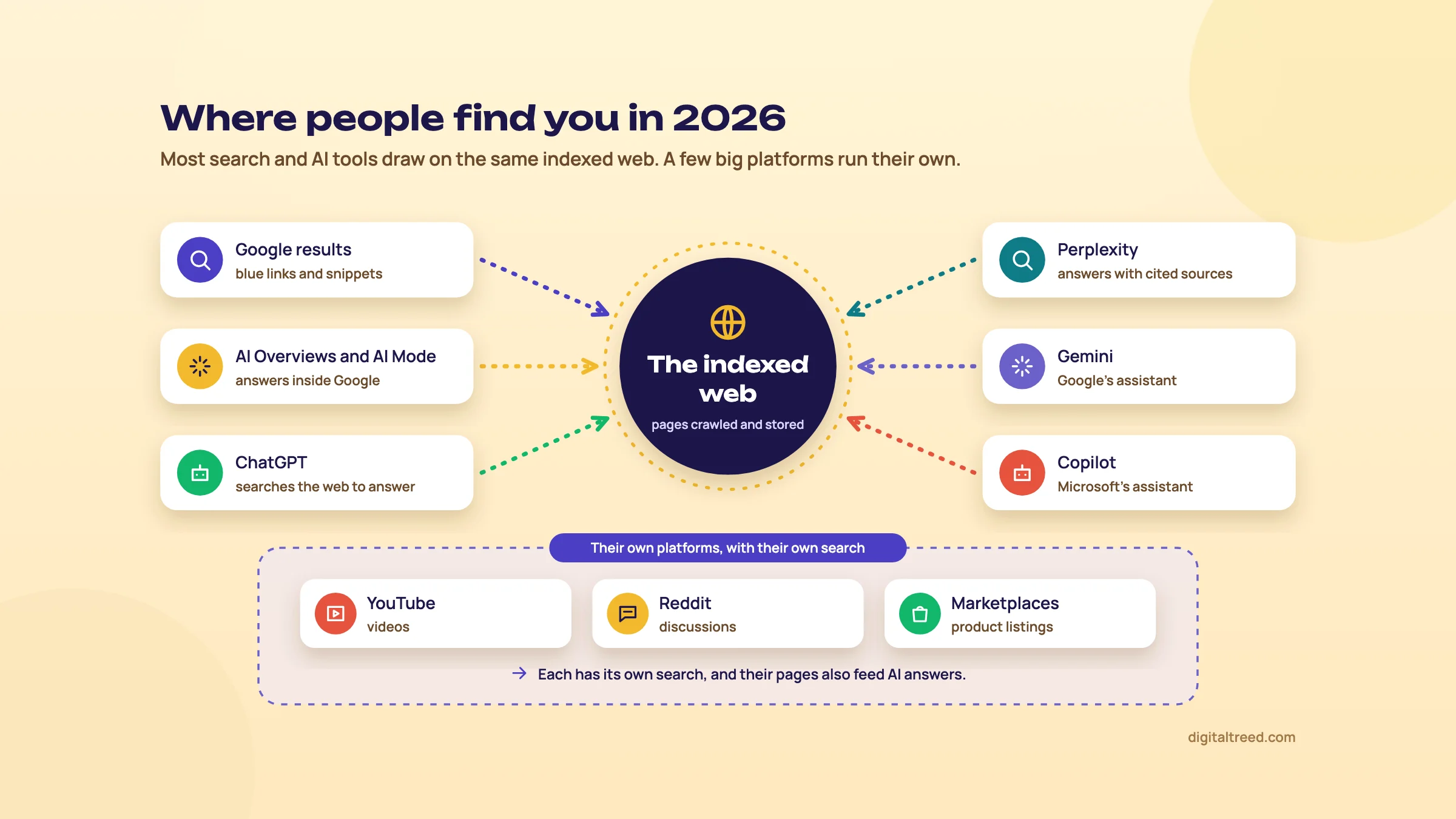 Most search and AI tools draw on the same indexed web; YouTube, Reddit and marketplaces run their own search but also feed AI answers.
Google's own position hasn't moved. Its guide to generative AI features, published in May 2026, says this:
From Google Search's perspective, optimizing for generative AI search is optimizing for the search experience, and thus still SEO.[8]
What happens to clicks
Two things are true at once, and you need both in your head.
First, clicks per search are falling where AI answers appear. Ahrefs compared 300,000 keywords in December 2023 and December 2025 using desktop Search Console data: when an AI Overview showed, it went with an average click-through rate about 58% lower for the top result.[86]
Second, AI assistants still send very little traffic. SE Ranking measured 101,574 websites with Google Analytics connected. From January to April 2026, AI platforms were 0.32% of all their traffic; organic search was 42.75%.[87]
Compare that with the 42.75% from organic search in the same study. AI referrals grew sixteen-fold in two years and are still under a third of one percent. So Google search isn't being replaced by ChatGPT traffic; it's sending fewer clicks per search, and some of the attention it used to send now ends on the results page.
What experts say, with dates
Organic traffic will naturally decline in this new environment.[88]
In the same post she wrote that AEO and GEO are "not an overhaul or abandonment of SEO."
Clicks are scarce. Influence is plentiful.[89]
He wrote that after a usability study of 37 US adults using AI Mode: about 88% of first interactions were with the AI text, and 77.6% of sessions had no visit to an outside site. It's a small sample, but it matches the click data above.
AI is secondary to zero-click.[90]
His answer to it, in the same conversation: "Brand is the solution."
A few more views, shorter:
| Who | When | What they said |
|---|---|---|
| Barry Schwartz, Search Engine Roundtable | June 2024 | Predicted that, despite what Google said, AI Overviews "will lead to fewer clicks to publishers, not more."[91] The later data in this chapter backs him. |
| Mike King, iPullRank | July 2025 | "The SEO community and industry is really not prepared for this moment."[92] |
| Kevin Indig and Amanda Johnson, Growth Memo | October 2026 | "Plan 2027 around the signals that happen before the visit… or despite it."[93] |
| Jono Alderson | September 2026 | Argues AI agents could keep a customer's request open as a standing condition and keep checking it, so your prices, stock and policies must be accurate and consistent everywhere an agent looks. "Making three contradictory prices machine-readable gives the agent a better-documented problem."[94] |
What stays, what changes
This is our reading of the sources above, not a forecast anyone has proven.
| Stays | Changes |
|---|---|
| Pages Google can crawl, index and show with a snippet; Google says there are no extra requirements for AI Overviews or AI Mode[7] | What you report: impressions, AI citations and brand mentions next to clicks |
| Ranking well, because AI answers lean on pages that already rank | More work off your own site: Reddit, YouTube, LinkedIn, reviews, the press |
| Links and mentions from other sites | Agents reading structured facts such as prices, stock and policies |
| Technical basics: speed, crawling, indexing | Fewer junior content-only roles; job ads already show it (chapter 2) |
| Useful content with first-hand experience | Generic "7 tips" articles that an AI answer can summarise in one line |
What to stop believing
- llms.txt as a ranking lever. Google's AI guide says it's fine to keep such files, but they don't help or hurt your visibility in Google Search.[8] It's optional and harmless. Don't sell it to a client as GEO.
- Guaranteed placement in ChatGPT or AI Overviews. The same Google guide says "No third-party tool has access to our internal ranking or AI systems."[8] Anyone guaranteeing AI placement is guessing.
- Scaling content with AI. Lily Ray tracked more than 220 sites publicly named as customers of AI content tools: 54% had lost 30% or more of their peak organic traffic by May 2026.[95] That's a correlation, not proof of cause, but the pattern was fast growth, a peak, then a fall.
Do not
- Pay for "guaranteed AI ranking"
- Promise clients that llms.txt will get them cited
- Publish hundreds of AI pages to cover every query variation
- Report only clicks and call a drop a failure
Do
- Check AI visibility monthly in Search Console's generative AI report and Bing's AI Performance report
- Keep pages crawlable by the AI bots you want
- Earn mentions on sites your audience reads
- Report exposure, behaviour and outcomes together
Search Console's generative AI reports show impressions, not clicks, and have been available to all sites since 31 August 2026.[50] Bing Webmaster Tools added an AI Performance report in February 2026 that shows citations in Copilot and Bing's AI answers.[96] Both are free. Paid AI-visibility trackers make sense only for larger clients.
A plan for when traffic is down
Kevin Indig and Amanda Johnson's October 2026 advice for planning next year is the most practical we've read. In our words:[93]
- Stop setting targets from last year's traffic. They cite SparkToro and Similarweb data putting zero-click searches at about 68% of US Google searches in early 2026.
- Plan for influence before the visit: AI answers, Reddit, LinkedIn.
- Give off-site work (mentions, citations, community) its own budget line. For community alone, the memo suggests 5% of marketing spend, and 10% in some cases.
- Report three groups together each month: exposure (visibility, mentions, citations), behaviour (branded searches, direct visits) and outcomes (leads, sales).
Skills to build for the next five years
- Technical SEO and data. Search Console, GA4 and, later, SQL. In Semrush's 2025 job data, Google Analytics was the most named tool and SQL showed up in 9.5% of senior listings.[10]
- Experimentation. Testing a change on some pages and measuring it. A/B testing was named in 23.9% of senior listings in the same study.
- Brand and digital PR. Getting mentioned where your audience already reads.
- Clear writing with first-hand experience. The content an AI answer can't summarise away.
- Working with product and engineering. Agents need clean, consistent facts, and those live in product data, not blog posts. Chapter 3 maps these skills to job levels.
Forecasts that haven't landed (yet)
In February 2024 Gartner predicted that traditional search engine volume would drop 25% by 2026 because of AI chatbots.[97] We found no follow-up from Gartner showing whether it happened. The data we do have points the other way for 2024: Datos clickstream data, presented by Rand Fishkin, showed Google searches in browsers up 22% that year.[5] Treat any "SEO will be dead by 20XX" chart the same way: ask who made it, when, and whether anyone checked.
Guide 5, "GEO: how to get cited by AI answers", goes deep on the AI side. Open your Search Console generative AI report this week and note your first number, so next year you have something to compare.
SEO news: the last 12 months, dated
Quick answer
Between October 2025 and October 2026 Google ran core updates in December 2025, March 2026 and May 2026, plus four spam updates in 2026. It stopped showing FAQ rich results, published a guide to optimising for its AI features, said llms.txt has no effect on Google Search, and added AI reports to Search Console.
Every item below has a date and a source you can open. If you work in SEO, interviewers and clients will ask about these, so know at least the top five. Newest first.
| Date | What changed | What it means for you |
|---|---|---|
| 15 Oct 2026 | Google adds more and higher-placed links inside AI answers and tests a section of key links at the top of a response[98] | More chances to be clicked from AI answers; make sure your key pages are the ones worth linking to |
| 6 Oct 2026 | Search Central publishes YouTube learning paths for beginners and technical SEO[70] | Free, official syllabus (chapter 7) |
| 1 Oct 2026 | Google's AI content guidance now says it is critical to fact-check AI-generated content by hand, including titles, descriptions, structured data and alt text[99] | Build a human review step into every AI-assisted workflow |
| 24 Sep 2026 | September 2026 spam update begins (about 14 days)[100] | Check client sites for scaled or thin pages |
| 24 Sep 2026 | Search Console adds a web multimodal search type (Lens, Circle to Search, image uploads)[101] | Image-led searches now measurable |
| 31 Aug 2026 | Search Console's generative AI performance reports open to all sites (announced 3 June); they show impressions, not clicks[50] | Add AI impressions to monthly reports |
| 28 Aug 2026 | Site reputation abuse manual actions limited to results outside the EEA from 30 August, after talks with the European Commission[102] | The policy now applies differently by region |
| 18 Aug 2026 | August 2026 spam update (about 3 days) | Same check as above |
| 7 Jul 2026 | Search Console platform properties for Instagram, TikTok, X and YouTube (announced 7 July, rolling out gradually)[103] | Social search performance in one place |
| 24 Jun 2026 | June 2026 spam update (about 2 days) | Same check as above |
| 16 Jun 2026 | Bing adds Intents, Topics, Citation Share and Compare to its AI Performance report[104] | Free AI citation data outside Google |
| 15 Jun 2026 | Google clarifies llms.txt has no positive or negative effect on Google Search; back button hijacking spam rule enforced[105] | Don't sell llms.txt as a Google lever |
| 5 Jun 2026 | Google publishes guidance on third-party SEO tools and "AEO/GEO" services[49] | Useful to show clients when someone promises AI rankings |
| 21 May 2026 | May 2026 core update (about 12 days) | Compare client data before and after |
| 20 May 2026 | Google I/O: AI Overviews and AI Mode merge into one AI Search experience; AI Mode passes 1 billion monthly users[84] | AI answers are now the default experience for many searches |
| 15 May 2026 | Google publishes its guide to optimising for generative AI features; spam policies now cover manipulating AI responses[8] | "Still SEO", in Google's words (chapter 9) |
| 7 May 2026 | FAQ rich results stop showing in Google Search | Keep FAQs for readers, not for rich results |
| 27 Mar 2026 | March 2026 core update (about 12 days), three days after the March spam update | Two updates overlapped; read data carefully |
| 10 Feb 2026 | Bing Webmaster Tools launches an AI Performance report (public preview)[96] | First free report of AI citations |
| 5 Feb 2026 | Discover core update: more local content, less clickbait, expertise judged topic by topic[106] | Matters most to publishers |
| 11 Dec 2025 | December 2025 core update (about 18 days); Google's docs now say smaller core updates run continuously[107] | Not every drop has a named update behind it |
| 20 Nov 2025 | Search Console adds a branded queries filter (all eligible sites from 11 March 2026)[108] | Split brand from non-brand clicks in reports |
| 13 Nov 2025 | European Commission opens Digital Markets Act proceedings over Google's site reputation abuse policy[109] | Background to the August 2026 EEA change |
| 21 Oct 2025 | OpenAI launches ChatGPT Atlas, a browser with ChatGPT built in, on macOS only.[110] OpenAI shut it down on 9 August 2026 and moved its browsing features into ChatGPT[111] | AI browsers come and go; people asking an assistant instead of a search box is the habit to watch |
| 8 Oct 2025 | AI Mode adds seven more Indian languages; Search Live launches in India[85] | AI answers now reach Indian-language searches |
Dates for Google ranking updates come from the Search Status Dashboard;[100] documentation changes come from the Search Central changelog. Guide 3's chapter on spam, updates and recovery has the full update history back to 2011, and Guide 1's history chapter tells the longer story.
How to read an update when it lands
Glenn Gabe of GSQi publishes analyses of Google's core updates. He notes when the rollout starts, when movement first shows and when it ends, then splits the impact by niche and by surface before judging anything.[112] Do the same for your clients: wait for the rollout to finish, compare the two weeks after with the two weeks before, and run an audit before changing anything.
Where to follow the news yourself
- Google Search Status Dashboard (status.search.google.com): the official start and end of every ranking update.
- Search Central blog and documentation changelog (developers.google.com/search): every policy and documentation change.
- Bing Webmaster blog (blogs.bing.com/webmaster): Bing and Copilot changes.
- Search Engine Roundtable: Barry Schwartz has run it since 2003, with daily recaps of what SEOs are seeing.[113]
Note
Last reviewed 16 October 2026. We update this chapter every 6 months. If an update lands in between, check the Search Status Dashboard first.
Pick two of these sources, subscribe today, and spend one hour a week on them, as the 90-day plan in chapter 7 suggests.
Test yourself
Ten questions on the whole guide. Pick an answer, check it, and see your score at the end.
You got 0 of 10 right.
Frequently asked questions
Frequently asked
Is SEO a good career in India in 2026?
Yes, if you like analysis, writing and fixing things, and you're patient. Entry pay is modest: AmbitionBox puts SEO executives in their first year at about ₹2.1 lakh a year on average (October 2026). Growth comes when you can show a site you grew, with dated numbers. Chapters 1 and 4 have the data.
Is SEO dead because of AI?
No. Google says optimising for its AI features "is optimizing for the search experience, and thus still SEO", and there are no extra requirements to appear in AI Overviews or AI Mode. But clicks per search are falling where AI answers appear: in Pew's March 2025 study of US adults, people clicked a regular result in 8% of visits with an AI summary, against 15% without one. Chapters 1 and 9 explain both sides.
What is the salary of an SEO executive in India?
Salary sites disagree, so use ranges with dates. AmbitionBox (20,800 salaries, updated 15 October 2026) puts SEO executives at about ₹2.7 lakh a year on average. That's ₹2.1 lakh in the first year, ₹2.5 lakh at 1 to 3 years and ₹3.4 lakh at 3 to 6 years. PayScale has no SEO executive page; its SEO analyst average is about ₹2.96 lakh (March 2026, 120 profiles). Small agencies often pay less, larger product and e-commerce firms more. Chapter 4 has a dated table for each role.
How much do SEO freelancers charge?
It varies a lot by country and experience. In an older Ahrefs survey of 439 SEO providers (page updated August 2024), 76% of India-based SEOs charged $1,000 a month or less per client, and 85.7% charged $30 an hour or less. Price by the work and your proof, not by the lowest bid on a platform. Chapter 5 shows how to set a rate.
Can I learn SEO in 3 months?
You can learn the basics and complete one real project in 90 days: set up a site, improve its pages, run a full audit and write a case study. Being good at it takes years of working on different sites. Chapter 7 has the 90-day plan in three 30-day blocks.
Which SEO certification is best?
Start with free ones: Google's Search Central learning paths on YouTube, and the beginner courses from Semrush Academy or Ahrefs Academy. We found no data showing employers require a specific SEO certificate. HubSpot retired its SEO certification in June 2026 and replaced it with two AEO certifications, so older "best certification" lists are out of date. Chapter 7 compares them.
Do I need a degree to get an SEO job?
It isn't required, but some employers ask for one. In Semrush's study of 3,900 US SEO job listings (November 2025), marketing was the most requested degree, named in 31.6% of senior listings. For your first job, a portfolio showing a site you grew usually counts for more. Chapter 3 covers skills by level.
How do Indian freelancers receive payments from foreign clients?
Common routes are PayPal, Payoneer, Wise, Skydo or the platform's own payout. Compare the total cost on your usual invoice, including conversion: PayPal India charges 4.40% plus a fixed fee on international commercial payments and 3.0% above the base rate to convert. Also check how you get a FIRA for each payment. Chapter 6 has the fee table and a worked $500 example.
Do SEO freelancers need GST registration for foreign clients?
It depends on your turnover and situation. CBIC says service suppliers need not register below ₹20 lakh of aggregate turnover a year (₹10 lakh in Manipur, Mizoram, Nagaland and Tripura). Opinions differ on how this applies to freelancers with only foreign clients. If you register, file an LUT to invoice exports without IGST. This is general information, not tax advice: ask a CA. Chapter 6 explains the rules.
Can I do SEO from home or remotely?
Yes. In Semrush's November 2025 snapshot of US SEO job listings, 43% of senior roles and 41.5% of other roles were remote, and freelancing is remote by default. Chapter 2 covers where the jobs are.
Will AI replace SEO jobs?
AI is changing which jobs exist more than removing the field. In SEOJobs.com's 2024 US data, content-related SEO roles fell 28% year on year, while technical SEO was required in 75% of listings by the last quarter. Writing-only roles are shrinking; technical, data and strategy roles are holding up. Chapters 2 and 9 go into it.
What is the difference between SEO, GEO and AEO?
GEO (generative engine optimisation) and AEO (answer engine optimisation) are names for getting your content seen and cited in AI answers. The core work is the same as SEO: crawlable, useful pages that earn trust and mentions. Google's own guide calls optimising for its generative AI features "still SEO". What changes is how you measure it: AI impressions and citations alongside clicks. Chapter 9 and Guide 5 cover it in depth.
Sources
References
- Google's Gary Illyes on AI, site migrations and 'SEO is dead' claims, Search Engine Journal, Matt G. Southern, 29 Apr 2024, accessed 16 Oct 2026
- Google users are less likely to click on links when an AI summary appears in the results, Pew Research Center, 22 Jul 2025, accessed 16 Oct 2026
- 2024 Zero-Click Search Study, SparkToro, Rand Fishkin, 1 Jul 2024, accessed 16 Oct 2026
- Google zero-click searches 2026 study (coverage of SparkToro and Similarweb data), Search Engine Land, 2026, accessed 16 Oct 2026
- SEO isn't dead: webinar with Rand Fishkin and Will Critchlow, SearchPilot, 29 May 2025, accessed 16 Oct 2026
- The State of SEO 2026: How to Survive, Search Engine Journal, Katie Morton, 10 Sep 2025, accessed 16 Oct 2026
- AI features and your website, Google Search Central, updated 10 Dec 2025, accessed 16 Oct 2026
- Optimizing your website for generative AI features on Google Search, Google Search Central, published 15 May 2026, updated 10 Jul 2026, accessed 16 Oct 2026
- The future of SEO and AI search: a conversation with Lily Ray, Peec AI, 23 Jul 2025, accessed 16 Oct 2026
- SEO job market study: 3,900 SEO job listings analysed, Semrush, Margarita Loktionova, 30 Mar 2026 (Indeed US snapshot 25 Nov 2025), accessed 16 Oct 2026
- SEO jobs search (India, United States, United Kingdom, Worldwide), LinkedIn, searched 16 Oct 2026
- SEO job trends, salaries and related skills (UK), IT Jobs Watch, 6 months to 15 Oct 2026, seen 16 Oct 2026
- SEO Job Report 2025, SEOJobs.com and Previsible, 27 Mar 2025, accessed 16 Oct 2026
- 2025 State of SEO Jobs Report, Previsible with SEOJobs.com, report PDF, March 2025, accessed 16 Oct 2026
- AI search jobs: who is hiring and what they pay, Kaleigh Moore, 6 Jul 2026, accessed 16 Oct 2026
- Gig work: India now contributes 1 in 4 freelancers, Business Today, 9 Jan 2018, accessed 16 Oct 2026
- Australia, US among major markets for Indian freelancers: report, Business Standard (PTI), on PayPal's global freelancer study (6,000 respondents, India included), 9 Jan 2018, accessed 16 Oct 2026
- Online Labour Index: where are online workers located?, Oxford Internet Institute, Vili Lehdonvirta, 11 Jul 2017, accessed 16 Oct 2026
- Top freelancing countries for Indian freelancers, Skydo (payment provider), 31 Aug 2026, seen 16 Oct 2026
- UK SEO industry market report 2026 (summary of global market estimates), The SEO Works, 2026, data collected July 2026, accessed 16 Oct 2026
- Digital ad spends climb across sectors in 2025, led by FMCG and e-commerce, exchange4media, on the dentsu-e4m Digital Advertising Report 2026, accessed 16 Oct 2026
- Occupational Outlook Handbook: Market research analysts, US Bureau of Labor Statistics, May 2025 data, seen 16 Oct 2026
- How SEO consultant Eli Schwartz made $159K prior to freelancing full-time, The SEO Freelancer, Nick LeRoy, 7 Mar 2022, accessed 16 Oct 2026
- How Google decimated HouseFresh, HouseFresh, Gisele Navarro, page dated 11 May 2026 (describes 2024 events), accessed 16 Oct 2026
- Is white label the future of agencies? With Manish Dudharejia (ep. 167), Agency Profit Podcast (Parakeeto), 5 Feb 2025, accessed 16 Oct 2026
- Episode 75: Women in Tech SEO with Areej AbuAli, With Candour podcast, 24 Aug 2020, accessed 16 Oct 2026
- SEO Executive salaries in India, AmbitionBox (Info Edge), updated 15 Oct 2026, seen 16 Oct 2026
- Search Engine Optimization (SEO) Analyst salary in India, PayScale, updated 10 Mar 2026, seen 16 Oct 2026
- SEO Analyst salaries in India, AmbitionBox (Info Edge), updated 15 Oct 2026, seen 16 Oct 2026
- Search Engine Optimization (SEO) Specialist salary in India, PayScale, updated 9 Apr 2026, seen 16 Oct 2026
- SEO Specialist salaries in India, AmbitionBox (Info Edge), updated 15 Oct 2026, seen 16 Oct 2026
- Search Engine Optimization (SEO) Manager salary in India, PayScale, updated 14 Jun 2025, seen 16 Oct 2026
- SEO Manager salaries in India, AmbitionBox (Info Edge), updated 13 Oct 2026, seen 16 Oct 2026
- Search Engine Optimization (SEO) Specialist salary (US), PayScale, updated 21 May 2026, seen 16 Oct 2026
- Search Engine Optimization (SEO) Manager salary (US), PayScale, updated 28 Feb 2026, seen 16 Oct 2026
- SEO jobs market in the USA (2025), Rankability, Adzuna data, Oct 2025, accessed 16 Oct 2026
- Search Engine Optimization (SEO) Specialist salary in United Kingdom, PayScale, updated 6 Oct 2025, seen 16 Oct 2026
- Search Engine Optimization (SEO) Manager salary in United Kingdom, PayScale, updated 30 Apr 2025, seen 16 Oct 2026
- Head of SEO job trends, salaries and skill sets (UK), IT Jobs Watch, seen 16 Oct 2026
- Local SEO freelancers and agencies: pay and costs, BrightLocal, 10 Jan 2018 (2017 survey data), accessed 16 Oct 2026
- Is Upwork free to join? Our pricing breakdown, Upwork, 2026, seen 16 Oct 2026
- Your earnings page, Fiverr Help Center, seen 16 Oct 2026
- SEO pricing: how much does SEO cost? (survey of 439 SEO providers), Ahrefs, Joshua Hardwick, updated 15 Aug 2024, accessed 16 Oct 2026
- SEO pricing guide 2025: how much does SEO cost?, PW Skills blog, 30 Oct 2025, seen 16 Oct 2026
- SEO services cost in India: 2026 pricing guide, upGrowth, Amol Ghemud, 30 Jun 2026, accessed 16 Oct 2026
- SEO pricing in Bangalore: what you'll actually pay in 2026, OneCity, updated 2 Sep 2026, seen 16 Oct 2026
- SEO Expert Hourly Rates, Upwork, seen 16 Oct 2026
- SEO pricing: how much do SEO services cost in 2025? (survey of 260 agencies), SE Ranking with Duda, 13 Dec 2024, accessed 16 Oct 2026
- Google Search's Guidance on Third-Party SEO Tools & Advice, Google Search Central, updated 5 Jun 2026, accessed 16 Oct 2026
- Generative AI performance reports in Search Console, Google Search Central blog, 3 Jun 2026, accessed 16 Oct 2026
- How to execute the Skyscraper Technique (and get results), Ahrefs, Si Quan Ong, 6 Feb 2023, accessed 16 Oct 2026
- PayPal merchant fees (India), PayPal India, updated 28 Mar 2024, read 16 Oct 2026
- Payoneer pricing, Payoneer, updated 1 Jan 2026, read 16 Oct 2026
- Receive money: pricing (India), Wise, read 16 Oct 2026
- Skydo: receive international payments, Skydo, fee tiers for global bank accounts (home page; no pricing page), read 16 Oct 2026
- Circular No. 161/17/2021-GST: Clarification relating to export of services, condition (v) of section 2(6) of the IGST Act 2017, CBIC, GST Policy Wing, 20 Sep 2021, accessed 16 Oct 2026
- Integrated Goods and Services Tax Act, 2017, section 2 (Definitions), CBIC Tax Information Portal, s.2(6)(iv) as amended from 1 Feb 2019, read 16 Oct 2026
- Integrated Goods and Services Tax Act, 2017, section 16 (Zero rated supply), CBIC Tax Information Portal, read 16 Oct 2026
- Registration under GST Law (taxpayer services flyer), CBIC, Directorate General of Taxpayer Services, read 16 Oct 2026
- Furnishing of Letter of Undertaking for Export of Goods or Services (user manual), GST portal (GSTN), read 16 Oct 2026
- Notification No. 01/2023-Integrated Tax (export of goods or services on payment of integrated tax, with refund), CBIC, 31 Jul 2023, in force from 1 Oct 2023; rule 96A of the CGST Rules, 2017 (bond or LUT) is on the same portal, read 16 Oct 2026
- File ITR-4 (Sugam) online: FAQs, Income Tax Department, e-filing portal, read 16 Oct 2026
- Income-tax Act, 2025 comes into force from 1st April 2026, CBDT press release, 1 Apr 2026, accessed 16 Oct 2026
- Section 58, Income-tax Act, 2025 (30 of 2025), as amended by the Finance Act, 2026, Income Tax Department; sections 1(3), 62(4), 408(2) and 536 read in the consolidated text of the Act as amended by the Finance Act, 2026, read 16 Oct 2026
- Refund of ITC on export of goods and services without payment of integrated tax (user manual), GST portal (GSTN), read 16 Oct 2026
- Foreign Inward Remittance Advise (FIRA), PayPal India, read 16 Oct 2026
- Digital FIRA FAQ, Payoneer Help Center, read 16 Oct 2026
- Receiving payments for Indian businesses, Wise Help Centre, read 16 Oct 2026
- Foreign Exchange Management (Export and Import of Goods and Services) Regulations, 2026 (Notification No. FEMA 23(R)/2026-RB), Reserve Bank of India, 13 Jan 2026, amended up to 22 Sep 2026, read 16 Oct 2026
- New learning paths: curated YouTube playlists for Search fundamentals and Technical SEO, Google Search Central blog, Daniel Waisberg, 6 Oct 2026, accessed 16 Oct 2026
- SEO courses, Semrush Academy, read 16 Oct 2026
- Ahrefs Academy, Ahrefs, read 16 Oct 2026
- AEO Fundamentals certification, HubSpot Academy, read 16 Oct 2026
- LearningSEO.io: SEO learning roadmap, Aleyda Solis, version 28, 9 Jun 2025, accessed 16 Oct 2026
- Aleyda Solis (expert profile), Sistrix, read 16 Oct 2026
- Google Digital Marketing & E-commerce Professional Certificate, Coursera, read 16 Oct 2026
- Search Central Live India 2026: Bengaluru, we're coming (for real this time), Google Search Central blog, 14 Sep 2026, accessed 16 Oct 2026
- ShoutMeLoud case study, Kinsta, undated, read 16 Oct 2026
- Blogging is incredible (ShoutMeLoud sixth anniversary post), Harsh Agrawal, ShoutMeLoud, about Dec 2014, accessed 16 Oct 2026
- About Amit Agarwal, Digital Inspiration (labnol.org), read 16 Oct 2026
- Brian Dean, "SEO Genius", on getting $5 million for Backlinko, a one employee company, Built to Sell Radio, 19 Apr 2024, accessed 16 Oct 2026
- Episode 205: Tim Soulo, Ahrefs, The SaaS Podcast (SaaS Club), episode date not shown, accessed 16 Oct 2026
- Alphabet Q2 2026 earnings: CEO remarks, Google (The Keyword), Sundar Pichai, 22 Jul 2026, accessed 16 Oct 2026
- Google I/O 2026: all our announcements, Google (The Keyword), 20 May 2026, accessed 16 Oct 2026
- Google's Search Live comes to India, AI Mode gets more languages, TechCrunch, 8 Oct 2025, accessed 16 Oct 2026
- AI Overviews reduce clicks (update), Ahrefs, Ryan Law and Xibeijia Guan, 4 Feb 2026, accessed 16 Oct 2026
- AI traffic research study, SE Ranking, 18 Jun 2026, accessed 16 Oct 2026
- A Reflection on SEO & AI Search in 2025, Lily Ray, Substack, 19 Jan 2026, accessed 16 Oct 2026
- What our AI Mode user behavior study reveals about the future of search, Search Engine Journal, Kevin Indig, 7 Oct 2025, accessed 16 Oct 2026
- Branding in the age of AI and zero-click SERPs (The Search Session, ep. 28), Advanced Web Ranking, 1 Sep 2025, accessed 16 Oct 2026
- Cracking Google: an interview with Barry Schwartz, Duda blog, 6 Jun 2024, accessed 16 Oct 2026
- AI Mode webinar recap, iPullRank, 3 Jul 2025, accessed 16 Oct 2026
- How to plan 2027 when traffic is down and AI won't attribute, Growth Memo, Kevin Indig and Amanda Johnson, 5 Oct 2026, accessed 16 Oct 2026
- From query to condition, Jono Alderson, 27 Sep 2026, accessed 16 Oct 2026
- It works, until it doesn't: AI content risks, Lily Ray, Substack, 13 May 2026, accessed 16 Oct 2026
- Introducing AI Performance in Bing Webmaster Tools (public preview), Bing Webmaster blog, 10 Feb 2026, accessed 16 Oct 2026
- Gartner predicts search engine volume will drop 25% by 2026, due to AI chatbots and other virtual agents, Gartner, 19 Feb 2024, accessed 16 Oct 2026
- More ways to connect with the web from Search, Google (The Keyword), Hema Budaraju, 15 Oct 2026, accessed 16 Oct 2026
- Google Search's guidance on using generative AI content on your website, Google Search Central, updated 1 Oct 2026, accessed 16 Oct 2026
- Google Search Status Dashboard: ranking incidents history, Google, read 16 Oct 2026
- Web multimodal search type in Search Console, Google Search Central blog, 24 Sep 2026, accessed 16 Oct 2026
- Update to our site reputation abuse policy, Google Search Central blog, 28 Aug 2026, accessed 16 Oct 2026
- Search Console platform properties for social and video platforms, Google Search Central blog, 7 Jul 2026, accessed 16 Oct 2026
- New AI visibility insights in Bing Webmaster Tools: Intents, Topics, Citation Share, Compare, Bing blog, 16 Jun 2026, accessed 16 Oct 2026
- Latest Google Search documentation updates (changelog), Google Search Central, read 16 Oct 2026
- February 2026 Discover core update, Google Search Central blog, 5 Feb 2026, accessed 16 Oct 2026
- Google Search's core updates and your website, Google Search Central, updated 9 Dec 2025, accessed 16 Oct 2026
- Branded queries filter in Search Console, Google Search Central blog, 20 Nov 2025, accessed 16 Oct 2026
- Commission opens investigation into potential Digital Markets Act breach by Google in demoting media publishers' content, European Commission, 13 Nov 2025, accessed 16 Oct 2026
- Introducing ChatGPT Atlas, OpenAI, 21 Oct 2025, accessed 16 Oct 2026
- OpenAI shuts down its Atlas browser after not even a year, TechRadar, Craig Hale, 13 Jul 2026, accessed 16 Oct 2026
- Core roars back: interesting cases and findings from Google's May 2026 broad core update, GSQi, Glenn Gabe, 10 Jun 2026, accessed 16 Oct 2026
- Q&A: Barry Schwartz, publisher of Search Engine Roundtable, Practical Ecommerce, 21 Dec 2022, accessed 16 Oct 2026
- SEO jobs search results, Naukri.com, 22,863 results seen 21 Oct 2026, accessed 21 Oct 2026
- SEO job vacancies in India, Indeed India, about 12,000 results seen 21 Oct 2026, accessed 21 Oct 2026
Get the free checklist
Every step of this guide on one page, to print or tick off. We email you the PDF link.