
Quick answer
Freelancing while working full time is often allowed, but your employment contract decides the terms. Read four clauses first: outside work, inventions, confidentiality and non-compete. Then keep side work off your employer's hours, laptop and customers. Quit only once side income, savings and a health plan all pass. An employment lawyer can read your actual contract.
Key takeaways
- Your contract and handbook set the rules, not advice online.
- Search the contract for four clauses before your first client.
- Some states, like Washington, protect inventions made off the clock.
- Never use the employer's laptop, hours, secrets or customers.
- Quit when income, savings and health coverage all pass.
Freelancing while working full time is how many people test a freelance business without betting the rent on it. The paycheck keeps coming. The clients prove whether the idea works.
But a side gig has a second party you didn't pick: your employer.
This guide is the employee's side of the plan. It covers what your contract can say, what some states won't let it say, and when it's safe to leave. Starting from zero with no job to protect? Our how to start freelancing guide covers pricing, client contracts and self-employment tax.
We quote the laws exactly, and we're not lawyers. For your own contract, talk to an employment lawyer licensed in your state.
Your contract sets the rules, so read four clauses first
So start with the paper you signed.
Your offer letter, employment agreement and employee handbook decide most of what you can do after 5 p.m. Many people never reread them after day one.
It takes ten minutes. Open the PDF and search for a few words, because the clauses that matter often sit deep in a long document. Here's what to look for.
- Outside work. Search "outside employment" or "other business". Some contracts ban side work; others ask you to disclose it or get approval.
- Inventions. Search "assign" and "inventions". This clause decides who owns what you make.
- Confidentiality. Search "confidential information". It covers what you can't reuse for clients.
- Non-compete and non-solicit. Search "after termination". These mostly bite once you leave.
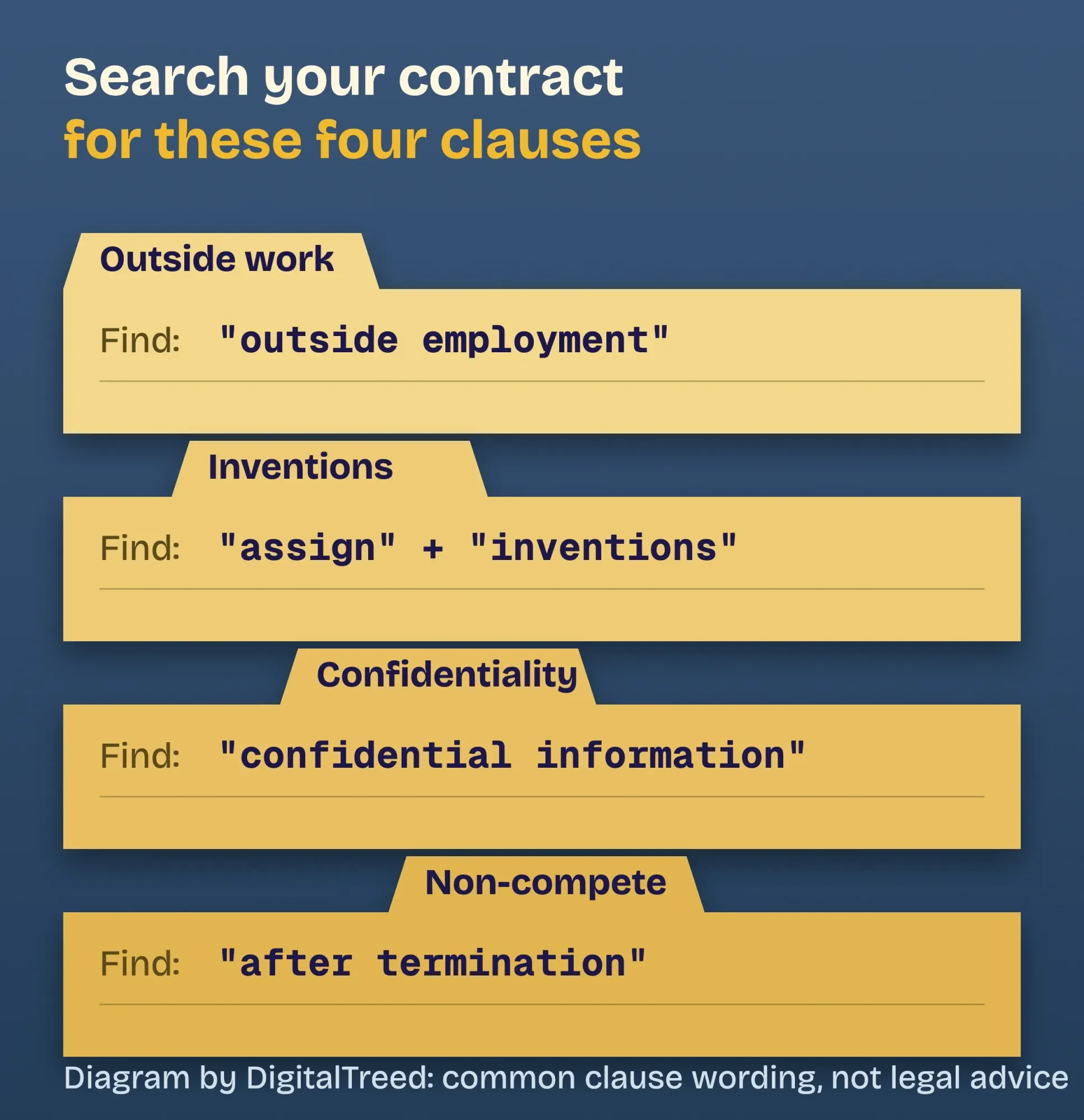 Diagram by DigitalTreed: common clause wording, not legal advice
Read the handbook too. A conflict-of-interest or outside-activity policy often lives there, not in the contract.
If a clause is unclear, don't guess. Write down the exact sentence and ask an employment lawyer what it means in your state before you sign a client.
Who owns what you build after hours?
Once you've found the clauses, the next question is ownership.
Your employer owns most of what you make as part of your job. Federal copyright law treats as "work made for hire" any "work prepared by an employee within the scope of his or her employment" (17 U.S.C. 101). Night work for your own clients usually sits outside that scope.
Usually isn't always. Invention clauses can reach further. That's where some states step in.
On October 27, 2026, we read three state laws on invention assignment side by side: Washington RCW 49.44.140, Minnesota Statutes 181.78 and Delaware Code title 19, section 805. The wording is close to identical. An assignment clause doesn't reach an invention made "entirely on the employee's own time" without the employer's equipment, supplies, facilities or trade secret information. The exception covers work that relates to the employer's business or results from work you did for them. We also tried California's official code page, but it blocked our request, so we haven't quoted it here.
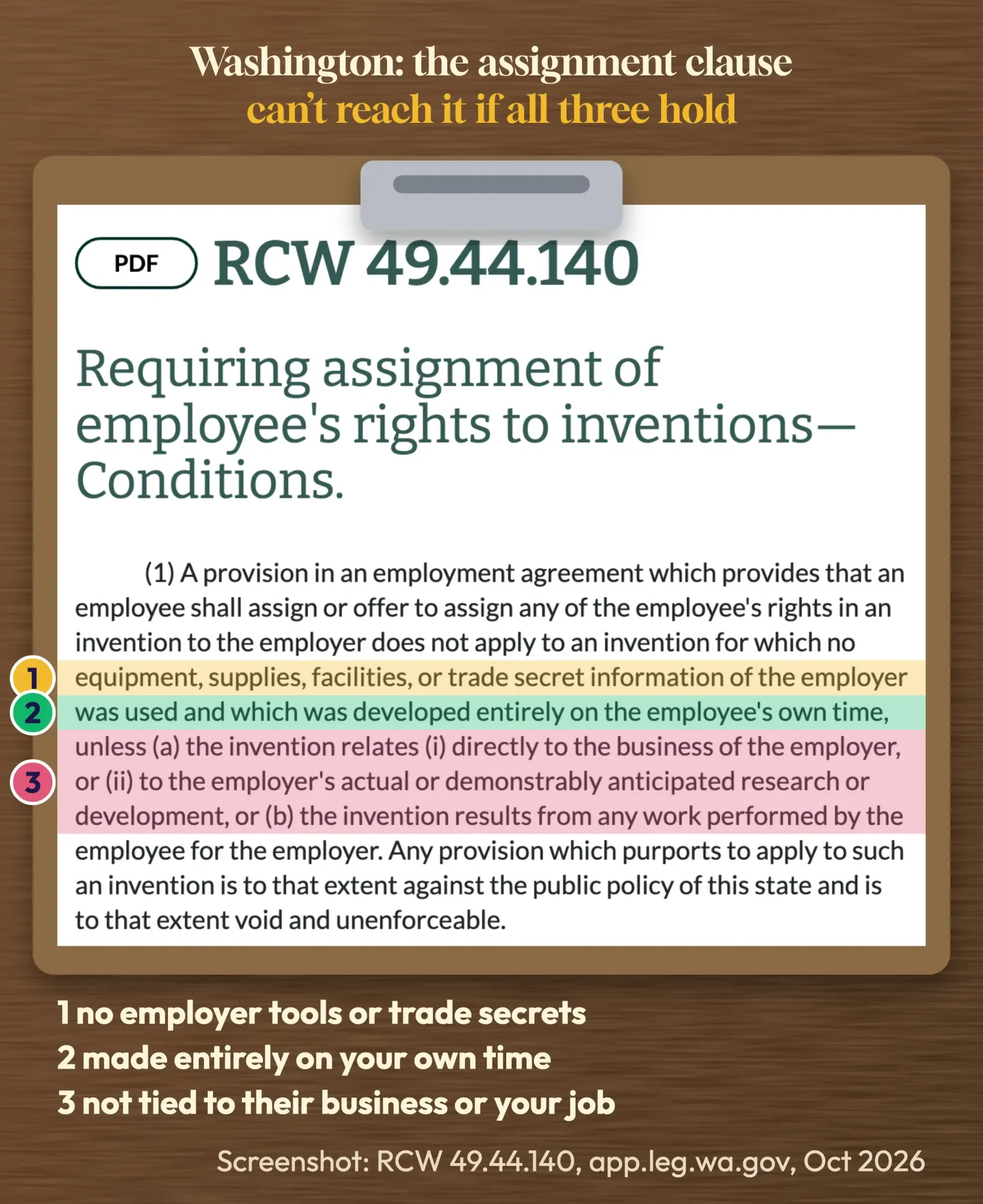 Screenshot: RCW 49.44.140 on app.leg.wa.gov, October 2026, with our highlights
One difference stood out.
Washington and Minnesota also make the employer hand you a written notice of this limit when you sign. Delaware's section has no notice sentence. So if you're in one of the first two states, look for that notice in your onboarding papers.
The practical rule in all three states is the same: build side work on your own laptop, on your own time, in a field your employer doesn't sell in. If your work sits close to their field, ask an employment lawyer first.
Washington limits side-job bans for lower earners
Beyond ownership, a few states protect the side job itself.
Some employees can't be barred from side work at all. In Washington, an employer "may not restrict, restrain, or prohibit an employee earning less than twice the applicable state minimum hourly wage" from side work (RCW 49.62.070). That list includes "working as an independent contractor, or being self-employed."
The math is short. The Washington Department of Labor & Industries lists the 2026 minimum wage at $17.13 an hour. Twice that is $34.26. The 2027 rate is $17.73, so the line moves to $35.46 in 2027.
Example: Ledgerline Copy is a made-up side-gig copywriter in Kennewick, Washington. Its owner's day job pays $28 an hour, which is under both lines. So a contract clause banning all side work would run into this statute. That matters.
There are limits, though. The rule doesn't cover side work that raises "issues of safety". It also leaves out work that would "interfere with the reasonable and normal scheduling expectations of the employer". And it "does not alter" the employee's "common law duty of loyalty and laws preventing conflicts of interest," in the same section's words.
Other states have their own rules, and many have none on this point.
Check yours, or ask an employment lawyer, before you lean on Washington's.
Stay out of your employer's lane
That duty of loyalty is the line most side gigs trip over. While you're on the payroll, don't sell the same service to your employer's customers, and don't compete for the work your employer bids on. If a former coworker asks you to do the same job for a rival company, wait until you've left, and check your non-compete and non-solicit before you answer.
Secrets matter just as much. Under federal law, information can be a trade secret if "the owner thereof has taken reasonable measures to keep such information secret" (18 U.S.C. 1839). Client lists, pricing sheets and internal templates can qualify when the company keeps them secret.
Leave them at work.
Non-competes are a different animal. Minnesota defines a covenant not to compete as one that restricts the employee "after termination of the employment" (Minnesota Statutes 181.988), and it voids most of them. Washington voids non-competes unless the worker's yearly pay tops a threshold the state adjusts each year. For employees, that threshold is $126,858.83 in 2026 (RCW 49.62.020; Washington L&I thresholds). That changes soon: from June 30, 2027, the amended section says "all noncompetition covenants are void and unenforceable."
A non-compete matters most on the day you quit, not while you're moonlighting. There's no federal ban to lean on: the FTC says its rule "is not in effect and it is not enforceable" (FTC: Noncompete Rule).
Government workers follow stricter rules. Federal employees "may not engage in outside employment or any other outside activity that conflicts with their official duties" (5 CFR 2635.802). Check your agency's own supplement too, and ask an employment lawyer if a side gig sits close to your duties.
Keep the laptop, the hours and the inbox separate
Once your lane is clear, separate the tools.
Separation is the cheapest protection you have. It also makes the invention test above easy to pass.
The federal ethics rules show how strict an employer can be. Federal staff "may not use such property" for unauthorized purposes, and the rule names "computers and other electronic devices" and "Government email" (5 CFR 2635.704). Official time must go to "an honest effort to perform official duties" (5 CFR 2635.705). Private employers' policies often read the same way.
- Use your own laptop and phone for client work, never the work machine.
- Use a personal email and calendar for clients.
- Take client calls on your breaks or after hours, not on paid time.
- Keep client files in your own cloud storage, not the employer's.
- Don't list your employer's clients or logos in your portfolio.
Example: Ledgerline Copy's owner works 8:30 to 5:00, Monday to Friday. Side work runs Tuesday and Thursday from 7 to 9 p.m., plus Saturday from 9 a.m. to 3 p.m. That's 10 hours a week, none of it on the clock.
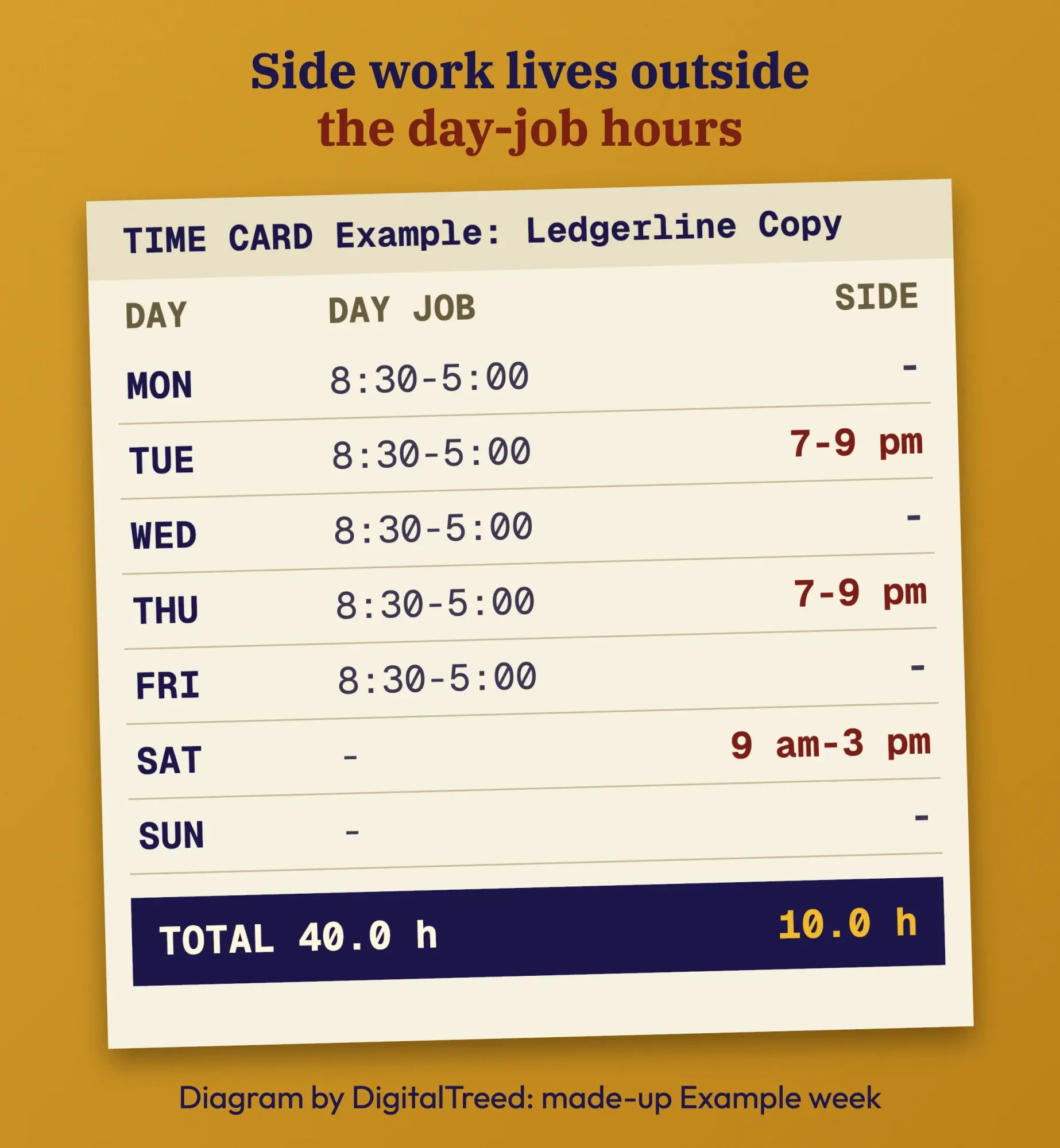 Diagram by DigitalTreed: a made-up Example week
Give the side business its own identity, too. A separate email address with its own email signature keeps clients from writing to your work inbox.
One tax step changes when you still get a W-2
Then there's tax.
You still owe self-employment tax on the side income; the starter guide linked above covers that. The difference for employees is an easier way to pay.
The IRS says: "If you receive salaries and wages, you can avoid having to pay estimated tax by asking your employer to withhold more tax from your earnings. To do this, file a new Form W-4 with your employer" (IRS: Estimated taxes).
The IRS Tax Withholding Estimator helps you set the extra amount. It's built to "estimate the correct amount of tax your employer (W-2) or pension provider should withhold each year."
Run it again whenever side income jumps. A big new client late in the year raises what you owe for that year, so check the numbers in the fall, not in April.
Bill every client from your own invoice template, not a company form, so side income is easy to total when you run the estimator. A tax professional can check the numbers for your situation.
When should you quit your day job to freelance?
Once withholding is set, the last question is timing.
Quit when three things are true at once, not when one good month arrives. We use three checks, like dials on a dashboard.
- Income: side income has averaged at least half your monthly needs for 3 months.
- Savings: you hold 6 months of needs in cash.
- Health coverage: you've picked the plan that replaces your job's plan.
Those numbers are our rule of thumb, not a law. Raise them if you have dependents or lumpy clients.
Back to the made-up Ledgerline Copy: its owner needs $4,200 a month. Side income over the last 3 months was $2,300, $2,600 and $2,950. That's $7,850, or $2,616.67 a month, about 62% of needs. The income dial passes.
Savings are $16,800, which is 4 months, so the dial reads 4 of 6. Six months would be $25,200, a gap of $8,400. Saving $1,400 a month closes it in 6 months. No health plan is picked yet. Close, but no. One of three dials is green, so the answer is "not yet."
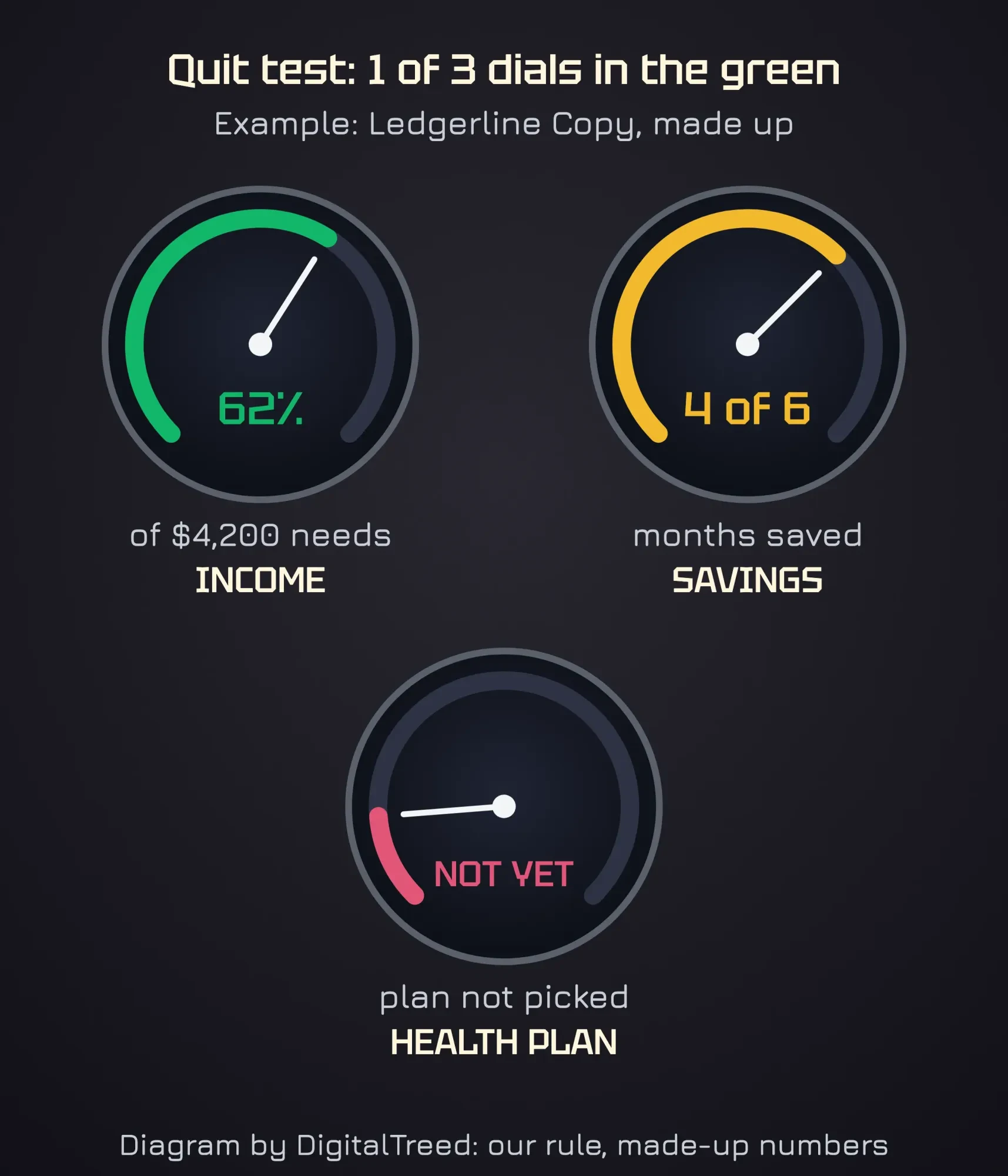 Diagram by DigitalTreed: our rule with made-up numbers
Health coverage needs a date in your calendar. You may qualify for a Special Enrollment Period if you "lost qualifying health coverage in the past 60 days" or expect to lose it in the next 60 days (HealthCare.gov). Your former employer may also offer COBRA, per HealthCare.gov on COBRA.
Compare both before your last day.
Our take: the savings dial is the one people skip, and it's the one that lets you turn down a bad client.
Before you give notice, have an employment lawyer read your non-compete and non-solicit clauses. Then line up your portfolio and where clients will find you. Marketplace sellers can read how to get your first job on Upwork. SEO freelancers can follow our SEO career guide.
A portfolio site is easier to build while the paycheck still lands. We sell website builds, so read this pitch knowing we profit from it. Our website builds for small businesses are one option when you're ready.
Frequently asked
Do I have to tell my employer about my side job?
It depends on your contract and handbook, so read the outside-work clause. Federal staff face a set rule: "When required by agency supplemental regulation, employees must obtain prior approval before engaging in outside employment or activities" (5 CFR 2635.803).
Can my employer make me sign a non-compete after I'm hired?
In Washington, until June 30, 2027, a non-compete signed after you start is void "unless the employer provides independent consideration for the covenant" (RCW 49.62.020). That means something new in return, beyond keeping the job. Other states differ.
Is a non-solicitation clause the same as a non-compete?
No. Minnesota's definition of a non-compete leaves them out. It "does not include a nonsolicitation agreement, or agreement restricting the ability to use client or contact lists, or solicit customers of the employer" (Minnesota Statutes 181.988). So a non-solicit can survive where a non-compete doesn't.
Can I drop COBRA later and switch to a Marketplace plan?
Not whenever you like. When COBRA runs out you get 60 days to enroll. HealthCare.gov warns that "Voluntarily dropping COBRA doesn't count" as a reason for a Special Enrollment Period (HealthCare.gov: COBRA).
How we made this guide: The DigitalTreed team read every law and rule on this page on October 27, 2026. That included three state invention statutes, Washington's side-job and non-compete sections, and Minnesota's non-compete law. We also read four federal ethics rules, the FTC's non-compete rule page, two IRS pages and two HealthCare.gov pages. Our hands-on work was the side-by-side read of the three invention laws and the annotated screenshot of Washington's statute. Ledgerline Copy and its numbers are made up. Each source sits beside the line it supports.
We explain what the statutes say here. That's general information, not advice on your contract. Laws change and vary by state, so an employment lawyer licensed where you work should read your own agreement.
First published April 2020. Rewritten October 27, 2026: we replaced the general tips with the employee's side of freelancing. It now covers contract clauses, invention laws, side-job limits, time and tools, withholding and a quit test.
Sources
- Washington RCW 49.44.140, assignment of employee inventions
- Washington RCW 49.62.070, additional jobs for lower-wage employees
- Washington RCW 49.62.020, noncompetition covenants
- Washington L&I: Minimum wage
- Washington L&I: Non-compete agreements and thresholds
- Minnesota Statutes 181.78, employee inventions
- Minnesota Statutes 181.988, covenants not to compete
- Delaware Code title 19, chapter 8, section 805
- 17 U.S.C. 101, definitions (Cornell LII)
- 18 U.S.C. 1839, definitions (Cornell LII)
- 5 CFR 2635.802, conflicting outside employment
- 5 CFR 2635.803, prior approval for outside employment
- 5 CFR 2635.704, use of Government property
- 5 CFR 2635.705, use of official time
- IRS: Estimated taxes
- IRS: Tax Withholding Estimator
- HealthCare.gov: Special Enrollment Period
- HealthCare.gov: COBRA coverage when you are unemployed
- FTC: Noncompete Rule status

Comments
No comments yet. Start the conversation below.