
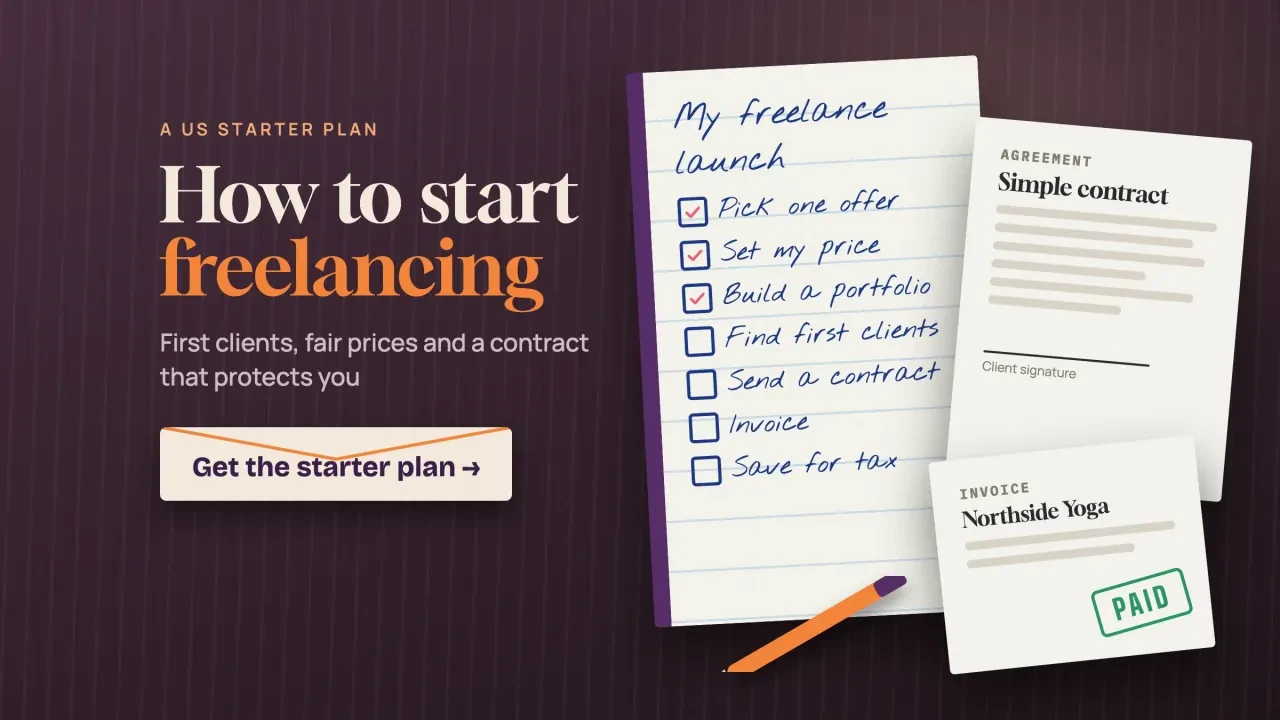
Quick answer
To start freelancing, pick one service a business already pays for, set a rate from your income goal and billable hours, and show three samples. Then land a first client, sign a one-page contract and send a clear invoice. Before the first payment lands, learn the IRS rules on self-employment tax.
Key takeaways
- Sell one clear service to one type of buyer.
- Price from income goal, costs and billable hours.
- Three good samples are enough to start pitching.
- Copyright starts with you; the contract says when it moves.
- Self-employment tax is 15.3% once net earnings reach $400.
If you're wondering how to start freelancing, here's the short version: you sell your skill to several clients as your own small business. You aren't anyone's employee.
That's the easy part.
The hard parts are the first price, the first client and the paperwork nobody warns you about. This guide takes them in the order you'll meet them, for US freelancers starting from zero. Still in a day job? Our guide to freelancing while working full time covers contract clauses and when to quit.
We'll follow one made-up freelancer the whole way, so the numbers stay real.
Sell one thing a business already pays for
So start with a single service, with a clear result, that a business already buys. "Logo and brand kit for a fitness studio" sells. "Creative services" doesn't, because nobody knows what to ask you for.
Here's a quick test: if you can't describe the offer in one line, name who pays for it and say what they'll get at the end, it isn't ready yet.
If you need three sentences, narrow it.
Pick a buyer you can reach this month, too. Local shops, studios and trades are easier to meet than national brands, and they buy small, fast projects. Building sites is your skill? Then read how to become a freelance web developer, which covers that one role in depth.
Example: Wren & Pine Design is a made-up freelance designer in Lafayette, Indiana. Its one offer is a logo and brand kit for small fitness and wellness studios. Its first client will be Northside Yoga, also made up.
That's narrow on purpose.
How much should you charge when you're new?
Now the money. Start from what you need to earn, not from what strangers charge online. Add your yearly income goal to your business costs, then divide by the hours you can really bill.
Billable hours are fewer than you'd guess, because pitching, chasing invoices, answering email and learning new tools all eat into a week that nobody's paying for.
Here's the math for our Example, with our own made-up numbers. Wren & Pine wants $52,000 a year and expects $4,800 in costs for software, a computer fund and insurance. That's $56,800. Simple so far. It plans 20 billable hours a week for 46 weeks, or 920 hours. Divide $56,800 by 920 and you get $61.74, which rounds to $62 an hour.
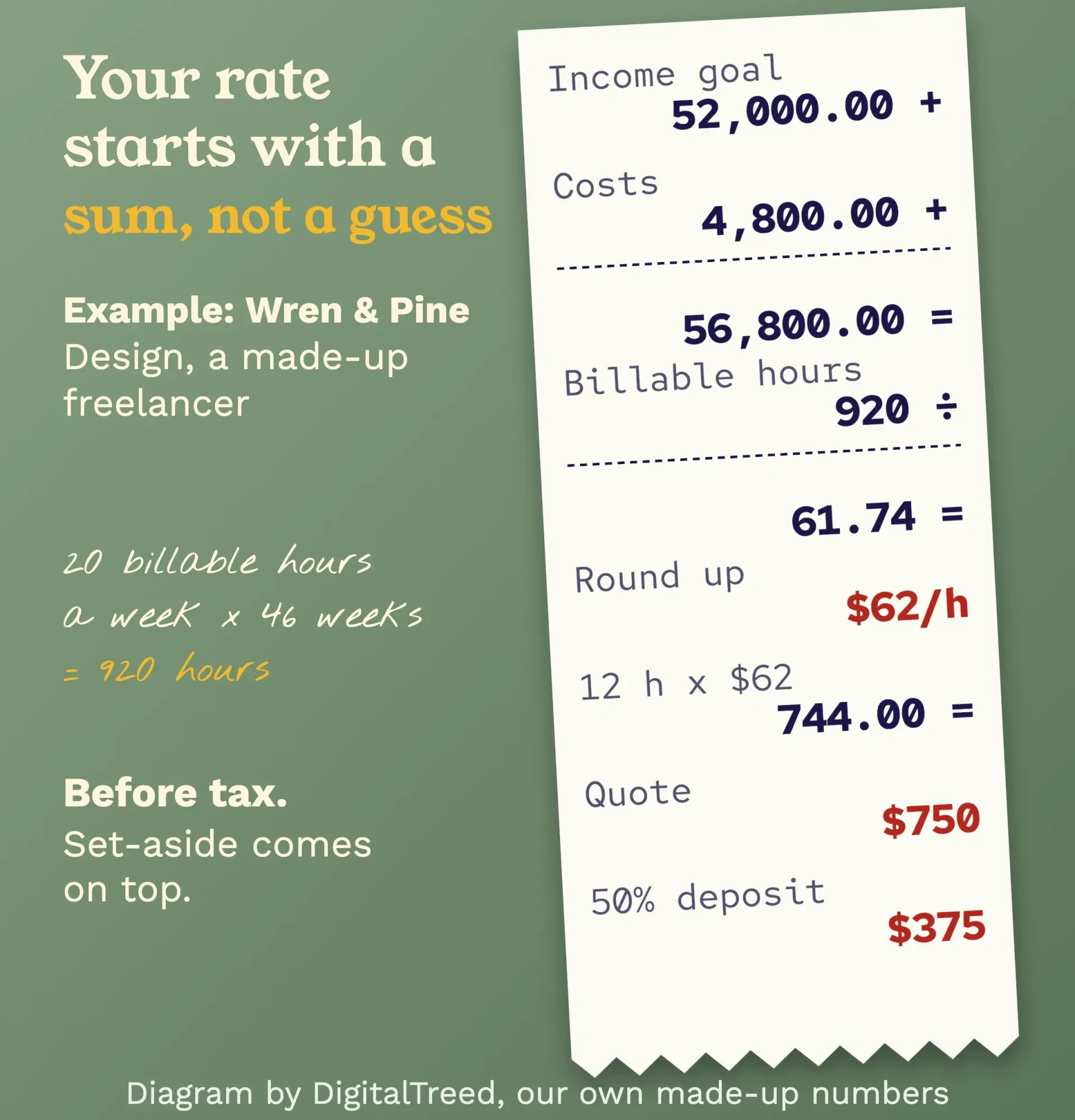 Diagram by DigitalTreed: our Example rate math (made-up freelancer, our own numbers)
That rate's a floor, and it comes before tax.
If it looks high next to what you've seen online, remember that an employee's salary doesn't have to cover unpaid hours, software, insurance or the employer's half of payroll taxes.
Next, turn hours into a project price. Clients like fixed prices because they know the bill up front. If the brand kit takes about 12 hours, 12 times $62 is $744, so Wren & Pine quotes $750. It asks for 50% before work starts.
A deposit also tests the client, since someone who won't pay half before you start is rarely the person who'll happily pay the rest after you finish.
Selling SEO? Our free Freelance SEO Rate Calculator runs this math with a tax set-aside line and prices your packages. Our SEO career guide also has a chapter on starting SEO freelancing, step by step.
Three samples are enough to start
Once the price is set, you need proof you can do the work.
You don't need a big portfolio. You need three pieces that look like the offer you're selling.
A studio owner shopping for a logo wants to see logos, not your college poster project.
No clients yet? Make practice briefs. Write a short made-up brief for a business like the ones you want, do the work properly and label it as a concept piece. Work from a past job counts too, if that employer lets you show it.
Put the three samples on one simple page with your offer, your starting price and a way to reach you, so a busy owner can say yes from a phone.
Keep each sample short: the problem, what you made and why it works. Buyers skim.
Find the first 3 clients close to home
With samples ready, go where people already know you. Write down 30 people and local businesses that might need your offer, or know someone who does. Then message each one personally, with a short note and your sample page. Warmest names first.
- Former coworkers and managers who've seen your work.
- Local businesses you already buy from.
- Business groups, chambers of commerce and meetups in your town.
- One freelance platform, picked on purpose, not five at once.
Platforms work, but they take a cut and the competition is stiff. If you try one, our walkthrough on how to get your first job on Upwork covers the profile, Connects and proposals.
Job boards help too. Before you answer a remote listing, read our list of legit work-from-home freelance jobs and the scams to spot. Still in school? These freelance jobs for college students fit around classes.
Expect slow replies. Follow up once after a week, then move on to the next name, because a quiet inbox usually means busy, not no, and you can try again next month.
It's a numbers game, and that's fine.
A one-page contract covers scope, pay and ownership
Once a client says yes, put the deal in writing before you start.
A short contract saves both sides from arguments later, and it doesn't need legal words; it just needs clear answers to five questions.
- Scope: what you'll deliver, and how many revisions are included.
- Price, deposit and what happens to the deposit if the client cancels.
- Dates: when you deliver and when the client pays.
- Ownership: when the rights to the work move to the client.
- How either side can end the project.
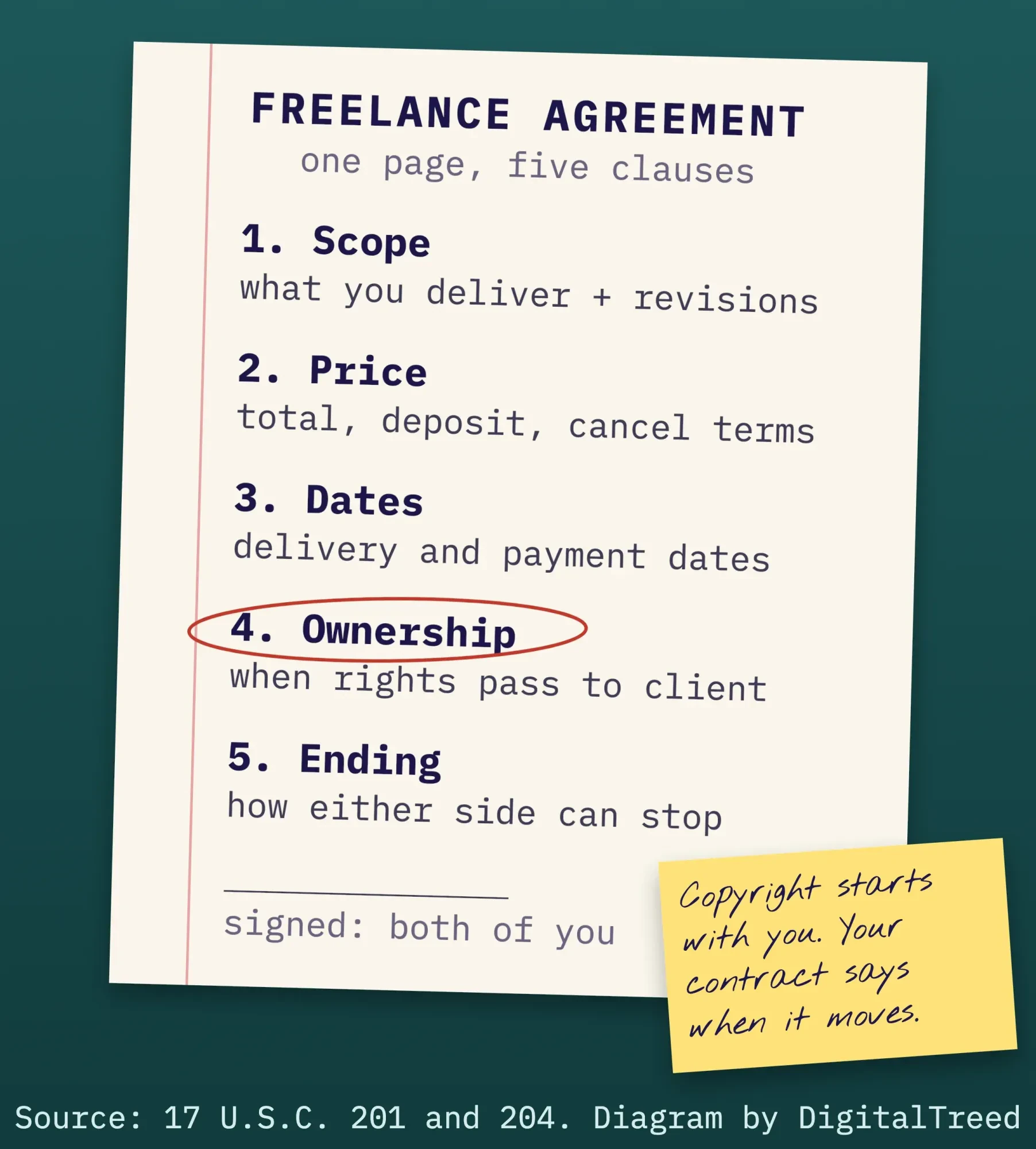 Diagram by DigitalTreed: the five clauses we suggest, with the copyright rule from 17 U.S.C. 201 and 204
Ownership is the clause beginners skip.
Under US copyright law, copyright "vests initially in the author or authors of the work" (17 U.S.C. 201). That's you, the freelancer. A transfer "is not valid unless" it's "in writing and signed by the owner of the rights conveyed" (17 U.S.C. 204). So say when rights pass, for example on final payment. A signed "work made for hire" deal is different, so have a lawyer read it first. There, the client "is considered the author" (17 U.S.C. 201(b)).
Some places spell this out in law. New York City's rules say "All contracts worth $800 or more must be in writing" (NYC Department of Consumer and Worker Protection). The contract must list the work, the pay and the payment date. With no date set, the client "must pay you within 30 days after you complete the work."
New York State added its own Freelance Isn't Free Act on August 28, 2024. Its Labor Department offers a model contract you can start from.
This section explains the law; it doesn't advise you on it. If you'll reuse a contract for years, have a business lawyer in your state read it once.
We made the first invoice and found the blank that stalls payment
With the contract signed, it's time for the deposit invoice. On October 27, 2026, we made Wren & Pine's first one in our Free Invoice Generator, on a local copy of our site. We entered Northside Yoga as the client and one line: "Logo and brand kit: 50% deposit," $375, due November 10, 2026.
Two things caught us. Both were small. The form starts with two item rows, and the empty second one printed a $0.00 line until we removed it. Worse, we'd left the payment section empty, so the finished invoice showed a dash under Payment Details. The client had no way to pay us.
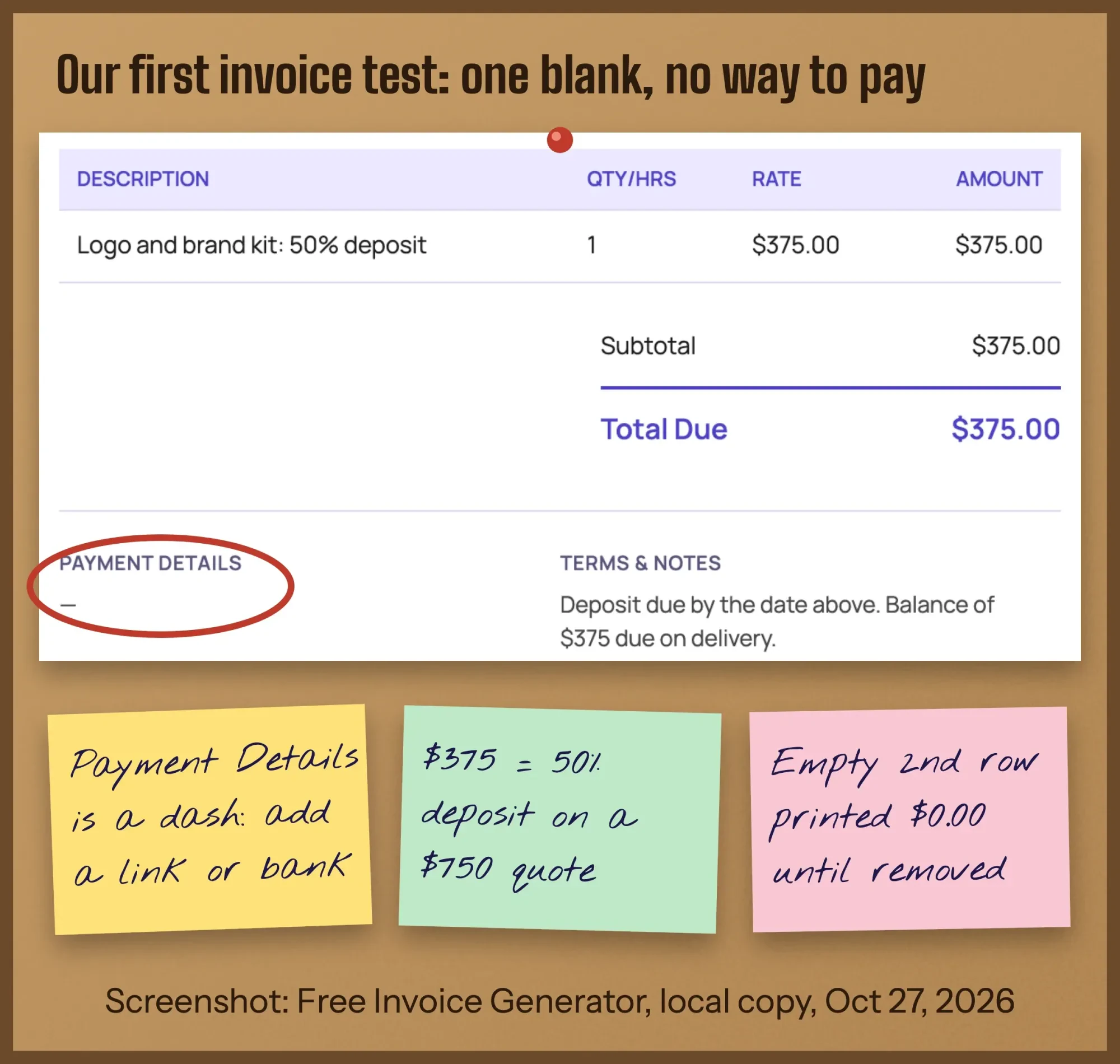 Screenshot: our Free Invoice Generator on a local copy, October 27, 2026, made-up business and client
So fill in a payment link or bank details every time.
Read the preview the way the client will see it, number invoices in order, and keep a copy of each one for tax season.
At year end, a business client may send you Form 1099-NEC. The reporting threshold rose to $2,000 "for tax years beginning after 2025" (IRS 1099-MISC and 1099-NEC instructions). Smaller payments still count as income, as the FAQ explains.
What taxes do freelancers pay in the US?
That income brings two federal taxes, and nobody withholds either for you. The IRS says "The self-employment tax rate is 15.3%" (IRS: Self-employment tax). It splits into "12.4% for social security" and "2.9% for Medicare."
You must pay it and file Schedule SE if "Your net earnings from self-employment (excluding church employee income) were $400 or more."
Income tax comes on top of that.
You report the business itself on Schedule C. The IRS says it's for "income or loss from a business you operated or a profession you practiced as a sole proprietor."
Then there's timing. You "generally have to make estimated tax payments if they expect to owe tax of $1,000 or more when their return is filed" (IRS: Estimated taxes). Pay late and "you may be charged a penalty even if you are due a refund."
| Income earned (tax year 2026) | Estimated tax due |
| January 1 to March 31 | April 15, 2026 |
| April 1 to May 31 | June 15, 2026 |
| June 1 to August 31 | September 15, 2026 |
| September 1 to December 31 | January 15, 2027 |
Put them on your calendar. Those dates come from IRS Publication 505, as of October 2026. The periods aren't equal quarters, whatever the nickname says.
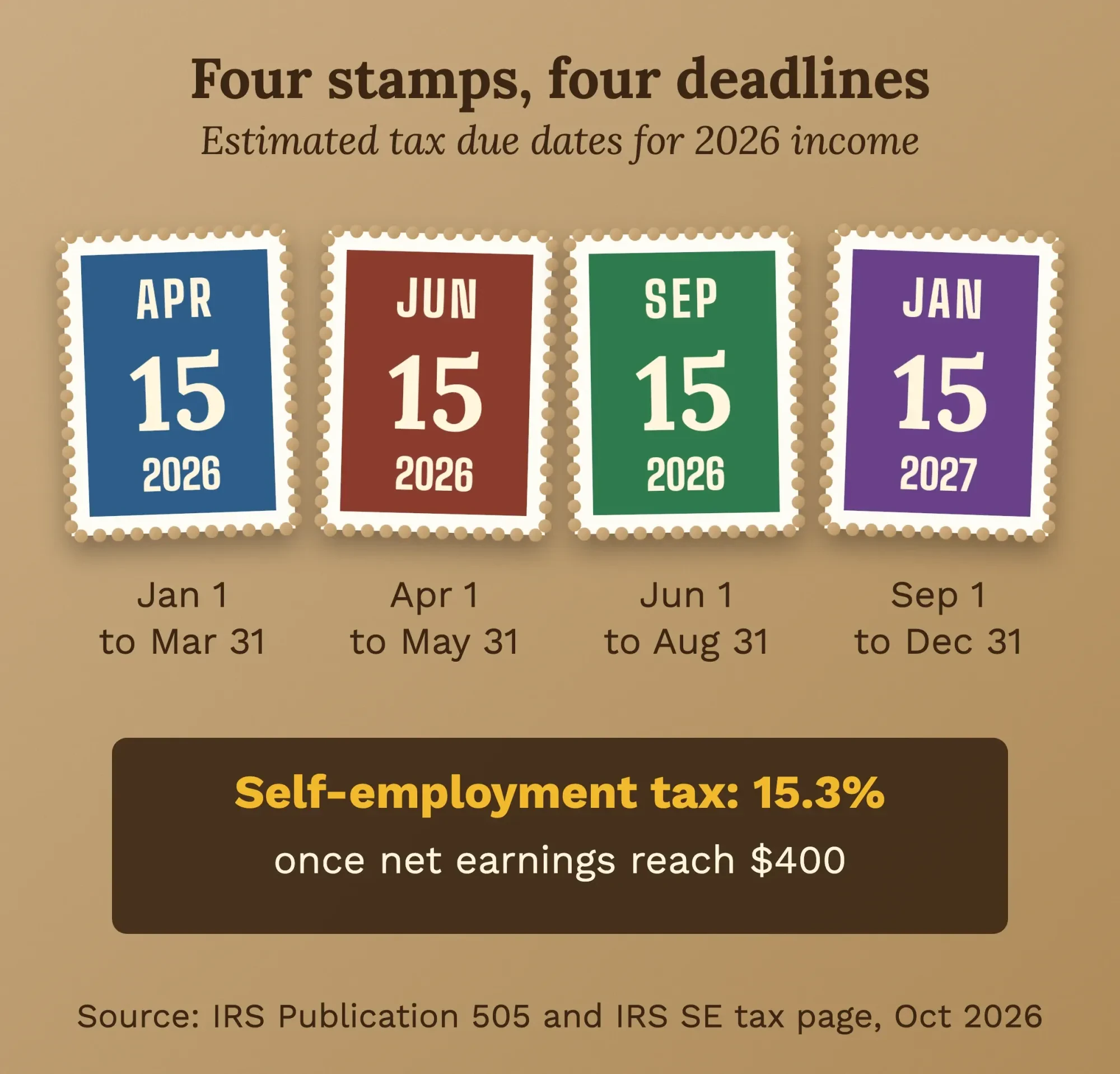 Source: IRS Publication 505, October 2026
How much should you set aside from each payment? It depends on your total income, deductions and state, so we won't guess.
Ask a tax professional before your first due date, then move that share out of every client payment. The IRS keeps a directory of tax preparers with credentials. Its warning is blunt: "Anyone can be a paid tax return preparer" with a PTIN, so check credentials first.
Nothing in this section is tax advice. It repeats the IRS's own wording and nothing more.
Keep the business side simple at first
After all that, here's some relief: you needn't form a company to start. The SBA says you're "automatically considered to be a sole proprietorship" if you work without registering as anything else (SBA: Choose a business structure). The catch: you "can be held personally liable for the debts and obligations of the business."
Working under a name like Wren & Pine instead of your own? The SBA notes that most states require you to register your DBA if you use one.
Open a separate account early, too. In the SBA's words, "As soon as you start accepting or spending money as your business, you should open a business bank account" (SBA: Open a business bank account). It'll make tax time far easier, because every business dollar sits in one place and you won't be sorting coffee from software in April.
Our take: get the first paid project before you spend money on an LLC, a logo for yourself or fancy software.
One offer, one fair price, one signed page and one clear invoice. That's the real start.
Your sample page can grow into a full portfolio site later. Building portfolio sites is how we earn a living, so we aren't neutral here. When you're ready to hand it off, our website builds for small businesses are one option.
Frequently asked
Do I have to report freelance income if I don't get a 1099?
Yes. The IRS gig economy tax center says you report it even without a 1099. It names income "Paid in any form, including cash, property, goods, or virtual currency."
Can I pay estimated taxes monthly instead of quarterly?
Yes. The IRS allows payments "weekly, bi-weekly, monthly, etc." as long as you've "paid enough in by the end of the quarter" (IRS: Estimated taxes). Smaller payments can be easier on cash flow.
Why does a client ask me for a Form W-9?
The client may need to report what it paid you. Form W-9 exists "to provide your correct Taxpayer Identification Number (TIN) to the person who is required to file an information return" (IRS: About Form W-9).
Is a freelancer an independent contractor?
For tax purposes, mostly yes. Per the IRS, "If you are a business owner or contractor who provides services to other businesses, then you are generally considered self-employed" (IRS: Independent contractor or employee).
How we made this guide: Our editors went through every rule on this page on October 27, 2026. Our reading list: the IRS pages on self-employment tax, estimated tax, Publication 505, Schedule C and the 1099 instructions. Beyond the IRS, we read the SBA start-up hub, both New York freelance pages and two sections of the copyright statute. Our one hands-on test was the deposit invoice above, built in our Free Invoice Generator on a local copy. The rate math is our own, for a made-up studio. You'll find each source linked right beside the line it backs.
First published April 2020. Rewritten October 27, 2026: we swapped the general tips for a US plan with our rate math and invoice test. It now covers samples, first clients, a one-page contract and the IRS tax rules.
Sources
- IRS: Self-employment tax (Social Security and Medicare taxes)
- IRS: Estimated taxes
- IRS: Publication 505, Tax Withholding and Estimated Tax (2026)
- IRS: About Schedule C (Form 1040)
- IRS: Instructions for Forms 1099-MISC and 1099-NEC
- IRS: Gig economy tax center
- IRS: About Form W-9
- IRS: Independent contractor (self-employed) or employee?
- IRS: Choosing a tax professional
- U.S. Small Business Administration: Launch your business
- NYC Department of Consumer and Worker Protection: Freelance worker rights
- New York State Department of Labor: Freelance Isn't Free Act
- 17 U.S.C. 201, Ownership of copyright (U.S. Copyright Office)
- 17 U.S.C. 204, Execution of transfers of copyright ownership (U.S. Copyright Office)


Comments
No comments yet. Start the conversation below.