
Quick answer
Magnet Brains is a free Indian video school for the CBSE and NCERT curriculum, from kindergarten to Class 12. Its English-medium YouTube channel showed 14.6 million subscribers on November 6, 2026. A second channel teaches Classes 6 to 12 in Hindi, with 1.35 million subscribers. Start from your child's class page and pick the course named for their current textbook.
Magnet Brains is an Indian free-education channel and Android app that follows India's CBSE school curriculum. It isn't a US program. Maybe your family moved from Bhopal to Ohio, and you'd like your fifth grader to keep CBSE maths and Hindi going, or you homeschool and want free maths videos.
Everything runs on two YouTube channels and an Android app. The videos are free to watch. The harder part from abroad is picking the course. Magnet Brains names courses after NCERT textbooks and keeps courses for earlier and newer titles online side by side.
Key takeaways
- Pick the course named for your child's current NCERT book, not the first one.
- 4 of 14 Class 5 course titles matched NCERT's list on November 6, 2026.
- Magnet Brains videos cost nothing, but its e-notes and e-books are sold.
- Apple's App Store search showed no Magnet Brains app on November 6, 2026.
- Turn off autoplay before a child watches lessons on YouTube.
Which company is behind Magnet Brains?
The website's footer names Magnet Brains Learning Foundation, with an address in Bhopal, Madhya Pradesh, India, and the same address sits on its contact page beside a support number. Its About page names the founders as Pankaj Agarwal and Neeraj Agarwal and calls Magnet Brains "India's Number 1 Online School Education Platform". That ranking is the company's claim. No outside measure backs it on any page we read.
The About page gives its vision as "Free access to high quality education for students across India" and claims "10 Million+ Active Learners". It also says it "Started a youtube channel in 2019" and crossed 1 million subscribers in October 2020. YouTube's own About panel for the English-medium channel says the channel joined on June 13, 2016. Neither page explains why the two dates differ. For a parent, the practical point is simpler: years of uploads mean courses for earlier and newer textbooks sit side by side on its class pages.
None of the Magnet Brains pages we read on November 6, 2026 mention students outside India.
Classes, subjects and the two teaching languages
Every course on the menu targets an Indian board or exam. The Magnet Brains home page says it covers "all the subjects from Kindergarten to Class 12th (NCERT/CBSE)" in English medium. Hindi-medium courses cover CBSE and the state boards of Uttar Pradesh, Bihar and Madhya Pradesh, and exam prep sits alongside for IIT-JEE, NEET, CUET, banking and government jobs in India. The Hindi-medium channel is separate. The home page lists it for Class 6 to 12. YouTube's About panel for the Hindi channel gives the same range on the NCERT syllabus. On November 6, 2026, that channel showed 14,229 videos and 1.35 million subscribers, while the English channel showed 61,402 videos and 3,997,742,709 views, as YouTube displayed them.
You pay nothing for the videos. The Google Play listing says "we do not sell video courses or any subscription packages", and the home page labels the videos 100% free. Study material is the paid part. A banner on every Magnet Brains page we saved sells e-notes and e-books to support the free classes, through a third-party payment page. We couldn't read a price there, because the payment page builds it with JavaScript when it loads in a browser, so this guide doesn't quote a number. The home page's feature list also names doubt-solving sessions, live interactive classes and sample papers, with no price beside any of them.
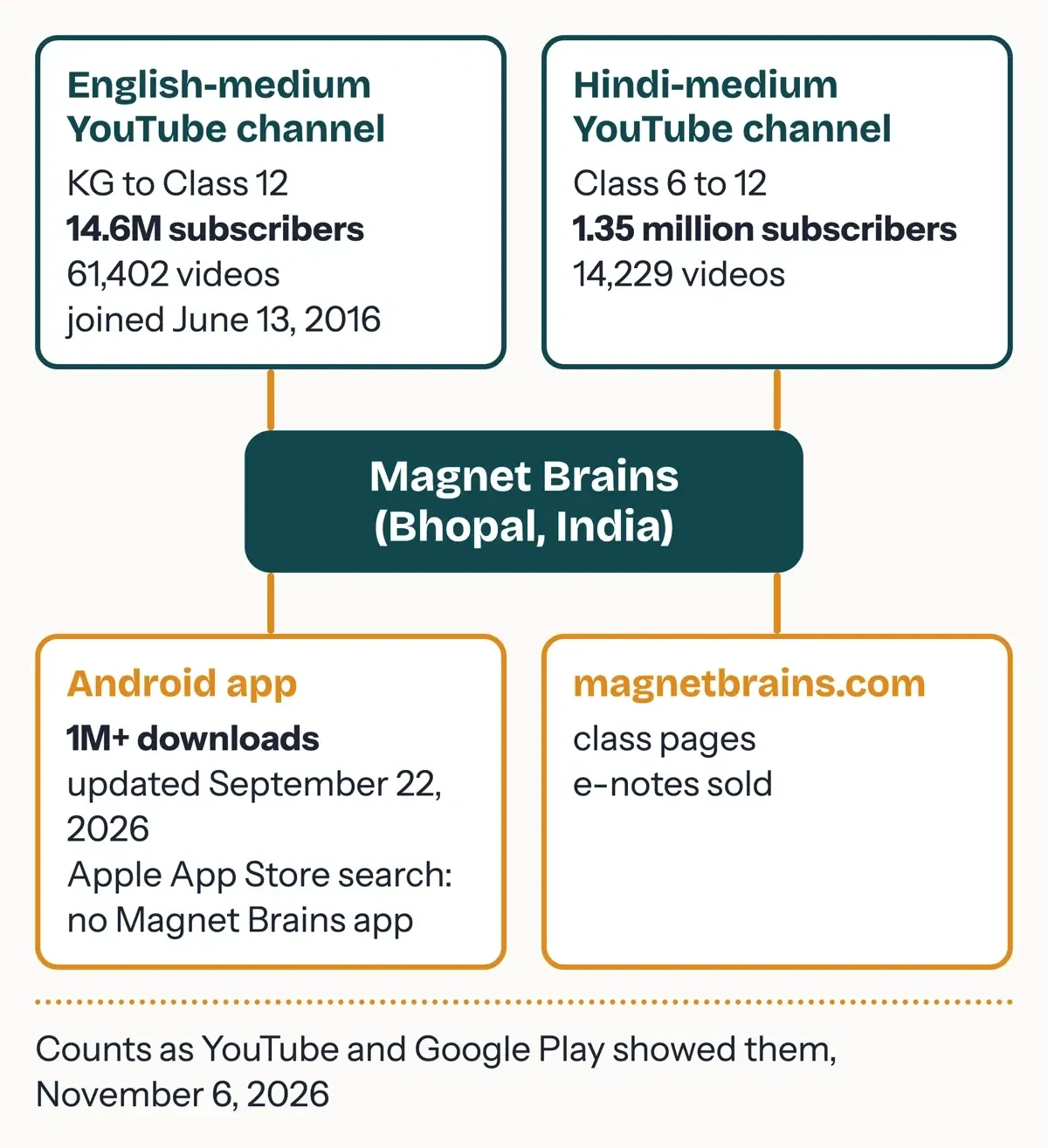 Diagram by DigitalTreed, from YouTube About panels, the Google Play listing and magnetbrains.com, read November 6, 2026.
The Android app, the website and two YouTube channels
The app is the third place to watch. From the US storefront on November 6, 2026, the Google Play listing showed 1M+ downloads and 4.4 stars from 10.4K reviews. It was last updated September 22, 2026. Its data safety panel says "No data collected" and "No data shared with third parties". Those labels are what the developer declared to Google, and we had no way to audit them without installing the app, which we didn't do.
The home page FAQ answers "Does Magnet Brains have a learning App?" with a Google Play link and no iPhone link. We searched Apple's App Store for "magnet brains" on November 6, 2026, in both the US and Indian stores. No Magnet Brains learning app came up. On an iPad, the YouTube app or a browser plays the same lessons. If you sign in to YouTube on a living-room TV for family viewing, the code steps are in our yt.be/activate smart TV sign-in guide.
Watching on YouTube takes no Magnet Brains account. The website account is optional. Its privacy policy says: "When you create an account on our Website, we collect information such as your name, email address, and password." We'd skip it for a young child.
If an older child later wants the site's extras, a parent can open the account in their own name and keep the child's email out of it.
Match each course to the NCERT textbook
NCERT has introduced new textbooks for some classes. Magnet Brains names each course after its book. A new title can differ from the old one while much of the content overlaps, so the check below compares titles, not teaching quality.
CBSE's notice list shows the "Release of CBSE Curriculum for the Academic Session 2026-27 for Classes IX-XII" on April 1, 2026. Its academics site holds that 2026-27 curriculum and links to NCERT's book list.
NCERT's textbook page listed these books on November 6, 2026. For Class 5 that's Math-Mela for maths, Santoor for English and Veena for Hindi, while Class 8 gets Ganita Prakash for maths, Curiosity for science and Poorvi for English. Earlier titles such as Math-Magic, Marigold and Honeydew didn't appear in its menus that day.
Magnet Brains keeps courses for both sets of titles online, and its pages don't say which one a given school uses. Its CBSE Class 5 course page lists "Maths Mela" as an Updated Course right beside a Math-Magic course. The CBSE Class 8 course page lists two Ganita Prakash courses next to four maths courses whose titles name no book. If your child's school uses Ganita Prakash, those two are the courses whose chapter names follow that book.
The Updated Course label helps, but it isn't proof on its own: two Class 8 courses, one in science and one in maths, carry it without naming any book. So ask the school, or check the cover, for the book name before you press play.
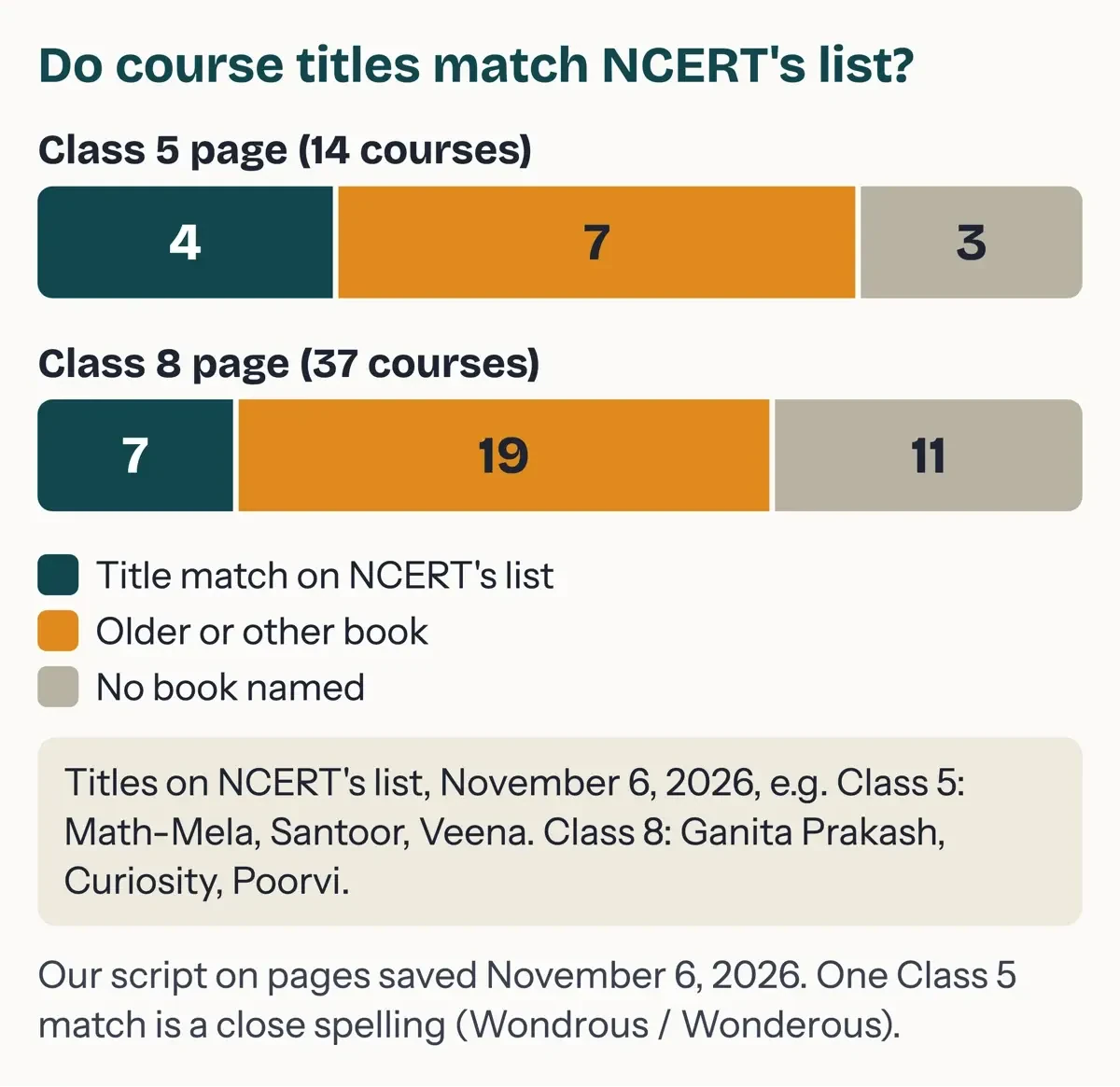 Drawn by us from our plan_builder.py results on saved Magnet Brains and NCERT pages, November 6, 2026.
What we tested
We saved both class pages and NCERT's textbook page on November 6, 2026, then ran our own script over every course title. On the Class 5 page, 4 of 14 titles match a title on NCERT's list that day. Seven name an older or other book, and 3 name no book. On the Class 8 page, 7 of 37 match, 19 name an older or other book, and 11 name no book. One Class 5 match needed a spelling check: Magnet Brains writes "Our Wondrous World" while NCERT writes "Our Wonderous World".
Fitting it around a US school week
A US school day already covers reading and maths. So we'd keep Magnet Brains to a short top-up on the CBSE books, plus a subject US schools skip, such as Hindi. The example plan below uses only the four Class 5 courses our script matched: maths, EVS, English and Hindi, for a made-up family with example minutes.
| Day | Minutes (example) | Subject | Magnet Brains course | Task |
|---|---|---|---|---|
| Monday | 25 | Mathematics | Mathematics Book Maths Mela | one video, then the matching textbook exercise |
| Tuesday | 25 | The World Around Us | EVS Our Wondrous World | one video, then the matching textbook exercise |
| Thursday | 25 | English | English Santoor Book | one video, then the matching textbook exercise |
| Friday | 25 | Hindi | Hindi Book Veena | one video, then the matching textbook exercise |
| Saturday | 40 | Review (all four) | rewatch one video the learner chose | a parent watches alongside |
That example adds up to 25 min x 4 weekdays + 40 min Saturday, or 140 minutes a week. We'd keep each session to one video plus its textbook exercise, because watching a lesson doesn't show whether your child can do the questions on their own. Swap subjects to match the school's report, and leave a weekday free for homework from the US school. If a CBSE school abroad sends home its own timetable, follow that chapter order instead of ours, since each course plays its book from the first chapter on.
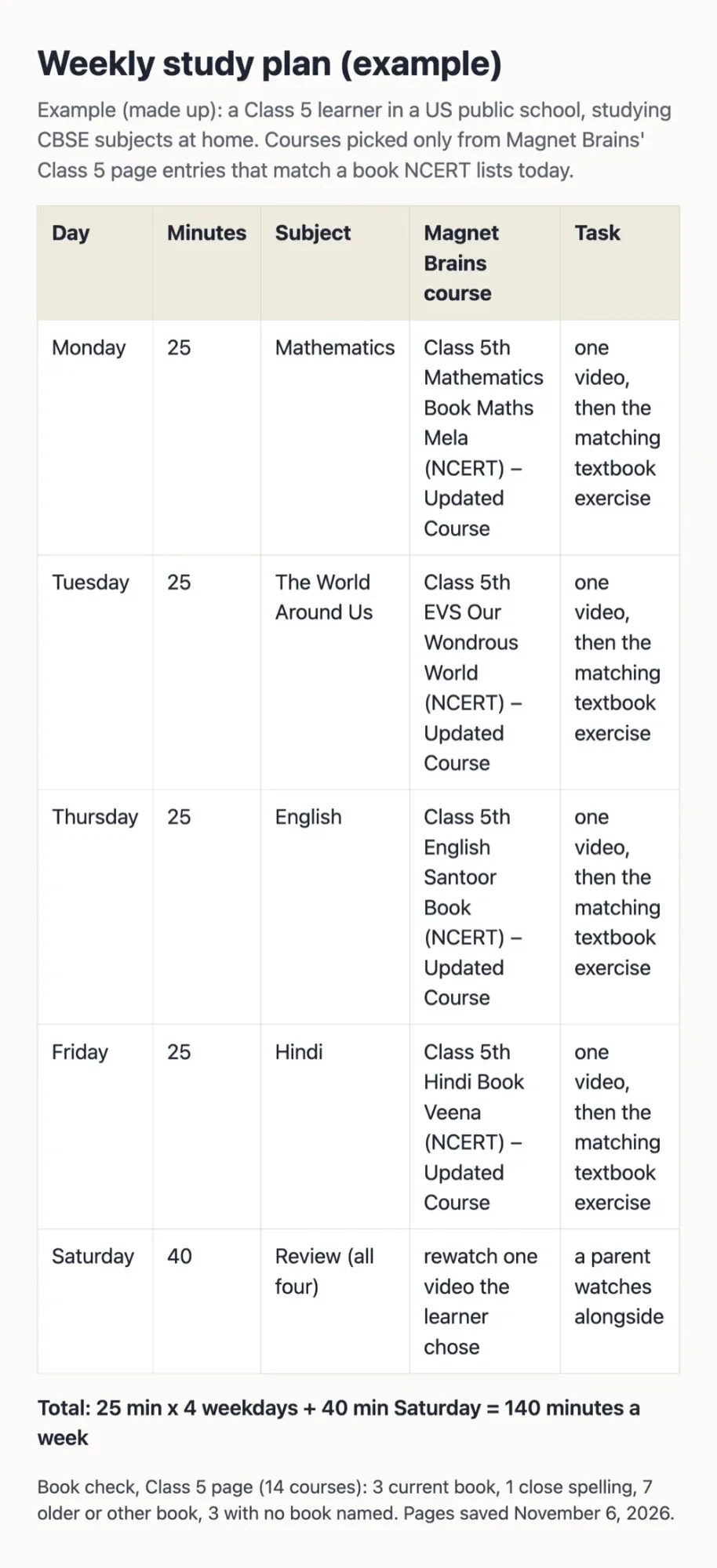 Screenshot: our plan_builder.py page served on 127.0.0.1, November 6, 2026. The family and minutes are made-up example figures.
If Magnet Brains becomes the main course at home, your state's homeschool rules apply. New York's home instruction page says parents "must provide written notice of intent to the school district superintendent". They then file an individualized home instruction plan. Check your own state's education department before you rely on CBSE videos alone.
If you tutor CBSE students for pay instead, that's a coaching-app question, and our Classplus app review for online coaches covers it.
Screen time and YouTube settings for younger learners
These lessons play on YouTube, where autoplay rolls straight into another video. That's the first switch to flip. The American Academy of Pediatrics' family media plan guide lists "Turn off autoplay and notifications: These features are designed to keep kids engaged longer."
The AAP's policy explainer adds that "Having a shared family tablet instead of separate tablets for everyone can encourage co-watching." It says its updated guidance helps families "move beyond simple screen-time limits and focus on quality, context and conversation." Its media and children page recommends a plan that weighs "the health, education and entertainment needs of each individual child". The same explainer calls content that helps "with school subjects like reading and math" beneficial, so a lesson counts differently from cartoons. We'd count the example 25-minute maths lesson as homework time rather than screen fun, and still play it with autoplay off and a parent within earshot.
YouTube's family accounts chart splits the options three ways. These are the settings we'd look at first:
- Supervised kid account (under 13): a parent picks Older kids (generally 9+), Teens (13+) or Older teens (16+).
- Family Center: screen time limits for the child, including a Shorts feed limit.
- Blocked channels: available in supervised accounts, so off-topic channels stay out of reach.
- YouTube Kids: Preschool, Younger (5-8), Older (9-12) or Approve content yourself, which turns search off.
Setting up a supervised account starts from Family Center in the parent's YouTube app, per YouTube's supervised account help page. If your child already has a Google Account, YouTube also names other routes, including the Family Link app and families.youtube.com on the web. The YouTube Kids parental controls page adds a Disable autoplay switch that the child can't turn back on. The same page lets you clear a child's watch and search history across all of their linked devices. If you also use Screen Time on an iPad and forget its passcode, see our steps for resetting a forgotten Screen Time passcode.
We couldn't check whether Magnet Brains videos appear inside YouTube Kids, because that needs the app on a child's profile.
Older kids on regular YouTube still see other channels in search. Our guide on blocking YouTube channels from search results shows the account-level block.
Comments and messages are the other risk, and lessons don't need either. Our checklist for protecting children from online predators and threats covers both, from privacy settings to what kids shouldn't share.
How does Magnet Brains compare with Khan Academy, PBS LearningMedia and CK-12?
Three free US programs publish enough about themselves to set beside Magnet Brains. All four say their core lessons are free. We read their own pages and store listings on November 6, 2026, and the table shows only what each one says about itself.
| Magnet Brains | Khan Academy | PBS LearningMedia | CK-12 | |
|---|---|---|---|---|
| Who runs it | Magnet Brains Learning Foundation, Bhopal, India | Khan Academy, a 501(c)(3) nonprofit | PBS (copyright line on its Teachers' Lounge page) | CK-12 Foundation, a nonprofit |
| Curriculum | CBSE and NCERT, KG to Class 12 | Math, science, grammar and more; Kids app for ages 2-8 | PreK-12, aligned to state and national standards | Common Core Math K-12 FlexBooks; NGSS |
| Cost it states | Free videos; notes sold | Free | Free teaching resources | Free; Flexi app with no ads |
| Apps | Android only | Khan Academy and Khan Academy Kids on iPhone | None in our App Store search | Flexi AI tutor on iPhone |
Khan Academy's App Store listing opens with "You can learn anything. For free." and calls it a 501(c)(3) nonprofit, and its blog describes Khan Academy as a nonprofit too. Its Khan Academy Kids listing says "Always 100% free, no ads, no subscriptions" for ages 2 to 8. The PBS LearningMedia home page promised, in November 2026, "thousands of free teaching resources including videos, lesson plans, and games aligned to state and national standards". PBS's Teachers' Lounge places it at PreK-12.
CK-12's mission page calls the foundation "a non-profit organization that provides free educational materials and resources". Its Flexi app listing says "No ads, no in-app purchases." Our take: keep Magnet Brains for the CBSE pieces, and use Khan Academy or CK-12 for maths in the order a US school teaches it. For reading practice, our Mahatma ELA app guide compares free US reading options. Two free programs at once can quietly double the screen time, so we'd drop one Magnet Brains weekday before adding a new app to the week.
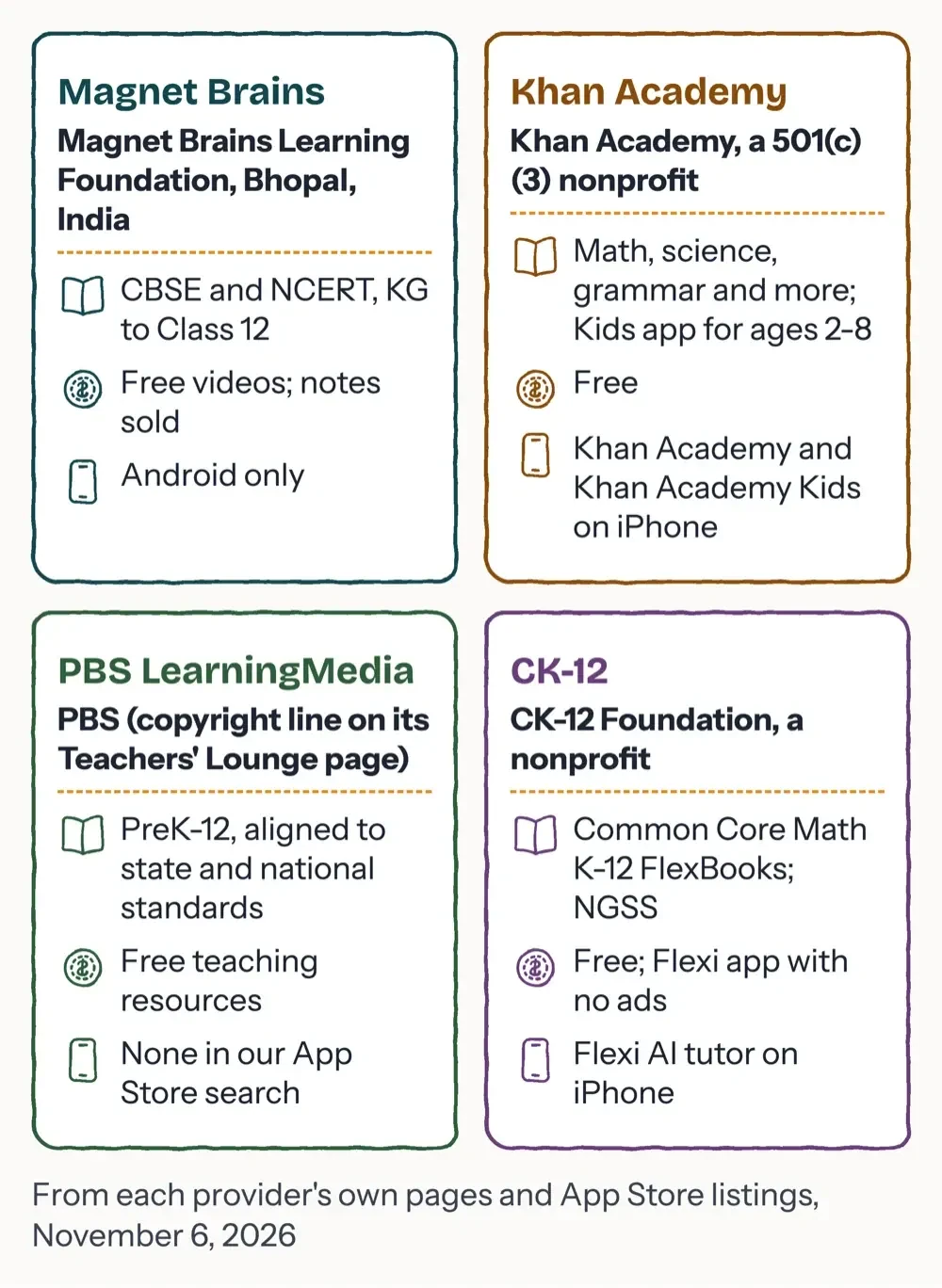 Diagram by DigitalTreed, from each provider’s own pages and App Store listings, read November 6, 2026.
Frequently asked
Is Magnet Brains really free?
The videos are. Its Play listing says most platforms "give only the first 2 chapters for free" and then ask you to upgrade. Its e-notes and e-books are the paid part.
Does Magnet Brains have an iPhone app?
None showed in Apple's US or Indian App Store search on November 6, 2026. The home page links only to Google Play, under the package name com.magnet.magnetbrains.
Does Magnet Brains follow the US Common Core?
No. Its Play listing says "All courses are based on CBSE, NCERT based school curriculum."
How do I contact Magnet Brains?
Its contact page lists "Notes & Support Inquiry : +919202737101", an Indian number.
How we made this guide: Every quote here was matched against copies of the 26 sourced pages taken November 6, 2026. The course counts come from our own title-matching script. Nobody here signed up, installed the app or bought notes. Facts checked by the DigitalTreed team on November 6, 2026.
First published December 2023, with course lists and teacher praise but no sources. Rewritten November 6, 2026 from Magnet Brains' own pages, its store listing and YouTube channels, CBSE and NCERT, and US family guidance.
Sources
- Magnet Brains: home page
- Magnet Brains: About Us
- Magnet Brains: Contact Us
- Magnet Brains: Privacy Policy
- Magnet Brains: CBSE Class 5th Full Video Course
- Magnet Brains: CBSE Class 8th Full Video Course
- Google Play: Magnet Brains app listing
- YouTube: Magnet Brains channel About
- YouTube: Magnet Brains Hindi Medium channel About
- CBSE: Central Board of Secondary Education notices
- CBSE Academics: Curriculum for the Academic Year 2026-27
- NCERT: Textbooks
- HealthyChildren.org (AAP): How to Make a Family Media Plan
- HealthyChildren.org (AAP): Helping Kids Thrive in a Digital World
- American Academy of Pediatrics: Media and Children
- YouTube Help: Understand your choices as a family
- YouTube Help: Set up supervised kid accounts
- YouTube for Families Help: Parental controls for YouTube Kids profiles
- App Store: Khan Academy
- App Store: Khan Academy Kids
- Khan Academy Blog
- PBS LearningMedia: home page
- PBS LearningMedia Teachers' Lounge
- CK-12 Foundation: Mission
- App Store: Flexi AI Tutor (CK-12 Foundation)
- New York State Education Department: Home Instruction
Comments
No comments yet. Start the conversation below.