

Quick answer
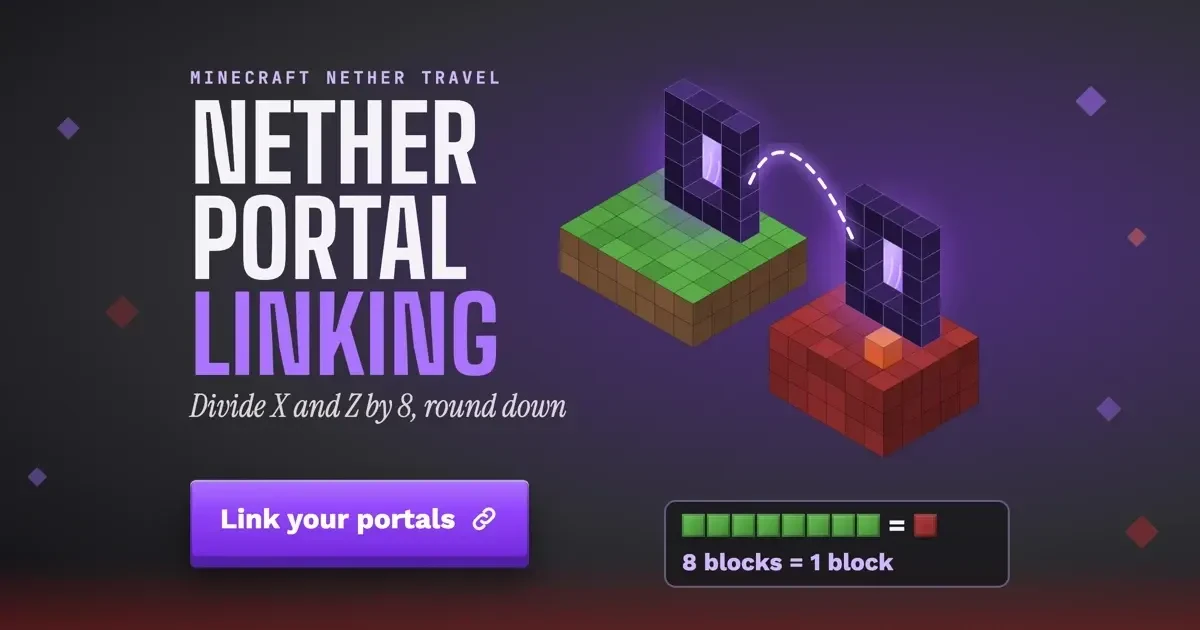
For Minecraft Nether travel, divide your Overworld X and Z by 8, round down, and keep Y the same (Minecraft Wiki, as of November 2026). Java then searches only 16 blocks around that Nether spot for a portal, while Bedrock searches 128 blocks. Build both portals yourself at matching coordinates, using the steps below.
You lit a second portal, stepped through, and came out somewhere you didn't plan to be, maybe on a ledge over a lava sea. Minecraft Nether travel runs on a few fixed rules, and that landing spot follows from them. A Nether portal is an obsidian frame, at least 4 by 5 blocks, that moves you between dimensions once it's lit. That definition and most numbers here come from the Minecraft Wiki's Nether portal page. Every block you walk in the Nether counts as 8 back home, so a 100-block tunnel there covers 800 blocks of Overworld.
The 8:1 ratio isn't what sends you to the wrong portal. Two other rules do that. One is rounding with negative coordinates, where -29.9 becomes -30, not -29; seven of our ten test conversions changed when decimals were simply cut off. The other is search distance. It's 16 Nether blocks on Java against 128 on Bedrock, and that decides whether a new portal finds your old one or gets a fresh partner.
Key takeaways
- Round down when you divide by 8, especially with negative coordinates.
- Java searches 16 blocks in the Nether; Bedrock searches 128.
- The closest portal wins, and height counts in that distance.
- Build both portals by hand instead of trusting the one the game makes.
- Cobblestone survives ghast fireballs; netherrack, at 0.4 blast resistance, doesn't.
How the 8:1 ratio works
The wiki's portal page says "by moving 1 block horizontally in the Nether, players have moved the equivalent of 8 blocks on the Overworld." That only covers X and Z. "This does not apply to the Y-axis," the same section adds. So a portal sitting at Y 70 in the Overworld wants its partner somewhere near Y 70 in the Nether, not at some divided-down height. Coming back, multiply X and Z by 8. Where people slip is rounding. The wiki writes the Nether X as floor(X ÷ 8), and floor always rounds down: "a coordinate of 29.9 rounds to 29, and one of −29.9 to −30."
So with negative numbers, rounding down moves you away from zero. The wiki page on the Nether gives a round-number check. Its player "enters a portal in the Overworld at X=0, Z=0 and travels in the Nether to X=1000, Z=1000." That player then "returns to the Overworld at X=8000, Z=8000."
You'll need your own numbers first. In Java, the Coordinates page says "pressing F3 (or Fn + F3 on Macs and some laptops) brings up a debug screen." The Debug screen page explains the two position lines on that screen, and they aren't the same thing. XYZ is where your feet are, down to decimals, while Block is the whole block you're standing in, which is the one you'll build on.
On Bedrock, your block position shows "in a box in the top left", but only after you've turned on "Show Coordinates" in the world options.
Write the Block numbers down before you go through. Once you're through, the screen shows Nether coordinates, and the XYZ line carries decimals such as 29.9, which are the numbers the rounding rule changes.
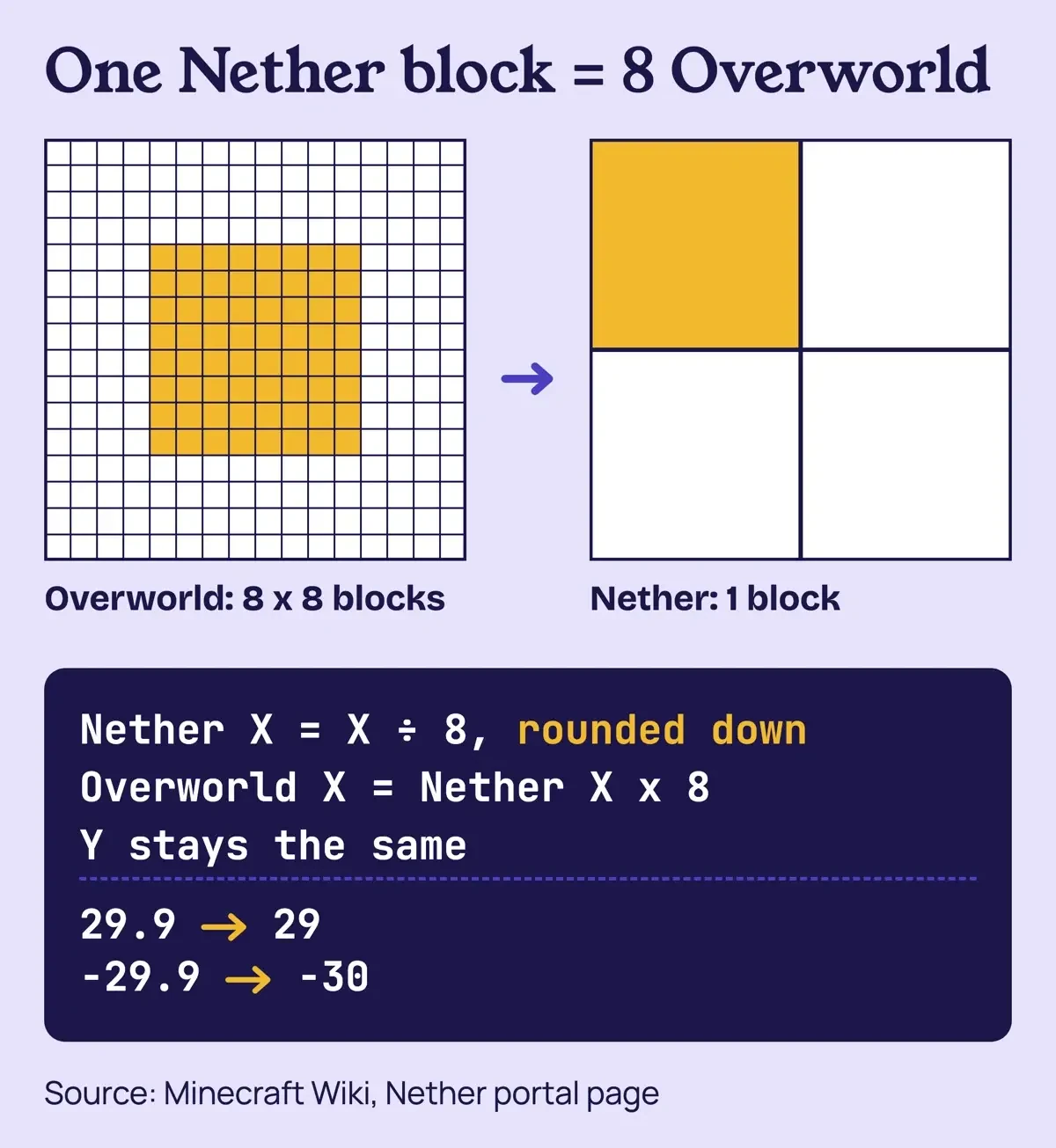 Diagram by DigitalTreed, from the Minecraft Wiki Nether portal and Nether pages, November 2, 2026.
How does the game pick which portal you come out of?
When you step in, the game converts your position by the 8:1 rule and searches a square around it. For Java, that's a "128-block radius" in the Overworld and a "16-block radius" in the Nether, full height.
If it finds more than one portal, it won't pick the one that looks closest on your map. It takes "the closest one as determined by its distance in the new coordinate system." The page adds that the Y coordinate "can cause seemingly more distant portals to be selected." The Nether portals tutorial is blunter: the distance counts "in all three coordinates." In our model, a Nether portal 50 blocks straight below the target lost to one only 10 blocks to the side. So a portal dug 50 blocks down under a ridge can lose to an old one 10 blocks away, even when its X and Z match the target exactly.
And if nothing's in range? The game builds a new portal, searching "within 16 blocks horizontally (but any distance vertically)" for open ground. With no room at all, it forces one onto an obsidian platform, and that's how you can end up on a slab over a lava sea.
The same rules explain two Overworld bases that both lead to one Nether portal. Picture bases at X 0 and X 100 on the same row, with made-up coordinates. The second base wants a Nether portal at floor(100 ÷ 8), which is 12. In Java, the search around X 12 finds the old Nether portal at X 0, just 12 blocks away, and uses it without building anything. So both bases now share one Nether door, and the trip back always leads to the base at X 0, since that's the closest Overworld portal.
So build a second Nether portal by hand at X 12. Our model then sends each base to its own Nether portal, both at a distance of 0.
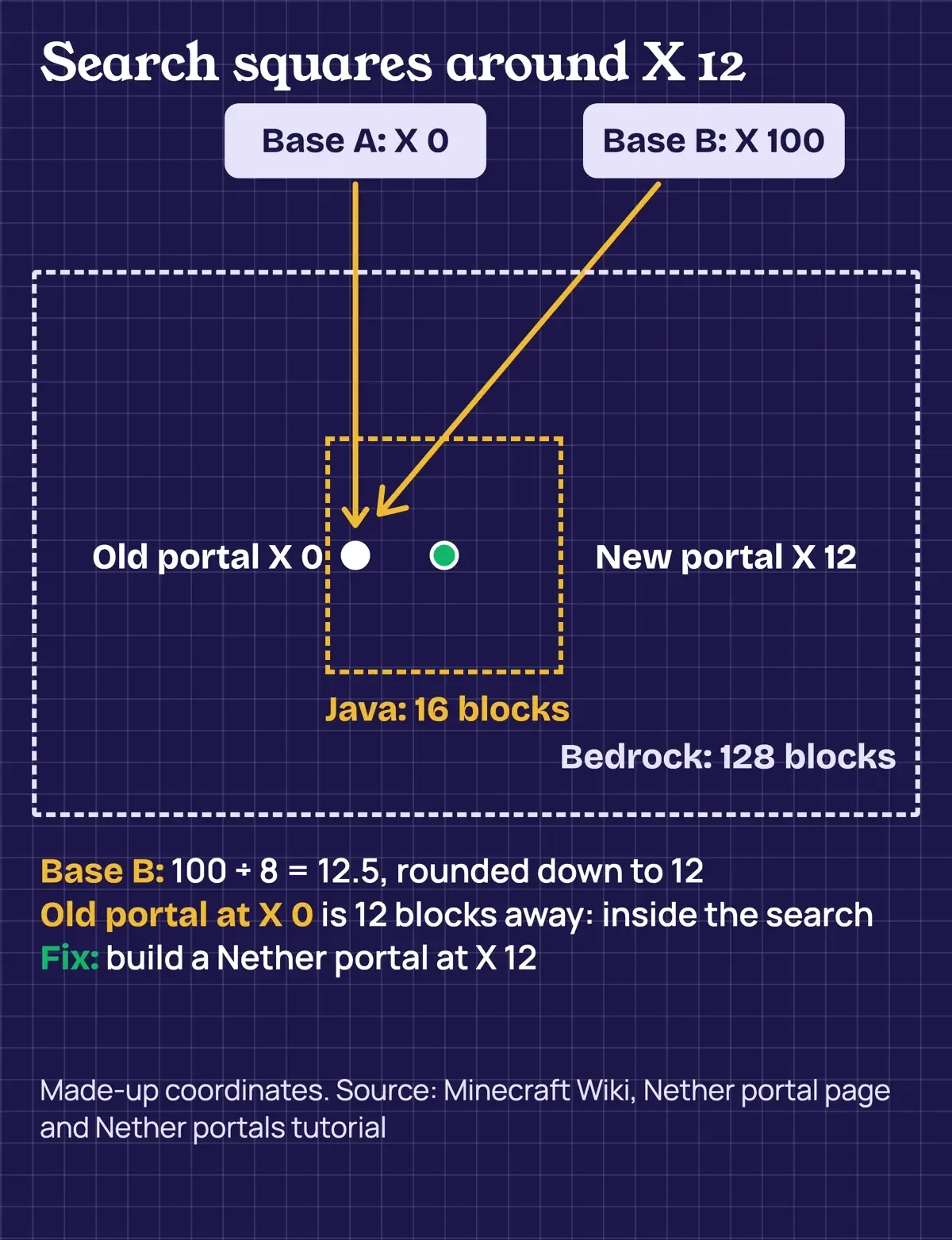 Diagram by DigitalTreed of made-up portal layouts, from the Minecraft Wiki Nether portal page and Nether portals tutorial, November 2, 2026.
Java and Bedrock link portals differently
That 16-block Nether search is a Java rule. Java 1.16.2 "Reduced the portal search radius when travelling to the Nether from 128 blocks to 16 blocks," says the portal page's history. Bedrock's rule there is wider: its point of interest "can be within a 256×256 square block area (128-block radius) in both the Overworld and Nether."
Minecraft.net timed out for our checker. Mojang's feedback site returned a challenge page, and we didn't try to get past it, so these are the wiki's words, not Mojang's.
| Rule (Minecraft Wiki, November 2, 2026) | Java Edition | Bedrock Edition |
|---|---|---|
| Search radius when going to the Nether | 16 blocks | 128 blocks |
| Search radius when going to the Overworld | 128 blocks | 128 blocks |
| Who can trigger a brand-new portal | Almost any entity except withers and the ender dragon | Only a player |
| Forced platform when there is no room | 2 by 3 obsidian | 2 by 3 obsidian, flanked by 4 netherrack on each side |
| How to see your coordinates | F3 debug screen | Show Coordinates world option |
The first row is where the editions split in our model. In made-up scenario B, a base at X 800 wants a Nether portal at X 100. Java finds nothing within 16 blocks and builds a fresh one, while Bedrock reaches the old portal at X 0, 100 blocks away, and sends you there. So on Bedrock, build the Nether side first. Do it before anyone walks through from the new base, and the old portal can't grab them.
Build a linked pair on purpose
That pull toward nearby portals is why linking on purpose means building the Nether side yourself. The Nether portals tutorial puts it plainly: "it is best to build both portals manually."
The Nether hub tutorial lists the kit as "10 obsidian at minimum (without filling corners)," something to light it, and blast-proof blocks such as cobblestone. We'd follow these five steps, using the tutorial's own village coordinates as the worked example.
- Stand in your Overworld portal and read the Block line. Example: the hub tutorial's village at X 1054, Y 78, Z -786.
- Divide X and Z by 8 and round down. 1054 ÷ 8 = 131.75, so X 131; -786 ÷ 8 = -98.25, so Z -99. Y stays 78.
- Enter the Nether through any portal you already have, carrying obsidian and flint and steel, and travel to X 131, Z -99.
- Climb or dig to about Y 78, then build the frame: 4 by 5 at minimum, corners optional. Over lava, build a floor first.
- Light it and step through. If you land at another portal, something closer is in range, so break it or move yours.
One note on step 2. The hub tutorial's "to get roughly X=132 and Z=-98" rounds to the nearest number, while the game rounds down to 131 and -99. The link still holds: our model takes X 131, Z -99 back to X 1048, Z -792, about 8.5 blocks from the village portal.
If a pair that used to work starts sending you elsewhere, look for a new portal near the ideal spot. The portal page describes the classic case, where "the player's Nether-side portal is deactivated by a ghast." If someone then uses the Overworld side, the game builds a fresh Nether portal that steals later trips. Relight the original and break the newcomer. Height helps here too. With two Overworld portals at the same X and Z, the tutorial says the Nether portal "links to whichever portal is closest on the Y axis."
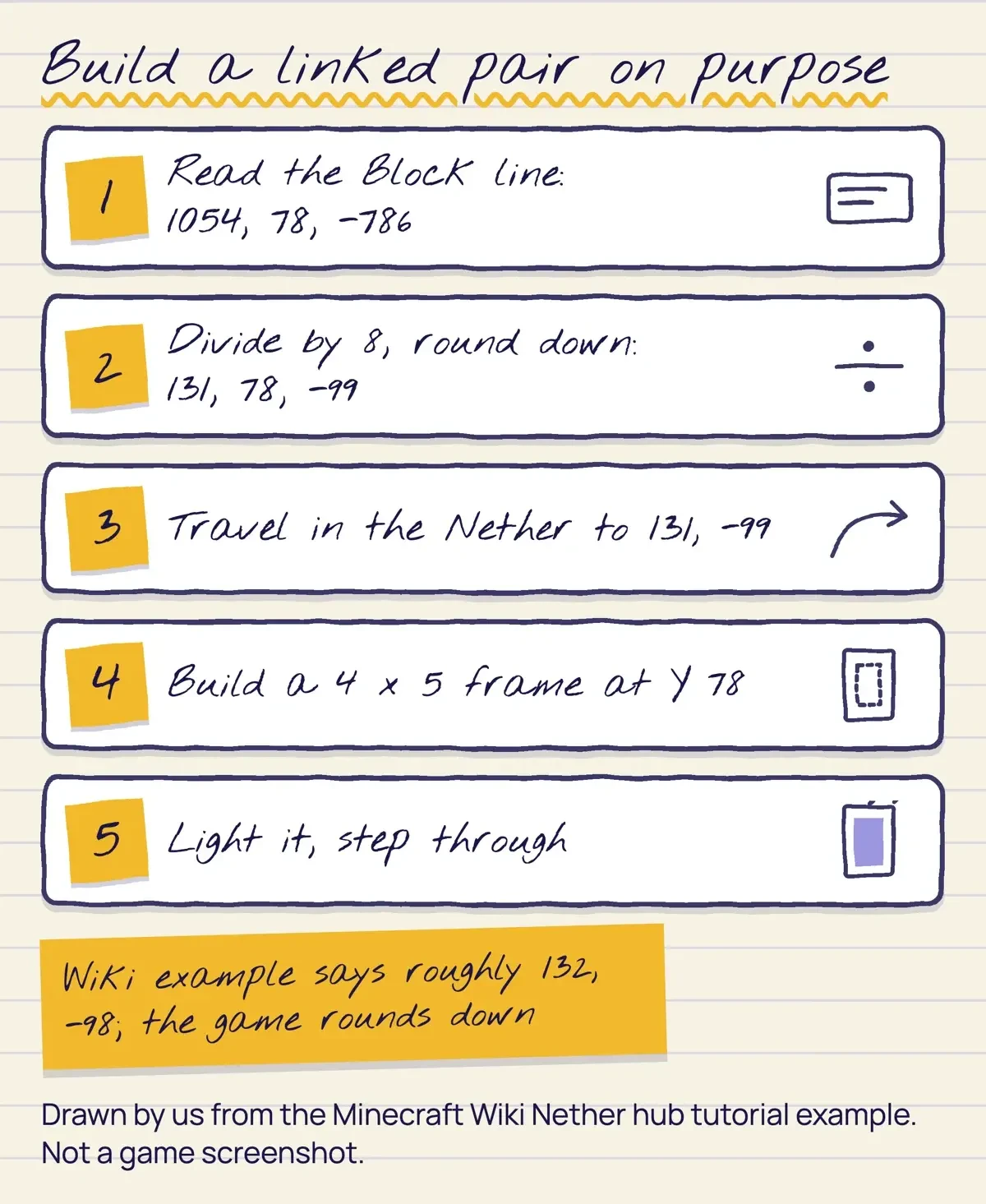 Drawn by us from the Minecraft Wiki Nether hub tutorial example, November 2, 2026. Not a game screenshot.
Ten conversions, including the negative ones
We ran the step 2 rounding on ten coordinate pairs, down to negative decimals like -99.5. Each pair went through the wiki's floor and through cutting decimals toward zero, as int() in Python and Math.trunc in JavaScript do. For -29.9, floor gives -30 and cutting gives -29.
| Overworld X, Z (example) | Nether X, Z (round down, the game rule) | Cut toward zero (the mistake) | Back in the Overworld (x 8) | Round-trip offset |
|---|---|---|---|---|
| 800, -400 | 100, -50 | 100, -50 | 800, -400 | 0, 0 |
| 1054, -786 | 131, -99 | 131, -98 (differs) | 1048, -792 | 6, 6 |
| 92, 45 | 11, 5 | 11, 5 | 88, 40 | 4, 5 |
| 7, 8 | 0, 1 | 0, 1 | 0, 8 | 7, 0 |
| -1, -7 | -1, -1 | 0, 0 (differs) | -8, -8 | 7, 1 |
| -8, -9 | -1, -2 | -1, -1 (differs) | -8, -16 | 0, 7 |
| -100, -12 | -13, -2 | -12, -1 (differs) | -104, -16 | 4, 4 |
| -99.5, 12.3 | -13, 1 | -12, 1 (differs) | -104, 8 | 4.5, 4.3 |
| 29.9, -29.9 | 3, -4 | 3, -3 (differs) | 24, -32 | 5.9, 2.1 |
| -1500, 2500 | -188, 312 | -187, 312 (differs) | -1504, 2496 | 4, 4 |
Seven of the ten rows differ, all with a negative X or Z; 800, -400 doesn't, since -400 ÷ 8 is exactly -50. One Nether block off is 8 Overworld blocks, the closest spacing the Nether portals tutorial allows for precise portals.
The last column shows a second limit: Nether portals only map back to multiples of 8, so the Overworld side lands less than 8 blocks short on each axis.
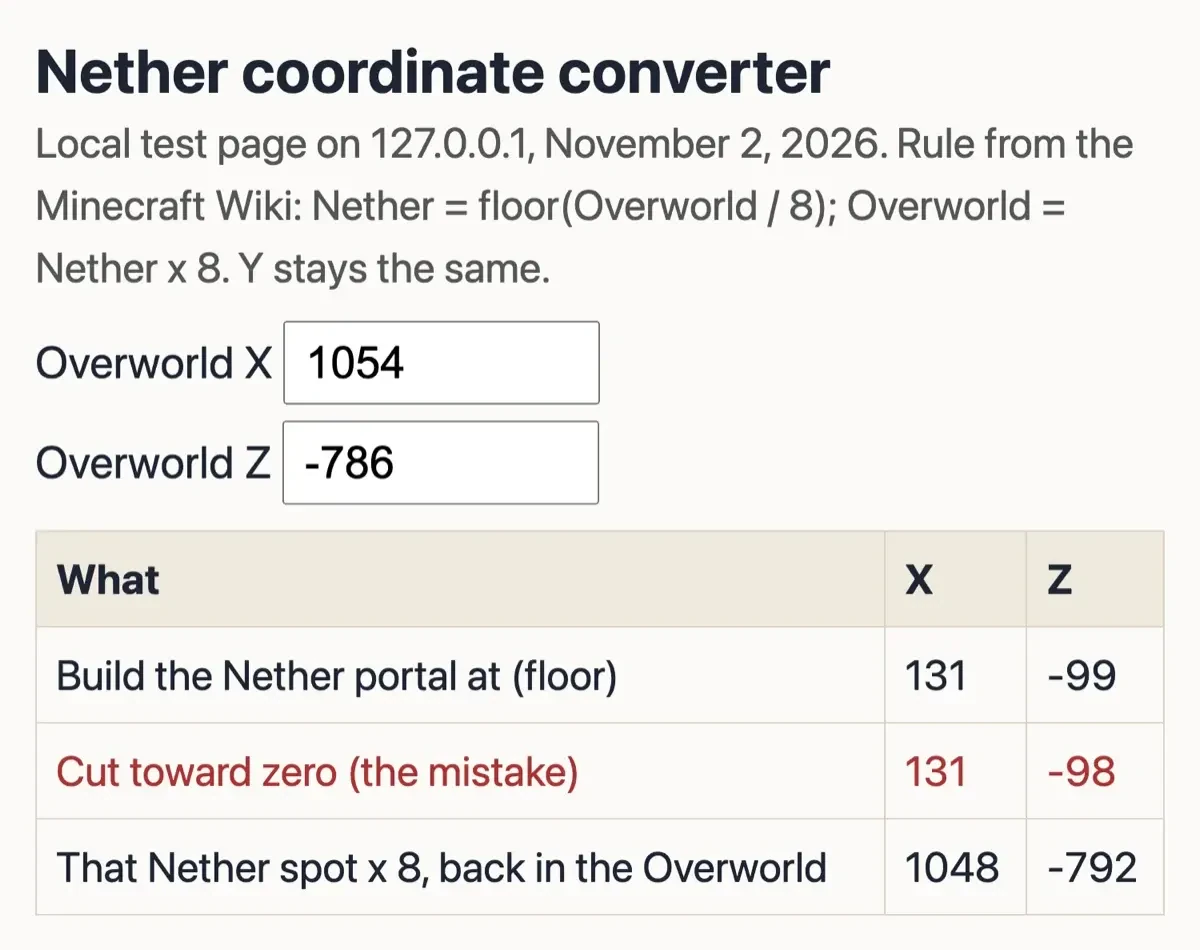 Screenshot: our Nether coordinate converter on 127.0.0.1, November 2, 2026.
What we tested
On November 2, 2026 we wrote a Python converter and put the same rule in a page on 127.0.0.1. A Node check ran that page's functions on all ten pairs: 10 of 10 matched. The script also models the five made-up layouts in this guide, following the wiki's description, not the game's code. We didn't run Minecraft.
A Nether path you can use every day
Once two or three pairs work, the Nether between them becomes your road. The hub tutorial builds it as a covered tunnel with "ghast-resistant blocks such as cobblestone" for walls and "lower slabs so no mobs spawn" underfoot.
Cobblestone is there for ghast fireballs. The Ghast page says "Blocks with blast resistance as low as 3.5 survive a fireball's explosion." The Fireball page puts the level that absorbs the whole blast at 4.034, and the Cobblestone page lists a blast resistance of 6, comfortably above both. The Netherrack page lists just 0.4 for the red stone most of the Nether is made of. So a bare netherrack tunnel won't stop a fireball, and the Explosion page table lists the same two numbers. We didn't check stone bricks or basalt, so we're not rating them here.
For speed, the tutorial points to ice and calls blue ice "best but very expensive." The Blue Ice page agrees: "It is the fastest ice type for boat riding." It puts a boat's top speed at 72.73 m/s on blue ice, while plain and packed ice top out at 40. The tutorial also describes a road on the Nether roof, above the bedrock ceiling. It warns, though: "This uses a bug to the advantage of the player, and only works in Java Edition." We'd stay in the tunnel, since a road built on a bug can stop working with any update and Bedrock players can't use it at all.
Ghasts, lava and piglins on the way
There's no tunnel yet on your first trip out. Ghasts shoot explosive fireballs that set fire to nearby blocks. They can switch off a Nether portal too, so once the frame is up, wall it in with cobblestone and keep a flint and steel on you to relight it.
Lava's the bigger danger on foot. The Nether page says "Lava seas generate at and below level 31 in all Nether biomes." The Lava page says "In the Nether, lava travels 7 blocks horizontally" from its source, against 3 in the Overworld. It spreads one block every 10 game ticks there, three times the Overworld pace of one block every 30. The Fire Resistance page says the effect "grants immunity to all kinds of fire damage," lava included. It lists 3:00 for the basic potion and 8:00 for the extended one. We'd drink one before any first dig toward a new portal spot, since a forced portal can sit right above that sea.
Piglins take less work than lava. The Piglin page says a piglin "is hostile to players unless they wear at least one piece of golden armor." One golden helmet or pair of boots will do. The Golden armor page backs that up: wearing it "pacifies piglins."
The Piglin page adds that you can give them gold ingots "to barter for various items." Our piece on in-game currencies and virtual economies looks at how games build trades like that.
Don't leave the Overworld side open, either. The Nether portals tutorial warns that mobs wandering through a portal "can accumulate over time in the Nether."
What we'd build first
So if we started a world today, we'd build the Nether side of every pair by hand, starting at spawn. Write down each Overworld portal's Block line, round down, and tunnel to the Nether spot before lighting anything. On Bedrock, the 128-block search covers 1,024 Overworld blocks (128 x 8), so we'd always build the Nether portal before anyone walks through from the new base. We'd also keep a cobblestone room around every Nether portal with a spare flint and steel in a chest. If a ghast switches off a portal, that spare lets you relight it before anyone's trip makes the game build a new one.
For games with no coordinates to track, we've written guides to the Poeltl NBA guessing game, the Google memory game, Gimkit game codes and joining a Blooket game.
PC players can read how free games on Steam work. If a Call of Duty account gets flagged or shadow banned, our Activision ban appeal steps cover the official route and what an appeal can't fix.
Nether travel questions
Frequently asked
Do you divide Y by 8 for Nether portals?
No, only X and Z change. The Nether hub tutorial says to note "these divided values, along with the unchanged Y value," and to build the Nether portal at about the same height.
What is the smallest Nether portal you can build?
A 4 by 5 obsidian frame, and the corners can be left out. The Nether portal page gives the range as 4 by 5 up to 23 by 23 and says portals the game builds itself are always 4 by 5 with corners.
How far do you travel in the Nether for Subspace Bubble?
875 Nether blocks. The advancement needs two Overworld points at least 7,000 blocks apart, and the Nether portal page notes that's "875 blocks in the Nether."
How close can two Overworld portals be?
As close as 8 blocks, if your numbers are exact. The Nether portals tutorial suggests a backup gate every 64 Nether blocks and says portals "can be built as close to 8 Overworld blocks apart, if the coordinates are precise."
How we made this guide: A script saved 20 Minecraft Wiki pages on November 2, 2026, and our build script checked every quote against those copies. Minecraft.net timed out, so it isn't cited, and no game was played. Facts checked by the DigitalTreed team on November 2, 2026.
First published February 2026. Rewritten November 2, 2026 with the wiki's round-down rule, the Java and Bedrock search radii and our converter results; a mention of a third-party calculator was removed.
Sources
- Minecraft Wiki: Nether Portal
- Minecraft Wiki: Tutorial, Nether portals
- Minecraft Wiki: Tutorial, Nether hub
- Minecraft Wiki: The Nether
- Minecraft Wiki: Coordinates
- Minecraft Wiki: Debug screen
- Minecraft Wiki: Ghast
- Minecraft Wiki: Fireball
- Minecraft Wiki: Cobblestone
- Minecraft Wiki: Netherrack
- Minecraft Wiki: Explosion
- Minecraft Wiki: Blue Ice
- Minecraft Wiki: Lava
- Minecraft Wiki: Fire Resistance
- Minecraft Wiki: Piglin
- Minecraft Wiki: Golden armor


Comments
No comments yet. Start the conversation below.