
Quick answer
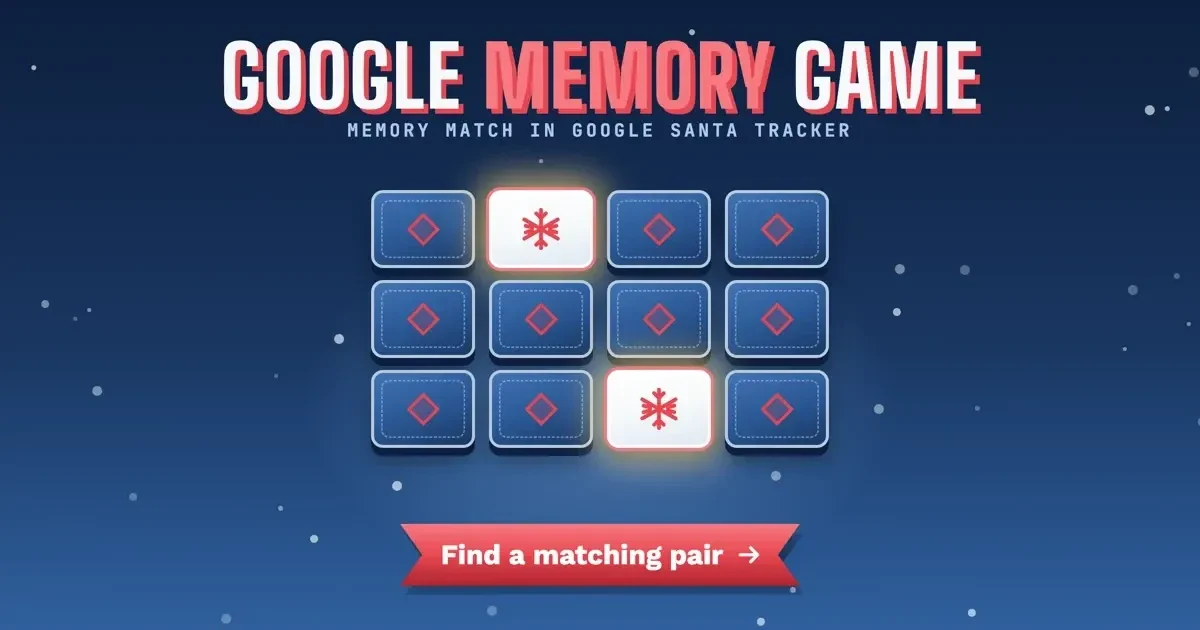
The Google Memory Game is Memory Match, a card-pairing game inside Google Santa Tracker, as of November 2, 2026, though no Google page we read uses that exact name. If you mean a Google Doodle, the closest archive card game is Rise of the Half Moon, from October 24, 2024. Start with Memory Match level 1: four doors and 30 seconds.
Maybe you flipped holiday picture cards on a Google page last December and want that Google Memory Game back. Memory Match is a matching game in Google Santa Tracker: you open two doors per turn and pair what's behind them before the clock runs out. If the cards you remember sat on Google's search page instead, you may mean a Doodle game.
Memory Match is the one Google game that fits the name. Google publishes its code. The door counts, timer and scoring below come from that code, not from play. Doodle card games sit in Google's archive, and Google Play memory apps are a separate install. The tips come from a 16-card demo board we built and ran ourselves. It's ours, not Google's.
Key takeaways
- Memory Match in Google Santa Tracker is the Google game behind this name.
- Its code runs ten levels, from 4 doors up to 12.
- Remembering every card took 11-13 moves on our 16-card board.
- Remembering nothing took 29-120 moves on the same ten deals.
- The National Academies called cognitive training evidence encouraging but inconclusive.
Which game is the Google Memory Game?
We found no Google page titled Google Memory Game on November 2, 2026, but Google does run a holiday site whose matching page carries the title Memory Match. That page sums up the whole site in one line: "Explore, play and learn with Santa's elves all December long." It also fits what this post used to describe, with snowflakes, ornaments, presents and reindeer hidden behind cards. Google also publishes the site's code, so the rules can be read instead of guessed. The Santa Tracker repository on GitHub calls the project "an educational and entertaining tradition for the December holiday period."
Its English strings file names the scene Memory Match. The note beside it reads "Traditional matching game, click doors to see items and try to pair them off." Type Memory Match into a search box, not Google Memory Game.
Interactive Doodles also get called a Google memory game, though none of them is Memory Match. They're games Google once showed on its search page, and they now live in the Doodle archive.
Memory apps on Google Play are the third candidate, installed like any other app. The diagram sorts the three by where they open: a browser page, the Doodle archive or an installed app.
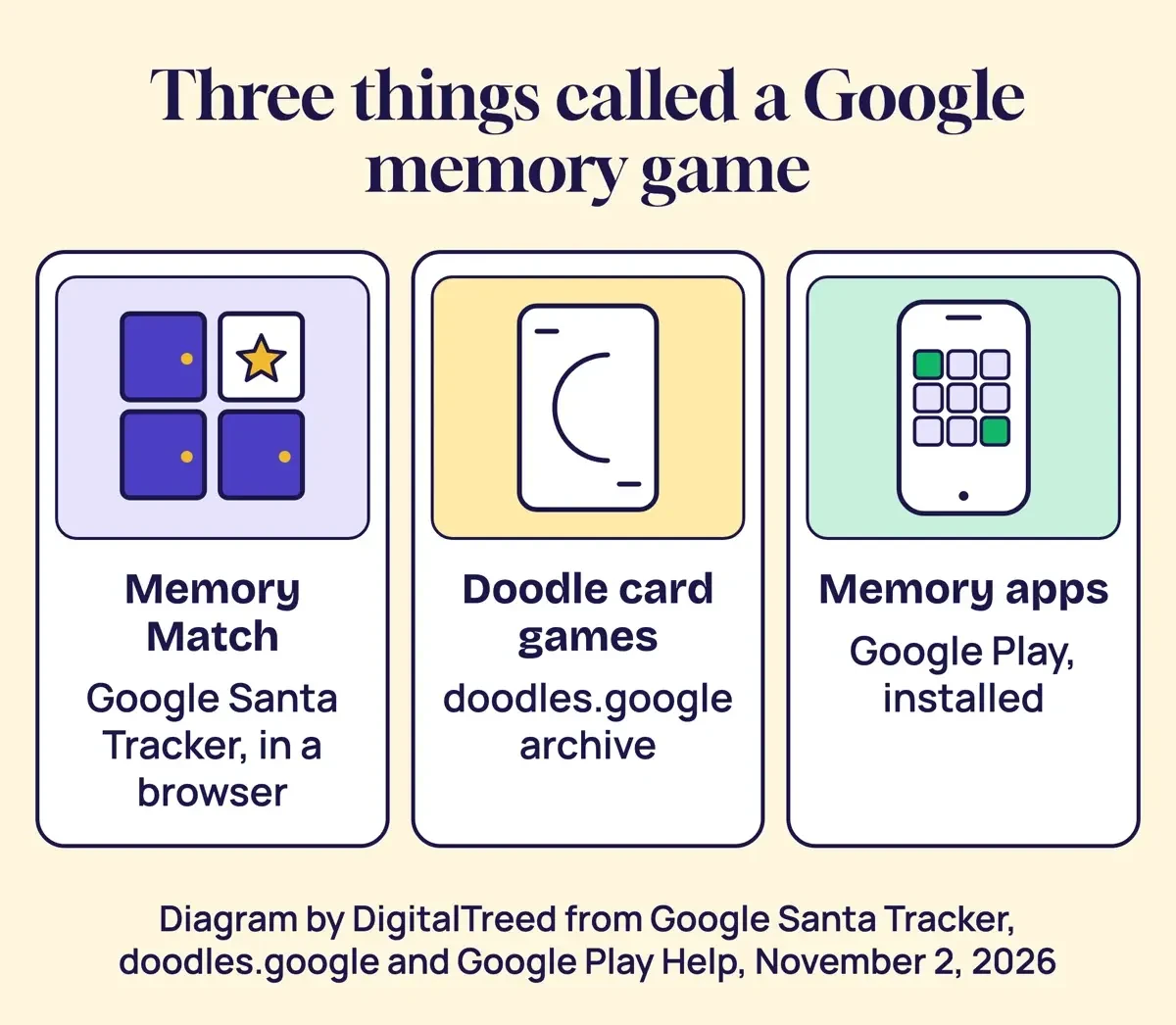 Diagram by DigitalTreed, November 2026, from Google Santa Tracker, doodles.google and Google Play Help
How Memory Match works, level by level
Each turn starts with a click on a door. You see what's behind it, then click a second door; a match scores points, and a miss closes again. The constants file sets that close-up delay at 400 milliseconds and allows two open doors at most, so a third click makes the code close the open pair first. A wrong pair costs a whole turn. In the game logic, each level adds 30 seconds minus 5 for every level already passed, and it never adds fewer than 15. Unused time carries over, because the code adds each level's new seconds to whatever's left on the clock, so a quick level 1 buys breathing room later.
The level model sets how many doors are in play. It's 4 on level 1. From level 5 through level 10, the last level in the code, it's 12. Treat the table as the rules in the code Google publishes; the live build in a given December can differ.
| Level | Doors (pairs) | Seconds added | Points per match |
|---|---|---|---|
| 1 | 4 (2) | 30 | 50 |
| 2 | 6 (3) | 25 | 55 |
| 3 | 8 (4) | 20 | 60 |
| 4 | 10 (5) | 15 | 65 |
| 5-10 | 12 (6) | 15 | 70-95 |
The score has two parts. A match is worth 50 on level 1 and 5 more on each later level, which makes 95 on level 10. Clearing a level adds a bonus of 500, plus 50 for each level past the first, multiplied by the seconds left and divided by 30. Example: you clear level 2 with 15 seconds left, so (500 + 50) x 15 / 30 = 275 points. That's as much as five matches on level 2. At zero seconds left, the bonus is zero.
Most levels don't shuffle at random, either. For each level the level model picks one layout from a short list: level 1 always gets horMirror, checkerboard or an offset layout. Only level 10 is purely random. On horMirror, a card's partner sits in the mirror-image spot of the same row. If your first pair sits at both ends of a row, open the mirror-image door for each new card, because on a horMirror deal that's where its partner sits. Some levels also allow a random deal, so the trick won't always land.
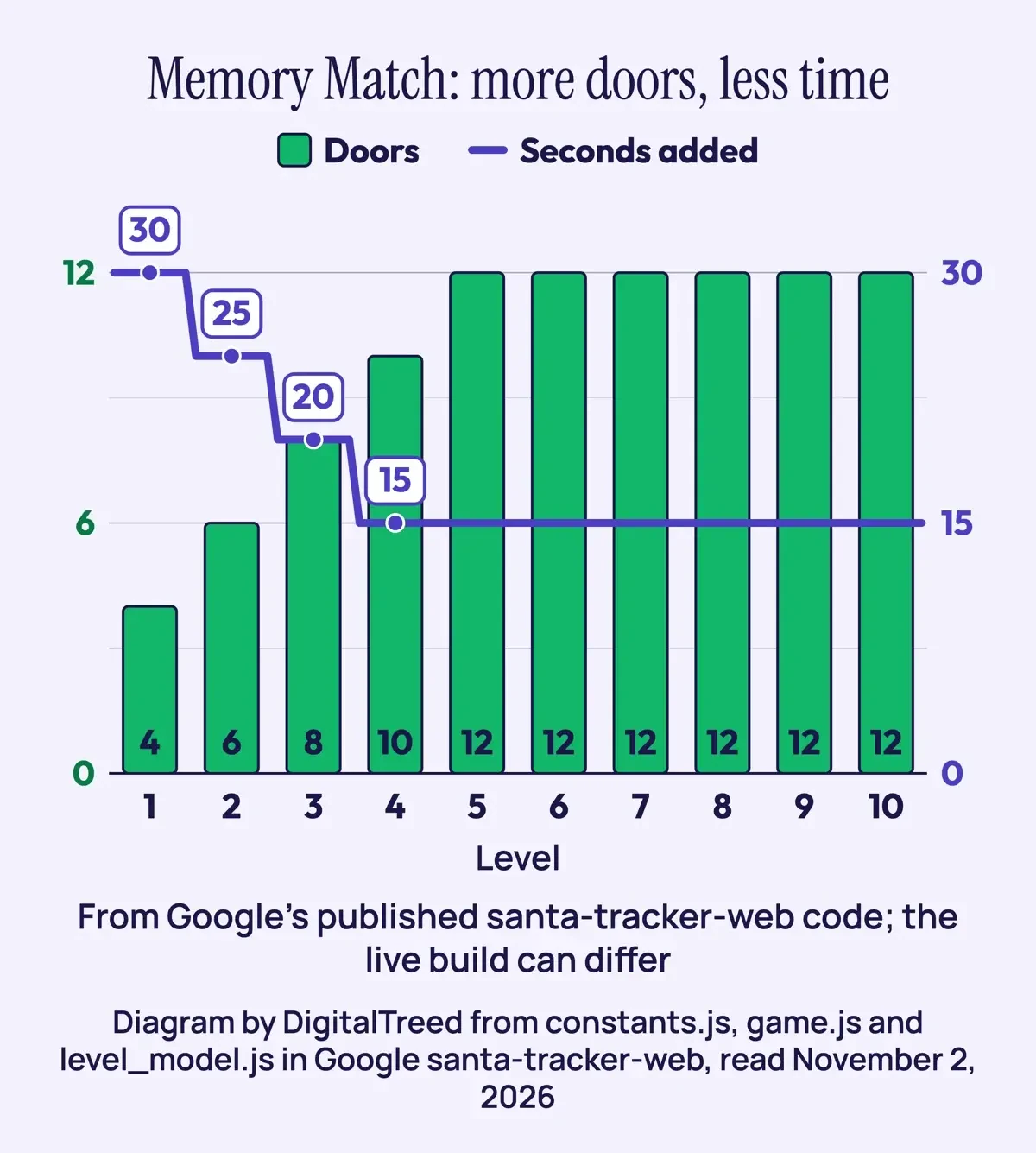 Diagram by DigitalTreed from constants.js, game.js and level_model.js in Google santa-tracker-web, read November 2, 2026
Doodle card and matching games in the archive
Memory Match is a holiday game, and Doodles are the other place Google keeps card games. The Doodles about page says "We've created more than 5,000 Doodles over the decades." It dates the first playable one to May 21, 2010, a PAC-MAN anniversary. To look for a memory game among them, we read the archive's own index. The Doodle sitemap, the list Google publishes for search engines to crawl, holds 6,400 Doodle pages. None of their addresses contains memory or matching. We then read 373 of those pages one by one, mostly the Celebrating and Halloween games, and none called itself a memory game. That's a sample of 6,400, so it's a hint, not proof.
Of the 373 Doodle pages we opened, 26 called themselves interactive or game Doodles. Three Doodles come closest, each asking you to match cards or items, and they span five years, from Lotería in 2019 to Rise of the Half Moon in 2024.
| Doodle | Date | What you do, in the page's words |
|---|---|---|
| Rise of the Half Moon | October 24, 2024 | connect the phases of the lunar cycle to earn points |
| Celebrating Pani Puri | July 12, 2023 | Choose the puris that match each customer's flavor and quantity preference |
| Celebrating Lotería | December 9, 2019 | Play the game with friends in a private match, or match with users around the globe at random |
For card players, Half Moon is the one to try. Its page calls it a "monthly recurring card game" against the moon, and the sitemap lists a separate page for each month of the series. Pani Puri is a matching game against the clock. It marks a 2015 record in Indore, where a restaurant "achieved the World Record for serving the most flavors of pani puri by offering 51 options." The page says "Click the Doodle to help complete customers' orders before time runs out!"
Lotería, from December 9, 2019, was "our second-ever multiplayer experience," the Doodle's page says, and it pairs you with friends in a private match or with random players.
Each Doodle in the archive has its own page with a date, a story and theme tags, and the Half Moon page files its card game under Games and Space. The search box on doodles.google runs in your browser and loads Google's reCAPTCHA, which is why our script read the sitemap instead. Typing a game's name in by hand is faster.
Memory games on Google Play are a different thing
Search Google Play for a memory game and you leave both of those behind. Google Play Help describes the store as the place where "You can install apps, games, and digital content on your device." The same page notes "Some content is available at no charge, and some you need to buy." An app from the store is its own product with its own listing, while Memory Match and the Doodles open in a web browser. Our script only read the Memory Match and Doodle pages. It didn't sign in or install anything, so we can't vouch for any Play app. Read its listing before you tap install.
If word games suit your house better, our Wordle Junior guide for kids covers what's real there.
Our demo board and why remembering pays
We didn't play Google's live Memory Match or the Doodles for this guide. Instead we built a tiny matching game of our own, on a local page that runs only on our machine, and let three scripted players loose on it. It isn't Google's game and doesn't copy Google's art: it's 16 plain cards in 8 pairs, with the same two-cards-per-turn rule. Each scripted player differs in one way only. The first remembers every card it has seen, the second keeps just the last four, and the third remembers nothing and flips at random. All three got the same ten deals, so a bad deal hurts everyone equally.
What we tested
We ran 30 rounds on November 2, 2026 (10 seeds x 3 players) with Node v26.10.0 and kept every result. A move is one pair of flips.
| Player | Moves in rounds 1-10 | Fewest | Most | Average |
|---|---|---|---|---|
| Remembers every card | 12 12 11 13 12 12 12 11 12 12 | 11 | 13 | 11.9 |
| Remembers the last 4 cards | 16 12 14 15 12 14 14 21 12 13 | 12 | 21 | 14.3 |
| Remembers nothing (random) | 32 120 29 79 70 71 62 92 56 61 | 29 | 120 | 67.2 |
Tips that cut wasted moves
On the same ten deals, the player that remembered nothing averaged 67.2 moves, while the full-memory player averaged 11.9. Its worst deal took 13. Keeping only four cards in mind still landed at 14.3, though one deal pushed it to 21, almost seven more than its average.
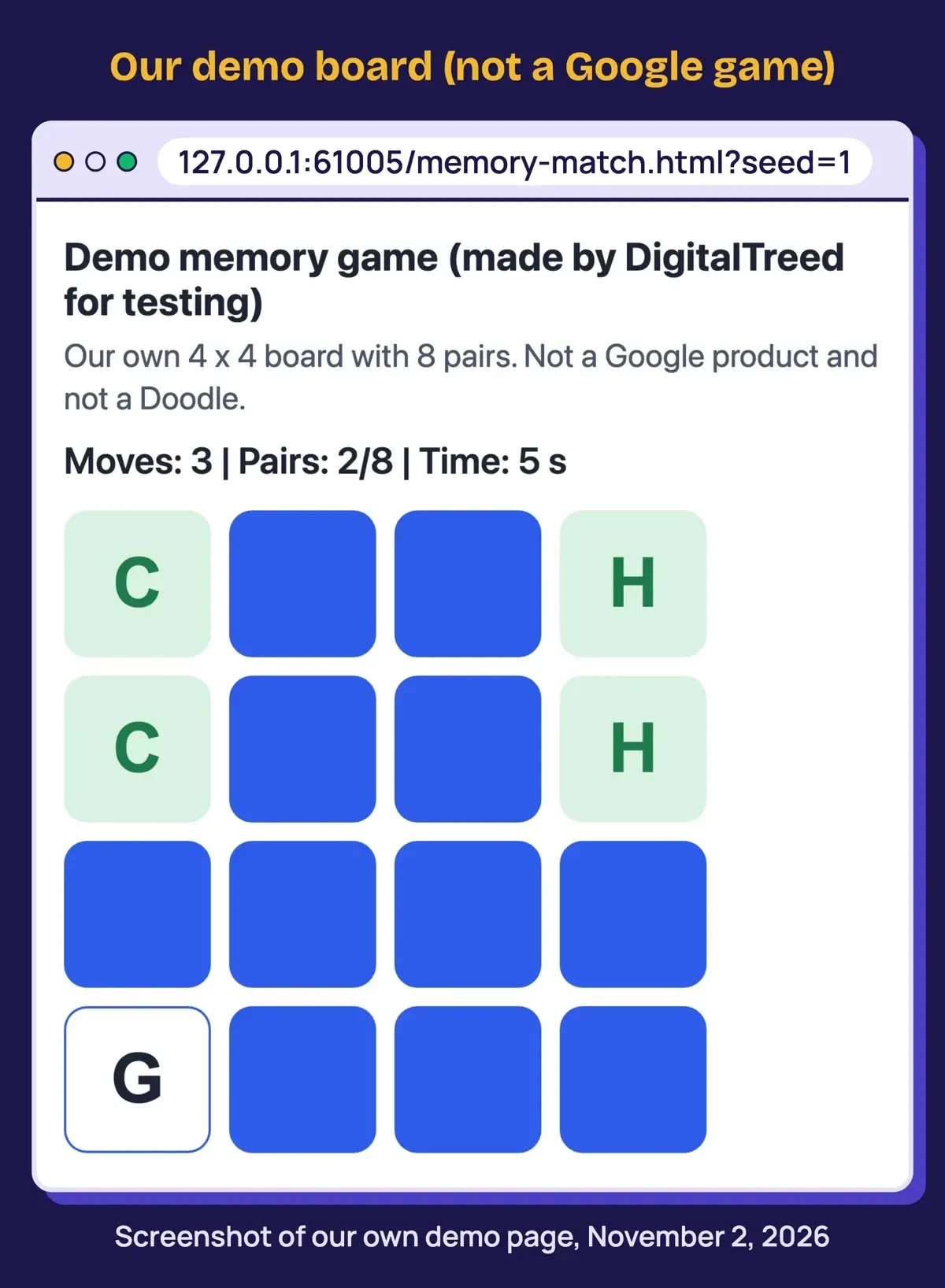 Screenshot: our own demo game at 127.0.0.1, November 2, 2026 (made by DigitalTreed, not a Google game)
Three habits follow from those numbers. Flip a door you haven't seen before you test a guess, because a new card adds something to remember and a wrong guess on a known card adds nothing. When the first card of a turn matches one you've already seen, go straight to it and take the pair before you open anything new. Our scripted players picked unseen cards at random, so this third habit isn't from the test. It's our suggestion: work along the rows in a fixed order, so you're tracking positions instead of a scatter of clicks.
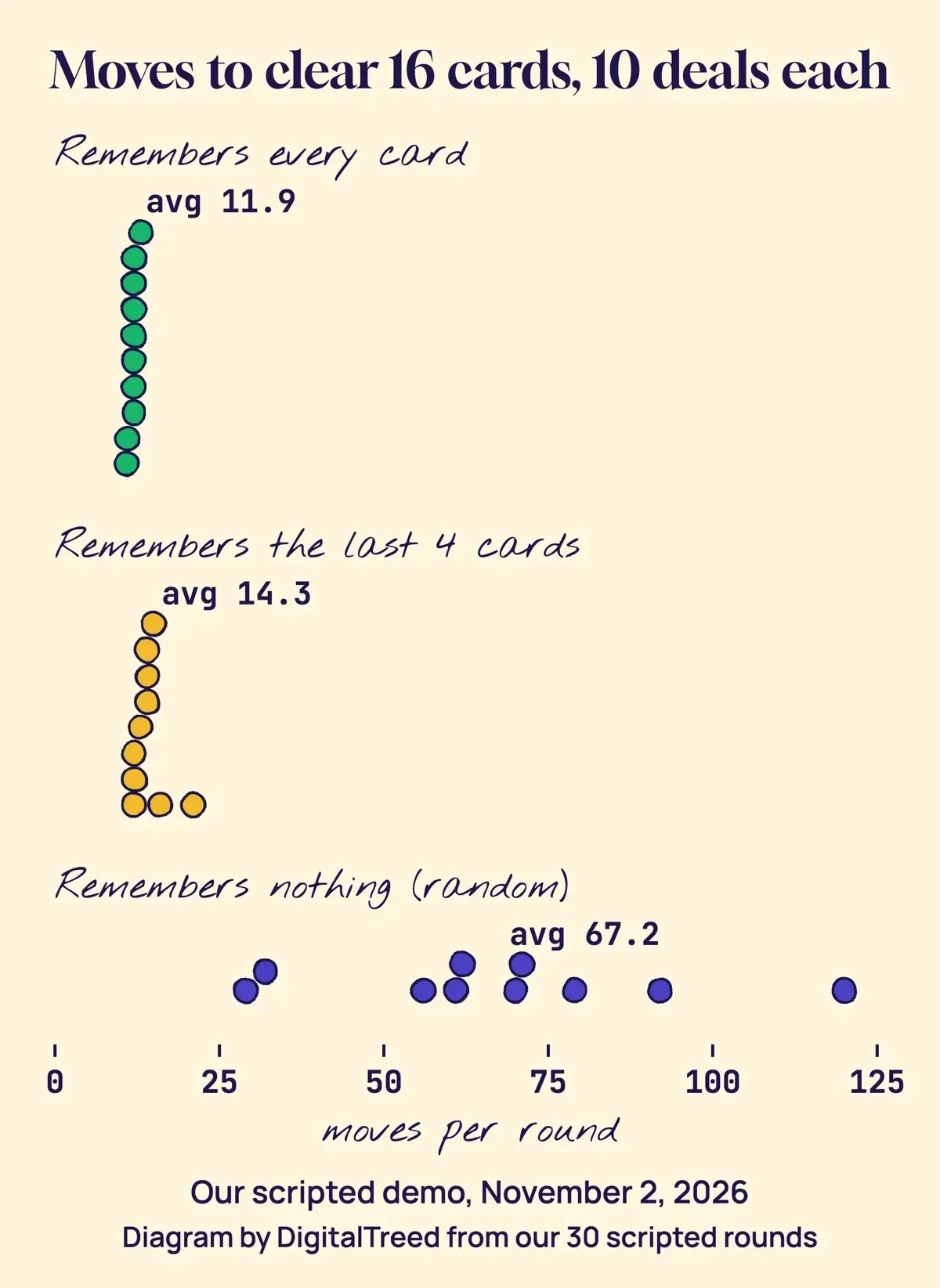 Diagram by DigitalTreed from our 30 scripted rounds, November 2, 2026
Two university study guides back parts of this. The UNC Learning Center suggests you "Connect the information you are trying to memorize to something that you already know." At a board, that means tying each picture to something you know. It also suggests you "create meaningful groups that simplify the material," so treat the left and right halves as two small boards. Washington University's teaching center says "The act of retrieving something from your memory actually strengthens the connections holding it there." UNC's page agrees: "Quiz yourself every so often by actively recalling the information you are trying to study." For a family round, cover the board, ask who remembers the star, and flip to check.
Can a memory game improve your memory?
Quizzing between rounds helps you learn one board. It doesn't show that a memory game helps your memory day to day. In 2017 a National Academies report on preventing cognitive decline rated cognitive training as backed by "encouraging but inconclusive evidence." It added that the findings "cannot be used to draw conclusions on the long-term cognitive benefits of commercial computerized cognitive training applications." On January 5, 2016, the FTC announced that the company behind Lumosity would pay $2 million to settle charges that its brain-training ads were deceptive.
"Lumosity simply did not have the science to back up its ads," the director of the FTC's consumer protection bureau said in that release. The FTC's business blog drew the lesson: claims like that "need solid scientific support."
MedlinePlus says "It's normal to forget things once in a while." Its memory loss entry adds that "Normal aging can cause some forgetfulness."
Worried about your own forgetfulness? MedlinePlus says to see your health care provider.
What we'd play first
Start with a family round of Memory Match level 1. It's the smallest board in the code, four doors and 30 seconds, and the bonus math rewards finishing early. On level 3, where horMirror is one of the layouts in the code, try the mirrored-door guess and see whether it holds. Outside December the page may look different, so open it yourself before you promise anyone a round.
For a longer game, try Rise of the Half Moon, since its page calls it a card game against the moon and the archive keeps a page for each month. Like guessing games? Our Poeltl game guide and Qourdle walkthrough are close cousins. For class, see how Gimkit codes work and how to join a Blooket game. Minecraft fans have our Nether travel guide, and our list of Google search tricks has more hidden Google fun.
Google Memory Game questions
Frequently asked
Is Google Santa Tracker only open in December?
The repository README calls it a tradition "for the December holiday period." Still, the Memory Match page answered our script on November 2, 2026.
Does Memory Match work in an old browser?
Partly. The Santa Tracker README lists current Chrome, Firefox and Safari, and gives older browsers a "fallback mode" to "play a small number of historic games."
Can I still play a Google Doodle game after its day?
Yes, from its archive page. The Pani Puri page still says "Click the Doodle" more than three years after July 12, 2023.
What was the first Google Doodle game?
Google's Doodle history page names the 30th Anniversary of PAC-MAN, May 21, 2010, "the first interactive Doodle game experience!"
How we made this guide: On November 2, 2026 a script read Google's Santa Tracker pages and code, the Doodle sitemap, 373 Doodle pages and the other pages linked here. We didn't play Google's games, but we built the demo and ran every round shown. Facts checked by the DigitalTreed team on November 2, 2026.
First published December 2023 as a general piece on a festive card game, with no sources. Rewritten November 2, 2026 around Memory Match's rules from Google's code, the dated Doodle card games and our own test.
Sources
- Google Santa Tracker: Memory Match page
- Google santa-tracker-web repository (README)
- santa-tracker-web: en_src_messages.json (scene_matching)
- santa-tracker-web: matching/js/constants.js
- santa-tracker-web: matching/js/game.js
- santa-tracker-web: matching/js/level_model.js
- Google Doodles: The story behind Doodles
- Google Doodles sitemap
- Google Doodles: Rise of the Half Moon (October 24, 2024)
- Google Doodles: Celebrating Pani Puri (July 12, 2023)
- Google Doodles: Celebrating Lotería (December 9, 2019)
- Google Play Help: Get Android apps and digital content
- UNC Learning Center: Memorization Strategies
- Washington University CTL: Using Retrieval Practice to Increase Student Learning
- National Academies (2017): Preventing Cognitive Decline and Dementia, Summary
- FTC press release (January 5, 2016): Lumosity to Pay $2 Million
- FTC Business Blog (January 5, 2016): Mind the gap
- MedlinePlus: Memory
- MedlinePlus Medical Encyclopedia: Memory loss
Comments
No comments yet. Start the conversation below.