
Quick answer
The pay scale GS for 2026 runs from $22,584 (GS-1 step 1) to $164,301 (GS-15 step 10) in OPM's base table, effective January 2026. Locality pay adds 17.06% to 46.34%, so GS-9 step 1 pays $61,722 to $77,161 in our three examples. Start with the grade on the USAJOBS posting.
If a USAJOBS posting says GS-9 or GS-11, the pay scale GS turns that label into dollars. The General Schedule is the federal pay system for most white-collar civilian jobs, covering "about 1.5 million worldwide," per OPM's General Schedule overview. Every pay figure below comes from OPM's 2026 tables.
Grade and step find your row in OPM's base table, and your worksite's locality pay raises it, by 17.06% at the least. No 2027 rates exist yet.
Key takeaways
- Locality pay adds 17.06% to 46.34% to every 2026 GS base rate.
- GS-9 step 1 pays $61,722 in Rest of U.S. and $77,161 near San Francisco.
- Steps 2 to 10 take 18 years: one-, two-, then three-year waits.
- No 2026 locality rate passes $197,200, Executive Schedule level IV.
- Ask for above-step-1 pay before day one; it can't be backdated.
Who the General Schedule covers, and who set the 2026 rates
OPM writes the rules and the tables, but your agency decides your grade. The OPM overview says "The General Schedule has 15 grades--GS-1 (lowest) to GS-15 (highest)" and that "Each agency classifies its GS positions." OPM's General Schedule pay fact sheet adds that the grades span "more than 400 occupations."
The 2026 numbers came from one presidential order. Executive Order 14368, signed December 18, 2025, set the General Schedule at its Schedule 1 and locality pay at Schedule 9. Both took effect "on the first day of the first applicable pay period beginning on or after January 1, 2026." That's why OPM's Salary Table 2026-GS reads "Incorporating the 1% General Schedule Increase" above its effective date, January 2026. Your education sets a typical starting grade, and OPM says "Individuals with a high school diploma and no additional experience typically qualify for GS-2 positions." A bachelor's degree typically fits GS-5. A master's fits GS-9.
Grade and step: what the two numbers mean
The grade is the job's level, GS-1 to GS-15, and the step is your place inside it, from step 1 to step 10.
The OPM overview puts each step at about 3% of salary, and the 2026 base table agrees: GS-9 step 1 is $52,727 and step 2 is $54,485, a 3.3% gap. These are OPM's base rates before locality pay, with one step's dollar value in the last column:
| Grade | Step 1 | Step 10 | One step (WGI) |
|---|---|---|---|
| GS-5 | $34,799 | $45,239 | $1,160 |
| GS-7 | $43,106 | $56,039 | $1,437 |
| GS-9 | $52,727 | $68,549 | $1,758 |
| GS-11 | $63,795 | $82,938 | $2,127 |
| GS-12 | $76,463 | $99,404 | $2,549 |
| GS-13 | $90,925 | $118,204 | $3,031 |
| GS-14 | $107,446 | $139,684 | $3,582 |
| GS-15 | $126,384 | $164,301 | $4,213 |
A GS-11 at step 4 earns $70,176 in base pay. That beats the $68,549 a GS-9 reaches after 18 years at step 10, so the grade you're hired at outweighs years of steps. Our GS-11 pay scale guide covers that grade in depth.
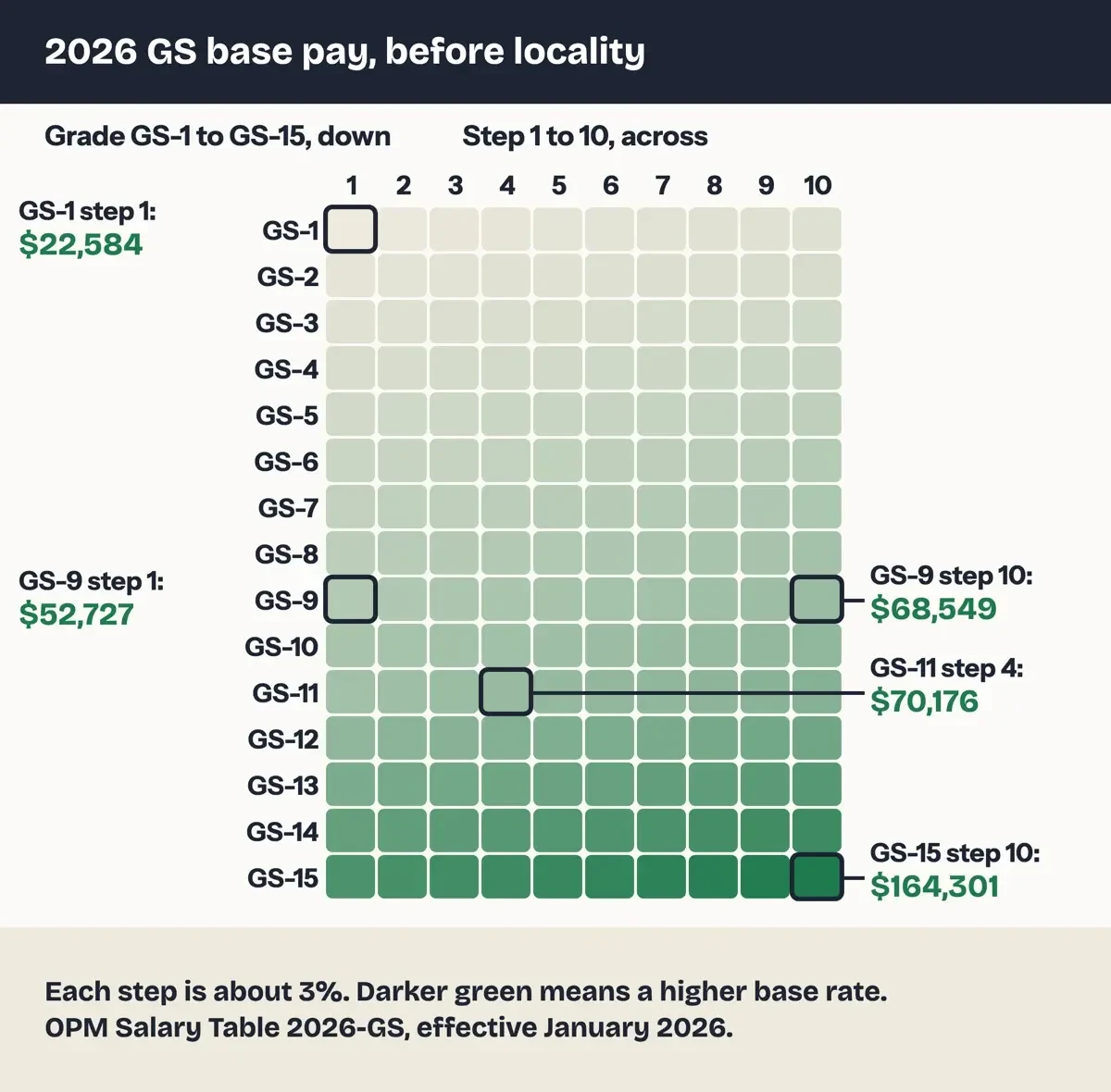 Diagram by DigitalTreed from OPM Salary Table 2026-GS, effective January 2026, read November 4, 2026.
OPM also prints each table by the hour. Its 2026 GS hourly table lists GS-9 step 1 at $25.26 basic and $37.89 under "Hourly Title 5 Overtime (O) Rates for FLSA-Exempt Employees." From step 5 up, that GS-9 overtime figure stays flat at $41.73.
How locality pay is added to the base table
Those hourly and annual figures are still base pay, and 5 CFR 531.604 sets the five steps that add locality to it.
Your agency finds your official worksite and its locality pay area, then raises the base rate by that area's percentage. Rest of U.S. covers anywhere outside the named areas. It rounds "to the nearest whole dollar (counting 50 cents and over as the next higher dollar)" and applies the pay cap last.
Your official worksite picks the table, not your home address. OPM's 2026 locality pay area definitions are drawn mostly by county and "will be the same as in calendar year 2025." The San Jose-San Francisco-Oakland area takes in 16 California counties, from Alameda to Stanislaus, while Washington-Baltimore-Arlington includes the District of Columbia and Montgomery County, Maryland. OPM's 2026 General Schedule page links 58 locality tables, including separate ones for Alaska (32.36%) and Hawaii (22.21%). The Rest of U.S. table has the smallest percentage, 17.06%. The San Jose-San Francisco-Oakland table has the largest, 46.34%. All 58 headers read "Total Increase: 1%," so 2026 raised base pay by 1% and left each area's percentage alone.
What does GS-9 step 1 pay in three locality areas?
Example: OPM says a master's degree typically qualifies you for GS-9, so we priced GS-9 step 1, whose 2026 base rate is $52,727. We applied three percentages from OPM's own tables, all effective January 2026, and the last column is OPM's published cell, there to check the formula against:
| Locality pay area | OPM table | Locality | Formula | Result | OPM cell |
|---|---|---|---|---|---|
| Rest of U.S. | Salary Table 2026-RUS | 17.06% | $52,727 x 1.1706 = $61,722.23 | $61,722 | $61,722 |
| Washington-Baltimore-Arlington | Salary Table 2026-DCB | 33.94% | $52,727 x 1.3394 = $70,622.54 | $70,623 | $70,623 |
| San Jose-San Francisco-Oakland | Salary Table 2026-SF | 46.34% | $52,727 x 1.4634 = $77,160.69 | $77,161 | $77,161 |
Near San Francisco, the same grade and step pays $15,439 a year more than in Rest of U.S., a 25% gap. The Washington-Baltimore-Arlington table puts it at $70,623, which is $8,901 above the Rest of U.S. figure. Step 10 keeps the spread: $80,243, $91,815 and $100,315.
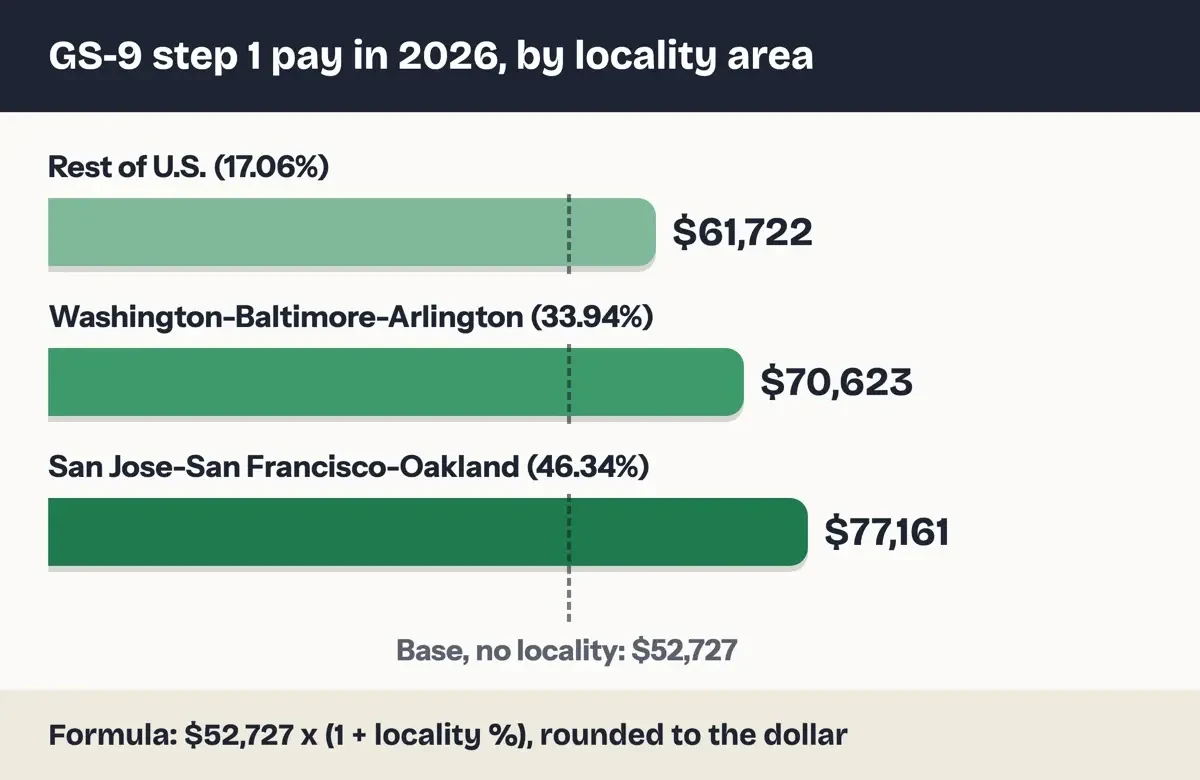 Diagram by DigitalTreed from OPM Salary Tables 2026-RUS, 2026-DCB and 2026-SF, effective January 2026.
What we tested
We didn't want to trust three rows, so our Python script read OPM's 2026 XML files for the base table and all 58 locality areas. It rebuilt each cell with the 5 CFR 531.604 rounding rule and the $197,200 cap, then compared it with OPM's number.
All 8,700 cells matched. In 97 of them the raw formula ran past $197,200, and OPM prints the capped $197,200 in exactly those cells.
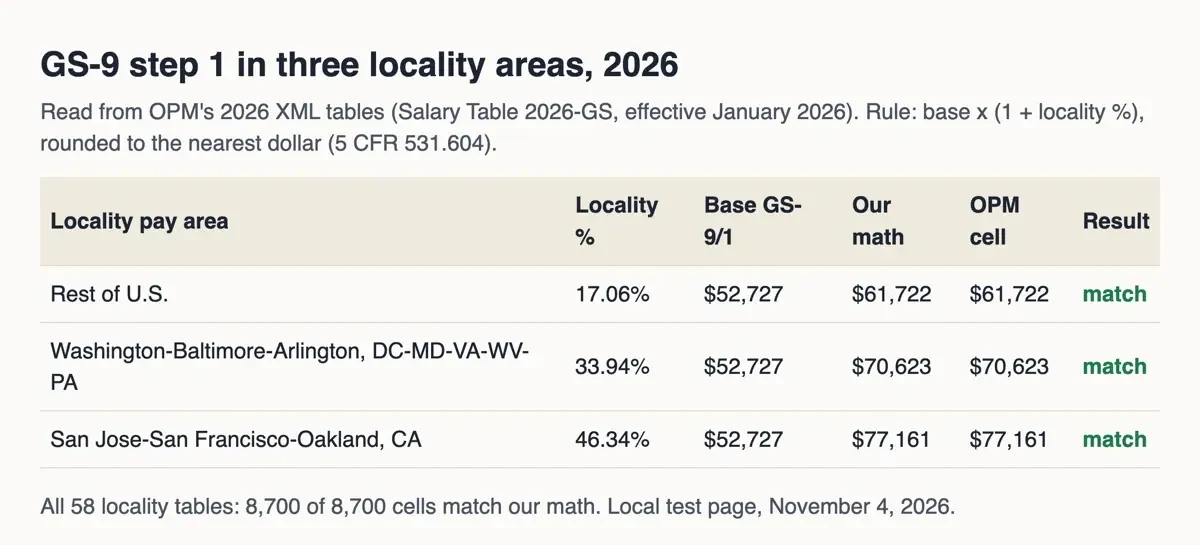 Screenshot: our GS check page on 127.0.0.1, November 4, 2026.
How long does each step increase take?
Once you're hired, step 1 turns into step 2 after one year of service. 5 CFR 531.405 sets 52 calendar weeks of creditable service in each of steps 1 to 3 for employees with a scheduled tour of duty. Steps 4 to 6 wait 104 weeks each and steps 7 to 9 wait 156, and OPM's within-grade increase fact sheet lists the same waits step by step:
| Reach | Wait in the step before | Total from step 1 | In years |
|---|---|---|---|
| Step 2 | 52 weeks | 52 weeks | 1 year |
| Step 3 | 52 weeks | 104 weeks | 2 years |
| Step 4 | 52 weeks | 156 weeks | 3 years |
| Step 5 | 104 weeks | 260 weeks | 5 years |
| Step 6 | 104 weeks | 364 weeks | 7 years |
| Step 7 | 104 weeks | 468 weeks | 9 years |
| Step 8 | 156 weeks | 624 weeks | 12 years |
| Step 9 | 156 weeks | 780 weeks | 15 years |
| Step 10 | 156 weeks | 936 weeks | 18 years |
Add them up and you get 936 weeks. That's the 18 years behind OPM's line, "It normally takes 18 years to advance from step 1 to step 10 within a single GS grade."
Time served isn't the only test. The fact sheet says your "most recent performance rating of record must be at least Level 3," which it calls "Fully Successful" or equivalent. It also says "WGIs apply only to GS employees occupying permanent positions," which leaves out appointments designated temporary or limited to 1 year or less. Strong ratings can speed things up with a quality step increase, which the OPM overview limits to a "(maximum of one per year)." Each step is worth the WGI amount in the base table, $1,758 at GS-9.
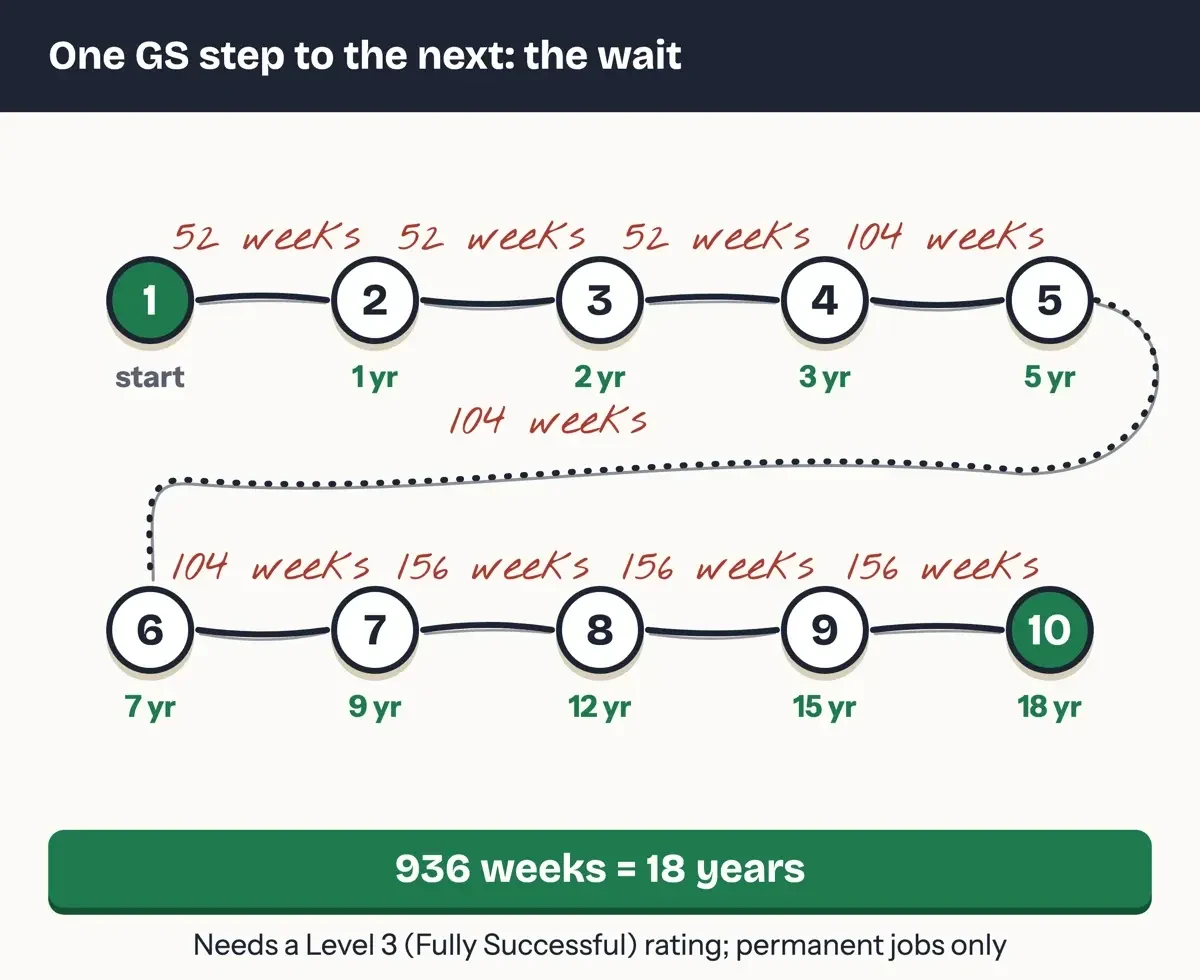 Diagram by DigitalTreed from 5 CFR 531.405 and the OPM within-grade increase fact sheet, read November 4, 2026.
The $197,200 cap and where it stops raises
Under 5 CFR 531.606, a locality rate "may not exceed the rate of basic pay payable for level IV of the Executive Schedule." OPM's 2026 Executive Schedule table sets level IV at $197,200. In the San Jose-San Francisco-Oakland table, the cap starts at GS-14 step 9. Every GS-15 cell from step 3 to step 10 reads $197,200, footnoted "Rate limited to the rate for level IV of the Executive Schedule."
A GS-15 at step 3 and one at step 10 in that area earn the same. Rest of U.S. never reaches the cap. Its top cell, GS-15 step 10, is $192,331.
The Washington-Baltimore-Arlington table hits the cap later, at GS-15 step 6, so its GS-15 steps 1 to 5 don't hit $197,200 and still rise with each step.
Starting above step 1: superior qualifications and special rates
Those capped cells sit far above where most people start, since OPM says a new employee is "usually hired at step one of the applicable GS grade." The agency can go higher, and it doesn't need you to ask first. OPM's superior qualifications fact sheet allows a rate "above the step 1 of their grade (not to exceed step 10)" for superior qualifications or a special agency need. At GS-9 in Rest of U.S., step 4 pays $67,896 against $61,722 at step 1, a difference of $6,174 a year from the first paycheck.
The fact sheet sets a deadline: "An agency must approve each determination to use this authority before the employee enters on duty in their position." It also "cannot be made retroactively." 5 CFR 531.212 limits it to a first federal civilian appointment or, with exceptions, a return after "a break in service of at least 90 days."
Some jobs pay above the locality table altogether. OPM sets those rates, not the agency. Its special rates page says OPM can set higher rates "to address existing or likely significant handicaps in recruiting or retaining well-qualified employees." 5 CFR 530.304 caps those at level IV too. If a posting's pay floor beats your locality table, ask HR whether a special rate applies.
Find your grade and pay on a USAJOBS posting
The USAJOBS Search API reference lists two grade fields for each job announcement, the "Lowest potential grade level for the job opportunity" and the highest. Pay appears as a minimum and a maximum with an interval, such as per year. The USAJOBS home page lets you search with "filters such as location, salary, work schedule or agency." In a range like GS-9 to GS-11, the top grade is what the OPM overview calls "the full promotion potential advertised in the job announcement."
Example: for a job in Montgomery County, Maryland, these five lookups end on the Washington-Baltimore-Arlington table:
- Write down the lowest and highest grade and the duty location.
- Find the location's county in OPM's 2026 locality pay area definitions.
- Open that area's 2026 table and read step 1 of the lowest grade.
- Compare it with the posting's pay range; a higher floor can mean a special rate.
- Before you accept, ask HR whether the agency will set pay above step 1.
The same home page tells you to "read the entire announcement to determine if you're eligible and meet the qualifications." Your resume has to prove it, and our ATS-friendly resume guide covers the layout that screening software reads. Our hiring manager responsibilities post explains who reads it after HR's first pass. Moving up the range gets easier in 2027. OPM's time-in-grade final rule removes the old rule that a candidate for a competitive GS-6 or higher job first spend 52 weeks no more than one grade lower. "This rule is effective January 19, 2027," the notice says, and qualification standards still apply.
What is set for 2027, and what isn't
That January 19, 2027 date is fixed, but 2027 GS pay rates aren't set as of November 4, 2026. The newest pay-rate order in the Federal Register is still Executive Order 14368, and OPM's salaries and wages index lists tables only through 2026. OPM's pay fact sheet says "The law requires a two-part GS pay adjustment in January each year." The last three pay-rate orders were signed December 18, 2025, December 23, 2024 and December 21, 2023, and each appeared in the Federal Register five to seven days later.
Our take: price the job on the 2026 table, not on a raise nobody has set. Work out step 1 for your worksite, mark the 52-week step dates on a calendar, and ask about above-step-1 pay before you sign the final offer. If you also hold a private-sector offer, our competitive pay explainer checks it against government wage data. For titles on both sides, like an executive assistant or a senior accountant, our job description guides list the duties to compare. This guide explains published pay rules; it isn't legal or career advice. Your agency's HR office sets your grade, step and locality, and its written offer is the number that counts.
GS pay scale questions
Frequently asked
Does GS locality pay follow where I live or where I work?
Where you work. 5 CFR 531.604 starts with "Determining the employee's official worksite," and your area follows from it.
When does the first step wait start?
On day one. 5 CFR 531.405 says it begins "On the first appointment as an employee of the Federal Government, regardless of tenure."
What if I don't have a regular work schedule?
Then the same section counts 260, 520 and 780 days in a pay status instead of weeks.
How much is one GS step worth in dollars?
OPM prints it in the WGI column of Salary Table 2026-GS: $1,160 at GS-5, $1,758 at GS-9 and $4,213 at GS-15.
How we made this guide: Our script saved OPM's 2026 XML salary files, fact sheets and table pages on November 4, 2026. It also saved Federal Register and USAJOBS developer pages; eCFR text came through eCFR's own API. USAJOBS help pages refused the script, so none is quoted. Facts checked by the DigitalTreed team on November 4, 2026.
First published April 2025 with no sources. Rewritten November 4, 2026 around OPM's 2026 tables, the eCFR pay rules and a cell-by-cell check.
Sources
- OPM: 2026 General Schedule (GS) locality pay tables
- OPM: Salary Table 2026-GS, effective January 2026
- OPM: Salary Table 2026-GS hourly rates
- OPM: Salary Table 2026-RUS (Rest of U.S.)
- OPM: Salary Table 2026-DCB (Washington-Baltimore-Arlington)
- OPM: Salary Table 2026-SF (San Jose-San Francisco-Oakland)
- OPM: Salary Table No. 2026-EX, Executive Schedule
- OPM: 2026 locality pay area definitions
- OPM: Salaries and wages index
- OPM: General Schedule overview
- OPM: General Schedule pay fact sheet
- OPM: Fact sheet, within-grade increases
- OPM: Fact sheet, superior qualifications and special needs pay-setting authority
- OPM: Special rates requests
- eCFR: 5 CFR 531.405, waiting periods for within-grade increase
- eCFR: 5 CFR 531.212, superior qualifications and special needs pay-setting authority
- eCFR: 5 CFR 531.604, determining an employee's locality rate
- eCFR: 5 CFR 531.606, maximum limits on locality rates
- eCFR: 5 CFR 530.304, establishing or increasing special rates
- Federal Register: Executive Order 14368, Adjustments of Certain Rates of Pay (December 23, 2025)
- Federal Register: Elimination of Time-in-Grade, final rule (October 19, 2026)
- USAJOBS developer docs: Search API reference
- USAJOBS home page


Comments
No comments yet. Start the conversation below.