
Quick answer
A senior accountant job description needs a summary, 7-9 duties such as the month-end close, the qualifications, who the role reports to, a pay range and an EEO statement. BLS put the median wage for accountants and auditors at $83,680 in May 2025, as of November 4, 2026. If you'll require a CPA, check your state first: New York adds a two-year route on November 21, 2026.
Your close now takes two weeks, the auditors want schedules nobody has time to build, and one staff accountant can't carry it all. That's usually when a senior accountant job description gets written. A senior accountant is the accountant who owns the monthly close, reconciles the balance sheet and reviews junior staff's entries before a controller signs off. Federal data doesn't split the level out, though: O*NET and BLS file staff and senior accountants under one code, 13-2011, so the pay figures below cover both levels.
Our view up front: write the CPA as preferred, not required, unless the work needs the license. New York, California and Oregon have each set a two-year route beside the 150-hour rule. A line demanding 150 hours can screen out people those boards will license. The template below has nine duties, each tagged for the ADA and run on made-up books. Its pay range comes from BLS percentiles for your metro.
Key takeaways
- BLS put the accountants and auditors median at $83,680 in May 2025.
- Staff and senior accountants share one federal code, so the duties set the level.
- New York adds a bachelor's-plus-two-years CPA route on November 21, 2026.
- BLS's handbook still says every state requires 150 hours; state boards now differ.
- CPAs generally meet the learned professional test; bookkeepers generally don't.
Senior accountant job description template to fill in
We wrote the duties from O*NET's Accountants and Auditors details page for code 13-2011.00. It lists 30 tasks and rates every one of them core, so each duty below points to a task a federal profile already counts as central to the job. Swap each [bracket] for your own numbers. Delete any duty your hire won't do.
- Job title: Senior Accountant
- Summary: We're hiring a senior accountant to own our monthly close, keep the balance sheet reconciled and produce GAAP statements our leaders and auditors trust. You'll review the work of [2] staff accountants.
- Reporting line: [Controller / Accounting Manager]. Supervises: [2] staff accountants.
- Location and schedule: [City, State / hybrid / remote]. Full time. Busy weeks at month-end, quarter-end and during the annual audit.
- Pay: $[low] to $[high] a year, plus [bonus / benefits]. Exempt (salaried).
- Equal opportunity: [Company] is an equal opportunity employer. All qualified applicants receive consideration without regard to race, color, religion, sex (including pregnancy, sexual orientation and gender identity), national origin, age (40 or older), disability or genetic information.
Each duty names a deliverable and a deadline you'd check in a review, such as a [5]-day close or a [60]-day limit on old reconciling items. The bracketed tag is our essential-or-marginal call; keep it in your internal copy even if you strip it from the public post.
- Run the month-end close on a [5]-business-day calendar: post accruals, prepaids and adjusting journal entries, and sign off the close checklist. [Essential]
- Reconcile bank, credit card and balance sheet accounts every month, and clear or explain any reconciling item older than [60] days. [Essential]
- Prepare monthly and quarterly financial statements under US GAAP, with a short note on every line that moved more than [10]% or $[25,000]. [Essential]
- Prepare audit schedules and answer the outside auditors' requests during the annual audit. [Essential]
- Review journal entries and reconciliations prepared by [2] staff accountants, and train them on close procedures. [Essential]
- Keep the fixed asset, prepaid and accrual schedules and the chart of accounts current. [Essential]
- Send budget-to-actual reports to department heads by business day [7]. [Essential]
- Document cash and payables controls, and recommend fixes when a reconciliation turns up a gap. [Marginal]
- Gather data for sales tax returns and year-end 1099s for our outside tax preparer. [Marginal]
BLS says accountants and auditors typically need at least a bachelor's degree in accounting or a related field to enter the occupation. O*NET puts the job in Job Zone Four and uses it as its own example. There, "an accountant must complete four years of college and work for several years in accounting to be considered qualified." That's why our template asks for [3-5] years, and why it names the close and reconciliations instead of a vague line about strong accounting skills.
- Bachelor's degree in accounting or a related field.
- [3-5] years of accounting experience, including month-end close and account reconciliations.
- Working knowledge of US GAAP and of [accounting software].
- Excel or Google Sheets skills: lookups, pivot tables and building reconciliation workbooks.
- CPA license or progress toward one: [preferred / required].
The essential tag isn't decoration. Under 29 CFR 1630.2(n), a duty can be essential "because of the limited number of employees available among whom the performance of that job function can be distributed." That's the small accounting team's case.
The EEOC's ADA guide for employers covers employers with 15 or more employees. It counts "a written job description prepared before advertising or interviewing for a job" as evidence.
So D8 and D9 are tagged marginal, since a controller or an outside tax preparer can pick them up if a strong candidate can't.
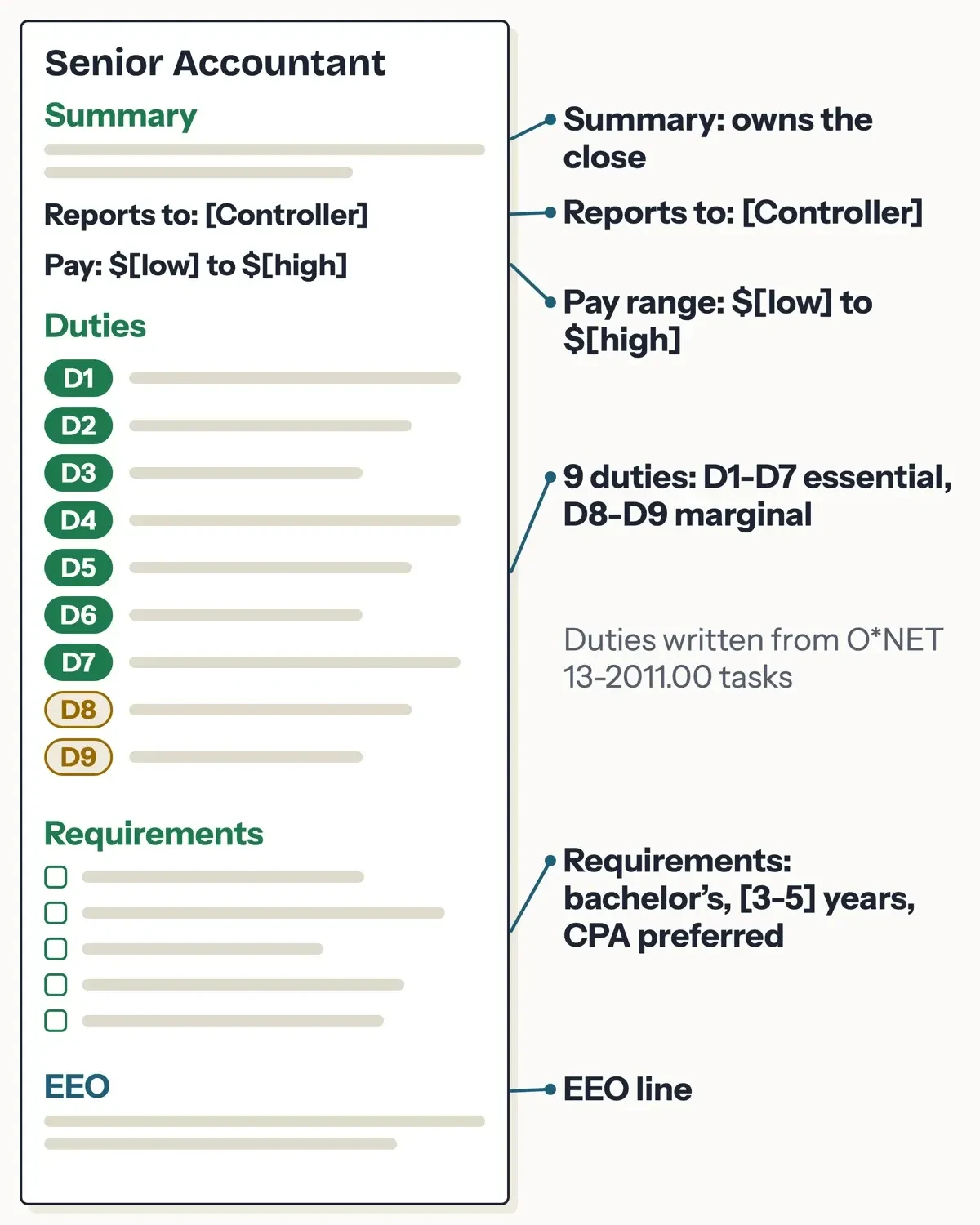 Diagram by DigitalTreed, from our senior accountant template and O*NET 13-2011.00 task statements, November 4, 2026.
What we tested
On November 4, 2026 we ran the work these duties describe on made-up books. Our script reconciled a made-up October 2026 bank statement against the cash ledger of Tallgrass Fixtures, a made-up company. It found 7 reconciling items: a deposit in transit, two outstanding checks and a returned customer check. The rest were a $45.00 fee, $18.62 of interest, and check 1043, booked at $6,040.00 but cleared at $6,400.00. Both sides matched after four adjusting entries, at $48,557.87. The script also found all 9 duty-linked O*NET task statements word for word on the saved page, scored from 62 for directing staff to 90 for analyzing reports.
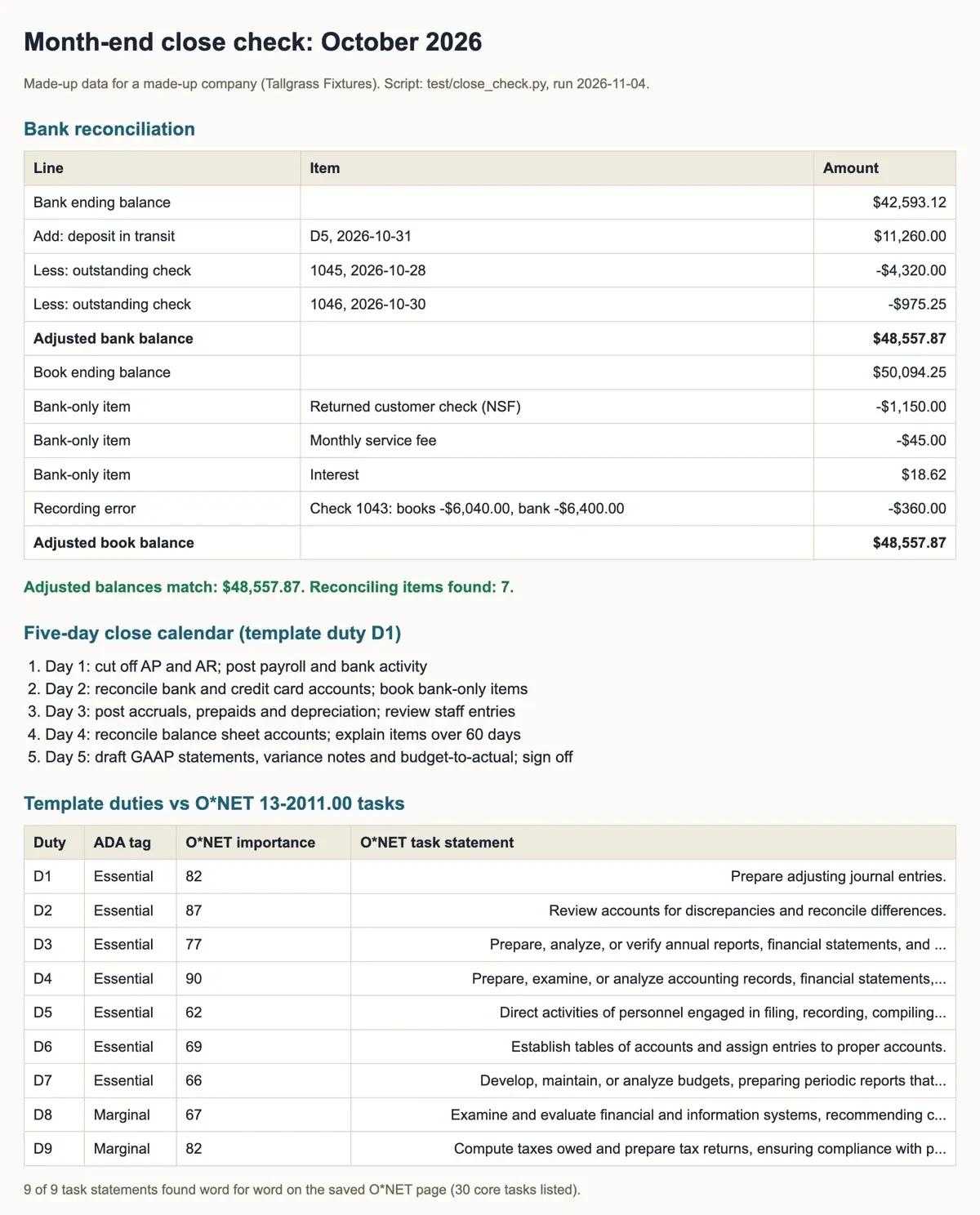 Screenshot: our month-end close check page on 127.0.0.1, made-up data, November 4, 2026.
What BLS pay data says about the salary line
Those nine duties sit inside one federal pay series, so the salary line starts with BLS. Its handbook page for accountants and auditors was last modified October 29, 2026. It says "The median annual wage for accountants and auditors was $83,680 in May 2025." O*NET's 13-2011.00 summary shows the same figure. That's $40.23 an hour. On the Pay tab, the lowest 10% earned less than $56,020 and the highest 10% more than $144,090. That's a spread of $88,070 inside one job code, and it's why a single median won't price your post.
Those figures come from the May 2025 OEWS survey, which BLS released on May 15, 2026, so they're 18 months old by a November 2026 offer. The code mixes first-year staff with 20-year veterans, so our reading is that a senior hire belongs above the median, not at it. You'll find your own metro in the OEWS profile for accountants and auditors, which breaks code 13-2011 out by industry, state and metro area. We'd pull the median and the 75th percentile for your metro, then set the range between them for a first senior hire. If the role also runs payroll or supervises three or more people, we'd stretch the range's upper end toward the 90th.
Industry moves the number too. BLS lists these May 2025 industry medians: $93,290 in finance and insurance, $91,940 in management of companies, and $87,790 in manufacturing. Government (excluding state and local education and hospitals) came in at $83,350, and accounting, tax and payroll services firms paid $81,490, the lowest of the five.
At those May 2025 medians, a finance-sector employer pays $11,800 more a year than an accounting services firm, so name your industry when you price the role.
Federal accounting jobs follow government pay tables instead, and our pay scale GS guide explains how those work.
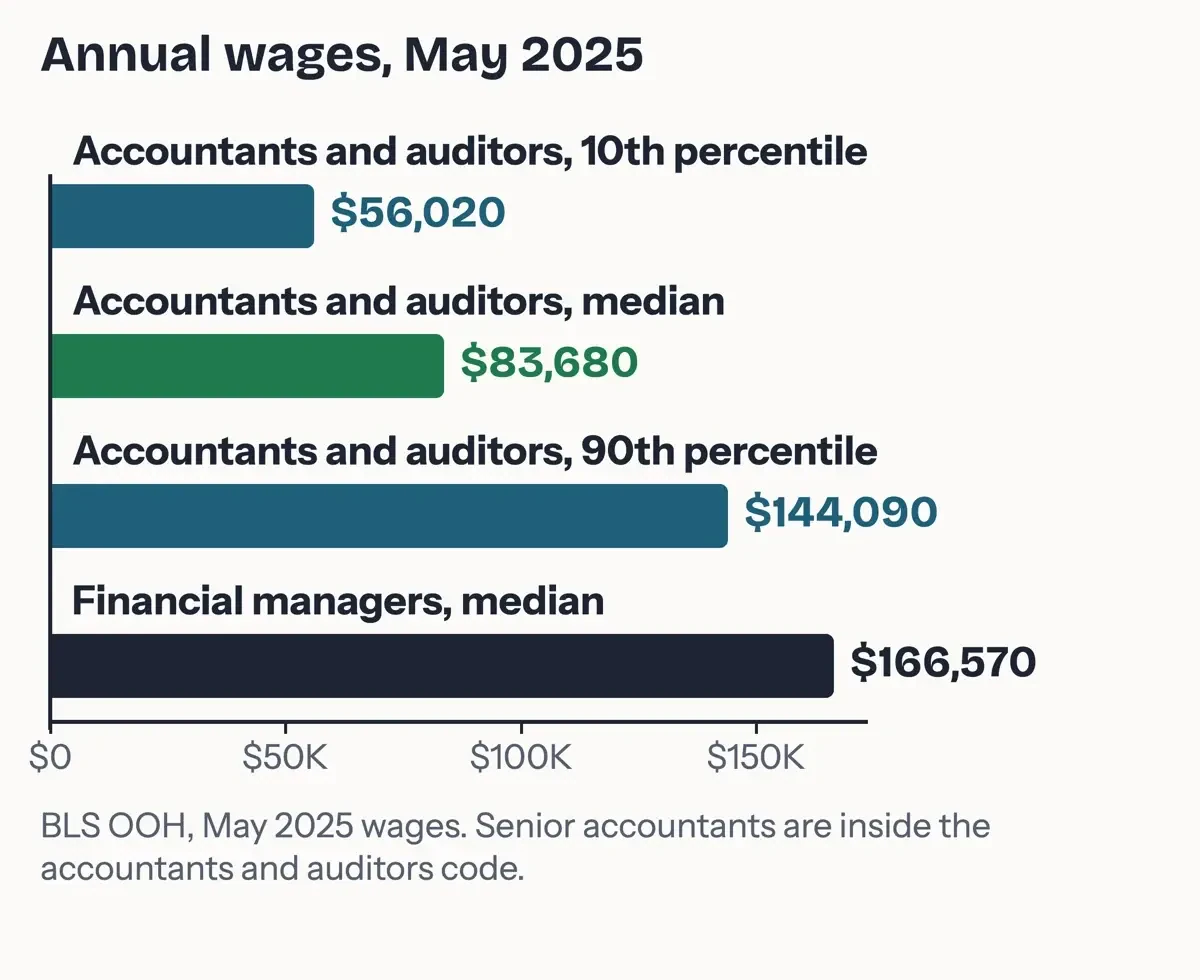 Source: BLS Occupational Outlook Handbook, Accountants and Auditors and Financial Managers, May 2025 wages, read November 4, 2026. Chart drawn by us.
Demand should grow a little faster than average. BLS projects 5% employment growth from 2025 to 2035, faster than average, and about 115,300 openings a year. Many of those openings, BLS says, are expected to come from the need to replace workers who move to different occupations or leave the labor force, such as to retire. Accountants and auditors held about 1.6 million jobs in 2025, and 21% of them worked at accounting, tax preparation, bookkeeping and payroll services firms, the largest group BLS lists.
Staff accountant, senior accountant or accounting manager
Pay data can't tell you the level, so the title and duties have to. O*NET's sample titles for 13-2011.00 run from Accountant and Cost Accountant to Audit Partner, all under one $83,680 median, and senior accountant isn't on that list. There's no separate senior code in the OEWS profile either, so a salary survey that quotes a senior accountant figure is using its own data, not the federal series.
We'd draw the line by who reviews whom. A staff accountant posts entries and prepares reconciliations. A senior accountant reviews those entries, runs the close calendar and drafts the statements. An accounting manager or controller signs off, manages people and reports up. That top rung is a different BLS occupation. The Financial Managers page says controllers "direct the preparation of financial reports that summarize and forecast an organization's financial position." In our test above, the senior's work was the reconciliation and the four adjusting entries. A controller would've approved them and explained the $360.00 error to the owner.
| Staff accountant | Journal entries, reconciliations, payables and receivables support | 13-2011 Accountants and Auditors | $83,680 (all levels in the code) |
| Senior accountant | Close calendar, review of staff work, GAAP statements, audit schedules | 13-2011 (same code) | Same series; set it from your metro percentiles |
| Accounting manager or controller | Sign-off, hiring and reviews, reporting to the CFO or owner | 11-3031 Financial Managers | $166,570 |
Rows two and three are far apart. At the May 2025 medians, $166,570 minus $83,680 is $82,890 a year, a ratio of 1.99. O*NET's Treasurers and Controllers profile shows the same $166,570. BLS says financial managers typically need a bachelor's degree and 5 years or more of experience in another business or financial occupation, such as accountant or financial analyst.
If your senior accountant will hire, fire and set reviews for two or more people, you're probably writing a manager's job under a cheaper title.
Our finance job titles guide lays out the full ladder from staff accountant to CFO. For an executive role written the same way, see our chief operating officer job description, which uses the same essential-functions tags with a different code.
Is a senior accountant exempt from overtime?
That level question also decides overtime. Under the Fair Labor Standards Act, accountants can be exempt as learned professionals. DOL Fact Sheet 17D lists accounting among the "fields of science or learning," and the rule names CPAs directly. The DOL's regulation at 29 CFR 541.301(e)(5) says "Certified public accountants generally meet the duties requirements for the learned professional exemption." Non-CPAs doing similar work "may qualify as exempt learned professionals," it adds.
The same paragraph draws the line we'd worry about. It says "accounting clerks, bookkeepers and other employees who normally perform a great deal of routine work generally will not qualify as exempt professionals." A senior accountant who mostly keys invoices may be non-exempt, whatever the title says.
Duties are only half the test. DOL Fact Sheet 17D says the employee must be paid on a salary or fee basis at no less than the standard salary level set by 29 CFR 541.600. The DOL's salary levels page puts that at $684 per week, or $35,568 a year. Example: the BLS 10th percentile of $56,020, divided by 52 weeks, is $1,077.31 a week. That clears $684 easily, so a senior accountant's claim to exemption usually fails on duties, not pay. That's why D1 to D7 in our template are written as judgment work, such as running the close and drafting statements, rather than data entry.
Accounting managers have a second route. DOL Fact Sheet 17A ties the executive exemption to an employee who must "customarily and regularly direct the work of at least two or more other full-time" employees. The same fact sheet adds: "Job titles do not determine exempt status." We're not lawyers, so have an employment lawyer review any job that mixes review work with routine entry.
The CPA line: 150 hours or the new two-year route
Exempt status doesn't need a license, but your requirements list probably mentions one. Until 2025, the model law behind state CPA rules had two routes, both with one year of experience. In May 2025 the AICPA and NASBA boards approved a third. Their joint release of May 14, 2025 says it needs "a baccalaureate degree, including an accounting concentration, plus two (2) years of experience, and passage of the Uniform CPA Examination."
NASBA's December 23, 2025 summary now lists three model pathways:
- Graduate degree in accounting, one year of professional experience and the CPA Exam.
- Bachelor's degree in accounting plus 30 more semester credits (150 in all), one year of experience and the CPA Exam.
- Bachelor's degree in accounting (120 semester hours), two years of professional experience and the CPA Exam.
Only the third route is new, and it trades a fifth year of school for a second year of work.
The Ninth Edition of the Uniform Accountancy Act put the new route into the model law in July 2025. A model law doesn't change anything by itself, though. NASBA's announcement says "Individual states will need to formally enact legislation and/or adopt rules and regulations, depending on the jurisdiction, before candidates can pursue this path." Adoption moved fast after that. The May 2025 release counted 14 states. By November 26, 2025, the AICPA's state policy roundup said "half of the states have adopted the third pathway." It added that 22 states planned to introduce legislation when sessions reconvened in 2026. NASBA keeps a list of jurisdictions that have signed new pathways into law, marked current as of October 1, 2026.
Requirement lists copied from older postings often carry the 150-hour line, and the federal handbook hasn't caught up either. The BLS handbook, modified October 29, 2026, still says "All states require CPA candidates to complete 150 semester hours of college coursework to be licensed." The state boards below say otherwise, so cite the board, not the handbook.
Two-year CPA routes in New York, California and Oregon
Oregon's route opened first, New York's comes next and California's follows in 2027. Each row below comes from the state's own board, read November 4, 2026.
| New York | 120 semester hours, with set accounting and business courses | At least 2 years full time, or the part-time equivalent | November 21, 2026 |
| California | Bachelor's or advanced degree with an accounting concentration | 2 years; an accounting-related advanced degree can replace 1 | January 1, 2027 |
| Oregon | Bachelor's degree, with no 120-hour count | 2 years, 24 months or 4,000 hours minimum | January 1, 2026 |
Texas and Tennessee aren't in the table, since we couldn't read their board pages; check those boards directly if you hire there.
New York's Chapter 530 page says the governor signed the law on November 21, 2025, and "The law will become effective on November 21, 2026." The NYSED 120-semester-hour page asks for "at least two years of full-time experience, or the part-time equivalent," supervised by a licensed US CPA.
To sit for the exam under the new route, candidates need 120 semester hours that include one course in each of five accounting areas and five business areas.
California follows on January 1, 2027. Its board news release of March 23, 2026 says the AB 1175 rules "remove the 150 total-unit requirement which often necessitated a fifth year of school." The board's September 2025 bill analysis listed January 1, 2026, a year earlier, as the operative date for the mobility changes. The bill text in that analysis lets an accounting-related advanced degree replace one year of the two-year experience requirement, but not alongside a board-recognized certificate. Applicants who file by December 31, 2028 can still use the old rules.
Oregon's route is the oldest of the three. The board's SB 797 FAQ lists three pathways from January 1, 2026. One is a bachelor's degree "plus longer supervised experience," which the FAQ sets at "2 years / 24 months / 4000 hours minimum."
The board kept the 150-hour route on purpose, and mobility is its first reason. The FAQ says "Keeping this pathway in place is helpful to ensure Oregon CPAs retain full mobility privileges."
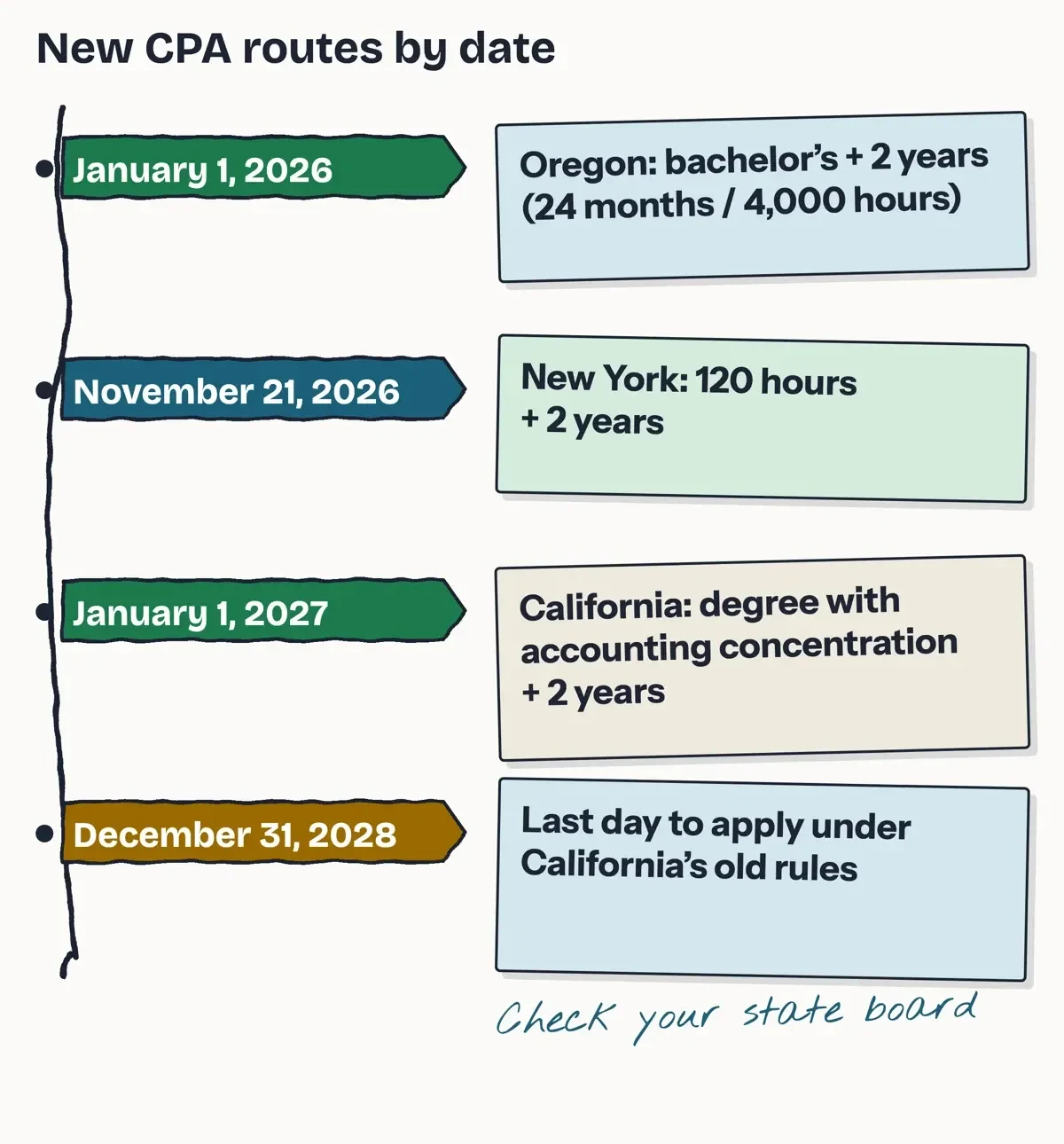 Diagram by DigitalTreed, from the Oregon Board of Accountancy, NYSED and California Board of Accountancy pages, November 4, 2026.
Where a CPA can practice matters more to you than which route they took. The new model law moves toward an individual-based practice privilege. NASBA's Ninth Edition announcement adds a safe harbor for CPAs licensed under differing rules as of December 31, 2024. California's AB 1175 even lets its board remove a state from automatic mobility when that state lacks comparable licensure requirements. If your senior accountant will sign or review work for clients in other states, ask each state's board how it treats your candidate's route before you make an offer.
For most company accounting jobs we'd write "CPA, or eligible within [2] years, preferred" and leave the route to the candidate. BLS says a CPA license may improve job prospects, and that's a reason to prefer it, not to screen everyone else out. Signing audit reports is different. California law already requires 500 hours of attest experience before a licensee can sign them, and the AB 1175 text in the same board analysis keeps that rule.
Posting it: pay range laws and the EEO line
With the CPA line settled, two template lines carry legal weight in the posting itself: pay and equal opportunity. California and Washington require a pay range in job posts from employers with 15 or more employees, and Washington's L&I enforces its rule.
New York reaches employers with four or more employees, and its FAQ dates the rule to September 17, 2023. Colorado also wants the date the application window is expected to close, so pick one you'll keep. The full state table, with a method for setting the range from OEWS percentiles, is in our competitive pay guide. Before you post in any of these states, have an employment lawyer read the ad.
The EEO line has a federal reason. The EEOC says it's illegal for an employer to publish a job advertisement that discourages applicants on protected grounds, or shows a preference among them. Our template's last line names those grounds, and its requirements ask for a range of years, never an age or a graduation year.
Once the post is live, the hiring steps take over, and our hiring manager guide covers who screens and who decides. If the real bottleneck is software rather than people, compare QuickBooks hosting options or a cloud ERP for small business first. Our post on cutting accounting costs at a growing startup lists cheaper fixes.
If you do hire, post the role with a real range from your metro's OEWS figures, a CPA-preferred line and close duties written as dated deadlines.
Senior accountant questions
Frequently asked
Must a senior accountant be a CPA?
Not for most company jobs. The BLS handbook names one place it matters. It says "Publicly traded companies are required to have CPAs sign documents they submit to the Securities and Exchange Commission (SEC)."
How many years of experience does a senior accountant need?
No rule sets a number. O*NET's Job Zone Four says workers "usually need several years of work-related experience, on-the-job training, and/or vocational training," so [3-5] years is a common ask.
What does a New York CPA license cost?
NYSED's licensing page lists $427 for the license and first registration, and it adds "Fees are subject to change."
Do senior accountants work overtime at busy times?
Often, yes. BLS says overtime hours are typical "at certain periods of the year, such as for quarterly audits or during tax season."
How we made this guide: The 30 sources listed below were saved on November 4, 2026, three of them as PDFs, and every quote here matches the saved copy. Our script couldn't read the Texas and Tennessee board pages or the BLS data API, so they aren't used. We ran the reconciliation and duty check above locally, on made-up books. Facts checked by the DigitalTreed team on November 4, 2026.
First published April 2025 with no sources and a statistic from a content site. Rewritten November 4, 2026 as a template with BLS, O*NET, DOL and state board facts.
Sources
- BLS Occupational Outlook Handbook: Accountants and Auditors
- BLS Occupational Outlook Handbook: Financial Managers
- BLS OEWS profile: 13-2011 Accountants and Auditors, May 2025
- BLS: Occupational Employment and Wages, May 2025 (news release, May 15, 2026)
- O*NET OnLine: 13-2011.00 Accountants and Auditors (summary)
- O*NET OnLine: 13-2011.00 Accountants and Auditors (details, tasks)
- O*NET OnLine: 11-3031.01 Treasurers and Controllers
- AICPA and NASBA: Approve Model Legislation for New CPA Licensure Path (May 14, 2025, PDF)
- NASBA: Ninth Edition of the Uniform Accountancy Act
- NASBA: New CPA Licensure Pathways and CPA Mobility (December 23, 2025)
- NASBA: Pathways (jurisdiction list)
- AICPA: State policy trends shaping accounting in 2026 (November 26, 2025)
- NYSED: Chapter 530, CPA Licensure Pathways and Practice Privilege
- NYSED: Initial License, 120 semester hours and 2 years of experience
- California Board of Accountancy: news release, March 23, 2026 (PDF)
- California Board of Accountancy: AB 1175 legislative analysis, September 2025 (PDF)
- Oregon Board of Accountancy: Senate Bill 797 FAQs
- 29 CFR 541.301, learned professionals (Cornell LII)
- DOL Fact Sheet 17D: Exemption for Professional Employees
- DOL Fact Sheet 17A: Exemption for Executive, Administrative, Professional, Computer and Outside Sales Employees
- DOL: Earnings thresholds for the EAP exemption
- 29 CFR 1630.2, ADA definitions (Cornell LII)
- EEOC: The ADA, your responsibilities as an employer
- EEOC: Prohibited employment policies and practices
- California DIR: Equal Pay Act and pay transparency FAQ
- Washington State Legislature: RCW 49.58.110
- Washington L&I: Equal Pay and Opportunities Act
- New York State DOL: Pay transparency
- New York State DOL: Pay Transparency Act FAQ
- Colorado General Assembly: SB23-105


Comments
No comments yet. Start the conversation below.