

Quick answer
A hiring manager's responsibilities are the start and the end of a hire: say why the job is needed, then interview, score and choose. As of November 2026, most EEOC interview rules start at 15 employees (age rules at 20). Start with a scorecard, and plan for Form I-9 Section 2 within 3 business days of the start date.
If you lead a team and just got approval to hire, the hiring manager responsibilities land on you. A hiring manager is the person who asks for the role, supervises the new hire and makes the final pick. OPM's federal roadmap gives that person the first two steps and the pick.
You won't do it alone. A recruiter finds and screens applicants, and HR runs the posting, the background check and Form I-9. Your part is the job request, the structured interview and the pick, plus the notes that back that pick up in the hiring file for a year.
Key takeaways
- Write the scorecard before the first interview and ask everyone the same questions.
- Disability and medical questions wait until after a conditional job offer.
- Finish Form I-9 Section 2 within 3 business days of the first paid day.
- Keep every application and interview note for one year, hired or not.
- Our word checker missed a family-history question, so a person reviews every list.
From job request to offer: the hiring manager's steps
OPM's End-to-End Hiring Roadmap for federal agencies gives every step an owner and a maximum number of calendar days, inside an 80-day standard that OPM calls "a suggested timeframe." The manager alone owns the first two steps, at one day each: checking the need against workforce plans and filing the request to fill the job. Two more steps are shared with HR: the position description review (1 day) and the job analysis (5 days). The table groups all 13 steps by owner:
| Step in OPM's roadmap | Owner | Max days |
|---|---|---|
| Validate the need against workforce plans | Manager | 1 |
| Request personnel action to fill the job | Manager | 1 |
| Review the position description | Manager and HR | 1 |
| Confirm job analysis and assessment strategy | Manager and HR | 5 |
| Post the job announcement | HR | 2 |
| Receive applications, evaluate them, issue a certificate of eligible candidates | HR | 10 + 15 + 1 |
| Review applications, interview, check references, select | Manager | 15 |
| Tentative offer, background investigation, official offer | HR and Security | 3 + 10 + 2 |
| Enter on duty | HR | 14 |
Step 10 is the manager's longest stretch, at up to 15 days. OPM's step 10 page says "the manager reviews the applications of eligible candidates on the certificate, schedules and conducts interviews, and signs and returns the certificate." The Merit Hiring Plan memo of May 29, 2025 goes further, saying hiring managers, "along with agency leadership, have ultimate ownership of hiring decisions."
No law makes a private company copy that split, but we'd keep three jobs with the manager: why the role exists, what good looks like and who's hired.
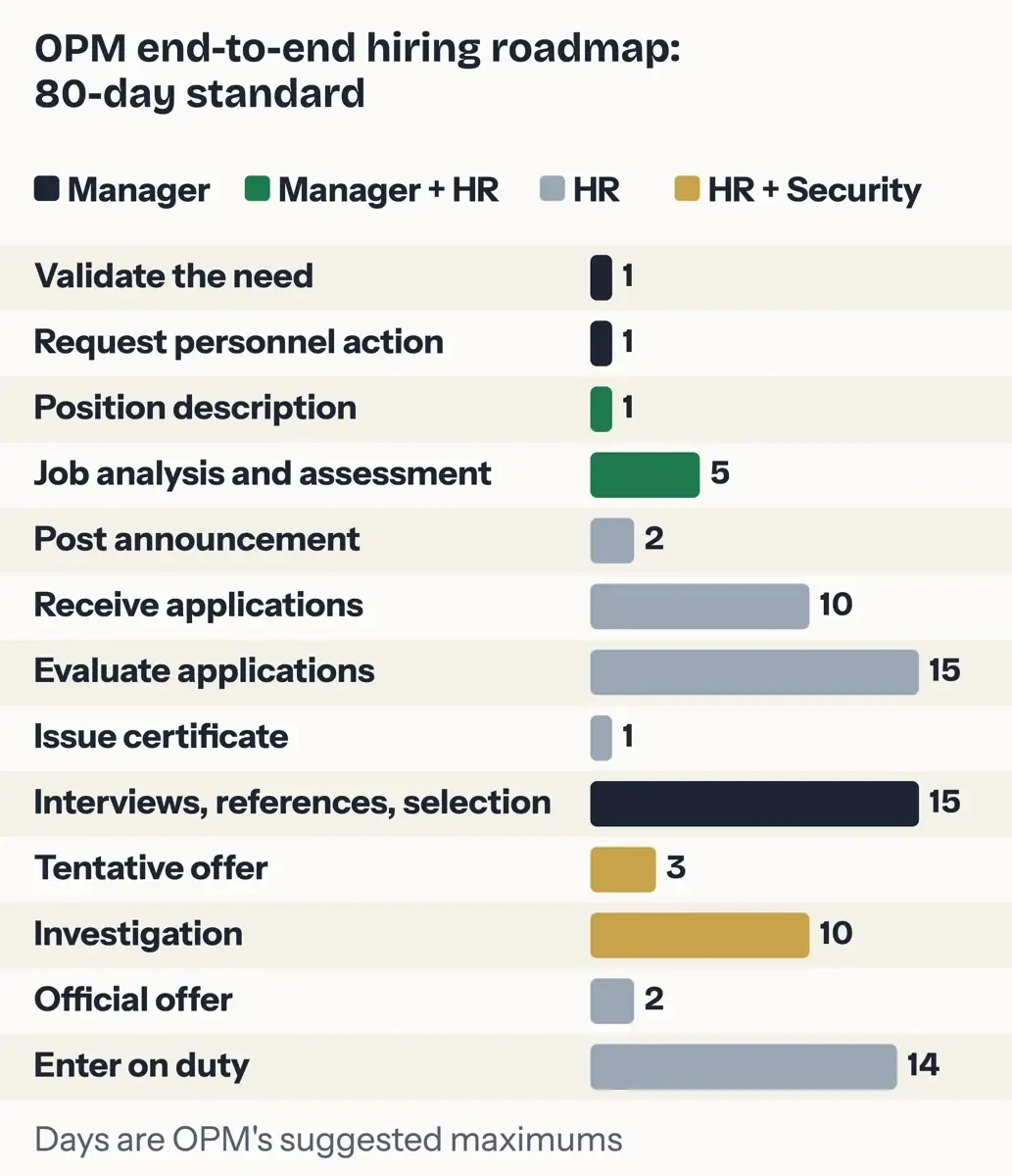 Diagram by DigitalTreed, from the OPM End-to-End Hiring Roadmap and the OPM step 10 page, November 4, 2026.
Hiring manager, recruiter or HR: who does which task?
Recruiters and HR carry the long middle of that roadmap, from the posting to the official offer. BLS's Occupational Outlook Handbook describes both jobs. Its page on HR specialists says recruiters search for applicants "by posting listings, attending job fairs, and visiting college campuses." They "also may test applicants, contact references, and extend job offers." The same page lists duties like "Check applicants' references and backgrounds" and "Keep employment records and process paperwork." HR managers are a separate occupation, and they "Serve as a consultant to advise other managers on human resources issues, such as equal employment opportunity and sexual harassment."
OPM draws the HR line in a two-column roles chart for the rating and certification stage. HR's column includes "Score applicants through assessments and apply veterans' preference." The hiring manager's column includes "Confirm job-specific requirements and critical skills" and "Document merit-based reasoning and selection justification." For a small company with one outside recruiter and one HR generalist, we'd map the duties like this:
| Task | Hiring manager | Recruiter | HR |
|---|---|---|---|
| Say why the job is needed and get approval | Owns | - | Checks budget and headcount |
| List duties and must-have skills | Owns | Asks questions | Checks wording |
| Write and post the job ad | Approves duties | Drafts and posts | Checks pay range and EEO wording |
| Source and screen applicants | Sets the must-haves | Owns | - |
| Structured interview and scoring | Owns | Schedules | Reviews the question list |
| Reference checks | Asks job questions only | Often runs them | Sets the policy |
| Final choice | Owns | Advises | Advises |
| Offer letter, background check, Form I-9 | Signs off on the offer | - | Owns |
| Keep the hiring file | Hands over notes | Hands over notes | Owns |
Keep reference calls to job questions, because the EEOC says its hiring rules "apply to any communications with or about the applicant, including application forms, interviews and reference checks."
Your interview notes go to HR, not a personal notebook, since they're hiring records under the EEOC's one-year rule.
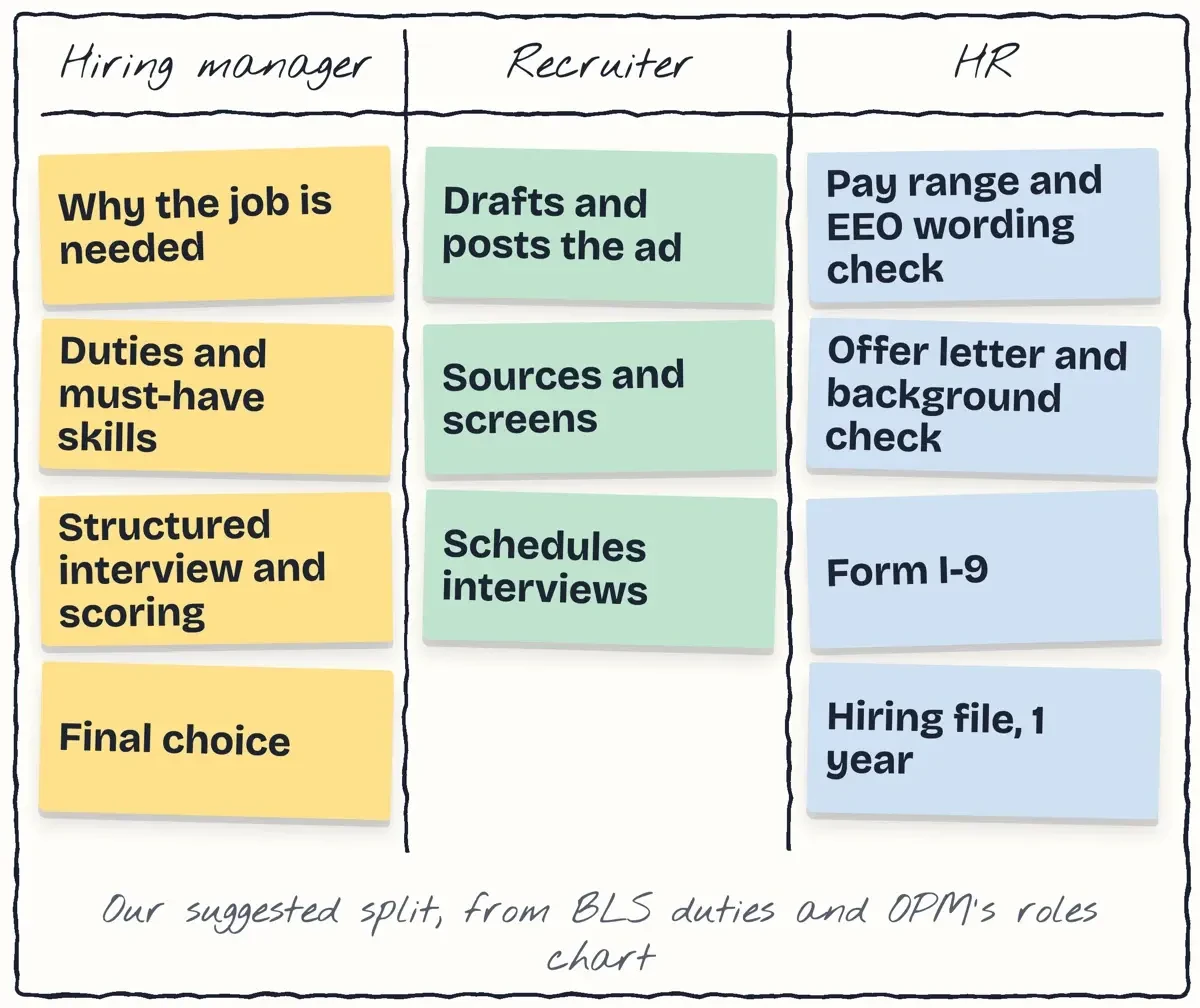 Drawn by us from BLS duties for HR specialists and managers and the OPM HR and hiring manager roles chart, November 4, 2026.
Writing the job request and the posting
Once the split's agreed, the manager's first written job is the job analysis. OPM's roadmap starts it with "Identify the critical duties and responsibilities of the job," then lists the knowledge, skills and abilities those duties need. Our job descriptions for a chief operating officer, a senior accountant, a business development director and an executive assistant show that step done.
The ad is where federal law first reaches the manager's words. The EEOC's prohibited practices page bans any job ad that "shows a preference for or discourages someone from applying for a job because of" a protected trait. As of November 2026, the traits it lists include race, color, religion, sex, national origin, "age (40 or older), disability or genetic information." That's why "recent graduates only" is risky: it points at age.
No federal law asks for a pay range in a job ad, but several states do, so agree the range with HR before the posting goes up.
California's pay transparency FAQ, Washington's RCW 49.58.110 and Illinois's Department of Labor set the line at 15 employees. New York's Department of Labor starts at four. Colorado's SB19-085 summary covers employers announcing openings, with "the pay range for the openings." Our competitive pay guide quotes each rule, with its start date and fines.
Running a structured interview
OPM's structured interviews page says the method measures "job-related competencies of candidates by systematically inquiring about their behavior in past experiences." Two rules make it structured. "All candidates are asked the same predetermined questions in the same order." And "All responses are evaluated using the same rating scale and standards for acceptable answers."
Pick the scale first. OPM's Structured Interviews: A Practical Guide (September 2008) suggests one range for every competency, such as 1 to 5. It says "Create at least three proficiency levels, but aim for five to seven levels." The guide's list of rating errors includes "giving all high ratings or all low ratings to candidates." OPM's step 10 page adds two jobs for the manager: "Develop interview questions specific to the position" and train anyone else on the panel. A scorecard for one job takes five steps:
- Pick three to five competencies from the job analysis, such as month-end close accuracy for an accountant.
- Write one past-behavior question per competency, with the same wording for every candidate.
- Label at least three points on a 1 to 5 scale, for example 1 unsatisfactory, 3 satisfactory, 5 superior.
- Write notes during each interview: what the candidate said or did, next to the score.
- Score each answer before you talk about candidates with anyone else on the panel.
Fill in the notes column even when a score seems obvious, because OPM's guide says notes should "Serve as documentation to support the employment decision." That's the paper the hiring manager hands HR with the final pick.
Our local test page on 127.0.0.1, under What we tested, fills in this layout for a made-up staff accountant job.
Interview questions the EEOC says to avoid
Whether these federal rules reach your company depends on headcount. Per the Title VII text, coverage starts with an employer "who has fifteen or more employees for each working day in each of twenty or more calendar weeks." The EEOC's small business requirements page adds the age discrimination rules from 20 employees up. Its hiring page warns that questions about protected traits "may be considered evidence of intent to discriminate by the EEOC." As of November 2026, these are the topics its pages name:
- Pregnancy, plans for children, the number and ages of children, and child care arrangements.
- Marital status, plans to marry, a spouse's name or a spouse's job.
- Religion: the EEOC names "place of worship, days of worship, and religious holidays" on its religion page.
- Race or ethnicity, with the EEOC examples "Are you biracial?" and "What language(s) do you speak at home?"
- Citizenship before an offer, per the EEOC citizenship page.
- Height and weight, unless they're job-related, per its height and weight page.
- Age, unless it checks a legal age rule for the job.
- Disability, medications, workers' compensation claims and family medical history.
You can still ask about the work itself. The EEOC's medical questions page says "An employer may ask a job applicant whether they can perform the job and how they would perform the job."
So describe the lifting the job needs and ask if the candidate can do it. Don't ask the EEOC's own example, "Do you have a disability?"
The EEOC's page on what you can't ask bars disability questions before an offer, and "This is true even if the disability is obvious." The ADA rule at 29 CFR 1630.13 makes it unlawful to ask "whether an applicant is an individual with a disability," except as section 1630.14 allows. The same EEOC page bars genetic questions too, with the example "Have any of your close relatives had a heart attack."
What we tested
On November 4, 2026 we wrote 12 made-up interview questions and a local script with 10 rules. Each rule rests on a phrase the script found on a saved EEOC page. It marked 6 questions flag, 1 check and 5 clear. The check was "Are you at least 18 years old?", fine only for a legal age rule. We'd labeled the list by hand first. The script matched our labels on 11 of 12.
The miss was "Has anyone in your family had heart disease?" The script passed it as clear. Our genetic rule looked for words like "family medical" and "relatives", and this question used neither. It asks the same thing as the EEOC's heart attack example, though, so HR or a lawyer still reads the whole list.
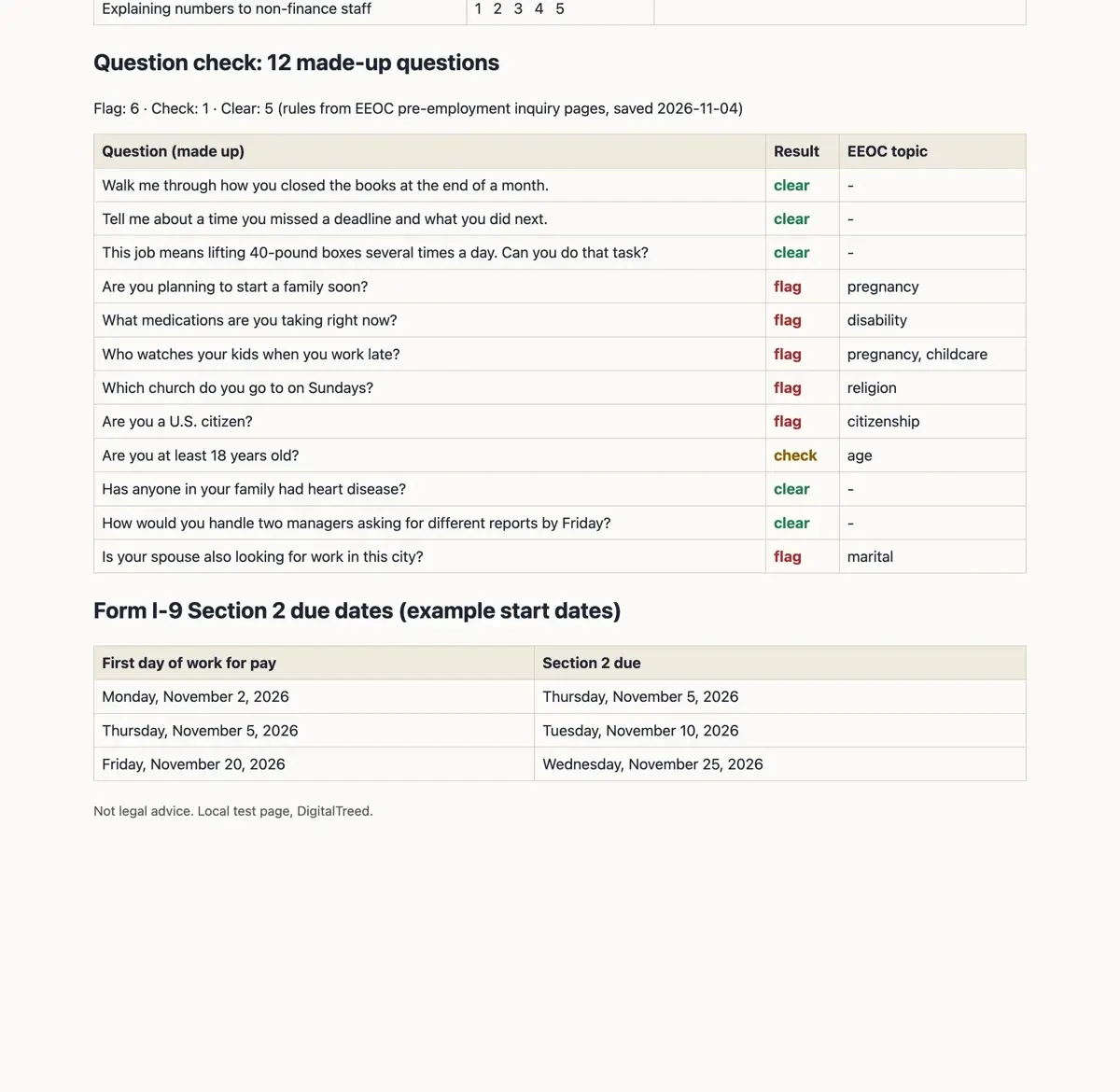 Screenshot: our scorecard test page on 127.0.0.1, November 4, 2026. Made-up questions.
The conditional offer and the background check
Medical questions open up only after a conditional offer. The EEOC's disability page allows them then, as long as "all individuals selected for the same job are asked the same questions or made to take the same examination." The rule at 29 CFR 1630.14(b) sets the same test for "all entering employees in the same job category."
A background check from a screening company falls under the Fair Credit Reporting Act. The FTC's guide for employers lists three steps before you order a report. First, a notice that "must be in writing and in a stand-alone format"; the guide adds that "The notice cannot be in an employment application." Second, "Get written permission from the applicant or employee." Third, certify compliance to the screening company. Later, before you reject anyone over the report, you send a pre-adverse action notice that includes the report and a summary of FCRA rights. The joint FTC and EEOC guide says that wait gives the person "an opportunity to review the report and explain any negative information."
The hiring manager's part is choosing which checks the job needs. Then every finalist for that job gets the same ones.
The EEOC's copy of that guide says "asking only people of a certain race about their financial histories or criminal records is evidence of discrimination." Our employer background check guide walks through each FCRA notice and the adverse action letter.
After the offer: the Form I-9 clock
Once the candidate accepts the offer, Form I-9 can start. The EEOC's citizenship page says federal law bars running it "before the employee has accepted an offer of employment." The same page suggests a line on the application form saying all persons hired "will be required to verify identity and eligibility to work in the United States." Per USCIS's Section 1 page, employees do Section 1 "no later than their first day of employment." They can start sooner, since they "may complete Section 1 any time after they accept the job offer."
Section 2 is the employer's part. USCIS's Section 2 page says to finish it "within 3 business days of the date of hire," and the hire date "means the first day of work for pay." Its example: "if your employee began work for pay on Monday, you must complete Section 2 by Thursday of that week." The rule at 8 CFR 274a.2 says "within three business days of the hire," or for jobs under three days "no later than the first day of work for pay." That page doesn't define a business day, so our script counted Monday to Friday, skipping weekends, from three example start dates:
| First day of work for pay (example) | Section 2 due |
|---|---|
| Monday, November 2, 2026 | Thursday, November 5, 2026 |
| Thursday, November 5, 2026 | Tuesday, November 10, 2026 |
| Friday, November 20, 2026 | Wednesday, November 25, 2026 |
None of those spans has a federal holiday in it. USCIS's page doesn't say how a holiday inside the count works, so ask HR or counsel when a start date sits near one.
The same rule keeps the form on file "three years after the date of the hire or one year after the date the individual's employment is terminated, whichever is later." USCIS's retention page has a calculator for that date.
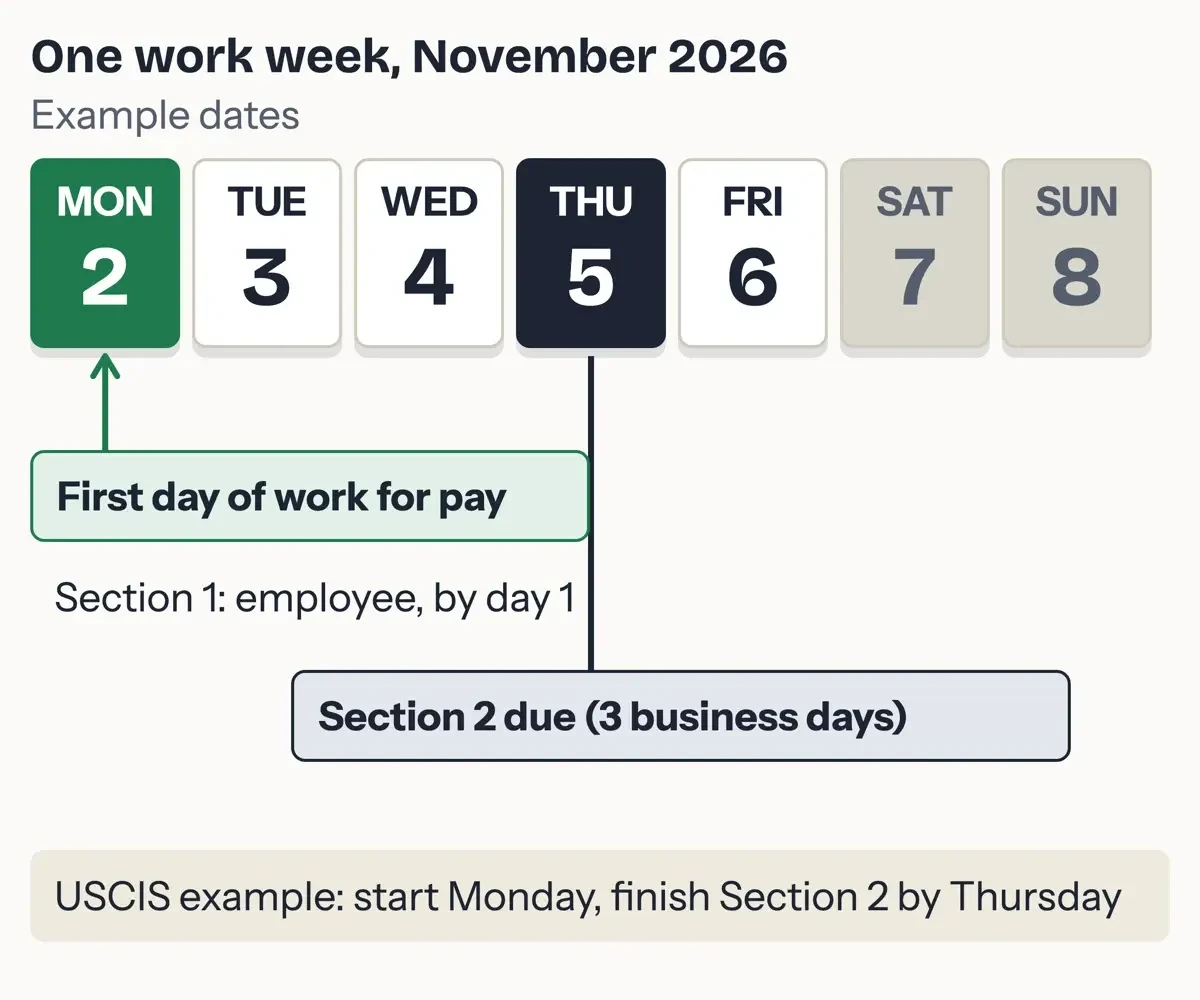 Diagram by DigitalTreed, from the USCIS Form I-9 Section 2 page and 8 CFR 274a.2, November 4, 2026. Example dates.
Keeping the hiring file for one year
Scorecards and notes on the people you didn't hire are records too. The EEOC's recordkeeping page says "EEOC Regulations require that employers keep all personnel or employment records for one year." 29 CFR 1602.14 counts that year from "the date of the making of the record or the personnel action involved, whichever occurs later." The FTC and EEOC guide says it covers "all application forms, regardless of whether the applicant was hired." Here's an example with made-up dates. An application arrives Monday, November 2, 2026, and the rejection goes out Tuesday, December 1, 2026. The rejection is the later date. The file stays until Wednesday, December 1, 2027.
If someone files a charge, the regulation says to keep the records "until final disposition of the charge or the action." Scorecards, interview notes and the rejection email all go in that file.
What we'd do on a first hire
For a first hire, we'd write the job analysis and the scorecard in the week the role's approved.
HR reads the question list before the first interview, since our own checker missed one question, and every finalist gets the same questions in the same order.
Notes go to HR the same day. The offer letter waits until the pick's written down with its reasons.
This guide gives steps, not legal advice. Cities and states add their own rules to the federal ones, so talk to an employment lawyer before you change how you hire. For how a large employer publishes its people system, see our Amazon human resources management case study.
Hiring manager questions
Frequently asked
Can a hiring manager ask a candidate's age?
Only to check a legal age rule. The EEOC's small business page says to avoid "Questions about age, unless used to verify that applicants meet any age-related legal requirements for the job."
Can I ask why a candidate is out of work?
Yes. The EEOC's unemployed status page says federal law allows the question, but "the federal EEO laws do prohibit using this information to discriminate."
Can I ask about a candidate's finances?
Federal law allows it, per the EEOC's financial information page, but the answers can't be used to discriminate. A screening company's credit report brings in the FCRA.
Can I collect race data on a phone screen?
No. The EEOC's race page says "Asking for race-related information on the telephone could probably never be justified." It suggests "tear-off" sheets for tracking.
How we made this guide: A plain script saved 44 OPM, BLS, EEOC, USCIS, FTC, Cornell LII and state pages on November 4, 2026; every quote matches one. Regulations are quoted from Cornell LII's eCFR copy, since ecfr.gov showed our script a bot check. Facts checked by the DigitalTreed team on November 4, 2026.
First published April 2025 as an opinion piece with no sources and one vendor mention. Rewritten November 4, 2026 around OPM's hiring roadmap and the federal hiring rules.
Sources
- OPM: End-to-End Hiring Roadmap, elements and tasks (PDF)
- OPM Hiring Process Analysis Tool, step 10: interviews, references, selection
- OPM: Collaborative HR and hiring manager roles (PDF)
- OPM: Merit Hiring Plan memo, May 29, 2025 (PDF)
- OPM: Structured interviews
- OPM: Structured Interviews, A Practical Guide, September 2008 (PDF)
- BLS Occupational Outlook Handbook: Human resources specialists
- BLS Occupational Outlook Handbook: Human resources managers
- EEOC: Prohibited employment policies and practices
- EEOC: Title VII of the Civil Rights Act of 1964
- EEOC: Small business requirements
- EEOC: What shouldn't I ask when hiring?
- EEOC: What can't I ask when hiring?
- EEOC: Pre-employment inquiries and marital status or number of children
- EEOC: Pre-employment inquiries and religious affiliation or beliefs
- EEOC: Pre-employment inquiries and citizenship
- EEOC: Pre-employment inquiries and height and weight
- EEOC: Pre-employment inquiries and race
- EEOC: Pre-employment inquiries and unemployed status
- EEOC: Pre-employment inquiries and financial information
- EEOC: Pre-employment inquiries and disability
- EEOC: Pre-employment inquiries and medical questions and examinations
- Cornell LII (eCFR text): 29 CFR 1630.13, prohibited medical examinations and inquiries
- Cornell LII (eCFR text): 29 CFR 1630.14, medical examinations and inquiries specifically permitted
- EEOC: Recordkeeping requirements
- Cornell LII (eCFR text): 29 CFR 1602.14, preservation of records
- EEOC: Background checks, what employers need to know
- FTC: Background checks, what employers need to know
- FTC: Using consumer reports, what employers need to know
- USCIS: Completing Section 1 of Form I-9
- USCIS: Completing Section 2 of Form I-9
- USCIS: Form I-9 retention and storage
- Cornell LII (eCFR text): 8 CFR 274a.2, verification of identity and employment authorization
- California DIR: Equal Pay Act and pay transparency FAQ
- New York State Department of Labor: Pay transparency
- Washington State Legislature: RCW 49.58.110
- Illinois Department of Labor: Equal Pay Act salary transparency
- Colorado General Assembly: SB19-085 Equal Pay for Equal Work Act


Comments
No comments yet. Start the conversation below.