
Quick answer
Competitive pay is pay near the local market median for your job. BLS put that median at $78,760 a year for market research analysts and marketing specialists nationwide in May 2025. Your metro changes it: Denver's median was $99,040 and Seattle's $102,170. Look up your own job and metro in BLS wage data, then add benefits.
If you're weighing a job offer, or writing the salary line of a job post for a small firm, "competitive pay" sounds like a promise nobody can check. Competitive pay is a salary that lands near the middle of what employers pay for the same job in the same area. BLS publishes that middle for "approximately 830 occupations," per its OEWS program page.
We priced one marketing job in Denver and Seattle from the May 2025 OEWS percentiles, ran three made-up offers through a script, and aged the year-old data with the ECI. A salary alone undercounts the cost: benefits add 25.9% to 35.3% of compensation by firm size. Five states also want the range printed in the job post, and our last section turns all of it into steps for an offer or a post.
Key takeaways
- Compare an offer with the 25th, 50th and 75th percentiles, not one average.
- Use the metro figure: Denver's marketing median beats the national one by $20,280.
- Age May 2025 OEWS figures with the 3.1% yearly ECI wage growth.
- At private firms with 1-49 workers, benefits are 25.9% of compensation costs.
- California, Washington and Illinois want ranges in posts at 15+ employees.
Competitive pay means a spot on the market's percentiles
The OEWS questions page says "A percentile wage is a boundary." The median is the 50th percentile. Half the workers in the job earn more, and half earn less. The Occupational Outlook Handbook's market research analysts page uses the same definition. So the 25th to 75th percentile band holds the middle half of the market. An offer at the 25th percentile is still a market wage, even though three of every four workers in that job and area earn more.
We'd call pay competitive when it sits between the median and the 75th percentile, a cutoff that's our rule and not a BLS term. Below the median, we'd want a stated reason, such as less experience or a narrower role.
Check what's inside the BLS number before you compare. The same FAQ says "Wages for the OEWS survey are straight-time, gross pay, exclusive of premium pay." Base rates, commissions, tips and production bonuses are in, while overtime pay, year-end bonuses, shift differentials and severance are left out of the figure. So put an offer's base salary against OEWS first, and weigh a signing or year-end bonus on its own, since the market number you're comparing with doesn't contain one.
How to look up a job in BLS OEWS by state or metro
BLS gives the market number away free. The newest set is the May 2025 estimates in its news release dated May 15, 2026. It covers the nation, every state and "approximately 530 areas." BLS says the funding lapse "from October 1 through November 12, 2025" added processing time, with a response rate "within the normal range." We took these steps for one job:
- Find the six-digit SOC code. The BLS occupation list gives 13-1161 for market research analysts and marketing specialists.
- Open the OEWS profile for 13-1161 and put your own code in the link; the major group is its first two digits plus 0000.
- Pick your state or metro area. The BLS area list gives Denver the code 0019740.
- Write down the annual 25th percentile, median and 75th percentile, not the mean.
- Note "May 2025" and the release date beside the numbers.
The profile page sent our plain script no figures, so it asked the BLS public API for the same figures, using plain requests and no registration key.
Each figure has its own series ID. It starts with "OEU," then the area type and code, six zeros for all industries, the SOC code and a two-digit data type. Type 12 is the annual 25th percentile, 13 the median and 14 the 75th. Denver's median for this job is series OEUM001974000000013116113, and you can paste that ID into the API link to see the raw answer.
We saved each answer as a JSON file, so the figures here won't move if BLS revises a series later.
Example: one marketing job in Denver and Seattle
Use the metro figure when the job's in a city: Denver's 13-1161 median is $99,040 against $78,760 nationally, per the same May 2025 API answers. Our worked example adds Seattle for the same job, SOC 13-1161. Both metros sit in states that require pay ranges in postings: Denver-Aurora-Centennial, Colorado and Seattle-Tacoma-Bellevue, Washington. The Handbook page confirms the national median: "The median annual wage for market research analysts was $78,760 in May 2025." Example figures, BLS OEWS May 2025:
| Area | 25th percentile | Median | 75th percentile | Spread, 25th to 75th |
|---|---|---|---|---|
| U.S. | $58,350 | $78,760 | $108,310 | $49,960 |
| Denver-Aurora-Centennial, CO | $70,310 | $99,040 | $129,570 | $59,260 |
| Seattle-Tacoma-Bellevue, WA | $74,930 | $102,170 | $161,120 | $86,190 |
The two medians are only $3,130 apart, yet Seattle's 75th percentile is $31,550 higher than Denver's. A $130,000 offer clears Denver's 75th percentile ($129,570) and still sits under Seattle's ($161,120). So a senior Seattle range can run much wider than the same title's range in Denver.
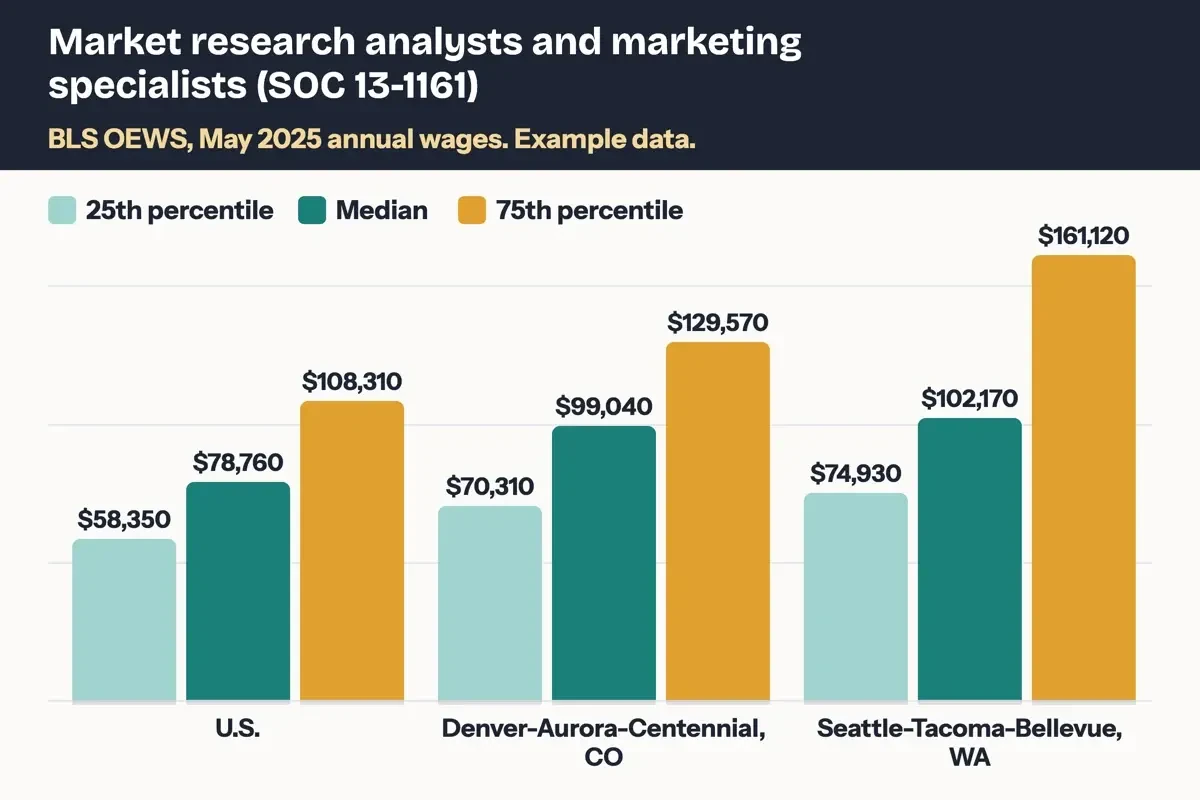 Diagram by DigitalTreed from BLS OEWS May 2025 estimates (SOC 13-1161), read through the BLS public API on November 4, 2026. Example data.
What we tested
Our Python script reads the BLS answers we saved on November 4, 2026 and compares three made-up offers with them. It places each one between two percentiles by straight-line estimate, our method rather than a BLS figure:
- Made-up offer A, Denver, $88,000: about the 40th percentile, $11,040 under the median.
- Made-up offer B, Seattle, $88,000: about the 37th percentile, $14,170 under the median.
- Made-up offer C, Denver, $104,000: about the 54th percentile, $4,960 over the median.
So $88,000 is 11.1% under the median in Denver and 13.9% under in Seattle. We served the results page on 127.0.0.1:
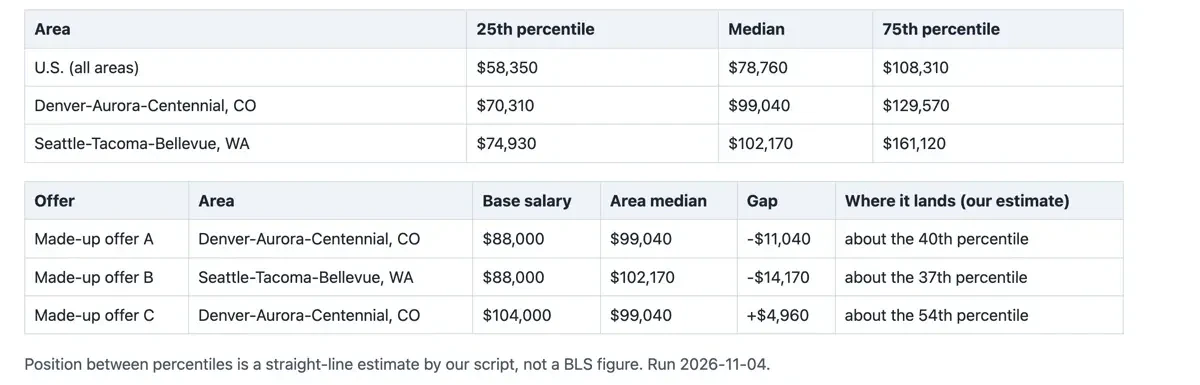 Screenshot of our offer-check page on 127.0.0.1, November 4, 2026. Made-up offers.
How old is the BLS data, and how do you adjust it?
Those medians date from May 2025, and BLS published them a full year later, on May 15, 2026. No raise given after May 2025 shows up in them.
Part of it's older still: the OEWS FAQ says each set uses the current May panel "along with data collected in the previous five semi-annual panels." Older wages are adjusted to May.
To move a figure closer to today, we use the Employment Cost Index. The BLS ECI release for September 2026, published October 30, says private wages and salaries rose 3.1% over the 12 months to September. Example: Denver's $99,040 median times 1.031 is $102,110. That's our rough step, not a BLS estimate, and it assumes marketing pay moved like all private pay, which it may not have.
The same release puts inflation-adjusted wages and salaries down 0.6% over that year. So an offer that only matches last year's median in dollars has slipped in real terms.
Colorado readers once waited more than three months for fresh figures: a BLS notice says Colorado's May 2024 estimates "were released on July 23, 2025." The April 2, 2025 release had left them out over a state unemployment insurance system problem.
Benefits add a quarter or more to the cost of pay
OEWS stops at wages. For benefits, BLS has the Employer Costs for Employee Compensation release of September 9, 2026. It found private employers paying $46.89 an hour in total compensation in June 2026. Benefits were $14.07 of it, or 30.0%, and wages and salaries the other $32.82, or 70.0%. Small firms don't spend as big a share. The ECEC table by establishment size shows benefits at 25.9% of compensation with 1-49 workers and 27.3% at 50-99. It's 30.3% at 100-499 and 35.3% at 500 or more. Paid leave alone is 6.2% of compensation at the small end and 9.1% at the large end, and insurance runs 6.3% against 9.6%.
BLS says workers' compensation costs leave the ECEC starting with December 2026 data, so these shares may shift.
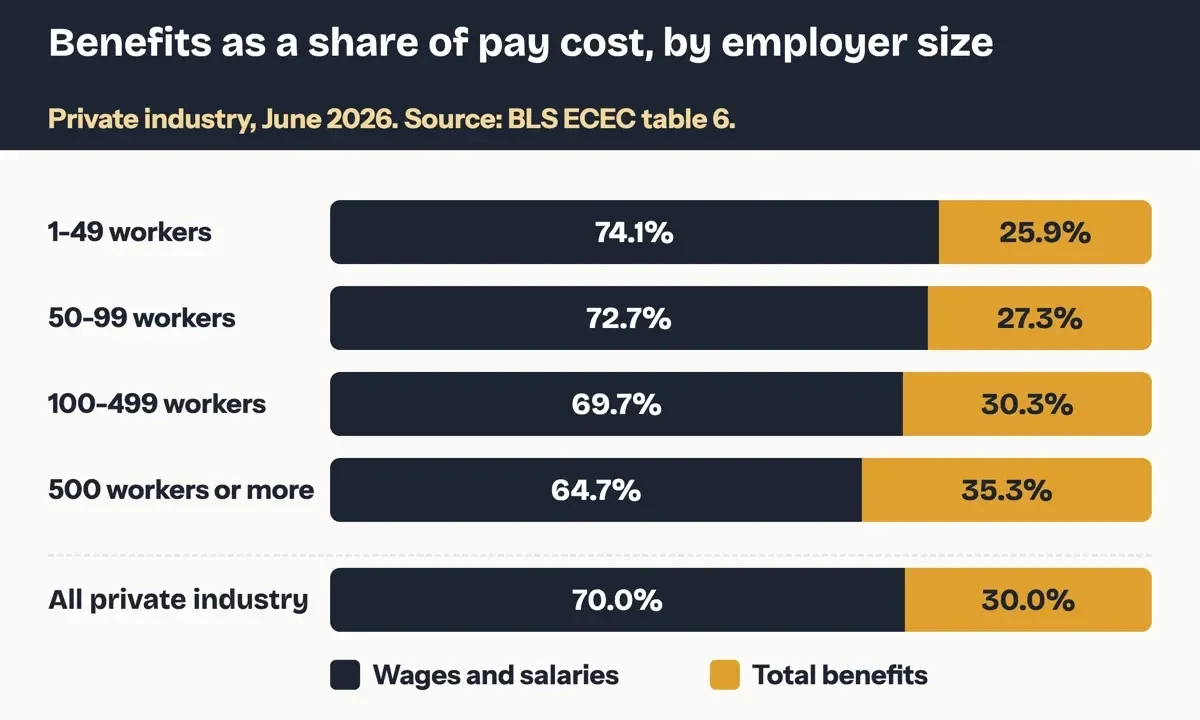 Diagram by DigitalTreed from the BLS ECEC June 2026 release, table 6, published September 9, 2026.
To put a salary on a total-compensation basis, divide it by the wage share. Example: $88,000 / (1 - 0.259) = $118,758 at the small-employer average. Your employer's plan isn't the average, though. You'll want to ask each one for its health premium split, retirement match and paid leave days before you compare two offers. Our Costco employee benefits guide shows what one big employer publishes about its own plan. The Amazon PTO and vacation policy post shows how leave tables change by role and years worked, detail that a total-compensation number hides.
Pay-range laws in Colorado, California, Washington, New York and Illinois
Posting a pay range isn't a federal rule. The EEOC says the Equal Pay Act "requires that men and women in the same workplace be given equal pay for equal work." The posting rules come from state law. This table shows what each state's agency or legislature page said on November 4, 2026:
| State | Who it covers | What the posting shows | In force | Agency |
|---|---|---|---|---|
| Colorado | Employers announcing openings | Pay range; since 2024 also benefits and the application close date | January 1, 2021; January 1, 2024 | CDLE |
| California | 15 or more employees | Pay scale (good faith salary or hourly range), in the post itself | Signed September 2022 | Labor Commissioner |
| Washington | 15 or more employees | Wage scale or salary range, plus benefits and other pay | January 1, 2023 | L&I |
| New York | Four or more employees | Compensation range; say if commission-based | September 17, 2023 | NY DOL |
| Illinois | 15 or more employees | Pay scale and benefits; a direct link is allowed | January 1, 2025 | IDOL |
Colorado's rule is the oldest of the five. The legislature's SB19-085 summary says employers must announce openings "and the pay range for the openings." Fines run "between $500 and $10,000 per violation," and the law took effect January 1, 2021. The SB23-105 summary added "compensation, benefits, and date that the application window is anticipated to close," effective January 1, 2024. The CDLE Equal Pay for Equal Work Act page has the agency's own guidance. It refused our script. Open it in a browser.
California's pay transparency FAQ is blunt: "An employer with 15 or more employees must include the pay scale for a position in any job posting." The FAQ defines that as "a good faith estimate of the salary or hourly wage range." It covers any job that "may ever be filled in California, either in-person or remotely." A link or a QR code doesn't count. The rule came from SB 1162, signed in September 2022, according to the state commission on women and girls and the Governor's office.
Washington's RCW 49.58.110 asks employers with 15 or more employees for "The wage scale or salary range" plus a general description of benefits and other pay. Its note says "This act takes effect January 1, 2023." Damages run $100 to $5,000 per violation. Through July 27, 2027, an employer that fixes a post within five business days of written notice avoids them, under a fix window that opened July 27, 2025. L&I adds: "If the employer does not correct the posting within 5 days, the department can proceed with enforcement actions."
New York's Department of Labor says Labor Law Section 194-B requires businesses "with four or more employees" to "list compensation ranges for designated job opportunities, promotions, and transfers." The page adds: "Employers must also clearly state if a position is commission-based." Its Pay Transparency Act FAQ gives the start date: "The law goes into effect on September 17, 2023." For city jobs, the page says "Any complaint regarding a New York City based opportunity may still be addressed to the New York State Department of Labor." It also links a complaint form for the New York City Commission on Human Rights, so a city applicant can report a post with no range to either agency.
Illinois is the newest. The Illinois Department of Labor says that "As of January 1, 2025," employers of 15 or more must show "pay scale (or compensation) and benefits" in job posts. Its December 16, 2024 press release traces the rule to HB 3129, signed in 2023. Once a job goes up publicly, the employer has 14 days to make the opening known to current staff, under the same section of the Illinois Equal Pay Act. Posting itself isn't required: "No employer is required to make a job posting, but if they do, Pay Transparency applies."
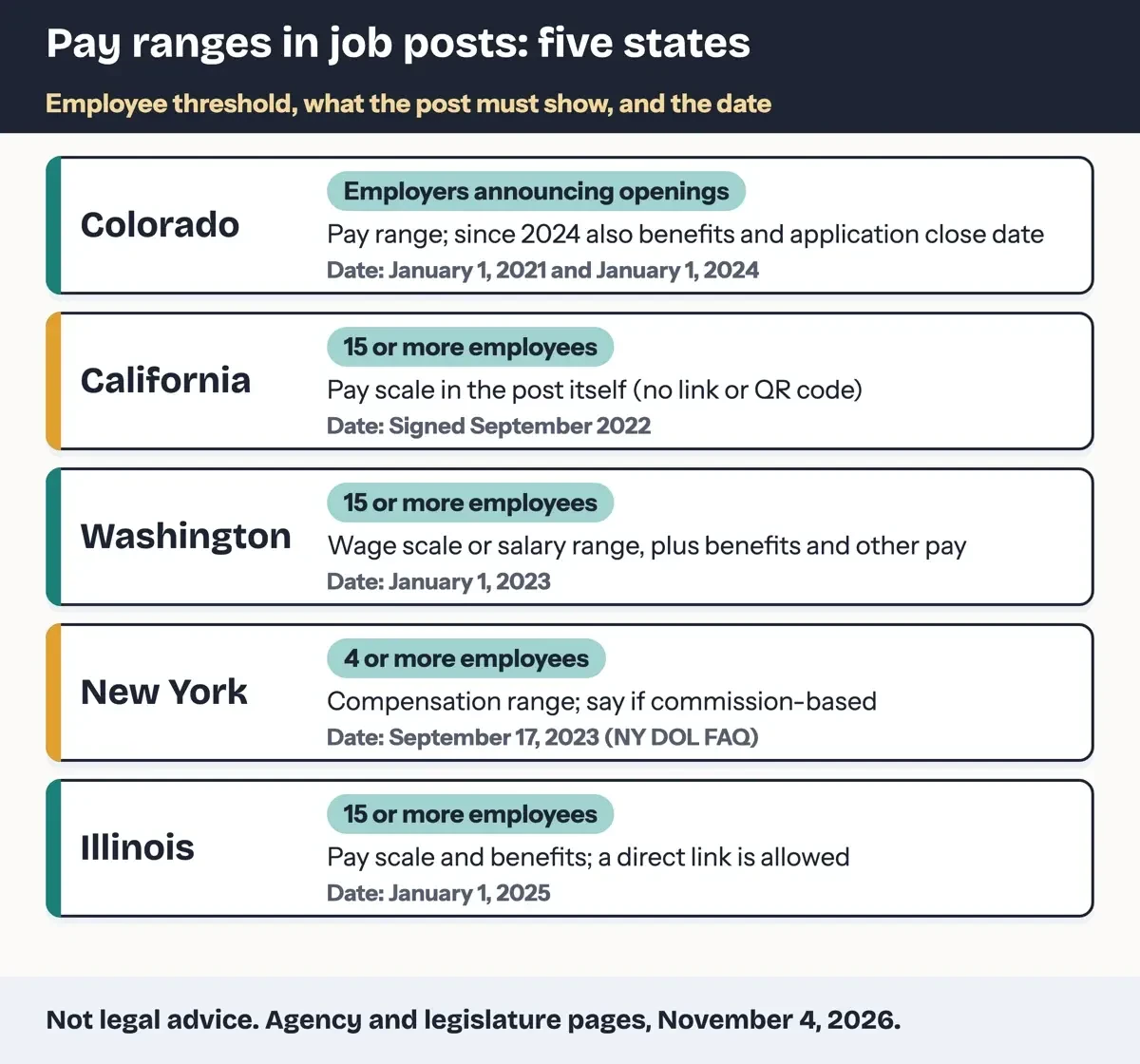 Diagram by DigitalTreed from Colorado legislature summaries, the California DIR FAQ, RCW 49.58.110, NY DOL and Illinois DOL pages, November 4, 2026.
That's our summary of those pages on November 4, 2026, not legal advice. For a remote or multi-state post, ask an employment lawyer first.
What we'd do with an offer or a job post
For an offer, we'd pull the 25th, median and 75th for the job and metro from the OEWS profile or the API. Next we'd age the median by the latest ECI figure, 3.1% for the year to September 2026, and see where the offer lands against all three numbers. In California, the DIR FAQ says an employer must give an applicant the pay scale "upon reasonable request." Ask for it before you counter. A resume that mirrors the job title helps too; our ATS-friendly resume guide covers that. Marketing and SEO readers can compare roles in our SEO career guide. Federal offers follow the tables in our GS pay scale guide.
For a job post, we'd start the range near the metro's 25th percentile and end it near the 75th for the closest SOC code. Then we'd narrow it to the role's level and print it in the post: Illinois accepts a direct link, California doesn't. Don't set a range before the duties are written; our chief operating officer job description and senior accountant job description show how we'd write them for two very different roles. Keep the paper trail, too. California wants job title and wage rate history kept for the job's length plus 3 years. Illinois says "at least five years." Our hiring manager responsibilities post covers who signs off on the final number.
Our take: "competitive" in a posting should mean a number you can defend with BLS data. Pull the percentiles, add benefits at your real cost, and post the range your state requires.
Competitive pay questions
Frequently asked
How reliable is BLS salary data for one city?
It's a big sample. The OEWS FAQ says three years of data cover "1.1 million establishments," about 57% of US employment.
Can a Colorado employer ask about my salary history?
No. The SB19-085 summary bars "Seeking the wage rate history of a prospective employee."
Can I ask what coworkers earn in California?
Yes, but the DIR FAQ says "no law requires an employer to provide that information."
Does a California pay scale have to include bonuses or benefits?
No. The Labor Commissioner FAQ says they're "not required to be posted," though commission ranges are.
How we made this guide: On November 4, 2026 a script saved BLS, EEOC, state agency and legislature pages plus 12 BLS API series. Every quote here matches those copies. Colorado's CDLE page refused the script; it is linked, and nothing in this guide is quoted from it. Facts checked by the DigitalTreed team on November 4, 2026.
This post began in April 2025 as an opinion piece without a single source. The November 4, 2026 rewrite added BLS wage data, benefits costs and state pay-range laws.
Sources
- BLS: Occupational Employment and Wages, May 2025 (news release, May 15, 2026)
- BLS: Occupational Employment and Wage Statistics home
- BLS: OEWS frequently asked questions
- BLS: OEWS profile, SOC 13-1161, May 2025
- BLS Occupational Outlook Handbook: Market research analysts
- BLS public API: series OEUM001974000000013116113
- BLS: Notice on Colorado May 2024 OEWS estimates
- BLS: Employment Cost Index, September 2026 (October 30, 2026)
- BLS: Employer Costs for Employee Compensation, June 2026 (September 9, 2026)
- BLS: ECEC table 6, private industry by establishment size
- EEOC: Equal pay and compensation discrimination
- Colorado General Assembly: SB19-085 Equal Pay for Equal Work Act
- Colorado General Assembly: SB23-105 Ensure Equal Pay for Equal Work
- Colorado CDLE: Equal Pay for Equal Work Act
- California DIR: Equal Pay Act and pay transparency FAQ
- California Commission on the Status of Women and Girls: current pay equity laws
- Office of the Governor of California: SB 1162 signing, September 27, 2022
- Washington State Legislature: RCW 49.58.110
- Washington L&I: Equal Pay and Opportunities Act
- New York State Department of Labor: Pay transparency
- New York State Department of Labor: Pay Transparency Act FAQ
- Illinois Department of Labor: Equal Pay Act salary transparency
- Illinois Department of Labor: Pay transparency law takes effect January 1 (December 16, 2024)


Comments
No comments yet. Start the conversation below.