


Quick answer
As of November 2026, new savings bonds sell only at TreasuryDirect, and I bonds have been electronic-only since January 1, 2025. Banks, brokers, insurers and metals dealers sell online too, so look each seller up first in BankFind, BrokerCheck, your state insurance department or the CFTC check page. FDIC insurance covers only deposits, to at least $250,000 per bank and category, and not annuities.
Digital-first buying journeys for traditional investment products usually start with a search result or an ad and can end in a payment before you've spoken to anyone. A digital-first buying journey is a purchase where the research, the comparison and the payment all happen online, so the seller is a website before it's a person. This guide covers bonds, CDs, annuities and precious metals with facts from regulators, not advice. For a decision about your own money, talk to a licensed professional whose license you've looked up; our finance job titles guide explains which licenses go with which roles.
We start with how buying bonds, CDs, annuities and gold moved online, then cover TreasuryDirect for savings bonds and Treasuries and BankFind for bank and brokered CDs. Next come annuities, with their license, free look and surrender period, and precious metals, with their premiums, storage and financing. The five lookups before you pay sit in one table, and the last section shows what we tested on four made-up offers.
Key takeaways
- New I bonds and EE bonds are sold only inside TreasuryDirect.
- FDIC insurance covers only deposits, to at least $250,000 per bank and ownership category.
- Deposit brokers selling CDs are not licensed or certified, so check BrokerCheck first.
- Variable annuity surrender periods can run eight years or more, says FINRA.
- Our made-up example coin's 19.5% premium is over the CFTC's 5-10% bullion band.
How did buying bonds, CDs, annuities and gold move online?
Savings bonds made the cleanest break. Treasury no longer issues new paper ones. TreasuryDirect's I bond page says "As of January 1, 2025, I bonds are only available electronically." Its EE bond page says new EE bonds are electronic only too, and you need a TreasuryDirect account to buy them. Bank CDs went the other way. They gained sellers. Investor.gov's page on certificates of deposit says most CDs are purchased directly from banks. Brokerage firms and independent salespeople sell them too, and the page calls those sellers deposit brokers.
Brokers and advisers picked up a paper trail of their own. Investor.gov's page on working with an investment professional says they've owed retail investors a relationship summary, Form CRS, since summer 2020.
Gold and silver sell through ads. The CFTC's own warning opens with TV commercials and internet videos. Its article on gold as an investment says to be wary of offers on TV, radio or the internet. Be warier still if the seller's name sounds like an official government agency. On a cold call, its advice is short: hang up. Those warnings also tell sellers what a careful buyer will ask for. The CFTC tells metals buyers to insist on getting all fees in writing, and Investor.gov tells CD buyers to check the background of the issuer or deposit broker. If you run one of those sites, our guide to showing expertise and trust on a website covers the page side.
Savings bonds and Treasuries come from TreasuryDirect
Treasury sells two kinds of debt to people like you, and only one of them can be bought anywhere other than TreasuryDirect. For savings bonds, the TreasuryDirect buying page is plain: "TreasuryDirect is the official United States government application in which you can buy and keep savings bonds." As of November 2026, an electronic bond costs any amount from $25 to $10,000, to the penny. Each calendar year you can buy up to $10,000 in EE bonds and $10,000 in I bonds, with gifts and purchases for a child on top. A site that isn't treasurydirect.gov but offers new I bonds is selling something else.
As of November 6, 2026, TreasuryDirect's I bond rates page lists 5.51% for I bonds issued November 1, 2026 to April 30, 2027. That includes a 1.40% fixed rate, and new EE bonds earn 2.90%. The I bond page says the fixed part never changes, while the inflation part, and with it the overall rate, resets every 6 months and can go down.
You can cash an I bond after 12 months. Cash it before five years and you'll lose the last 3 months of interest.
Treasury bills, notes, bonds, TIPS and FRNs work differently: they're marketable, which means you can sell them before they mature, per TreasuryDirect's marketable securities page. Its page on buying a marketable security says you can bid in your TreasuryDirect account, with non-competitive bids only, while competitive bids need a bank, broker or dealer. As of November 2026, the minimum bid is $100, in $100 steps up to $10 million. Anything you buy in TreasuryDirect must be held 45 calendar days before you can transfer or sell it.
The Fiscal Service's frauds, phonies and scams page says it knows of several schemes built on securities falsely said to be issued or backed by the Treasury. Our lookalike finance website check shows how to compare a domain with the official one.
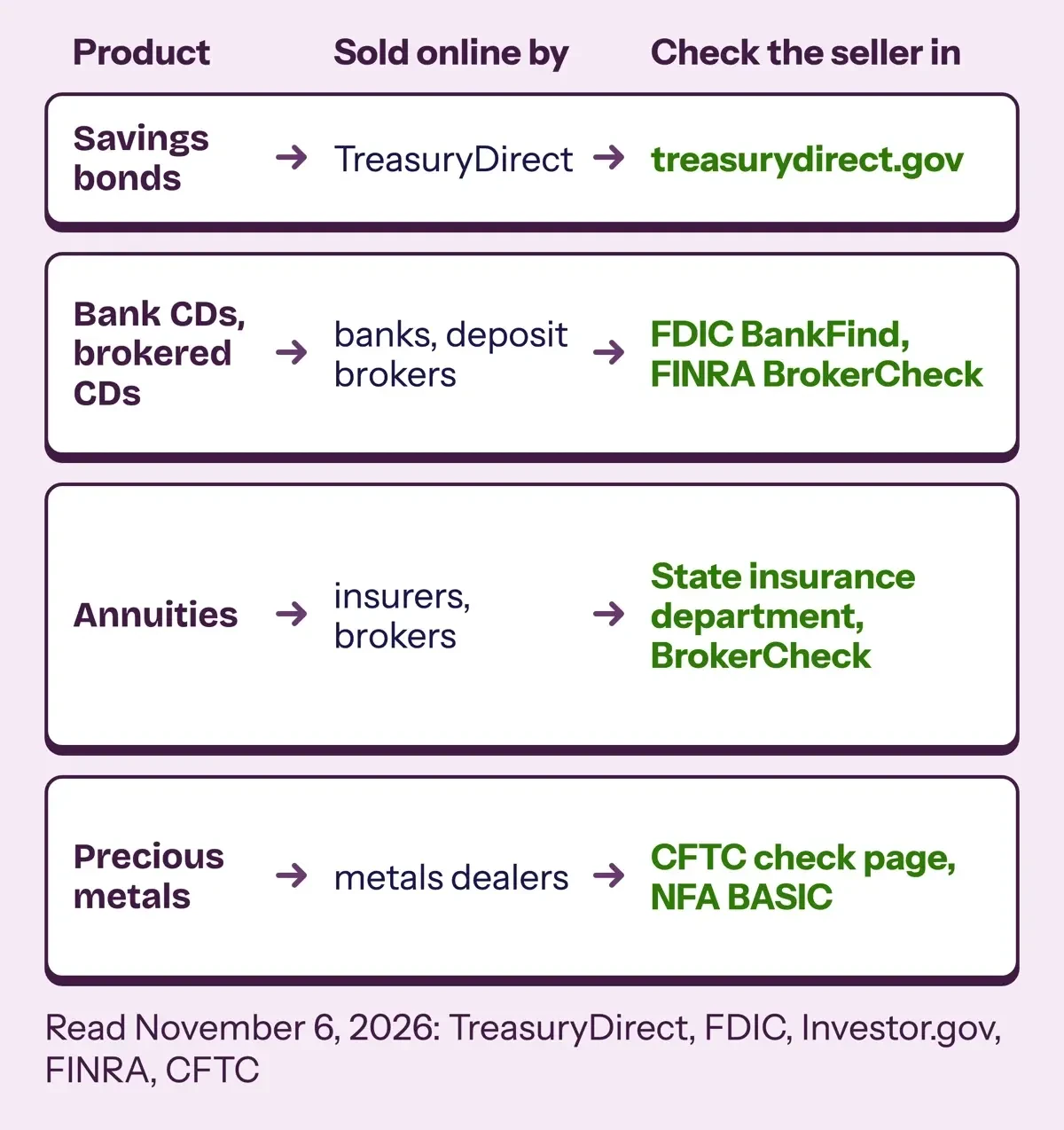 Diagram by DigitalTreed: where each traditional product is sold online and which official lookup checks the seller, from TreasuryDirect, FDIC, Investor.gov, FINRA and CFTC pages read November 6, 2026.
Bank and brokered CDs start with BankFind
A CD is a bank deposit, so the official check starts with the bank. FDIC's deposit insurance page says deposits are insured to at least $250,000 at each FDIC-insured bank. That limit is per ownership category, so all single accounts one person holds at one bank share it, per FDIC's coverage table. Investor.gov's CD page puts it plainly: the $250,000 covers all accounts in your name at the same bank, not each CD.
Joint accounts are counted separately. Each co-owner's shares of every joint account at that bank are insured up to $250,000 under the same table.
Online, a bank's name is easy to copy. FDIC's page on scammers and fake banks says some fake bank sites use the FDIC name or the Member FDIC logo. Its fix is BankFind, where you can search for a bank by name or by web address. FDIC's deposit insurance FAQ adds that BankFind lists each bank's official website and current status. The FDIC's deposit insurance page says it also searches by certificate number, location or branch office, with current and historical records for each insured bank.
If the address doesn't match the one BankFind lists, close the tab before you enter anything, and don't call the number on that page either.
Brokered CDs add a second party, the deposit broker. Investor.gov's CD page says "Deposit brokers are not licensed or certified, and no state or federal agency approves them." It sends you to the SEC and FINRA databases instead. FINRA described one pattern in a February 21, 2019 investor insight on high-yield CD offers. A high CD rate is the bait. The real sale is a fixed or equity-indexed annuity that isn't FDIC-insured, on which you're still likely to pay a hefty commission. Its warning signs include being pushed to show up at an office and the promise of risk-free guarantees. FINRA's advice is to check BrokerCheck first, then your state insurance commission.
Annuities online: license, free look and surrender period
Annuities are insurance contracts, which changes who you check. FINRA's annuities page says state insurance commissioners regulate all annuities, while variable annuities and RILAs are also securities that the SEC and FINRA oversee. Investor.gov's annuities page adds that annuities registered with the SEC have prospectuses. So a variable annuity sold online should come with a prospectus, and its seller should be in BrokerCheck. No annuity is a bank deposit, though: FDIC lists annuities among the products its insurance doesn't cover, next to mutual funds, stocks, bonds and crypto.
If a seller's page pairs an annuity with FDIC insurance, one of the two facts can't be true. Ask which one, in writing. Then look the company up in BankFind, which covers FDIC-insured institutions.
The free-look period lets you cancel a new contract without surrender charges. FINRA says it generally runs 10 to 30 days, set by your state. Investor.gov says the contract should state that length prominently.
FINRA says surrender periods on variable annuities can run eight years or more, and money you take out inside that window can carry a charge.
Investor.gov puts annuity fees in dollars. In its own example, a 1.25% base contract fee on a $300,000 annuity costs $3,750 a year, and fund fees inside a variable annuity come on top. Many fixed annuities, fixed indexed annuities and RILAs charge no explicit ongoing fee, Investor.gov says, but implicit costs can show up as a lower credited rate. The formula is fee rate x contract value, so run it on any quote you get. A licensed insurance or securities professional can walk you through the terms, once you've checked that license.
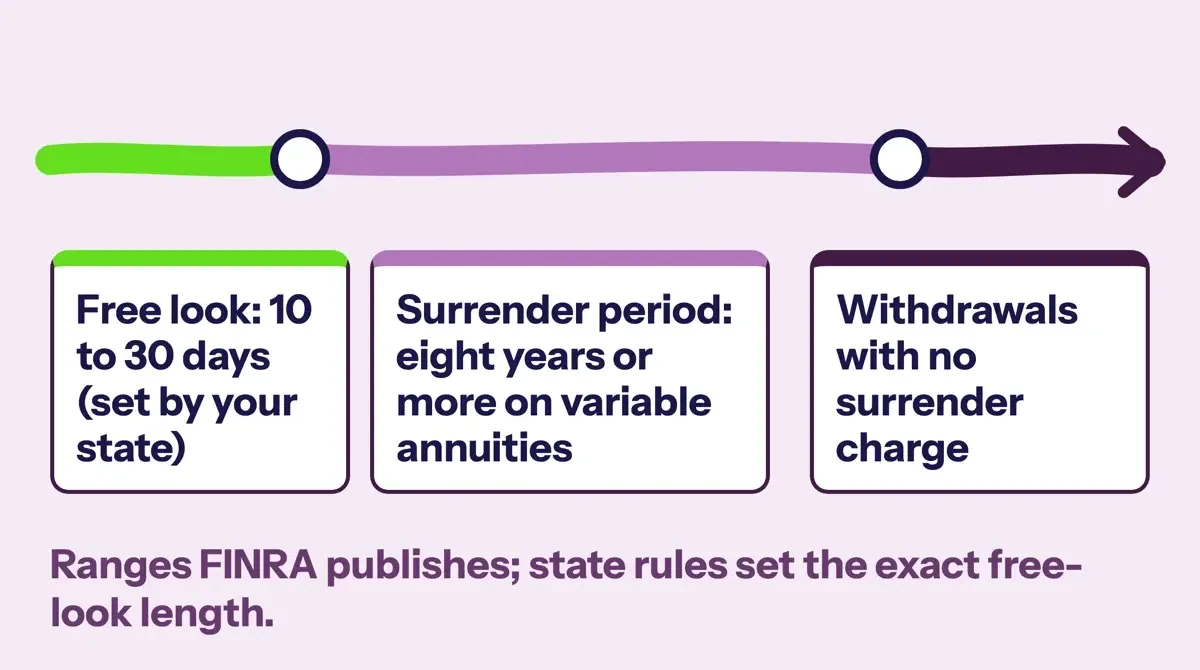 Drawn by us: the free-look window and surrender period on a variable annuity, using the ranges FINRA publishes (state rules set the exact free-look length).
Precious metals online: premiums, storage and financing
The CFTC's advisory on gold and silver schemes aimed at retirement savings gives a formula: premium % = (sales price - spot price) / spot price x 100. It puts bullion premiums at 5% to 10% over spot and collectible coins at 40% to 200%. Convert spot to the coin's weight first. In our made-up example, a $2,390 coin against a made-up $2,000 spot price works out to 19.5%.
The CFTC's precious metals fraud advisory flags two setups. One is a financing deal where the company arranges a loan for most of the price. The other is a promise to store the metal for you. In the schemes it describes, firms charged interest and storage fees without arranging a loan through an independent lender or storing metal with an independent facility. As of November 2026, the CFTC's gold article says the law it describes doesn't cover metals sales that end in physical delivery within 28 days. Dealers like that don't have to register with securities regulators either.
If you financed the metal and never got it, the CFTC says to check the seller's registration with the National Futures Association.
Retirement accounts get a separate CFTC advisory, and it cites one complaint: a gold dealer and IRA custodian charged nearly $150,000 in commissions and fees on a $300,000 rollover. It adds that dealers calling themselves IRA experts often aren't licensed to give investment advice. The same advisory says never to buy metals because of a cold call, an unsolicited email, a social media post or an infomercial. Our get-rich-quick math guide takes apart promises like a coin "guaranteed to double". If a card payment for metal never turns into a delivery, our card charge dispute guide covers the steps.
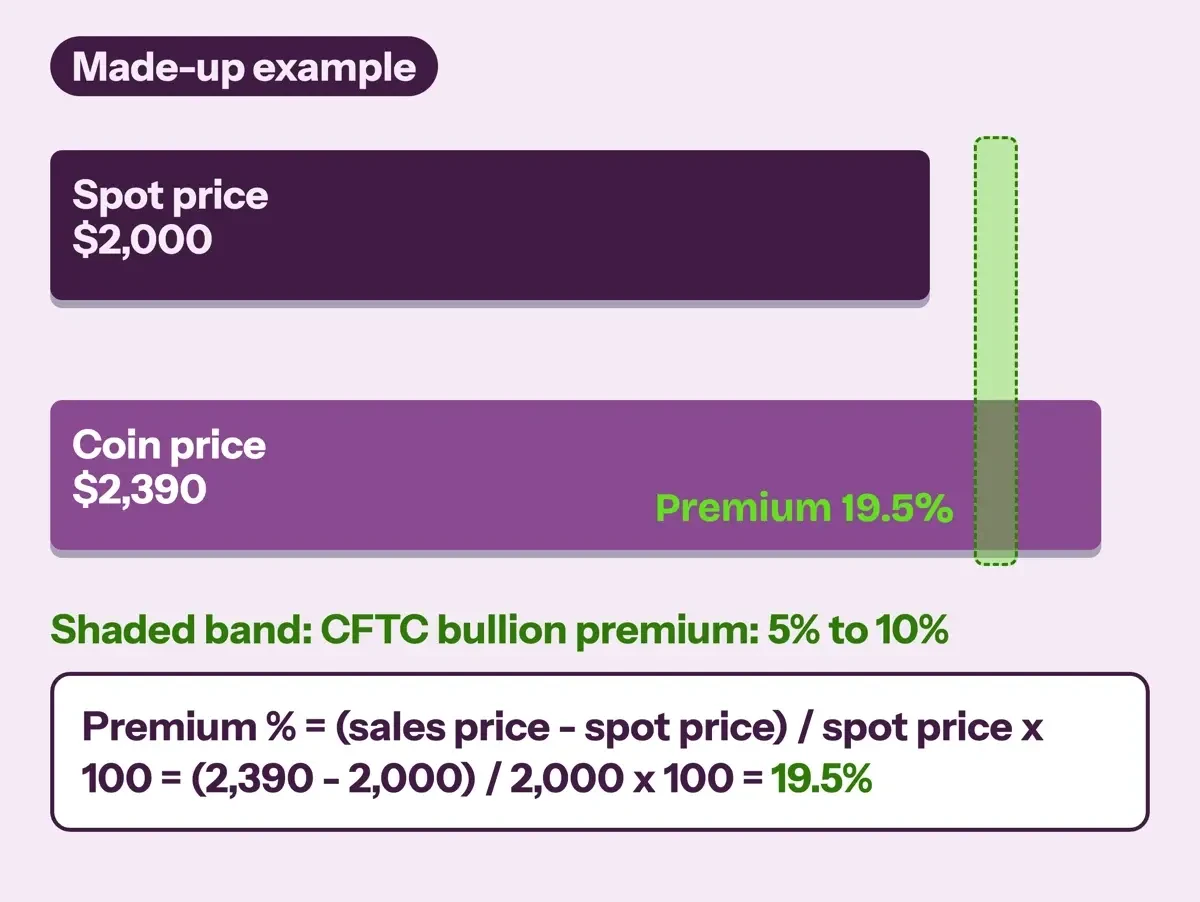 Diagram by DigitalTreed: the CFTC premium formula on made-up example prices, against the 5% to 10% bullion premium the CFTC describes.
The five lookups before you pay
Each product above has one official place that confirms the seller. Type that address yourself instead of tapping an ad, since a copied site can sit behind a convincing link.
| Product | Official place to check | What it confirms | Who says so |
|---|---|---|---|
| New savings bonds, Treasury bids | TreasuryDirect (treasurydirect.gov) | The official seller of savings bonds; non-competitive bids | TreasuryDirect |
| Bank CDs | FDIC BankFind | The bank is FDIC-insured, and its official website | FDIC |
| Brokered CDs, variable annuities, RILAs | FINRA BrokerCheck | The broker and firm are registered, with any disciplinary history | FINRA, Investor.gov |
| Investment advisers | SEC adviser search (IAPD) | The adviser is registered with the SEC or a state | Investor.gov, CFTC |
| Fixed and indexed annuities | Your state insurance department | The agent and insurer hold a license where you live | FINRA |
| Financed precious metals | CFTC check page (NFA BASIC) | Registration and disciplinary history | CFTC |
The CFTC's check page says registration won't protect you from fraud, but "most scams involve unregistered entities, people, and products." Investor.gov's common scams page adds a trap: "A filing with the SEC does not necessarily mean that an individual or firm is registered with the SEC." Scammers copy the names and profiles of registered firms, too. FDIC's fake banks page calls a copied bank site a form of phishing, set up to get people to transfer money or share personal information. If you've already typed details into one, our phishing click recovery steps cover what to do next.
What we tested
We built these lookups and red flags into a local checker, then fed it four made-up online offers on November 6, 2026. A HEAD request went to each official tool in the table.
Four made-up offers through our checker
The checker is test/offer_check.py. It reads only a local file. The sellers are made up: Brevmont Bond Club, Tidewick CD Exchange, Quorvale Annuity Group and Larkspan Metals Desk, with web addresses on the reserved .example domain. Each check names the regulator page behind it, such as FINRA's avoid fraud page for "guaranteed" and countdown wording.
| Offer (made up) | Product | Checks passed | What failed |
|---|---|---|---|
| Brevmont Bond Club | I bonds | 1/5 | Guarantee wording, a countdown, no registration number, not on treasurydirect.gov |
| Tidewick CD Exchange | Brokered CD | 2/6 | No registration number, no issuing bank named, an annuity pitch, an in-person meeting |
| Quorvale Annuity Group | Variable annuity | 6/7 | Claimed FDIC insurance |
| Larkspan Metals Desk | Gold coin | 1/8 | Guarantee and scarcity wording, no registration, a 19.5% premium (made-up example), company financing and storage, 45-day delivery on a financed sale |
Of 26 checks, 16 failed. Every offer missed at least one.
The annuity offer came closest, with a prospectus, a free look and an 8-year surrender period. Its FDIC claim can't be true.
The word check has a blind spot, too. It flagged "government guaranteed" on the bond offer, yet TreasuryDirect says its marketable securities are backed by the full faith and credit of the United States. The real failure there was the domain.
We sent the HEAD request (curl -I) to six official tools, with our own user agent and normal certificate checks. All six answered 200 with a verified certificate: TreasuryDirect, BankFind, BrokerCheck, the SEC adviser search, Investor.gov and the CFTC check page. NAIC's list of state insurance departments sent back a 403 bot-block, though people can still open that page by hand. The made-up look-alike address didn't resolve. Our first try with an older curl build failed the certificate check on treasurydirect.gov, so we switched to the system curl instead of turning verification off.
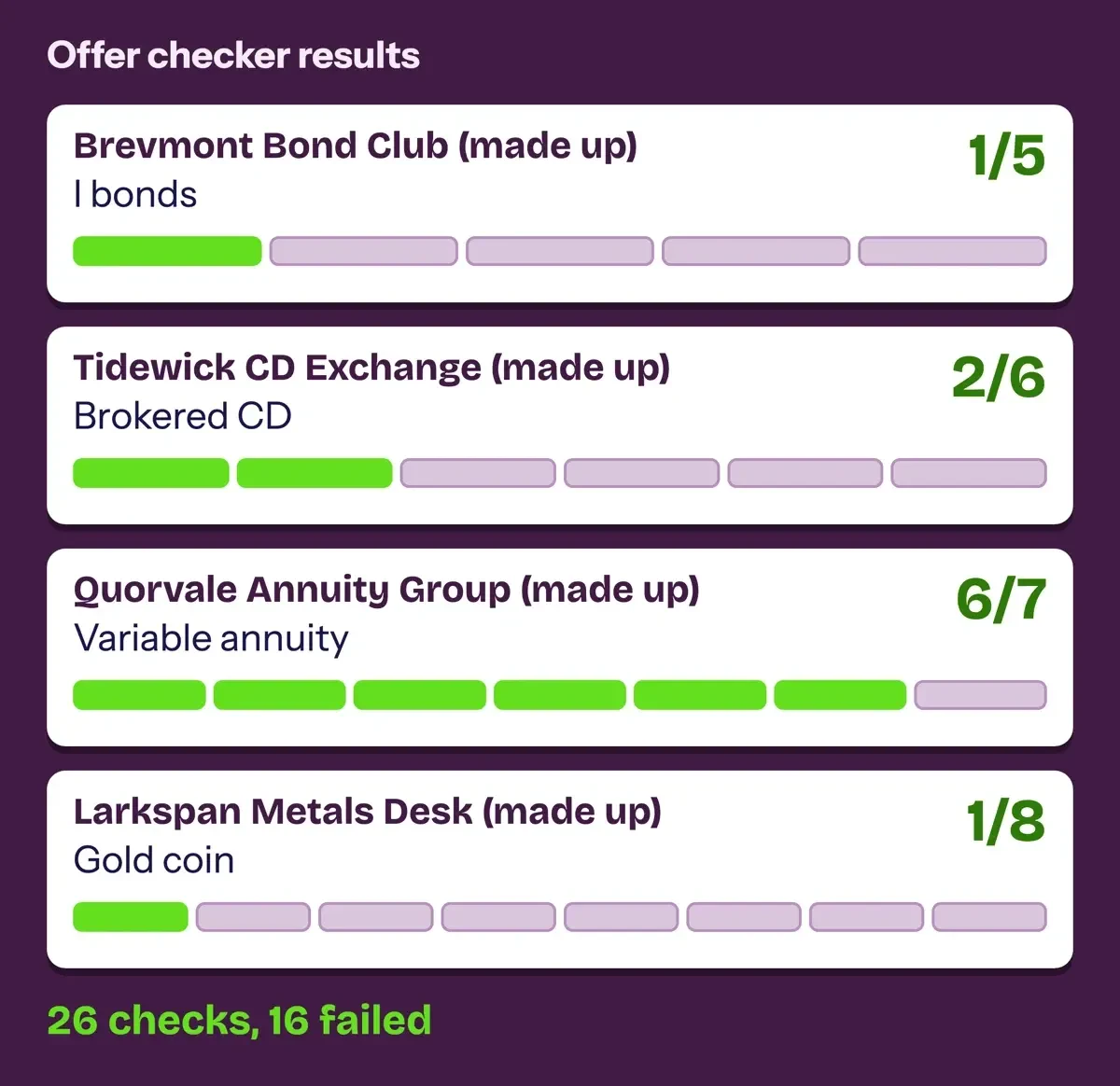 Drawn by us: results of our offer checker on four made-up offers, run November 6, 2026 (test/results.json).
None of this says whether to buy. Before you move savings into an annuity, a brokered CD or metal, talk to a licensed professional whose registration you've checked. Ask how they're paid. Investor.gov says you should always feel free to ask, and to get a percentage fee translated into dollars.
Frequently asked
What about paper savings bonds I already own?
TreasuryDirect's EE bond page says Treasury issued paper EE bonds between 1980 and 2012. They earn interest for up to 30 years, and you submit the paper bond to cash it.
Are annuities protected by SIPC?
No. FINRA's annuities page says annuities aren't guaranteed by the FDIC, SIPC or any federal agency, though state guarantees may apply if an insurer fails.
How do I check an investment adviser instead of a broker?
Use the SEC's Investment Adviser Public Disclosure site. The CFTC's check page lists it for adviser firms and points to NAIC for insurance contacts.
Who do I contact about a suspicious gold offer?
The CFTC's precious metals advisory lists 866.366.2382. For a fake bank site, FDIC lists 1-877-ASK-FDIC on its fake banks page.
How we made this guide: We read 22 official pages from TreasuryDirect, FDIC, Investor.gov, FINRA and the CFTC on November 6, 2026. We saved text copies and checked each quote against them. Our offer checker ran on four made-up offers, and a HEAD check covered the six official lookup tools. Facts checked by the DigitalTreed team on November 6, 2026. Nothing here is investment, tax or legal advice.
First published June 2026 as a marketing piece with no sources and a pitch for gold sellers and private vaults. Rewritten November 6, 2026 as a buyer's guide to official checks; the old vendor lines were cut.
Sources
- TreasuryDirect: I bonds
- TreasuryDirect: Buying savings bonds
- TreasuryDirect: EE bonds
- TreasuryDirect: I bonds interest rates
- TreasuryDirect: About Treasury marketable securities
- TreasuryDirect: Buying a Treasury marketable security
- TreasuryDirect: Frauds, phonies and scams
- FDIC: Deposit insurance
- FDIC: Financial products that are insured
- FDIC: Deposit insurance FAQs
- FDIC: Scammers and fake banks
- Investor.gov (SEC): Certificates of deposit
- Investor.gov (SEC): Annuities
- Investor.gov (SEC): Working with an investment professional
- Investor.gov (SEC): Common scams
- FINRA: High-yield CD offers can be bait for high-commission investments (February 21, 2019)
- FINRA: Annuities
- FINRA: Avoid fraud
- CFTC: Precious metals fraud advisory
- CFTC: Gold is no safe investment
- CFTC: Beware of gold and silver schemes designed to drain your retirement savings
- CFTC: Check registration and disciplinary history

Comments
No comments yet. Start the conversation below.