
Quick answer
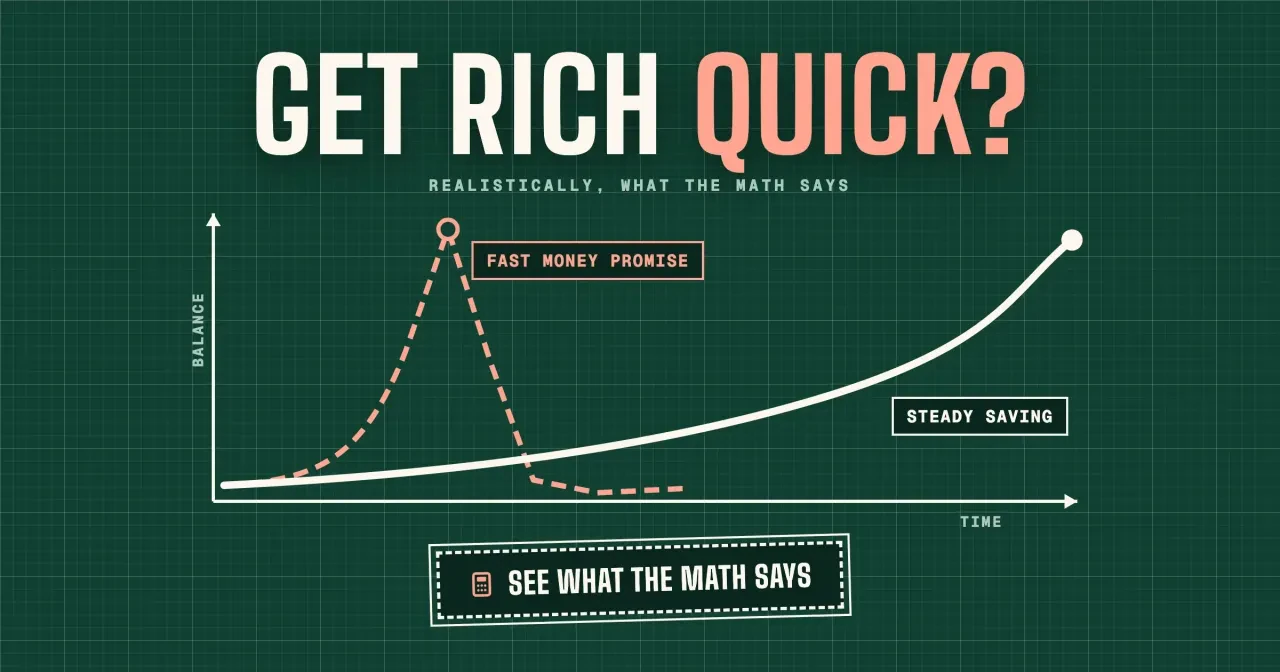
Realistically, the math doesn't back getting rich quick: at an example 6% a year, $1,000 plus $200 a month reaches $206,925.58 in 30 years (as of October 2026). Start 10 years later and the same plan ends at $95,718.38. The 2026 IRS limits, $24,500 for a 401(k) and $7,500 for an IRA, cap how much of the slow plan can go into those accounts each year.
If you've searched how to get rich quick realistically, you may be holding two offers. One's a 401(k) enrollment packet, and the other's a post promising to double your money in a month. Both run on one formula. Compound interest is a return earned on your deposits plus the interest they've already earned, which Investor.gov's glossary calls "Interest paid on principal and on accumulated interest." This page explains rules and arithmetic only and isn't investment advice. Your plan administrator or HR office can confirm match and vesting terms, and a CPA handles tax questions.
The fast-money promise comes first because its own numbers are the cheapest check, then the fraud signs regulators list. After that, the compound interest formula is checked against Investor.gov's own answers and run on a slow-money plan of $200 a month. What we tested shows the checker. The last two sections cover the 2026 IRS limits and employer match math, down to what leaving after 4 years costs.
Key takeaways
- An example 1% a day would turn $1,000 into $37,783.43 in a year.
- Starting 10 years later cut our example balance from $206,925.58 to $95,718.38.
- The 2026 IRS limits are $24,500 for a 401(k) and $7,500 for an IRA.
- Ages 60 to 63 get an $11,250 catch-up in 2026 instead of $8,000.
- Our example 3% saver missed $750 of employer match each year.
What does a fast-money promise look like as math?
You can test a fast-money promise by compounding it exactly the way the seller says it compounds. Investor.gov's page on high-yield investment programs says such sites "might promise annual (or even monthly, weekly, or daily!) returns" of 30% or 40% or more. It says they're "unregistered investments typically run by unlicensed individuals," and its verdict on such an offer is short: "it is likely a fraud." So take 1% a day and 30% a month, neither higher than that page's figures, on an example $1,000, and use FV = P x (1 + r)^n. P is the starting amount, r is the rate per period, and n counts the days or months.
| 1% a day for 365 days | $1,000 x 1.01^365 | $37,783.43 |
| 1% a day for 3 years (1,095 days) | $1,000 x 1.01^1095 | $53,939,174.05 |
| 30% a month for 12 months | $1,000 x 1.30^12 | $23,298.09 |
| 6% a year for 1 year (example rate) | $1,000 x 1.06 | $1,060.00 |
The daily row gives the promise away. By the Rule of 72, money growing 1% a day doubles in about 72 days (72 / 1), and the exact figure, ln 2 / ln 1.01, is 69.7 days. Over 365 days, that's about 38 times the money ($37,783.43 / $1,000). Written as a yearly return, that's 3,678% (($37,783.43 / $1,000 - 1) x 100), and kept up for three years it'd turn the same $1,000 into more than $53.9 million. At 30% a month the same rule gives a doubling about every 2.4 months (72 / 30), which is how $1,000 reaches $23,298.09 in a year. The 6% row is a made-up rate for scale, not a forecast of what any account pays.
Copy-trading pitches say you can mirror a famous trader in real time, but public trade records arrive late. A member of Congress may report a trade up to 45 days after it happens, and our explainer on the delay between a congressional trade and its public filing shows.
Fraud signs regulators list for fast-money offers
That steady 1% a day is the pattern regulators flag. Investor.gov defines a Ponzi scheme as "an investment fraud that pays existing investors with funds collected from new investors." Its first red flag is "High returns with little or no risk," and the second is "Overly consistent returns," since "Investments tend to go up and down over time." A balance that climbs 1% every day, good market or bad, trips both. FINRA's guide to avoiding investment fraud has a name for this bait, the "Phantom Riches" tactic, and it says words like "guaranteed" or "risk-free" are "unrealistic goals for any investment." Investor.gov's Ponzi page adds two more flags that show up in these pitches: "Unregistered investments" and "Unlicensed sellers."
The FTC's page on investment scams lists the lines these pitches lean on, and it says scammers "promise you'll make big money, guaranteed income, or guaranteed profits or returns." Its answer is short: "There are no guaranteed returns." It also says scammers claim they'll "teach you a secret method or have a proven system to make money." Speed is a flag too. "It's a red flag if someone pressures you or says to act quickly on an investment." Pitches that sell a course or a job first can use the same pressure. Our page on remote job listings that charge before you earn shows the same shape in job ads.
Cashing out is the test these schemes can't pass for long. Investor.gov says they "tend to collapse" when it gets hard to recruit or when "large numbers of existing investors cash out." It also warns, "Be suspicious if you don't receive a payment or have difficulty cashing out." Some promoters even try to keep people in "by offering even higher returns for staying put." The FTC describes crypto versions in the same terms: "You'll see fake reports showing how much your money is growing, and scammers will urge you to invest more." Once the money is sent, it says, scammers "shut down the accounts and disappear without a trace."
Before any money moves, the FTC points to "the free simple search tool on Investor.gov" to check whether the seller is licensed or registered. It's free. Our steps for checking who runs a stock-tip website start with that same Investor.gov search, then move to the SEC's action records.
If a pitch has already reached you, the FTC page names two places to report it: ReportFraud.ftc.gov and the SEC at sec.gov/tcr. Gold and coin pitches go to a third place, the CFTC, covered in the FAQ below.
The compound interest formula, checked on Investor.gov's examples
Now for the slow version, which runs on the same formula with smaller numbers. For one deposit compounded once a year, FV = P x (1 + r)^t, where t is the number of years.
Investor.gov's teaching page, What is compound interest?, works it on $100 at 5%. It says "you'll have $105" after one year and "$110.25" after two.
It carries on: in 10 years "you'll have more than $162," and in 25 years "almost $340." Our checker got $162.89 ($100 x 1.05^10) and $338.64 ($100 x 1.05^25), so both lines hold.
The page's pizza example saves $730 for a year at 5%, and it gives "$931.69" after five years and "$3,155.02" after 30. We got the same cents from $730 x 1.05^5 and $730 x 1.05^30, so the formula above reproduces Investor.gov's own answers.
For doubling time, the page's shortcut is the Rule of 72: "Simply divide the number 72 by your investment's expected rate of return (interest rate)." At 9% that's 8 years, and the exact answer, ln 2 / ln 1.09, is 8.04, so the shortcut holds up at ordinary rates. That's where the 72-day doubling for the 1% a day promise came from, too.
Monthly saving adds a term. Investor.gov's compound interest calculator asks for an initial investment, a monthly contribution, years, an estimated interest rate and a compound frequency. It also has an interest rate variance range for comparing rates. With monthly compounding and deposits at month end, the formula becomes FV = P x (1 + r/12)^(12t) + PMT x ((1 + r/12)^(12t) - 1) / (r/12). PMT is the monthly deposit. Monthly compounding adds little: $1,000 at 6% for one year is $1,060.00 compounded yearly and $1,061.68 monthly ($1,000 x (1 + 0.06/12)^12). Run it on a card balance and the same math works against you, as our what a carried card balance costs each month shows.
Slow money: the same $200 a month over 30 years or 20
So here's that formula on a plain example: $1,000 to start, $200 a month and a made-up 6% a year, compounded monthly. After 30 years the balance is $206,925.58. You put in $73,000.00 of it ($1,000 + $200 x 12 x 30), so $133,925.58 is growth. Growth is the bigger part. After year one it's just $3,528.79, which is why early statements look so ordinary. Waiting, though, costs more than the skipped deposits: start the same plan 10 years later, with 20 years left, and it ends at $95,718.38. That's on $49,000.00 put in ($1,000 + $200 x 12 x 20). The later saver deposits $24,000.00 less but ends $111,207.20 lower, because money added in the first decade compounds the longest.
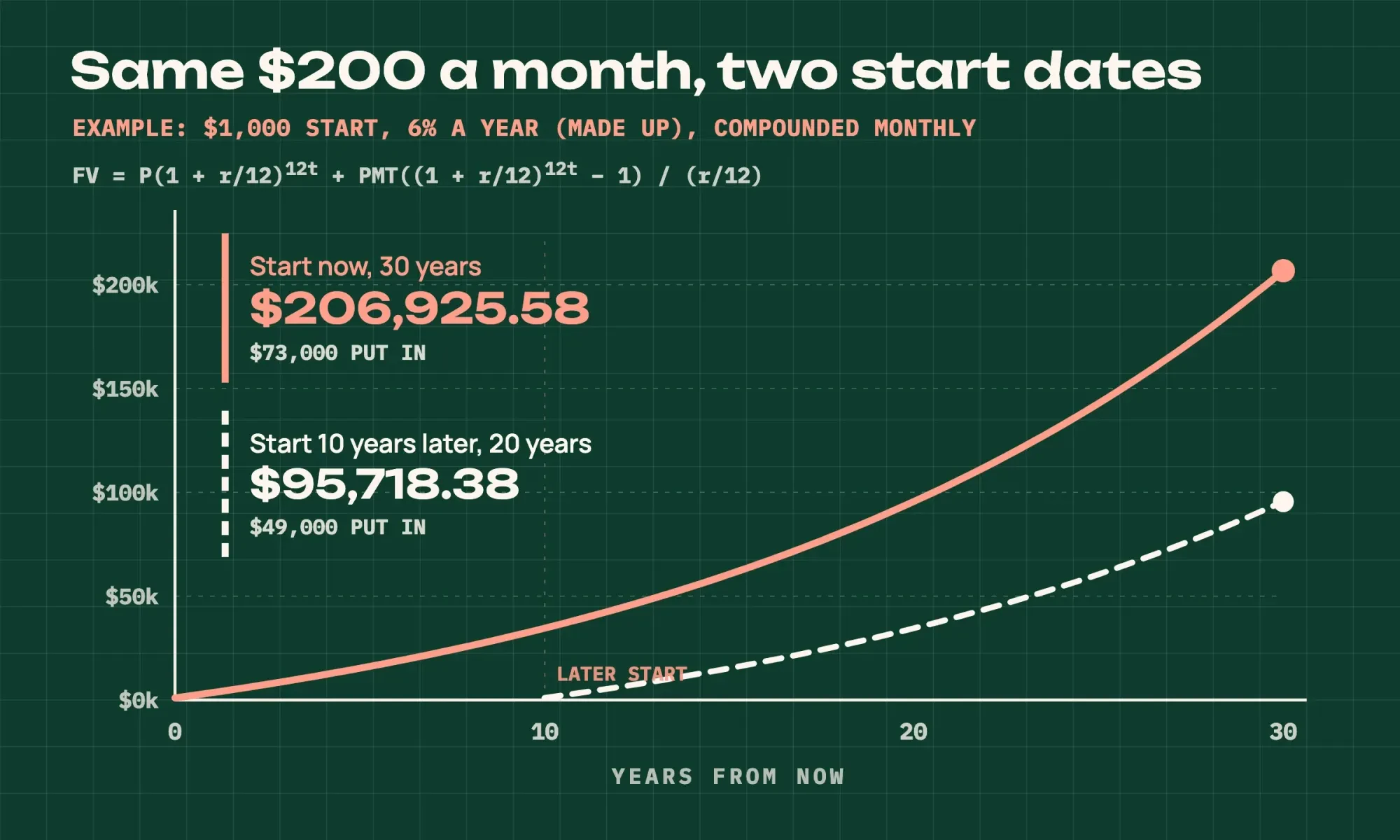 Diagram by DigitalTreed. Same deposits, two start dates: $1,000 plus $200 a month at a made-up 6% rate, balances recomputed in our local checker.
The 6% is an example, and real accounts don't earn a fixed rate, which the FTC puts plainly: "All investments come with the risk that you'll lose money.
In a down year r is below zero. The smooth curve in the chart above is an example, not a path any real balance follows.
The $200 in this example works out to about $46.15 a week ($200 x 12 / 52). That's the size of one or two lines on a weekly grocery bill. Our shelf-tag unit price math for groceries works through one weekly bill line by line.
A skipped month costs less than a late fee spiral: in our example, missing the first $200 deposit lowers the 30-year balance by $1,198.52 ($200 x 1.005^359). Our page on hardship plans and local aid for an overdue bill starts with a call to the biller, so savings aren't the first thing to go.
What we tested
Those balances came from a Python checker we wrote and ran offline on October 30, 2026, using the Investor.gov calculator's inputs. It first redid Investor.gov's seven published answers ($105, $110.25, more than $162, almost $340, $931.69, $3,155.02 and 8 years by the Rule of 72). All seven passed.
Next, a page on 127.0.0.1 recomputed 12 dollar figures in JavaScript. All 12 matched Python to the cent. Nothing was sent anywhere. The checker assumes a fixed rate, month-end deposits and no fees or taxes, so a real account won't land on these cents.
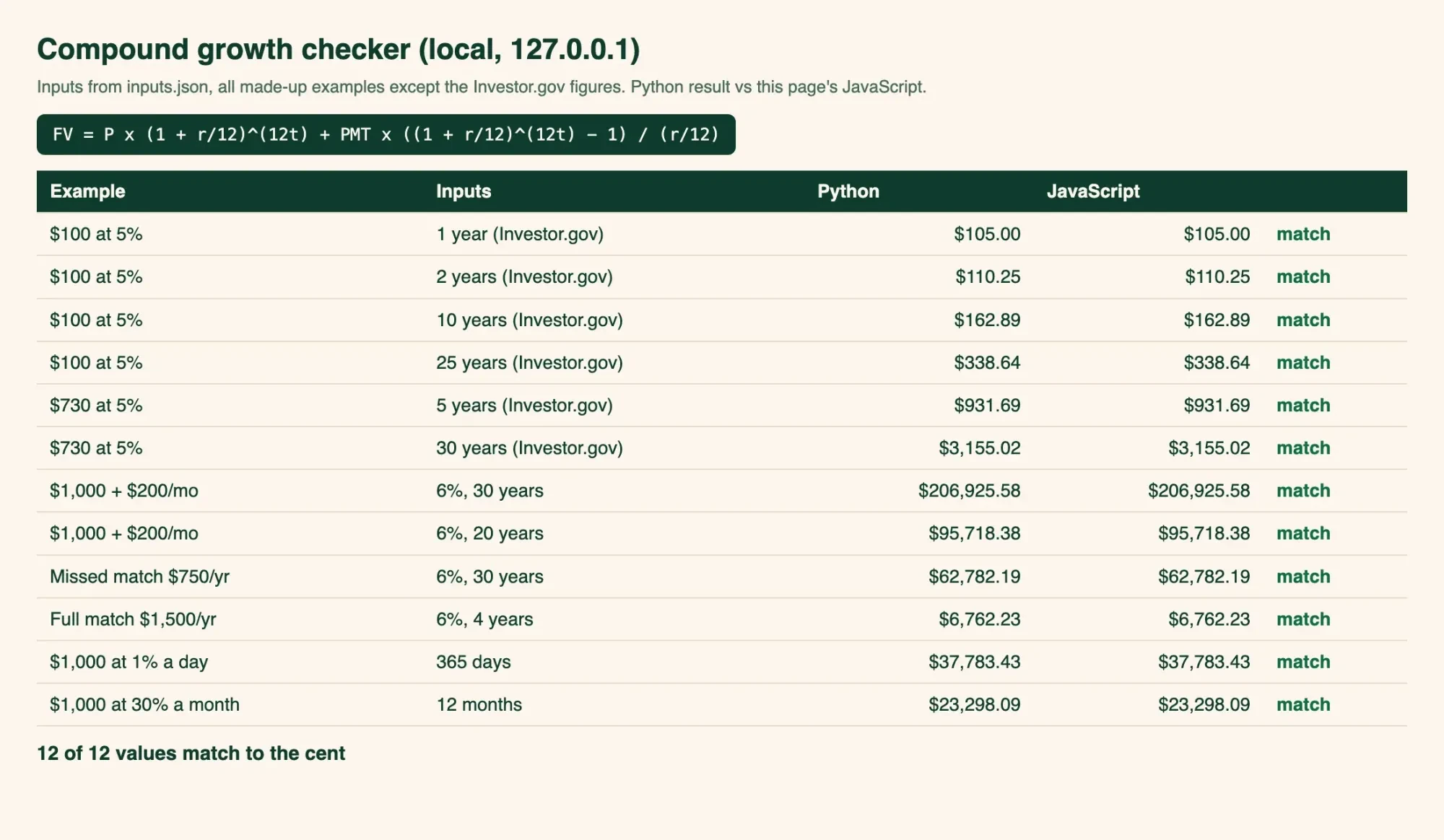 Screenshot: growth.html on 127.0.0.1 after the JavaScript recheck of October 30, 2026, 12 of 12 rows matching the Python results (example inputs).
2026 IRS limits for 401(k) plans and IRAs
Beyond the formula, the slow path has a yearly ceiling, and the IRS resets it most years. Its 401(k) contribution limits page gives the 2026 employee deferral limit as "$24,500 in 2026, subject to cost-of-living adjustments." That's up from $23,500 in 2025, and spread over 12 months it comes to $24,500 / 12 = $2,041.67 a month. Catch-up amounts sit on top for people who are 50 or older by year end. The IRS catch-up contributions page says "Annual catch-up contributions up to $8,000 in 2026 may be permitted by these plans." Ages 60 through 63 get more: "For 2026, this higher catch-up contribution limit is $11,250 (instead of $8,000)."
| 401(k) employee deferrals | $24,500 | IRS limits page and Notice 2025-67 |
| 401(k) catch-up, age 50 or over | $8,000 | IRS catch-up page |
| 401(k) total at 50 or over | $32,500 | $24,500 + $8,000; the IRS release states $32,500 |
| Higher catch-up, ages 60 to 63 | $11,250 | IRS catch-up page (replaces the $8,000) |
| 401(k) total at 60 to 63 | $35,750 | $24,500 + $11,250 (our sum) |
| IRA, all traditional and Roth IRAs together | $7,500 | IRS IRA limits page |
| IRA at 50 or over | $8,600 | $7,500 + $1,100 catch-up; the IRS page states $8,600 |
| All additions to one 401(k) account, employer money included | $72,000 | IRS limits page (higher with catch-ups) |
For the IRA rows, the IRS's IRA contribution limits page caps 2026 contributions to all your traditional and Roth IRAs at "$7,500 ($8,600 if you're age 50 or older)." If your taxable pay for the year is lower, that's the cap instead.
Income matters too. The IRS announcement of November 13, 2025 puts the 2026 Roth IRA phase-out "between $153,000 and $168,000 for singles and heads of household." A traditional IRA deduction, for single filers covered by a workplace plan, phases out "between $81,000 and $91,000."
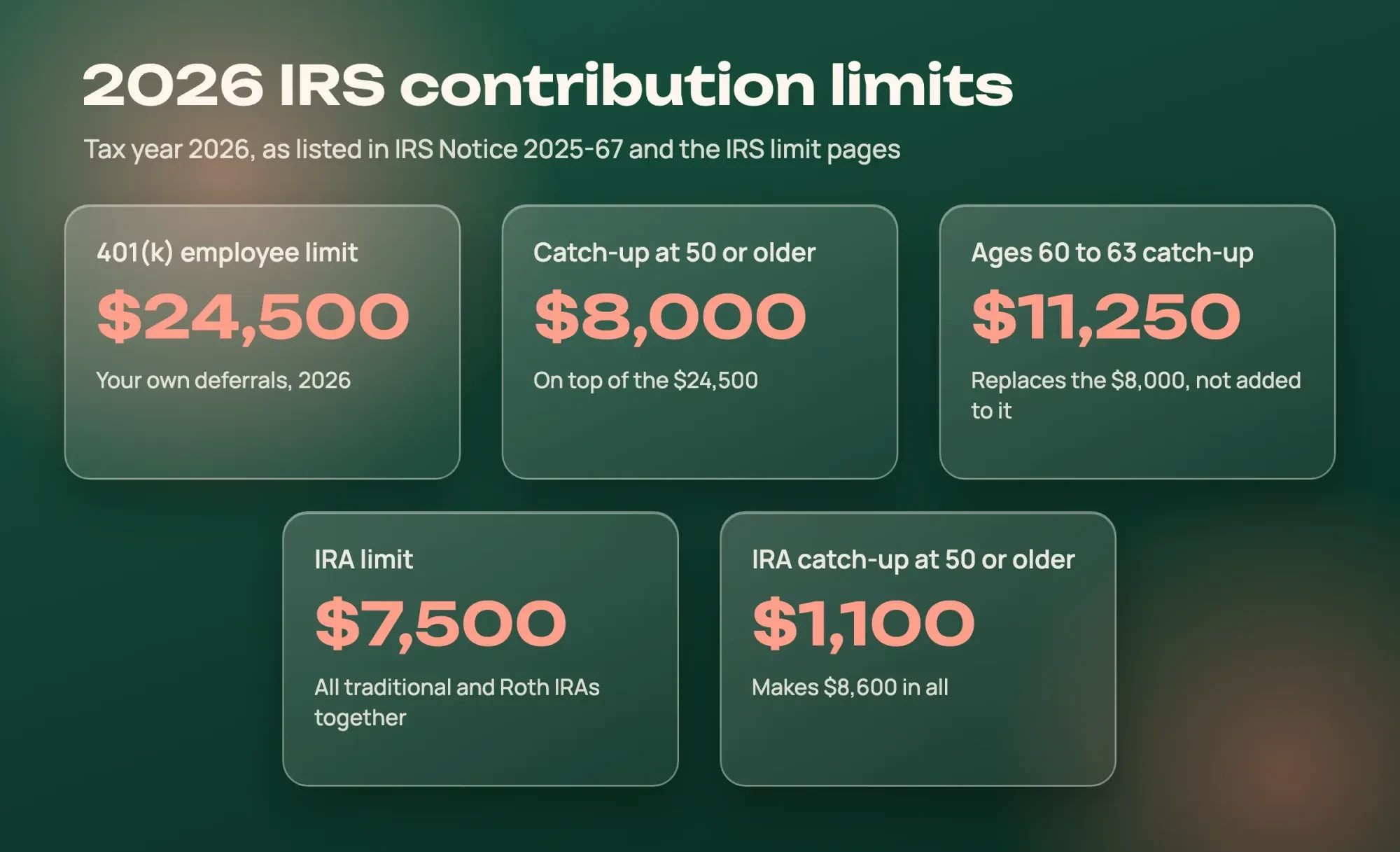 Drawn by us. Each amount appears on an IRS page for tax year 2026; the 60 to 63 card is the higher catch-up that replaces the $8,000, not an extra one.
Each base limit here also appears in IRS Notice 2025-67 and in the IRS cost-of-living table, which lists earlier years beside it. The totals we added up don't appear in either. The IRS says the tax law requires these limits "to be adjusted annually for cost-of-living increases."
One more rule changes how catch-ups go in. From 2026, per the IRS catch-up page, catch-up contributions must go in "on a Roth basis" when prior-year wages from that employer topped $150,000. That rule covers plans with a Roth feature that offer catch-ups. It's new in 2026.
The total going into one 401(k), your deferrals plus employer money, can't pass "$72,000 in 2026" or 100% of pay, whichever is lower. With catch-ups that rises to $80,000 ($72,000 + $8,000), or $83,250 at ages 60 to 63 ($72,000 + $11,250).
Side work can bring a second plan, such as a solo 401(k) for taking freelance clients alongside a day job. The $24,500 doesn't double, though, because the IRS says you "aggregate all elective deferrals you made to all plans in which you participate."
Employer match math, and when the match is yours
That $72,000 ceiling counts employer money too, which FINRA's 401(k) investing page says comes "most commonly through a match of some portion of the amount you contribute." The IRS 401(k) plan overview gives a sample formula. A plan "might provide that the employer will contribute 50 cents for each dollar that participating employees choose to defer under the plan." It's only an example rate. FINRA adds that many plans match only "up to a preset limit," and some also match "based on your repayment of qualified student loans." So picture a made-up plan paying 50 cents per dollar on deferrals up to 6% of a $50,000 salary.
At 3% of pay you defer $1,500.00 ($50,000 x 3%), and the match is $750.00 ($1,500 x 0.5). At 6% you defer $3,000.00 and the match is $1,500.00, so the 3% saver leaves $750.00 a year on the table.
Added as $62.50 a month at our 6% example rate for 30 years, that missed match would've grown to $62,782.19 on $22,500.00 of match. That's $2.79 of balance for each $1 of missed match ($62,782.19 / $22,500.00).
A match isn't fully yours until it vests. The IRS vesting page says your own deferrals "are always 100% vested, or owned, by the employee." Employer money is different: it can vest on a schedule the plan sets.
For a 401(k), 26 U.S.C. 411(a)(2)(B) sets the slowest ones allowed, and one of them is 100% after 3 years of service. The other's a graded table: 20% at 2 years, then 40%, 60% and 80%, and 100% at 6 years.
On that graded table, leaving after 4 years keeps 60% of the match. In our example, four years of $1,500 matches are paid in as $125 a month for 48 months at our 6% example rate. They grow to $6,762.23, so $4,057.34 stays with you ($6,762.23 x 60%), and $2,704.89 goes back to the plan.
Plans can vest faster, and a safe harbor 401(k) has to: the IRS overview says it "must provide for employer contributions that are fully vested when made." Any other schedule is "determined by the plan document," the IRS vesting page says, so the plan's paperwork holds the real one.
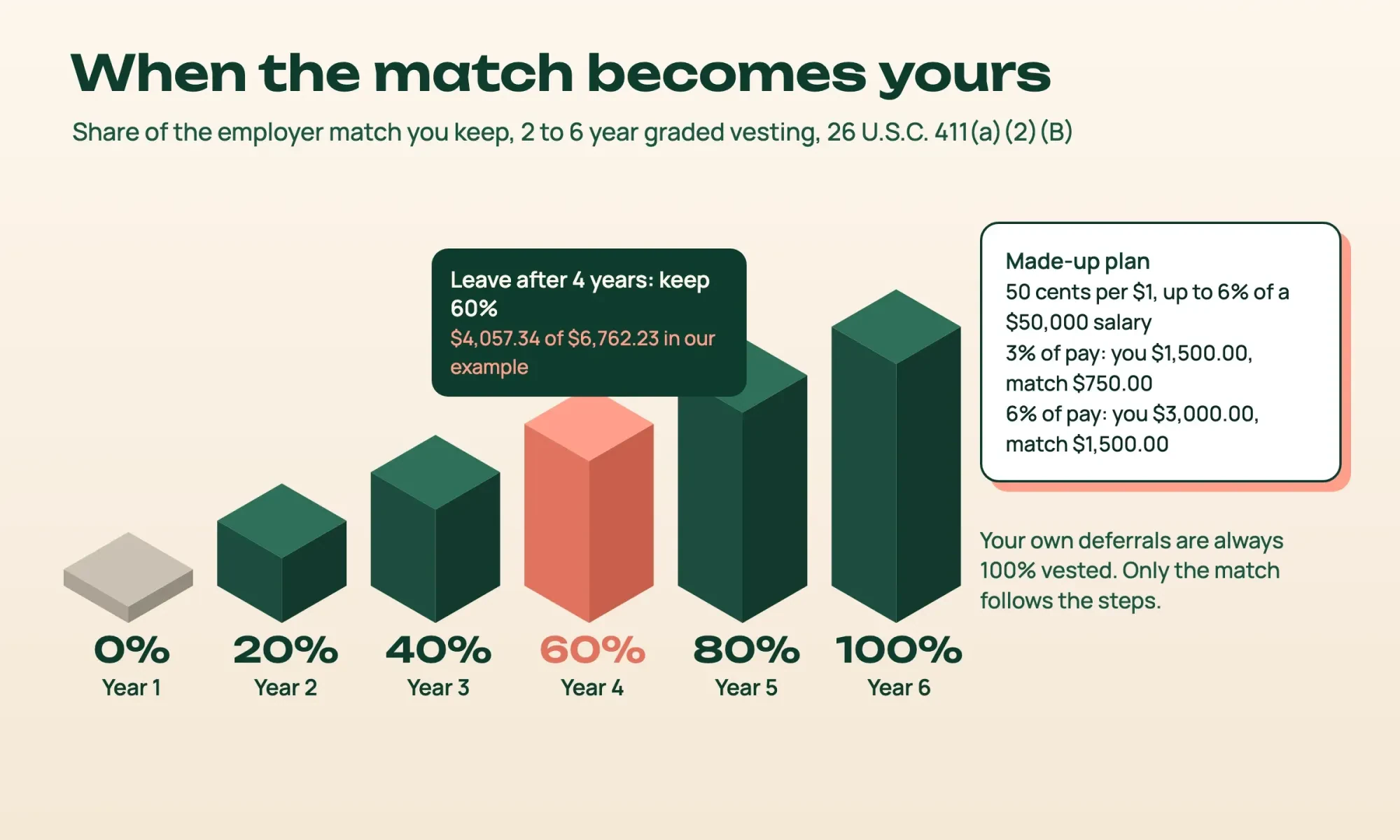 Diagram by DigitalTreed. Vesting steps follow the 2 to 6 year table in 26 U.S.C. 411; match amounts are for a made-up $50,000 salary.
Your plan's real numbers are in its Summary Plan Description. The Department of Labor's guide to retirement plans calls it "the retirement plan booklet that you should receive when you enroll in the plan." You can ask for a copy. FINRA says to take a plan problem to "your plan administrator or employer first," and if that doesn't settle it, to the DOL's Employee Benefits Security Administration (EBSA). FINRA describes EBSA as "the agency charged with enforcing the rules governing the conduct of plan managers." FINRA also notes the match "may be made as infrequently as once a year," so a paycheck without one isn't always an error.
Questions about fast money and slow money
Frequently asked
Can I put money in a 401(k) and an IRA in the same year?
Yes. The IRS says "You can contribute to a traditional or Roth IRA even if you participate in another retirement plan through your employer or business."
Does the age 60 to 63 catch-up apply to IRAs?
No. The $11,250 is for workplace plans such as a 401(k), and SIMPLE plans have their own 60 to 63 figure, $5,250. The IRA catch-up for 2026 is "up to $1,100," per the IRS catch-up page.
How fast must my employer deposit what comes out of my paycheck?
"As a rule," FINRA says, it's due within "15 business days after the end of the month in which the money is deducted from your pay."
Where do I report a gold or coin investment pitch?
The FTC sends precious metals and commodities fraud to the CFTC, and the CFTC's own reporting form takes those reports.
How we made this guide: IRS pages and Notice 2025-67 supply the limits; Investor.gov, the FTC and FINRA supply the fraud signs. Our local checker redid the growth, match and vesting figures, and the IRS sums are shown in the limits table. Facts checked by the DigitalTreed team on October 30, 2026.
Until this rewrite on October 30, 2026, the page offered general wealth tips and cited nothing. The rewrite replaced them with the fast-money table, the $200-a-month example and the 2026 IRS limits. Each one's tied to the IRS, Investor.gov, FTC or FINRA page it comes from.
Sources
- IRS: Retirement topics, 401(k) and profit-sharing plan contribution limits
- IRS: Retirement topics, catch-up contributions
- IRS: Retirement topics, IRA contribution limits
- IRS IR-2025-111: 401(k) limit increases to $24,500 for 2026, IRA limit increases to $7,500
- IRS Notice 2025-67: 2026 cost-of-living adjustments (PDF)
- IRS: COLA increases for dollar limitations on benefits and contributions
- IRS: 401(k) plan overview
- IRS: Retirement topics, vesting
- 26 U.S.C. 411: Minimum vesting standards (govinfo)
- Investor.gov: Compound interest (glossary)
- Investor.gov: What is compound interest?
- Investor.gov: Compound interest calculator
- Investor.gov: Ponzi scheme
- Investor.gov: High-yield investment programs
- FTC: Investment scams
- FTC: ReportFraud.ftc.gov
- SEC: Tips, complaints and referrals
- CFTC: Submit a complaint
- FINRA: Avoid fraud
- FINRA: 401(k) and other retirement accounts
- U.S. Department of Labor: What you should know about your retirement plan


Comments
No comments yet. Start the conversation below.