
Quick answer
An FDMS charge on your bank statement most likely marks a card payment processed by First Data Merchant Services, a Fiserv company. You've got 60 days from the statement to dispute one you don't recognize (as of October 2026). A lost debit card is the exception: report it within 2 business days to keep your share at $50 or less. Match the line to a receipt first.
An FDMS charge on a bank statement is often one line: the letters FDMS, a clipped word and an amount you can't place. FDMS is the short name North Carolina's state controller uses for First Data Merchant Services LLC, a card-payment company Fiserv owns. This guide explains the rules; it is not legal advice. Questions about your own account go to your bank or card issuer first, then the CFPB, your state attorney general or a licensed attorney.
First: what FDMS on a statement means and how to find the shop behind the line. Then: can you ask the bank who the shop is first? After that come the credit card billing-error letter, telling your bank about a debit card charge, and what to do if the bank says no. Where we land: ask the bank first, because a clarification request sent inside the 60 days still counts as a notice under both rules.
Key takeaways
- You can ask your bank to explain a charge before disputing it.
- FDMS stands for First Data Merchant Services, part of Fiserv since July 2019.
- Credit card disputes go in writing within 60 days of the statement (October 2026).
- Debit card: your bank decides in 10 business days, or 45 (October 2026).
- Lost debit card: report within 2 business days for a $50 cap (October 2026).
What FDMS on a statement means
The four letters name the company that moved the money, not the place you shopped. On July 29, 2019, Fiserv's press release announced it had completed its acquisition of First Data Corporation. That release lists "merchant acquiring and processing" among Fiserv's lines of business. A Delaware State Treasurer contract summary confirms the date. It also calls First Data Merchant Services LLC "a wholly owned subsidiary of Fiserv."
Other state records line up. Texas lists the vendor on its Department of Information Resources page, and "First Data Merchant Services, subsidiary of Fiserv, Inc" is how its title reads. North Carolina's state controller contract page uses FDMS as the short name for First Data Merchant Services LLC. Fiserv's own merchant services site says in its footer that First Data Merchant Services LLC provides its merchant services. Put together, an FDMS line most likely marks a card payment that a shop ran through Fiserv's merchant business, and it can't say whether you made it. None of those pages lists which shops use Fiserv, so the statement line and your receipts are what tie a charge to a store.
Federal rules set what the line must show, and that's a lever you can use. For a credit card purchase, 12 CFR 1026.8 requires the amount and the date. It also needs a short description of what was bought when the card company and the seller are related. Otherwise, it's "The seller's name; and the city and state or foreign country where the transaction took place." On the debit side, 12 CFR 1005.9 requires each statement to list "The name of any third party to or from whom funds were transferred." Both rules treat a charge that isn't properly identified as an error. A processor label and a cut-off word may not be enough.
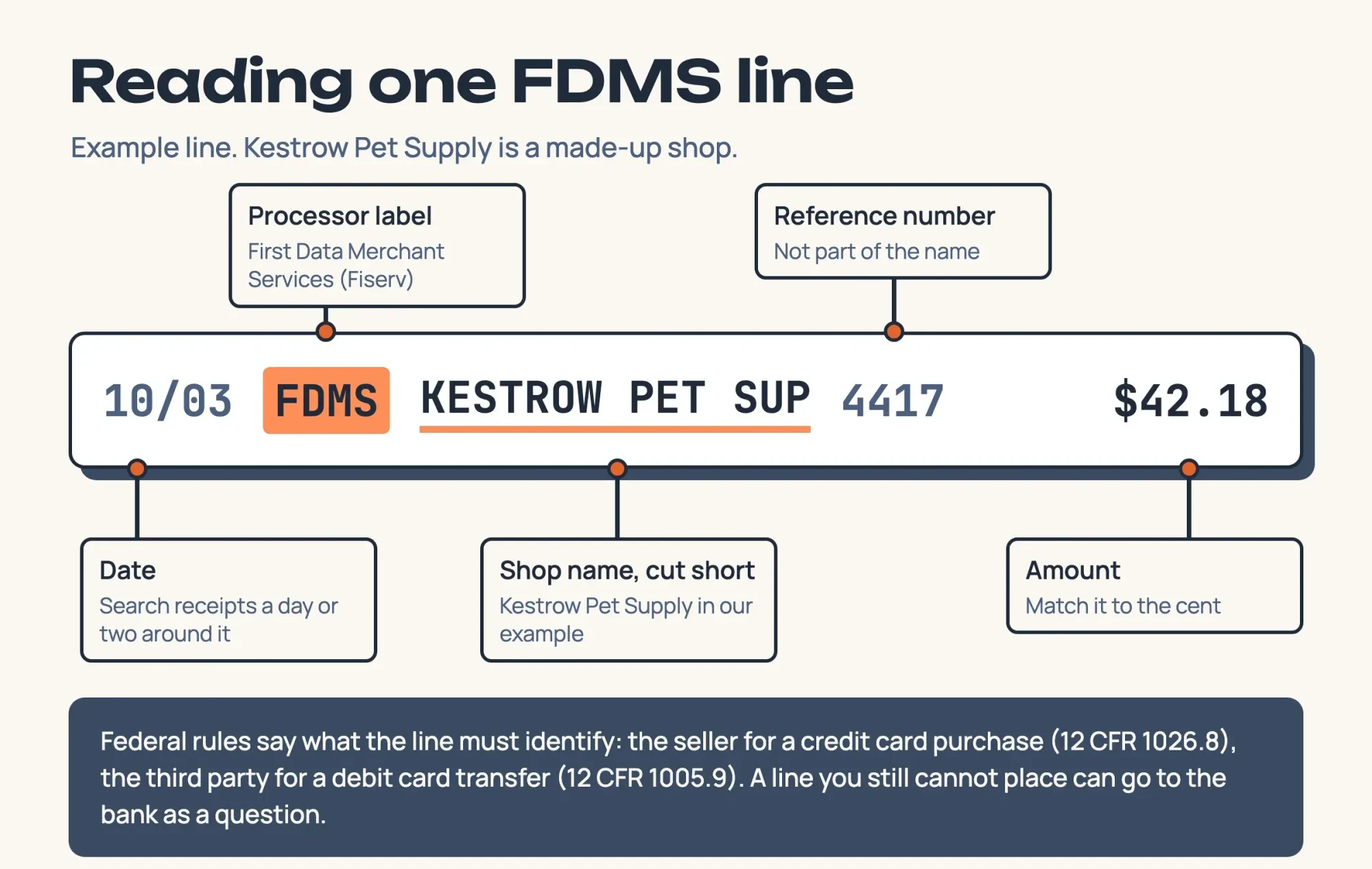 Drawn by us. Kestrow Pet Supply is a made-up shop; the labels follow 12 CFR 1026.8 and 1005.9, read October 29, 2026.
Find the shop behind the line before you dispute
It's possible a mystery line is a real purchase with a squeezed name. So match first, and write later. Statement fields are short. A shop called Kestrow Pet Supply, a made-up name from our test, can shrink to KESTROW PET SUP. Work from the two facts the line does give you, the date and the exact amount. Then you'll check them against these places, in this order:
- Email receipts and order confirmations from a day or two around the date, searched by the exact amount.
- Paper receipts and the app or wallet history on your phone, where the full shop name often appears.
- Recurring charges such as streaming, gyms and memberships, which repeat on a schedule.
- Anyone who shares the card or account, since a family member or an authorized user may have bought it.
Found it? Then there's nothing to file. If it's a subscription you meant to stop, cancel it with the company itself. Our walkthroughs on canceling a Hulu subscription and writing a gym cancellation letter show how that goes.
Seeing the same amount twice from one shop is different. That's a possible double charge, and in our test below the second Kestrow line came back flagged for exactly that.
On a debit card, 12 CFR 1005.11(a)(1)(ii) counts "An incorrect electronic fund transfer to or from the consumer's account" as an error. So a second pull for one purchase isn't a separate problem; it goes to the bank on the same 60-day clock.
What we tested
We ran a matcher and a deadline clock locally on made-up data. The matcher dropped the FDMS label and reference numbers, then compared the words left, amount and date with two example receipts. All 8 checks passed:
FDMS KESTROW PET SUP 4417  $42.18  -> matched (Kestrow Pet Supply)
CORNER GROCERY             $63.40  -> matched (Corner Grocery)
FDMS*KESTROW PET SUP       $42.18  -> second line for one receipt: possible duplicate
FDMS 8004 HOLLIN TRADING   $19.99  -> no receipt: ask the bank or card issuer for details
Statement sent Fri Oct 9, 2026 -> written credit card notice due Tue Dec 8, 2026
Checks: 8 of 8 True
Can you ask the bank who the shop is first?
Yes. In our test, HOLLIN TRADING matched nothing, and that's the kind of line to take to the bank as a question. The rules count that question as a notice, so asking starts the same protections a dispute would. Under 12 CFR 1026.13(a)(6), a billing error includes a charge "for which the consumer requests additional clarification, including documentary evidence." For debit cards, 12 CFR 1005.11(a)(1)(vii) covers a request "for additional information or clarification concerning an electronic fund transfer." The FTC's credit card dispute guide also lists, as a billing error, a charge where you want "an explanation or clarification" or a written receipt.
You needn't call a charge fraud to get answers. Ask for the merchant's full name, its location or website and the transaction record, and send that request inside the 60 days the clock is already counting.
Debit users get one more window under 12 CFR 1005.11(b)(3). A notice based on documents you asked for is on time if it arrives "no later than 60 days after the institution sends the information requested."
Both rules list what a notice has to carry, so the request's only four lines:
- Your name and account number, which both 12 CFR 1026.13(b)(2) and 1005.11(b)(1)(ii) require.
- The line exactly as printed, with its posting date and amount.
- A request for the merchant's full name, its location and the transaction record.
- One sentence saying you don't recognize the charge and may dispute it once you see the details.
Keep a copy with the date you sent it, since both clocks run from dates on paper. If the reply names a shop you know, nothing else needs filing, and if it doesn't, you've already started the record a dispute needs.
Credit card: the billing-error letter and its 60 days
Still can't place it, or sure you didn't buy it? A credit card dispute then runs on the Fair Credit Billing Act, which the FTC describes as an amendment to the Truth in Lending Act. Under 12 CFR 1026.13(b)(1), your written notice must arrive "no later than 60 days after the creditor transmitted the first periodic statement" showing the error. The CFPB's credit card dispute answer says to call the card company right away as well, but it's the written notice that protects your rights. Under 12 CFR 1026.13(b)(2) and (3), the notice has to identify your name and account number. Where it can, it should say why you think there's an error.
The FTC spells out the letter. "Use the address given for billing inquiries, not the address for sending your payments." Include your name, address, account number and a description of the mistake. Certified mail with a return receipt "gives you proof of what the issuer got," the guide adds.
In our example, a statement sent October 9, 2026 means the letter has to arrive by December 8, 2026. Mail takes days, so it's safer to send it well ahead. Our clock printed that date, and it counted the issuer's own deadlines from a notice received October 19.
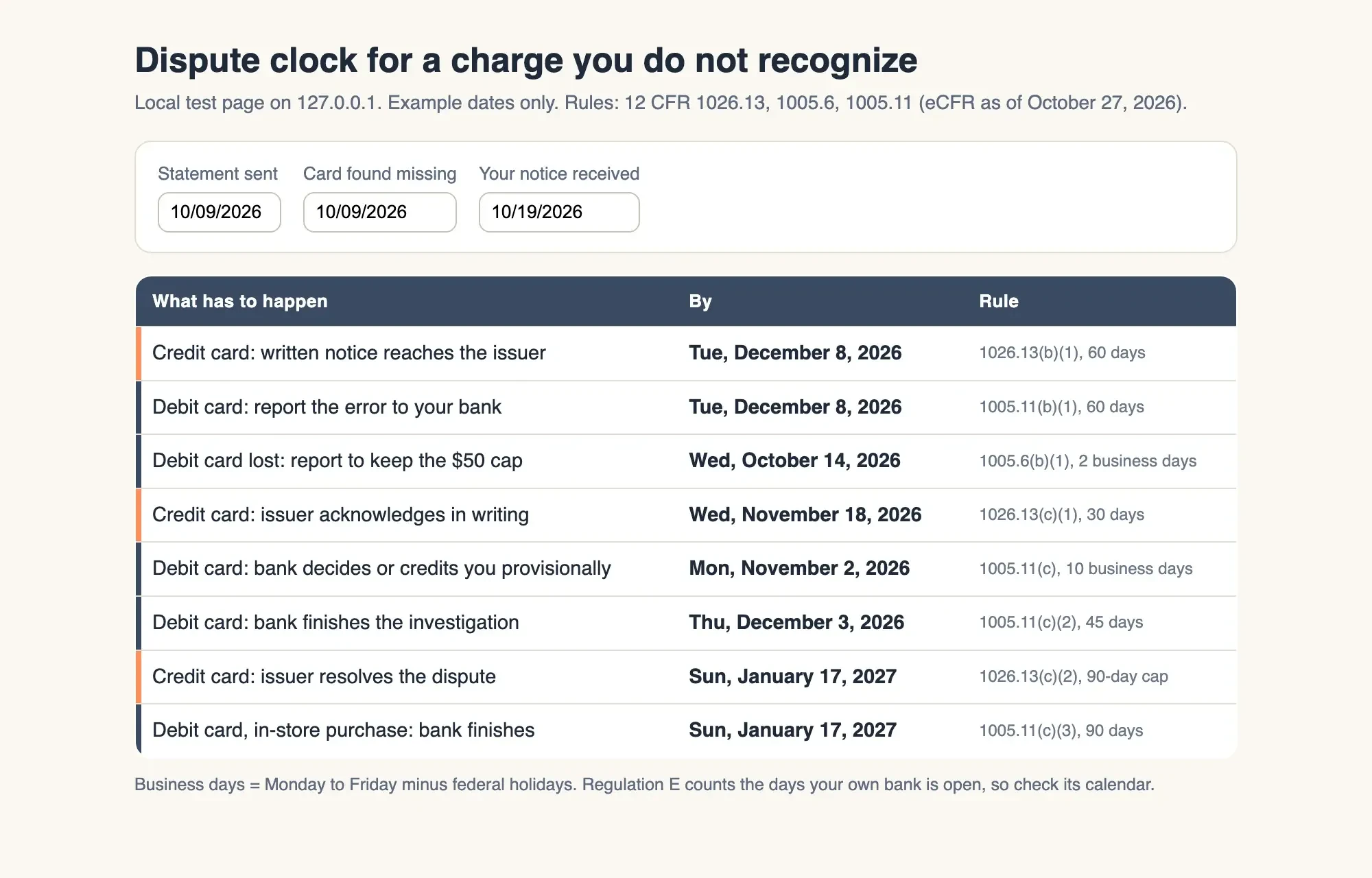 Screenshot of the dispute clock we ran on 127.0.0.1 on October 29, 2026: example dates only, no bank data.
Once it's there, the issuer's clock starts. Under 12 CFR 1026.13(c), it has 30 days to acknowledge your letter in writing and two complete billing cycles, never more than 90 days, to resolve it. Meanwhile you needn't pay the disputed amount, and the CFPB's answer on interest during a dispute says the issuer can't charge interest on it.
On autopay from a bank account? Under 12 CFR 1026.13(d)(1), the issuer can't deduct the disputed amount if your notice is received "any time up to 3 business days before the scheduled payment date." If the issuer finds you're right, 12 CFR 1026.13(e) says it must correct the error, credit the disputed amount and related charges, and send you a correction notice.
Fraud has its own cap, and it's low. If someone used your card without permission, 12 CFR 1026.12(b) caps your share at $50, and the FTC calls $50 the most you might owe (as of October 2026).
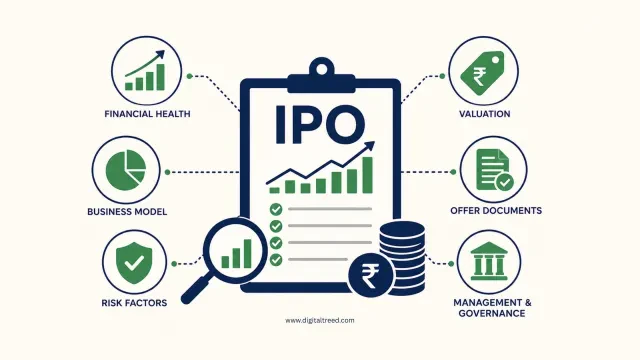
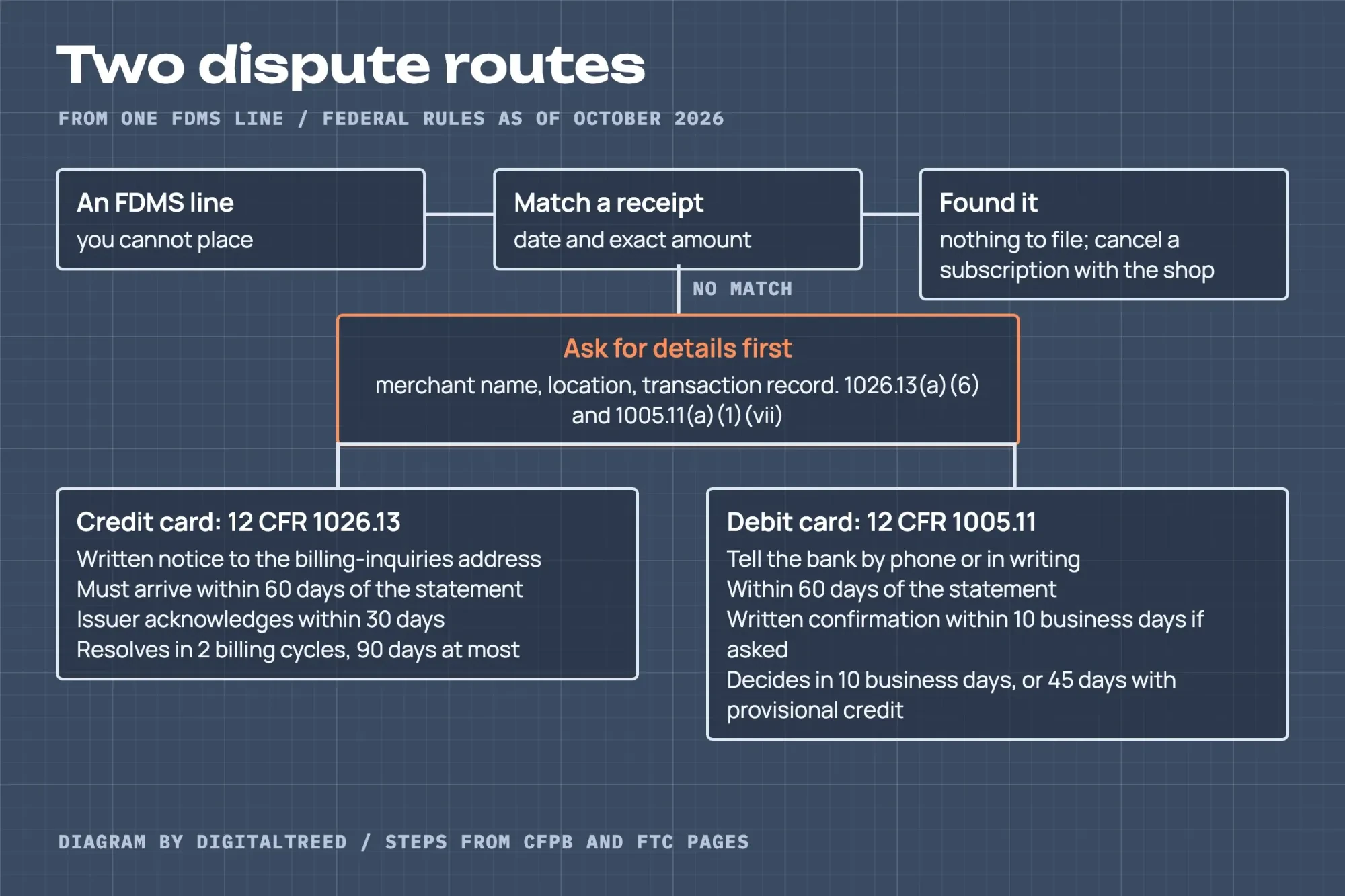 Diagram by DigitalTreed: both dispute routes from 12 CFR 1026.13 and 1005.11, with the CFPB and FTC steps, as of October 2026.
Debit card: telling your bank under Regulation E
A debit card charge comes straight out of checking, so the rules aren't the same. The CFPB's page on unauthorized transactions says debit card purchases are electronic fund transfers, and that you "might have additional protections under federal law". The FTC's Electronic Fund Transfer Act page says that law sets liability limits for unauthorized transfers. Under 12 CFR 1005.11(b)(1), your notice can be oral or written. It must reach the bank "no later than 60 days after the institution sends the periodic statement" that shows it. Those are calendar days, the FTC's table says. The same section treats a request for documents or clarification as an error notice, so the question from earlier fits here too.
A phone call works, with one catch. The bank's allowed to ask for written confirmation "within 10 business days of an oral notice," and it's got to tell you so and give the address when you call. Skip that, and it needn't credit you during the investigation.
Our example notice reached the bank on Monday, October 19, 2026. Here's every clock that date starts:
| What the bank must do (example dates) | Rule | Deadline |
| Decide whether an error happened | 10 business days | Monday, November 2, 2026 |
| Or credit you provisionally and keep investigating | Up to 45 days | Thursday, December 3, 2026 |
| Point-of-sale debit purchase, foreign or new account | Up to 90 days | Sunday, January 17, 2027 |
| Report results to you after deciding | 3 business days | Depends on the decision date |
Those dates come from our script, and each row's rule is 12 CFR 1005.11(c) as of October 2026. A debit card purchase at a store is a point-of-sale transaction, so the 90-day limit can apply to an FDMS line from one. The CFPB adds that a provisional credit can be the amount "minus a maximum of $50" when the bank believes the charge was unauthorized. If the bank later decides it was yours, the CFPB says it "must provide you with written notice before taking the money" back out of your account.
And if the bank finds no error? Under 12 CFR 1005.11(d)(1), its report must explain why in writing and note your right to ask for the documents it relied on. The CFPB says the bank has to send that information promptly once you ask.
A lost or stolen debit card runs on a tighter clock. Tell the bank within two business days of learning about the loss, and 12 CFR 1005.6(b) caps your share at the lesser of $50 or the amount taken. Wait longer, and it can reach $500 (as of October 2026). The FTC's lost or stolen card page shows what happens past 60 days from the statement: "All the money taken from your ATM/debit card account, and possibly more." The CFPB gives a stolen PIN or security code the same two-business-day timing. Report the loss before anyone uses the card, and the FTC's table shows you owe $0.
In our example, a card missed on Friday, October 9, 2026 had to be reported by Wednesday, October 14, because Columbus Day fell on Monday. We counted Monday to Friday minus federal holidays, which is our assumption. 12 CFR 1005.2 counts the days your own bank is open, so check its calendar.
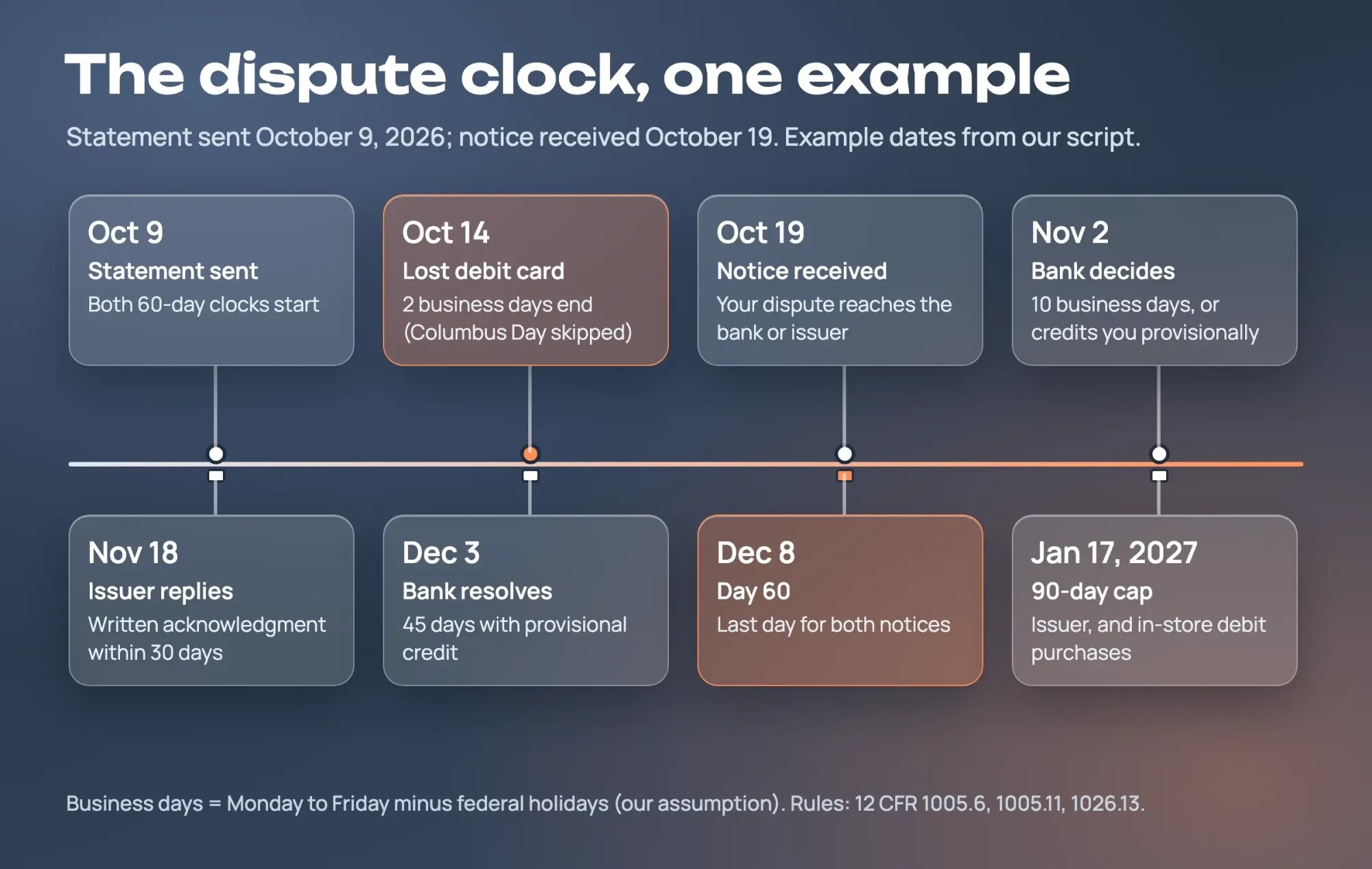 Drawn by us: example dates from our script, rules from 12 CFR 1005.6, 1005.11 and 1026.13, read October 29, 2026.
If the bank says no, or the charge keeps coming
After a denial, ask for the documents the bank relied on, keep its reply, and write down the date of every call, as the CFPB suggests. The CFPB takes complaints through its complaint portal or at (855) 411-2372, and it says companies generally respond in 15 days.
Your state attorney general is another place to ask, and USA.gov keeps a directory of every state attorney general. If money's still missing, a licensed attorney can look at your case, and the Legal Services Corporation's legal aid finder lists the offices it funds by address.
The FTC says unauthorized charges "might be a sign of identity theft," so a charge you never made can mean someone has your card number. IdentityTheft.gov gives a recovery plan.
Typed card details into a page that now looks fake? Our guide on what to do after clicking a phishing link covers the first hour. Copied finance sites are a separate problem, and our check of lookalike finance websites shows how to spot one.
A charge that returns every month can be a subscription or another preauthorized payment. Canceling with the company stops it at the source, and its cancellation confirmation is your proof if another charge posts later. When the money goes to a lender, our online payday lender check covers the separate rule for stopping automatic debits.
When a charge points to stolen card details, the rest of your credit's worth a look too. Our explainer on checking your own Social Security number and credit covers reports and freezes.
If the unknown line turns out to be a screening fee from a job application, our employer background check guide covers what the employer must tell you first. If it were our statement, we'd match it first, ask the bank second, and dispute only what's still unexplained, all before day 60.
FDMS charge questions
Frequently asked
Can my issuer close my account over a dispute?
Not for that alone. 12 CFR 1026.13(d)(3) bars closing or restricting an account solely because you used these rights in good faith.
What if I miss the 60 days?
For a debit card, 12 CFR 1005.6(b)(4) extends the time for extenuating circumstances, and the CFPB names lengthy travel or hospitalization.
Will a dispute hurt my credit?
Not over the disputed amount while it's open. 12 CFR 1026.13(d)(2) bars reporting you as delinquent for not paying it.
Why does an online FDMS charge show no city?
Under 12 CFR 1026.8(a)(1)(ii), the card issuer may omit the address for a mail, Internet or telephone order. Run a shop yourself? Our guide to payment gateway integration and card fees covers your side.
How we made this guide: Two federal rules carry this guide. We worked from the eCFR text of Regulation Z and Regulation E and checked each deadline against a CFPB or FTC page. Facts checked by the DigitalTreed team on October 29, 2026.
First published April 2025 as a general explainer with no sources. Rewritten October 29, 2026: it now sources who FDMS is, adds the clarification request and both federal dispute routes, and shows our deadline clock.
Sources
- Fiserv: Fiserv Completes Combination With First Data, July 29, 2019 (PDF)
- Fiserv merchant services site, footer
- Texas DIR: First Data Merchant Services, subsidiary of Fiserv, Inc
- Delaware State Treasurer: merchant services contract summary (PDF)
- North Carolina OSC: Merchant Card Master Services Agreement
- eCFR: 12 CFR 1026.8, identifying transactions
- eCFR: 12 CFR 1026.12, unauthorized use
- eCFR: 12 CFR 1026.13, billing error resolution
- eCFR: 12 CFR 1005.2, definitions
- eCFR: 12 CFR 1005.6, liability for unauthorized transfers
- eCFR: 12 CFR 1005.9, receipts and periodic statements
- eCFR: 12 CFR 1005.11, procedures for resolving errors
- CFPB: How do I dispute a charge on my credit card bill?
- CFPB: Can they charge me interest on a charge I told them I did not make?
- CFPB: How do I get my money back after an unauthorized transaction?
- CFPB: Submit a complaint
- FTC: Using Credit Cards and Disputing Charges
- FTC: Lost or Stolen Credit, ATM, and Debit Cards
- FTC: Fair Credit Billing Act
- FTC: Electronic Fund Transfer Act
- FTC: IdentityTheft.gov
- USA.gov: State attorneys general
- Legal Services Corporation: Get legal help

Comments
No comments yet. Start the conversation below.