

Quick answer
Seven of the 10 AI avatar tools we compared can run a live avatar. Synthesia publishes the lowest per-minute live rate of the vendors that list one, $0.10 per minute for the avatar alone, as of November 2026. If you only need recorded host videos, Synthesia Starter is $19 a month on monthly billing. Before cloning a real speaker, read the vendor's consent rule.
If you're planning a webinar, a product launch or a two-day summit, AI avatar tools for virtual event hosting can stand in for a presenter. They can also staff a help desk between sessions. An AI avatar tool is a service that turns a script, or a live chat, into a talking digital presenter on screen. Vendors sell very different things under that name, though: some render a recorded clip, and others stream a face that answers attendees in real time.
The split matters for the budget. Seven of these 10 vendors stream a live face, billed by the minute, by credits or by included minutes, while Colossyan, Elai and MetaHuman suit recorded intros and 3D production. For each one we read the vendor's own pricing and policy pages on November 5, 2026, and priced a made-up 720-minute help desk. We also noted who asks for consent before a real person becomes an avatar.
Key takeaways
- Seven of the 10 vendors publish a real-time avatar for live attendee questions.
- Synthesia publishes the lowest per-minute live rate here: $0.10, avatar only.
- Example: a made-up 720-minute help desk costs $288.40 on Tavus Starter.
- HeyGen, Tavus, Colossyan and Microsoft spell out consent for real people's avatars.
- Elai's terms and ethics pages had no likeness-consent rule we could find.
How we picked the 10 tools
Before any tool made the list, it had to clear four checks on its own website, read on November 5, 2026. Does the vendor say whether its avatar works live, recorded or both? Does it publish a language count? Is a price visible on its pricing page without signing in? Does a terms or policy page say what you need before you turn a real person, such as a speaker or an employee, into an avatar? So "best" here means best on those four checks. It doesn't mean the best-looking video, because we didn't sign up for or use any of these products, and nothing below rates lip sync, motion or picture quality.
This post used to list NVIDIA ACE, Kling AI, Luma Dream Machine, Runway, Adobe Firefly and Canva. NVIDIA's ACE for Games page now calls ACE "a suite of AI technologies designed to help middleware and game developers", so it's out. We swapped the other five for vendors that sell a presenter avatar and publish a policy for it, such as Tavus and Akool. A tool that misses one of the four checks still appears below, and the table shows which check it missed.
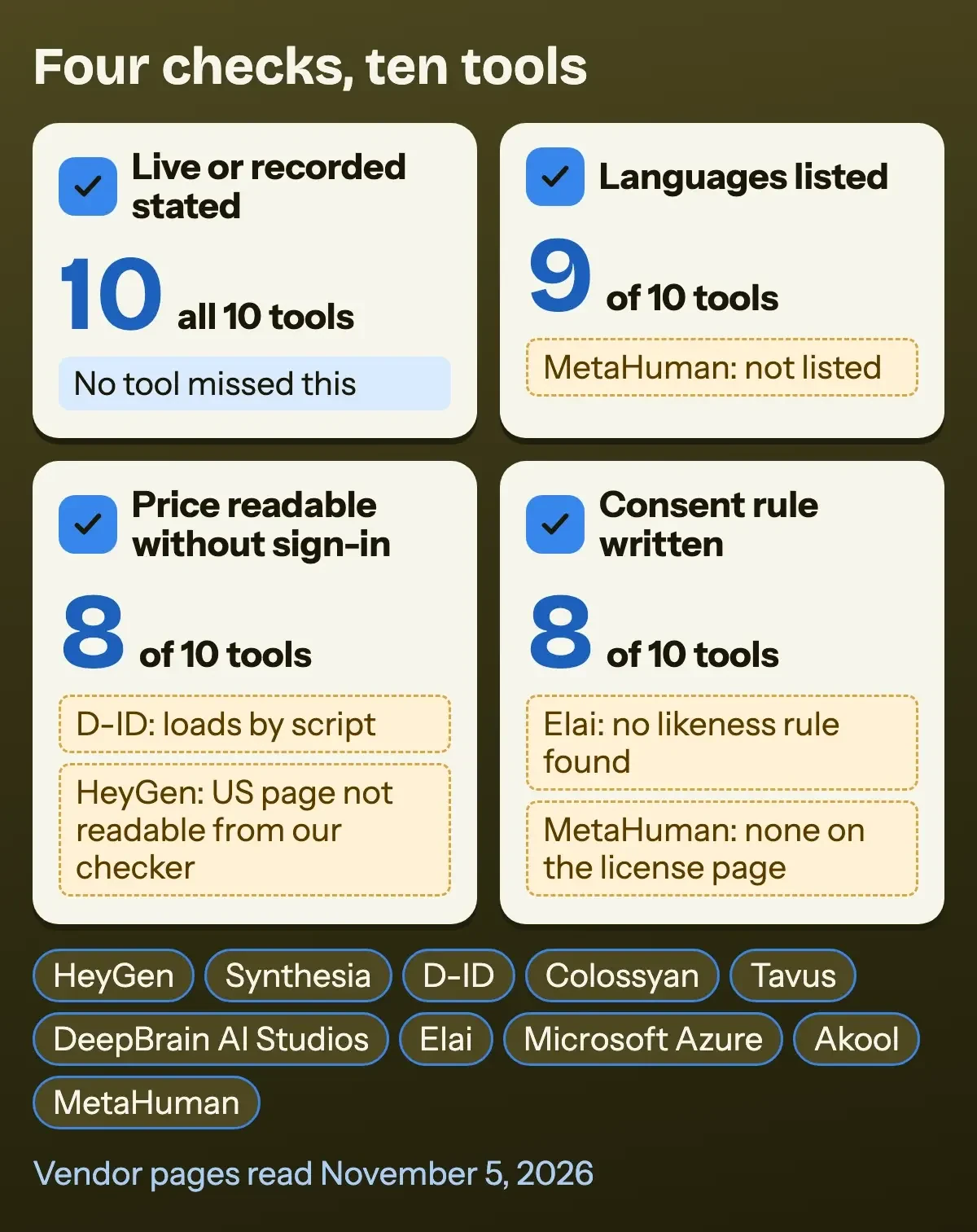 Diagram by DigitalTreed: the four checks every tool had to pass, read November 5, 2026
The 10 tools side by side
Each row comes from the vendor's own pages, read November 5, 2026. The price column shows each vendor's lowest paid plan with its billing term, which is why a monthly plan and a per-minute rate share one column.
| Tool | Live or recorded | Languages listed | Lowest paid price listed (billing term) | Written consent rule |
|---|---|---|---|---|
| HeyGen | Both (LiveAvatar) | 175+ (Creator plan) | US price not readable by our checker | Yes, explicit consent |
| Synthesia | Both (Interactive Avatars) | 140+ | $19/month after a $9 first month | Yes, for custom avatars |
| D-ID | Both (avatar agents) | 120+ | Not readable without a script | General, "if so required" |
| Colossyan | Recorded | 120+ | $59/month on an annual plan | Yes |
| Tavus | Live | 30+ | $59/month plus usage | Yes, explicit and informed |
| DeepBrain AI Studios | Both | 70+ (dubbing) | $24/month on annual billing ($288) | Rights to your uploads |
| Elai | Recorded | 75+ | $29/month, or $23/month on annual billing | No likeness rule found; uploads are your responsibility |
| Microsoft Azure avatar | Both | Same as Azure text to speech | $0.50 per live minute, pay as you go | Registration plus written permission |
| Akool | Both (streaming) | 155+ (video translation) | $12 per seat monthly, paid yearly ($144) | You decide if a release is needed |
| MetaHuman | Real-time 3D characters | Not listed | Free under $1 million in revenue | None on the license page |
In the consent column, Elai and MetaHuman show no written consent rule. With them, the signed release is your job.
Tools that can talk with attendees live
Seven vendors sell a streaming avatar that can take attendee questions, which is what a help desk at a hybrid event with remote attendees needs. Session caps run from 2 to 60 minutes.
HeyGen
HeyGen's pricing page lists "Over 175 languages and dialects" on its Creator plan. We left HeyGen's video plan prices out, because HeyGen's US price was not readable by our checker. It runs from India, and both the /pricing and /en-us/pricing addresses redirected it to the India (en-in) page. Read the US page yourself before you budget.
Live hosting is a separate product, LiveAvatar. As of November 2026, its $99 Essential plan gives 1,100 credits a month and a 20-minute session limit, and the $475 Business plan raises that limit to 60 minutes. The page also says rates fall to $0.01 a minute in Enterprise, on custom terms, while the free plan keeps a watermark and allows one session at a time.
We couldn't find a minutes-per-credit rate on that page, so LiveAvatar credits don't convert into event minutes.
Synthesia
Synthesia's pricing page lists Starter at $9 for the first month, then $19 a month, as of November 2026. Free Basic videos carry a Synthesia watermark. For live use, the API pricing page charges $0.10 per minute for interactive avatars when you bring your own voice and language model. A $0.20 full-stack option is marked "COMING SOON". The $0.10 rate is the lowest per-minute live rate these vendors publish. By comparison, Tavus charges $0.37 a minute past Starter's 100, Azure charges $0.50, and DeepBrain's $99 for 500 minutes works out to about $0.20 ($99 ÷ 500). The languages page advertises 140+ languages.
D-ID
D-ID's avatar agents page describes "AI avatar agents for real-time, face-to-face conversations" and counts "120+ languages on the D-ID platform". Its pricing page loads prices with a script, so our plain request saw no dollar figures. The FAQ does say length is "rounded up to the nearest 15-second interval": a 70-second clip uses 75 seconds.
Tavus
Tavus is built around live conversation: its pricing page bills "real-time AI-driven conversations" by the minute. Starter is listed at $59 a month plus usage as of November 2026, covering 100 conversation minutes and 3 concurrent streams before $0.37 per extra minute. Growth costs $397 a month for 1,250 minutes and up to 10 streams. Growth also adds conversation recordings.
Each Tavus conversation carries a 30-second minimum charge. That adds up when attendees open the chat, ask one thing and leave.
DeepBrain AI Studios
DeepBrain AI Studios sells recorded video and an interactive plan on one pricing page. Personal is $24 a month on annual billing ($288 a year), as of November 2026, with refunds within 14 days only if you haven't used the service. The interactive Standard plan is $99 a month for 100 credits, billed at 1 credit per 5 minutes, with sessions capped at 20 minutes and 20 concurrent users.
Microsoft Azure text to speech avatar
Microsoft's avatar overview says the video can be made "asynchronously or in real time", and the avatar speaks any language Azure text to speech supports. Microsoft's public price list shows the standard avatar at $0.50 per real-time minute in East US, pay as you go, as of November 2026. Batch video costs $1.00 a minute; the Speech pricing page loads its figures by script, so we read them from the price list. Its real-time avatar guide says the stream runs over WebRTC, which a venue firewall must allow. It's a developer service, so you'll build the event page and the conversation flow yourself. Our post on AI tools for business communication covers that kind of build.
Akool
Akool's pricing page puts a streaming avatar on every plan and starts paid plans at $12 per seat each month, paid yearly as $144, as of November 2026. Streaming sessions run from 5 free minutes up to 60 minutes on higher plans, so check the cap before you book an avatar for a long Q&A.
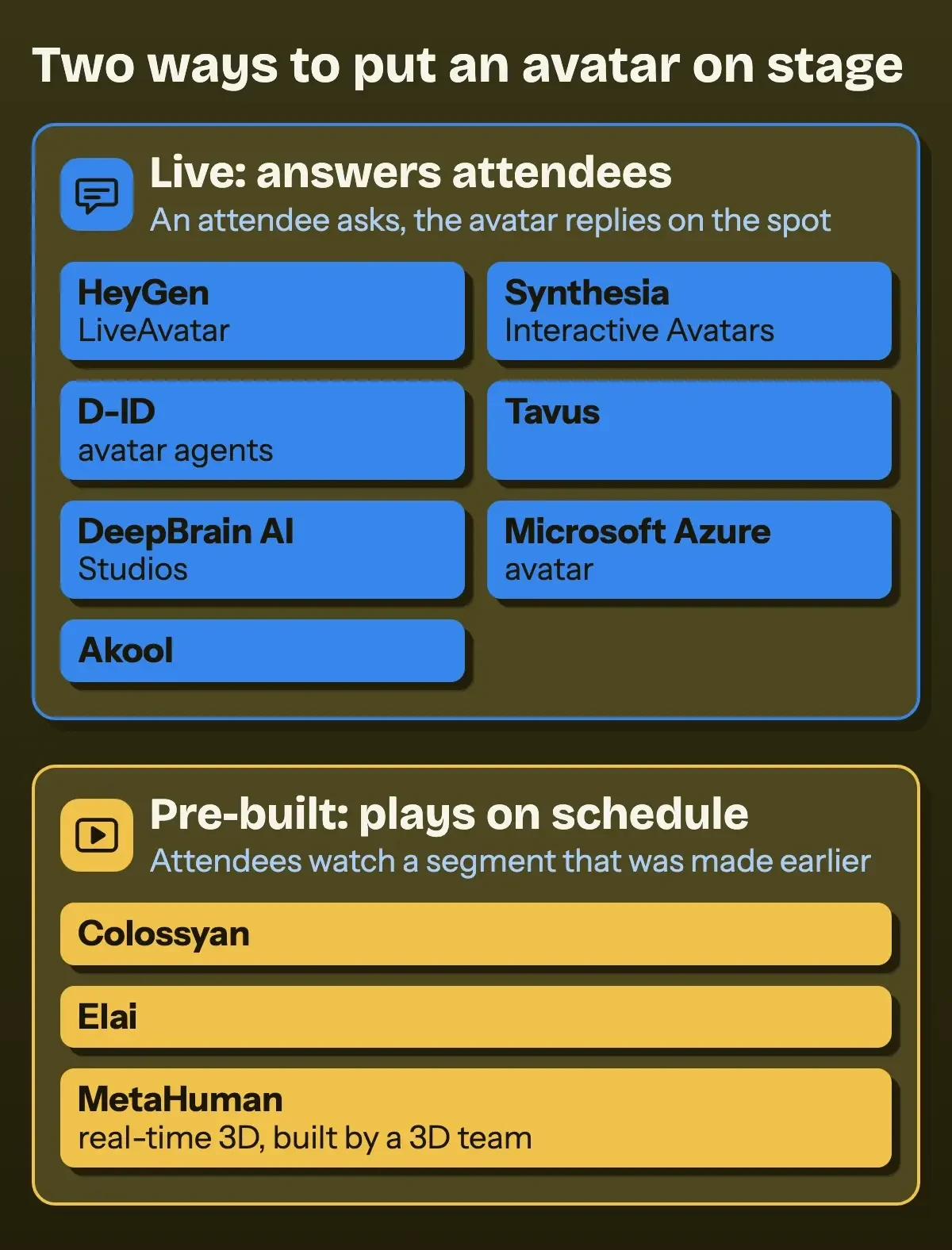 Diagram by DigitalTreed: which tools stream a live AI avatar and which suit pre-built host segments, from vendor pages read November 5, 2026
Tools for recorded host segments
Colossyan, Elai and MetaHuman don't sell a hosted live presenter, so they fit the parts of an agenda that play on schedule: the welcome, sponsor reads and session intros. The same clips can be reused in corporate video marketing after the event.
Colossyan
Colossyan meters recorded avatar video in minutes: per its pricing page, Professional includes 30 minutes a month of its NEO video. Its plan table counts 120+ supported languages. Starter is free and Professional is $59 a month on an annual plan, plus $30 a month per added member, as of November 2026.
Elai
Elai's pricing page lists Creator at $29 a month, or $23 a month on annual billing ($276 a year), as of November 2026. Custom avatars cost extra. A selfie avatar recorded on a phone is $199 a year, and a custom avatar built from studio video footage is $500 a year, both sold as yearly add-ons. Even the free plan there covers 75+ languages. Before you dub a welcome, run the script checks from AI voice for multilingual campaigns.
MetaHuman
Epic Games' MetaHuman site describes a framework for digital humans in "real-time 3D projects", built and animated by a 3D team in Unreal Engine or another engine. That makes it a production tool for real-time 3D, film and television work, not a hosted presenter service that reads your event script on cue. The license page says it's free for anyone making under $1 million USD in revenue, as of November 2026. MetaHumans "can be used with any engine or creative software", it adds.
If you just need slides with a narrator, AI presentation tools are a lighter option.
What does a live avatar cost for a 2-day event?
Per-minute rates, credit bundles and included minutes only line up on one workload. Our made-up example is a help desk avatar open 6 hours a day for 2 days, one chat at a time. That gives 6 × 60 × 2 = 720 minutes.
| Tool and plan | Formula (example) | Example total |
|---|---|---|
| Tavus Starter, $59/month | $59 + (720 - 100) × $0.37 | $288.40 |
| Tavus Growth, $397/month | 720 minutes fit in the 1,250 included | $397.00 |
| Synthesia Interactive Avatars, avatar only | 720 × $0.10 | $72.00 plus voice, AI model and plan |
| Microsoft Azure standard avatar, East US | 720 × $0.50 | $360.00, avatar meter only |
| DeepBrain Interactive Standard, $99/month | 100 credits × 5 minutes = 500 minutes | Short by 220 minutes, no overage rate listed |
| HeyGen LiveAvatar Essential, $99/month | 1,100 credits | No minute rate listed |
Synthesia's $72.00 covers the face only. Its rate card leaves the voice, the language model and a paid plan to you, at rates as of November 2026.
Tavus Starter comes to $288.40 in this example, per its pricing page as of November 2026.
At Tavus's rates as of November 2026, Growth gets cheaper past about 1,014 minutes, because $59 + (m - 100) × $0.37 reaches $397 at m = 1,013.5. So at the same 6 hours a day, a third day (6 × 60 × 3 = 1,080 minutes) would make Growth the cheaper Tavus plan.
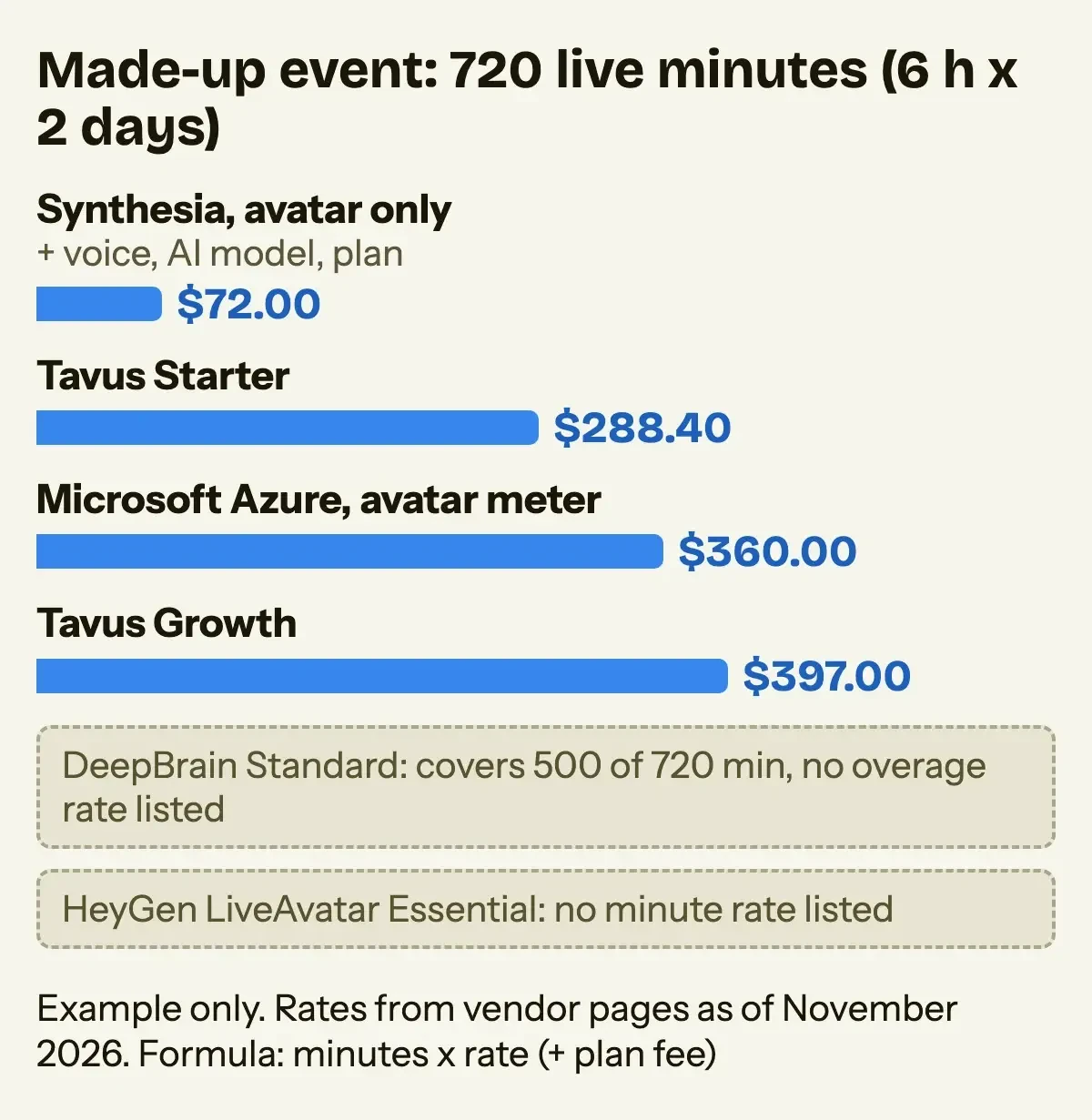 Diagram by DigitalTreed: example costs for 720 live minutes, from vendor rates as of November 2026
What we tested
Those prices and quotes come from vendor pages we saved on November 5, 2026, using plain requests from a script that names itself. A second script searched 29 of those copies for 45 quoted lines and prices, and it found all 45.
Three pages fell short. HeyGen sent our India-based request to its en-in pricing page, so we left its video plan prices out. D-ID's prices load by script, and Unreal Engine's license page returned a 403 bot-block, so we didn't link it.
Consent and likeness rules before you clone a speaker
Those prices assume a stock avatar. A custom avatar of your CEO or a keynote speaker brings in each vendor's consent rule. HeyGen's moderation policy sets one of the clearest bars: for custom avatars, "you are required to obtain the explicit consent of the individual being represented". Tavus's acceptable use policy requires "the explicit, informed consent of the individual depicted". Microsoft's Limited Access rules make its custom avatar "available by registration only" and require "explicit written permission from avatar talent" before an avatar model is created.
Colossyan's ethics page bars avatars of people "who have not consented to have their likeness used". Synthesia's acceptable use policy allows a custom avatar in paid social ads "only with appropriate consent from the individual". Its responsible AI page names "consent requirements for avatars" as a core safeguard.
Others hand the job to you. D-ID's ethics page says it'll work to ensure customers use its technology "while obtaining the necessary third-party consent if so required". DeepBrain's terms of use say "You must ensure that you have the necessary rights and permissions to use the content you upload". Akool's terms of service leave you "solely responsible for determining whether a release is required". On Elai's terms of service and ethical policy, we found no rule about consent from the person an avatar shows. The terms do say "You are solely responsible for your User Content", and they point to a separate acceptable use policy we didn't read.
Federal law applies on top of any vendor rule. The FTC's Impersonation Rule took effect on April 1, 2024. Under 16 CFR 461.3, it's unlawful to "materially and falsely pose as, directly or by implication, a business or officer thereof". An avatar that looks like another company's executive, or claims a sponsor's backing it doesn't have, can cross that line. Have a lawyer review the release form before any real person's likeness goes on stage.
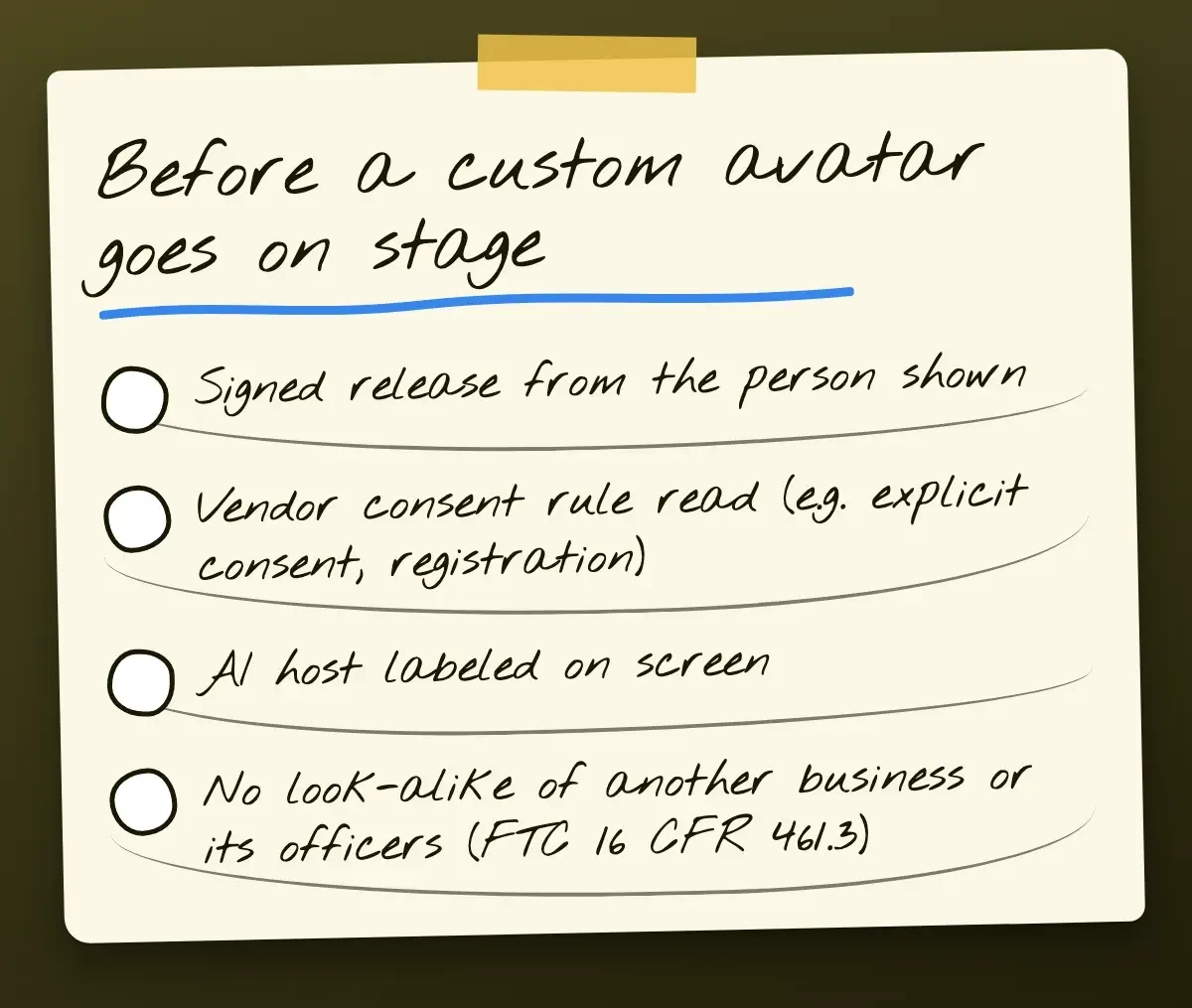 Drawn by us: the consent checks to finish before a custom avatar goes on stage
Event-day checklist for an AI host
Three of these checks come from rules or plan limits quoted above. The other two cover a dropped stream and phone viewers.
- Live captions: WCAG 2.2 success criterion 1.2.4 (Level AA) reads "Captions are provided for all live audio content in synchronized media", per the W3C explainer.
- Disclosure: label the host as AI on screen. Tavus requires its customers to tell end users when they're dealing with AI-generated content or an AI-powered agent. The rise of AI companions explains how US regulators treat AI that talks to people.
- Session caps: match the agenda to the plan, such as 20 minutes per session on HeyGen Essential and DeepBrain Standard.
- A human backup: name someone who takes over the Q&A if the stream drops.
- Join links: put a code from our QR code generator on the welcome slide so phone viewers reach the help desk.
Our take: for a first event, we'd use a recorded avatar for intros and keep a person on the live Q&A. Then we'd trial a live avatar on the help desk, where a 20-minute cap matters least. If you want help building the event pages, our team takes requests through a quote form.
Frequently asked
Can an AI avatar host a whole live webinar?
Only within each plan's session cap. DeepBrain's free interactive plan stops at 10 minutes and 1 user, and HeyGen's free LiveAvatar plan at 2 minutes, as of November 2026.
Do I have to tell attendees the host is AI?
On Tavus, yes: its acceptable use policy requires customers to tell end users when they're dealing with an AI-powered agent. D-ID's pricing FAQ says Trial and Lite videos carry a watermark so "there is transparency about the synthetic nature of the videos they generate".
Is MetaHuman free for a business?
Yes, under $1 million USD in revenue. Above that, Epic's license page says "Unreal Engine standard terms apply above that threshold".
Can I make an avatar of our CEO?
Yes, with documented consent and within the vendor's rules. Colossyan's ethics page says "All avatars are real people who have explicitly consented and fully understand how their image will be used".
How we made this guide: We saved the 10 vendors' pricing, product and policy pages on November 5, 2026. A script matched 45 quoted lines and prices to those copies, and nobody here used the tools. Facts checked by the DigitalTreed team on November 5, 2026.
First published March 2026 with hands-on claims we couldn't support. Rewritten November 5, 2026 from vendor pages, Microsoft's price list, the FTC, the CFR and W3C.
Sources
- HeyGen: Pricing
- HeyGen: LiveAvatar real-time avatar API
- HeyGen: Moderation Policy
- Synthesia: Pricing
- Synthesia: API pricing
- Synthesia: Languages
- Synthesia: Acceptable Use Policy
- Synthesia: Responsible AI
- D-ID: AI avatar agents
- D-ID: Studio pricing
- D-ID: Ethics in AI
- Microsoft Learn: Real-time synthesis for text to speech avatar
- Colossyan: Pricing
- Colossyan: Ethics
- W3C: Web Content Accessibility Guidelines (WCAG) 2.2
- Tavus: Pricing
- Tavus: Acceptable Use Policy
- DeepBrain AI Studios: Pricing
- DeepBrain AI Studios: Terms of Use
- Elai: Pricing
- Elai: Ethical Policy
- Elai: Terms of Service
- Microsoft Learn: What is text to speech avatar?
- Microsoft: Azure Retail Prices API, avatar meters
- Microsoft Learn: Limited Access for custom neural voice and custom avatar
- Microsoft Azure: Speech pricing
- Akool: Pricing
- Akool: Terms of Service
- Epic Games: MetaHuman
- Epic Games: MetaHuman licensing
- NVIDIA Developer: ACE for Games
- FTC: Impersonation Rule goes into effect (April 1, 2024)
- 16 CFR 461.3, Impersonation of businesses prohibited (Cornell LII)
- W3C: Understanding SC 1.2.4 Captions (Live)
Comments
No comments yet. Start the conversation below.