
Quick answer
AI can draft email, transcribe calls, route chats and place calls, but an AI voice call needs prior consent. The FCC ruled so on February 8, 2024, and each unlawful call can cost $500 in damages. Recording is stricter in all-party states such as Florida, Maryland and Washington, where everyone on the call must agree. List each AI use and its rule before you switch it on.
Take a home-services firm with 25 staff (an example) that's planning three AI jobs this quarter: reminder calls, notes on sales calls and customer email drafts. AI solutions for business communication are the tools that write, transcribe, sort or speak messages for a business, from a reply draft to a synthetic voice on the phone. Those three jobs fall under three different laws: the TCPA for the calls, state recording statutes for the notes and CAN-SPAM for the email.
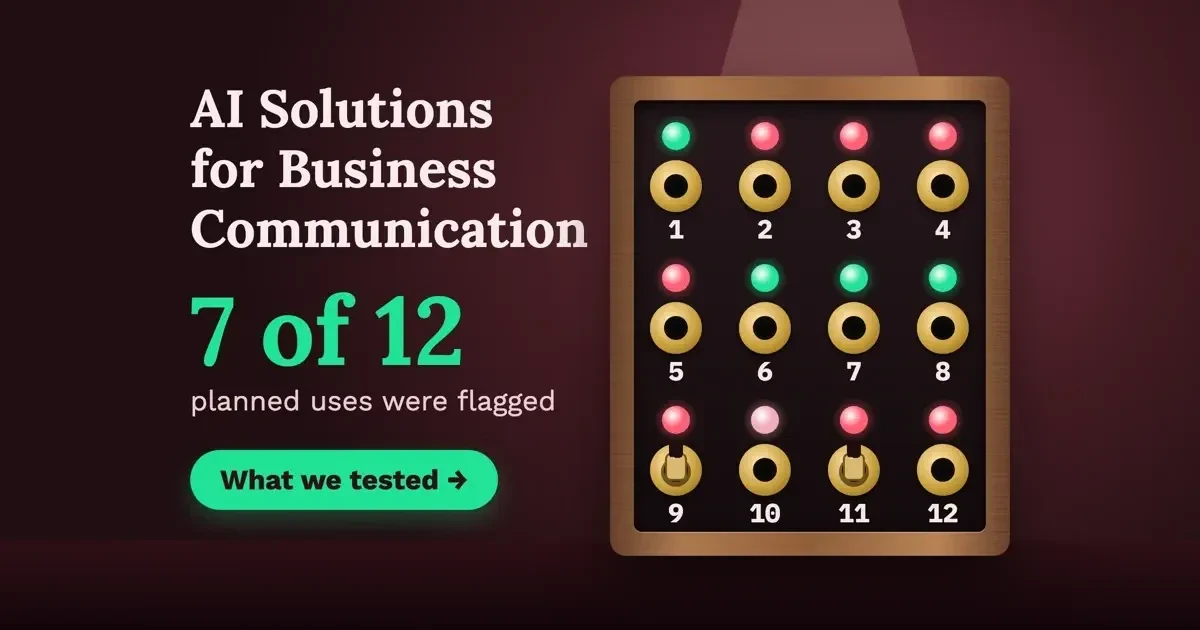
We read the rule behind each use: the FCC's 2024 ruling on AI voices, three state wiretap statutes, CAN-SPAM and the FTC's lines on AI claims and impersonation. Then we ran a script that applies those rules to a made-up plan of 12 AI uses, and 7 of the 12 didn't pass.
Key takeaways
- An AI-generated voice is an artificial voice under the TCPA since February 2024.
- AI telemarketing calls need prior express written consent from the person called.
- Florida, Maryland and Washington require every party's consent to record a call.
- An AI-drafted order email that opens with a coupon can count as commercial.
- Our check flagged 7 of 12 planned AI uses in a made-up plan.
Where AI helps in day-to-day business communication
Most of the useful work is plain: a first draft of a reply, a transcript of a call, a ticket sent to the right desk. Each job touches a different US rule, and the channel decides which one. An email draft falls under CAN-SPAM once it promotes something. A transcript is a recording under federal and state wiretap laws, and a synthetic voice on an outbound call falls under the Telephone Consumer Protection Act (TCPA). In the made-up plan we test later, 5 of the 12 uses were outbound AI voice calls, and that's the channel where damages are counted per call. A misrouted billing question costs a reply; an unconsented AI call can cost $500.
| Use | What the AI does | Rule it touches |
|---|---|---|
| Drafting email | Writes first drafts of replies and newsletters | CAN-SPAM (15 U.S.C. 7704, 16 CFR 316) |
| Transcription | Records and transcribes calls and meetings | 18 U.S.C. 2511 and state recording laws |
| Voice calls | Speaks reminders or offers in a synthetic voice | TCPA, 47 CFR 64.1200, FCC 24-17 |
| Routing and chat | Sorts tickets and answers chats | FTC Act Section 5; CFPB guidance in finance |
| Claims about your AI | Describes what your AI does on your site | FTC substantiation policy |
Many customers have already met a bank's bot. The CFPB's June 2023 report on chatbots in consumer finance estimated that about 37% of the US population had used a bank's chatbot in 2022.
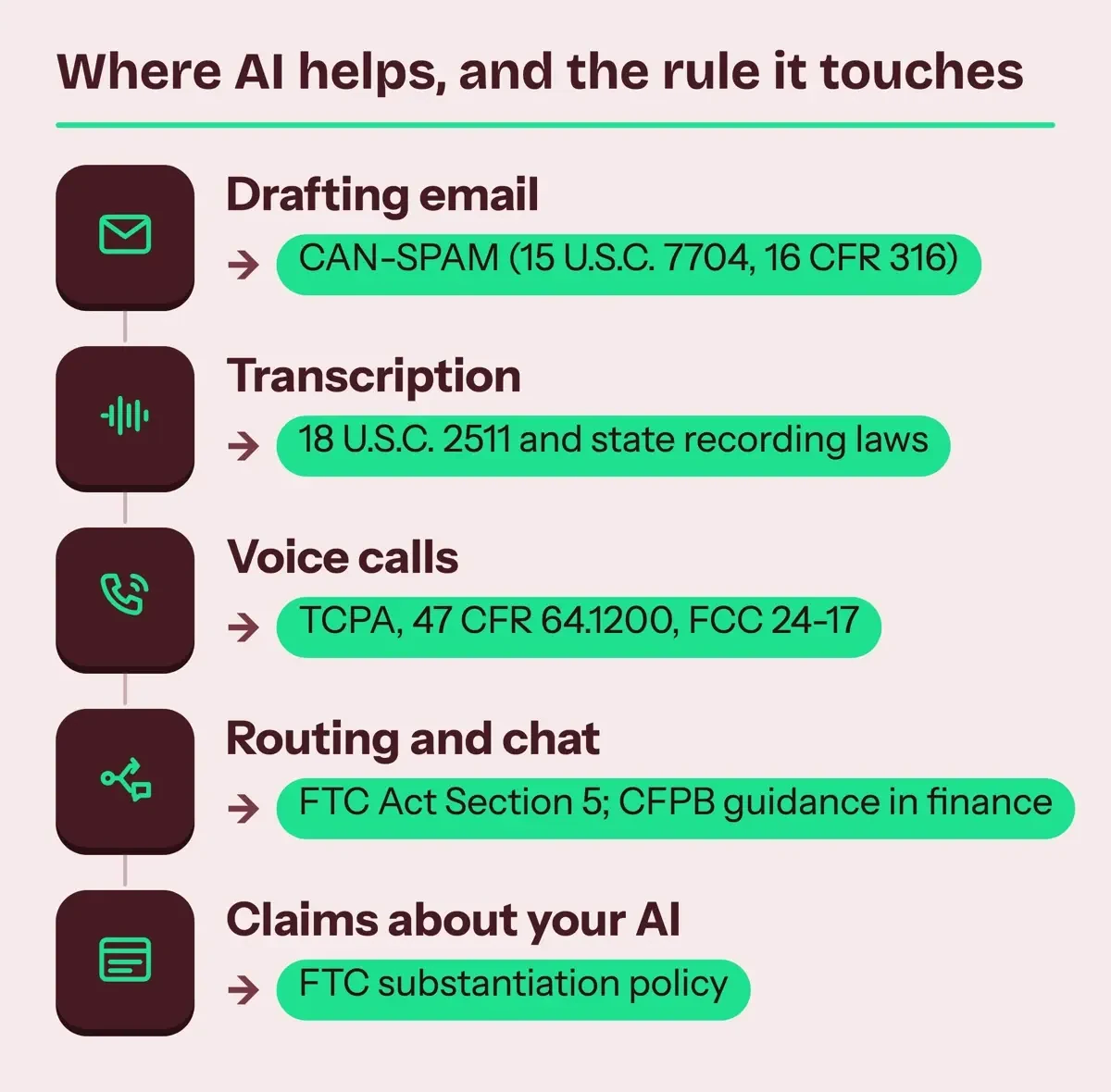 Diagram by DigitalTreed: five AI communication uses and the rule each one touches, from the FCC, FTC, CFPB and statute pages cited in this guide.
Drafting email and replies with AI
CAN-SPAM doesn't care who typed an email. Each email that violates the Act can draw a penalty as high as $53,088, according to the FTC's compliance guide on CAN-SPAM, as of November 2026. It also says, "The law makes no exception for business-to-business email." Our guides to cold email and cold calling rules and using AI in marketing cover the basics: a real postal address, an honest subject line and an opt-out that works.
Where AI adds risk is the upsell nobody asked for. Tell an assistant to answer an order question in a friendly tone, and the draft's first line can be a discount code.
Under 16 CFR 316.3, a message that mixes a promotion with transactional content is commercial if the subject line reads like an ad. It's also commercial if the transactional part "does not appear, in whole or in substantial part, at the beginning of the body of the message."
A pure order update is mostly exempt. It just can't carry false or misleading routing details, the FTC guide says.
So an AI-drafted shipping notice that leads with a 20% coupon (example) becomes a commercial email. Now it needs an opt-out link, and 15 U.S.C. 7704 bars more sales mail to anyone who opted out over 10 business days earlier. Two settings address the coupon problem above. Keep the order details in the first lines of anything the AI fills, and switch off automatic promotions in transactional replies. If your CRM sends both kinds, our CRM automation examples show how to sync opt-outs across workflows. That way a customer who says stop once isn't mailed by a second sequence a week later.
Can an AI notetaker record a call without telling everyone?
Unlike an email draft, an AI notetaker records the call before it transcribes it, so wiretap law applies. The federal statute, 18 U.S.C. 2511(2)(d), allows recording where the person is a party or "one of the parties to the communication has given prior consent".
States can ask for more. All three statutes we read on November 7, 2026 do. Florida's section 934.03 makes interception lawful when "all of the parties to the communication have given prior consent", and a violation is generally a third-degree felony. Maryland's section 10-402 of the Courts and Judicial Proceedings Article uses the same all-parties wording, and Washington's RCW 9.73.030 requires "the consent of all the participants". It counts consent as given when one party announces the recording to everyone, and the announcement itself has to be on the recording.
In practice, a notetaker on a call with anyone in those states needs everyone's yes, not just your team's. Ask at the very start, in one spoken line, for example: this call is recorded and transcribed by an AI notetaker, is everyone OK with that? Keep the recording with the answers in it, so the announcement is on tape, as Washington's statute asks. We didn't read the other 47 states, so check the statute where each caller sits. This is background, not legal advice; a lawyer in your state can confirm what applies.
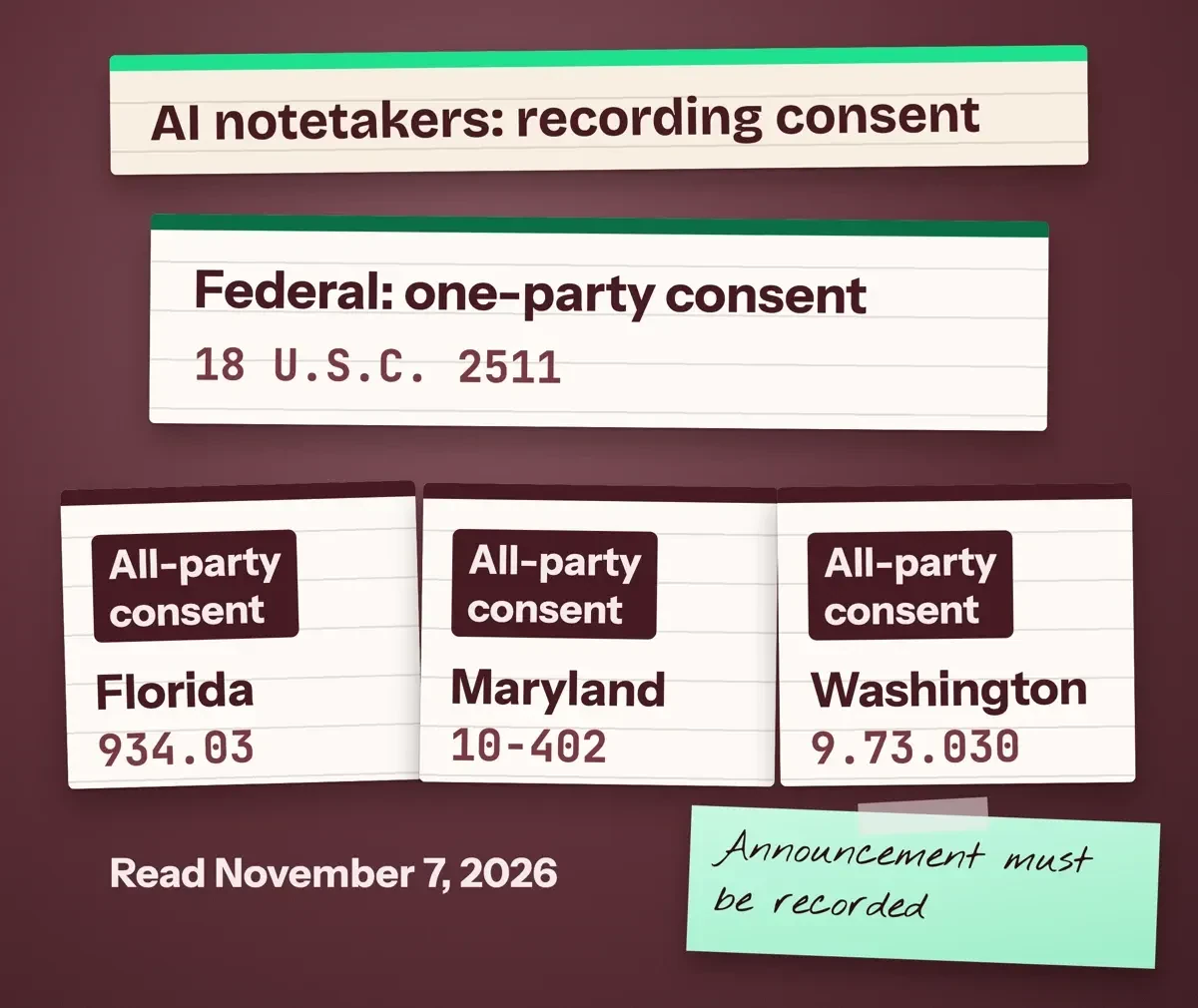 Diagram by DigitalTreed: recording consent for AI notetakers under 18 U.S.C. 2511, Florida 934.03, Maryland 10-402 and Washington 9.73.030, read November 7, 2026.
AI voice calls under the FCC's TCPA ruling
Unlike a notetaker, an AI voice call reaches people outside any meeting. The FCC has ruled on it directly. In Declaratory Ruling FCC 24-17, released February 8, 2024, the FCC said the TCPA's limits on artificial or prerecorded voices "encompass current AI technologies that generate human voices". Callers "must obtain prior express consent from the called party" first.
A cloned voice counts too, per the ruling. The FCC's news release on AI-generated voices said the ruling took effect at once and gave state attorneys general a new tool. Twenty-six of them had written in support.
The consent you'll need depends on the call. An informational AI call, such as an appointment reminder, needs the person's prior express consent.
Sales calls need more. For a cell or home line, 47 CFR 64.1200(a)(2) and (a)(3) says an AI sales call needs "the prior express written consent of the called party".
Section 64.1200(b) covers every artificial-voice message. It must, "At the beginning of the message, state clearly the identity of the business", and it must give a callback number during or after it. A telemarketing message also needs an automated opt-out that works by voice or key press before the call ends, and the FCC's ruling applies all of it to AI callers. Check a vendor's default greeting for all three, the name first, the number before hanging up and a way to say stop, and change it before the first call.
The TCPA's damages are counted per call. As of November 2026, 47 U.S.C. 227(b)(3) lets a person sue for actual loss or $500 for each violation, whichever is greater. A court can triple that for willful or knowing violations.
An AI reminder run to 400 customers who'd never agreed could face $200,000 in statutory damages (example: 400 calls x $500).
Deepfake calls have drawn far bigger penalties. In a forfeiture order adopted September 26, 2024, the FCC imposed $6,000,000 on Steve Kramer over robocalls with an AI voice imitating President Biden. The calls went out two days before New Hampshire's 2024 Democratic primary. The fine rested on the Truth in Caller ID Act. In FCC 24-84, adopted August 7, 2024, the FCC also proposed making callers disclose AI-generated calls. As of November 7, 2026, it was still a proposal. The FCC's regulatory agenda in the Federal Register of August 14, 2026 lists docket 23-362 as a long-term action, with the next action undetermined.
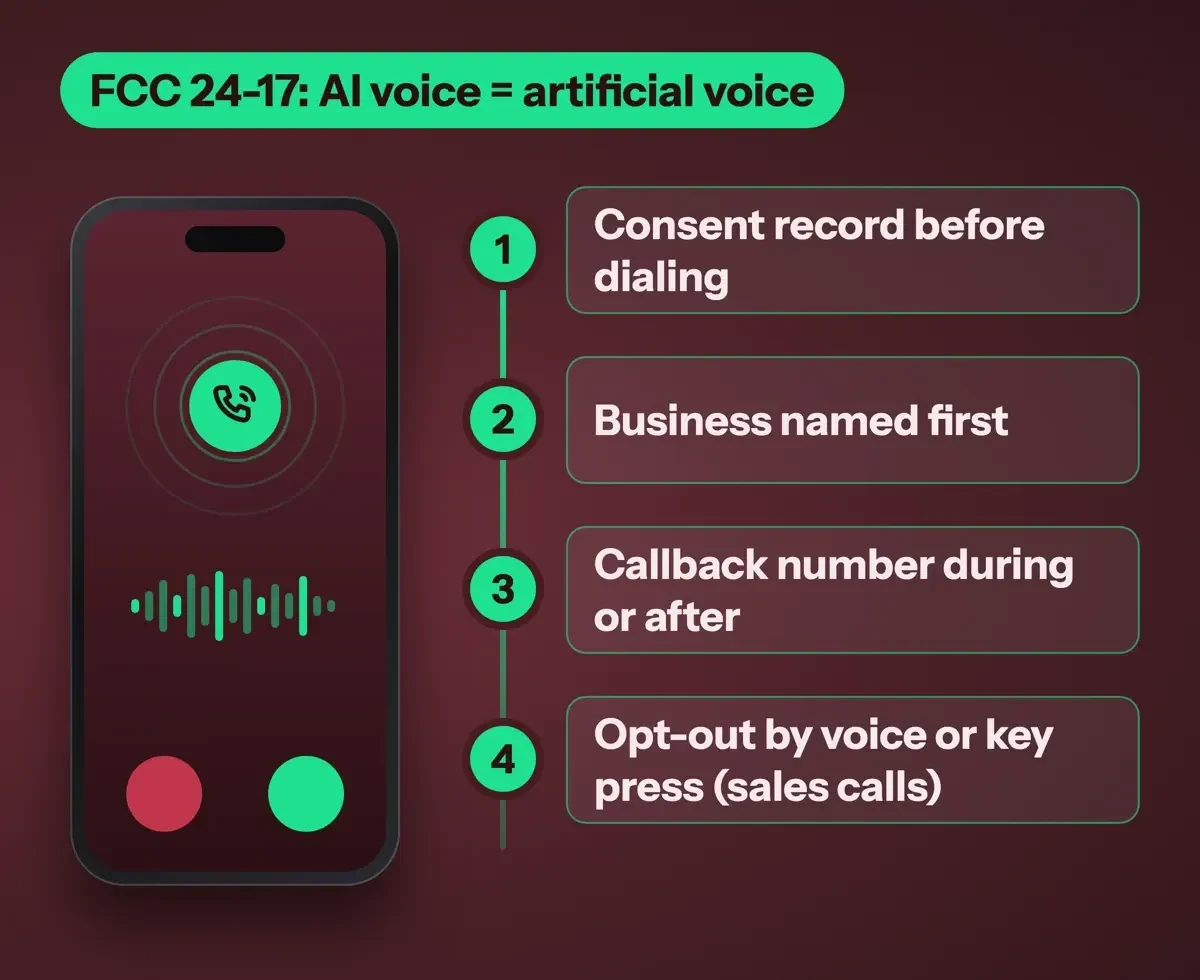 Diagram by DigitalTreed: what an AI voice call needs under 47 CFR 64.1200 and FCC 24-17.
Routing and chat: keep a way to a person
In routing, a model reads an email or chat and sends it to billing, scheduling or a technician. Routing isn't banned by any statute we read. The CFPB's chatbot report shows where it goes wrong, though. It describes doom loops, in which a customer gets repetitive answers "without an offramp to a human customer service representative". The report adds that chatbots "must comply with all applicable federal consumer financial laws", so a lender's bot carries the lender's duties. Outside finance, the report's fix still works. Give every chat and phone menu a way out, such as typing or saying agent, and send that request to a person within your posted hours.
If the bot runs on your website, our AI chatbot guide covers the California and Maine laws on telling visitors they're talking to a bot. When chats start to show patterns, our piece on customer feedback with AI shows how small teams sort them.
What the FTC says about AI claims and impersonation
Beyond chat, two FTC rules reach AI communication where call and email laws don't. The first is Section 5 of the FTC Act, which declares "unfair or deceptive acts or practices in or affecting commerce" unlawful. The FTC's 1984 advertising substantiation policy says advertisers must "have a reasonable basis for advertising claims before they are disseminated." So a website line like "our AI answers every call in under one second" needs a test behind it before it's published.
In an August 2025 complaint, the FTC alleged that Air AI sold "conversational AI" it said could replace human customer service staff. The complaint also alleged false earnings and refund promises. The March 2026 proposed settlement order, filed in federal court, includes an $18 million judgment, largely suspended, with $50,000 to be paid to the Commission. On August 27, 2026, the FTC finalized orders making Cox Media Group and two marketing firms pay $930,000 in total. It had alleged their "Active Listening" service claimed to target ads from conversations heard by smart devices. The FTC's 2024 AI cases are in our AI services partner checklist.
The second is the Impersonation Rule, 16 CFR Part 461, which the FTC finalized in February 2024. Section 461.3 bars falsely posing as a business, and it bars misrepresenting "affiliation with, including endorsement or sponsorship by," one. An AI sales voice that says it's calling for a manufacturer you don't represent can fall under that rule, synthetic voice or not.
In a February 2024 proposal, the FTC also moved to cover impersonating individuals, citing AI-generated deepfakes. It also asked about liability for firms, such as AI platforms, whose tools are used to impersonate. That would reach a firm that knows, or has reason to know, about the misuse. In a December 26, 2024 Federal Register notice, the FTC said it had decided not to proceed with that provision "at this time". It set a January 17, 2025 hearing on the ban on impersonating individuals instead. As of November 7, 2026, we found no final rule on individuals, and Part 461 still covers only government and business impersonation.
The same rule protects you when a scammer poses as your business. The FTC's September 2025 advice to small businesses is to turn on email authentication and report spoofing at ReportFraud.ftc.gov and IC3.gov. Warn customers in an email without hyperlinks, it says, so the warning doesn't look like phishing.
A rollout checklist for AI communication tools
Run this list once per use, not once per vendor. Each channel has its own rule, so one tool can need a consent record on the phone and an opt-out link in email.
- Write down each AI use, its channel and who it reaches.
- Keep a consent record for AI voice calls: written for sales calls, express for reminders.
- Open every AI voice message with your business name and give a callback number.
- Add a voice or key-press opt-out to every AI telemarketing message.
- Note the state of every caller and meeting guest; get all-party consent where the law asks.
- Record the consent announcement along with the call.
- Keep order details first in AI-drafted transactional email, with no promotion on top.
- Put an unsubscribe link in every commercial email and stop mailing anyone who uses it.
- Give every bot and phone menu a way to reach a person.
- Test any claim about your AI before it goes on your website.
- Never let an AI voice claim a brand or partner you don't represent.
Keep each tool's answers with its settings, consent records and call script, so they're in one place if a customer or regulator asks. For what these tools store about customers, our data protection compliance guide covers state privacy laws.
What we tested
On November 7, 2026, we wrote a script, test/ai_comm_check.py, that applies the rules above. We ran it on a made-up plan of 12 AI uses for Kestrelline Home Services, a made-up company. Before it checks a row, it confirms that all 14 rule quotes it relies on appear in our saved copies of the source pages. It flagged 7 rows, warned on 1 and passed 4.
Why 7 of the 12 planned uses were flagged
Four of the seven flagged rows were AI voice calls (rows 2, 3, 4 and 11), and the others were a notetaker, an order email and a website claim. Row 10 drew a warning for a chat that didn't offer a way to reach a person.
| Row (made up) | Planned AI use | Result | Rule |
|---|---|---|---|
| 2 | AI voice tune-up offer to past customers, no written consent | Flag: no written consent | 47 CFR 64.1200(a) |
| 3 | AI voice discount call with written consent | Flag: no automated opt-out | 47 CFR 64.1200(b)(3) |
| 4 | AI voice payment reminder naming the company at the end | Flag: business not named first | 47 CFR 64.1200(b)(1) |
| 5 | AI notetaker, client in Florida, only staff told | Flag: all-party consent missing | Florida 934.03 |
| 9 | AI order update opening with a coupon, no unsubscribe link | Flag: commercial email with no opt-out | 16 CFR 316.3; 15 U.S.C. 7704 |
| 10 | Website chat with no way to reach a person | Warn: doom loop risk | CFPB chatbot report |
| 11 | AI sales voice claiming a furnace maker it doesn't represent | Flag: false affiliation | 16 CFR 461.3 |
| 12 | Website line about one-second answers, never tested | Flag: no reasonable basis | FTC substantiation policy |
Rows 1, 6, 7 and 8 passed. Row 1 was a consented reminder call naming the business first, and row 6 a Washington line with a recorded notice. The other two were a Maryland call where all agreed and a newsletter with an unsubscribe link.
Row 9 tripped two rules at once. The coupon on top made it commercial, and it had no unsubscribe link.
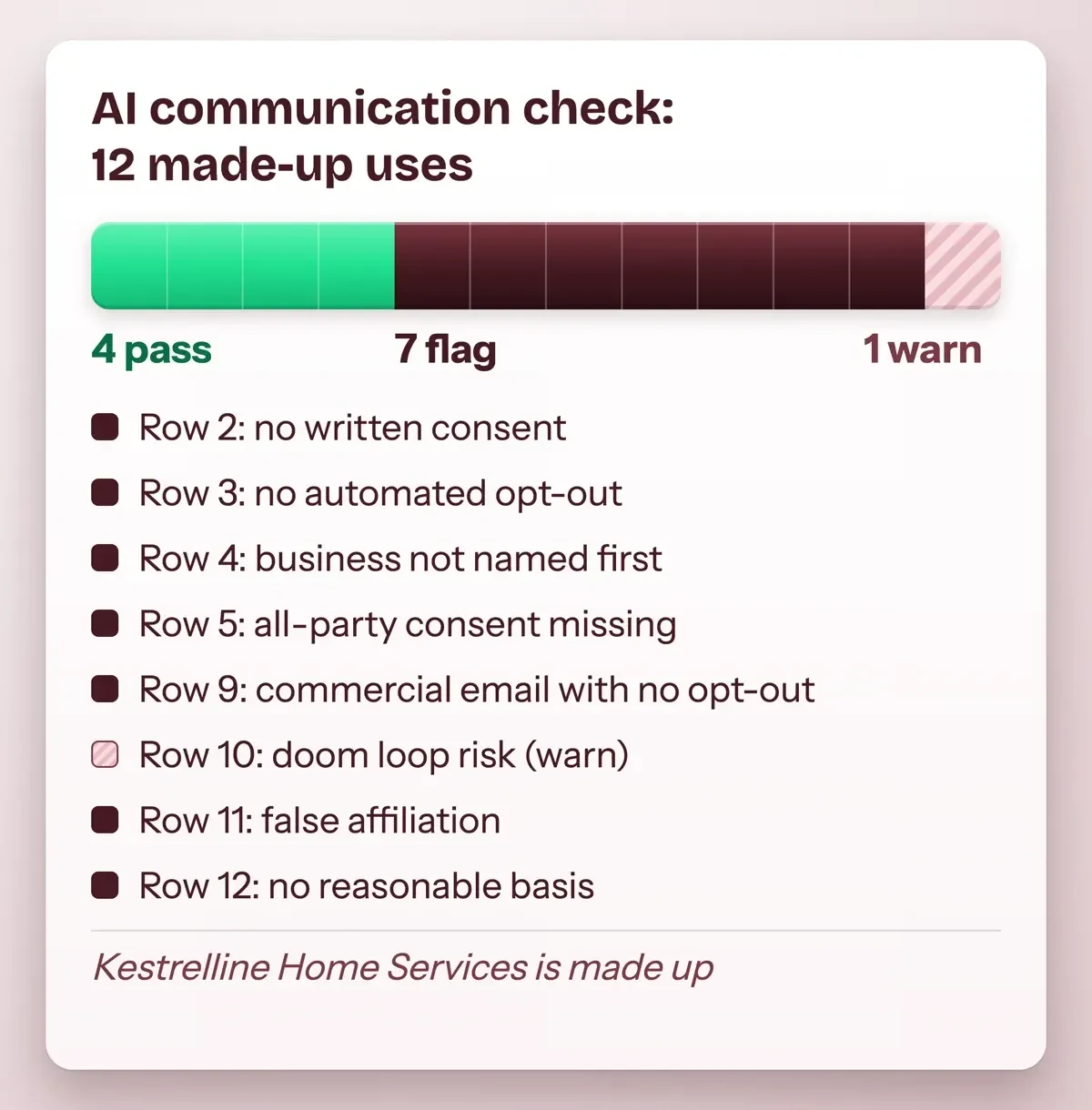 Drawn by us: results of our AI communication check on a made-up 12-use plan, from test/results.json.
Each flag traced to a setup step a person controls. The gaps were a consent record, an opening line, an opt-out, an announcement, an email's order, a false affiliation and an untested claim.
The Washington row passed only because the notice was on the call's recording, so without it the same setup has no consent under RCW 9.73.030.
Our take: start with the uses that reach people outside your company, voice calls and notetakers on client calls, since that's where per-call damages and Florida's felony statute sit.
Drafting and routing can follow once templates keep order details first and every bot has a way out. If you're also retiring fax lines, our enterprise fax guide covers HIPAA and the junk fax law.
Frequently asked
Can I use an AI clone of my own employee's voice for reminder calls?
It's still an artificial voice. FCC 24-17 requires prior consent unless the call has an emergency purpose or an exemption applies.
Does the FCC require me to say a call is AI-generated?
Not as of November 7, 2026; the FCC's August 2026 agenda lists the next action on it as undetermined. FCC 24-84 proposed it and also asked about AI that helps people with disabilities use the phone.
Does CAN-SPAM apply to an AI-drafted reply to a customer?
If it promotes something, yes. The FTC guide says header and routing details must identify who sent it.
Who can enforce the AI voice rule?
The FCC, state attorneys general and people called. The FCC release says it can also block calls from carriers facilitating illegal robocalls.
How we made this guide: On November 7, 2026, we saved each source page and downloaded five FCC documents as PDFs from docs.fcc.gov. California's legislature site returned a 403, and eCFR and the Federal Register's web pages sent our checker to a bot check. So we used the state statutes that loaded, Cornell LII's copy of the CFR and the Federal Register's PDFs on govinfo.gov. Facts checked by the DigitalTreed team on November 7, 2026. This guide isn't legal advice; have a telecom or privacy lawyer review your call and recording setup.
In August 2025 this post praised AI for business communication without citing a source. Rewritten November 7, 2026: where AI helps, the TCPA rules for AI voices, recording consent, CAN-SPAM, the FTC's AI and impersonation rules, a rollout checklist and a tested made-up plan. Unsourced claims about satisfaction and return on investment were cut.
Sources
- FCC 24-17: Declaratory Ruling on AI technologies and the TCPA (released February 8, 2024)
- FCC news release: AI-generated voices in robocalls (February 8, 2024)
- FCC 24-84: Proposed rules on AI-generated calls (adopted August 7, 2024); status: FCC regulatory agenda, Federal Register (August 14, 2026)
- FCC 24-104: Forfeiture order, Steve Kramer (adopted September 26, 2024)
- 47 U.S.C. 227: Telephone Consumer Protection Act (Cornell LII)
- 47 CFR 64.1200: Delivery restrictions (Cornell LII)
- 18 U.S.C. 2511: Interception of communications (Cornell LII)
- Florida Statutes 934.03: Interception and disclosure of communications
- Maryland Courts and Judicial Proceedings 10-402
- Washington RCW 9.73.030: Recording private communications
- FTC: CAN-SPAM Act compliance guide for business
- 15 U.S.C. 7704: CAN-SPAM requirements (Cornell LII)
- 16 CFR 316.3: Primary purpose of an email (Cornell LII)
- 15 U.S.C. 45: FTC Act Section 5 (Cornell LII)
- FTC: Policy statement regarding advertising substantiation (1984)
- FTC: Complaint against Air AI (August 25, 2025)
- FTC: Air AI proposed settlement order (March 24, 2026)
- FTC: Final orders against Cox Media Group and two firms (August 27, 2026)
- 16 CFR 461.3: Impersonation of businesses (Cornell LII)
- FTC business blog: New impersonator rule (February 15, 2024)
- FTC: Proposed protections against AI impersonation of individuals (February 15, 2024); status: FTC hearing notice, Federal Register (December 26, 2024)
- FTC business blog: Stop a would-be business impersonator (September 29, 2025)
- CFPB: Chatbots in consumer finance (June 6, 2023)
Comments
No comments yet. Start the conversation below.